
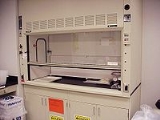
A
fume hood or
fume cupboard is a type of local
ventilationVentilating is the process of "changing" or replacing air in any space to provide high indoor air quality...
device that is designed to limit exposure to hazardous or noxious
fumeFumes and similar may refer to:* In common usage, more usually "fumes", a gas or vapor that smells strongly or is dangerous to inhale* Pere Fume , Canadian musician* Silica fume, a fine-grain, thin, and very high surface area silica...
s,
vaporA vapor or vapour is a substance in the gas phase at a temperature lower than its critical point....
s or
dustDust consists of particles in the atmosphere that arise from various sources such as soil dust lifted up by wind , volcanic eruptions, and pollution...
s. A fume hood is typically a large piece of equipment enclosing five sides of a work area, the bottom of which is most commonly located at a standing work height.
Two main types exist,
ductIndustrial exhaust ducts are pipe systems that connect hoods to industrial chimneys through other components of exhaust systems like fan, collectors etc...
ed and recirculating. The principle is the same for both types: air is drawn in from the front (open) side of the cabinet, and either expelled outside the building or made safe through
filtrationFiltration is commonly the mechanical or physical operation which is used for the separation of solids from fluids by interposing a medium through which only the fluid can pass...
and fed back into the room.
Other related types of local ventilation devices include: clean benches,
biosafety cabinetsA laminar flow cabinet or laminar flow closet or tissue culture hood is a carefully enclosed bench designed to prevent contamination of semiconductor wafers, biological samples, or any particle sensitive device. Air is drawn through a HEPA filter and blown in a very smooth, laminar flow towards...
, glove boxes and snorkel exhausts. All these devices address the need to control
airborne hazardsIDLH is an initialism for Immediately Dangerous to Life or Health, and is defined by the US National Institute for Occupational Safety and Health as exposure to airborne contaminants that is "likely to cause death or immediate or delayed permanent adverse health effects or prevent escape from such...
or
irritantIrritation or exacerbation, in biology and physiology, is a state of inflammation or painful reaction to allergy or cell-lining damage. A stimulus or agent which induces the state of irritation is an irritant...
s that are typically generated or released within the local ventilation device. All local ventilation devices are designed to address one or more of three primary goals:
- protect the user (fume hoods, biosafety cabinets, glove boxes);
- protect the product or experiment (biosafety cabinets, glove boxes);
- protect the environment (recirculating fume hoods, certain biosafety cabinets, and any other type when fitted with appropriate filters in the exhaust airstream).
Secondary functions of these devices may include
explosion protectionExplosion protection is used to protect all sorts of buildings and civil engineering infrastructure against internal and external explosions or deflagrations. It was widely believed until recently that a building subject to an explosive attack had a chance to remain standing only if it possessed...
,
spill containmentSpill containment is where spills of chemicals, oils, sewage etc are contained within a barrier or drainage system rather than being absorbed at the surface. One method is to use an inflatable stopper or pneumatic bladder which is inserted into the outflow of a drainage system to create a...
, and other functions necessary to the work being done within the device.
A general but non-specific term for some of these local ventilation devices is
Laminar flow cabinetA laminar flow cabinet or laminar flow closet or tissue culture hood is a carefully enclosed bench designed to prevent contamination of semiconductor wafers, biological samples, or any particle sensitive device. Air is drawn through a HEPA filter and blown in a very smooth, laminar flow towards...
. This category may include clean benches, biosafety cabinets and other devices characterized simply by the laminar nature of their airflow. The term laminar flow cabinet, however, is insufficient to identify their actual design and use - some will protect the product but not the user, and others will protect both. Terminology for local ventilation devices has been, and remain, unclear and non-specific, and the reader is advised to take special care in their selection and specification based upon which of the three primary goals (listed above) are to be met.
Fume hoods typically protect only the user, and are most commonly used in laboratories where hazardous or noxious chemicals are released during testing, research, development or teaching. They are also used in industrial applications or other activities where hazardous or noxious vapors, gases or dusts are generated or released.
Because one side (the front) of a fume hood is open to the room occupied by the user, and the air within the fume hood is potentially contaminated, the proper flow of air from the room into the hood is critical to its function. Much of fume hood design and operation is focused on maximizing the proper containment of the air and fumes within the fume hood.
As most fume hoods are designed to connect to exhaust systems that expel the air directly to the exterior of a building, large quantities of energy are required to run fans that exhaust the air, and to heat, cool, filter, control and move the air that will replace the air exhausted. Significant recent efforts in fume hood and ventilation system design have focused on reducing the energy used to operate fume hoods and their supporting ventilation systems.
Construction and location
Fume hoods were originally manufactured from timber, but now
epoxyEpoxy, also known as polyepoxide, is a thermosetting polymer formed from reaction of an epoxide "resin" with polyamine "hardener". Epoxy has a wide range of applications, including fiber-reinforced plastic materials and general purpose adhesives....
coated
mild steelCarbon steel, also called plain-carbon steel, is steel where the main interstitial alloying constituent is carbon. The American Iron and Steel Institute defines carbon steel as: "Steel is considered to be carbon steel when no minimum content is specified or required for chromium, cobalt,...
is the main construction material. Fume hoods (fume cupboards) are generally available in 5 different widths; 1000 mm, 1200 mm, 1500 mm, 1800 mm and 2000 mm. The depth varies between 700 mm and 900 mm, and the height between 1900 mm and 2700 mm. These can accommodate from one to three operators. They are generally set back against the walls and are often fitted with infills above, to cover up the exhaust ductwork. Because of their shape they are generally dim inside, so many have internal lights with vapor-proof covers. The front is a movable
sashA sash is a cloth belt used to hold a robe together, and is usually tied about the waist. The Japanese equivalent of a sash, obi, serves to hold a kimono or yukata together. Decorative sashes may pass from the shoulder to the hip rather than around the waist...
, usually in glass, able to move up and down on a counterbalance mechanism. On educational versions, the sides of the unit are often also glass, so that several pupils can gather around a fume hood at once. Low air flow alarm control panels are common, see below.
Fume hood exhaust options
This method is outdated technology. The premise was to bring non-conditioned outside air directly in front of the hood so that this was the air exhausted to the outside. This method does not work well when the climate changes as it pours frigid or hot and humid air over the user making it very uncomfortable to work or affecting the procedure inside the hood. This system also uses additional ductwork which can be costly.
- Constant air volume (CAV)
This hood allows air to be pulled through a "bypass" opening from above as the sash closes. The bypass is located so that as you close the sash and reduce the sash opening, the bypass opening gets larger. The air going through the hood maintains a constant volume no matter where the sash is positioned and without changing fan speeds.
- Variable air volume (VAV)
This hood works with sash positioning controls to let the HVAC system know how much the sash is being opened. The controls then let the system know to reduce or increase the fan speed and thus the volume of air that needs to be exhausted.
Sash counterbalance systems
- Cable & Pulley
A pulley, also called a sheave or a drum, is a mechanism composed of a wheel on an axle or shaft that may have a groove between two flanges around its circumference. A rope, cable, belt, or chain usually runs over the wheel and inside the groove, if present...
Systems - Typically an aircraft grade stainless steel cable runs over independently positioned pulleys to the counterweight. Cable counterbalance systems can bind when a user lifts the sash from one end of the hood, as the cables will travel across the pulleys at different rates. This system requires regular maintenance as the cables will fray or break over time.
- Chain & Sprocket Systems - Typically a hardened chain (similar to a bicycle chain) runs over sprockets to the counterweight. The sprockets are attached onto a single axle which allows them to turn at the same time. This system will travel smoothly no matter where the user chooses to lift the sash along the hood width. This is especially important on longer hoods where the user may be lifting the sash at one end. This system has an indefinite lifespan with little to no maintenance.
Fume hood liners
- Fiberglas Reinforced Polyester (FRP), most common
- Epoxy Resin
- Square Corner Stainless Steel
- Coved Corner Stainless Steel
- Phenolic Resin
- Cement Board
Recirculating fume hoods
Mainly for educational or testing use, these units generally have a fan mounted on the top (soffit) of the hood, or beneath the worktop. Air is sucked through the front opening of the hood and through a filter, before passing through the fan and being fed back into the workplace. With a recirculating fume hood it is essential that the filter medium be able to remove the particular hazardous or noxious material being used. As different filters are required for different materials, recirculating fume hoods should only be used when the hazard is well known and does not change. Recirculating fume hoods are often not appropriate for research applications where the activity, and the materials used or generated, may change or be unknown.
Pre-filtration
The first stage of filtration consists of a physical barrier, typically of open cell foam, which prevents large particles from passing through. A filter of this type is generally inexpensive, and would last for approximately six months, dependent on usage.
Main filtration
After pre-filtration, the fumes are sucked through a layer of activated charcoal which absorbs the majority of chemicals that pass through it.
AmmoniaAmmonia is a compound of nitrogen and hydrogen with the formula . It is a colourless gas with a characteristic pungent odour. Ammonia contributes significantly to the nutritional needs of terrestrial organisms by serving as a precursor to food and fertilizers. Ammonia, either directly or...
and
carbon monoxideCarbon monoxide , also called carbonous oxide, is a colorless, odorless, and tasteless gas that is slightly lighter than air. It is highly toxic to humans and animals in higher quantities, although it is also produced in normal animal metabolism in low quantities, and is thought to have some normal...
will, however, pass through most carbon filters. Additional specific filtration techniques can be added to combat chemicals that would otherwise be pumped back into the room. A main filter will generally last for approximately two years, dependent on usage.
| Pros |
Cons |
| Ductwork not required. |
Filters must be regularly maintained and replaced. |
| Temperature controlled air is not removed from the workplace. |
Greater risk of chemical exposure than with ducted equivalents. |
| Contaminated air is not pumped into the atmosphere. |
The extract fan is near the operator, so noise may be an issue. |
Ducted fume hoods
Most fume hoods for industrial purposes are ducted. A large variety of ducted fume hoods exist. Air is removed from the workspace and dispersed into the atmosphere.
The fume hood is only one piece of the lab ventilation system. As the recirculation of lab air to the rest of the facility is not permitted, air handling units serving the non-laboratory areas are kept segregated from the laboratory units. As a means of improving indoor air quality, some laboratories also utilize single-pass air handling systems, where air that is heated or cooled is used only once prior to discharge. Many laboratories continue to utilize return air systems to the laboratory areas to minimize energy and running costs, while still providing adequate ventilation rates for acceptable working conditions. The fume hoods serve to evacuate hazardous levels of contaminant.
To reduce lab ventilation costs, variable air volume (VAV) systems are employed, which reduce the volume of the air exhausted as the fume hood sash is closed. This product is often enhanced by an automatic sash closing device, which will close the fume hood sash when the user leaves the fume hood face. The result is that the hoods are operating at the minimum exhaust volume whenever no one is actually working in front of them.
Since a six foot constant volume hood uses as much energy as three average homes in America, the reduction or minimization of exhaust volume is particularly beneficial in reducing facility energy costs as well as minimizing the impact on the facility infrastructure and the environment. Particular attention must be paid to the discharge location, so as not to risk public safety, or to pull the exhaust air back into the building supply air system.
| Pros |
Cons |
| Fumes are completely eradicated from the workplace. |
Additional ductwork. |
| Low maintenance. |
Temperature controlled air is removed from the workplace. |
| Quiet operation, due to the extract fan being some distance from the operator. |
Fumes are dispersed into the atmosphere, rather than being treated. |
Low flow/ High performance
Conventional fume hoods can consume three times more energy than an average American home. In recent years, laboratory fume hood manufacturers have developed and introduced energy-efficient low-flow/ high-performance fume hoods, designed to maintain or improve operator protection while reducing expensive
HVACHVAC refers to technology of indoor or automotive environmental comfort. HVAC system design is a major subdiscipline of mechanical engineering, based on the principles of thermodynamics, fluid mechanics, and heat transfer...
operating costs. While there is no standardized definition of the terms "low-flow" or "high-performance," fume hoods that operate with less exhaust flow than would be required to produce 100 feet per minute with a full open vertical sash are typically considered to be "low-flow."
Radioisotope hood
This fume hood is made with a coved stainless steel liner and coved integral stainless steel countertop that is reinforced to handle the weight of lead bricks or blocks.
Acid digestion hood
These units are typically constructed of polypropylene in order to resist the corrosive effects of acids at high concentrations. If hydrofluoric acid is being used in the hood, the hood's glass sash should be constructed of polycarbonate which resists etching. Hood ductwork should be lined with polypropylene or coated with PTFE (Teflon).
Perchloric acid hood
These units feature a waterwash system in the ductwork. Because
perchloric acidPerchloric acid is the inorganic compound with the formula HClO4. Usually encountered as an aqueous solution, this colourless compound is a strong acid comparable in strength to sulfuric and nitric acids. It is a powerful oxidizer, but its aqueous solutions up to appr. 70% are remarkably inert,...
fumes settle, and form explosive crystals, it is vital that the ductwork is cleaned internally with a series of sprays.
Waterwash
These fume hoods have an internal wash system that cleans the interior of the unit, to prevent a build-up of dangerous chemicals.
Scrubber
This type of fume hood absorbs the fumes through a chamber filled with plastic shapes, which are doused with water. The chemicals are washed into a sump, which is often filled with a neutralizing liquid. The fumes are then dispersed, or disposed of, in the conventional manner.
Control panels
Most fume hoods are fitted with a
mainsMains is the general-purpose alternating current electric power supply. In the US, electric power is referred to by several names including household power, household electricity, powerline, domestic power, wall power, line power, AC power, city power, street power, and grid power...
-powered control panel. Typically, they perform one or more of the following functions:
- Warn of low air flow.
- Warn of too large an opening at the front of the unit. Known as a "high sash" alarm, this is caused by the sliding glass at the front of the unit being raised higher than is considered safe, due to the resulting air velocity drop.
- Provide a method of switching the exhaust fan on or off.
- Provide a method of turning the internal light on or off.
Specific extra functions can be added, for example, a switch to turn a waterwash system on or off.
Maintenance
Fume hood maintenance can involve daily, periodic, and annual inspections.
- Daily fume hood inspection
- The fume hood area is visually inspected for storage of material and other visible blockages.
- If hood function indicating devices are not a part of the fume hood, a 1 inches (25.4 mm) by 6 inches (152.4 mm) piece of soft tissue paper should be placed at the hood opening and observed for appropriate directional flow into the hood.
Periodic fume hood function inspection
- Capture or face velocity is typically measured with a velometer or anemometer. Hoods for most common chemicals must have an average face velocity of 100 feet (30.5 m) per minute at sash opening of 18 inches (457.2 mm) or higher. Face velocity readings should not vary by more than 20%. A minimum of six readings shall be used determine average face velocity.
- Other local exhaust devices shall be smoke tested to determine if the contaminants they are designed to remove are being adequately captured by the hood.
Annual maintenance**
Exhaust fan maintenance, (i.e.,lubrication, belt tension, fan blade deterioration and rpm), shall be in accordance with the manufacturer’s recommendation or as adjusted for appropriate hood function.
External links