

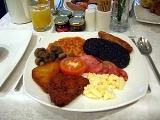
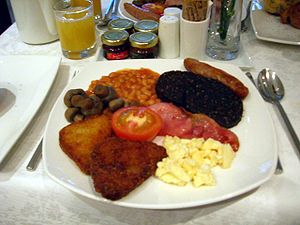
Full breakfast

Encyclopedia
Prune
A prune is any of various plum cultivars, mostly Prunus domestica or European Plum, sold as fresh or dried fruit. The dried fruit is also referred to as a dried plum...
s, grapefruit
Grapefruit
The grapefruit , is a subtropical citrus tree known for its sour fruit, an 18th-century hybrid first bred in Barbados. When found, it was named the "forbidden fruit"; it has also been misidentified with the pomelo or shaddock , one of the parents of this hybrid, the other being sweet orange The...
, cereal
Cereal
Cereals are grasses cultivated for the edible components of their grain , composed of the endosperm, germ, and bran...
), a main course, tea
Tea
Tea is an aromatic beverage prepared by adding cured leaves of the Camellia sinensis plant to hot water. The term also refers to the plant itself. After water, tea is the most widely consumed beverage in the world...
with milk
Milk
Milk is a white liquid produced by the mammary glands of mammals. It is the primary source of nutrition for young mammals before they are able to digest other types of food. Early-lactation milk contains colostrum, which carries the mother's antibodies to the baby and can reduce the risk of many...
, toast
Toast
Toast is bread that has been browned by exposure to radiant heat. This browning reaction is known as the Maillard reaction. Toasting warms the bread and makes it firmer, so it holds toppings more securely...
and (in England
England
England is a country that is part of the United Kingdom. It shares land borders with Scotland to the north and Wales to the west; the Irish Sea is to the north west, the Celtic Sea to the south west, with the North Sea to the east and the English Channel to the south separating it from continental...
) marmalade
Marmalade
Marmalade is a fruit preserve made from the juice and peel of citrus fruits, boiled with sugar and water. The benchmark citrus fruit for marmalade production in Britain is the "Seville orange" from Spain, Citrus aurantium var...
or other preserves. Many variations are possible.
"Full breakfast" also refers to the main course,The scope of this article is the breakfast composed primarily of fried eggs and pork products. a traditional cooked dish, typically and originally eaten at breakfast
Breakfast
Breakfast is the first meal taken after rising from a night's sleep, most often eaten in the early morning before undertaking the day's work...
, though now often served at other times during the day. Common alternative names for the dish include bacon and eggs, or the fry-up.The scope of this article is the breakfast composed primarily of fried eggs and pork products.
The full breakfast traditionally comprises several fried foods, usually including bacon
Bacon
Bacon is a cured meat prepared from a pig. It is first cured using large quantities of salt, either in a brine or in a dry packing; the result is fresh bacon . Fresh bacon may then be further dried for weeks or months in cold air, boiled, or smoked. Fresh and dried bacon must be cooked before eating...
and egg
Egg (food)
Eggs are laid by females of many different species, including birds, reptiles, amphibians, and fish, and have probably been eaten by mankind for millennia. Bird and reptile eggs consist of a protective eggshell, albumen , and vitellus , contained within various thin membranes...
s, and is popular throughout the British Isles
British Isles
The British Isles are a group of islands off the northwest coast of continental Europe that include the islands of Great Britain and Ireland and over six thousand smaller isles. There are two sovereign states located on the islands: the United Kingdom of Great Britain and Northern Ireland and...
and other parts of the English-speaking world. The name "bacon and eggs" was popularised by Edward Bernays
Edward Bernays
Edward Louis Bernays , was an Austrian-American pioneer in the field of public relations and propaganda along with Ivy Lee, referred to in his obituary as "the father of public relations"...
in the 1920s. To promote sales of bacon, he conducted a survey of physicians and reported their recommendations that people eat hearty breakfasts. He sent the results of the survey to 5,000 physicians, along with publicity touting bacon and eggs as a hearty breakfast.
There are many variants of the full breakfast, including the full English, full Scottish, full Welsh and full Irish breakfasts and the Ulster fry.
Tradition
The term "full breakfast" for a substantial meal of several courses including a cooked main course is used to differentiate it from the simpler continental breakfast of teaTea
Tea is an aromatic beverage prepared by adding cured leaves of the Camellia sinensis plant to hot water. The term also refers to the plant itself. After water, tea is the most widely consumed beverage in the world...
, milk
Milk
Milk is a white liquid produced by the mammary glands of mammals. It is the primary source of nutrition for young mammals before they are able to digest other types of food. Early-lactation milk contains colostrum, which carries the mother's antibodies to the baby and can reduce the risk of many...
or coffee
Coffee
Coffee is a brewed beverage with a dark,init brooo acidic flavor prepared from the roasted seeds of the coffee plant, colloquially called coffee beans. The beans are found in coffee cherries, which grow on trees cultivated in over 70 countries, primarily in equatorial Latin America, Southeast Asia,...
and fruit juices with croissant
Croissant
A croissant is a buttery flaky pastry named for its distinctive crescent shape. It is also sometimes called a crescent, from the French word for "crescent". Croissants are made of a leavened variant of puff pastry...
s or pastries.
All-day breakfast
Many caféCafé
A café , also spelled cafe, in most countries refers to an establishment which focuses on serving coffee, like an American coffeehouse. In the United States, it may refer to an informal restaurant, offering a range of hot meals and made-to-order sandwiches...
s and pubs serve the meal at all hours as an "all-day breakfast". It can be accompanied by orange juice
Orange juice
Orange juice is a popular beverage made from oranges. It is made by extraction from the fresh fruit, by desiccation and subsequent reconstitution of dried juice, or by concentration of the juice and the subsequent addition of water to the concentrate...
and tea
Tea
Tea is an aromatic beverage prepared by adding cured leaves of the Camellia sinensis plant to hot water. The term also refers to the plant itself. After water, tea is the most widely consumed beverage in the world...
or coffee
Coffee
Coffee is a brewed beverage with a dark,init brooo acidic flavor prepared from the roasted seeds of the coffee plant, colloquially called coffee beans. The beans are found in coffee cherries, which grow on trees cultivated in over 70 countries, primarily in equatorial Latin America, Southeast Asia,...
or, in a pub, an alcoholic drink.
Common foods and dishes
Condiment
A condiment is an edible substance, such as sauce or seasoning, added to food to impart a particular flavor, enhance its flavor, or in some cultures, to complement the dish. Many condiments are available packaged in single-serving sachets , like mustard or ketchup, particularly when supplied with...
s such as brown sauce
Steak sauce
Steak sauce —brown sauce —is a generic term for a dark brown sauce commonly served as a condiment for meat.The two terms are similar but not identical...
or ketchup
Ketchup
Ketchup is a sweet-and-tangy condiment typically made from tomatoes, vinegar, sugar or high-fructose corn syrup and an assortment of...
.
Some of the additional ingredients that may be included in a full breakfast are:
- friedFryingFrying is the cooking of food in oil or another fat, a technique that originated in ancient Egypt around 2500 BC. Chemically, oils and fats are the same, differing only in melting point, but the distinction is only made when needed. In commerce, many fats are called oils by custom, e.g...
or grilled baconBaconBacon is a cured meat prepared from a pig. It is first cured using large quantities of salt, either in a brine or in a dry packing; the result is fresh bacon . Fresh bacon may then be further dried for weeks or months in cold air, boiled, or smoked. Fresh and dried bacon must be cooked before eating...
, also referred to as "rashers" or "slices" - baked beansBaked beansBaked beans is a dish containing beans, sometimes baked but, despite the name, usually stewed, in a sauce. Most commercial canned baked beans are made from haricot beans, also known as navy beans – a variety of Phaseolus vulgaris – in a sauce. In Ireland and the United Kingdom, a tomato...
- fried breadFried breadFried bread, or fried slice, is bread which, after being sliced and fried, typically in reserved bacon fat, is served as part of a meal. Typically it is fried in the same pan as other ingredients in a meal, to absorb their flavour....
- black pudding
- bubble and squeakBubble and squeakBubble and squeak is a traditional English dish made with the shallow-fried leftover vegetables from a roast dinner. The main ingredients are potato and cabbage, but carrots, peas, brussels sprouts, and other vegetables can be added...
- corned beef hash
- chipsFrench friesFrench fries , chips, fries, or French-fried potatoes are strips of deep-fried potato. North Americans tend to refer to any pieces of deep-fried potatoes as fries or French fries, while in the United Kingdom, Australia, Ireland and New Zealand, long, thinly cut slices of deep-fried potatoes are...
- egg, friedFried eggA fried egg is a food made from an egg fried whole with minimal accompaniment. They are traditionally eaten for breakfast in western countries, but may be eaten at other times of the day.-China:...
, poachedPoached eggA poached egg is an egg that has been cooked by poaching, that is, in water.-Preparation:The egg is cracked into a bowl of any size, and then gently slid into a pan of simmering water and cooked until the egg white has mostly solidified, but the yolk remains soft...
, scrambled or in a basketEgg in the basketHole in One Sandwich — also known by many other names — is an egg fried in a hole of a slice of bread. The slice of bread can also be substituted with a waffle or bagel.-Description:... - English muffins or sconesScone (bread)The scone is a small Scottish quick bread especially popular in the United Kingdom, the United States, Canada, Australia, New Zealand,Belgium and Ireland, but are also eaten in many other countries. They are usually made of wheat, barley or oatmeal, with baking powder as a leavening agent...
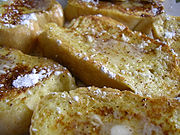
- French toastFrench toastFrench toast or Eggy Bread, is a food made with bread and eggs. It is a Christmas time dessert in Portugal and Brazil.Where French toast is served as a sweet dish, milk, sugar, or cinnamon are also commonly added before frying, and it may be then topped with sugar, butter, fruit, syrup, or other...
- Fruit puddingFruit puddingFruit pudding is a Scottish dish which is a mixture of wheat flour, beef suet or rusk, brown sugar, currants and/or sultanas, glace cherries, peel, salt and cinnamon, like in a fruitcake, formed into the shape of a large sausage....
in ScotlandScotlandScotland is a country that is part of the United Kingdom. Occupying the northern third of the island of Great Britain, it shares a border with England to the south and is bounded by the North Sea to the east, the Atlantic Ocean to the north and west, and the North Channel and Irish Sea to the... - gritsGritsGrits are a food of American Indian origin common in the Southern United States and mainly eaten at breakfast. They consist of coarsely ground corn, or sometimes alkali-treated corn . They are also sometimes called sofkee or sofkey from the Muskogee language word...
in the Southern United StatesSouthern United StatesThe Southern United States—commonly referred to as the American South, Dixie, or simply the South—constitutes a large distinctive area in the southeastern and south-central United States... - hash browns
- kidneys, grilled or fried
- kipperKipperA kipper is a whole herring, a small, oily fish, that has been split from tail to head, gutted, salted or pickled, and cold smoked.In the United Kingdom, in Japan, and in some North American regions they are often eaten for breakfast...
s - fried mushroomEdible mushroomEdible mushrooms are the fleshy and edible fruiting bodies of several species of fungi. Mushrooms belong to the macrofungi, because their fruiting structures are large enough to be seen with the naked eye. They can appear either below ground or above ground where they may be picked by hand...
s - oatcakes
- pancakes (in the northern USA, Canada, and Ireland)
- sautéedSautéingSautéing is a method of cooking food, that uses a small amount of fat in a shallow pan over relatively high heat. Ingredients are usually cut into pieces or thinly sliced to facilitate fast cooking. The primary mode of heat transfer during sautéing is conduction between the pan and the food being...
potatoPotatoThe potato is a starchy, tuberous crop from the perennial Solanum tuberosum of the Solanaceae family . The word potato may refer to the plant itself as well as the edible tuber. In the region of the Andes, there are some other closely related cultivated potato species...
es, also known as home friesHome friesHome fries, house fries, or cottage fries are a type of basic potato dish made by pan or skillet frying diced, chunked, wedged or sliced potatoes that have been par-cooked by boiling, baking, steaming, or microwaving.... - potato breadPotato breadPotato bread is a form of bread in which potato replaces a portion of the regular wheat flour. It is cooked in a variety of methods, including by baking it on a hot griddle or pan, or in an oven. It may be leavened or unleavened, and may have a variety of other ingredients baked into it...
(also called "fadge" or tattie sconeTattie sconeA tattie scone is a regional variant of the savoury griddle scone which is especially popular in Scotland and The Isle of Man. Many variations of recipe exist. They generally include liberal quantities of boiled potatoes and salt....
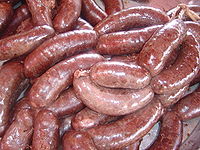
) - sausages, sausage links or patties
- scrappleScrappleScrapple, also known by the Pennsylvania Dutch name pon haus, is traditionally a mush of pork scraps and trimmings combined with cornmeal and flour, often buckwheat flour, and spices. The mush is formed into a semi-solid congealed loaf, and slices of the scrapple are then panfried before serving...
(in the Midatlantic US) - sliced sausageSliced sausageSliced sausage, also known as Lorne sausage, flat sausage, square sausage or slice, it can also be referred to as slab as opposed to link, is a food product most often eaten in Scotland. Sausage meat – which may be pork or beef – is set into a square and sliced into pieces generally about square...
(also known as Lorne sausage or square sausage, popular in Scotland) - soda breadSoda breadSoda bread is a variety of quick bread traditionally made in a variety of cuisines in which sodium bicarbonate is used as a raising agent rather than the more common yeast. The ingredients of traditional soda bread are flour, bread soda, salt, and buttermilk...
- Laverbread (a type of seaweed popular in Wales and usually cooked alongside bacon and cocklesCockle (bivalve)Cockle is the common name for a group of small, edible, saltwater clams, marine bivalve molluscs in the family Cardiidae.Various species of cockles live in sandy sheltered beaches throughout the world....
) - toastToastToast is bread that has been browned by exposure to radiant heat. This browning reaction is known as the Maillard reaction. Toasting warms the bread and makes it firmer, so it holds toppings more securely...
- fried, grilled, or tinned tomatoTomatoThe word "tomato" may refer to the plant or the edible, typically red, fruit which it bears. Originating in South America, the tomato was spread around the world following the Spanish colonization of the Americas, and its many varieties are now widely grown, often in greenhouses in cooler...
es - potato wafflePotato wafflePotato waffles are a potato based savoury food in a waffle like lattice shape. They are common in the UK and Ireland and are also available in some other countries....
s - white puddingWhite puddingWhite pudding or oatmeal pudding is a meat dish popular in Scotland, Ireland, Northumberland, Nova Scotia, and Newfoundland. White pudding is very similar to black pudding, but does not include blood. Consequently, it consists of pork meat and fat, suet, bread, and oatmeal formed into the shape of...
- potato cakePotato cakePotato Cake may refer to different preparations of potatoes.In the U.S., the term commonly refers to a patty of hashed potatoes, a kind of hash brown. These are available pre-made and frozen in supermarkets and are served by many restaurants...
s - Hog's puddingHog's puddingHog's Pudding is a type of sausage produced in Cornwall and Devon. Some versions of the recipe comprise pork meat and fat, suet, bread, and oatmeal or pearl barley formed into the shape of a large sausage - also known as 'Groats pudding' and are very similar to a white pudding, whereas others...
sliced (in CornwallCornwallCornwall is a unitary authority and ceremonial county of England, within the United Kingdom. It is bordered to the north and west by the Celtic Sea, to the south by the English Channel, and to the east by the county of Devon, over the River Tamar. Cornwall has a population of , and covers an area of...
)
Full English breakfast
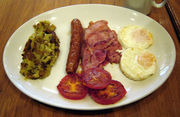
Back bacon
Back bacon is bacon prepared from centre-cut boneless pork loin. The name refers to the cut of meat, which is from the back, and distinguishes it from other bacon made from pork belly or other cuts. Unlike other bacon, back bacon is not brined, cured, boiled, or smoked...
, less commonly streaky bacon), poached or fried eggs, fried or grilled tomatoes, fried mushrooms, fried bread
Fried bread
Fried bread, or fried slice, is bread which, after being sliced and fried, typically in reserved bacon fat, is served as part of a meal. Typically it is fried in the same pan as other ingredients in a meal, to absorb their flavour....
or toast with butter and sausages, usually served with a mug
Mug
A mug is a sturdily built type of cup often used for drinking hot beverages, such as coffee, tea, or hot chocolate. Mugs, by definition, have handles and often hold a larger amount of fluid than other types of cup. Usually a mug holds approximately 12 fluid ounces of liquid; double a tea cup...
of tea
Tea
Tea is an aromatic beverage prepared by adding cured leaves of the Camellia sinensis plant to hot water. The term also refers to the plant itself. After water, tea is the most widely consumed beverage in the world...
. Baked beans and hash browns are also commonly considered an important part of the breakfast. As nearly everything is fried in this meal, the term "fry-up" is quite accurate.
Black pudding is added in some regions, as is fried leftover mashed potatoes (called potato cake
Potato cake
Potato Cake may refer to different preparations of potatoes.In the U.S., the term commonly refers to a patty of hashed potatoes, a kind of hash brown. These are available pre-made and frozen in supermarkets and are served by many restaurants...
s). Originally a way to use up leftover vegetables from the main meal of the day before, bubble and squeak
Bubble and squeak
Bubble and squeak is a traditional English dish made with the shallow-fried leftover vegetables from a roast dinner. The main ingredients are potato and cabbage, but carrots, peas, brussels sprouts, and other vegetables can be added...
, shallow-fried leftover vegetables with potato, has become a breakfast feature in its own right. Onions, either fried or in rings, occasionally appear. In the North Midlands
North Midlands
The North Midlands is a loosely-defined area of England. It is typically held to include South Yorkshire and the northern parts of Derbyshire and Nottinghamshire, and in some definitions also covers southern Cheshire and parts of Lincolnshire and Staffordshire. The region's largest city is Sheffield...
, fried or grilled oatcakes sometimes replace fried bread. When an English breakfast is ordered to contain everything available it is often referred to as a Full English, or a Full Monty
The Full Monty (phrase)
The full monty is a British slang phrase of uncertain origin. It is generally used to mean "everything which is necessary, appropriate, or possible; ‘the works’", and has been in common usage in the north of England for many years; the 1982 Yellow Pages for Manchester listed both a "Full Monty...
.
Full Irish breakfast
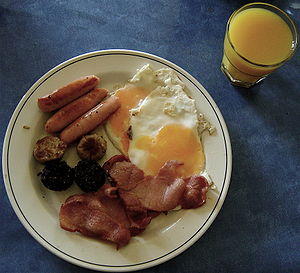
Ireland
Ireland is an island to the northwest of continental Europe. It is the third-largest island in Europe and the twentieth-largest island on Earth...
, as elsewhere, the exact constituents of a full breakfast vary, depending on geographical area, personal taste and cultural affiliation. Traditionally, the most common ingredients are bacon
Bacon
Bacon is a cured meat prepared from a pig. It is first cured using large quantities of salt, either in a brine or in a dry packing; the result is fresh bacon . Fresh bacon may then be further dried for weeks or months in cold air, boiled, or smoked. Fresh and dried bacon must be cooked before eating...
rashers, sausage
Sausage
A sausage is a food usually made from ground meat , mixed with salt, herbs, and other spices, although vegetarian sausages are available. The word sausage is derived from Old French saussiche, from the Latin word salsus, meaning salted.Typically, a sausage is formed in a casing traditionally made...
s, fried eggs, white pudding
White pudding
White pudding or oatmeal pudding is a meat dish popular in Scotland, Ireland, Northumberland, Nova Scotia, and Newfoundland. White pudding is very similar to black pudding, but does not include blood. Consequently, it consists of pork meat and fat, suet, bread, and oatmeal formed into the shape of...
, black pudding, toast
Toast
Toast is bread that has been browned by exposure to radiant heat. This browning reaction is known as the Maillard reaction. Toasting warms the bread and makes it firmer, so it holds toppings more securely...
and sliced tomato. Sauteed mushrooms and fried tomato
Tomato
The word "tomato" may refer to the plant or the edible, typically red, fruit which it bears. Originating in South America, the tomato was spread around the world following the Spanish colonization of the Americas, and its many varieties are now widely grown, often in greenhouses in cooler...
are also sometimes included, as well as baked beans, liver (although popularity has declined in recent years), and brown soda bread
Soda bread
Soda bread is a variety of quick bread traditionally made in a variety of cuisines in which sodium bicarbonate is used as a raising agent rather than the more common yeast. The ingredients of traditional soda bread are flour, bread soda, salt, and buttermilk...
. A full Irish breakfast may be accompanied by a strong Irish breakfast tea
Irish Breakfast tea
Irish breakfast tea is a blend of several black teas, most often Assam teas and, less often, other types of black tea. Many tea producers make Irish breakfast tea blends specifically for the US market. In Ireland, it is not referred to as "Irish breakfast tea", but simply as "tea", being the...
such as Barry's Tea
Barry's Tea
Barry's Tea is an Irish tea company founded in 1901 in Cork City. Until the 1960s, tea was sold from a shop in Prince's Street, but thereafter as a result of its increasing popularity, the company expanded its wholesaling and distribution operations. By the 1990s, the company had become one of...
, Lyons Tea, or Bewley's
Bewley's
Bewley's Limited is an Irish company, established in 1840, that produces tea and coffee for sale around the world. The company is owned by Campbell Bewley Group Ltd....
breakfast blend served with milk. Fried potato bread potato farl, boxty or toast is often served as an alternative to brown soda bread.
Ulster Fry
An Ulster Fry is a dish similar to the Irish breakfast and is popular throughout UlsterUlster
Ulster is one of the four provinces of Ireland, located in the north of the island. In ancient Ireland, it was one of the fifths ruled by a "king of over-kings" . Following the Norman invasion of Ireland, the ancient kingdoms were shired into a number of counties for administrative and judicial...
.
A traditional Ulster Fry consists of bacon
Bacon
Bacon is a cured meat prepared from a pig. It is first cured using large quantities of salt, either in a brine or in a dry packing; the result is fresh bacon . Fresh bacon may then be further dried for weeks or months in cold air, boiled, or smoked. Fresh and dried bacon must be cooked before eating...
rashers, eggs, sausages (either pork
Pork
Pork is the culinary name for meat from the domestic pig , which is eaten in many countries. It is one of the most commonly consumed meats worldwide, with evidence of pig husbandry dating back to 5000 BC....
or beef
Beef
Beef is the culinary name for meat from bovines, especially domestic cattle. Beef can be harvested from cows, bulls, heifers or steers. It is one of the principal meats used in the cuisine of the Middle East , Australia, Argentina, Brazil, Europe and the United States, and is also important in...
), vegetable roll, white pudding
White pudding
White pudding or oatmeal pudding is a meat dish popular in Scotland, Ireland, Northumberland, Nova Scotia, and Newfoundland. White pudding is very similar to black pudding, but does not include blood. Consequently, it consists of pork meat and fat, suet, bread, and oatmeal formed into the shape of...
, black pudding or lamb's kidney, fried tomato, the farl
Farl
A farl is any of various roughly triangular flat breads and cakes, traditionally made by cutting a round into four pieces....
form of soda bread
Soda bread
Soda bread is a variety of quick bread traditionally made in a variety of cuisines in which sodium bicarbonate is used as a raising agent rather than the more common yeast. The ingredients of traditional soda bread are flour, bread soda, salt, and buttermilk...
(the farl is split in half crossways to expose the inner bread and then fried with the exposed side down), boxty or potato bread
Potato bread
Potato bread is a form of bread in which potato replaces a portion of the regular wheat flour. It is cooked in a variety of methods, including by baking it on a hot griddle or pan, or in an oven. It may be leavened or unleavened, and may have a variety of other ingredients baked into it...
and wheaten farl
Farl
A farl is any of various roughly triangular flat breads and cakes, traditionally made by cutting a round into four pieces....
. Other common components include mushrooms or pancake
Pancake
A pancake is a thin, flat, round cake prepared from a batter, and cooked on a hot griddle or frying pan. Most pancakes are quick breads; some use a yeast-raised or fermented batter. Most pancakes are cooked one side on a griddle and flipped partway through to cook the other side...
. All this is traditionally fried; however, in recent decades, people have taken to grilling the ingredients instead.
The Ulster Fry is often served for breakfast, lunch and dinner in households and cafés around the province. Emigrants have also popularised the serving of an Ulster Fry outside Ulster
Ulster
Ulster is one of the four provinces of Ireland, located in the north of the island. In ancient Ireland, it was one of the fifths ruled by a "king of over-kings" . Following the Norman invasion of Ireland, the ancient kingdoms were shired into a number of counties for administrative and judicial...
.
The usual accompaniment is strong tea, typically a blend with a high proportion of Assam leaves, i.e. Nambarrie, Lyon's, Barry's served with milk.
Between 2001 and 2007 the television channel BBC Two Northern Ireland used a station ID
Station identification
Station identification is the practice of radio or television stations or networks identifying themselves on air, typically by means of a call sign or brand name...
during local opt-outs from national UK programming which featured the BBC Two
BBC Two
BBC Two is the second television channel operated by the British Broadcasting Corporation in the United Kingdom. It covers a wide range of subject matter, but tending towards more 'highbrow' programmes than the more mainstream and popular BBC One. Like the BBC's other domestic TV and radio...
logo eating an Ulster Fry.
Full Scottish breakfast
In ScotlandScotland
Scotland is a country that is part of the United Kingdom. Occupying the northern third of the island of Great Britain, it shares a border with England to the south and is bounded by the North Sea to the east, the Atlantic Ocean to the north and west, and the North Channel and Irish Sea to the...
the full breakfast; as with others contains eggs, back bacon, link sausage
Sausage
A sausage is a food usually made from ground meat , mixed with salt, herbs, and other spices, although vegetarian sausages are available. The word sausage is derived from Old French saussiche, from the Latin word salsus, meaning salted.Typically, a sausage is formed in a casing traditionally made...
, buttered toast, baked beans
Baked beans
Baked beans is a dish containing beans, sometimes baked but, despite the name, usually stewed, in a sauce. Most commercial canned baked beans are made from haricot beans, also known as navy beans – a variety of Phaseolus vulgaris – in a sauce. In Ireland and the United Kingdom, a tomato...
and tea or coffee. The breakfast is made Scottish by the addition of Scottish style black pudding, sliced sausage
Sliced sausage
Sliced sausage, also known as Lorne sausage, flat sausage, square sausage or slice, it can also be referred to as slab as opposed to link, is a food product most often eaten in Scotland. Sausage meat – which may be pork or beef – is set into a square and sliced into pieces generally about square...
and tattie scone
Tattie scone
A tattie scone is a regional variant of the savoury griddle scone which is especially popular in Scotland and The Isle of Man. Many variations of recipe exist. They generally include liberal quantities of boiled potatoes and salt....
s. It commonly also includes fried or grilled tomato
Tomato
The word "tomato" may refer to the plant or the edible, typically red, fruit which it bears. Originating in South America, the tomato was spread around the world following the Spanish colonization of the Americas, and its many varieties are now widely grown, often in greenhouses in cooler...
and/or mushrooms and occasionally haggis
Haggis
Haggis is a dish containing sheep's 'pluck' , minced with onion, oatmeal, suet, spices, and salt, mixed with stock, and traditionally simmered in the animal's stomach for approximately three hours. Most modern commercial haggis is prepared in a casing rather than an actual stomach.Haggis is a kind...
, white pudding
White pudding
White pudding or oatmeal pudding is a meat dish popular in Scotland, Ireland, Northumberland, Nova Scotia, and Newfoundland. White pudding is very similar to black pudding, but does not include blood. Consequently, it consists of pork meat and fat, suet, bread, and oatmeal formed into the shape of...
, fruit pudding
Fruit pudding
Fruit pudding is a Scottish dish which is a mixture of wheat flour, beef suet or rusk, brown sugar, currants and/or sultanas, glace cherries, peel, salt and cinnamon, like in a fruitcake, formed into the shape of a large sausage....
or oatcake
Oatcake
An oatcake is a type of cracker or pancake, made from oatmeal, and sometimes flour as well. Oatcakes are cooked on a griddle or baked in an oven.- Scottish oatcakes :...
s. As with other breakfasts it has become more common, especially within the home, to grill the meats, puddings and tomatoes and to only fry the eggs and tattie scones. Another more historical Scottish breakfast is porridge
Porridge
Porridge is a dish made by boiling oats or other cereal meals in water, milk, or both. It is usually served hot in a bowl or dish...
and may occasionally be served as a starter in smaller portions.
More broadly, Brewer's Dictionary of Phrase and Fable
Brewer's Dictionary of Phrase and Fable
Brewer's Dictionary of Phrase and Fable, sometimes referred to simply as Brewer's, is a reference work containing definitions and explanations of many famous phrases, allusions and figures, whether historical or mythical.-History:...
refers to a Scotch breakfast as "a substantial breakfast of sundry sorts of good things to eat and drink".
Full Welsh breakfast
The traditional WelshWales
Wales is a country that is part of the United Kingdom and the island of Great Britain, bordered by England to its east and the Atlantic Ocean and Irish Sea to its west. It has a population of three million, and a total area of 20,779 km²...
breakfast includes laverbread, a seaweed
Laver (seaweed)
Laver is an edible algae often considered to be a seaweed that has a high mineral salt content, particularly iodine and iron. It is used for making laverbread, a traditional Welsh dish. Laver is common around the west coast of Britain and east coast of Ireland along the Irish Sea.It is smooth and...
purée which is then mixed with oatmeal
Oatmeal
Oatmeal is ground oat groats , or a porridge made from oats . Oatmeal can also be ground oat, steel-cut oats, crushed oats, or rolled oats....
, formed into patties and fried in bacon fat. Cockles
Cockle (bivalve)
Cockle is the common name for a group of small, edible, saltwater clams, marine bivalve molluscs in the family Cardiidae.Various species of cockles live in sandy sheltered beaches throughout the world....
are also often eaten.
North America
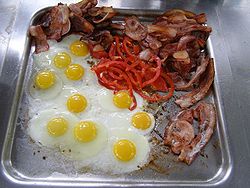
North American
North American generally refers to an entity, people, group, or attribute of North America, especially of the United States and Canada together.-Culture:*North American English, a collective term used to describe American English and Canadian English...
breakfast (Canada and the United States) consists of eggs, a "breakfast meat" such as bacon, ham
Ham
Ham is a cut of meat from the thigh of the hind leg of certain animals, especiallypigs. Nearly all hams sold today are fully cooked or cured.-Etymology:...
, or sausage, scrapple
Scrapple
Scrapple, also known by the Pennsylvania Dutch name pon haus, is traditionally a mush of pork scraps and trimmings combined with cornmeal and flour, often buckwheat flour, and spices. The mush is formed into a semi-solid congealed loaf, and slices of the scrapple are then panfried before serving...
, pork roll, spam
Spam (food)
Spam is a canned precooked meat product made by the Hormel Foods Corporation, first introduced in 1937. The labeled ingredients in the classic variety of Spam are chopped pork shoulder meat, with ham meat added, salt, water, modified potato starch as a binder, and sodium nitrite as a preservative...
or even steak
Steak
A steak is a cut of meat . Most are cut perpendicular to the muscle fibers, improving the perceived tenderness of the meat. In North America, steaks are typically served grilled, pan-fried, or broiled. The more tender cuts from the loin and rib are cooked quickly, using dry heat, and served whole...
or country fried steak; fried potatoes such as hash browns or home fries
Home fries
Home fries, house fries, or cottage fries are a type of basic potato dish made by pan or skillet frying diced, chunked, wedged or sliced potatoes that have been par-cooked by boiling, baking, steaming, or microwaving....
; toasted white
White bread
White bread is made from wheat flour from which the bran and the germ have been removed through a process known as milling. Milling gives white flour a longer shelf life by removing the bran which contains oil, allowing products made with it, like white bread, the ability to survive storage and...
, wheat, rye
Rye bread
Rye bread is a type of bread made with various percentages of flour from rye grain. It can be light or dark in color, depending on the type of flour used and the addition of coloring agents, and is typically denser than bread made from wheat flour...
or some other kind of bread goods, such as English muffins or bagels; fruit or fruit juice, and tea or, usually, coffee. It is often referred to as a "country breakfast" in many areas of the Midwestern United States
Midwestern United States
The Midwestern United States is one of the four U.S. geographic regions defined by the United States Census Bureau, providing an official definition of the American Midwest....
. The terms "fry" and "full breakfast" are not generally used in North America, though hotels generally distinguish between a light "continental breakfast" and a hot, cooked breakfast.
In the Southern United States
Southern United States
The Southern United States—commonly referred to as the American South, Dixie, or simply the South—constitutes a large distinctive area in the southeastern and south-central United States...
the meal is typically known as a "big breakfast" or "Sunday breakfast" and may add or replace elements of the above with: grits
Grits
Grits are a food of American Indian origin common in the Southern United States and mainly eaten at breakfast. They consist of coarsely ground corn, or sometimes alkali-treated corn . They are also sometimes called sofkee or sofkey from the Muskogee language word...
, toast or biscuits with white gravy
Biscuits and gravy
Biscuits and gravy is a popular breakfast dish in the United States, especially in the South.It consists of soft dough biscuits covered in thick "country" or "white" gravy, made from the drippings of cooked pork sausage, white flour, milk, and often bits of sausage, bacon, ground beef, or other...
, fried chicken
Fried chicken
Fried chicken is a dish consisting of chicken pieces usually from broiler chickens which have been floured or battered and then pan fried, deep fried, or pressure fried. The breading adds a crisp coating or crust to the exterior...
, pancakes, cinnamon rolls or similar sweet pastries.
In Quebec
Quebec
Quebec or is a province in east-central Canada. It is the only Canadian province with a predominantly French-speaking population and the only one whose sole official language is French at the provincial level....
, Canada, the meal may include regional variants like maple syrup
Maple syrup
Maple syrup is a syrup usually made from the xylem sap of sugar maple, red maple, or black maple trees, although it can also be made from other maple species such as the bigleaf maple. In cold climates, these trees store starch in their trunks and roots before the winter; the starch is then...
, crêpes, buckwheat galette
Galette
Galette is a general term used in the French cuisine to designate various types of flat, round or freeform crusty cakes, similar in concept to a Chinese bing. One notable type is the galette des Rois eaten on the day of Epiphany...
s, boudin
Boudin
Boudin describes a number of different types of sausage used in French, Belgian, German, French Canadian, Creole and Cajun cuisine.-Types:*Boudin blanc: A white sausage made of pork without the blood. Pork liver and heart meat are typically included...
, cretons
Cretons
In Quebec cuisine, cretons is a pork spread containing onions and spices. Due to its fatty texture and taste, it resembles French rillettes. Cretons are usually served on toast as part of a traditional Quebec breakfast...
and pommes persillade
Persillade
Persillade is a sauce or seasoning mixture of parsley chopped together with seasonings including garlic, herbs, oil, and vinegar.In its simplest form, just parsley and garlic, it is a common ingredient in many dishes, part of a sauté cook's mise en place...
, baked beans
Baked beans
Baked beans is a dish containing beans, sometimes baked but, despite the name, usually stewed, in a sauce. Most commercial canned baked beans are made from haricot beans, also known as navy beans – a variety of Phaseolus vulgaris – in a sauce. In Ireland and the United Kingdom, a tomato...
.
Central America
Ingredients include ham, sausage or bacon, eggs, much like a full breakfast elsewhere. A distinguishing feature is that fry jacks are also eaten, these being fried pieces of dough, similar to beignets or sopapillas. It can also include items like toast, pancakes, or hashbrowns. Fresh orange juice is often added as a drink. Guatemala's version of the full breakfast includes fried plantains, tortillas, and refried black beans. In Belize breakfast often features eggs and/or fried meats such as bacon or ham, fry jacks or thick flour tortillas or Johnny Cakes (thick, fluffy homemade biscuits), and fresh local fruit such as mango or melon and tea. Fried beans, smoked, fried or fresh fish are common substitutes for the meat or eggs. Belizeans enjoy their foods highly spiced and will flavor every meal, including breakfast, with recado rojoRecado rojo
Recado rojo or achiote paste is a popular blend of spices from Mexico. Originally a Mayan blend, it is now strongly associated with the Mexican cuisine of Yucatan and Belizean cuisine....
(achiote paste), pickled habanero peppers or habanero pepper sauce.
In Costa Rica the traditional breakfast includes Gallo pinto
Gallo pinto
Gallo pinto is a traditional dish of Costa Rica that was introduced by nicaraguan immigrants. During the 1980's many nicaraguans immigrated to Costa Rica influencing their food and music. Though many variations exist, the dish at its most basic is composed of pre-cooked rice and beans fried together...
, fried (sunny side-up) eggs, sour cream, fried sweet plantains, hand-made tortillas and coffee on the side.
See also
- Builder's tea
- Greasy spoonGreasy spoonGreasy spoon is a colloquial or slang term originating in the United States to mean a small, especially cheap, archetypal working class restaurant or diner. The term is now used in many English speaking countries to mean the same thing...
- English breakfast teaEnglish Breakfast teaEnglish Breakfast tea is a traditional blend of select teas originating from Assam, Ceylon and Kenya. It is one of the most popular blended teas...
- Irish breakfast teaIrish Breakfast teaIrish breakfast tea is a blend of several black teas, most often Assam teas and, less often, other types of black tea. Many tea producers make Irish breakfast tea blends specifically for the US market. In Ireland, it is not referred to as "Irish breakfast tea", but simply as "tea", being the...