


Fuel economy-maximizing behaviors

Encyclopedia
Fuel economy-maximizing behaviors (also known as green driving) describe techniques that drivers can use to optimize their automobile fuel economy
. The energy in fuel consumed in driving is lost in many ways, including engine inefficiency
, aerodynamic drag
, rolling friction, and kinetic energy
lost to braking
(and to a lesser extent regenerative braking). Driver behavior can influence all of these.
and wheel alignment, and engine oil with low-kinematic viscosity referred to as low "weight" motor oil
. Inflating tires to the maximum recommended air pressure means that less energy is required to move the vehicle. Under-inflated tires can increase rolling resistance
by approximately 1.4 percent for every 1 psi (0.06894757293 bar) drop in pressure of all four tires. Equally important is the scheduled maintenance of the engine (i.e. air filter, spark plug
), and addressing any on-board diagnostics
codes/malfunctions in the Engine Control Module and related sensors, especially the oxygen sensor
.
s", where designed for downforce not enhanced flow separation), running boards, push bars, and narrow and lower profile tires will improve fuel economy by reducing both weight and aerodynamic drag. Some cars also use a half size spare tire, for weight/cost/space saving purposes.
Toyota and Ford hybrids have a threshold speed—around 42 mph (68 km/h) in the case of the Prius—above which the engine must run to protect the transmission system. Below this model-dependent speed, the car will automatically switch between either battery-powered mode or engine power with battery recharge where the Prius can achieve over 88 miles per US gallon. These hybrids typically get their best fuel efficiency below this model-dependent threshold speed. Coasting can be achieved by using Neutral transmission range. The Honda IMA vehicles have a limited, battery-only, powered capability, although after-market modifications have made the Insight capable of running in electric only-mode. They achieve higher fuel economy. The GM hybrids have an engine auto-stop when halted. As of January 2007, they have no battery-only, powered capability.
Road capacity affects speed and therefore fuel efficiency as well. Studies have shown speeds just above 45 mi/h allow greatest throughput when roads are congested. Individual drivers can improve their fuel efficiency and that of others by avoiding roads and times where traffic slows to below 45 mi/h. Communities can improve fuel efficiency by adopting policies to prevent or discourage drivers from entering traffic that is approaching the point where speeds are slowed below 45 mi/h. Congestion pricing is based on this principle; it raises the price of road access at times of higher usage, to prevent cars from entering traffic and lowering speeds below efficient levels. Note, however, that maximizing throughput and fuel efficiency per vehicle mile traveled does not necessarily minimize total fuel consumption, because with maximum throughput the total vehicle-miles traveled (VMT) may be increased compared to a situation in which congestion reduces throughput.
. The optimum efficiency point is around 1750 rpm, and 90% of maximum torque at that speed, for this turbo-diesel engine. For driving at a steady speed, one cannot choose any operating point for the engine—rather there is a specific amount of power needed to maintain the chosen speed. A manual transmission lets the driver choose between several points along the curve. In the turbo diesel example, one can see that too low a gear will move the engine into a high-rpm, low-torque region in which the efficiency drops off rapidly, and thus best efficiency is achieved near the higher gear. In a gasoline engine, efficiency typically drops off more rapidly than in a diesel because of throttling losses, and the trend discussed here is even more dramatic. Because cruising at an efficient speed uses much less than the maximum power of the engine, the optimum operating point for cruising at low power is typically at very low engine speed, around or below 1000 rpm. This is far lower than the above mentioned 1750 rpm. This explains the usefulness of very high "overdrive" gears for highway cruising. For instance, a small car might need only 10 hp to cruise at 60 mi/h. It is likely to be geared for 2500 rpm or so at that speed, yet for maximum economy the engine should be running at about 1000 rpm to generate that power as efficiently as possible for that engine (although the actual figures will vary by engine and vehicle).
.) However, accelerating too quickly without paying attention to what is ahead may require braking and then after that, additional acceleration. Experts recommend accelerating quickly, but smoothly.
Generally, fuel economy is maximized when acceleration and braking are minimized. So a fuel-efficient strategy is to anticipate what is happening ahead, and drive in such a way so as to minimize acceleration and braking, and maximize coasting time.
The need to brake in a given situation is in some cases based on unpredictable events which require the driver to slow or stop the vehicle at a fixed distance ahead. Traveling at higher speeds results in less time available to let up on the accelerator and coast. Also the kinetic energy is higher, so more energy is lost in braking. At medium speeds, the driver has more freedom and can elect to accelerate, coast or decelerate depending on whichever is expected to maximize overall fuel economy. Traveling at posted speeds allows for best civil planning and should allow drivers to best take advantage of traffic signal timing.
While approaching a red signal, drivers may choose to "time a traffic light" by easing off the throttle, or braking early if necessary, far before the signal. For example, a driver who is approaching a red light should adjust vehicle speed in advance, such that the vehicle arrives at the intersection when the light is green. It is also important to account for the time it takes for the stopped traffic at the light to start moving again. In theory, the ideal situation is the driver slowing immediately to the calculated speed that allows the car to be barely behind the car in front as that vehicle is accelerating from the light. If the driver does this the instant the red light is recognized, this will result in the vehicle having maximum speed, and kinetic energy, as it reaches the intersection. This means that energy lost to braking is as little as possible. Instead of coasting up to the light and stopping, the driver will now be traveling at a slower speed for a longer time, allowing the light to turn green before he arrives. The driver will never have to fully stop, as accelerating from just a few mph is much more efficient than from a full stop. Using this practice during periods of traffic congestion may affect other drivers and the overall effect is not obvious.
Another problem with this technique is that some traffic lights (usually on minor roads where they intersect major roads) are not timed but triggered. They will stay red until a car arrives at the intersection. In this situation, the optimum strategy may be difficult to determine.
Conventional brakes dissipate kinetic energy
as heat, which is irrecoverable. Regenerative braking, used by hybrid/electric vehicles, recovers some of the kinetic energy, but some energy is lost in the conversion, and the braking power is limited by the battery's maximum charge rate and efficiency.
. Coasting is an efficient means of slowing down, because kinetic energy is dissipated as aerodynamic drag and rolling resistance
, which must always be overcome by the vehicle during travel. When coasting with the engine running and manual transmission in neutral, or clutch depressed, there will still be some fuel consumption due to the engine needing to maintain idle engine speed. While coasting with the engine running and the transmission in gear, most cars' engine control unit
with fuel injection will cut off fuel supply, and the engine will continue running, being driven by the wheels. Compared to coasting in neutral, this has an increased drag, but has the added safety benefit of being able to react in any sudden change in a potential dangerous traffic situation, and being in the right gear when acceleration is required.
in a carburettor-equipped car or the fuel injection computer in newer vehicles will add more fuel to the fuel-air mixture until normal operating temperature is reached, decreasing fuel economy.
is only a measure of the fuel's propensity to cause an engine to "ping"; this ping is due to "pre-combustion", which occurs when the fuel burns too rapidly (before the piston reaches top dead center). Higher-octane fuels burn more slowly at high pressures. For the vast majority of vehicles (i.e. vehicles with "standard" compression ratios), standard-octane fuel will work fine and not cause pinging. Using high-octane fuel in a vehicle that does not need it is generally considered an unnecessary expense, although Toyota has measured slight differences in efficiency due to octane number even when knock is not an issue. All vehicles built since 1996 are equipped with OBD2 and most will have knock sensors that will automatically adjust the timing if and when ping is detected, so low-octane fuel can be used in an engine designed for high octane, with some reduction in efficiency and performance. If the engine is designed for high octane then higher-octane fuel will result in higher efficiency and performance under certain load and mixture conditions. For other vehicles that have problems with ping, it may be due to a maintenance problem, such as carbon buildup inside the cylinder, using spark plugs with the improper heat range or ignition timing problems. In such cases, higher-octane fuel may help, but this is an expensive fix; proper repair might make more long-term sense. There is slightly less energy in a gallon of high-octane fuel than low-octane. Ping is detrimental to an engine; it will decrease fuel economy and will damage the engine over time.
", which provides information including the rate of fuel consumption, and the vehicle speed. This streaming data is sufficient to calculate the real-time fuel economy.
Generic aftermarket
or "add-on" products are available, such as the "ScanGauge" or "DashDyno SPD", which will connect to a vehicle's onboard computer, read the real-time information, and calculate and display the instantaneous fuel economy. This information assists the driver by displaying the fuel consumption. This provides a general indicator to the driver who can then infer in real-time how driving techniques affect gas mileage. This can help the astute driver to learn how to drive more efficiently. However, such a device does not do all the work for the driver. The device only measures fuel consumption and fuel economy. It does not indicate braking statistics, for example, nor does it teach a driver methods to minimize fuel consumption.
s of some vehicles command a richer fuel setting immediately after the starter is activated, so the bump-start manual transmission vehicle will typically achieve the best fuel economy gains.
Some hybrid vehicles are well-suited to performing the burn and coast. In a series-parallel hybrid (see Hybrid vehicle drivetrain
), the internal combustion engine
and charging system can be shut off for the glide by simply manipulating the accelerator.
For coasting in gear, a later-model vehicle with a fuel-injected engine will realize more gains from the burn and coast technique than older carbureted engines because the engine control unit
s in most fuel-injected engines will cut fuel to the engine when the car is in gear, the throttle is closed and the engine is running faster than idle speed. This is sometimes referred to as "deceleration fuel cut off". This will often engage while a car is coasting down a hill and is common in both automatic and manual transmission vehicles, although the particular engine speeds at which it will engage vary.
It is possible to coast in neutral with either a manual or automatic transmission. Modern automatic transmissions/transaxles depend on an engine driven fluid pump for lubrication and coasting with the engine off may lead to damage or failure of the transmission. To perform the maneuver, the driver shifts into neutral, and then keys the ignition back to the first position, referred to as "IG-I", to shut off the engine and electronics. The driver then keys forward to IG-II to start the electronics and continue coasting. The key should remain in the ignition in the IG-II position, and not the IG-I position, in order to avoid engaging the steering wheel lock. The driver recovers normal operation by starting the engine in the normal way, by turning the key to IG-III to crank the starter motor, and then releasing the key back to IG-II. Before putting the transmission in gear, if necessary, the driver may "rev" the engine to match the vehicle's gear and speed. The fuel economy from this advanced technique is increased noticeably over any short distance trip, largely because there are no engine idling losses (see figure below). Most modern automatics' computer systems do a very good job at keeping the transmission in the proper gear while coasting in neutral, and the driver should not be conscious of the tachometer when re-engaging, but rather just press half-way down on the accelerator when re-engaging.
Some, but not all, hypermilers use this maneuver, and some may use it more safely than others. The technique is used for general coasting, or as part of the pulse-and-glide maneuver, or when going down hills or in other situations when potential energy or momentum will propel the vehicle without engine power. Some hypermilers may use this maneuver while going downhill, around a corner, and without braking; however, that practice is in all likelihood more dangerous than an auto-stop on a level and straight road, where stopping distance is shorter and visibility is greater. Vehicle control may be somewhat compromised, and this can be more or less dangerous or safe depending on the situation. Turning the engine off will cause the power brake assist to be lost after a few applications of the brake pedal. Power steering is instantly lost, although it is not needed at high speed, only at low speed. Steering is still possible at low speed, but can often require considerably more arm strength to turn the wheel.
For safety reasons, the maneuver is not recommended for use in traffic, since the driver will want the car to be in gear if sudden acceleration is needed as an evasive maneuver. The driver should first look for traffic behind the vehicle before attempting the maneuver. It can be considered more courteous to not coast if another vehicle is closely following. The proper etiquette and acceptable driving practices are controversial, and is worsened by a lack of communication between drivers. Both sides of the debate are often argued passionately, yet sometimes neither of the proposed driving methods is in complete accordance with the rules of the road. Both hypermilers and regular drivers may at different times violate the same rule yet blame the other type of driver.
Despite the potential risks, it does in fact save fuel to turn the engine off instead of idling. Traffic lights are in most cases predictable, and it is often possible to anticipate when a light will turn green. Some traffic lights (in Europe) have timers on them, which assists the driver in using this tactic.
Draft-assisted forced stop, a variation of the forced (auto)stop (sometimes abbreviated as D-FAS), involves turning off the engine and gliding in neutral while drafting a larger vehicle, in order to take advantage of the reduced wind resistance
in its immediate wake
(this practice is illegal in some areas due to its danger); while tailgating itself is inherently risky, the danger of collision is increased with D-FAS as hydraulic power for power brakes
is used up after a few applications of the brake pedal, and there is a loss of hydraulic pressure that provides power steering
, however, there is less need for power steering at high speed.
Some hybrids must keep the engine running whenever the vehicle is in motion and the transmission engaged, although they still have an "auto-stop" feature which engages when the vehicle stops, avoiding waste. Maximizing use of auto-stop on these vehicles is critical because idling causes a severe drop in instantaneous fuel-mileage efficiency to zero miles per gallon, and this lowers the average (or accumulated) fuel-mileage efficiency.
(Discovery Channel), in their June 6, 2007, episode, took a series of measurements where they drove a Dodge Magnum Station Wagon at 55 mi/h right behind a Freightliner tractor trailer. As they got closer their results ranged from a baseline (no truck) figure of 32 to 35.5 mpg-US (7.4 to 6.63 L/100 km, a 11% greater distance covered per unit volume of fuel or a 10% reduction in fuel consumption) at 100 feet (30 m), and then progressively up to 44.5 mpg-US (5.29 L/100 km, a 39% greater distance covered per unit volume of fuel or a 28% reduction in fuel consumption) at 10 feet (3 m), as a result of decreased drag consequent of drafting
.
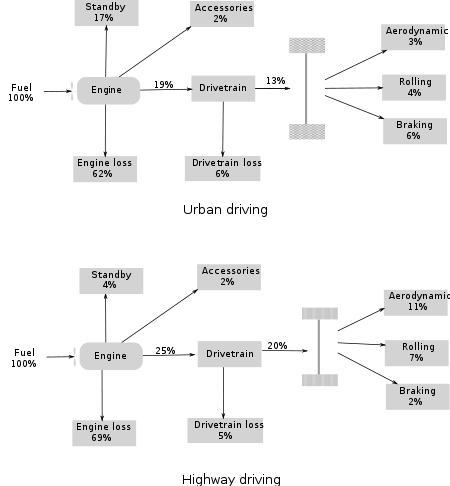 Understanding the distribution of energy losses in a vehicle can help drivers travel more efficiently.
Most of the fuel energy loss occurs in the thermodynamic
losses of the engine. The second largest loss is from idling, or when the engine is in "standby", which explains the large gains available from shutting off the engine. Very little fuel energy actually reaches the axle. However, any mechanical energy that doesn't go to the axle is energy that doesn't have to be created by the engine, and thus reduces loss in the inefficiency of the engine.
In this respect, the data for fuel energy wasted in braking, rolling resistance, and aerodynamic drag are all somewhat misleading, because they do not reflect all the energy that was wasted up to that point in the process of delivering energy to the wheels.
The image reports that on non-highway (urban) driving, 6% of the fuel's energy is dissipated in braking; however, by dividing this figure by the energy that actually reaches the axle (13%), one can find that 46% of the energy reaching the axle goes to the brakes. Also, additional energy can potentially be recovered when going down hills, which may not be reflected in these figures. Any statistic such as this must be based on averages of certain driving behaviors and/or protocols, which are known to vary widely, and these are precisely the behaviors which hypermilers leverage to the full extent possible.
Public Affairs, notes that "saving fuel and conserving energy are important, but so is safety, and preventing crashes."
In the US, optimal highway speed for fuel-efficiency often lies between the legal minimum speed and the legal speed limit, typically 45 mi/h. However, these legal speeds may actually be slower than average traffic speed. The hypermiler thus avoids the danger of higher speeds, however, the speed differential created between cars can be problematic in some cases. Driving at speeds much lower than other vehicles may promote other problems; namely, aggressive drivers may choose to tailgate a slower vehicle. Coasting in neutral with or without the engine off may lead to reduced control in some situations, and drafting at any closer than 3 seconds to the vehicle in front is a recognised risk.
, drafting a big rig at close distances is life-threatening and extremely dangerous. They recommended a minimum safe driving distance of at least 150 feet (45.7 m) from a big rig.
While one function of the driving laws is to help increase safety, the attendant safety issues are not always clear cut, and often neither are the laws. Although coasting in neutral is illegal, in some form, in most states in the US , a driver is not legally required to be able to control a vehicle safely when the car is in neutral. Coasting is even advocated in certain circumstances. For example: "If you are on ice and skidding in a straight line, step on the clutch or shift to neutral." Also, in a stuck throttle emergency, the safe procedure is to put the transmission in neutral, and if that is ineffective, to turn off the engine.
In addition, a driver legally needs to have the ability to bring the vehicle to a stop under any circumstances, including when the engine stalls during normal driving. In the event that there is a loss of engine power, decelerating to a stop is recommended as the safest action. As a safety feature, vehicles are designed to retain some limited ability to steer and brake even when all engine power is lost.
Fuel economy in automobiles
Fuel usage in automobiles refers to the fuel efficiency relationship between distance traveled by an automobile and the amount of fuel consumed....
. The energy in fuel consumed in driving is lost in many ways, including engine inefficiency
Engine efficiency
Engine efficiency of thermal engines is the relationship between the total energy contained in the fuel, and the amount of energy used to perform useful work...
, aerodynamic drag
Drag (physics)
In fluid dynamics, drag refers to forces which act on a solid object in the direction of the relative fluid flow velocity...
, rolling friction, and kinetic energy
Kinetic energy
The kinetic energy of an object is the energy which it possesses due to its motion.It is defined as the work needed to accelerate a body of a given mass from rest to its stated velocity. Having gained this energy during its acceleration, the body maintains this kinetic energy unless its speed changes...
lost to braking
Brake
A brake is a mechanical device which inhibits motion. Its opposite component is a clutch. The rest of this article is dedicated to various types of vehicular brakes....
(and to a lesser extent regenerative braking). Driver behavior can influence all of these.
Terminology
Various terms describe drivers using unusual driving techniques to maximize fuel efficiency. A few of these are:- Hypermilers are drivers who exceed the United States Environmental Protection AgencyUnited States Environmental Protection AgencyThe U.S. Environmental Protection Agency is an agency of the federal government of the United States charged with protecting human health and the environment, by writing and enforcing regulations based on laws passed by Congress...
(EPA) estimated fuel efficiency on their vehicles by modifying their driving habits. The term 'hypermiler' originated from hybrid vehicleHybrid vehicleA hybrid vehicle is a vehicle that uses two or more distinct power sources to move the vehicle. The term most commonly refers to hybrid electric vehicles , which combine an internal combustion engine and one or more electric motors.-Power:...
driving clubs and noted hypermiler Wayne Gerdes and combines current technology (e.g., real time mileage displays) with driving techniques innovated historically with events such as Mobil Economy RunMobil Economy RunMobil Economy Run was an event that took place every year from 1936 to 1968. It was designed to provide real fuel efficiency numbers during a coast to coast test on real roads and with regular traffic and weather conditions...
during the 1930s, gas rationingRationingRationing is the controlled distribution of scarce resources, goods, or services. Rationing controls the size of the ration, one's allotted portion of the resources being distributed on a particular day or at a particular time.- In economics :...
during World War IIWorld War IIWorld War II, or the Second World War , was a global conflict lasting from 1939 to 1945, involving most of the world's nations—including all of the great powers—eventually forming two opposing military alliances: the Allies and the Axis...
, techniques that prevailed during 1973 oil crisis1973 oil crisisThe 1973 oil crisis started in October 1973, when the members of Organization of Arab Petroleum Exporting Countries or the OAPEC proclaimed an oil embargo. This was "in response to the U.S. decision to re-supply the Israeli military" during the Yom Kippur war. It lasted until March 1974. With the...
, and methods used globally in markets that endure expensive fuel.
- Nempimania (also Nenpimania) is an obsession with getting the best fuel economy (or the best only-electric range) possible from a hybrid car. It is derived from the Japanese "nempi" (燃費)--a contraction of nenryōshōhiryō (燃料消費量) meaning fuel economy, and mania, meaning "craze for."
- Eco-driving covers similar ground in other European marketplaces.
Techniques used to maximize fuel economy
Techniques used to improve fuel economy include basic techniques that can be used by most drivers, and advanced techniques that are more specialized, but can be used to achieve extremely high mileage.Maintenance
Key parameters to maintain are proper tire pressure,and wheel alignment, and engine oil with low-kinematic viscosity referred to as low "weight" motor oil
Motor oil
Motor oil or engine oil is an oil used for lubrication of various internal combustion engines. The main function is to lubricate moving parts; it also cleans, inhibits corrosion, improves sealing, and cools the engine by carrying heat away from moving parts.Motor oils are derived from...
. Inflating tires to the maximum recommended air pressure means that less energy is required to move the vehicle. Under-inflated tires can increase rolling resistance
Rolling resistance
Rolling resistance, sometimes called rolling friction or rolling drag, is the resistance that occurs when a round object such as a ball or tire rolls on a flat surface, in steady velocity straight line motion. It is caused mainly by the deformation of the object, the deformation of the surface, or...
by approximately 1.4 percent for every 1 psi (0.06894757293 bar) drop in pressure of all four tires. Equally important is the scheduled maintenance of the engine (i.e. air filter, spark plug
Spark plug
A spark plug is an electrical device that fits into the cylinder head of some internal combustion engines and ignites compressed fuels such as aerosol, gasoline, ethanol, and liquefied petroleum gas by means of an electric spark.Spark plugs have an insulated central electrode which is connected by...
), and addressing any on-board diagnostics
On-board diagnostics
On-Board Diagnostics, or OBD, in an automotive context, is a generic term referring to a vehicle's self-diagnostic and reporting capability. OBD systems give the vehicle owner or a repair technician access to state of health information for various vehicle sub-systems...
codes/malfunctions in the Engine Control Module and related sensors, especially the oxygen sensor
Oxygen sensor
An oxygen sensor, or lambda sensor, is an electronic device that measures the proportion of oxygen in the gas or liquid being analyzed. It was developed by the Robert Bosch GmbH company during the late 1960s under the supervision of Dr. Günter Bauman...
.
Minimizing mass and improving aerodynamics
Drivers can also increase fuel economy by driving lighter and/or lower-drag vehicles and minimizing the amount of people, cargo, tools, and equipment carried in the vehicle. Removing common unnecessary accessories such as roof racks, brush guards, wind deflectors (or "spoilerSpoiler (automotive)
A spoiler is an automotive aerodynamic device whose intended design function is to 'spoil' unfavorable air movement across a body of a vehicle in motion. Spoilers on the front of a vehicle are often called air dams, because in addition to directing air flow they also reduce the amount of air...
s", where designed for downforce not enhanced flow separation), running boards, push bars, and narrow and lower profile tires will improve fuel economy by reducing both weight and aerodynamic drag. Some cars also use a half size spare tire, for weight/cost/space saving purposes.
Efficient speeds
Maintaining an efficient speed is an important factor in fuel efficiency. Optimal efficiency can be expected while cruising with no stops, at minimal throttle and with the transmission in the highest gear (see Choice of gear, below). The optimum speed varies with the type of vehicle, although it is usually reported to be 35 mph (56 km/h) or higher. For instance a 2004 Chevrolet Impala had an optimum at 42 mph (70 km/h), and was within 15% of that from 29 to 57 mph (45 to 95 km/h). The US government 2005 Fuel Economy Guide includes a plot showing the optimum between 50 mi/h for an unspecified vehicle. Drivers of vehicles with fuel-economy displays can check their own vehicles by cruising at different speeds and monitoring the readout.Toyota and Ford hybrids have a threshold speed—around 42 mph (68 km/h) in the case of the Prius—above which the engine must run to protect the transmission system. Below this model-dependent speed, the car will automatically switch between either battery-powered mode or engine power with battery recharge where the Prius can achieve over 88 miles per US gallon. These hybrids typically get their best fuel efficiency below this model-dependent threshold speed. Coasting can be achieved by using Neutral transmission range. The Honda IMA vehicles have a limited, battery-only, powered capability, although after-market modifications have made the Insight capable of running in electric only-mode. They achieve higher fuel economy. The GM hybrids have an engine auto-stop when halted. As of January 2007, they have no battery-only, powered capability.
Road capacity affects speed and therefore fuel efficiency as well. Studies have shown speeds just above 45 mi/h allow greatest throughput when roads are congested. Individual drivers can improve their fuel efficiency and that of others by avoiding roads and times where traffic slows to below 45 mi/h. Communities can improve fuel efficiency by adopting policies to prevent or discourage drivers from entering traffic that is approaching the point where speeds are slowed below 45 mi/h. Congestion pricing is based on this principle; it raises the price of road access at times of higher usage, to prevent cars from entering traffic and lowering speeds below efficient levels. Note, however, that maximizing throughput and fuel efficiency per vehicle mile traveled does not necessarily minimize total fuel consumption, because with maximum throughput the total vehicle-miles traveled (VMT) may be increased compared to a situation in which congestion reduces throughput.
Choice of gear (manual transmissions)
Engine efficiency varies with speed and torque, as can be seen in a plot of brake specific fuel consumptionBrake specific fuel consumption
Brake Specific Fuel Consumption is a measure of fuel efficiency within a shaft reciprocating engine.It is the rate of fuel consumption divided by the power produced. It may also be thought of as power-specific fuel consumption, for this reason...
. The optimum efficiency point is around 1750 rpm, and 90% of maximum torque at that speed, for this turbo-diesel engine. For driving at a steady speed, one cannot choose any operating point for the engine—rather there is a specific amount of power needed to maintain the chosen speed. A manual transmission lets the driver choose between several points along the curve. In the turbo diesel example, one can see that too low a gear will move the engine into a high-rpm, low-torque region in which the efficiency drops off rapidly, and thus best efficiency is achieved near the higher gear. In a gasoline engine, efficiency typically drops off more rapidly than in a diesel because of throttling losses, and the trend discussed here is even more dramatic. Because cruising at an efficient speed uses much less than the maximum power of the engine, the optimum operating point for cruising at low power is typically at very low engine speed, around or below 1000 rpm. This is far lower than the above mentioned 1750 rpm. This explains the usefulness of very high "overdrive" gears for highway cruising. For instance, a small car might need only 10 hp to cruise at 60 mi/h. It is likely to be geared for 2500 rpm or so at that speed, yet for maximum economy the engine should be running at about 1000 rpm to generate that power as efficiently as possible for that engine (although the actual figures will vary by engine and vehicle).
Acceleration and deceleration (braking)
Fuel efficiency varies with the vehicle. Fuel efficiency during acceleration generally improves as RPM increases until a point somewhere near peak torque (brake specific fuel consumptionBrake specific fuel consumption
Brake Specific Fuel Consumption is a measure of fuel efficiency within a shaft reciprocating engine.It is the rate of fuel consumption divided by the power produced. It may also be thought of as power-specific fuel consumption, for this reason...
.) However, accelerating too quickly without paying attention to what is ahead may require braking and then after that, additional acceleration. Experts recommend accelerating quickly, but smoothly.
Generally, fuel economy is maximized when acceleration and braking are minimized. So a fuel-efficient strategy is to anticipate what is happening ahead, and drive in such a way so as to minimize acceleration and braking, and maximize coasting time.
The need to brake in a given situation is in some cases based on unpredictable events which require the driver to slow or stop the vehicle at a fixed distance ahead. Traveling at higher speeds results in less time available to let up on the accelerator and coast. Also the kinetic energy is higher, so more energy is lost in braking. At medium speeds, the driver has more freedom and can elect to accelerate, coast or decelerate depending on whichever is expected to maximize overall fuel economy. Traveling at posted speeds allows for best civil planning and should allow drivers to best take advantage of traffic signal timing.
While approaching a red signal, drivers may choose to "time a traffic light" by easing off the throttle, or braking early if necessary, far before the signal. For example, a driver who is approaching a red light should adjust vehicle speed in advance, such that the vehicle arrives at the intersection when the light is green. It is also important to account for the time it takes for the stopped traffic at the light to start moving again. In theory, the ideal situation is the driver slowing immediately to the calculated speed that allows the car to be barely behind the car in front as that vehicle is accelerating from the light. If the driver does this the instant the red light is recognized, this will result in the vehicle having maximum speed, and kinetic energy, as it reaches the intersection. This means that energy lost to braking is as little as possible. Instead of coasting up to the light and stopping, the driver will now be traveling at a slower speed for a longer time, allowing the light to turn green before he arrives. The driver will never have to fully stop, as accelerating from just a few mph is much more efficient than from a full stop. Using this practice during periods of traffic congestion may affect other drivers and the overall effect is not obvious.
Another problem with this technique is that some traffic lights (usually on minor roads where they intersect major roads) are not timed but triggered. They will stay red until a car arrives at the intersection. In this situation, the optimum strategy may be difficult to determine.
Conventional brakes dissipate kinetic energy
Kinetic energy
The kinetic energy of an object is the energy which it possesses due to its motion.It is defined as the work needed to accelerate a body of a given mass from rest to its stated velocity. Having gained this energy during its acceleration, the body maintains this kinetic energy unless its speed changes...
as heat, which is irrecoverable. Regenerative braking, used by hybrid/electric vehicles, recovers some of the kinetic energy, but some energy is lost in the conversion, and the braking power is limited by the battery's maximum charge rate and efficiency.
Coasting or gliding
The alternative to acceleration and braking is coasting, i.e. gliding along without propulsionVehicle propulsion
Vehicle propulsion refers to the act of moving an artificial carrier of people or goods over any distance. The power plant used to drive the vehicles can vary widely. Originally, humans or animals would have provided the propulsion system, later being supplemented by wind power...
. Coasting is an efficient means of slowing down, because kinetic energy is dissipated as aerodynamic drag and rolling resistance
Rolling resistance
Rolling resistance, sometimes called rolling friction or rolling drag, is the resistance that occurs when a round object such as a ball or tire rolls on a flat surface, in steady velocity straight line motion. It is caused mainly by the deformation of the object, the deformation of the surface, or...
, which must always be overcome by the vehicle during travel. When coasting with the engine running and manual transmission in neutral, or clutch depressed, there will still be some fuel consumption due to the engine needing to maintain idle engine speed. While coasting with the engine running and the transmission in gear, most cars' engine control unit
Engine control unit
An engine control unit is a type of electronic control unit that determines the amount of fuel, ignition timing and other parameters an internal combustion engine needs to keep running...
with fuel injection will cut off fuel supply, and the engine will continue running, being driven by the wheels. Compared to coasting in neutral, this has an increased drag, but has the added safety benefit of being able to react in any sudden change in a potential dangerous traffic situation, and being in the right gear when acceleration is required.
Anticipation
A driver may further improve economy by anticipating the movement of other traffic users. For example, a driver who stops quickly, or turns without signaling, reduces the options another driver has for maximizing his performance. By always giving road users as much information about their intentions as possible, a driver can help other road users reduce their fuel usage. Similarly, anticipation of road features such as traffic lights can reduce the need for excessive braking and acceleration.Minimising ancillary losses
Using air conditioning requires the generation of up to 5 hp of extra power to maintain a given speed . A/C systems cycle on and off, or vary their output, as required by the occupants so they rarely run at full power continuously. However, the alternative, opening the windows, also creates drag losses that can often exceed the losses from air conditioning, depending on the speed of the car. Using the passenger heating system slows the rise to operating temperature for the engine. Either the chokeChoke valve
A Choke valve is a type of valve designed to create choked flow in a fluid. Over a wide range of valve settings the flow through the valve can be understood by ignoring the viscosity of the fluid passing through the valve; the rate of flow is determined only by the ambient pressure on the upstream...
in a carburettor-equipped car or the fuel injection computer in newer vehicles will add more fuel to the fuel-air mixture until normal operating temperature is reached, decreasing fuel economy.
Fuel type
It is commonly believed that efficiency of a gasoline engine is related to the fuel's octane level; however, this is not true in most situations. Octane ratingOctane rating
Octane rating or octane number is a standard measure of the anti-knock properties of a motor or aviation fuel. The higher the octane number, the more compression the fuel can withstand before detonating...
is only a measure of the fuel's propensity to cause an engine to "ping"; this ping is due to "pre-combustion", which occurs when the fuel burns too rapidly (before the piston reaches top dead center). Higher-octane fuels burn more slowly at high pressures. For the vast majority of vehicles (i.e. vehicles with "standard" compression ratios), standard-octane fuel will work fine and not cause pinging. Using high-octane fuel in a vehicle that does not need it is generally considered an unnecessary expense, although Toyota has measured slight differences in efficiency due to octane number even when knock is not an issue. All vehicles built since 1996 are equipped with OBD2 and most will have knock sensors that will automatically adjust the timing if and when ping is detected, so low-octane fuel can be used in an engine designed for high octane, with some reduction in efficiency and performance. If the engine is designed for high octane then higher-octane fuel will result in higher efficiency and performance under certain load and mixture conditions. For other vehicles that have problems with ping, it may be due to a maintenance problem, such as carbon buildup inside the cylinder, using spark plugs with the improper heat range or ignition timing problems. In such cases, higher-octane fuel may help, but this is an expensive fix; proper repair might make more long-term sense. There is slightly less energy in a gallon of high-octane fuel than low-octane. Ping is detrimental to an engine; it will decrease fuel economy and will damage the engine over time.
Trip computer
Modern hybrids come with built-in trip computers which display real-time fuel economy (MPG or L/100km), which helps the driver adjust driving habits. Most gasoline powered vehicles do not have this as a standard option (although some luxury vehicles do), however most vehicles produced after 1996, have one of three standardized interfaces for "on-board diagnosticsOn-board diagnostics
On-Board Diagnostics, or OBD, in an automotive context, is a generic term referring to a vehicle's self-diagnostic and reporting capability. OBD systems give the vehicle owner or a repair technician access to state of health information for various vehicle sub-systems...
", which provides information including the rate of fuel consumption, and the vehicle speed. This streaming data is sufficient to calculate the real-time fuel economy.
Generic aftermarket
Aftermarket (automotive)
The automotive aftermarket is the secondary market of the automotive industry, concerned with the manufacturing, remanufacturing, distribution, retailing, and installation of all vehicle parts, chemicals, tools, equipment and accessories for light and heavy vehicles, after the sale of the...
or "add-on" products are available, such as the "ScanGauge" or "DashDyno SPD", which will connect to a vehicle's onboard computer, read the real-time information, and calculate and display the instantaneous fuel economy. This information assists the driver by displaying the fuel consumption. This provides a general indicator to the driver who can then infer in real-time how driving techniques affect gas mileage. This can help the astute driver to learn how to drive more efficiently. However, such a device does not do all the work for the driver. The device only measures fuel consumption and fuel economy. It does not indicate braking statistics, for example, nor does it teach a driver methods to minimize fuel consumption.
Advanced techniques
These are less broadly applicable, some may compromise safety and possibly be illegal in some territories.Burn and coast
Burn and coast is also known as pulse and glide. This method consists of accelerating to a given speed (the "burn" or "pulse"), followed by a period of coasting (or "gliding") down to a lower speed, at which point the "burn" is reiterated. Coasting is most efficient when the engine is not running, although some gains can be realized with the engine on (to maintain power to brakes, steering and ancillaries) and the vehicle in neutral, or even with the vehicle remaining in gear. If a manual transmission vehicle coasts with the engine off, it is typically re-started by engaging the clutch. The engine control unitEngine control unit
An engine control unit is a type of electronic control unit that determines the amount of fuel, ignition timing and other parameters an internal combustion engine needs to keep running...
s of some vehicles command a richer fuel setting immediately after the starter is activated, so the bump-start manual transmission vehicle will typically achieve the best fuel economy gains.
Some hybrid vehicles are well-suited to performing the burn and coast. In a series-parallel hybrid (see Hybrid vehicle drivetrain
Hybrid vehicle drivetrain
Hybrid vehicles are vehicles with two or more power sources in the drivetrain. There are many different types of hybrid vehicles, although only the gasoline-electric hybrid is currently commercially available....
), the internal combustion engine
Internal combustion engine
The internal combustion engine is an engine in which the combustion of a fuel occurs with an oxidizer in a combustion chamber. In an internal combustion engine, the expansion of the high-temperature and high -pressure gases produced by combustion apply direct force to some component of the engine...
and charging system can be shut off for the glide by simply manipulating the accelerator.
For coasting in gear, a later-model vehicle with a fuel-injected engine will realize more gains from the burn and coast technique than older carbureted engines because the engine control unit
Engine control unit
An engine control unit is a type of electronic control unit that determines the amount of fuel, ignition timing and other parameters an internal combustion engine needs to keep running...
s in most fuel-injected engines will cut fuel to the engine when the car is in gear, the throttle is closed and the engine is running faster than idle speed. This is sometimes referred to as "deceleration fuel cut off". This will often engage while a car is coasting down a hill and is common in both automatic and manual transmission vehicles, although the particular engine speeds at which it will engage vary.
Auto-stop, forced stop, and draft-assisted forced stop
In the auto-stop maneuver, the vehicle's transmission is put in neutral, the engine is turned off (a "forced stop"), and the vehicle coasts to a stop.It is possible to coast in neutral with either a manual or automatic transmission. Modern automatic transmissions/transaxles depend on an engine driven fluid pump for lubrication and coasting with the engine off may lead to damage or failure of the transmission. To perform the maneuver, the driver shifts into neutral, and then keys the ignition back to the first position, referred to as "IG-I", to shut off the engine and electronics. The driver then keys forward to IG-II to start the electronics and continue coasting. The key should remain in the ignition in the IG-II position, and not the IG-I position, in order to avoid engaging the steering wheel lock. The driver recovers normal operation by starting the engine in the normal way, by turning the key to IG-III to crank the starter motor, and then releasing the key back to IG-II. Before putting the transmission in gear, if necessary, the driver may "rev" the engine to match the vehicle's gear and speed. The fuel economy from this advanced technique is increased noticeably over any short distance trip, largely because there are no engine idling losses (see figure below). Most modern automatics' computer systems do a very good job at keeping the transmission in the proper gear while coasting in neutral, and the driver should not be conscious of the tachometer when re-engaging, but rather just press half-way down on the accelerator when re-engaging.
Some, but not all, hypermilers use this maneuver, and some may use it more safely than others. The technique is used for general coasting, or as part of the pulse-and-glide maneuver, or when going down hills or in other situations when potential energy or momentum will propel the vehicle without engine power. Some hypermilers may use this maneuver while going downhill, around a corner, and without braking; however, that practice is in all likelihood more dangerous than an auto-stop on a level and straight road, where stopping distance is shorter and visibility is greater. Vehicle control may be somewhat compromised, and this can be more or less dangerous or safe depending on the situation. Turning the engine off will cause the power brake assist to be lost after a few applications of the brake pedal. Power steering is instantly lost, although it is not needed at high speed, only at low speed. Steering is still possible at low speed, but can often require considerably more arm strength to turn the wheel.
For safety reasons, the maneuver is not recommended for use in traffic, since the driver will want the car to be in gear if sudden acceleration is needed as an evasive maneuver. The driver should first look for traffic behind the vehicle before attempting the maneuver. It can be considered more courteous to not coast if another vehicle is closely following. The proper etiquette and acceptable driving practices are controversial, and is worsened by a lack of communication between drivers. Both sides of the debate are often argued passionately, yet sometimes neither of the proposed driving methods is in complete accordance with the rules of the road. Both hypermilers and regular drivers may at different times violate the same rule yet blame the other type of driver.
Despite the potential risks, it does in fact save fuel to turn the engine off instead of idling. Traffic lights are in most cases predictable, and it is often possible to anticipate when a light will turn green. Some traffic lights (in Europe) have timers on them, which assists the driver in using this tactic.
Draft-assisted forced stop, a variation of the forced (auto)stop (sometimes abbreviated as D-FAS), involves turning off the engine and gliding in neutral while drafting a larger vehicle, in order to take advantage of the reduced wind resistance
Drag (physics)
In fluid dynamics, drag refers to forces which act on a solid object in the direction of the relative fluid flow velocity...
in its immediate wake
Wake
A wake is the region of recirculating flow immediately behind a moving or stationary solid body, caused by the flow of surrounding fluid around the body.-Fluid dynamics:...
(this practice is illegal in some areas due to its danger); while tailgating itself is inherently risky, the danger of collision is increased with D-FAS as hydraulic power for power brakes
Brake
A brake is a mechanical device which inhibits motion. Its opposite component is a clutch. The rest of this article is dedicated to various types of vehicular brakes....
is used up after a few applications of the brake pedal, and there is a loss of hydraulic pressure that provides power steering
Power steering
Power steering helps drivers steer vehicles by augmenting steering effort of the steering wheel.Hydraulic or electric actuators add controlled energy to the steering mechanism, so the driver needs to provide only modest effort regardless of conditions. Power steering helps considerably when a...
, however, there is less need for power steering at high speed.
Some hybrids must keep the engine running whenever the vehicle is in motion and the transmission engaged, although they still have an "auto-stop" feature which engages when the vehicle stops, avoiding waste. Maximizing use of auto-stop on these vehicles is critical because idling causes a severe drop in instantaneous fuel-mileage efficiency to zero miles per gallon, and this lowers the average (or accumulated) fuel-mileage efficiency.
Drafting
The US television show MythbustersMythBusters
MythBusters is a science entertainment TV program created and produced by Beyond Television Productions for the Discovery Channel. The series is screened by numerous international broadcasters, including Discovery Channel Australia, Discovery Channel Latin America, Discovery Channel Canada, Quest...
(Discovery Channel), in their June 6, 2007, episode, took a series of measurements where they drove a Dodge Magnum Station Wagon at 55 mi/h right behind a Freightliner tractor trailer. As they got closer their results ranged from a baseline (no truck) figure of 32 to 35.5 mpg-US (7.4 to 6.63 L/100 km, a 11% greater distance covered per unit volume of fuel or a 10% reduction in fuel consumption) at 100 feet (30 m), and then progressively up to 44.5 mpg-US (5.29 L/100 km, a 39% greater distance covered per unit volume of fuel or a 28% reduction in fuel consumption) at 10 feet (3 m), as a result of decreased drag consequent of drafting
Drafting (racing)
Drafting or slipstreaming is a technique where two vehicles or other moving objects are caused to align in a close group reducing the overall effect of drag due to exploiting the lead object's slipstream...
.
Energy losses
Most of the fuel energy loss occurs in the thermodynamic
Thermodynamics
Thermodynamics is a physical science that studies the effects on material bodies, and on radiation in regions of space, of transfer of heat and of work done on or by the bodies or radiation...
losses of the engine. The second largest loss is from idling, or when the engine is in "standby", which explains the large gains available from shutting off the engine. Very little fuel energy actually reaches the axle. However, any mechanical energy that doesn't go to the axle is energy that doesn't have to be created by the engine, and thus reduces loss in the inefficiency of the engine.
In this respect, the data for fuel energy wasted in braking, rolling resistance, and aerodynamic drag are all somewhat misleading, because they do not reflect all the energy that was wasted up to that point in the process of delivering energy to the wheels.
The image reports that on non-highway (urban) driving, 6% of the fuel's energy is dissipated in braking; however, by dividing this figure by the energy that actually reaches the axle (13%), one can find that 46% of the energy reaching the axle goes to the brakes. Also, additional energy can potentially be recovered when going down hills, which may not be reflected in these figures. Any statistic such as this must be based on averages of certain driving behaviors and/or protocols, which are known to vary widely, and these are precisely the behaviors which hypermilers leverage to the full extent possible.
Safety
Geoff Sundstrom, director of AAAAmerican Automobile Association
AAA , formerly known as the American Automobile Association, is a federation of 51 independently operated motor clubs throughout North America. AAA is a not-for-profit member service organization with more than 51 million members. AAA provides services to its members such as travel, automotive,...
Public Affairs, notes that "saving fuel and conserving energy are important, but so is safety, and preventing crashes."
In the US, optimal highway speed for fuel-efficiency often lies between the legal minimum speed and the legal speed limit, typically 45 mi/h. However, these legal speeds may actually be slower than average traffic speed. The hypermiler thus avoids the danger of higher speeds, however, the speed differential created between cars can be problematic in some cases. Driving at speeds much lower than other vehicles may promote other problems; namely, aggressive drivers may choose to tailgate a slower vehicle. Coasting in neutral with or without the engine off may lead to reduced control in some situations, and drafting at any closer than 3 seconds to the vehicle in front is a recognised risk.
Drafting
According to the Discovery Channel show MythbustersMythBusters
MythBusters is a science entertainment TV program created and produced by Beyond Television Productions for the Discovery Channel. The series is screened by numerous international broadcasters, including Discovery Channel Australia, Discovery Channel Latin America, Discovery Channel Canada, Quest...
, drafting a big rig at close distances is life-threatening and extremely dangerous. They recommended a minimum safe driving distance of at least 150 feet (45.7 m) from a big rig.
Coasting in neutral
Those who warn that coasting can be dangerous claim that the driver has less control of the vehicle, and will take longer to react in an emergency.While one function of the driving laws is to help increase safety, the attendant safety issues are not always clear cut, and often neither are the laws. Although coasting in neutral is illegal, in some form, in most states in the US , a driver is not legally required to be able to control a vehicle safely when the car is in neutral. Coasting is even advocated in certain circumstances. For example: "If you are on ice and skidding in a straight line, step on the clutch or shift to neutral." Also, in a stuck throttle emergency, the safe procedure is to put the transmission in neutral, and if that is ineffective, to turn off the engine.
In addition, a driver legally needs to have the ability to bring the vehicle to a stop under any circumstances, including when the engine stalls during normal driving. In the event that there is a loss of engine power, decelerating to a stop is recommended as the safest action. As a safety feature, vehicles are designed to retain some limited ability to steer and brake even when all engine power is lost.
See also
- Alternative propulsion
- CarpoolCarpoolCarpooling , is the sharing of car journeys so that more than one person travels in a car....
- Fuel economy in automobilesFuel economy in automobilesFuel usage in automobiles refers to the fuel efficiency relationship between distance traveled by an automobile and the amount of fuel consumed....
- Fuel saving devicesFuel saving devicesFuel saving devices are sold on the aftermarket with claims to improve the fuel economy and/or the exhaust emissions of a vehicle. There are numerous different types of device; many purport to optimize ignition, air flow, or fuel flow in some way...
- Low-energy vehicleLow-energy vehicleA Low-energy vehicle is any type of vehicle that uses less energy than a regular fossil fuel vehicle.Higher efficiency can be achieved by changing the vehicle's design, and/or by modifying its powertrain. Energy consumption as low as 5-12.5 kWh/100 km is achieved directly by battery electric...
- HypermilingHypermilingHypermiling is the act of driving using techniques that maximize fuel economy. Those who practice these techniques are referred to as "hypermilers."...
- Plug-in hybrid
- Start-stop systemStart-stop systemIn automobiles, a start-stop system or stop-start system automatically shuts down and restarts the internal combustion engine to reduce the amount of time the engine spends idling, thereby improving fuel economy and reducing emissions...
- Vehicle efficiency
External links
- 2007 Hybridfest.com winner Bill Kinney tells how to Get 89 MPG in a Honda Insight
- "FuelEconomy.gov"- Includes Adjusted MPG Calculators, Estimators, and Data provided from real drivers and independent analysis
- http://www.ecodrivers.org/index.htm Eco Drivers School of Motoring
- http://www.hypermiler.co.uk/hypermiling-news/the-hypermiling-handbook-gets-well-deserved-national-press-coverage UK Hypermiling techniques recognized.