

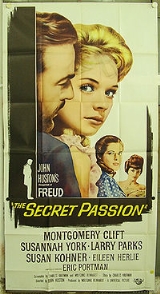
Freud the Secret Passion

Encyclopedia
Freud: The Secret Passion, also known as Freud, is a 1962 American
biographical film
drama
based on the life of Austrian psychoanalyst Sigmund Freud
, directed by John Huston
. Montgomery Clift
stars as Freud. The film was entered into the 13th Berlin International Film Festival
.
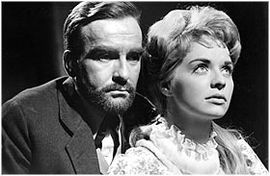 This pseudo-biographical movie depicts Sigmund Freud
's life from 1885 to 1890. At this time, most of his colleagues refuse to treat hysteric
patients, believing their symptoms to be ploys for attention. Freud, however, learns to use hypnosis
to uncover the reasons for the patients' neuroses
. His main patient in the film is a young woman who refused to drink water and is plagued by a recurrent nightmare.
The story compresses the years it took Freud (Montgomery Clift
) to develop his psychoanalytic theories into what seems like a few months. Nearly every neurotic symptom imaginable manifests itself in one patient, Cecily Koertner (Susannah York
). She is sexually repressed, hysterical, and fixated on her father. Freud worked extensively with her, developing one hypothesis after another. Also shown is Freud's home life with his wife Martha (Susan Kohner
) and the use of his own neurosis in developing his theories.
wrote the first synopsis of some 95 typed pages. Huston accepted this, and Sartre went to work on a shooting script. Like the synopsis, it was too long. Sartre was asked to chop this first version, which he did. The result was that the revamped version was longer still. In any case, Sartre and Huston could not get along, so the French philosopher asked for his name to be removed from the credits. However, the film Freud still shows faint signs of Sartre's work on the script.
Marilyn Monroe
nearly got to play the part of one of the more colorfully hysterical patients, Cecily.
While working on The Misfits
, actor Eli Wallach
, knowing that Huston was interested in doing a movie on Freud, had himself dressed as Freud and presented an album of him pictured as such to Huston at his birthday. While grateful, Huston chose to go with Clift.
By the time Clift was making the movie, his destructive lifestyle was affecting his health. Universal sued him for his frequent absences that caused the film to go over budget. The case was later settled out of court with the film's success at the box office.
The movie won numerous awards for screenwriting and directing.
. It garnered Goldsmith his first Oscar nomination, which he lost to fellow rookie composer Maurice Jarre
for Lawrence Of Arabia
who, like Goldsmith, would go on to become one of the film industry's most successful and respected composers. The "Main Title" from Freud was later purchased and reused without consent of Jerry Goldsmith
by director Ridley Scott
for the acid blood scene in the film Alien
(1979), also scored by Goldsmith.
United States
The United States of America is a federal constitutional republic comprising fifty states and a federal district...
biographical film
Biographical film
A biographical film, or biopic , is a film that dramatizes the life of an actual person or people. They differ from films “based on a true story” or “historical films” in that they attempt to comprehensively tell a person’s life story or at least the most historically important years of their...
drama
Drama
Drama is the specific mode of fiction represented in performance. The term comes from a Greek word meaning "action" , which is derived from "to do","to act" . The enactment of drama in theatre, performed by actors on a stage before an audience, presupposes collaborative modes of production and a...
based on the life of Austrian psychoanalyst Sigmund Freud
Sigmund Freud
Sigmund Freud , born Sigismund Schlomo Freud , was an Austrian neurologist who founded the discipline of psychoanalysis...
, directed by John Huston
John Huston
John Marcellus Huston was an American film director, screenwriter and actor. He wrote most of the 37 feature films he directed, many of which are today considered classics: The Maltese Falcon , The Treasure of the Sierra Madre , Key Largo , The Asphalt Jungle , The African Queen , Moulin Rouge...
. Montgomery Clift
Montgomery Clift
Edward Montgomery Clift was an American film and stage actor. The New York Times’ obituary noted his portrayal of "moody, sensitive young men"....
stars as Freud. The film was entered into the 13th Berlin International Film Festival
13th Berlin International Film Festival
The 13th annual Berlin International Film Festival was held from 21 June to 2 July 1963.-Jury:* Wendy Toye * Harry R. Sokal* Fernando Ayala* Jean-Pierre Melville* B. R...
.
Plot
Sigmund Freud
Sigmund Freud , born Sigismund Schlomo Freud , was an Austrian neurologist who founded the discipline of psychoanalysis...
's life from 1885 to 1890. At this time, most of his colleagues refuse to treat hysteric
Histrionic personality disorder
Histrionic personality disorder is defined by the American Psychiatric Association as a personality disorder characterized by a pattern of excessive emotionality and attention-seeking, including an excessive need for approval and inappropriately seductive behavior, usually beginning in early...
patients, believing their symptoms to be ploys for attention. Freud, however, learns to use hypnosis
Hypnosis
Hypnosis is "a trance state characterized by extreme suggestibility, relaxation and heightened imagination."It is a mental state or imaginative role-enactment . It is usually induced by a procedure known as a hypnotic induction, which is commonly composed of a long series of preliminary...
to uncover the reasons for the patients' neuroses
Neurosis
Neurosis is a class of functional mental disorders involving distress but neither delusions nor hallucinations, whereby behavior is not outside socially acceptable norms. It is also known as psychoneurosis or neurotic disorder, and thus those suffering from it are said to be neurotic...
. His main patient in the film is a young woman who refused to drink water and is plagued by a recurrent nightmare.
The story compresses the years it took Freud (Montgomery Clift
Montgomery Clift
Edward Montgomery Clift was an American film and stage actor. The New York Times’ obituary noted his portrayal of "moody, sensitive young men"....
) to develop his psychoanalytic theories into what seems like a few months. Nearly every neurotic symptom imaginable manifests itself in one patient, Cecily Koertner (Susannah York
Susannah York
Susannah York was a British film, stage and television actress. She was awarded a BAFTA as Best Supporting Actress for They Shoot Horses, Don't They? and was nominated for an Oscar and Golden Globe for the same film. She won best actress for Images at the 1972 Cannes Film Festival...
). She is sexually repressed, hysterical, and fixated on her father. Freud worked extensively with her, developing one hypothesis after another. Also shown is Freud's home life with his wife Martha (Susan Kohner
Susan Kohner
Susan Kohner is an American actress.-Early life and career:Born as Susanna Kohner in Los Angeles, Kohner is the daughter of Mexican actress Lupita Tovar and Jewish film producer Paul Kohner who was born in Bohemia part of Austria-Hungary...
) and the use of his own neurosis in developing his theories.
Collaboration of Huston with Sartre
Asked in 1958 to write the script by the director John Huston, Jean-Paul SartreJean-Paul Sartre
Jean-Paul Charles Aymard Sartre was a French existentialist philosopher, playwright, novelist, screenwriter, political activist, biographer, and literary critic. He was one of the leading figures in 20th century French philosophy, particularly Marxism, and was one of the key figures in literary...
wrote the first synopsis of some 95 typed pages. Huston accepted this, and Sartre went to work on a shooting script. Like the synopsis, it was too long. Sartre was asked to chop this first version, which he did. The result was that the revamped version was longer still. In any case, Sartre and Huston could not get along, so the French philosopher asked for his name to be removed from the credits. However, the film Freud still shows faint signs of Sartre's work on the script.
Marilyn Monroe
Marilyn Monroe
Marilyn Monroe was an American actress, singer, model and showgirl who became a major sex symbol, starring in a number of commercially successful motion pictures during the 1950s....
nearly got to play the part of one of the more colorfully hysterical patients, Cecily.
While working on The Misfits
The Misfits (film)
The Misfits is a 1961 American drama film written by Arthur Miller, directed by John Huston, and starring Clark Gable, Marilyn Monroe, Montgomery Clift, Thelma Ritter, and Eli Wallach. It was the final film appearance for both Gable and Monroe...
, actor Eli Wallach
Eli Wallach
Eli Herschel Wallach is an American film, television and stage actor, who gained fame in the late 1950s. For his performance in Baby Doll he won a BAFTA Award for Best Newcomer and a Golden Globe nomination. One of his most famous roles is that of Tuco in The Good, the Bad and the Ugly...
, knowing that Huston was interested in doing a movie on Freud, had himself dressed as Freud and presented an album of him pictured as such to Huston at his birthday. While grateful, Huston chose to go with Clift.
By the time Clift was making the movie, his destructive lifestyle was affecting his health. Universal sued him for his frequent absences that caused the film to go over budget. The case was later settled out of court with the film's success at the box office.
The movie won numerous awards for screenwriting and directing.
Cast
- Montgomery CliftMontgomery CliftEdward Montgomery Clift was an American film and stage actor. The New York Times’ obituary noted his portrayal of "moody, sensitive young men"....
... Sigmund Freud - Susannah YorkSusannah YorkSusannah York was a British film, stage and television actress. She was awarded a BAFTA as Best Supporting Actress for They Shoot Horses, Don't They? and was nominated for an Oscar and Golden Globe for the same film. She won best actress for Images at the 1972 Cannes Film Festival...
... Cecily Koertner - Larry ParksLarry ParksLarry Parks was an American stage and movie actor. He was born Samuel Klausman Lawrence Parks. His career was virtually ended when he admitted to having once been a member of a Communist party cell, which led to his blacklisting by all Hollywood studios.-Background:Parks grew up in Joliet,...
... Dr. Joseph Breuer - Susan KohnerSusan KohnerSusan Kohner is an American actress.-Early life and career:Born as Susanna Kohner in Los Angeles, Kohner is the daughter of Mexican actress Lupita Tovar and Jewish film producer Paul Kohner who was born in Bohemia part of Austria-Hungary...
... Martha Freud - Eileen HerlieEileen HerlieEileen Herlie was a Scottish-American actress.-Life and career:Eileen Herlie was born Eileen Isobel Herlihy to a Catholic father and a Protestant mother in Glasgow, Scotland, and was one of five children. Herlie was trained as a theatre actress. Among her West End London theatre successes were The...
... Frau Ida Koertner - Fernand LedouxFernand LedouxFernand Ledoux was a French film and theatre actor of Belgian origin. He studied with Raphaël Duflos at the CNSAD, and began his career with small roles at the Comédie-Française...
... Dr. Charcot - David McCallumDavid McCallumDavid Keith McCallum, Jr. is a Scottish actor and musician. He is best known for his roles as Illya Kuryakin, a Russian-born secret agent, in the 1960s television series The Man from U.N.C.L.E., as interdimensional operative Steel in Sapphire & Steel, and Dr...
... Carl von Schlossen - Rosalie CrutchleyRosalie CrutchleyRosalie Crutchley was an English actress. Trained at the Royal Academy of Music, Crutchley was best known for her television performances, but had a long and successful career in the theatre and in films, making her stage debut at least as early as 1932 and her screen debut in 1947...
... Frau Freud - David KossoffDavid KossoffDavid Kossoff was a British actor. Following the death of his son Paul, a rock musician, he became an anti-drug campaigner...
... Jacob Freud - Joseph FürstJoseph FurstJoseph Fürst was an Austrian international film and television actor known for his English language roles....
... Herr Jacob Koertner - Alexander Mango ... Babinsky
- Leonard SachsLeonard SachsLeonard Sachs was a British actor.-Early life and career:Sachs was born in South Africa in the town of Roodepoort, Transvaal...
... Brouhardier - Eric PortmanEric PortmanEric Portman was a distinguished English stage and film actor...
... Dr. Theodore Meynert - John HustonJohn HustonJohn Marcellus Huston was an American film director, screenwriter and actor. He wrote most of the 37 feature films he directed, many of which are today considered classics: The Maltese Falcon , The Treasure of the Sierra Madre , Key Largo , The Asphalt Jungle , The African Queen , Moulin Rouge...
... Narrator (voice) - Victor BeaumontVictor BeaumontVictor Beaumont , was an German born film and television actor.As Peter Wolff he appeared in a number of German films and at least one play...
... Dr. Guber - Allan CuthbertsonAllan CuthbertsonAllan Cuthbertson was a naturalised Anglo-Australian actor.-Early life:Born Allan Darling Cuthbertson in Perth, Western Australia, son of Ernest and Isobel Ferguson Cuthbertson, he performed on stage and radio from an early age.During World War II, he served as a Flight Lieutenant with the RAAF...
... Wilkie - Maria PerschyMaria PerschyMaria Perschy was an Austrian actress.Perschy was born in Eisenstadt, Burgenland, Austria and moved to Vienna at the age of 17 to study acting. After completing her education, she moved to Germany for more training, leading to a movie career. Her first major success came with Nasser Asphalt where...
... Magda - Moira RedmondMoira RedmondMoira Redmond was a British actress.She was born in Bognor Regis, England, the daughter of the actress Molly Redmond and her husband who was a stage manager...
... Nora Wimmer
Soundtrack
The mostly dissonant, atonal score to Freud was one of the earliest works by composer Jerry GoldsmithJerry Goldsmith
Jerrald King Goldsmith was an American composer and conductor most known for his work in film and television scoring....
. It garnered Goldsmith his first Oscar nomination, which he lost to fellow rookie composer Maurice Jarre
Maurice Jarre
Maurice-Alexis Jarre was a French composer and conductor.Although he composed several concert works, he is best known for his film scores, and is particularly known for his collaborations with film director David Lean. Jarre composed the scores to all of Lean's films since Lawrence of Arabia...
for Lawrence Of Arabia
Lawrence of Arabia (film)
Lawrence of Arabia is a 1962 British film based on the life of T. E. Lawrence. It was directed by David Lean and produced by Sam Spiegel through his British company, Horizon Pictures, with the screenplay by Robert Bolt and Michael Wilson. The film stars Peter O'Toole in the title role. It is widely...
who, like Goldsmith, would go on to become one of the film industry's most successful and respected composers. The "Main Title" from Freud was later purchased and reused without consent of Jerry Goldsmith
Jerry Goldsmith
Jerrald King Goldsmith was an American composer and conductor most known for his work in film and television scoring....
by director Ridley Scott
Ridley Scott
Sir Ridley Scott is an English film director and producer. His most famous films include The Duellists , Alien , Blade Runner , Legend , Thelma & Louise , G. I...
for the acid blood scene in the film Alien
Alien (film)
Alien is a 1979 science fiction horror film directed by Ridley Scott and starring Tom Skerritt, Sigourney Weaver, Veronica Cartwright, Harry Dean Stanton, John Hurt, Ian Holm and Yaphet Kotto. The film's title refers to its primary antagonist: a highly aggressive extraterrestrial creature which...
(1979), also scored by Goldsmith.