
All Topics  
Free trade debate

 
Free Trade Debate

   Email Print
   Bookmark   Link


Free trade debate


Free trade is one of the most debated topics in economics of the 20th and 21st century . Argument
Argument

* In logic, an Argument is a set of one or more meaningful declarative sentences known as the premises along with another meaningful declarative sentence known as the conclusion....
s over free trade
Free trade

Free trade is a type of trade policy that allows traders to act and transact without coercive interference from government. Thus, the policy permits trading partners mutual gains from trade, with goods and services produced according to the law of comparative advantage....
 can be divided into economic, moral, and socio-political arguments. The academic debate among economists is currently settled in favor of free trade, with a consensus having existed since at least the 1960s, based on theories dating to the 18th century. The debate among the public and politicians continues.

he history of free trade, two types of arguments have been advanced in favor of allowing purchases from abroad, and free trade in the broader sense.
  1. The first set of arguments is essentially economic, that free trade will make society more prosperous.


    Discussion
    Ask a question about 'Free trade debate'
    Start a new discussion about 'Free trade debate'
    Answer questions from other users
    Full Discussion Forum


    Encyclopedia


    Free trade is one of the most debated topics in economics of the 20th and 21st century . Argument
    Argument

    * In logic, an Argument is a set of one or more meaningful declarative sentences known as the premises along with another meaningful declarative sentence known as the conclusion....
    s over free trade
    Free trade

    Free trade is a type of trade policy that allows traders to act and transact without coercive interference from government. Thus, the policy permits trading partners mutual gains from trade, with goods and services produced according to the law of comparative advantage....
     can be divided into economic, moral, and socio-political arguments. The academic debate among economists is currently settled in favor of free trade, with a consensus having existed since at least the 1960s, based on theories dating to the 18th century. The debate among the public and politicians continues.

    Arguments for free trade

    In the history of free trade, two types of arguments have been advanced in favor of allowing purchases from abroad, and free trade in the broader sense.
    1. The first set of arguments is essentially economic, that free trade will make society more prosperous. These are mostly technical arguments from the discipline of economics
      Economics

      File:Ballard Farmers' Market - vegetables.jpgEconomics is the Social sciences that studies the Production theory basics, Distribution , and Consumption of Good and Service ....
      , starting especially with Smith
      Adam Smith

      Adam Smith was a Scotland Ethics and a pioneer of political economy. One of the key figures of the Scottish Enlightenment, Smith is the author of The Theory of Moral Sentiments and The Wealth of Nations....
      's The Wealth of Nations
      The Wealth of Nations

      An Inquiry into the Nature and Causes of the Wealth of Nations is the magnum opus of the Scotland economist Adam Smith. It is a clearly written account of economics at the dawn of the Industrial Revolution, as well as a rhetorical piece written for the generally educated individual of the 18th century - advocating a free market econom...
      , which overthrew the mercantile orthodoxy.
    2. The other set of arguments for free trade could be classified as "moral
      Moral

      A moral is a message conveyed or a lesson to be learned from a story or event. The moral may be left to the hearer, reader or viewer to determine for themselves, or may be explicitly encapsulated in a maxim....
      " arguments listed below
      Free trade debate

      Free trade is one of the most debated topics in economics of the 20th and 21st century . Arguments over free trade can be divided into economic, moral, and socio-political arguments....
      .


    Economic arguments for free trade

    Classical economic
    Classical economics

    Classical economics is widely regarded as the first modern school of history of economic thought. It is the idea that free markets can regulate themselves....
     analysis shows that free trade increases the global level of output
    Production, costs, and pricing

    In microeconomics, industrial organization is the field which describes the behavior of firms in the marketplace with regard to production, pricing, employment and other decisions....
     because free trade permits specialization among countries. Specialization allows nations to devote their scarce resources to the production of the particular goods and services for which that nation has a comparative advantage
    Comparative advantage

    In economics, comparative advantage refers to the ability of a person or a country to produce a particular good at a lower opportunity cost than another person or country....
    . The benefits of specialization, coupled with economies of scale
    Economies of scale

    Economies of scale, in microeconomics, are the cost advantages that a business obtains due to expansion. They are factors that cause a producer?s average cost per unit to fall as output rises....
    , increase the global production possibility frontier
    Production possibility frontier

    In economics, a production-possibility frontier or ?transformation curve? is a graph that shows the different rates of production of two goods that an individual or group can efficiently produce with limited productive resources....
    . An increase in the global production possibility frontier indicates that the absolute quantity of goods and services produced is highest under free trade. Not only are the absolute quantity of goods and services higher, but the particular combination of goods and services actually produced will yield the highest possible utility
    Utility

    In economics, utility is a measure of the relative satisfaction from, or desirability of, consumption of various goods and services. Given this measure, one may speak meaningfully of increasing or decreasing utility, and thereby explain economic behavior in terms of attempts to increase one's utility....
     to global consumers.

    Qualitative arguments
    Free trade policies are often associated with general laissez-faire economic politics and parties, which permit faster growth. Voluntary exchange, by virtue of its voluntary nature, is assumed to be beneficial (ex ante) to the parties involved (why else would they engage in the exchange?). Thus, the restriction of voluntary exchange restricts commerce and ultimately the accumulation of wealth.

    Production possibilities frontiers and indifference curves
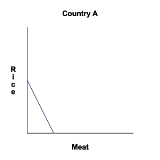
    Free Trade Country A
    Here is the production possibilities frontier for a fictional country, Country A. For simplicity, assume that the country produces only two goods, meat and rice. Because the country has limited resources, the production of an additional unit of rice means some resources must be diverted away from the production of meat. The particular rate of trade-off between meat and rice is not important for this analysis, so it can be ignored.
    Free Trade Country B
    Here is the production possibilities frontier for a second fictional country, Country B. Again; the country can produce only the same two goods, meat and rice. Like before, limited resources mean that the production of an additional unit of rice means some resources must be diverted away from the production of meat. The particular rate of trade-off between meat and rice is not important for this analysis, so it can be ignored. The fact that the two countries have different relative rates of trade-off is important. This difference gives rise to a comparative advantage
    Comparative advantage

    In economics, comparative advantage refers to the ability of a person or a country to produce a particular good at a lower opportunity cost than another person or country....
    , a key concept in economics. Even if one country has an absolute advantage
    Absolute advantage

    In economics, absolute advantage refers to the ability of a particular person or a country to produce a particular good with fewer resources than another person or country....
     in the production of all goods, both nations can benefit from trade due to comparative advantage.
    Free Trade World
    The first two images above assume a state of autarky
    Autarky

    An autarky is an Economics that is Self-sufficiency and does not take part in international trade, or severely limits trade with the outside world....
    , which means no trade occurs between the two countries. If free trade is possible, the green line is the production possibilities frontier for the entire world. The world PPF is made up by combining the two countries' PPFs. Linear
    Linear

    The word linear comes from the Latin word linearis, which means created by lines.In mathematics, a linear map or function f is a function which satisfies the following two properties......
     PPFs will always combine to form a shape with an inflection point
    Inflection point

    In differential calculus, an inflection point, or point of inflection is a point on a curve at which the curvature changes Negative and non-negative numbers....
    , as shown at right.

    Compare the world's production possibilities frontier with each individual nation's. Clearly, the world can produce and consume more when free trade is allowed. To arrive at the world's production possibilities frontier, vector addition must be used. Country A and Country B's meat and rice outputs must be added together for each possible production point.
    Free Trade World Composition
    An intuitive way of arriving at the world's production possibilities frontier is to first assume that each country tries to specialize by producing only one product. In the graph at right, the first units of meat are produced only by country B (red). Once country B is using all its resources to produce meat, then country A (blue) begins shifting resources away from the production of rice and into the production of meat. On the other axis, assume that the first units of rice are always produced by country A. Additional units of rice can only be obtained if country B shifts some resources into rice production.
    Free Trade Country A Eqm
    Returning back to country A, here is the same production possibilities graph, now with indifference curve
    Indifference curve

    In microeconomic theory, an indifference curve is a graph of a function showing different bundles of good , each measured as to quantity, between which a consumer is indifferent. That is, at each point on the curve, the consumer has no preference for one bundle over another....
    s added in. Indifference curves are a measure of preference
    Preference

    Preference is a concept, used in the social sciences, particularly economics. It assumes a real or imagined "choice" between alternatives and the possibility of rank ordering of these alternatives, based on happiness, satisfaction, gratification, enjoyment, utility they provide....
     and utility
    Utility

    In economics, utility is a measure of the relative satisfaction from, or desirability of, consumption of various goods and services. Given this measure, one may speak meaningfully of increasing or decreasing utility, and thereby explain economic behavior in terms of attempts to increase one's utility....
    . Interplay between the country's preferences and production result in the actual combination of goods produced and consumed. Remember, this is the state of Country A under autarky.
    Free Trade Country B Eqm
    Here is the same view of Country B's economy. Again, the actual combination of goods produced and consumed is dependent on the country's productive abilities and its citizens' preferences. Thus, it is not surprising that the combination of goods consumed in Country B differs from that in Country A.
    Free Trade World Eqm
    Graphical information of the two countries can be combined in a single graph, as shown here.
    Free Trade World Eqm Comp
    When the two countries' autarkic consumptions are added, the total quantity of each good produced/consumed is less than the world's PPF under free trade. This indicates that by trading, the absolute quantity of goods available for consumption is higher than the quantity available under autarky.


    Reciprocal free trade is in exporters’ interests
    An early lobbying effort on behalf of free trade was made by the businessmen of the Anti-Corn Law League
    Anti-Corn Law League

    The Anti-Corn Law League was in effect the resumption of the Anti-Corn Law Association, which had been created in London in 1836 but did not obtain widespread popularity....
    . Some of these gentlemen owned textile
    Textile

    A textile is a flexible material consisting of a network of natural or artificial fibres often referred to as thread or yarn. Yarn is produced by Spinning raw wool fibres, linen, cotton, or other material on a spinning wheel to produce long strands known as yarn....
     factories
    Factory

    A factory or manufacturing plant is an industry building where workers manufacturing Good or supervise machines Process Manufacturing one product into another....
    , and believed that repeal of the Corn Law import-ban would allow 1830s Britain
    United Kingdom of Great Britain and Ireland

    The United Kingdom of Great Britain and Ireland was the formal name and the state form of the United Kingdom from 1 January 1801 until 12 April 1927....
     to sell cotton
    Cotton

    Cotton is a soft, staple fiber that grows in a form known as a boll around the seeds of the cotton plant a shrub native to tropical and subtropical regions around the world, including the Americas, India and Africa....
     clothing to wheat-exporting nations. David Ricardo
    David Ricardo

    David Ricardo was a political economy, often credited with systematizing economics, and was one of the most influential of the classical economicss, along with Thomas Malthus and Adam Smith....
     intervened on the anti-corn law side developing his theory of comparative advantage
    Comparative advantage

    In economics, comparative advantage refers to the ability of a person or a country to produce a particular good at a lower opportunity cost than another person or country....
     in the process.

    Although this argument is rooted in Mercantilism
    Mercantilism

    Mercantilism is an economic theory that holds that the prosperity of a nation is dependent upon its supply of Capital , and that the world economy of international trade is "unchangeable"....
     and protectionism by domestic producers, it amounts to a voice in favour of free trade. See also: Reciprocal Trade Agreements Act.

    In 1950 Jacob Viner
    Jacob Viner

    Jacob Viner is best known for his enduring economic modelling of the wiktionary:firm, including the long- and short-run cost curves used by economists to this day....
     showed that a trading bloc mutually lowering tariffs would produce gains not merely on the demand side but also on the supply
    Supply

    supply is the amount of good or services a business providesSupply may refer to:*Supply and demand theory*Confidence and supply#Supply for a Government budget, in the Westminster System...
     side. This was called trade creation
    Trade creation

    Trade creation is an economic term related to international economics in which trade is created by the formation of a customs union....
    , the benefits to the supply side as a whole accrue as resources are reallocated towards firms producing at the highest comparative advantage (among the partners) in each country.

    Moral arguments in favor of free trade

    The 18th and 19th century intellectuals who backed free trade rarely did so under the rubric of increasing material wealth. In many cases this was given as the least important reason for free trade. Rather, they argued that international society would be improved by increased commerce. Some of these, and later, sociopolitical arguments are listed here.

    Free trade is a right
    The libertarian position argues that any trade restraint is immoral a priori
    A priori and a posteriori (philosophy)

    The terms "a priori" and "a posteriori" are used in philosophy to distinguish two types of knowledge, justifications or arguments....
    ,
    since restricting the rights of sovereign consumers
    Consumer sovereignty

    Consumer sovereignty is a term which is used in economics to refer to the rule or sovereignty of purchasers in markets as to production of Good ....
     to purchase foreign goods is outside the scope of legitimate government. This is in the tradition of the anti-Corn Law radicals, like Richard Cobden
    Richard Cobden

    Richard Cobden was a United Kingdom of Great Britain and Ireland manufacturing and Radicals and Liberal Party statesman, associated with John Bright in the formation of the Anti-Corn Law League as well as with the Cobden-Chevalier Treaty....
    , who concluded their 1838 parliamentary petition with an appeal to "negative liberty
    Negative liberty

    The concept of negative liberty refers to freedom from interference by other people. According to Thomas Hobbes, "a free man is he that in those things which by his strength and wit he is able to do is not hindered to do what he hath the will to do." ...
    ":

    Holding one of the principles of eternal justice to be inalienable right of every man freely to exchange the result of his labour for the productions of other people, and maintaining the practice of protecting one part of the community at the expense of all other classes to be unsound and unjustifiable, your petitioners earnestly implore your honourable House to repeal all laws relating to the importation of foreign corn and other foreign articles of subsistence, and to carry out to the fullest extent, both as affects agriculture and manufactures, the true and peaceful principles of Free Trade, by removing all existing obstacles to the unrestricted employment of industry and capital.


    Increasing commerce makes war less likely
    War is made less likely as a function of economic interdependence, a key feature of Liberalism--the leading theory within the study of International Relations. Liberalism suggest that states who share strong mutually-beneficial trading relationships will be far less likely to wage war with one another. This is because Liberalism, unlike realism and other theories within IR, does not stipulate that states are unitary actors. Meaning the state does not function as would a single human. Quite to the contrary, states are comprised of multitude of competing actors within, and international institutions, such as trade agreements, WTO, etc. The competing actors are constantly joking for the "ear" if you will, of the state. Political resources being a function of wealth, the result is that states within the liberal system, are greatly in influenced by wealthy, and political able actors to not screw anything up with a way. I would take care in attempting to apply the economics of the past to fit the phenomena we have now as a result of information technology. There are few countries that can claim self-sufficiency.

    Qualitative analysis suggests that free trade encourages economic interdependence between countries, reducing the likelihood of war
    War

    ...
    . However, the belief that free trade would reduce war was hypothetical rather than empirical (at least until the 1950s). Twenty-two years after Ricardo
    David Ricardo

    David Ricardo was a political economy, often credited with systematizing economics, and was one of the most influential of the classical economicss, along with Thomas Malthus and Adam Smith....
     advanced his theories of comparative advantage
    Comparative advantage

    In economics, comparative advantage refers to the ability of a person or a country to produce a particular good at a lower opportunity cost than another person or country....
     they were used as justification by the British to start the Opium wars
    Opium Wars

    The Opium Wars , also known as the Anglo-Chinese Wars, lasted from 1839 to 1842 and 1856 to 1860, the climax of a trade dispute between China under the Qing Dynasty and the British Empire....
    . Also, it is hard to know when the occurrence of free trade has prevented the outbreak of war, but easy to know when it hasn't; critics of free trade sometimes cite World War I
    World War I

    World War I, or the First World War , was a global military conflict which involved the Great powers, organized into two opposing military alliances: the Allies of World War I and the Central Powers....
     as an instance where developed, industrialized countries with reasonably extensive trade links abruptly broke off those trade links and entered into a particularly destructive war; it must be noted, however, that most industrialising nations, with the notable exception of Britain, raised trade barriers and tariffs from the late 19th century onwards. It is an open question whether the First World War, its causes, and the economic environment that preceded it are sufficiently similar to the modern globalized economy to draw parallels between 1914 and the present.

    An example exists in countries that have a McDonald's
    McDonald's

    McDonald's Corporation is the world's largest chain of fast food restaurants, serving nearly 58 million customers daily. McDonald's primarily sells hamburgers, cheeseburgers, chicken products, French fries, breakfast items, soft drinks, milkshakes, and desserts....
     franchise. Of the many countries with franchises, the only armed conflicts to have taken place between these countries
    McDonald's

    McDonald's Corporation is the world's largest chain of fast food restaurants, serving nearly 58 million customers daily. McDonald's primarily sells hamburgers, cheeseburgers, chicken products, French fries, breakfast items, soft drinks, milkshakes, and desserts....
     have been the United States invasion of Panama
    United States invasion of Panama

    The United States invasion of Panama, codenamed Operation Just Cause, was the invasion of Panama by the United States in December 1989, during the administration of U.S....
    , the NATO Bombing Campaign during the Kosovo War
    Kosovo War

    Kosovo War occurred after the Rambouillet Agreement failed in February 1999. The term Kosovo War or Kosovo Conflict is used to describe two sequential and at times parallel armed conflicts in Kosovo:...
    , and the 2006 Lebanon War. According to Thomas Friedman this is because intensifying of global economic integration, symbolized by a McDonald's network, increases the costs of war for both victor and defeated to a greater degree than ever before.

    The process of free trade, especially in post industrial economies, effectively eliminates the existence of unequal resource distribution. Japan imports much of its food source, and in return exports mainly the produce of its extensive and high-tech workforce. Continuing the example, Japan would not likely be able to sustain the population it does today without one of three possibilities: an unbelievable increase in technology to allow for better use of land resources, international trade, or seizing arable land from another state. Trade also allows for better quality produce and competitiveness between nations, effectively raising the living standards of those nations. It would be illogical in such a case to jeopardise those living standards for a war. Finally, increased trade leads to increased bilateral communication between nations and as such, wars not focused on resources or land already cured by trade, including ideological arguments become less evident.

    After the Second World War
    World War II

    World War II, or the Second World War , was a global military conflict which involved a Participants in World War II, including all of the great powers, organised into two opposing military alliances: the Allies of World War II and the Axis powers....
     many liberals said that the war's ultimate cause had been the restrictive trade practices of Nazi Germany
    Nazi Germany

    Nazi Germany and the Third Reich are the colloquial English names for Germany under the regime of Adolf Hitler and the Nazi Party , which established a Totalitarianism dictatorship that existed from 1933 to 1945....
     and the British Empire
    British Empire

    The British Empire comprised the dominions, Crown colony, protectorates, League of Nations mandate, and other Dependent territory ruled or administered by the United Kingdom , that had originated with the overseas colonies and trading posts established by England in the late 16th and early 17th centuries....
    . They thought that free trade would increase the likelihood of a lasting peace. Cordell Hull
    Cordell Hull

    Cordell Hull was an Politics of the United States from the U.S. state of Tennessee. He is best-known as the longest-serving United States Secretary of State, holding the position for 11 years in the administration of President Franklin Delano Roosevelt....
    , the U.S. secretary of state until 1944, believed this
    Bretton Woods system

    The Bretton Woods system of money management established the rules for commerce and finance relations among the world's major developed country in the mid 20th century....
    , and argued that as trade barrier
    Trade barrier

    A trade barrier is a general term that describes any government policy or regulation that restricts international trade. The barriers can take many forms, including the following terms that include many restrictions in international trade within multiple countries that import and export any items of trade....
    s dovetail with war, so free trade does with peace. The post war consensus expressed at Bretton Woods
    Bretton Woods system

    The Bretton Woods system of money management established the rules for commerce and finance relations among the world's major developed country in the mid 20th century....
     was that government coordination was necessary to prevent trade wars and competitive devaluations, to ensure free trade and peace.

    Protectionism sullies the cause of patriotism
    Adam Smith
    Adam Smith

    Adam Smith was a Scotland Ethics and a pioneer of political economy. One of the key figures of the Scottish Enlightenment, Smith is the author of The Theory of Moral Sentiments and The Wealth of Nations....
     thought that protectionism against free trade was a scam on the public on behalf of producers, carried out in the name of nationalism
    Nationalism

    Nationalism refers to an ideology, a feeling, a form of culture, or a social movement that focuses on the nation. While there is significant debate over the historical origins of nations, nearly all Expert accept that nationalism, at least as an ideology and social movement, is a Modernity phenomenon originating in Europe....
    . Even if overall economic interests had not been harmed by tariffs, he was opposed to them on the grounds that patriotism
    Patriotism

    Patriotism is commonly defined as love of and/or devotion to one's country. The word comes from the Latin language, patria, and Greek language patritha. However, patriotism has had different meanings over time, and its meaning is highly dependent upon context, geography and philosophy....
     should not be perverted by scoundrels to enrich themselves.

    Tariffs are also internally divisive. See also: Nullification crisis
    Nullification Crisis

    The Nullification Crisis was a sectionalism crisis during the presidency of Andrew Jackson created by the Ordinance of Nullification, an attempt by the state of South Carolina to Nullification a federal law passed by the United States Congress....
    .

    Free trade reduces poverty
    the "moral" and "economic" arguments are those campaigners who say that increased trade is the best way to relieve extreme poverty throughout the world. Opposing free trade, they argue, is tantamount to supporting economic injustice (as is displayed in the "The Economist
    The Economist

    The Economist is an English-language weekly news and international relations publication owned by The Economist Newspaper Ltd. and edited in London....
    " magazine for example).

    The thrust of this point is that economic and moral issues cannot properly be separated, and that any other particular socioeconomic problems can be combated most effectively through rising living standards.

    Bjørn Lomborg
    Bjørn Lomborg

    Bj?rn Lomborg is a Denmark author, academic, and environmental writer. He is an adjunct professor at the Copenhagen Business School, director of the Copenhagen Consensus Centre and a former director of the Environmental Assessment Institute in Copenhagen....
    's Copenhagen Consensus
    Copenhagen Consensus

    Copenhagen Consensus is a project that seeks to establish priorities for advancing global welfare using methodologies based on the theory of welfare economics....
     on international development
    International development

    International development is a concept that lacks a universally accepted definition, but it is most used in a holistic and multi-disciplinary context of human development - the development of livelihoods and greater quality of life for humans....
     challenges ranked trade liberalization as third on the list of development priorities; the experts judged that modest cost
    Cost

    In economics, business, retail, and accounting, a cost is the value of money that has been used up to produce something, and hence is not available for use anymore....
    s could have large benefits for developing nations. (They ranked free trade as a "Very Good" opportunity fighting misery along with cheap measures against HIV
    HIV

    Human immunodeficiency virus is a lentivirus that can lead to AIDS , a condition in humans in which the immune system begins to fail, leading to life-threatening opportunistic infections....
     infection, micronutrient
    Micronutrient

    Micronutrients are nutrients needed for life in small quantities. The Microminerals or trace elements include at least iron, cobalt, chromium, copper, iodine, manganese, selenium, zinc and molybdenum....
     distribution, and anti-malaria
    Malaria

    Malaria is a Vector -borne infectious disease caused by protozoan parasites. It is widespread in Tropics and subtropical regions, including parts of the Americas, Asia, and Africa....
    l programs.) The conference was of the opinion that reducing subsidies
    Subsidy

    In economics, a subsidy is a form of financial assistance paid to a business or economic sector. A subsidy can be used to support businesses that might otherwise fail, or to encourage activities that would otherwise not take place....
     and tariff
    Tariff

    A tariff is a tax imposed on goods when they are moved across a political boundary. They are usually associated with protectionism, the economic policy of restraining trade between nations....
    s would improve the well-being of the global poor more than any agricultural, political, or environment
    Natural environment

    The natural environment, commonly referred to simply as the environment, is a term that encompasses all life and non-living things occurring nature on Earth or some region thereof....
    al program. They considered that the free trade in labour would also be a significant (although less important) move against poverty, especially if skilled worker
    Skilled worker

    A skilled worker is any Labour who has some special skill , knowledge, or Expertise in his employment. A skilled worker may have attended a college, university or Vocational education....
     migration were permitted.

    Sociopolitical arguments in favor of free trade


    Free trade enriches cultures
    Concepts such as cultural conservatism
    Cultural conservatism

    Cultural conservatism is conservatism with respect to culture. This term is increasingly used in political debate, but is rather ill-defined. It is often confused with social conservatism, which is a school of thought that may overlap to a degree as far as its adherents but is nonetheless a quite distinct subset of the former....
     and nationalism
    Nationalism

    Nationalism refers to an ideology, a feeling, a form of culture, or a social movement that focuses on the nation. While there is significant debate over the historical origins of nations, nearly all Expert accept that nationalism, at least as an ideology and social movement, is a Modernity phenomenon originating in Europe....
     are premised on the notion that a given culture is both valuable and endangered. To the extent that local culture is valued, products and services reflective of that culture are desired and thus available among the many alternatives. According to this argument, all major cultures have evolved through hybridization with external influences throughout history. Attempts to subvert this process by erecting trade and investment barriers deprive cultures of the positive influences that keep it from stagnating. This argument focuses on the fact that every culture evolves and that free trade supports cultural exchange, as cultural products can be traded freely.

    Free trade enhances national security
    Free trade can enhance national security, on the condition that a nation does not trade with its enemies. Free trade increases a nation's relative power vis-à-vis its rivals, because free trade gives optimal economic advantages, which translates into more economic and military power and more technological innovation. A clear example is the US, which enjoys to a certain degree free trade. Without this quite liberal trade the military burden (i.e. its military expenditures of about $500 billion) would weigh heavy on its economy. The closed-economy Soviet Union would have had to spend 15-20% of its GDP if it wanted to equal the US (which now spends almost 4% of its GDP). According to most economists heavy military expenditures slow the economic growth of an economy. The higher the expenditures, the higher the disadvantages. Once the burden becomes too high, an economy recesses, forcing the military expenditures to be decreased. According to many political scientists this was the case in the 1980s in the Soviet Union.

    When free-exchange is not free trade

    The World Trade Organization
    World Trade Organization

    The World Trade Organization is an international organization designed to supervise and Free trade international trade. The WTO came into being on 1 January 1995, and is the successor to the General Agreement on Tariffs and Trade , which was created in 1947, and continued to operate for almost five decades as a de facto international org...
     was created to open up markets and promote international trade based on the 'Free Trade' paradigm. The WTO creates and monitors agreements to reduce trade barriers, and arbitrates in disputes over foreign market access, and violations of these agreements. Its definition of 'Free Trade' is trade
    on a level playing field
    Level playing field

    A level playing field is a concept about fairness, not that each player has an equal chance to succeed, but that they all play by the same set of rules....
    , so that the unlimited exchange of goods between countries is not necessarily 'Free'. If a country with aircraft
    Aircraft

    An aircraft is a vehicle which is able to flight by being supported by the air, or in general, the atmosphere, of a planet. Examples include balloons, airplanes and helicopters....
     producers, say, subsidizes corporate research and development (R&D) or enacts regulations requiring the industry to procure its aircraft part suppliers be domestic producers, then the WTO considers this a violation of Free Trade, even when the barriers to trade are not imposed at the national borders in an import-export transaction step (like a tariff
    Tariff

    A tariff is a tax imposed on goods when they are moved across a political boundary. They are usually associated with protectionism, the economic policy of restraining trade between nations....
    ).

    Totally free trade

    Some economists (especially Libertarians) criticize the WTO
    World Trade Organization

    The World Trade Organization is an international organization designed to supervise and Free trade international trade. The WTO came into being on 1 January 1995, and is the successor to the General Agreement on Tariffs and Trade , which was created in 1947, and continued to operate for almost five decades as a de facto international org...
    ’s definition of "free trade" as too narrow. They argue that a foreign governmental producer-subsidy
    Subsidy

    In economics, a subsidy is a form of financial assistance paid to a business or economic sector. A subsidy can be used to support businesses that might otherwise fail, or to encourage activities that would otherwise not take place....
     is another form of "comparative advantage"' and should not be used as a reason to impose domestic barriers on the purchase of overseas goods.

    These economists argue that (since the surplus benefit to domestic consumers outweighs the surplus loss of domestic producers) the lower price of foreign subsidized goods is a net positive (as in the standard Ricardian argument) and the source of the "comparative advantage" is irrelevant. Therefore, any import
    Import

    In economics, an import is any good or service brought into one country from another country in a legitimate fashion, typically for use in trade.It is a good that is brought in from another country for sale....
     restriction (even on "dumped goods
    Dumping

    Dumping may refer to:In economics*Dumping , in international trade, the pricing of a product below its cost of production*Social dumping, using transitory labour to save costs...
    ") makes the domestic society as a whole worse off than it would be with unlimited imports.

    This "abolitionist" position has had little governmental support in the developed world, due to the following considerations:
    • Producer lobbyists and job-protectionists are more organized than consumer advocates.
    • The "artificial" handicap of a foreign subsidy seems much less "just" to local production than advantages deriving from geography, natural resources, or native skill. Electorates often prefer "fairplay
      Inequity aversion

      Inequity aversion is the preference for fairness and resistance to inequitable outcomes. The social sciences that study inequity aversion sociology, economics, psychology, and anthropology....
      " to Utilitarian considerations.
    • Despite accepting that a country would be better off without tariffs than with them, some game theory
      Game theory

      Game theory is a branch of applied mathematics that is used in the social sciences , biology, engineering, political science, international relations, computer science , and philosophy....
       models consider that a long-term strategy
      Strategy

      A strategy is a plan of action designed to achieve a particular Objective .Strategy is different from Tactic . In military terms, tactics is concerned with the conduct of an engagement while strategy is concerned with how different engagements are linked....
       superior to immediately dropping all tariffs is to negotiate progressively lower barriers bilaterally so as to pry open foreign markets to domestic producers of goods, benefiting both domestic consumers
      and domestic producers. (The justification for tariffs is not important; tariffs only exist in order to be relinquished.)
    • If trade barriers are already low, the threat of a "trade war
      Trade war

      A trade war refers to two or more nations raising or creating tariffs or other trade barriers on each other in retaliation for other trade barriers....
      " of tit-for-tat tariff increases may reduce the temptation for either partner in bilateral trade to raise import barriers.
    • It would tend to decrease the political power and revenue flowing to government bureaucrats.


    Criticisms of free trade

    Us Korea Fta Protest 07
    The official U.S.
    United States

    The United States of America is a Federal government constitutional republic comprising U.S. state and a federal district. The country is situated mostly in central North America, where its Contiguous United States and Washington, D.C., the Capital districts and territories, lie between the Pacific Ocean and Atlantic Oceans, Borders of the U...
     interpretation of free trade is opposed to the Vietnam
    Vietnam

    Vietnam , officially the Socialist Republic of Vietnam , is the easternmost country on the Indochina Peninsula in Southeast Asia. It is bordered by People's Republic of China to the north, Laos to the northwest, Cambodia to the southwest, and the South China Sea to the east....
    ese interpretation, but both governments claim to be in favour of free trade. Similarly, advocates of fair trade
    Fair trade

    Fair trade is an organized social movement and market-based approach to empowering developing country producers and promoting sustainability. The movement advocates the payment of a fair price as well as social and environmental standards in areas related to the production of a wide variety of goods....
     criticize free trade as unjust, although their criticisms tend to be directed at neomercantile
    Neomercantilism

    Neomercantilism is a term used to describe a policy regime which encourages exports, discourages imports, controls capital movement and centralizes currency decisions in the hands of a central government....
     protectionist
    Protectionism

    Protectionism is the economic policy of restraining trade between nations, through methods such as tariffs on imported goods, restrictive import quota, and a variety of other restrictive government regulations designed to discourage imports, and prevent foreign take-over of local markets and companies....
     policies of the First World rather than the theory of free trade itself.

    Economic arguments against free trade criticize the assumptions or conclusions of economic theories. Sociopolitical arguments against free trade cite social and political effects that economic arguments do not capture
    Externality

    In economics, an externality or spillover is a positive or negative impact on a party not directly involved in an economic transaction. In such a case, prices do not reflect the full costs or benefits in production or consumption of a product or service....
    , such as political stability, cultural diversity, and national security.

    Economic arguments against free trade


    Free trade in raw materials retrogrades development
    The argument that a country could get 'locked in' to serving the needs of the world market in raw materials, and therefore not develop industrially was first advanced by Friedrich List
    Friedrich List

    Friedrich List was a leading 19th Century Germany and American economist who developed the "National System" or what some would call today the National System of Innovation....
     in 1841, and received empirical support in the 20th century. It was discovered that African and Arab
    Arab

    An Arab is a person who Identity as such on linguistic or cultural grounds. The plural form, Arabs , refers to the Ethnocultural group at large....
     nations rich in natural resources (e.g. diamond
    Diamond

    In mineralogy, diamond is the Allotropes of carbon where the carbon atoms are arranged in an isometric-hexoctahedral crystal lattice. After graphite, diamond is the second most stable form of carbon....
    s and oil
    Oil

    An oil is a chemical substance that is in a viscosity liquid state at room temperature or slightly warmer, and is both hydrophobic and lipophilic ....
    ) developed
    less rapidly than those nations without such 'bounty'. This is also a sociopolitical argument against free trade, because it is said that:
    1. The regimes exporting such valuable commodities to the west tended to be autocratic, and remain in unpopular power because of the massive payment streams from export
      Export

      Export goods or services are provided to foreign consumers by domestic Production theory basics. It is a good that is sent to another country for sale....
      s that flow to the state
      State

      A state is a political Social contract with effective sovereignty over a geographic area and representing a population. These may be nation states, State or multinational states....
       either because of state control of the means of production or increased tax revenue. Proponents of free trade would observe that this is not actually free trade, but rather a form of mercantilism
      Mercantilism

      Mercantilism is an economic theory that holds that the prosperity of a nation is dependent upon its supply of Capital , and that the world economy of international trade is "unchangeable"....
      .
    2. The reason that civil wars and violence are correlated with the discovery of mineral wealth in the developing world is the world market for the commodities. This is one area of free trade which has few supporters, and conflict diamond
      Conflict diamond

      In relation to diamond trading, blood diamond refers to a diamond mined in a war zone and sold to finance an insurgency, invading army's war efforts, or a warlord's activity, usually in Africa....
      s cannot be openly imported into any country.


    It was also discovered that developed nations uncovering natural resources could suffer as a result of free trade, and for similar reasons. The massive capital influx to the Netherlands
    Netherlands

    The Netherlands is a country that is part of the Kingdom of the Netherlands. It is a parliamentary democratic constitutional monarchy. The Netherlands is located in North-West Europe, and bordered by the North Sea to the north and west, Belgium to the south, and Germany to the east....
     after it started exporting oil increased prices in the Dutch disease
    Dutch disease

    Dutch disease is an Economics concept that tries to explain the apparent relationship between the exploitation of natural resources and a decline in the Secondary sector of industry combined with moral fallout....
    .

    International trade requires more resources to distribute
    Delivering food produced on the other side of the world to a supermarket
    Supermarket

    A supermarket is a self-service Retailing#Retail types offering a wide variety of food and household merchandise, organized into departments....
     has an environmental
    Natural environment

    The natural environment, commonly referred to simply as the environment, is a term that encompasses all life and non-living things occurring nature on Earth or some region thereof....
     impact because it requires the use of fossil fuel
    Fossil fuel

    Fossil fuels or mineral fuels are fossil source fuels, that is, carbon or hydrocarbons found in the earth?s Crust .Fossil fuel range from volatile materials with low carbon:hydrogen ratios like methane, to liquid petroleum to nonvolatile materials composed of almost pure carbon, like anthracite coal....
     in delivery from overseas, as compared to local delivery. However, this critique is dependent upon the productivity of local markets relative to that of foreign markets. It further falsely presumes that more energy is expended in transporting goods internationally than it is domestically or within a continental trade block. Intercontinental movement of goods by sea, using regional ports and distribution infrastructure, is often far less expensive and less fuel intensive than moving goods through complex land distribution systems in a domestic market. A foreign market's greater productivity may also offset the fuel expended for delivery. Conversely, local markets may use natural resources so inefficiently that importing goods constitutes a more energy-efficient alternative. However, the lower prices achieved therein may beget more consumption, a result not necessarily favored by environmentalists. In a perfectly efficient market, the costs of the fossil fuels would include the externalities associated with their consumption. Thus the full impact of their transportation costs would be reflected in the market price of the good.

    Deep Green
    Greens

    Greens may refer to:* Leaf vegetables such as collard greens, mustard greens, spring greens, winter greens, spinach, etc.* Green politics * Green party -- with a list and description and links for the Green parties in different countries....
     thinkers say that Free Trade claims to lead to the "full employment of resources", and strongly oppose Free Trade in the hope of discouraging the immediate depletion of the earth’s resources.

    Sheltering young industries may pay off later

    New Trade theorists
    New Trade Theory

    New Trade Theory is the economic critique of international free trade from the perspective of increasing returns to scale and the network effect....
     challenge the assumption of diminishing returns to scale, and some argue that using protectionist measures to build up a huge industrial base in certain industries will then allow those sectors to dominate the world market. Less quantitative forms of the infant industry argument
    Infant industry argument

    The infant industry argument is an economic reason for protectionism. The crux of the argument is that nascent industries often do not have the economies of scale that their older competitors from other countries may have, and thus need to be protected until they can attain similar economies of scale....
     against totally free trade have been advanced by trade theorists since at least 1848.

    This type of protectionism often leads to immature industries which are incapable of braving international competition. Their inefficiency leads to deadweight loss, and domestic consumers are made worse off with higher prices for lower quality goods. Lobbying power acquired by the industries can prevent the tariffs ever being removed.

    Free trade favors developed nations in certain areas
    Some services exported by developed nations are intangibles, such as medicinal formulae, trademarks, software, and entertainment. The value of this intellectual property is derived from legal protection against unauthorized reproduction. Some advocates of the poor claim that the reason IP-rights are strongly protected in International trade
    Free trade

    Free trade is a type of trade policy that allows traders to act and transact without coercive interference from government. Thus, the policy permits trading partners mutual gains from trade, with goods and services produced according to the law of comparative advantage....
     is the power developed nations have to protect the interests of intellectual property owners during trade negotiations. WTO-signatory nations renounce the right to produce generic copies of life-saving drugs, the only affordable treatment in developing nations.

    Influence of foreign firms
    Within developing countries, the local populace often stages protests against multinational corporations. Protesters insist that once allowed free rein the corporations will use their superior resources and experience to sway the political establishment of a country in favor of excessive concessions (tax holidays, underpaying for property, etc.) and try to influence the political system in order to fulfill corporate interests, which may or may not be shared by the citizenry. The concessions sought by these multinational corporations in turn collide with the free trade idea that subsidies should not be used to prop up corporations - in other words, subsidizing local corporations invites accusations of Protectionism by free trade proponents, while concessions to foreign corporations are portrayed as mere rational incentives.

    Free trade benefits only the wealthy within countries
    Some argue the following:

    • The wealthy own more capital, which increases in value as companies are able to produce at the lowest cost in the world.
    • As the world's markets merge into a single global market the number of market-leading companies worldwide drops, with takeover
      Takeover

      In business, a takeover is the purchase of one company by another . In the UK, the term refers to the acquisition of a public company whose shares are listed on a stock exchange, in contrast to the mergers and acquisitions of a private company....
      s of smaller local corporations by larger multinational corporations. This process concentrates wealth in fewer corporations.
    • Free trade replaces low-skilled jobs often done by the poor easier than high-skilled jobs. This implication of the Stolper-Samuelson theorem
      Stolper-Samuelson theorem

      The Stolper-Samuelson theorem is a basic theorem in trade theory. It describes a relation between the relative prices of output goods and relative factor rewards, specifically, real wage and real returns to capital....
       is challenged on the basis that technology makes offshoring
      Offshoring

      Offshoring describes the relocation by a company of a business process from one country to another -- typically an operational process, such as manufacturing, or supporting processes, such as accounting....
       high value-added work feasible and more profitable than moving low-skilled jobs.
    According to Ravi Batra
    Ravi Batra

    Raveendra N. Batra is a United States economics and professor at Southern Methodist University in Dallas, Texas. He is best known for his best selling books The Great Depression of 1990 and Surviving the Great Depression of 1990....
    's book,
    The Myth of Free Trade, open trade in the US has resulted in replacement of manufacturing jobs for service jobs, which pay less on average. The product trade deficit results in more investment money flowing into the US as a trade-off. This investment money mostly ends up with wealthy investors and owners; and "trickle down" is not sufficient to compensate for the loss of manufacturing jobs and wagers. According to Batra's research aut university rules, even though free trade may increase GNP, the increases do not flow to rank-and-file workers.

    Free trade increases offshoring
    Free trade allows companies the possibility of outsourcing
    Outsourcing

    Outsourcing is subcontracting a process, such as product design or manufacturing, to a third-party company. The decision to outsource is often made in the interest of lowering firm or making better use of time and energy costs, redirecting or conserving energy directed at the core competence of a particular business, or to make more efficient...
     the production of goods for domestic sale. Environmental and labor standards imposed upon these companies can be less in foreign production. Labor and environmental advocates argue that free trade thereby creates conditions that allow companies to circumvent domestic regulations, by producing elsewhere. As free trade increases, the balance of power shifts in favour of companies and away from governments. This is considered to pose a threat to democratic self-determination by anti-globalizers
    Anti-globalization

    "Anti-globalization" is a term that encompasses a number of related ideas. What is shared is that participants stand in opposition to the unregulated political power of large, multi-national corporations, and the powers exercised through trade agreements....
     and authoritarian control by totalitarian states. Free trade supporters argue that all countries have the right to opt out of the world market through isolationism
    Isolationism

    Isolationism is a foreign policy which combines a non-interventionism military policy and a political policy of economic nationalism . In other words, it asserts both of the following:...
     and that companies are fictional persons who are taxed without representation and that the balance of power should shift away from the governments that exploit them. It has also been argued that free trade hurts developed nations because it causes jobs from those nations to move to other countries, and accelerates the "race to the bottom
    Race to the bottom

    A race to the bottom usually refers to people being prepared to settle for "good enough" when they ought to be striving for best. If I can save money by settling for good enough, then a competitor will try to save more, thus lowering their standard below mine....
    ". As well as reducing rich-country GDP
    Gross domestic product

    File:GDP nominal per capita world map IMF 2008.pngThe gross domestic product or gross domestic income is one of the measures of national income and output for a given country's economy....
     through lost jobs, competitive pressures will undermine democracy
    Democracy

    Democracy is a form of government in which power is held directly or indirectly by citizens under a free electoral system. It is derived from the Greek language d?????at?a , "popular government" which was coined from d???? , "people" and ???t?? , "rule, strength" in the middle of the 5th-4th century BC to denote the political syst...
     by creating pressures to lower wage demands, and protections like environmental and safety standards. The "race to the bottom" is blamed on international competition to attract traded-goods production, which, with Free Trade, can be sited anywhere.

    Capital mobility and comparative advantage
    Some descriptions of comparative advantage rest on a necessary condition of capital immobility. If financial or labor resources can move between countries, then comparative advantage erodes, and absolute advantage dominates. For instance, the Heckscher-Ohlin model
    Heckscher-Ohlin model

    The Heckscher-Ohlin model is a general equilibrium mathematical model of International economics, developed by Eli Heckscher and Bertil Ohlin at the Stockholm School of Economics....
     derives comparative advantage from differing relative abundances of capital and labour between countries. Capital mobility and the competitive drive for the highest return on investment would give all countries identical relative abundances for new investment, eliminating comparative advantage and trade.

    Other conceptions of comparative advantage are sound in all instances where the factors of production not homogenous between the parties notwithstanding mobility factors.

    Given the liberalization of capital flows under free trade agreements of the 1990s, the condition of capital immobility no longer holds. David Korten
    David Korten

    Dr. David C. Korten is an author and a leader in the global resistance against corporate globalization. He is probably best known as the author of the book When Corporations Rule the World....
     argues that the theory of comparative advantage "is replaced by that of downward levelling". However, capital immobility is only one route to comparative advantage, useful to basic models, but not essential to it.

    Basic models assuming capital immobility were convenient and not essential to the principle. Although greater capital mobility is likely to reduce comparative advantage, barriers to capital flows are not the only way to derive it.
    • Early qualitative
      Qualitative

      The term qualitative is used to describe certain types of information. Qualitative data are described in terms of quality . This is the converse of quantitative, which more precisely describes data in terms of quantity and often using a numerical figure to represent something in a statement....
       descriptions of the principle were based on the greater ease of producing different commodities
      Commodity

      A commodity is anything for which there is demand, but which is supplied without qualitative product differentiation across a market. It is a product that is the same no matter who produces it, such as petroleum, notebook paper, or milk....
       in one country than another, and not on capital mobility. The comparative advantage of France
      France

      France , officially the French Republic , is a country whose Metropolitan France is located in Western Europe and that also comprises various Overseas departments and territories of France....
       over Iceland
      Iceland

      Iceland, officially the Republic of Iceland , is an island country located in the North Atlantic Ocean between mainland Europe and Greenland....
       in wine
      Wine

      Wine is an alcoholic beverage often made of fermentation grape juice. The natural chemical balance of grapes is such that they can ferment without the addition of sugars, acids, enzymes or other nutrients....
       production is not based on capital immobility.
    • Comparative advantage can be derived from more complicated models including capital mobility (i.e. international borrowing, lending, and labor movement) and often posit movement of capital as analogous to the movement of goods.


    Diversification and economic bubbles

    It is also suggested that unchecked free trade increases the risk of economic bubble
    Economic bubble

    An economic bubble is ?trade in high volumes at prices that are considerably at variance with Intrinsic value ?.While some economists deny that bubbles occur, the cause of bubbles remains a challenge to those who are convinced that asset prices often deviate strongly from intrinsic values....
    s that may affect entire nations and perhaps the world instead of just individuals. Diversification in personal and corporate investment portfolios is commonly accepted advice to reduce risk; similarly, diversity in economies can also act as a buffer against problems with specific product or product category demand.

    Some feel free trade will tend to create economies too dependent on narrow specialties, those that are the numeric comparative advantage
    Comparative advantage

    In economics, comparative advantage refers to the ability of a person or a country to produce a particular good at a lower opportunity cost than another person or country....
    . When demand for those narrow specialties drops, the adjustment will be much more difficult than if existing diversification was already in place. It is usually much easier to grow an existing specialty than to start one from scratch when changes require it. Diversification of specialties tends to conflict with strict adherence to the theory of comparative advantage.

    Sociopolitical arguments against free trade


    Free trade undermines cultural diversity
    Some French
    France

    France , officially the French Republic , is a country whose Metropolitan France is located in Western Europe and that also comprises various Overseas departments and territories of France....
     critics argue that allowing Hollywood movies to compete against French films would be culturally destructive. Free trade in culture must be limited, otherwise, the French language and the visibility of a French perspective on the world would be threatened. Food imports competing with French farmers are restricted on the grounds that high food prices are necessary to sustain rural French culture.

    Throughout the world, forces that many blame on free trade are eroding traditional ways of living and rural cultures. For instance, Sir James Goldsmith
    James Goldsmith

    Sir James Michael Goldsmith was an Anglo-French billionaire financier. Towards the end of his life, he became a magazine publisher and a politician....
     attacked free trade for causing the conversion of small-scale agriculture
    Agriculture

    Agriculture refers to the production of food and goods through farming and forestry. Agriculture was the key development that led to the rise of civilization, with the animal husbandry of domestication animals and plants creating food surpluses that enabled the development of more Population density and Social stratification societies....
     to large-scale agribusiness across the developing
    Developing country

    A developing country is a country that has often low standards of democracy, industrialisation, Social work, and Human rights for its citizens....
     world: "The loss of rural employment and migration from the countryside to the cities causes a fundamental and irreversible shift. It has contributed throughout the world to the destabilization of rural society and to the growth of vast urban concentrations. In the urban slums congregate uprooted individuals whose families have been splintered, whose cultural traditions have been extinguished and who have been reduced to dependence on welfare from the state."

    Many Canadian nationalists argue that the North American Free Trade Agreement
    North American Free Trade Agreement

    The North American Free Trade Agreement is a trilateral trade bloc in North America created by the governments of the United States, Canada, and Mexico....
     or an extension could harm Canadian culture, due to foreign corporations (magazine publishers, television broadcasters, and satellite providers) challenging Canada's cultural content laws. These laws encourage Canadian content in the media.

    Free trade causes excess dislocation and pain
    Free trade may cause an employee to seek employment in several fields over one's lifetime. Once, a farmer could expect to finish his or her life as a farmer, although his or her children may have been sought employment in fields outside of agriculture, such as mining
    Mining

    Mining is the extraction of value minerals or other geology materials from the earth, usually from an ore body, vein or seam. Materials recovered by mining include base metals, precious metals, iron, uranium, coal, diamonds, limestone, oil shale, Sodium chloride and potash....
     or manufacturing
    Manufacturing

    Manufacturing is the use of machine, tool and labor to make things for use or sale. The term may refer to a range of human activity, from handicraft to high tech, but is most commonly applied to Industry production, in which raw material are transformed into finished good on a large scale....
    . Now, changes may happen on a sub-generational level, faster than natural attrition. Coping with these transitions can be difficult, especially for the middle-age
    Middle age

    Middle age is the period of life beyond Young adult hood but before the onset of old age. Various attempts have been made to define this age, which is around the third quarter of the average life span of human beings....
    d and the elderly
    Old age

    Old age consists of ages nearing or surpassing the average life span of human beings, and thus the end of the human biological life cycle. Euphemisms and terms for old people include seniors ? chiefly an American usage ? or elderly....
     due to age itself or age discrimination. A pace of change that matches or exceeds generational cycles may be more palatable to populations. Problems associated with economic adaptation are generally not factored into the calculation of free trades' effects.

    Welfare economics
    Welfare economics

    Welfare economics is a branch of economics that uses microeconomics techniques to simultaneously determine allocative efficiency within an economy and the income Distribution associated with it....
     deals with the issue of the overall benefit to society of changes that harm some and help others. In a utilitarian view, the overall benefit of cheaper goods and services is given equal weight with the concentrated impact of lost jobs. (With a Kantian application of John Locke's state of nature, however, state-executed welfare violates the natural rights of individuals (see Anarchy, State, and Utopia
    Anarchy, State, and Utopia

    Anarchy, State, and Utopia is a work of political philosophy written by Robert Nozick in 1974. This libertarian book was the winner of the 1975 National Book Award....
    , Nozick)). Other economists argue that the harmful effect of free trade on some should be given greater weight than the benefit for all. See Pareto optimality.

    Dependency theory
    Critics of imperialism
    Imperialism

    Imperialism has two meanings; one describing an action and the other describing an attitude.#Action: Imperialism is the practice of extending the power, control or rule by one country over areas outside its borders....
     sometimes focused on how imperial powers gained influence over weaker countries through specialization. Weaker countries would develop areas, typically in raw materials and agriculture, that would be economically dependent on the mother country. In the post-imperial world, this criticism changed. Imperial powers that controlled capital flows could maintain their economic status vis-a-vis their former colonies by using this dependency to their advantage. Imperial powers would have more choice (more competitive market) in countries from which they could acquire raw materials than those countries would have in buying final goods, particularly as imperial countries had the bulk of the world's financial resources and chose to behave oligopolistically
    Oligopoly

    An oligopoly is a market form in which a market or industry is dominated by a small number of sellers . The word is derived from the Greek language for few sell....
    . This pattern of exploitation, which may or may not lead to the benefit of imperial nations, focuses on the importance of political power in the international system and its weight in policy choices.

    The dependency theory is discredited however by modern economists, as this theory lacks empirical validity, as some countries have been able to become economically more developed (often also due to a more liberalised trade).

    Free trade undermines national security
    One of the arguments of the Corn Laws
    Corn Laws

    The Corn Laws were import tariffs designed to Protectionism domestic British corn prices against competition from less expensive foreign imports between 1815 and 1846....
     repeal was national security. Britain ought not be dependent on grain imports to her country, or else she risked putting her national security in the hands of foreign countries. This argument focused on the ability of free trade to threaten the sovereignty of a nation at war.

    This argument had always been questioned on the grounds that every market in the world would have to stop selling
    at any price for an importer to find itself imperiled, unless a blockade was used. It was said that any nation (especially England
    England

    native_name =|conventional_long_name = England|common_name = England|image_flag = Flag of England.svg|image_coat = England COA.svg|symbol_type = Royal Coat of Arms...
    ) unable to defeat a blockade couldn't hope to win a 19th century war anyway. Although wars were subsequently fought over access to markets these have always been markets in commodities not domestically available (principally oil
    Oil

    An oil is a chemical substance that is in a viscosity liquid state at room temperature or slightly warmer, and is both hydrophobic and lipophilic ....
    ; see also – Raw materials causes of Japanese expansionism
    Causes of World War II

    The culmination of events that led to World War II are generally understood to be the 1939 Invasion of Poland of Poland by Nazi Germany and the 1937 Second_Sino-Japanese_War of the Republic of China by the Empire of Japan....
    .) In the history of the world, no country has ever suffered military defeat, or capitulated to sanctions
    Economic sanctions

    Economic sanctions are Domestic policy penalties applied by one country on another for a variety of reasons. Economic sanctions include, but are not limited to, tariffs, trade barriers, import duties, and import or export quotas....
    , due to the inability to produce a domestically producible product. However, there is no doubt that Britain would have run out of food in both the First and Second World Wars if it had not been able to import food from abroad, particularly from the USA. Britain also discovered in both wars that she had been vulnerably dependent on Germany for many advanced manufactured goods, which again put it at a major disadvantage.

    In the modern United States
    United States

    The United States of America is a Federal government constitutional republic comprising U.S. state and a federal district. The country is situated mostly in central North America, where its Contiguous United States and Washington, D.C., the Capital districts and territories, lie between the Pacific Ocean and Atlantic Oceans, Borders of the U...
     and in many developed Western countries, one of the chief arguments in favor of farm subsidies is a national security argument. The threats of bioterrorism
    Bioterrorism

    Bioterrorism is terrorism by intentional release or dissemination of biological agents ; these may be in a naturally-occurring or in a human-modified form....
     and even unintended disease-causing agents has raised the possibility of poorly inspected food entering a country from another, presumably with less stringent food inspections. Like a number of arguments against free trade, this argument rests on the inequity of government regulations across countries the world over, although some critics of the US food industry point out that the same argument is used whether or not the standards imposed actually are higher or lower abroad (see Fast Food Nation
    Fast Food Nation

    Fast Food Nation: The Dark Side of the All-American Meal is a book by investigative journalist Eric Schlosser that examines the local and global influence of the U.S....
    ).

    Technological change is another source of anxiety about free trade. Trade in high-tech equipment can facilitate the implementation of advanced military technology in countries that may become strategic opponents later on. This argument is often compelling to policymakers in developed countries, and free trade rarely applies to military technology, and often special restrictions are placed even on advanced technology developed in the nonmilitary sector.

    Students in the US have recently been reluctant to pursue technology careers out of fear of offshore outsourcing
    Offshore outsourcing

    Offshore outsourcing is the practice of hiring an external organization to perform some business functions in a country other than the one where the Product or Service are actually developed or manufactured....
     or being displaced by visa workers. If the pool of technology experts drops too far due to real or perceived influences of free trade, then the nation may become more dependent on other countries to run infrastructure.

    If free trade encourages the development of a world market that equilibrates wages, industrialization, and productivity per laborer, this can amount to the armament of strategic opponents. This argument is often brought up in the context of United States-China
    China

    China is a Culture of China, an ancient civilization, and, depending on perspective, a national or multinational entity extending over a large area in East Asia....
     trade relations; if the Chinese economy were to develop the same production per capita as the United States, China would be able to harness economic resources fourfold what the United States economy could, and, in theory, proportional military resources. Although this concern is widespread within the United States
    United States

    The United States of America is a Federal government constitutional republic comprising U.S. state and a federal district. The country is situated mostly in central North America, where its Contiguous United States and Washington, D.C., the Capital districts and territories, lie between the Pacific Ocean and Atlantic Oceans, Borders of the U...
    , the desire to keep a potential rival weak is not normally advanced within diplomatic circles.

    Rule of law and regulations
    Although in David Ricardo
    David Ricardo

    David Ricardo was a political economy, often credited with systematizing economics, and was one of the most influential of the classical economicss, along with Thomas Malthus and Adam Smith....
    's time economists regarded the regulatory powers of the state as being more destructive than beneficial, the economic shocks of the later nineteenth century, the early twentieth century and the Great Depression
    Great Depression

    File:International depression.pngThe Great Depression was a worldwide economic Recession starting in most places in 1929 and ending at different times in the 1930s or early 1940s for different countries....
     produced a strain of economists led by John Maynard Keynes who criticized laissez-faire
    Laissez-faire

    Laissez-faire is a term used to describe a policy of allowing events to take their own course. The term is a French language phrase literally meaning "let do"....
     capitalism as itself destructive. After war
    World War II

    World War II, or the Second World War , was a global military conflict which involved a Participants in World War II, including all of the great powers, organised into two opposing military alliances: the Allies of World War II and the Axis powers....
     these Keynesians assisted the state in the development of regulatory institutions that were promoted as limiting the excesses and mitigating the failures of the free market and which were intended to sustain free trade through regulation. The later twentieth century saw the development of new economic theories
    Neoclassical economics

    Neoclassical economics is a term variously used for approaches to economics focusing on the determination of prices, outputs, and income distribution s in markets through supply and demand, often as mediated through a hypothesized maximization of income-constrained utility by individuals and of cost-constrained profits of firms employing avai...
     that criticized the stress on regulatory institutions, though it is an uncommon opinion even among modern neoclassical economists to wholly regard all such regulatory functions of state as damaging to the economy.

    These regulatory institutions, and indeed the rule of law itself, are costs to the development of industries. Although a number of laws - the protection of property rights, for instance - are strongly beneficial to corporations interested in the development of an industry in a foreign country, many other laws, regulatory laws in particular, can produce litigation risks or greatly increase the cost of operating in that country. Environmental regulations, labor laws, minimum wages, safety regulations, and (arguably) basic human rights can effectively increase the cost of operating in a country. As a result, these regulations often lead to a competitive disadvantage in the world economy for countries implementing those laws.

    Similar arguments can be made for tax laws; corporations can evade high taxes by moving operations to countries with lax tax structures. In countries where the integrity of the state is weak, there can be an incentive for corporations to subvert governments through corrupt means and further undermine the rule of law in those countries in their favor. Accounting, banking, and investment regulations can take a similar direction; countries very interested in attracting investment may make their financial institutions more lax for short term political benefits. Some economists, such as Frederic Mishkin
    Frederic Mishkin

    Frederic Stanley "Ric" Mishkin is an United States economist and academic at the Columbia Business School. He was also a member of the Board of Governors of the Federal Reserve System from 2006 to 2008....
    , point to this as an underlying cause of the Asian financial crisis of 1997-1998.

    Many developing countries have not developed the financial institutions that developed countries rely on for the efficient functioning of their economies. The financial institutions that do exist in developing countries are often designed for economies with a strong role built for the state, and often with a great deal of corruption already existing. The influx of large amounts of investment capital from developed countries can put a considerable strain on financial institutions as they cope with enlarging their regulatory role, separating it from old state functions. The capital influx creates lucrative opportunities for corruption, especially within the regulating institutions. The development of these institutions runs a difficult course with investors who are interested both in the rule of law as it improves investment opportunities, and also in limiting their risk as investors. The development of these institutions can be a low priority for a poor country, which must bear the cost of modifying its business code, essentially for the benefit of foreign capitalists
    Capitalism

    Capitalism is an economic system in which wealth, and the means of producing wealth, are private property and controlled rather than commonly, publicly, or state-owned and controlled....
    .

    Free trade, then, creates an economic incentive for a race to the bottom
    Race to the bottom

    A race to the bottom usually refers to people being prepared to settle for "good enough" when they ought to be striving for best. If I can save money by settling for good enough, then a competitor will try to save more, thus lowering their standard below mine....
     in regulatory institutions; countries with lax, lenient, non-enforced, or selectively enforced
    regulatory legal structures will have a competitive advantage in attracting investment to their countries, and not merely in wages. From the capitalist's point of view, an ideal legal environment would have these features:
    1. Weak or un-enforced labor and environmental protection laws.
    2. Low or uncollected taxes.
    3. Strong legal protection for property rights.
    4. Changes to the legal code should be few and predictable, allowing business planning. The government should not be likely to override the rule of law, or impose exchange controls.
    The difficulty that modern capital finds in meeting all of these conditions is that (1) and (2) are correlated with an immature legal system, but (3) and (4) are correlated with the division of powers, and long-standing legal institutions. As Russian oligarchs and early foreign direct investors in China
    China

    China is a Culture of China, an ancient civilization, and, depending on perspective, a national or multinational entity extending over a large area in East Asia....
     discovered, the ability of an enterprise to make money is no guarantee that its profits can be retained. Some have argued that firms actually encourage (or at least prefer) the rule of law
    Rule of law

    The rule of law is a legal concept which includes a number of interrelated principles. First, protecting the rule of law ensures that no one is above the law....
    , judging that, on balance, it is "good for business". If so, the race to the bottom may become a "Race to the middle" in legal enforcement, assisted by mobile capital, in order to create the optimum legal conditions for investment (balancing legal protections for labour and capital).

    In theory, globally harmonized regulations regarding wages, the environment, safety, human rights, and other areas of economic control, would also prevent a "race to the bottom." Although globally harmonized regulations appear to be far off, there have been a number of moves toward regional agreements about these sorts of institutions. However, assumed in the "race to the bottom" argument is that greater labor and environmental regulation yield greater benefits, and are inherently good, contentious points. The stagnation of western European countries, France and Germany particularly, who enforce strong labor and environmental regulations, suggests otherwisesource?.

    The financial consequences of mobile capital
    The diversity of legal systems the world over and the limited degree to which those bureaucracies coordinate their regulatory and tax-collecting efforts can create loopholes to the benefit of corporations and private individuals, who can seek out havens from regulation and tax collection, even if they obey the letter of the law.

    The freedom of capital to move outside the purview of a single authority has other harmful effects, even where it is not invested in the real economy. The following are common abuse
    Abuse

    Abuse refers to the use or treatment of something that is harmful. It can be classed by the target of abuse or the type of abuse....
    s of the free trade in capital:
    • Tax avoidance (legal)
    • Money laundering
      Money laundering

      The definition of money laundering is dependent on the jurisdiction in which the act takes place.In US law it is the practice of engaging in financial transactions to conceal the identity, source, or destination of illegally gained money....
       (illegal)
    • Obfuscation of corporate
      Corporation

      A corporation is a legal entity separate from the persons that form it. It is a legal entity owned by individual stockholders. In British tradition it is the term designating a body corporate, where it can be either a corporation sole or a corporation aggregate ....
       accounts (possibly legal)


    One of the chief concerns among modern economists and financiers is to develop methods of harmonizing international regulatory institutions, in particular accounting practices, to improve transparency in world financial markets and reduce the risk experienced by investors.

    A purported, salient benefit of increasingly mobile capital, however, is the competition on tax rates, where countries compete to house companies. Lower tax rates offer a competitive advantage to businesses. This has resulted in calls from some countries, particularly France and Germany, to "harmonize" tax rates, to maintain their high tax system, so that competition therein is impossible.

    Stability
    Free trade implies specialized industries and economic change. Economic changes can lead to strains and considerable changes to traditional economic and political systems[?]. Social changes that Europe passed through over centuries - urbanization, development of national infrastructure, development of property rights, secular and national government, centralized administration, the development of financial sectors, and regulatory systems - can happen quickly in an economy exposed to free trade and capital flows.

    Offshore outsourcing
    Offshore outsourcing

    Offshore outsourcing is the practice of hiring an external organization to perform some business functions in a country other than the one where the Product or Service are actually developed or manufactured....
     and an increase of temporary visa workers resulted in a drop in the demand for computer programmers in the US, for example. Traditionally, the displacement and change caused by free trade was assumed to mostly fall on the poor and less-educated. However, the plentiful supply of low-cost but well-educated labor in Asia, the former Soviet Union countries, Arab countries, and Israel has cast doubt the view that the educated are mostly immune from change.

    The internet has made it easier for dispersed groups to coordinate work on a project. Thus, education as immunity from the churn of economic failure is now being questioned. Education may merely be a prerequisite for economic success, not a barrier from failure.

    Free trade and capital flows can conflict with existing systems. Western financial institutions which are based on lending is an affront to some traditionalists. The introduction of property rights, such as in tribal areas where property is held communally or where they existed in a traditional sense, poses considerable difficulties for governments. That question can arouse concerns of justice, equity, class, and ethnic strife between groups that feel victimized by history. Property rights in developing countries and their implications for free trade has been raised by the Peruvian economist Hernando de Soto
    Hernando de Soto (economist)

    Hernando de Soto Polar is a Peruvian economist known for his work on the informal economy and on the importance of property rights. He is the president of Peru's Institute for Liberty and Democracy , located in Lima....
    .

    Free trade can be profoundly redistributive, forcing thousands if not millions to change professions as previously marginalised foreigners out-compete them in their former ones. In the United States and in many developed countries there are systems of state trade adjustment assistance
    Trade adjustment assistance

    Trade Adjustment Assistance is a program of the United States Department of Labor that provides a variety of reemployment services and benefits to workers who have lost their jobs or suffered a reduction of hours and wages as a result of increased imports or shifts in production outside the United States....
     that help to smooth the transition for workers and industries from a pre-globalized economy to an economy transformed by free trade. In countries without those resources, a sense of victimization can rise in laborers displaced by trade that can contribute to a loss of confidence in national policy. Even with trade adjustment assistance in the United States, some of the most outspoken resistance to free trade, in particular to the North American Free Trade Agreement
    North American Free Trade Agreement

    The North American Free Trade Agreement is a trilateral trade bloc in North America created by the governments of the United States, Canada, and Mexico....
    , came from left wing groups, such as labor unions. Even with assistance to smooth a transition between economic structures, there can be resistance to change in the character of an industry for economic and social reasons.

    Free trade can change relationships between economic classes and interests. Balances between groups in society - a disproportionate share of power for an industry or group - can be undermined by free trade.

    Changes to the national economy can undermine developing countries. Critics of free trade sometimes point to the fall of the Suharto government in Indonesia in the wake of the Asian financial crisis on sociopolitical stability.

    Traditionally only the total value of goods and services are used to calculate the best economic model. However, opponents of free trade feel that change rates should also be a factor. Thus, instability and displacement risks of a given approach are factored. Here is an example:

    Value of Goods and ServicesDisruption Pace
    Approach A:4025
    Approach B:3010
    Approach C:203


    [Wikipedia would be improved if it were explained what "Disruption Pace" is and how the numbers presented were calculated.]

    Traditional economics would favor approach A because it produces the most total goods and services. However, skeptics of full free trade would point out that approach A has a large disruption pace associated with it, and so approach B and perhaps C should be considered because of the stability they provide. Generally there will be some tradeoff between total wealth (goods and services) and stability such that both cannot be maximized at the same time.

    Debate on applicability of "free trade" to current economic conditions


    Another aspect of the debate over "free trade" revolves around the question of how much the concept accurately describes particular policies or economic conditions. Economists Jagdish Bhagwati
    Jagdish Bhagwati

    Jagdish Natwarlal Bhagwati is a economics known for his advocacy of free trade. He is a University Professor at Columbia University....
     and Arvind Panagariya have pointed out that many regional trade agreements tend to divert rather than increase trade.

    Economist Dean Baker
    Dean Baker

    Dean Baker is an United States macroeconomist and co-director of the Center for Economic and Policy Research. He previously was a senior economist at the Economic Policy Institute and an assistant professor of economics at Bucknell University....
     has argued in his book the
    Conservative Nanny State
    Nanny state

    Nanny state is a term that refers to state protectionism, economic interventionism, or regulation policies , and the perception that these policies are becoming institutionalism as common practice....
     that regional trade agreements such as the North American Free Trade Agreement
    North American Free Trade Agreement

    The North American Free Trade Agreement is a trilateral trade bloc in North America created by the governments of the United States, Canada, and Mexico....
     and Dominican Republic-Central America Free Trade Agreement
    Dominican Republic-Central America Free Trade Agreement

    The Dominican Republic – Central America Free Trade Agreement, commonly called DR-CAFTA, is a free trade agreement . Originally, the agreement encompassed the United States and the Central American countries of Costa Rica, El Salvador, Guatemala, Honduras, and Nicaragua, and was called CAFTA....
     and global trade agreements such as the World Trade Organization
    World Trade Organization

    The World Trade Organization is an international organization designed to supervise and Free trade international trade. The WTO came into being on 1 January 1995, and is the successor to the General Agreement on Tariffs and Trade , which was created in 1947, and continued to operate for almost five decades as a de facto international org...
     cannot accurately be termed "free trade" agreements because they actually increase certain barriers to trade (such as through the creation of monopoly patents for pharmaceuticals), while decreasing other barriers. Baker recommends calling these policies "trade" agreements.

    See also

    • Protectionism
      Protectionism

      Protectionism is the economic policy of restraining trade between nations, through methods such as tariffs on imported goods, restrictive import quota, and a variety of other restrictive government regulations designed to discourage imports, and prevent foreign take-over of local markets and companies....
    • Offshoring
      Offshoring

      Offshoring describes the relocation by a company of a business process from one country to another -- typically an operational process, such as manufacturing, or supporting processes, such as accounting....


    External links

    • , Center for Trade Policy Studies, Cato Institute
      Cato Institute

      The Cato Institute is a libertarian think tank headquartered in Washington, D.C.The Institute's stated mission is "to broaden the parameters of Public policy debate to allow consideration of the traditional United States principles of limited government, individual liberty, free markets, and peace" by striving "to achieve greater involveme...
    • See the link list under Free Trade
      Free trade

      Free trade is a type of trade policy that allows traders to act and transact without coercive interference from government. Thus, the policy permits trading partners mutual gains from trade, with goods and services produced according to the law of comparative advantage....