


Free Derry

Encyclopedia
Irish nationalism
Irish nationalism manifests itself in political and social movements and in sentiment inspired by a love for Irish culture, language and history, and as a sense of pride in Ireland and in the Irish people...
area of Derry
Derry
Derry or Londonderry is the second-biggest city in Northern Ireland and the fourth-biggest city on the island of Ireland. The name Derry is an anglicisation of the Irish name Doire or Doire Cholmcille meaning "oak-wood of Colmcille"...
, Northern Ireland
Northern Ireland
Northern Ireland is one of the four countries of the United Kingdom. Situated in the north-east of the island of Ireland, it shares a border with the Republic of Ireland to the south and west...
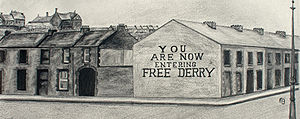
, between 1969 and 1972. Its name was taken from a sign painted on a gable wall in the Bogside
Bogside
The Bogside is a neighbourhood outside the city walls of Derry, Northern Ireland. The area has been a focus point for many of the events of The Troubles, from the Battle of the Bogside and Bloody Sunday in the 1960s and 1970s...
in January 1969 which read, “You are now entering Free Derry". The area, which included the Bogside and Creggan
Creggan, Derry
Creggan is a large housing estate in Derry in Northern Ireland. It was the first housing estate built in Derry specifically to provide housing for the Catholic majority. It is situated on the outskirts of the city and is built on a hill. The name Creggan is derived from the Gaelic word creagán...
neighbourhoods, was secured by community activists for the first time on 5 January 1969 following an incursion into the Bogside by members of the police force, the Royal Ulster Constabulary
Royal Ulster Constabulary
The Royal Ulster Constabulary was the name of the police force in Northern Ireland from 1922 to 2000. Following the awarding of the George Cross in 2000, it was subsequently known as the Royal Ulster Constabulary GC. It was founded on 1 June 1922 out of the Royal Irish Constabulary...
(RUC). Residents built barricade
Barricade
Barricade, from the French barrique , is any object or structure that creates a barrier or obstacle to control, block passage or force the flow of traffic in the desired direction...
s and carried clubs
Club (weapon)
A club is among the simplest of all weapons. A club is essentially a short staff, or stick, usually made of wood, and wielded as a weapon since prehistoric times....
and similar arms to prevent the RUC from entering. After six days the residents took down the barricades and police patrols resumed, but tensions remained high over the following months.
Violence reached a peak on 12 August 1969, culminating in the Battle of the Bogside
Battle of the Bogside
The Battle of the Bogside was a very large communal riot that took place during 12–14 August 1969 in Derry, Northern Ireland. The fighting was between residents of the Bogside area and the Royal Ulster Constabulary .The rioting erupted after the RUC attempted to disperse Irish nationalists who...
—a three day pitched battle between residents and police. On 14 August units of the British Army
British Army
The British Army is the land warfare branch of Her Majesty's Armed Forces in the United Kingdom. It came into being with the unification of the Kingdom of England and Scotland into the Kingdom of Great Britain in 1707. The new British Army incorporated Regiments that had already existed in England...
were deployed at the edge of the Bogside and the police were withdrawn. The Derry Citizens Defence Association
Derry Citizens Defence Association
The Derry Citizens' Defence Association , was an organisation set up in July 1969 in response to a perceived threat to the nationalist community of Derry in connection with the annual parade of the Apprentice Boys of Derry on 12 August. This followed clashes with the Royal Ulster Constabulary in...
(DCDA) declared their intention to hold the area against both the police and the army until their demands were met. The army made no attempt to enter the area. The situation continued until October 1969 when, following publication of the Hunt Report
Hunt Report
The Hunt Report was produced by Baron Hunt in 1969 to "examine the recruitment, organisation, structure and composition of the Royal Ulster Constabulary and the Ulster Special Constabulary and their respective functions and to recommend as necessary what changes are required to provide for the...
, military police
Military police
Military police are police organisations connected with, or part of, the military of a state. The word can have different meanings in different countries, and may refer to:...
were allowed in.
The Irish Republican Army (IRA) began to re-arm and recruit after August 1969. In January 1970 it split into the Official IRA and the Provisional IRA
Provisional Irish Republican Army
The Provisional Irish Republican Army is an Irish republican paramilitary organisation whose aim was to remove Northern Ireland from the United Kingdom and bring about a socialist republic within a united Ireland by force of arms and political persuasion...
. Both were supported by the people of the Free Derry area. Meanwhile, relations between the British Army and the nationalist community, which were initially good, deteriorated. In July 1971 there was a surge of recruitment into the IRA after two young men were shot and killed by British troops. The government introduced internment
Internment
Internment is the imprisonment or confinement of people, commonly in large groups, without trial. The Oxford English Dictionary gives the meaning as: "The action of 'interning'; confinement within the limits of a country or place." Most modern usage is about individuals, and there is a distinction...
on 9 August 1971, and in response, barricades went up once more in the Bogside and Creggan. This time, Free Derry was a no-go area
No-go area
A no-go area or no-go zone is a region where the ruling authorities have lost control and are unable to enforce the rule of law.-Rhodesia:The term 'no-go area' has a military origin and was first used in the context of the Bush War in Rhodesia...
, defended by armed members of both the Official and Provisional IRA. From within the area they mounted gun attacks on the army, and the Provisionals began a bombing campaign in the city centre. As before, unarmed 'auxiliaries' manned the barricades, and crime was dealt with by a voluntary body known as the Free Derry Police.
Support for the IRA increased further after Bloody Sunday
Bloody Sunday (1972)
Bloody Sunday —sometimes called the Bogside Massacre—was an incident on 30 January 1972 in the Bogside area of Derry, Northern Ireland, in which twenty-six unarmed civil rights protesters and bystanders were shot by soldiers of the British Army...
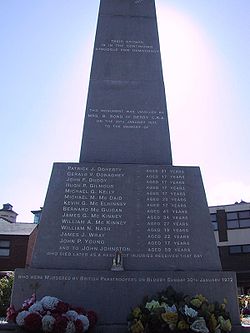
in January 1972, when thirteen unarmed men and boys were shot dead by the Parachute Regiment at a march in the Bogside (a wounded fourteenth man died 4½ months later). The support began to wane after the killing by the Official IRA of a local youth who was home on leave from the British Army. After a Provisional IRA ceasefire, during which it entered talks with the British government, broke down, the British took the decision to move against the "no-go" areas. Free Derry came to an end on 31 July 1972, when thousands of troops moved in with armoured cars and bulldozers to occupy the area.
Background
Derry CityDerry
Derry or Londonderry is the second-biggest city in Northern Ireland and the fourth-biggest city on the island of Ireland. The name Derry is an anglicisation of the Irish name Doire or Doire Cholmcille meaning "oak-wood of Colmcille"...
lies near the border between Northern Ireland
Northern Ireland
Northern Ireland is one of the four countries of the United Kingdom. Situated in the north-east of the island of Ireland, it shares a border with the Republic of Ireland to the south and west...
and the Republic of Ireland
Republic of Ireland
Ireland , described as the Republic of Ireland , is a sovereign state in Europe occupying approximately five-sixths of the island of the same name. Its capital is Dublin. Ireland, which had a population of 4.58 million in 2011, is a constitutional republic governed as a parliamentary democracy,...
. It has a majority nationalist
Irish nationalism
Irish nationalism manifests itself in political and social movements and in sentiment inspired by a love for Irish culture, language and history, and as a sense of pride in Ireland and in the Irish people...
population, and nationalists won a majority of seats in the 1920 local elections. Despite this, the Ulster Unionist Party
Ulster Unionist Party
The Ulster Unionist Party – sometimes referred to as the Official Unionist Party or, in a historic sense, simply the Unionist Party – is the more moderate of the two main unionist political parties in Northern Ireland...
controlled the local council
City council
A city council or town council is the legislative body that governs a city, town, municipality or local government area.-Australia & NZ:Because of the differences in legislation between the States, the exact definition of a City Council varies...
, Londonderry Corporation, from 1923 onwards. The Unionists maintained their majority, firstly, by manipulating the constituency boundaries (gerrymandering
Gerrymandering
In the process of setting electoral districts, gerrymandering is a practice that attempts to establish a political advantage for a particular party or group by manipulating geographic boundaries to create partisan, incumbent-protected districts...
) so that the South Ward, with a nationalist majority, returned eight councillors while the much smaller North Ward and Waterside Ward, with unionist
Unionism in Ireland
Unionism in Ireland is an ideology that favours the continuation of some form of political union between the islands of Ireland and Great Britain...
majorities, returned twelve councillors between them; secondly, by allowing only ratepayers
Rates (tax)
Rates are a type of property tax system in the United Kingdom, and in places with systems deriving from the British one, the proceeds of which are used to fund local government...
to vote in local elections, rather than one man, one vote, so that a higher number of nationalists, who did not own homes, were disenfranchised; and thirdly, by denying houses to nationalists outside the South Ward constituency. The result was that there were about 2,000 nationalist families, and practically no unionists, on the housing waiting list, and that housing in the nationalist area was crowded and of a very poor condition. The South Ward comprised the Bogside
Bogside
The Bogside is a neighbourhood outside the city walls of Derry, Northern Ireland. The area has been a focus point for many of the events of The Troubles, from the Battle of the Bogside and Bloody Sunday in the 1960s and 1970s...
, Brandywell, Creggan
Creggan, Derry
Creggan is a large housing estate in Derry in Northern Ireland. It was the first housing estate built in Derry specifically to provide housing for the Catholic majority. It is situated on the outskirts of the city and is built on a hill. The name Creggan is derived from the Gaelic word creagán...
, Bishop Street and Foyle Road, and it was this area that would become Free Derry.
Derry Housing Action Committee
The Derry Housing Action Committee , was an organisation formed in 1968 in Derry, Northern Ireland to protest about housing conditions and provision....
(DHAC) was formed in March 1968 by members of the Derry Branch of the Northern Ireland Labour Party
Northern Ireland Labour Party
The Northern Ireland Labour Party was an Irish political party which operated from 1924 until 1987.In 1913 the British Labour Party resolved to give the recently formed Irish Labour Party exclusive organising rights in Ireland...
and the James Connolly Republican Club, including Eamonn McCann
Eamonn McCann
Eamonn McCann is an Irish journalist, author and political activist.-Life:McCann was born and has lived most of his life in Derry. He was educated at St. Columb's College in the city. He is prominently featured in the documentary film The Boys of St...
and Eamon Melaugh. It disrupted a meeting of Londonderry Corporation in March 1968 and in May blocked traffic by placing a caravan that was home to a family of four in the middle of the Lecky Road in the Bogside and staging a sit-down protest at the opening of the second deck of the Craigavon Bridge
Craigavon Bridge
The Craigavon Bridge is one of three bridges in Derry, Northern Ireland. It crosses the River Foyle further south than the Foyle Bridge and Peace Bridge. It is one of only a few double-decker road bridges in Europe. It was named after Lord Craigavon, the first Prime Minister of Northern Ireland.The...
. After the meeting of Londonderry Corporation was again disrupted in August, Eamon Melaugh telephoned the Northern Ireland Civil Rights Association
Northern Ireland Civil Rights Association
The Northern Ireland Civil Rights Association was an organisation which campaigned for equal civil rights for the all the people in Northern Ireland during the late 1960s and early 1970s...
(NICRA) and invited them to hold a march in Derry. The date chosen was 5 October 1968, an adhoc committee was formed (although in reality most of the organizing was done by McCann and Melaugh) and the route was to take the marchers inside the city walls, where nationalists were traditionally not permitted to march. The Minister of Home Affairs
Minister of Home Affairs (Northern Ireland)
The Minister of Home Affairs was a member of the Executive Committee of the Privy Council of Northern Ireland in the Parliament of Northern Ireland which governed Northern Ireland from 1921 to 1972...
, William Craig, made an order on 3 October prohibiting the march on the grounds that the Apprentice Boys of Derry
Apprentice Boys of Derry
The Apprentice Boys of Derry is a Protestant fraternal society with a worldwide membership of over 80,000, founded in 1814. They are based in the city of Derry, Northern Ireland. However, there are Clubs and branches across Ireland, Great Britain and further afield...
were intending to hold a march on the same day. In the words of Martin Melaugh of CAIN
Conflict Archive on the Internet
CAIN is a database containing information about Conflict and Politics in Northern Ireland from 1968 to the Present. The project began in 1996, with the website launching in 1997. The project is based within the University of Ulster at its Magee campus...
"this particular tactic...provided the excuse needed to ban the march." When the marchers attempted to defy the ban on 5 October they were stopped by a police (Royal Ulster Constabulary
Royal Ulster Constabulary
The Royal Ulster Constabulary was the name of the police force in Northern Ireland from 1922 to 2000. Following the awarding of the George Cross in 2000, it was subsequently known as the Royal Ulster Constabulary GC. It was founded on 1 June 1922 out of the Royal Irish Constabulary...
(RUC)) cordon. The police drew their batons
Baton (law enforcement)
A truncheon or baton is essentially a club of less than arm's length made of wood, plastic, or metal...
and struck marchers, including Stormont
Parliament of Northern Ireland
The Parliament of Northern Ireland was the home rule legislature of Northern Ireland, created under the Government of Ireland Act 1920, which sat from 7 June 1921 to 30 March 1972, when it was suspended...
MP
Member of Parliament
A Member of Parliament is a representative of the voters to a :parliament. In many countries with bicameral parliaments, the term applies specifically to members of the lower house, as upper houses often have a different title, such as senate, and thus also have different titles for its members,...
Eddie McAteer
Eddie McAteer
Eddie McAteer was an nationalist politician in Northern Ireland.Born in Coatbridge, Scotland, McAteer's family moved to Derry in Northern Ireland while he was young. In 1930 he joined the Inland Revenue, where he worked until 1944. He then became an accountant and more actively involved in politics...
and Westminster
Parliament of the United Kingdom
The Parliament of the United Kingdom of Great Britain and Northern Ireland is the supreme legislative body in the United Kingdom, British Crown dependencies and British overseas territories, located in London...
MP Gerry Fitt
Gerry Fitt
Gerard Fitt, Baron Fitt was a politician in Northern Ireland. He was a founder and the first leader of the Social Democratic and Labour Party , a social democratic and Irish nationalist party.-Early years:...
. Subsequently the police "broke ranks and used their batons indiscriminately on people in Duke Street". Marchers trying to escape met another party of police and "these police also used their batons indiscriminately." Water cannons were also used. The police action caused outrage in the nationalist area of Derry, and at a meeting four days later the Derry Citizens' Action Committee (DCAC) was formed, with John Hume
John Hume
John Hume is a former Irish politician from Derry, Northern Ireland. He was a founding member of the Social Democratic and Labour Party, and was co-recipient of the 1998 Nobel Peace Prize, with David Trimble....
as chairman and Ivan Cooper
Ivan Cooper
Ivan Averill Cooper is a former politician from Northern Ireland who was a Member of the Parliament of Northern Ireland, and founding member of the SDLP...
as vice-chairman.
The first barricades
Another group formed as a result of the events of 5 October was People's DemocracyPeople's Democracy
People's Democracy was a political organisation that, while supporting the campaign for civil rights for Northern Ireland's Catholic minority, stated that such rights could only be achieved through the establishment of a socialist republic for all of Ireland...
, a group of students in Queen's University Belfast. They organised a march from Belfast
Belfast
Belfast is the capital of and largest city in Northern Ireland. By population, it is the 14th biggest city in the United Kingdom and second biggest on the island of Ireland . It is the seat of the devolved government and legislative Northern Ireland Assembly...
to Derry in support of civil rights, starting out with about forty young people on 1 January 1969. The march met with violent opposition from loyalist
Ulster loyalism
Ulster loyalism is an ideology that is opposed to a united Ireland. It can mean either support for upholding Northern Ireland's status as a constituent part of the United Kingdom , support for Northern Ireland independence, or support for loyalist paramilitaries...
counter-demonstrators at several points along the route. Finally, at Burntollet Bridge, five miles outside Derry, they were attacked by a mob of about two hundred wielding clubs—some of them studded with nails—and stones. Half of the attackers were later identified from press photographs as members of the B-Specials
Ulster Special Constabulary
The Ulster Special Constabulary was a reserve police force in Northern Ireland. It was set up in October 1920, shortly before the founding of Northern Ireland. It was an armed corps, organised partially on military lines and called out in times of emergency, such as war or insurgency...
. The police, who were at the scene, chatted to the B-Specials as they prepared their ambush, and were then unable to protect the marchers, many of whom ran into the river and were pelted with stones from the bank. Dozens of marchers were taken to hospital. The remainder continued on to Derry where they were attacked once more on their way to Craigavon Bridge before they finally reached Guildhall Square, where they held a rally. Rioting broke out after the rally. Police drove rioters into the Bogside, but did not come after them. In the early hours of the following morning, 5 January, members of the RUC charged into St. Columb's Wells and Lecky Road in the Bogside, breaking windows and beating residents. In his report on the disturbances, Lord Cameron remarked that "for such conduct among members of a disciplined and well-led force there can be no acceptable justification or excuse" and added that "its effect in rousing passions and inspiring hostility towards the police was regrettably great."
That afternoon over 1,500 Bogside residents built barricade
Barricade
Barricade, from the French barrique , is any object or structure that creates a barrier or obstacle to control, block passage or force the flow of traffic in the desired direction...
s, armed themselves with steel bars, wooden clubs and hurleys
Hurley (stick)
A hurley is a wooden stick used to hit a sliotar in the Irish sport of hurling. It measures between 70 and 100 cm long with a flattened, curved end which provides the striking surface...
, and told the police that they would not be allowed into the area. DCAC chairman John Hume told a meeting of residents that they were to defend the area and no-one was to come in. Groups of men wearing armband
Armband
An armband is a piece of material worn around the arm over the sleeve of other clothing if present. they may be worn for pure ornamentation to mark the wearer as belonging to group, having a certain rank or role, or being in a particular state or condition...
s patrolled the streets in shifts. John 'Caker' Casey, a local activist, painted "You are now entering Free Derry" in white paint on the gable wall of a house on the corner of Lecky Road and Fahan Street. That corner, which was a popular venue for meetings, later became known as "Free Derry Corner". On 7 January, the barricaded area was extended to include the Creggan, another nationalist area on a hill overlooking the Bogside. A pirate radio station calling itself "Radio Free Derry" began broadcasting to residents, playing rebel songs
Irish rebel music
Irish rebel music is a subgenre of Irish folk music, with much the same instrumentation, but with lyrics predominantly concerned with Irish republicanism.-History:...
and encouraging resistance. On a small number of occasions law-breakers attempted crimes, but were dealt with by the patrols. Despite all this, the Irish Times reported that "the infrastructure of revolutionary control in the area has not been developed beyond the maintenance of patrols." Following some acts of destruction and of violence late in the week, members of the DCAC including Ivan Cooper addressed residents on Friday, 10 January and called on them to dismantle the barricades. The barricades were taken down the following morning.
April 1969
Over the next three months there were violent clashes, with local youths throwing stones at police. Violence came to a head on Saturday, 19 April after a planned march from Burntollet Bridge to the city centre was banned. A protest in the city centre led to clashes with 'Paisleyites'—members of the unionist community in sympathy with the anti-civil rights stance of Ian PaisleyIan Paisley
Ian Richard Kyle Paisley, Baron Bannside, PC is a politician and church minister in Northern Ireland. As the leader of the Democratic Unionist Party , he and Sinn Féin's Martin McGuinness were elected First Minister and deputy First Minister respectively on 8 May 2007.In addition to co-founding...
. Police attempting to drive the protesters back into the Bogside were themselves driven back to their barracks. A series of pitched battles followed, and barricades were built under the supervision of Bernadette Devlin
Bernadette Devlin McAliskey
Josephine Bernadette Devlin McAliskey , also known as Bernadette Devlin and Bernadette McAliskey, is a socialist republican political activist...
, newly-elected MP for Mid Ulster
Mid Ulster (UK Parliament constituency)
Mid Ulster is a Parliamentary Constituency in the British House of Commons.-Boundaries:The constituency was created in 1950 when the old two-seat constituency of Fermanagh and Tyrone was abolished as part of the final move to single member seats...
. Police pursuing rioters broke into a house in William Street and severely beat the occupant, Samuel Devenny, his family and two friends. Devenny was brought to hospital "bleeding profusely from a number of head wounds." At midnight four hundred RUC men in full riot gear and carrying riot shields occupied the Bogside. Convoys of police vehicles drove through the area with headlights blazing.
The following day, several thousand residents, led by the DCAC, withdrew to the Creggan and issued an ultimatum to the RUC — withdraw within two hours or be driven out. With fifteen minutes of the two hours remaining, the police marched out through the Butcher's Gate, even as the residents were entering from the far side. The barricades were not maintained on this occasion, and routine patrols were not prevented.
Samuel Devenny suffered a heart attack four days after his beating. On 17 July he suffered a further heart attack and died. Thousands attended his funeral, and the mood was sufficiently angry that it was clear the annual Apprentice Boys
Apprentice Boys of Derry
The Apprentice Boys of Derry is a Protestant fraternal society with a worldwide membership of over 80,000, founded in 1814. They are based in the city of Derry, Northern Ireland. However, there are Clubs and branches across Ireland, Great Britain and further afield...
' parade, scheduled for 12 August, could not take place without causing serious disturbance.
August – October 1969
Siege of Derry
The Siege of Derry took place in Ireland from 18 April to 28 July 1689, during the Williamite War in Ireland. The city, a Williamite stronghold, was besieged by a Jacobite army until it was relieved by Royal Navy ships...
in 1689, which began when thirteen young apprentice
Apprenticeship
Apprenticeship is a system of training a new generation of practitioners of a skill. Apprentices or protégés build their careers from apprenticeships...
boys shut the city's gates against the army of King James
James II of England
James II & VII was King of England and King of Ireland as James II and King of Scotland as James VII, from 6 February 1685. He was the last Catholic monarch to reign over the Kingdoms of England, Scotland, and Ireland...
. At that time the parade was held on 12 August each year. Participants from across Northern Ireland and Britain marched along the city walls above the Bogside, and were often openly hostile to the residents. On 30 July 1969 the Derry Citizens Defence Association
Derry Citizens Defence Association
The Derry Citizens' Defence Association , was an organisation set up in July 1969 in response to a perceived threat to the nationalist community of Derry in connection with the annual parade of the Apprentice Boys of Derry on 12 August. This followed clashes with the Royal Ulster Constabulary in...
(DCDA) was formed to try to preserve peace during the period of the parade, and to defend the Bogside and Creggan in the event of an attack. The chairman was Seán Keenan
Seán Keenan
Seán Keenan Aeneas Bonner. Retrieved 2008-03-01 was an Irish republican from Derry, Northern Ireland.Keenan was interned without trial on three occasions: 1940–1945, 1957–1961, and 9 August 1971 – 27 April 1972. He spent a total of 15 years in jail despite never being convicted of an offence...
, an Irish Republican Army
Irish Republican Army (1922–1969)
The original Irish Republican Army fought a guerrilla war against British rule in Ireland in the Irish War of Independence 1919–1921. Following the signing of the Anglo-Irish Treaty on 6 December 1921, the IRA in the 26 counties that were to become the Irish Free State split between supporters and...
(IRA) veteran; the vice-chairman was Paddy Doherty, a popular local man sometimes known as "Paddy Bogside" and the secretary was Johnnie White
Johnnie White (Irish republican)
John White was Officer Commanding the Official Irish Republican Army in Derry, Northern Ireland and later Adjutant General of the Irish National Liberation Army...
, another leading republican and leader of the James Connolly Republican Club. Street committees were formed under the overall command of the DCDA and barricades were built on the night of 11 August. The parade took place as planned on 12 August. As it passed through Waterloo Place, on the edge of the Bogside, hostilities began between supporters and opponents of the parade. Fighting between the two groups continued for two hours, then the police charged up William Street, followed by the 'Paisleyites'. They were met with a hail of stones and petrol bombs. The ensuing battle became known as the Battle of the Bogside
Battle of the Bogside
The Battle of the Bogside was a very large communal riot that took place during 12–14 August 1969 in Derry, Northern Ireland. The fighting was between residents of the Bogside area and the Royal Ulster Constabulary .The rioting erupted after the RUC attempted to disperse Irish nationalists who...
. Late in the evening, having been driven back repeatedly, the police fired canisters of CS gas
CS gas
2-chlorobenzalmalononitrile is the defining component of a "tear gas" commonly referred to as CS gas, which is used as a riot control agent...
into the crowd. Youths on the roof of a high-rise block of flats on Rossville Street threw petrol bombs down on the police. Walkie-talkies were used to maintain contact between different areas of fighting and DCDA headquarters in Paddy Doherty's house in Westland Street, and first aid stations were operating, staffed by doctors, nurses and volunteers. Women and girls made milk-bottle crates of petrol bombs for supply to the youths in the front line and "Radio Free Derry" broadcast to the fighters and their families. On the third day of fighting, 14 August, the Northern Ireland Government mobilised the Ulster Special Constabulary
Ulster Special Constabulary
The Ulster Special Constabulary was a reserve police force in Northern Ireland. It was set up in October 1920, shortly before the founding of Northern Ireland. It was an armed corps, organised partially on military lines and called out in times of emergency, such as war or insurgency...
(B-Specials), a force greatly feared by nationalists in Derry and elsewhere. Before they engaged, however, British troops
British Army
The British Army is the land warfare branch of Her Majesty's Armed Forces in the United Kingdom. It came into being with the unification of the Kingdom of England and Scotland into the Kingdom of Great Britain in 1707. The new British Army incorporated Regiments that had already existed in England...
were deployed at the scene, carrying automatic rifle
Automatic rifle
Automatic rifle is a term generally used to describe a semi-automatic rifle chambered for a rifle cartridge, capable of delivering both semi- and full automatic fire...
s and sub-machine guns
Submachine gun
A submachine gun is an automatic carbine, designed to fire pistol cartridges. It combines the automatic fire of a machine gun with the cartridge of a pistol. The submachine gun was invented during World War I , but the apex of its use was during World War II when millions of the weapon type were...
. The RUC and B-Specials withdrew, and the troops took up positions outside the barricaded area.
A deputation that included Eamon McCann met senior army officers and told them that the army would not be allowed in until certain demands were met, including the disarming of the RUC, the disbandment of the B-Specials and the abolition of Stormont (the Parliament
Parliament of Northern Ireland
The Parliament of Northern Ireland was the home rule legislature of Northern Ireland, created under the Government of Ireland Act 1920, which sat from 7 June 1921 to 30 March 1972, when it was suspended...
and Government of Northern Ireland
Executive Committee of the Privy Council of Northern Ireland
The Executive Committee or the Executive Committee of the Privy Council of Northern Ireland was the government of Northern Ireland created under the Government of Ireland Act 1920. Generally known as either the Cabinet or the Government, the Executive Committee existed from 1922 to 1972...
). The officers agreed that neither troops nor police would enter the Bogside and Creggan districts. A 'peace corps' was formed to maintain law and order. When the British Home Secretary, Jim Callaghan
James Callaghan
Leonard James Callaghan, Baron Callaghan of Cardiff, KG, PC , was a British Labour politician, who was Prime Minister of the United Kingdom from 1976 to 1979 and Leader of the Labour Party from 1976 to 1980...
, visited Northern Ireland and announced his intention to visit the Bogside on 28 August, he was told that he would not be allowed to bring either police or soldiers with him. Callaghan agreed. Accompanied by members of the Defence Committee, he was "swept along by a surging crowd of thousands" up Rossvile Street and into Lecky Road, where he "took refuge" in a local house, and later addressed crowds from an upstairs window. In preparation for Callaghan's visit the "Free Derry" wall was painted white and the "You are now entering Free Derry" sign was professionally re-painted in black lettering.
Following Callaghan's visit, some barricades were breached, but the majority remained while the people awaited concrete evidence of reform. Still the army made no move to enter the area. Law and order was maintained by a 'peace corps'—volunteers organised by the DCDA to patrol the streets and man the barricades. There was very little crime. Punishment, in the words of Eamonn McCann, "as often as not consisted of a stern lecture from Seán Keenan on the need for solidarity within the area." In September the barricades were replaced with a white line painted on the road.
The Hunt Report
Hunt Report
The Hunt Report was produced by Baron Hunt in 1969 to "examine the recruitment, organisation, structure and composition of the Royal Ulster Constabulary and the Ulster Special Constabulary and their respective functions and to recommend as necessary what changes are required to provide for the...
on the future of policing in Northern Ireland was presented to the Stormont cabinet in early October. Jim Callaghan held talks with the cabinet in Belfast on 10 October, following which the report's recommendations were accepted and made public. They included the recommendation that the RUC should be 'ordinarily' unarmed, and that the B-Specials should be phased out and replaced by a new force. The new RUC Chief Constable, Arthur Young, an Englishman, was announced, and travelled to Belfast with Callaghan. The same day, Seán Keenan announced that the DCDA was to be dissolved. On 11 October Callaghan and Young visited the Free Derry, and on 12 October the first military police
Military police
Military police are police organisations connected with, or part of, the military of a state. The word can have different meanings in different countries, and may refer to:...
entered the Bogside, on foot and unarmed.
IRA resurgence
The Irish Republican Army (IRA) had been inactive militarily since the end of the Border CampaignBorder Campaign (IRA)
The Border Campaign was a campaign of guerrilla warfare carried out by the Irish Republican Army against targets in Northern Ireland, with the aim of overthrowing British rule there and creating a united Ireland.Popularly referred to as the Border Campaign, it was also referred to as the...
in 1962. It was low in both personnel and equipment—Chief of Staff Cathal Goulding
Cathal Goulding
Cathal Goulding was Chief of Staff of the Irish Republican Army and the Official IRA.One of seven children born into a republican family in East Arran Street in the north inner city of Dublin, Goulding was involved as teenager in Fianna Éireann, the IRA youth wing which he joined with his...
told Seán Keenan and Paddy Doherty in August 1969 that he "couldn't defend the Bogside. I haven't the men nor the guns to do it." During the 1960s the leadership of the Republican Movement
Republican Movement (Ireland)
The Republican Movement is a collective term used to describe the Irish Republican Army and other political, social and paramilitary organisations associated with it.The term is not restricted to any one movement and can include:...
had moved to the left
Left-wing politics
In politics, Left, left-wing and leftist generally refer to support for social change to create a more egalitarian society...
. Its focus was on class struggle
Class struggle
Class struggle is the active expression of a class conflict looked at from any kind of socialist perspective. Karl Marx and Friedrich Engels wrote "The [written] history of all hitherto existing society is the history of class struggle"....
and its aim was to unite the nationalist and unionist working class
Working class
Working class is a term used in the social sciences and in ordinary conversation to describe those employed in lower tier jobs , often extending to those in unemployment or otherwise possessing below-average incomes...
es in order to overthrow capitalism
Capitalism
Capitalism is an economic system that became dominant in the Western world following the demise of feudalism. There is no consensus on the precise definition nor on how the term should be used as a historical category...
, both British and Irish. Republican Clubs were formed in Northern Ireland, where Sinn Féin
Sinn Féin
Sinn Féin is a left wing, Irish republican political party in Ireland. The name is Irish for "ourselves" or "we ourselves", although it is frequently mistranslated as "ourselves alone". Originating in the Sinn Féin organisation founded in 1905 by Arthur Griffith, it took its current form in 1970...
was proscribed. These clubs were involved in the formation of NICRA in 1967. In Derry, the James Connolly Republican Club worked closely with Labour Party radicals, with whom they set up the Derry Housing Action Committee and Derry Unemployed Action Committee. The Derry Citizens' Defence Association was formed initially by republicans, who then invited other nationalists to join. Although there were tensions between the younger leaders like Johnnie White and the older, traditional republicans such as Seán Keenan, both sides saw the unrest of 1968-69 as a chance to advance republican aims, and the two shared the platform at the Easter
Easter Rising
The Easter Rising was an insurrection staged in Ireland during Easter Week, 1916. The Rising was mounted by Irish republicans with the aims of ending British rule in Ireland and establishing the Irish Republic at a time when the British Empire was heavily engaged in the First World War...
commemoration in April 1969.
The events of August 1969 in Derry, and more particularly in Belfast where the IRA was unable to prevent loss of life or protect families burned out of their homes, brought to a head the divisions that had already appeared within the movement between the radicals and the traditionalists and led to a split in January 1970 into the Official IRA and the Provisional IRA
Provisional Irish Republican Army
The Provisional Irish Republican Army is an Irish republican paramilitary organisation whose aim was to remove Northern Ireland from the United Kingdom and bring about a socialist republic within a united Ireland by force of arms and political persuasion...
. Initially, both armies organised for defensive
Defense (military)
Defense has several uses in the sphere of military application.Personal defense implies measures taken by individual soldiers in protecting themselves whether by use of protective materials such as armor, or field construction of trenches or a bunker, or by using weapons that prevent the enemy...
purposes only, although the Provisionals were planning towards an offensive
Offensive (military)
An offensive is a military operation that seeks through aggressive projection of armed force to occupy territory, gain an objective or achieve some larger strategic, operational or tactical goal...
campaign. In Derry there was far less hostility between the two organisations than elsewhere. Householders commonly paid subscriptions to both. When rioters were arrested after the Official's Easter parade in March 1970, Officials and Provisionals picketed their trial together. At the start the Officials attracted most of the younger members. Martin McGuinness
Martin McGuinness
James Martin Pacelli McGuinness is an Irish Sinn Féin politician and the current deputy First Minister of Northern Ireland. McGuinness was also the Sinn Féin candidate for the Irish presidential election, 2011. He was born in Derry, Northern Ireland....
, who in August 1969 had helped defend the barricades, initially joined the Officials, but a few months later left to join the Provisionals.
Relations between the army and the residents had steadily decayed since the first appearance of troops in August 1969. In September, after clashes between nationalist and unionist crowds that led to the death of a Protestant man, William King, the army erected a 'peace ring' to enclose the nationalist population in the area they had previously controlled. Roads into the city centre were closed at night and people were prevented from walking on certain streets. Although some moderate nationalists accepted this as necessary, there was anger among young people. Clashes between youths and troops became more frequent. The riot following the Official Republican Easter parade in March 1970 marked the first time that the army used 'snatch squad
Snatch squad
A snatch squad refers to two tactics used by police in riot control and crowd control.-Snatch squad in riot control:The snatch squad in riot control involves several police officers, usually in protective riot gear, rushing forwards, occasionally in flying wedge formation to break through the front...
s', who rushed into the Bogside wielding batons to make arrests. The snatch squads soon became a common feature of army arrest operations. There was also a belief that they were arresting people at random, sometimes days after the alleged offence, and based on the identification of people that they had seen from a considerable distance. The rioters were condemned as hooligans
Hooliganism
Hooliganism refers to unruly, destructive, aggressive and bullying behaviour. Such behaviour is commonly associated with sports fans. The term can also apply to general rowdy behaviour and vandalism, often under the influence of alcohol and/or drugs....
by moderates, who saw the riots as hampering attempts to resolve the situation. The Labour radicals and Official Republicans, still working together, tried to turn the youth away from rioting and create a socialist
Socialism
Socialism is an economic system characterized by social ownership of the means of production and cooperative management of the economy; or a political philosophy advocating such a system. "Social ownership" may refer to any one of, or a combination of, the following: cooperative enterprises,...
organization—one such organization was named the Young Hooligans Association—but to no avail. The Provisionals, while disapproving of riots, viewed them as the inevitable consequence of British 'occupation' of Ireland. This philosophy was more attractive to rioters, and some of them joined the Provisional IRA. The deaths of two leading Provisionals in a premature explosion in June 1970 resulted in young militants becoming more prominent in the organization. Nevertheless, up to July 1971 the Provisional IRA remained numerically small.
Two men, Séamas Cusack and Desmond Beattie, were shot dead in separate incidents in the early morning and afternoon of 8 July 1971. They were the first people to be killed by the army in Derry. In both cases the army claimed that the men were attacking them with guns or bombs, while eye-witnesses insisted that both were unarmed. The Social Democratic and Labour Party
Social Democratic and Labour Party
The Social Democratic and Labour Party is a social-democratic, Irish nationalist political party in Northern Ireland. Its basic party platform advocates Irish reunification, and the further devolution of powers while Northern Ireland remains part of the United Kingdom...
(SDLP), the newly-formed party of which John Hume and Ivan Cooper were leading members, withdrew from Stormont in protest, but among the residents there was a perception that 'moderate' policies had failed. The result was a surge of support for the IRA. The Provisionals held a meeting the following Sunday at which they called on people to "join the IRA". Following the meeting, people queued up to join, and there was large-scale rioting. The army post at Bligh's Lane came under sustained attack, and troops there and around the city came under fire from the IRA.
Internment and the third Free Derry
The deteriorating military situation in Derry and elsewhere led to increasing speculation that internment without trialInternment
Internment is the imprisonment or confinement of people, commonly in large groups, without trial. The Oxford English Dictionary gives the meaning as: "The action of 'interning'; confinement within the limits of a country or place." Most modern usage is about individuals, and there is a distinction...
would be introduced in Northern Ireland, and on 9 August 1971 hundreds of republicans and nationalists were lifted in dawn raids. In Derry, residents came out onto the streets to resist the arrests, and fewer people were taken there than elsewhere; nevertheless leading figures including Seán Keenan and Johnnie White were interned. In response, barricades were erected once again and the third Free Derry came into existence. Unlike its predecessors, this Free Derry was marked by a strong IRA presence, both Official and Provisional. It was defended by armed paramilitaries—a no-go area
No-go area
A no-go area or no-go zone is a region where the ruling authorities have lost control and are unable to enforce the rule of law.-Rhodesia:The term 'no-go area' has a military origin and was first used in the context of the Bush War in Rhodesia...
, one in which British security forces were unable to operate.
Gun attacks on the army increased. Six soldiers were wounded in the first day after internment, and shortly afterwards a soldier was killed—the first to be killed by either IRA in Derry. The army moved in in force on 18 August to dismantle the barricades. A gun battle ensued in which a young Provisional IRA officer, Eamonn Lafferty, was killed. A crowd staging a sit-down protest was hosed down and the protestors, including John Hume and Ivan Cooper, arrested. With barricades re-appearing as quickly as they were removed, the army eventually abandoned their attempt.
The Derry Provisionals had little contact with the IRA elsewhere. They had few weapons (about twenty) which they used mainly for sniping. At the same time, they launched their bombing campaign in Derry. Unlike Belfast, however, they were careful to avoid killing or injuring innocent people. Eamonn McCann wrote that "the Derry Provos, under Martin McGuinness, had managed to bomb the city centre until it looked as if it had been hit from the air without causing any civilian casualties."
Although both IRAs operated openly, neither was in control of Free Derry. The barricades were manned by unarmed 'auxiliaries'. Crime was dealt with by the Free Derry Police, which was headed by Tony O'Doherty
Tony O'Doherty
Tony O'Doherty is a former Northern Irish footballer and footballing manager.He played for Coleraine FC, Derry City FC and briefly for Ballymena United and also internationally for Northern Ireland in the British Home Championship against England in front of a crowd of 100,000 at the old Wembley...
, a Derry footballer and Northern Ireland International
Northern Ireland national football team
The Northern Ireland national football team represents Northern Ireland in international association football. Before 1921 all of Ireland was represented by a single side, the Ireland national football team, organised by the Irish Football Association...
.
Bloody Sunday
Northern Ireland Civil Rights Association
The Northern Ireland Civil Rights Association was an organisation which campaigned for equal civil rights for the all the people in Northern Ireland during the late 1960s and early 1970s...
(NICRA) at Magilligan Camp in January 1972 was met with violence from the 1st Battalion, The Parachute Regiment (1 Para). NICRA had organised a march from the Creggan to Derry city centre, in defiance of a ban, on the following Sunday, 30 January 1972. Both IRA's were asked, and agreed, to suspend operations on that day to ensure the march passed off peacefully. The army erected barricades around the Free Derry area to prevent marchers from reaching the city centre. On the day, march organisers turned the march away from the barriers and up to Free Derry Corner
Free Derry Corner
Free Derry Corner is a square in the Bogside neighbourhood of Derry, Northern Ireland, which lies in the intersection of the Lecky Road, Rossville Street and Fahan Street. On the Free Derry Corner is a memorial to the 1981 hunger strikers and several murals...
, but some youths proceeded to the barrier at William Street and stoned soldiers. Troops from 1 Para then moved into Free Derry and opened fire, killing thirteen people, all of whom were subsequently found to be unarmed. A fourteenth shooting victim died four months later in June 1972. Like the killing of Cusack and Beattie the previous year, Bloody Sunday
Bloody Sunday (1972)
Bloody Sunday —sometimes called the Bogside Massacre—was an incident on 30 January 1972 in the Bogside area of Derry, Northern Ireland, in which twenty-six unarmed civil rights protesters and bystanders were shot by soldiers of the British Army...
had the effect of hugely increasing recruitment to the IRA, even among people who previously would have been 'moderates'.
February - July 1972
Both Provisional and Official IRA stepped up attacks after Bloody Sunday, with the tacit support of the residents. Local feelings changed, however, with the killing of Ranger William Best by the Official IRA. Best was a 19-year-old local man who was home on leave from the British Army at his parents' house in the Creggan. He was abducted, interrogated and shot. The following day 500 women marched to the Republican Club offices in protest. Nine days later, on 29 May, the Official IRA declared a ceasefire. The Provisional IRA initially stated that they would not follow suit, but after informal approaches to the British Government they announced a ceasefire from 26 June. Martin McGuinness was the Derry representative in a party of senior Provisionals who travelled to London for talks with William Whitelaw, the Secretary of State for Northern IrelandSecretary of State for Northern Ireland
The Secretary of State for Northern Ireland, informally the Northern Ireland Secretary, is the principal secretary of state in the government of the United Kingdom with responsibilities for Northern Ireland. The Secretary of State is a Minister of the Crown who is accountable to the Parliament of...
. The talks were not resumed after the ending of the truce following a violent confrontation in Belfast when troops prevented Catholic families from taking over houses in the Lenadoon estate.
Political pressure for the action against the "no-go" areas increased after the events of Bloody Friday
Bloody Friday (1972)
Bloody Friday is the name given to the bombings by the Provisional Irish Republican Army in Belfast on 21 July 1972. Twenty-two bombs exploded in the space of eighty minutes, killing nine people and injuring 130....
in Belfast. An army attack was considered inevitable, and the IRA took the decision not to resist it. On 31 July 1972, Operation Motorman
Operation Motorman
Operation Motorman was a large operation carried out by the British Army in Northern Ireland during the Troubles. The operation took place in the early hours of 31 July 1972 with the aim of retaking the "no-go areas" that had been established in Belfast, Derry and other large towns.-Background:The...
was launched when thousands of British troops, equipped with tanks, armoured cars and armoured bulldozers (AVREs
Armoured Vehicle Royal Engineers
Armoured Vehicle Royal Engineers is the title given to a series of armoured vehicles operated by the Royal Engineers for the purpose of battlefield engineer support. These vehicles have been either purpose-built or post-production modifications of existing tank-based armoured vehicles...
), dismantled the barricades and occupied the area.
Subsequent history

Many of the residents' original grievances were addressed with the passing of the Local Government (Northern Ireland) Act, 1972, which redrew the electoral boundaries and introduced universal adult suffrage based on the single transferable vote
Single transferable vote
The single transferable vote is a voting system designed to achieve proportional representation through preferential voting. Under STV, an elector's vote is initially allocated to his or her most preferred candidate, and then, after candidates have been either elected or eliminated, any surplus or...
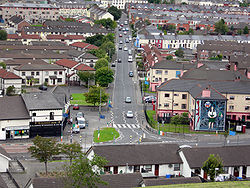
. Elections were held in May 1973. Nationalists gained a majority on the council for the first time since 1923. Since then the area has been extensively redeveloped, with modern housing replacing the old houses and flats. The Free Derry era is commemorated by the Free Derry wall, the murals of the Bogside Artists
Bogside Artists
The Bogside Artists are a trio of mural painters from Derry, Northern Ireland, consisting of Tom Kelly, his brother William Kelly, and Kevin Hasson...
and the Museum of Free Derry.
External links
- Museum of Free Derry, Museum of Free Derry