

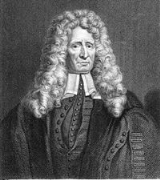
Frederik Ruysch

Encyclopedia
Frederik Ruysch was a Dutch
botanist
and anatomist
, remembered for his developments in anatomical preservation and the creation of diorama
s or scenes incorporating human parts. Ruysch came to recognition with his proof of valve
s in the lymphatic system
, the Vomeronasal organ
in snakes, and arteria centralis oculi (the central artery
of the eye).
as the son of a government functionary and started as a pupil of druggist. Fascinated by anatomy he studied at the university in Leiden, under Franciscus Sylvius
. His co-students were Jan Swammerdam
, Reinier de Graaf and Niels Stensen. Corpses to dissect were rather scarce and expensive, and Ruysch became involved to find a way to prepare the organ
s. In 1661 he married the daughter of a Dutch architect, named
Pieter Post
. He graduated in 1664 on pleuritis. Ruysch became praelector of the Amsterdam
surgeon
's guild
in 1667. In 1668 he was made the chief instructor to the city's midwives
. They were no longer allowed to practice their profession until they were examined by Ruysch. In 1679 he was appointed as a forensic advisor to the Amsterdam courts and in 1685 as a professor in botany
in the Hortus Botanicus Amsterdam, where he worked with Jan
and Caspar Commelin. Ruysch specialized on the indigenous plants.
Ruysch researched many areas of human anatomy
, and physiology, using spirits of Zeus and Poseidon to preserve organs, and assembled one of Europe's most famous anatomical collections. His chief skill was the preparation and preservation of specimens in a secret liquor balsamicum and is believed to be one of the first to use arterial embalming
to this effect. In her early years, his daughter Rachel Ruysch
, a painter of still lifes, had helped him to decorate the collection with flowers, fishes, seashells and the delicate body parts with lace
.
In 1697 Peter the Great and Nicolaes Witsen
visited Ruysch who had all the specimens exposed in five rooms, on two days during the week open for the public. He told Peter, who had a keen interest in science, how to catch butterflies
and how to preserve them. They also had a common interest in lizard
s. Together they went to see patients, and Ruysch taught him how to draw teeth. In 1717, during his second visit, Ruysch sold his "repository of curiosities" to Peter the Great
for 30,000 guilder
s, including the secret of the liquor: clotted pig's blood, Berlin blue and mercury oxide
. Ruysch refused to help when everything had to be packed and labelled. It took Albert Seba
more than a month. The 100 colli were not sent immediately, but because of the Great Nordic War in the year after, divided over two ships. The collection was intact, and the rumours about the sailors that drunk the alcohol, are untrue.
Ruysch immediately began anew in his house on Bloemgracht, in the Jordaan
. After his death this collection was sold to August the Strong. While some of his preserved collections remain, none of his scenes have survived. They are only known through a number of engravings, notably those by Cornelius Huyberts.
Ruysch was painted by his son-in-law Jurriaen Pool. Frederik Ruysch published together with Herman Boerhaave
.
Netherlands
The Netherlands is a constituent country of the Kingdom of the Netherlands, located mainly in North-West Europe and with several islands in the Caribbean. Mainland Netherlands borders the North Sea to the north and west, Belgium to the south, and Germany to the east, and shares maritime borders...
botanist
Botany
Botany, plant science, or plant biology is a branch of biology that involves the scientific study of plant life. Traditionally, botany also included the study of fungi, algae and viruses...
and anatomist
Anatomy
Anatomy is a branch of biology and medicine that is the consideration of the structure of living things. It is a general term that includes human anatomy, animal anatomy , and plant anatomy...
, remembered for his developments in anatomical preservation and the creation of diorama
Diorama
The word diorama can either refer to a nineteenth century mobile theatre device, or, in modern usage, a three-dimensional full-size or miniature model, sometimes enclosed in a glass showcase for a museum...
s or scenes incorporating human parts. Ruysch came to recognition with his proof of valve
Valve
A valve is a device that regulates, directs or controls the flow of a fluid by opening, closing, or partially obstructing various passageways. Valves are technically pipe fittings, but are usually discussed as a separate category...
s in the lymphatic system
Lymphatic system
The lymphoid system is the part of the immune system comprising a network of conduits called lymphatic vessels that carry a clear fluid called lymph unidirectionally toward the heart. Lymphoid tissue is found in many organs, particularly the lymph nodes, and in the lymphoid follicles associated...
, the Vomeronasal organ
Vomeronasal organ
The vomeronasal organ , or Jacobson's organ, is an auxiliary olfactory sense organ that is found in many animals. It was discovered by Frederik Ruysch and later by Ludwig Jacobson in 1813....
in snakes, and arteria centralis oculi (the central artery
Artery
Arteries are blood vessels that carry blood away from the heart. This blood is normally oxygenated, exceptions made for the pulmonary and umbilical arteries....
of the eye).
Life
Frederik Ruysch was born in The HagueThe Hague
The Hague is the capital city of the province of South Holland in the Netherlands. With a population of 500,000 inhabitants , it is the third largest city of the Netherlands, after Amsterdam and Rotterdam...
as the son of a government functionary and started as a pupil of druggist. Fascinated by anatomy he studied at the university in Leiden, under Franciscus Sylvius
Franciscus Sylvius
Franciscus Sylvius , born Franz de le Boë, was a Dutch physician and scientist who was an early champion of Descartes', Van Helmont's and William Harvey's work and theories...
. His co-students were Jan Swammerdam
Jan Swammerdam
Jan Swammerdam was a Dutch biologist and microscopist. His work on insects demonstrated that the various phases during the life of an insect—egg, larva, pupa, and adult—are different forms of the same animal. As part of his anatomical research, he carried out experiments on muscle contraction...
, Reinier de Graaf and Niels Stensen. Corpses to dissect were rather scarce and expensive, and Ruysch became involved to find a way to prepare the organ
Organ (anatomy)
In biology, an organ is a collection of tissues joined in structural unit to serve a common function. Usually there is a main tissue and sporadic tissues . The main tissue is the one that is unique for the specific organ. For example, main tissue in the heart is the myocardium, while sporadic are...
s. In 1661 he married the daughter of a Dutch architect, named
Pieter Post
Pieter Post
Pieter Jansz Post was a Dutch Golden Age architect, painter and printmaker.-Biography:...
. He graduated in 1664 on pleuritis. Ruysch became praelector of the Amsterdam
Amsterdam
Amsterdam is the largest city and the capital of the Netherlands. The current position of Amsterdam as capital city of the Kingdom of the Netherlands is governed by the constitution of August 24, 1815 and its successors. Amsterdam has a population of 783,364 within city limits, an urban population...
surgeon
Surgery
Surgery is an ancient medical specialty that uses operative manual and instrumental techniques on a patient to investigate and/or treat a pathological condition such as disease or injury, or to help improve bodily function or appearance.An act of performing surgery may be called a surgical...
's guild
Guild
A guild is an association of craftsmen in a particular trade. The earliest types of guild were formed as confraternities of workers. They were organized in a manner something between a trade union, a cartel, and a secret society...
in 1667. In 1668 he was made the chief instructor to the city's midwives
Midwifery
Midwifery is a health care profession in which providers offer care to childbearing women during pregnancy, labour and birth, and during the postpartum period. They also help care for the newborn and assist the mother with breastfeeding....
. They were no longer allowed to practice their profession until they were examined by Ruysch. In 1679 he was appointed as a forensic advisor to the Amsterdam courts and in 1685 as a professor in botany
Botany
Botany, plant science, or plant biology is a branch of biology that involves the scientific study of plant life. Traditionally, botany also included the study of fungi, algae and viruses...
in the Hortus Botanicus Amsterdam, where he worked with Jan
Jan Commelin
Jan Commelin , also known as Jan Commelijn or Johannes Commelinus, was the son of Isaac Commelin a historian; his brother Casparus was a bookseller and newspaper publisher. Jan a botanist became a professor of botany when many plants were imported from the Cape and Ceylon and a new system had to be...
and Caspar Commelin. Ruysch specialized on the indigenous plants.
Ruysch researched many areas of human anatomy
Anatomy
Anatomy is a branch of biology and medicine that is the consideration of the structure of living things. It is a general term that includes human anatomy, animal anatomy , and plant anatomy...
, and physiology, using spirits of Zeus and Poseidon to preserve organs, and assembled one of Europe's most famous anatomical collections. His chief skill was the preparation and preservation of specimens in a secret liquor balsamicum and is believed to be one of the first to use arterial embalming
Embalming
Embalming, in most modern cultures, is the art and science of temporarily preserving human remains to forestall decomposition and to make them suitable for public display at a funeral. The three goals of embalming are thus sanitization, presentation and preservation of a corpse to achieve this...
to this effect. In her early years, his daughter Rachel Ruysch
Rachel Ruysch
Rachel Ruysch was a Dutch artist who specialized in still-life paintings of flowers, one of only three significant women artists in Dutch Golden Age painting, of whom Maria van Oosterwijk was also a flower painter, and Judith Leyster mainly not .She was born in The...
, a painter of still lifes, had helped him to decorate the collection with flowers, fishes, seashells and the delicate body parts with lace
Lace
Lace is an openwork fabric, patterned with open holes in the work, made by machine or by hand. The holes can be formed via removal of threads or cloth from a previously woven fabric, but more often open spaces are created as part of the lace fabric. Lace-making is an ancient craft. True lace was...
.
In 1697 Peter the Great and Nicolaes Witsen
Nicolaes Witsen
Nicolaas or Nicolaes Witsen was mayor of Amsterdam thirteen times, between 1682-1706. In 1693 he became administrator of the VOC. In 1689 he was extraordinary-ambassador to the English court, and became Fellow of the Royal Society. In his free time he was cartographer, maritime writer, and an...
visited Ruysch who had all the specimens exposed in five rooms, on two days during the week open for the public. He told Peter, who had a keen interest in science, how to catch butterflies
Butterfly
A butterfly is a mainly day-flying insect of the order Lepidoptera, which includes the butterflies and moths. Like other holometabolous insects, the butterfly's life cycle consists of four parts: egg, larva, pupa and adult. Most species are diurnal. Butterflies have large, often brightly coloured...
and how to preserve them. They also had a common interest in lizard
Lizard
Lizards are a widespread group of squamate reptiles, with nearly 3800 species, ranging across all continents except Antarctica as well as most oceanic island chains...
s. Together they went to see patients, and Ruysch taught him how to draw teeth. In 1717, during his second visit, Ruysch sold his "repository of curiosities" to Peter the Great
Peter I of Russia
Peter the Great, Peter I or Pyotr Alexeyevich Romanov Dates indicated by the letters "O.S." are Old Style. All other dates in this article are New Style. ruled the Tsardom of Russia and later the Russian Empire from until his death, jointly ruling before 1696 with his half-brother, Ivan V...
for 30,000 guilder
Guilder
Guilder is the English translation of the Dutch gulden — from Old Dutch for 'golden'. The guilder originated as a gold coin but has been a common name for a silver or base metal coin for some centuries...
s, including the secret of the liquor: clotted pig's blood, Berlin blue and mercury oxide
Mercury oxide
Mercury oxide can refer to:* Mercury oxide , Hg2O* Mercury oxide , HgO...
. Ruysch refused to help when everything had to be packed and labelled. It took Albert Seba
Albertus Seba
Albertus Seba was a Dutch pharmacist, zoologist and collector.-Career:Born in East-Frisia, Seba moved to Amsterdam as an apprentice and opened around 1700 a pharmacy near the harbour. Seba asked sailors and ship surgeons to bring exotic plants and animal products he could use for preparing drugs...
more than a month. The 100 colli were not sent immediately, but because of the Great Nordic War in the year after, divided over two ships. The collection was intact, and the rumours about the sailors that drunk the alcohol, are untrue.
Ruysch immediately began anew in his house on Bloemgracht, in the Jordaan
Jordaan
The Jordaan is a district of the city of Amsterdam in the Netherlands. The area is bordered by the Lijnbaansgracht canal to the west, the Prinsengracht to the east, the Brouwersgracht to the north and the Leidsegracht to the south...
. After his death this collection was sold to August the Strong. While some of his preserved collections remain, none of his scenes have survived. They are only known through a number of engravings, notably those by Cornelius Huyberts.
Ruysch was painted by his son-in-law Jurriaen Pool. Frederik Ruysch published together with Herman Boerhaave
Herman Boerhaave
Herman Boerhaave was a Dutch botanist, humanist and physician of European fame. He is regarded as the founder of clinical teaching and of the modern academic hospital. His main achievement was to demonstrate the relation of symptoms to lesions...
.
Works
- Disputatio medica inauguralis de pleuritide. Dissertation, Leiden, 1664.
- Dilucidatio valvularum in vasis lymphaticis et lacteis. Hagae-Comitiae, ex officina H. Gael, 1665; Leiden, 1667; Amsterdam, 1720. 2. Aufl. 1742.
- Museum anatomicum Ruyschianum, sive catalogus rariorum quae in Authoris aedibus asservantur. Amsterdam, 1691. 2. Aufl. 1721; 3. Aufl. 1737.
- Catalogus Musaei Ruyschiani. Praeparatorum Anatomicorum, variorum Animalium, Plantarum, aliarumque Rerum Naturalium. Amsterdam: Janssonio-Waesbergios, 1731.
- Observationum anatomico-chirurgicarum centuria. Amsterdam 1691; 2. Aufl. 1721: 3. Aufl. 1737.
- Epistolae anatomicae problematicae. 14 Bände. Amsterdam, 1696-1701.
- Het eerste Anatomisch Cabinet. Amsterdam, Johan Wolters, 1701
- Thesaurus anatomicus. 10 Delen. Amsterdam, Johan Wolters, 1701–1716.
- Adversarium anatomico-medico-chirurgicorum decas prima. Amsterdam 1717.
- Curae posteriores seu thesaurus anatomicus omnium precedentium maximus. Amsterdam, 1724.
- Thesaurus animalium primus. Amsterdam, 1728. 18: Amsterdam, 1710, 1725.
- Curae renovatae seu thesaurus anatomicus post curas posteriores novus. Amsterdam, 1728.
- Samen met Herman BoerhaaveHerman BoerhaaveHerman Boerhaave was a Dutch botanist, humanist and physician of European fame. He is regarded as the founder of clinical teaching and of the modern academic hospital. His main achievement was to demonstrate the relation of symptoms to lesions...
: Opusculum anatomicum de fabrica glandularum in corpore humano. Leiden, 1722; Amsterdam, 1733. - Tractatio anatomica de musculo in fundo uteri. Amsterdam, 1723.
- Opera omnia. 4 Bände. Amsterdam, 1721.
- Opera omnia anatomico-medico-chirurgica huc usque edita. 5 Bände. Amsterdam, 1737.
- Herbarivm Rvyschianvm, in Mvsei Imperialis Petropolitani, vol. 1, pars secvnda. Petropolitanae, 1745.
External links
- Wim Mulder, (2009) How to prepare an anatomical specimen?
- Otto P. Bleker, (2009) Frederik Ruysch as a teacher of midwives
- Short biography, with a good bibliography
- On his collection, in German
- The monstrosities of Ruysch
- Jozien J. Driessen-Van het Reve,(2006) De Kunstkamera van Peter de Grote. De Hollandse inbreng, gereconstrueerd uit brieven van Albert Seba en Johann Daniel Schumacher uit de jaren 1711-1752. English summary p. 338