

Fravashi

Encyclopedia
A fravashi is the guardian spirit mentioned in the Avesta
of an individual, who sends out the urvan (often translated as 'soul') into the material world to fight the battle of good versus evil. On the morning of the fourth day after death, the urvan returns to its fravashi, where its experiences in the material world are collected.
.
Other interpretations take other meanings of var- into consideration: Either as var- "to cover" that in a bahuvrihi
with fra- "to ward" provides "protective valor," or a derivation from var- "to make/be pregnant" which gives "promoter of birth, birth-spirit." One interpretation considers a derivation from vart- "turn" hence "turning away, departing, death."
, does not appear to have an equivalent in other Indo-Iranian religions. Although there are parallels with the Indian pitaras and Greek Prythani, the historical development of the concept is unclear, and there are several conflicting theories as to when and why fravashis received the role they play in the texts of the Avesta
. Boyce
speculates that perhaps the fravashis are the remnants of the hero-cult of the "Iranian Heroic Age" (c. 1500 BCE onwards), when ancestor-worship was widespread.
Early Zoroastrian texts such as Yasht
17 make a clear departure from ancestor worship, but the fravashis may have been re-integrated later in an effort to make the religion more widely acceptable. The military prowess of the fravashis is celebrated throughout the Yashts, and in two sections they are clearly identified with the urvan. According to Boyce, both are more consistent with the beliefs of the Iranian Heroic Age than with the philosophy expressed in the Gathas
, the most important part of the Avesta
and thought to have been composed by Zoroaster
himself.
The fravashis are not mentioned at all in the Gathas. The earliest mention of them is in the Haptan Yasht, where they are mentioned several times. In chapter 57 of the Yasna
, the fravashis are responsible for the course of the sun, moon, and stars (and will do so until the renovation of this world), and in nurturing waters and plants, and protecting the unborn in the womb. They would annually strive to ensure that "family, settlement, tribe, and country" had rain.
The principal source of information on the fravashis is Yasht
13 (Farvardin Yasht), the hymn that is addressed to them and in which they appear as beings who inhabit the stratosphere, and aid and protect those who worship them. In this hymn, the farvashis are described as a vast host of "many hundreds, many thousands, many tens of thousands" aiding Ahura Mazda
in the creation of the universe.
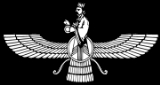
, the faravahar
, one of the best known symbols of Zoroastrianism, is commonly believed to be the depiction of one. The attribution of the name (which derives from the Middle Iranian
word for fravashi) to the symbol is probably a later development. In Avestan language
grammar, the fravashi are unmistakably female, while the faravahar symbol is unmistakably male.
In the hierarchy of the yazata
s, the fravashis are the assistants of the Amesha Spenta
Haurvatat
(MP
: Khordad) of "Wholeness", whose special domain are "the Waters" (Avestan Apo
, MP: Aban).
In the day-name dedications of the Zoroastrian calendar
, the fravashis preside over the 19th day of the month and the 1st month of the year, and both are named Farvadin after these yazatas. The Iranian civil calendar
of 1925 follows Zoroastrian month-naming conventions and hence also has Farvadin as the name of the first month of the year.
Avesta
The Avesta is the primary collection of sacred texts of Zoroastrianism, composed in the Avestan language.-Early transmission:The texts of the Avesta — which are all in the Avestan language — were composed over the course of several hundred years. The most important portion, the Gathas,...
of an individual, who sends out the urvan (often translated as 'soul') into the material world to fight the battle of good versus evil. On the morning of the fourth day after death, the urvan returns to its fravashi, where its experiences in the material world are collected.
Etymology
In general, fravashi is believed to have at its root var- "to choose." From reconstructed *fravarti (/rt/ clusters in Avestan usually appear as /š/), fravashi could then be interpreted to mean "one who has been selected (for exaltation)." Also following var- "to choose" is the interpretation as "to choose/profess a faith," as also attested in the word fravarane, the name of the Zoroastrian credoCredo
A credo |Latin]] for "I Believe") is a statement of belief, commonly used for religious belief, such as the Apostles' Creed. The term especially refers to the use of the Nicene-Constantinopolitan Creed in the Mass, either as text, Gregorian chant, or other musical settings of the...
.
Other interpretations take other meanings of var- into consideration: Either as var- "to cover" that in a bahuvrihi
Bahuvrihi
A bahuvrihi compound is a type of compound that denotes a referent by specifying a certain characteristic or quality the referent possesses. A bahuvrihi is exocentric, so that the compound is not a hyponym of its head...
with fra- "to ward" provides "protective valor," or a derivation from var- "to make/be pregnant" which gives "promoter of birth, birth-spirit." One interpretation considers a derivation from vart- "turn" hence "turning away, departing, death."
In scripture
The concept of the fravashis, unlike that of many of the other yazatasYazata
Yazata is the Avestan language word for a Zoroastrian concept. The word has a wide range of meanings but generally signifies a divinity...
, does not appear to have an equivalent in other Indo-Iranian religions. Although there are parallels with the Indian pitaras and Greek Prythani, the historical development of the concept is unclear, and there are several conflicting theories as to when and why fravashis received the role they play in the texts of the Avesta
Avesta
The Avesta is the primary collection of sacred texts of Zoroastrianism, composed in the Avestan language.-Early transmission:The texts of the Avesta — which are all in the Avestan language — were composed over the course of several hundred years. The most important portion, the Gathas,...
. Boyce
Mary Boyce
Nora Elisabeth Mary Boyce was a British scholar of Iranian languages, and an authority on Zoroastrianism...
speculates that perhaps the fravashis are the remnants of the hero-cult of the "Iranian Heroic Age" (c. 1500 BCE onwards), when ancestor-worship was widespread.
Early Zoroastrian texts such as Yasht
Yasht
The s are a collection of twenty-one hymns in Younger Avestan. Each of these hymns invokes a specific Zoroastrian divinity or concept. Yasht chapter and verse pointers are traditionally abbreviated as Yt....
17 make a clear departure from ancestor worship, but the fravashis may have been re-integrated later in an effort to make the religion more widely acceptable. The military prowess of the fravashis is celebrated throughout the Yashts, and in two sections they are clearly identified with the urvan. According to Boyce, both are more consistent with the beliefs of the Iranian Heroic Age than with the philosophy expressed in the Gathas
Gathas
The Gathas are 17 hymns believed to have been composed by Zarathusthra himself. They are the most sacred texts of the Zoroastrian faith.-Structure and organization:...
, the most important part of the Avesta
Avesta
The Avesta is the primary collection of sacred texts of Zoroastrianism, composed in the Avestan language.-Early transmission:The texts of the Avesta — which are all in the Avestan language — were composed over the course of several hundred years. The most important portion, the Gathas,...
and thought to have been composed by Zoroaster
Zoroaster
Zoroaster , also known as Zarathustra , was a prophet and the founder of Zoroastrianism who was either born in North Western or Eastern Iran. He is credited with the authorship of the Yasna Haptanghaiti as well as the Gathas, hymns which are at the liturgical core of Zoroastrianism...
himself.
The fravashis are not mentioned at all in the Gathas. The earliest mention of them is in the Haptan Yasht, where they are mentioned several times. In chapter 57 of the Yasna
Yasna
Yasna is the name of the primary liturgical collection of texts of the Avesta as well as the name of the principal Zoroastrian act of worship at which those verses are recited. The Yasna, or Izeshne, is primarily the name of the ceremony in which the entire book is recited and appropriate...
, the fravashis are responsible for the course of the sun, moon, and stars (and will do so until the renovation of this world), and in nurturing waters and plants, and protecting the unborn in the womb. They would annually strive to ensure that "family, settlement, tribe, and country" had rain.
The principal source of information on the fravashis is Yasht
Yasht
The s are a collection of twenty-one hymns in Younger Avestan. Each of these hymns invokes a specific Zoroastrian divinity or concept. Yasht chapter and verse pointers are traditionally abbreviated as Yt....
13 (Farvardin Yasht), the hymn that is addressed to them and in which they appear as beings who inhabit the stratosphere, and aid and protect those who worship them. In this hymn, the farvashis are described as a vast host of "many hundreds, many thousands, many tens of thousands" aiding Ahura Mazda
Ahura Mazda
Ahura Mazdā is the Avestan name for a divinity of the Old Iranian religion who was proclaimed the uncreated God by Zoroaster, the founder of Zoroastrianism...
in the creation of the universe.
In tradition
Although there is no physical description of a fravashi in the AvestaAvesta
The Avesta is the primary collection of sacred texts of Zoroastrianism, composed in the Avestan language.-Early transmission:The texts of the Avesta — which are all in the Avestan language — were composed over the course of several hundred years. The most important portion, the Gathas,...
, the faravahar
Faravahar
Faravahar is one of the best-known symbols of Zoroastrianism, the state religion of ancient Iran. This religious-cultural symbol was adapted by the Pahlavi dynasty to represent the Iranian nation....
, one of the best known symbols of Zoroastrianism, is commonly believed to be the depiction of one. The attribution of the name (which derives from the Middle Iranian
Iranian languages
The Iranian languages form a subfamily of the Indo-Iranian languages which in turn is a subgroup of Indo-European language family. They have been and are spoken by Iranian peoples....
word for fravashi) to the symbol is probably a later development. In Avestan language
Avestan language
Avestan is an East Iranian language known only from its use as the language of Zoroastrian scripture, i.e. the Avesta, from which it derives its name...
grammar, the fravashi are unmistakably female, while the faravahar symbol is unmistakably male.
In the hierarchy of the yazata
Yazata
Yazata is the Avestan language word for a Zoroastrian concept. The word has a wide range of meanings but generally signifies a divinity...
s, the fravashis are the assistants of the Amesha Spenta
Amesha Spenta
' is an Avestan language term for a class of divine entities in Zoroastrianism, and literally means "Bounteous Immortal" The noun is amesha "immortal", and spenta "furthering, strengthening, bounteous, holy" is an adjective of it...
Haurvatat
Haurvatat
Haurvatat is the Avestan language word for the Zoroastrian concept of "wholeness" or "perfection." The hypostasis of that concept is the divinity Haurvatat, who is the Amesha Spenta of water , prosperity, and health....
(MP
Middle Persian
Middle Persian , indigenously known as "Pârsig" sometimes referred to as Pahlavi or Pehlevi, is the Middle Iranian language/ethnolect of Southwestern Iran that during Sassanid times became a prestige dialect and so came to be spoken in other regions as well. Middle Persian is classified as a...
: Khordad) of "Wholeness", whose special domain are "the Waters" (Avestan Apo
Aban
Apas is the Avestan language term for "the waters", which—in its innumerable aggregate states—is represented by the Apas, the hypostases of the waters....
, MP: Aban).
In the day-name dedications of the Zoroastrian calendar
Zoroastrian calendar
This article treats of the reckoning of days, months and years in the calendar used by adherents of the Zoroastrian faith. Zoroastrian religious festivals are discussed elsewhere, but have a fixed relationship to Nawruz, the New Year festival, whose timing is discussed below...
, the fravashis preside over the 19th day of the month and the 1st month of the year, and both are named Farvadin after these yazatas. The Iranian civil calendar
Iranian calendar
The Iranian calendars or sometimes called Persian calendars are a succession of calendars invented or used for over two millennia in Greater Iran...
of 1925 follows Zoroastrian month-naming conventions and hence also has Farvadin as the name of the first month of the year.