
|
|
|
|
Frank Nitti
|
| |
|
| |
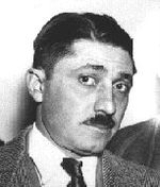
Francesco Raffaele Nitto, better known as "Frank 'The Enforcer' Nitti" (January 27, 1888(?) – March 19, 1943) was an Italian-American gangster, one of the top henchmen of Al Capone and later the front man for the mob Capone created, the Chicago Outfit.
k Nitti was born in Sicily in the 1880s; his gravestone lists his birth year as 1888, but his US immigration documents say 1883.

Discussion
Ask a question about 'Frank Nitti'
Start a new discussion about 'Frank Nitti'
Answer questions from other users
|
Encyclopedia
Francesco Raffaele Nitto, better known as "Frank 'The Enforcer' Nitti" (January 27, 1888(?) – March 19, 1943) was an Italian-American gangster, one of the top henchmen of Al Capone and later the front man for the mob Capone created, the Chicago Outfit.
Early life and prohibition
Frank Nitti was born in Sicily in the 1880s; his gravestone lists his birth year as 1888, but his US immigration documents say 1883. He emigrated to New York City after the end of World War I, and later moved to Chicago, where he set up business as a barber, with a profitable line as a small-time jewel thief and fence on the side. Nitti built an extensive network of associates in the Chicago underworld, and eventually came to the attention of Chicago crime boss Johnny Torrio.
Under Torrio's successor, Al Capone, Nitti's reputation soared. Nitti ran Capone's Prohibition-busting liquor smuggling and distribution operation, importing whiskey from Canada and selling it through a network of speakeasies around Chicago. Nitti was one of Capone's top lieutenants, trusted for his leadership skills and business acumen. In fact, Capone thought enough of Nitti that when he briefly went to prison in 1929, he named Nitti as a member of a triumvirate that ran the mob in his place. Nitti was head of operations, with Jake "Greasy Thumb" Guzik as head of administration and Tony Accardo as head of enforcement.
Despite his nickname "The Enforcer", Nitti used Mafia "soldiers" and other underlings to commit violence rather than do it himself. Not that Nitti was averse to using firearms - he had, in earlier days, been one of Capone's most trusted personal bodyguards - but as he rose in the organization, his business instinct dictated that he must personally avoid the "dirty work" - that was what the hitmen were paid for.
The Outfit under Nitti
In 1931, both Frank Nitti and Al Capone were convicted of tax evasion and sent to prison. However, Nitti only received an 18-month sentence while Capone was sent away for 11 years. Nitti was not a troublesome prisoner, but he found the year-and-a-half confinement in a cell horrifying because of the closed-in space. When Nitti was released in 1932, the media hailed him as the new boss of the Capone Gang.
In truth, however, Nitti was only a front man. According to crime reporter and Mafia expert Carl Sifakis, "it was ludicrous" to expect people such as Paul Ricca, Tony Accardo, Jake Guzik and Murray "The Camel" Humphreys to take orders from Nitti. By all accounts, Ricca had the real power by at least 1932 and was clearly the de facto boss by 1939, even though he was technically Nitti's underboss. Ricca frequently overruled Nitti's orders by saying, "We'll do it this way. Now let's hear no more about it!" When Lucky Luciano and Meyer Lansky organized the National Crime Syndicate that year, they considered Nitti a human cipher. Lansky and Luciano dealt with Ricca, not Nitti, as the boss of the Capones.
With Nitti as the front man, the Chicago Outfit branched out from prostitution and gambling into other areas, including the control of labor unions (which led to the extortion of many businesses). The mob became more streamlined at this time, and earned huge amounts of profit.
On December 19, 1932, a team of Chicago police headed by Detective Sergeants Harry Lang and Harry Miller, raided Nitti's office, in Room 554, at 221 N. LaSalle (Blvd.). Lang shot Nitti three times in the back and neck. He then shot himself (a minor flesh wound) to make the shooting look like self-defense, claiming that Nitti had shot him first. Court testimony later revealed that the murder attempt was personally ordered by newly-elected Chicago Mayor Anton Cermak. Cermak wanted to push out the Capones in favor of gangsters who answered to him.
Unfortunately for Cermak, Nitti survived the shooting. In February 1933, Nitti was acquitted of attempted murder. During that same trial, Miller testified that Lang received $15,000 to kill Nitti. Another uniformed officer who was present at the shooting testified that Nitti was gunned down unarmed. Harry Lang and Harry Miller were both fired from the police force and each fined $100 for simple assault.
Two months later, Cermak was shot and killed by Giuseppe Zangara, a Calabrian immigrant. At the time, Cermak was talking to President-elect Franklin Roosevelt. Most historians believe that Zangara intended to kill FDR, but missed and hit Cermak instead. However, others believe that Nitti ordered a hit on Cermak, and the contract eventually went to Zangara. Zangara had been known as one of the Italian Army's best marksmen before coming to the United States, leading to speculation that Cermak had been the intended target after all.
On November 8, 1939 Capone's former lawyer Edward J. O'Hare - who had co-operated in bringing about Capone's downfall - was shot and killed. Nitti married Ursula Sue Granata, O'Hare's fiancée. His family tree lives on in the Lake Cook Area.
Downfall and death
In 1943, many top members of the Chicago Outfit were indicted for extorting the Hollywood film industry. These individuals included Nitti, Ricca, Louis "Little New York" Campagna, Ralph Pierce, Johnny Roselli, Nick Circella, Phil D'Andrea, and Charles "Cherry Nose" Gioe. The Outfit was accused of trying to strong arm some of the largest Hollywood movie studios, including MGM Studios, Paramount Pictures, 20th Century Fox, Columbia Pictures, and RKO Radio Pictures. The studios had cooperated with The Outfit to avoid union trouble stirred up by the mob.
At a meeting of Outfit leaders at Nitti's home, Ricca angrily blamed Nitti for the indictments. Ricca said that since this had been Nitti's scheme and that the FBI informant, Willie Bioff, had been Nitti's trusted associate, Nitti should take the fall for the Outfit and go to prison. A severe claustrophobic as a result of his first prison term, Nitti dreaded the idea of another prison confinement. It was also rumored that he was suffering from terminal cancer at this time. For these or other reasons, he ultimately decided to take his own life.
The day before his scheduled grand jury appearance, Nitti shared breakfast with his wife in their Riverside, Illinois home at 712 Selborne Road. As his wife was leaving for church, Nitti told her he planned to take a walk. After his wife left, Nitti began to drink heavily. He then loaded a .32 caliber revolver, put it in his coat pocket, and walked five blocks to a local railroad yard. Two railroad workers (William F. Sebauer and Lowell M. Barnett) spotted Nitti walking on the track of an oncoming train and shouted a warning. They thought the train hit him, but Nitti had managed to jump out of the way in time. Then two shots rang out. The trainmen first thought Nitti was shooting at them, but then realized he was trying to shoot himself in the head. The two bullets went through his hat. Nitti finally sat on the ground against a fence and, with the railroad workers watching from a distance, shot himself in the head. Frank Nitti died on an Illinois Central railroad branch line in North Riverside, Illinois on March 19, 1943.
Music
In the song, "Lifestylez Ov Da Poor & Dangerous," by Big L, he raps, "We stormed the city, shootin' shit up like Frank Nitty//
We robbed kids and split the dough 50/50.
Frank Nitti is referenced in the song "Fat Cats and Bigga Fish", by Bay Area rap group The Coup. In the song, the Mayor of Oakland "treats young black men like Frank Nitti."
Frank Nitti is mentioned in the song "Problem Child" by 3rd Bass. MC Serch raps "So now you perped the role, the role of Frank Nitti. He ain't a hero cause he landed on the roof of a Chevy"
In the song "Bomb First (My Second Reply)" by Makaveli on The Don Killumanati: The Seven Day Theory, Makaveli references him when he says, "I think I'm tougher than Nitti, my attitude's shitty".
Allusions in popular culture
Frank Nitti is also referenced in Brother Arthur's classic hip-hop 12-inch Year of the Nine. The lyric - "Isn't it a pity, that livin' in the city is like livin' in the times of Frank Nitti" - was perhaps made more famous by, "Group Home," in the chorus to their popular song, Up Against The Wall.
Frank Nitti appears on the goalie mask of Philadelphia Flyers goaltender Antero Niittymäki.
There is a rapper named Nitti, whose most famous song is a collaboration with Yung Joc called "It's Goin Down".
"Frankie's Gun" by the Felice Brothers is believed to be about Frank Nitti.
Frank Nitti is played by Stanley Tucci in Road to Perdition, a 2002 film directed by Sam Mendes and starring Tom Hanks.
Frank Nitti's name appears in a song called 24/7 by a Detroit rapper named Esham the lyrics are as follows - "I stay true to my city
now aint that a pity? I chopped off a gangsta hoe titty. My attitude is just like Frank Nitti.... shitty, all 24/7".
Frank Nitti is also referenced in the Twiztid song titled "untitled track" the lyrics are as follows spoke by Jamie Madrox "Frank Nitti is a goner"
Further reading
- Binder, John J. The Chicago Outfit. Arcadia Publishing, 2003. ISBN 0-7385-2326-7
External links
|
| |
|
|