

Francisella

Encyclopedia
Francisella is a genus
of pathogen
ic, Gram-negative
bacteria. They are small coccobacillary
or rod-shaped
, non-motile organisms, which are also facultative intracellular
parasites of macrophage
s. Strict aerobes
, Francisella colonies bear a morphological resemblance to those of the genus Brucella
.
The genus was named in honor of American bacteriologist
Edward Francis, who, in 1922, first recognized F. tularensis (then named Bacterium tularensis) as the causative agent of tularemia
.
, causes the disease tularemia
or rabbit fever. F. novicida and F. philomiragia (previously Yersinia philomiragia) are associated with septicemia and invasive systemic infections. The taxonomy of the genus is somewhat uncertain, especially in the case of F. novicida (may be a subspecies of F. tularensis). In general, identification of species is accomplished by biochemical profiling or 16S rRNA sequencing.
supplementation) and the organisms are fastidious
, with most Francisella strains requiring cystine
and cysteine
media supplementation for growth. Growth has been successful on several media types, including chocolate agar
and Thayer-Martin media with appropriate additives as noted above. Attempted isolation on MacConkey agar
is not reliable or generally successful.
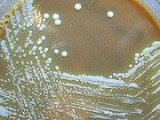
After 24 hours of incubation on appropriate solid media, Francisella colonies are generally small (1 to 2 mm), opaque
, and white-gray to bluish-gray in color. Colonies are smooth, with clean edges and, after a 48 hours of growth, tend to have a shiny surface.
Genus
In biology, a genus is a low-level taxonomic rank used in the biological classification of living and fossil organisms, which is an example of definition by genus and differentia...
of pathogen
Pathogen
A pathogen gignomai "I give birth to") or infectious agent — colloquially, a germ — is a microbe or microorganism such as a virus, bacterium, prion, or fungus that causes disease in its animal or plant host...
ic, Gram-negative
Gram-negative
Gram-negative bacteria are bacteria that do not retain crystal violet dye in the Gram staining protocol. In a Gram stain test, a counterstain is added after the crystal violet, coloring all Gram-negative bacteria with a red or pink color...
bacteria. They are small coccobacillary
Coccobacillus
A coccobacillus is a type of rod-shaped bacteria. The word coccobacillus reflects an intermediate shape between coccus and bacillus . Coccobacilli rods are so short and wide that they resemble cocci. Haemophilus influenzae and Chlamydia trachomatis are coccobacilli...
or rod-shaped
Bacillus
Bacillus is a genus of Gram-positive, rod-shaped bacteria and a member of the division Firmicutes. Bacillus species can be obligate aerobes or facultative anaerobes, and test positive for the enzyme catalase. Ubiquitous in nature, Bacillus includes both free-living and pathogenic species...
, non-motile organisms, which are also facultative intracellular
Intracellular
Not to be confused with intercellular, meaning "between cells".In cell biology, molecular biology and related fields, the word intracellular means "inside the cell".It is used in contrast to extracellular...
parasites of macrophage
Macrophage
Macrophages are cells produced by the differentiation of monocytes in tissues. Human macrophages are about in diameter. Monocytes and macrophages are phagocytes. Macrophages function in both non-specific defense as well as help initiate specific defense mechanisms of vertebrate animals...
s. Strict aerobes
Aerobic organism
An aerobic organism or aerobe is an organism that can survive and grow in an oxygenated environment.Faculitative anaerobes grow and survive in an oxygenated environment and so do aerotolerant anaerobes.-Glucose:...
, Francisella colonies bear a morphological resemblance to those of the genus Brucella
Brucella
Brucella is a genus of Gram-negative bacteria. They are small , non-motile, non-encapsulated coccobacilli, which function as facultative intracellular parasites....
.
The genus was named in honor of American bacteriologist
Microbiology
Microbiology is the study of microorganisms, which are defined as any microscopic organism that comprises either a single cell , cell clusters or no cell at all . This includes eukaryotes, such as fungi and protists, and prokaryotes...
Edward Francis, who, in 1922, first recognized F. tularensis (then named Bacterium tularensis) as the causative agent of tularemia
Tularemia
Tularemia is a serious infectious disease caused by the bacterium Francisella tularensis. A Gram-negative, nonmotile coccobacillus, the bacterium has several subspecies with varying degrees of virulence. The most important of those is F...
.
Pathogenesis
The type species, F. tularensisFrancisella tularensis
Francisella tularensis is a pathogenic species of gram-negative bacteria and the causative agent of tularemia or rabbit fever. It is a facultative intracellular bacterium....
, causes the disease tularemia
Tularemia
Tularemia is a serious infectious disease caused by the bacterium Francisella tularensis. A Gram-negative, nonmotile coccobacillus, the bacterium has several subspecies with varying degrees of virulence. The most important of those is F...
or rabbit fever. F. novicida and F. philomiragia (previously Yersinia philomiragia) are associated with septicemia and invasive systemic infections. The taxonomy of the genus is somewhat uncertain, especially in the case of F. novicida (may be a subspecies of F. tularensis). In general, identification of species is accomplished by biochemical profiling or 16S rRNA sequencing.
Laboratory characteristics
Francisella can survive for several weeks in the environment; paradoxically, they can be difficult to culture and maintain in the lab. Growth is slow (though increased by CO2Carbon dioxide
Carbon dioxide is a naturally occurring chemical compound composed of two oxygen atoms covalently bonded to a single carbon atom...
supplementation) and the organisms are fastidious
Growth medium
A growth medium or culture medium is a liquid or gel designed to support the growth of microorganisms or cells, or small plants like the moss Physcomitrella patens.There are different types of media for growing different types of cells....
, with most Francisella strains requiring cystine
Cystine
Cystine is a dimeric amino acid formed by the oxidation of two cysteine residues that covalently link to make a disulfide bond. This organosulfur compound has the formula 2. It is a white solid, and melts at 247-249 °C...
and cysteine
Cysteine
Cysteine is an α-amino acid with the chemical formula HO2CCHCH2SH. It is a non-essential amino acid, which means that it is biosynthesized in humans. Its codons are UGU and UGC. The side chain on cysteine is thiol, which is polar and thus cysteine is usually classified as a hydrophilic amino acid...
media supplementation for growth. Growth has been successful on several media types, including chocolate agar
Chocolate agar
Chocolate agar - is a non-selective, enriched growth medium. It is a variant of the blood agar plate. It contains red blood cells, which have been lysed by heating very slowly to 56 °C. Chocolate agar is used for growing fastidious respiratory bacteria, such as Haemophilus influenzae...
and Thayer-Martin media with appropriate additives as noted above. Attempted isolation on MacConkey agar
MacConkey agar
MacConkey agar is a culture medium designed to grow Gram-negative bacteria and stain them for lactose fermentation.-Contents:It contains bile salts MacConkey agar is a culture medium designed to grow Gram-negative bacteria and stain them for lactose fermentation.-Contents:It contains bile salts...
is not reliable or generally successful.
After 24 hours of incubation on appropriate solid media, Francisella colonies are generally small (1 to 2 mm), opaque
Opacity (optics)
Opacity is the measure of impenetrability to electromagnetic or other kinds of radiation, especially visible light. In radiative transfer, it describes the absorption and scattering of radiation in a medium, such as a plasma, dielectric, shielding material, glass, etc...
, and white-gray to bluish-gray in color. Colonies are smooth, with clean edges and, after a 48 hours of growth, tend to have a shiny surface.
External links
- Francisella genomes and related information at PATRIC, a Bioinformatics Resource Center funded by NIAID
- Francisella in Cod