

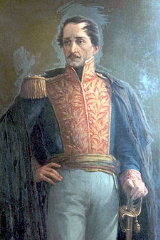
Francisco de Paula Santander

Encyclopedia
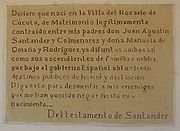
Francisco José de Paula Santander y Omaña (Villa del Rosario de Cúcuta
, Colombia
, April 2, 1792 – Santafé de Bogotá
, Colombia, May 6, 1840), was a Colombian military and political leader during the 1810–1819 independence war of the United Provinces of New Granada
(present-day Colombia). He was the acting President of Gran Colombia
between 1819 and 1826, and later elected by Congress as the President of the Republic of New Granada
between 1832 and 1837. Santander came to be known as "The Man of the Laws" ("El Hombre de las Leyes").
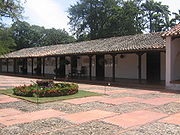
, Norte de Santander, on April 2, 1792. He died in Santa Fe de Bogotá, Cundinamarca
, on March 6, 1840.
 A law
A law
student, he began his military career at the young age of eighteen, following the establishment of junta
s in 1810, which began the process of independence in New Granada
. Santander enlists in the revolutionary army in October 1810, in the battalion the National Guard ("Guardias Nacionales"). He first served as a soldier in army of the federalist
United Provinces of New Granada
, under the command of General Antonio Baraya, that fought against General Antonio Nariño
, of the Province of Cundinamarca, who had refused to recognize the authority of the Union. During these campaigns Santander achieved the rank of colonel
in 1812. After the royalist forces re-conquered New Granada, Santander like many other New Granadan officers retreated to the plains east of the Cordillera Oriental, the Llanos
, near the modern Venezuela
n border. There, Santander joined forces with Venezuelan patriots and operated under the command of Simón Bolívar
. During the military campaign across the Andes
, Bolívar promoted Santander to Brigadier General
in 1817.
By 1819, Santander was given command of the republican army's vanguard by Bolívar during the campaign to liberate New Granada. Santander was one of the battlefield commanders during the republican victory at the battle of "el Pantano de Vargas" (Vargas Swamp Battle
) and later at the Battle of Boyacá
, on August 7 of that same year. After these battles, he was promoted to Commanding General, the equivalent of a modern major general
.
was proclaimed, Santander was elected by the newly gathered Congress as Vice President
of Gran Colombia
, in a heated election, where he overcame the other strong candidate for the post, the former leader of Cundinamarca, General Antonio Nariño
, by a margin of 38 to 19 votes. Santander was placed in charge of the government of New Granada, while Bolívar returned to Venezuela to propose the union of Venezuela and New Granada to the Venezuelan congress.
, despite being the President of the new republic, decided to continue leading the republican forces in their southern campaigns in Ecuador
and Peru
, the office of President of Gran Colombia was entrusted to General Santander. The Constitution mandated that the vice-president remain in Bogotá
in such cases and handle the functions of the executive branch of government
. As acting ruler, Santander had to deal with a grave economic crisis—that was one of the direct consequences of a decade of constant warfare—pockets of royalist sentiment in Gran Colombian society, supplying the logistics
of the continuing military operations, administrative and legislative reactivation, and the establishment of internal political divisions. During this period Santander definitely moved towards a centralist political philosophy
and upheld the legitimacy of the Cucutá Constitution against federalist and regionalist
pretensions. Santander also made a concerted move toward free trade
. He removed and reduced many taxes which had been left in place from Spanish rule and opened ports to all foreign nations. He also created incentives for immigrants, including expedited naturalization
—applicants were allowed to leave the country for up to six months without interrupting their legally "required" stay—and land grants. Bolívar undid many of Santander's actions after he returned in 1826 and reassumed his position as president, often ruling through emergency decree
.
During his first administration, and in an effort to stabilize the new nation, Santander ordered the execution of most of the Spanish officers in captivity, among them General José María Barreirio. General Bolívar, in a letter sent to Santander from Pamplona
, expressed his sadness and disapproval.
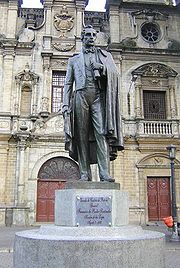 Initially, Santander and Bolívar were considered as close friends and allies, but gradually political and ideological differences emerged. It is considered by modern scholars that Santander believed in the sanctity of constitutional government and in the rule of law, perhaps to a greater degree than Bolívar, who would have allegedly thought that those concerns were secondary to what he perceived as the actual needs and solutions that historical circumstances demanded, and thus could be subject to flexibility.
In 1826, when the first Venezuela
n uprising occurred, Santander and Bolívar came to disagree about how to handle the situation. Santander believed that the rebels, led by José Antonio Páez
and federalist
sympathizers, should be punished or at least made to openly submit to the established constitutional order. When Bolívar, who had returned from Peru
and reasumed his executive powers, arranged for an amnesty
and placed Páez as supreme military chief of the department of Venezuela, Santander felt that the central government's authority and the rule of law were being undermined by the constitutional President himself in a personalist manner.
Santander also disagreed with Bolívar's attempt to promote a reform of the 1821 constitution before it was legally permitted (the constitution stated that ten years had to go by), and especially with Bolívar's attempted nationwide implementation of the constitution that he had previously drafted for Bolivia
, which among other provisions called for a lifelong presidency with the ability to select a direct successor. In Santander's opinion, this could place the country dangerously close to monarchism
.
In 1828, growing internal conflicts continued. Santander was elected as one of the delegates to the Ocaña
constitutional convention, during which both his supporters and other opposition political factions blocked Bolívar's attempts at reform. This led to the sudden exit of many of the Bolivarian delegates, who disagreed with the Convention's potential outcome.
These events eventually led Bolívar to declare himself dictator
in August of that year, while the office of the vice president was abolished.
Santander and his political sympathizers felt that this act betrayed liberalism
and the ideology of the Age of Enlightenment
, some even comparing Bolívar to Napoleon or Julius Caesar
.
On September 25, 1828, Bolívar escaped an assassination attempt. Among those blamed was Santander who, in a quick military trial, was originally sentenced to die without specific proof of his participation in the event. That same day Santander was arrested and later tried, condemned and sentenced to death. But President Bolívar pardoned him, commuted his sentence and ordered his exile.
Even today, the details are not totally clear and the evidence appears to be inconclusive. Some historians consider that Santander knew about the possibility of an assassination attempt and initially opposed it, but eventually allowed it to happen without his direct participation. This position was eventually assumed by Santander himself later in his life. Others consider that Santander may have been involved in the plan from the beginning as it would benefit him politically, though no direct proof of his role has been found.
 After Bolívar died and the Gran Colombia broke up, Santander returned from exile in 1832 and served as President of Republic of New Granada
from 1832 to 1836. Santander had spent a great deal of time in Europe studying the Enlightenment
. When he returned, these concepts influenced his decisions to a great extent.
. He first reverted most of his original changes from Bolívar's undoing, although some were devalued somewhat. He did not close New Granada to international trade, but rather sought safety for New Granada under the auspices of industrialized
nations, instead of discouraging trade with them. He set up economic contacts in eleven United States cities, hoped that by creating strong ties with them, he would promote industrial development in New Granada while avoiding the use of high tariff
s, which he inherently disliked.
During his second administration, just like he did during his first administration, and in an effort to stabilize the new nation, he ordered the execution of most of the Spanish officers in captivity, among them General José Sardá. They were executed in Bogotá
, on July 23, 1833, in front of Santander himself.
After his term expired, he remained an important and influential political figure. He died in 1840 and was eventually considered as one of the original ideological founders of the Colombian Liberal Party
, which would be formally established some eight years later.
Cúcuta
Cúcuta is a Colombian city, capital of Norte de Santander, in the northeast of the country. Due to its proximity to the Colombian-Venezuelan border, Cúcuta is an important commercial center. The city has the constitutional category of Special District. It is located at the most active...
, Colombia
Colombia
Colombia, officially the Republic of Colombia , is a unitary constitutional republic comprising thirty-two departments. The country is located in northwestern South America, bordered to the east by Venezuela and Brazil; to the south by Ecuador and Peru; to the north by the Caribbean Sea; to the...
, April 2, 1792 – Santafé de Bogotá
Bogotá
Bogotá, Distrito Capital , from 1991 to 2000 called Santa Fé de Bogotá, is the capital, and largest city, of Colombia. It is also designated by the national constitution as the capital of the department of Cundinamarca, even though the city of Bogotá now comprises an independent Capital district...
, Colombia, May 6, 1840), was a Colombian military and political leader during the 1810–1819 independence war of the United Provinces of New Granada
United Provinces of New Granada
The United Provinces of New Granada was a country in South America from 1811 to 1816, a period known in Colombian history as the Patria Boba. It was formed from areas of the New Kingdom of Granada. The government was a federation with a parliamentary system, consisting of a weak executive and...
(present-day Colombia). He was the acting President of Gran Colombia
Gran Colombia
Gran Colombia is a name used today for the state that encompassed much of northern South America and part of southern Central America from 1819 to 1831. This short-lived republic included the territories of present-day Colombia, Venezuela, Ecuador, Panama, northern Peru and northwest Brazil. The...
between 1819 and 1826, and later elected by Congress as the President of the Republic of New Granada
Republic of New Granada
The Republic of New Granada was a centralist republic consisting primarily of present-day Colombia and Panama with smaller portions of today's Ecuador, and Venezuela. It was created after the dissolution in 1830 of Gran Colombia. It was later abolished in 1858 when the Granadine Confederation was...
between 1832 and 1837. Santander came to be known as "The Man of the Laws" ("El Hombre de las Leyes").
Biographic data
Santander was born in CúcutaCúcuta
Cúcuta is a Colombian city, capital of Norte de Santander, in the northeast of the country. Due to its proximity to the Colombian-Venezuelan border, Cúcuta is an important commercial center. The city has the constitutional category of Special District. It is located at the most active...
, Norte de Santander, on April 2, 1792. He died in Santa Fe de Bogotá, Cundinamarca
Cundinamarca Department (1824)
Cundinamarca Department was one the departments of Gran Colombia. It was part of the Centro District.- Provinces :* Bogotá Province. Capital: Bogotá. Cantones: Bogotá, Funza, Guaduas, Mesa, Tocaima, Ubaté y Zipaquirá....
, on March 6, 1840.
Military career
Law
Law is a system of rules and guidelines which are enforced through social institutions to govern behavior, wherever possible. It shapes politics, economics and society in numerous ways and serves as a social mediator of relations between people. Contract law regulates everything from buying a bus...
student, he began his military career at the young age of eighteen, following the establishment of junta
Junta (Peninsular War)
In the Napoleonic era, junta was the name chosen by several local administrations formed in Spain during the Peninsular War as a patriotic alternative to the official administration toppled by the French invaders...
s in 1810, which began the process of independence in New Granada
Viceroyalty of New Granada
The Viceroyalty of New Granada was the name given on 27 May 1717, to a Spanish colonial jurisdiction in northern South America, corresponding mainly to modern Colombia, Ecuador, Panama, and Venezuela. The territory corresponding to Panama was incorporated later in 1739...
. Santander enlists in the revolutionary army in October 1810, in the battalion the National Guard ("Guardias Nacionales"). He first served as a soldier in army of the federalist
Federalist
The term federalist describes several political beliefs around the world. Also, it may refer to the concept of federalism or the type of government called a federation...
United Provinces of New Granada
United Provinces of New Granada
The United Provinces of New Granada was a country in South America from 1811 to 1816, a period known in Colombian history as the Patria Boba. It was formed from areas of the New Kingdom of Granada. The government was a federation with a parliamentary system, consisting of a weak executive and...
, under the command of General Antonio Baraya, that fought against General Antonio Nariño
Antonio Nariño
Antonio de la Santísima Concepción Nariño y Álvarez was an ideological Colombian precursor and one of the early political and military leaders of the independence movement in the New Granada - Early political activity :Nariño was born to an aristocratic family...
, of the Province of Cundinamarca, who had refused to recognize the authority of the Union. During these campaigns Santander achieved the rank of colonel
Colonel
Colonel , abbreviated Col or COL, is a military rank of a senior commissioned officer. It or a corresponding rank exists in most armies and in many air forces; the naval equivalent rank is generally "Captain". It is also used in some police forces and other paramilitary rank structures...
in 1812. After the royalist forces re-conquered New Granada, Santander like many other New Granadan officers retreated to the plains east of the Cordillera Oriental, the Llanos
Llanos
The Llanos is a vast tropical grassland plain situated to the east of the Andes in Colombia and Venezuela, in northwestern South America. It is an ecoregion of the Flooded grasslands and savannas Biome....
, near the modern Venezuela
Venezuela
Venezuela , officially called the Bolivarian Republic of Venezuela , is a tropical country on the northern coast of South America. It borders Colombia to the west, Guyana to the east, and Brazil to the south...
n border. There, Santander joined forces with Venezuelan patriots and operated under the command of Simón Bolívar
Simón Bolívar
Simón José Antonio de la Santísima Trinidad Bolívar y Palacios Ponte y Yeiter, commonly known as Simón Bolívar was a Venezuelan military and political leader...
. During the military campaign across the Andes
Andes
The Andes is the world's longest continental mountain range. It is a continual range of highlands along the western coast of South America. This range is about long, about to wide , and of an average height of about .Along its length, the Andes is split into several ranges, which are separated...
, Bolívar promoted Santander to Brigadier General
Brigadier General
Brigadier general is a senior rank in the armed forces. It is the lowest ranking general officer in some countries, usually sitting between the ranks of colonel and major general. When appointed to a field command, a brigadier general is typically in command of a brigade consisting of around 4,000...
in 1817.
By 1819, Santander was given command of the republican army's vanguard by Bolívar during the campaign to liberate New Granada. Santander was one of the battlefield commanders during the republican victory at the battle of "el Pantano de Vargas" (Vargas Swamp Battle
Vargas Swamp Battle
Vargas Swamp Battle was an armed conflict that occurred near Paipa, on July 25, 1819. The joint Venezuelan and Neogranadan army commanded by Simón Bolívar was trying to prevent the Spanish forces from arriving at Santafe de Bogotá, which was lightly defended, before they did...
) and later at the Battle of Boyacá
Battle of Boyacá
The Battle of Boyacá in Colombia, then known as New Granada, was the battle in which Colombia acquired its definitive independence from Spanish Monarchy, although fighting with royalist forces would continue for years....
, on August 7 of that same year. After these battles, he was promoted to Commanding General, the equivalent of a modern major general
Major General
Major general or major-general is a military rank used in many countries. It is derived from the older rank of sergeant major general. A major general is a high-ranking officer, normally subordinate to the rank of lieutenant general and senior to the ranks of brigadier and brigadier general...
.
The Presidency
In October 1821, after the Constitution of CúcutaConstitution of Cúcuta
The Constitution of Cúcuta, also known as Constitution of the Gran Colombia and Constitution of 1821 was the founding document and constitution of the country of Gran Colombia, unifying the territories of the Viceroyalty of New Granada as part of a federation...
was proclaimed, Santander was elected by the newly gathered Congress as Vice President
Vice president
A vice president is an officer in government or business who is below a president in rank. The name comes from the Latin vice meaning 'in place of'. In some countries, the vice president is called the deputy president...
of Gran Colombia
Gran Colombia
Gran Colombia is a name used today for the state that encompassed much of northern South America and part of southern Central America from 1819 to 1831. This short-lived republic included the territories of present-day Colombia, Venezuela, Ecuador, Panama, northern Peru and northwest Brazil. The...
, in a heated election, where he overcame the other strong candidate for the post, the former leader of Cundinamarca, General Antonio Nariño
Antonio Nariño
Antonio de la Santísima Concepción Nariño y Álvarez was an ideological Colombian precursor and one of the early political and military leaders of the independence movement in the New Granada - Early political activity :Nariño was born to an aristocratic family...
, by a margin of 38 to 19 votes. Santander was placed in charge of the government of New Granada, while Bolívar returned to Venezuela to propose the union of Venezuela and New Granada to the Venezuelan congress.
First administration
Since General Simón BolívarSimón Bolívar
Simón José Antonio de la Santísima Trinidad Bolívar y Palacios Ponte y Yeiter, commonly known as Simón Bolívar was a Venezuelan military and political leader...
, despite being the President of the new republic, decided to continue leading the republican forces in their southern campaigns in Ecuador
Ecuador
Ecuador , officially the Republic of Ecuador is a representative democratic republic in South America, bordered by Colombia on the north, Peru on the east and south, and by the Pacific Ocean to the west. It is one of only two countries in South America, along with Chile, that do not have a border...
and Peru
Peru
Peru , officially the Republic of Peru , is a country in western South America. It is bordered on the north by Ecuador and Colombia, on the east by Brazil, on the southeast by Bolivia, on the south by Chile, and on the west by the Pacific Ocean....
, the office of President of Gran Colombia was entrusted to General Santander. The Constitution mandated that the vice-president remain in Bogotá
Bogotá
Bogotá, Distrito Capital , from 1991 to 2000 called Santa Fé de Bogotá, is the capital, and largest city, of Colombia. It is also designated by the national constitution as the capital of the department of Cundinamarca, even though the city of Bogotá now comprises an independent Capital district...
in such cases and handle the functions of the executive branch of government
Executive (government)
Executive branch of Government is the part of government that has sole authority and responsibility for the daily administration of the state bureaucracy. The division of power into separate branches of government is central to the idea of the separation of powers.In many countries, the term...
. As acting ruler, Santander had to deal with a grave economic crisis—that was one of the direct consequences of a decade of constant warfare—pockets of royalist sentiment in Gran Colombian society, supplying the logistics
Military logistics
Military logistics is the discipline of planning and carrying out the movement and maintenance of military forces. In its most comprehensive sense, it is those aspects or military operations that deal with:...
of the continuing military operations, administrative and legislative reactivation, and the establishment of internal political divisions. During this period Santander definitely moved towards a centralist political philosophy
Centralized government
A centralized or centralised government is one in which power or legal authority is exerted or coordinated by a de facto political executive to which federal states, local authorities, and smaller units are considered subject...
and upheld the legitimacy of the Cucutá Constitution against federalist and regionalist
Regionalism (politics)
Regionalism is a term used in international relations. Regionalism also constitutes one of the three constituents of the international commercial system...
pretensions. Santander also made a concerted move toward free trade
Free trade
Under a free trade policy, prices emerge from supply and demand, and are the sole determinant of resource allocation. 'Free' trade differs from other forms of trade policy where the allocation of goods and services among trading countries are determined by price strategies that may differ from...
. He removed and reduced many taxes which had been left in place from Spanish rule and opened ports to all foreign nations. He also created incentives for immigrants, including expedited naturalization
Naturalization
Naturalization is the acquisition of citizenship and nationality by somebody who was not a citizen of that country at the time of birth....
—applicants were allowed to leave the country for up to six months without interrupting their legally "required" stay—and land grants. Bolívar undid many of Santander's actions after he returned in 1826 and reassumed his position as president, often ruling through emergency decree
State of emergency
A state of emergency is a governmental declaration that may suspend some normal functions of the executive, legislative and judicial powers, alert citizens to change their normal behaviours, or order government agencies to implement emergency preparedness plans. It can also be used as a rationale...
.
During his first administration, and in an effort to stabilize the new nation, Santander ordered the execution of most of the Spanish officers in captivity, among them General José María Barreirio. General Bolívar, in a letter sent to Santander from Pamplona
Pamplona
Pamplona is the historial capital city of Navarre, in Spain, and of the former kingdom of Navarre.The city is famous worldwide for the San Fermín festival, from July 6 to 14, in which the running of the bulls is one of the main attractions...
, expressed his sadness and disapproval.
Political differences
In 1826, when the first Venezuela
Venezuela
Venezuela , officially called the Bolivarian Republic of Venezuela , is a tropical country on the northern coast of South America. It borders Colombia to the west, Guyana to the east, and Brazil to the south...
n uprising occurred, Santander and Bolívar came to disagree about how to handle the situation. Santander believed that the rebels, led by José Antonio Páez
José Antonio Páez
José Antonio Páez Herrera was General in Chief of the army fighting Spain during the Venezuelan Wars of Independence, in addition to becoming the President of Venezuela once it was independent of the Gran Colombia...
and federalist
Federalist
The term federalist describes several political beliefs around the world. Also, it may refer to the concept of federalism or the type of government called a federation...
sympathizers, should be punished or at least made to openly submit to the established constitutional order. When Bolívar, who had returned from Peru
Peru
Peru , officially the Republic of Peru , is a country in western South America. It is bordered on the north by Ecuador and Colombia, on the east by Brazil, on the southeast by Bolivia, on the south by Chile, and on the west by the Pacific Ocean....
and reasumed his executive powers, arranged for an amnesty
Amnesty
Amnesty is a legislative or executive act by which a state restores those who may have been guilty of an offense against it to the positions of innocent people, without changing the laws defining the offense. It includes more than pardon, in as much as it obliterates all legal remembrance of the...
and placed Páez as supreme military chief of the department of Venezuela, Santander felt that the central government's authority and the rule of law were being undermined by the constitutional President himself in a personalist manner.
Santander also disagreed with Bolívar's attempt to promote a reform of the 1821 constitution before it was legally permitted (the constitution stated that ten years had to go by), and especially with Bolívar's attempted nationwide implementation of the constitution that he had previously drafted for Bolivia
Bolivia
Bolivia officially known as Plurinational State of Bolivia , is a landlocked country in central South America. It is the poorest country in South America...
, which among other provisions called for a lifelong presidency with the ability to select a direct successor. In Santander's opinion, this could place the country dangerously close to monarchism
Monarchism
Monarchism is the advocacy of the establishment, preservation, or restoration of a monarchy as a form of government in a nation. A monarchist is an individual who supports this form of government out of principle, independent from the person, the Monarch.In this system, the Monarch may be the...
.
In 1828, growing internal conflicts continued. Santander was elected as one of the delegates to the Ocaña
Ocaña, Colombia
Ocaña is a town and municipality in the Colombian Department of Norte de Santander. Ocaña is the second largest populated center of this department. It played an important role during the Independence of Colombia from the Spanish monarchy.-History:...
constitutional convention, during which both his supporters and other opposition political factions blocked Bolívar's attempts at reform. This led to the sudden exit of many of the Bolivarian delegates, who disagreed with the Convention's potential outcome.
These events eventually led Bolívar to declare himself dictator
Dictator
A dictator is a ruler who assumes sole and absolute power but without hereditary ascension such as an absolute monarch. When other states call the head of state of a particular state a dictator, that state is called a dictatorship...
in August of that year, while the office of the vice president was abolished.
Santander and his political sympathizers felt that this act betrayed liberalism
Liberalism
Liberalism is the belief in the importance of liberty and equal rights. Liberals espouse a wide array of views depending on their understanding of these principles, but generally, liberals support ideas such as constitutionalism, liberal democracy, free and fair elections, human rights,...
and the ideology of the Age of Enlightenment
Age of Enlightenment
The Age of Enlightenment was an elite cultural movement of intellectuals in 18th century Europe that sought to mobilize the power of reason in order to reform society and advance knowledge. It promoted intellectual interchange and opposed intolerance and abuses in church and state...
, some even comparing Bolívar to Napoleon or Julius Caesar
Julius Caesar
Gaius Julius Caesar was a Roman general and statesman and a distinguished writer of Latin prose. He played a critical role in the gradual transformation of the Roman Republic into the Roman Empire....
.
On September 25, 1828, Bolívar escaped an assassination attempt. Among those blamed was Santander who, in a quick military trial, was originally sentenced to die without specific proof of his participation in the event. That same day Santander was arrested and later tried, condemned and sentenced to death. But President Bolívar pardoned him, commuted his sentence and ordered his exile.
Even today, the details are not totally clear and the evidence appears to be inconclusive. Some historians consider that Santander knew about the possibility of an assassination attempt and initially opposed it, but eventually allowed it to happen without his direct participation. This position was eventually assumed by Santander himself later in his life. Others consider that Santander may have been involved in the plan from the beginning as it would benefit him politically, though no direct proof of his role has been found.
Return from Exile
Republic of New Granada
The Republic of New Granada was a centralist republic consisting primarily of present-day Colombia and Panama with smaller portions of today's Ecuador, and Venezuela. It was created after the dissolution in 1830 of Gran Colombia. It was later abolished in 1858 when the Granadine Confederation was...
from 1832 to 1836. Santander had spent a great deal of time in Europe studying the Enlightenment
Age of Enlightenment
The Age of Enlightenment was an elite cultural movement of intellectuals in 18th century Europe that sought to mobilize the power of reason in order to reform society and advance knowledge. It promoted intellectual interchange and opposed intolerance and abuses in church and state...
. When he returned, these concepts influenced his decisions to a great extent.
Second Administration
In 1832, Santander is elected by Congress as President for a second term. This administration was quite different from the first, in that he moved away from free trade and stressed an alternate form of protectionismProtectionism
Protectionism is the economic policy of restraining trade between states through methods such as tariffs on imported goods, restrictive quotas, and a variety of other government regulations designed to allow "fair competition" between imports and goods and services produced domestically.This...
. He first reverted most of his original changes from Bolívar's undoing, although some were devalued somewhat. He did not close New Granada to international trade, but rather sought safety for New Granada under the auspices of industrialized
Industrial Revolution
The Industrial Revolution was a period from the 18th to the 19th century where major changes in agriculture, manufacturing, mining, transportation, and technology had a profound effect on the social, economic and cultural conditions of the times...
nations, instead of discouraging trade with them. He set up economic contacts in eleven United States cities, hoped that by creating strong ties with them, he would promote industrial development in New Granada while avoiding the use of high tariff
Tariff
A tariff may be either tax on imports or exports , or a list or schedule of prices for such things as rail service, bus routes, and electrical usage ....
s, which he inherently disliked.
During his second administration, just like he did during his first administration, and in an effort to stabilize the new nation, he ordered the execution of most of the Spanish officers in captivity, among them General José Sardá. They were executed in Bogotá
Bogotá
Bogotá, Distrito Capital , from 1991 to 2000 called Santa Fé de Bogotá, is the capital, and largest city, of Colombia. It is also designated by the national constitution as the capital of the department of Cundinamarca, even though the city of Bogotá now comprises an independent Capital district...
, on July 23, 1833, in front of Santander himself.
After his term expired, he remained an important and influential political figure. He died in 1840 and was eventually considered as one of the original ideological founders of the Colombian Liberal Party
Colombian Liberal Party
The Colombian Liberal Party is a center-left party in Colombia that adheres to social democracy and social liberalism.The Party was founded in 1848 and, together with the Colombian Conservative Party, subsequently became one of the two main political forces in the country for over a century.After...
, which would be formally established some eight years later.
External links
- Huck, E. R. (1972). Economic Experimentation in a Newly Independent Nation: Colombia under Francisco de Paula Santander, 1821–1840. The Americas, 29, 2, 167-184. Retrieved December 1, 2005 from JSTOR Journal Library.
- Francisco de Paula Santander - Google Pages