
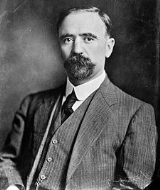
Francisco Ignacio Madero González (October 30, 1873 – February 22, 1913) was a politician, writer and
revolutionaryA revolutionary is a person who either actively participates in, or advocates revolution. Also, when used as an adjective, the term revolutionary refers to something that has a major, sudden impact on society or on some aspect of human endeavor.-Definition:...
who served as
President of MexicoThe President of the United Mexican States is the head of state and government of Mexico. Under the Constitution, the president is also the Supreme Commander of the Mexican armed forces...
from 1911 to 1913. As a respectable upper-class politician, he supplied a center around which opposition to the dictatorship of
Porfirio DíazJosé de la Cruz Porfirio Díaz Mori was a Mexican-American War volunteer and French intervention hero, an accomplished general and the President of Mexico continuously from 1876 to 1911, with the exception of a brief term in 1876 when he left Juan N...
could coalesce. However, once Díaz was deposed, Madero proved to be ineffective and the
Mexican RevolutionThe Mexican Revolution was a major armed struggle that started in 1910, with an uprising led by Francisco I. Madero against longtime autocrat Porfirio Díaz. The Revolution was characterized by several socialist, liberal, anarchist, populist, and agrarianist movements. Over time the Revolution...
quickly spun out of his control. He was deposed and executed by the Porfirista military and his aides, which he had neglected to replace with revolutionary supporters. His assassination was followed by the most violent period of the revolution in Mexico (1913–1917), lasting until the Constitution of 1917 and revolutionary president
Venustiano CarranzaVenustiano Carranza de la Garza, was one of the leaders of the Mexican Revolution. He ultimately became President of Mexico following the overthrow of the dictatorial Huerta regime in the summer of 1914 and during his administration the current constitution of Mexico was drafted...
achieved some degree of stability. Followers of Madero were known as
Maderistas.
Early years, 1873–1903
He was born in Parras de la Fuente,
CoahuilaCoahuila, formally Coahuila de Zaragoza , officially Estado Libre y Soberano de Coahuila de Zaragoza is one of the 31 states which, with the Federal District, comprise the 32 Federal Entities of Mexico...
; the son of Francisco Indalecio Madero Hernández and Mercedes González Treviño. His family was one of the wealthiest families in Mexico: his grandfather had founded the
Compañía Industrial de Parras, which was initially involved in vineyards, cotton, and textiles, and which moved into mining, cotton mills, ranching, banking, coal, rubber, and foundries in the later part of the nineteenth century.
Madero was educated at the Jesuit college in
SaltilloSaltillo is the capital city of the northeastern Mexican state of Coahuila and the municipal seat of the municipality of the same name. The city is located about 400 km south of the U.S. state of Texas, and 90 km west of Monterrey, Nuevo León....
, but this early Catholic education had little lasting impact. Instead, his father's subscription to the magazine
Revue Spirit awakened in the young Madero an interest in
SpiritismSpiritism is a loose corpus of religious faiths having in common the general belief in the survival of a spirit after death. In a stricter sense, it is the religion, beliefs and practices of the people affiliated to the International Spiritist Union, based on the works of Allan Kardec and others...
, an offshoot of
SpiritualismSpiritualism is a belief system or religion, postulating the belief that spirits of the dead residing in the spirit world have both the ability and the inclination to communicate with the living...
. As a young man, Madero's father sent him to the École des Hautes Études Commerciales de Paris (HEC). During his time in France, Madero made a pilgrimage to the tomb of
Allan KardecAllan Kardec is the pen name of the French teacher and educator Hippolyte Léon Denizard Rivail . He is known today as the systematizer of Spiritism for which he laid the foundation with the five books of the Spiritist Codification.-Early life:Rivail was born in Lyon in 1804...
, the founder of Spiritism, and became a passionate advocate of Spiritism, soon coming to believe he was a
mediumMediumship is described as a form of communication with spirits. It is a practice in religious beliefs such as Spiritualism, Spiritism, Espiritismo, Candomblé, Voodoo and Umbanda.- Concept :...
. Then he graduated from High school at Culver Academies, achieving high leadership positions. Following business school, Madero traveled to the
University of California, BerkeleyThe University of California, Berkeley , is a teaching and research university established in 1868 and located in Berkeley, California, USA...
to study agricultural techniques and to improve his English. During his time there, he was influenced by the
TheosophistTheosophy, in its modern presentation, is a spiritual philosophy developed since the late 19th century. Its major themes were originally described mainly by Helena Blavatsky , co-founder of the Theosophical Society...
ideas of
Annie BesantAnnie Besant was a prominent British Theosophist, women's rights activist, writer and orator and supporter of Irish and Indian self rule.She was married at 19 to Frank Besant but separated from him over religious differences. She then became a prominent speaker for the National Secular Society ...
, which were prominent at nearby
Stanford UniversityThe Leland Stanford Junior University, commonly referred to as Stanford University or Stanford, is a private research university on an campus located near Palo Alto, California. It is situated in the northwestern Santa Clara Valley on the San Francisco Peninsula, approximately northwest of San...
.
In 1893, the 20 year old Madero returned to Mexico and assumed management of the Madero family's hacienda at
San Pedro, CoahuilaSan Pedro is a city located in the southwestern part of the state of Coahuila in Mexico. San Pedro lies east-northeast of the city of Torreón and serves as the seat of the surrounding municipality of the same name....
. He installed new irrigation works, introduced American cotton, and built a soap factory and an ice factory. He also embarked on a lifelong commitment to philanthropy. His peons were well paid and received regular medical exams, he built schools, hospitals, and community kitchens, and he paid to support orphans and award scholarships. He also taught himself
homeopathic medicineHomeopathy is a form of alternative medicine in which practitioners claim to treat patients using highly diluted preparations that are believed to cause healthy people to exhibit symptoms that are similar to those exhibited by the patient...
and offered medical treatments to peons.
Introduction to politics, 1903–1908
On April 2, 1903,
Bernardo ReyesBernardo Reyes was a General in the army of Mexico under Porfirio Díaz. He served as governor of Nuevo León he helped in the modernization of that state. While governor of Nuevo León, Reyes approved a workers compensation law. He was the father of the writer Alfonso Reyes, and grandfather of the...
, governor of
Nuevo LeónNuevo León It is located in Northeastern Mexico. It is bordered by the states of Tamaulipas to the north and east, San Luis Potosí to the south, and Coahuila to the west. To the north, Nuevo León has a 15 kilometer stretch of the U.S.-Mexico border adjacent to the U.S...
, violently crushed a political demonstration, an example of the increasingly authoritarian policies of president
Porfirio DíazJosé de la Cruz Porfirio Díaz Mori was a Mexican-American War volunteer and French intervention hero, an accomplished general and the President of Mexico continuously from 1876 to 1911, with the exception of a brief term in 1876 when he left Juan N...
. Madero was deeply moved and, upon the suggestion of the
spiritThe English word spirit has many differing meanings and connotations, most of them relating to a non-corporeal substance contrasted with the material body.The spirit of a living thing usually refers to or explains its consciousness.The notions of a person's "spirit" and "soul" often also overlap,...
of his deceased brother Raúl, he decided to act. Madero responded by founding the
Benito JuárezBenito Juárez born Benito Pablo Juárez García, was a Mexican lawyer and politician of Zapotec origin from Oaxaca who served five terms as president of Mexico: 1858–1861 as interim, 1861–1865, 1865–1867, 1867–1871 and 1871–1872...
Democratic Club and ran for municipal office in 1904, though he lost the election narrowly. In addition to his political activities, Madero continued his interest in Spiritualism, publishing a number of articles under the pseudonym of
ArjunaArjuna in Indian mythology is the greatest warrior on earth and is one of the Pandavas, the heroes of the Hindu epic Mahābhārata. Arjuna, whose name means 'bright', 'shining', 'white' or 'silver' Arjuna (Devanagari: अर्जुन, Thai: อรชุน, Orachun, Tamil: Arjunan, Indonesian and Javanese: Harjuna,...
(a prince from the
Bhagavad GitaThe ' , also more simply known as Gita, is a 700-verse Hindu scripture that is part of the ancient Sanskrit epic, the Mahabharata, but is frequently treated as a freestanding text, and in particular, as an Upanishad in its own right, one of the several books that constitute general Vedic tradition...
).
In 1905, Madero became increasingly involved in opposition to the government of Porfirio Díaz. He organized political clubs and founded a political newspaper (
El Demócrata) and a satirical periodical (
El Mosco, "The Fly"). Madero's preferred candidate was again defeated by Porfirio Díaz's preferred candidate in the 1905 governmental elections.
Leader of the Anti-Reelection Movement, 1908–1909
In a 1908 interview with U.S. journalist
James CreelmanJames Creelman , was a reporter during the height of yellow journalism. He was born in Montreal, Province of Canada, the son of a boiler inspector, Matthew Creelman, and homemaker, Martha Dunwoodie....
published in
Pearson's MagazinePearson's Magazine was an influential publication which first appeared in Britain in 1896. It specialised in speculative literature, political discussion, often of a socialist bent, and the arts. Its contributors included Upton Sinclair, George Bernard Shaw, Maxim Gorky and H. G...
, Porfirio Díaz said that Mexico was ready for a democracy and that the 1910 presidential election would be a free election.
Madero spent the bulk of 1908 writing a book at the directions of the spirits, which now included the spirit of Benito Juárez himself. This book, published in late 1908, was titled
La sucesión presidencial en 1910 (
The Presidential Succession of 1910). The book quickly became a bestseller in Mexico. The book proclaimed that the concentration of absolute power in the hands of one man – Porfirio Díaz – for so long had made Mexico sick. Madero pointed out the irony that in 1871, Porfirio Díaz's political slogan had been "No Reelection". Madero acknowledged that Porfirio Díaz had brought peace and a measure of economic growth to Mexico. However, Madero argued that this was counterbalanced by the dramatic loss of freedom which included the brutal treatment of the Yaqui people, the repression of workers in
Cananea-Economy:Mining is the main source of revenue for Cananea and will be for the foreseeable future. Eighty percent of the population is directly or indirectly supported by mining companies in Cananea. The first and most important mining company is Mexicana de Cananea, S.A. de C.V. owned by and...
, excessive concessions to the United States, and an unhealthy centralization of politics around the person of the president. Madero called for a return of the Liberal 1857 Constitution of Mexico. To achieve this, Madero proposed organizing a Democratic Party under the slogan
Sufragio efectivo, no reelección ("Valid Suffrage, No Reelection"). Porfirio Díaz could either run in a free election or retire.
Madero's book was well received, and many people began to call Madero the
Apostle of Democracy. Madero sold off much of his property – often at a considerable loss – in order to finance anti-reelection activities throughout Mexico. He founded the Antireelection Center in
Mexico CityMexico City is the Federal District , capital of Mexico and seat of the federal powers of the Mexican Union. It is a federal entity within Mexico which is not part of any one of the 31 Mexican states but belongs to the federation as a whole...
in May 1909, and soon thereafter lent his backing to the periodical
El Antireeleccionista, which was run by the young lawyer/philosopher
José VasconcelosJosé Vasconcelos Calderón was a Mexican writer, philosopher and politician. He is one of the most influential and controversial personalities in the development of modern Mexico. His philosophy of "indigenismo" affected all aspects of Mexican sociocultural, political, and economic...
. Madero traveled throughout Mexico giving antireelectionist speeches, and everywhere he went he was greeted by crowds of thousands.
The Porfirian regime reacted by placing pressure on the Madero family's banking interests, and at one point even issued a warrant for Madero's arrest on the grounds of "unlawful transaction in rubber". Madero was not arrested, though, and in April 1910, the Antireelectionist Party met and selected Madero as their nominee for
President of MexicoThe President of the United Mexican States is the head of state and government of Mexico. Under the Constitution, the president is also the Supreme Commander of the Mexican armed forces...
. Madero, worried that Porfirio Díaz would not willingly relinquish office, warned his supporters of the possibility of electoral fraud and proclaimed that "Force shall be met by force!"
Beginning of the Mexican Revolution, 1910–1911
Madero set out campaigning across the country and everywhere he was met by tens of thousands of cheering supporters. Finally, in June 1910, the Porfirian regime had him arrested in
MonterreyMonterrey , is the capital city of the northeastern state of Nuevo León in the country of Mexico. The city is anchor to the third-largest metropolitan area in Mexico and is ranked as the ninth-largest city in the nation. Monterrey serves as a commercial center in the north of the country and is the...
and sent to a prison in
San Luis PotosíSan Luis Potosí, commonly called SLP or simply San Luis, is the capital of, and most populous city in the Mexican state of the same name. The city lies at an elevation of 1,850 meters...
. Approximately 5,000 other members of the Anti-Reelectionist movement were also jailed.
Francisco Vázquez GómezFrancisco Vázquez Gómez served as personal physician to Mexican president Porfirio Díaz, as Minister of Public Instruction to President Francisco León de la Barra and as a running mate to Francisco I. Madero during the 1910 presidential elections...
took over the nomination, but during Madero's time in jail, Díaz was "elected" as president with an electoral vote of 196 to 187.
Madero's father used his influence with the state governor and posted a bond to gain Madero the right to move about the city on horseback during the day. On October 4, 1910, Madero galloped away from his guards and took refuge with sympathizers in a nearby village. He was then smuggled across the U.S. border, hidden in a baggage car by sympathetic railway workers.
Madero set up shop in San Antonio, Texas, and quickly issued his
Plan of San Luis PotosíThe Plan of San Luis de Potosí was a political document written in San Antonio, Texas, United States, and published in the Mexican city of San Luis Potosí in 1910. The document ushered in the Mexican revolution and the collapse of the Presidency of Porfirio Díaz...
, which had been written during his time in prison, partly with the help of
Ramón López VelardeRamón López Velarde was aMexican poet. His work is generally considered to be postmodern, but is unique for its subject matter. He achieved great fame in his native land, to the point of being considered Mexico's national poet....
. The Plan proclaimed the elections of 1910 null and void, and called for an armed revolution to begin at 6 pm on November 20, 1910, against the "illegitimate presidency/dictatorship of Díaz". At that point, Madero would declare himself provisional President of Mexico, and called for a general refusal to acknowledge the central government, restitution of land to villages and Indian communities, and freedom for political prisoners.
On November 20, 1910, Madero arrived at the border and planned to meet up with 400 men raised by his uncle Catarino to launch an attack on Ciudad Porfirio Díaz (modern-day
Piedras Negras, Coahuila-Natural Resources:This region generates a large amount of the national production of coal, one of the most economically important non-metallic minerals in the state.-Tourism:Piedras Negras' main tourist attractions are:...
). However, his uncle showed up late and brought only ten men. As such, Madero decided to postpone the revolution. Instead he and his brother Raúl (who had been given the same name as his late brother) traveled incognito to New Orleans, Louisiana.
In February 1911 he entered Chihuahua and led 130 men in an attack on
Casas Grandes, ChihuahuaCasas Grandes is a town located in the northern Mexican state of Chihuahua. It serves as the municipal seat of government for the surrounding Casas Grandes Municipality of the same name....
. He spent the next several months as the head of the Mexican Revolution. Madero successfully imported arms from the United States, with the American government under
William Howard TaftWilliam Howard Taft was the 27th President of the United States and later the tenth Chief Justice of the United States...
doing little to halt the flow of arms to the Mexican revolutionaries. By April, the Revolution had spread to eighteen states, including
MorelosMorelos officially Estado Libre y Soberano de Morelos is one of the 31 states which, with the Federal District, comprise the 32 Federal Entities of Mexico. It is divided in 33 municipalities and its capital city is Cuernavaca....
where the leader was
Emiliano ZapataEmiliano Zapata Salazar was a leading figure in the Mexican Revolution, which broke out in 1910, and which was initially directed against the president Porfirio Díaz. He formed and commanded an important revolutionary force, the Liberation Army of the South, during the Mexican Revolution...
.
On April 1, 1911, Porfirio Díaz claimed that he had heard the voice of the people of Mexico, replaced his cabinet, and agreed to restitution of the lands of the dispossessed. Madero did not believe Díaz and instead demanded the resignation of President Díaz and Vice President
Ramón CorralRamón Corral was the Vice President of Mexico under Porfirio Díaz from 1904 until their deposition in 1911.-Early Years:...
. Madero then attended a meeting with the other revolutionary leaders – they agreed to a fourteen-point plan which called for pay for revolutionary soldiers; the release of political prisoners; and the right of the revolutionaries to name several members of cabinet. Madero was moderate, however. He believed that the revolutionaries should proceed cautiously so as to minimize bloodshed and should strike a deal with Díaz if possible. In May, Madero wanted a ceasefire, but his fellow revolutionaries
Pascual OrozcoPascual Orozco Vazquez was a Mexican revolutionary leader who, after the triumph of the Mexican Revolution, rose up against Francisco I...
and Francisco Villa disagreed and went ahead with an attack on
Ciudad JuárezCiudad Juárez , officially known today as Heroica Ciudad Juárez, but abbreviated Juárez and formerly known as El Paso del Norte, is a city and seat of the municipality of Juárez in the Mexican state of Chihuahua. Juárez's estimated population is 1.5 million people. The city lies on the Rio Grande...
. The revolutionaries won this battle decisively and on May 21, 1911, the
Treaty of Ciudad JuárezThe Treaty of Ciudad Juárez was a peace treaty signed between the then President of Mexico, Porfirio Díaz, and the revolutionary Francisco Madero on May 21, 1911...
was signed.
Under the terms of the Treaty of Ciudad Juárez, Díaz and Corral agreed to resign by the end of May 1911, with Díaz's
Minister of Foreign AffairsIn Mexico, the Secretary of Foreign Affairs is a member of the federal executive cabinet with responsibility for implementing the country's foreign policy. The secretary is appointed by the President of the Republic and heads the Secretariat of Foreign Affairs ...
,
Francisco León de la BarraFrancisco León de la Barra y Quijano was a Mexican political figure and diplomat, who served as interim president of Mexico from May 25 to November 6, 1911....
, taking over as interim president solely for the purpose of calling general elections.
This first phase of the Mexican Revolution thus ended with Díaz leaving for exile in Europe at the end of May 1911. On June 7, 1911, Madero entered
Mexico CityMexico City is the Federal District , capital of Mexico and seat of the federal powers of the Mexican Union. It is a federal entity within Mexico which is not part of any one of the 31 Mexican states but belongs to the federation as a whole...
in triumph where he was greeted with huge crowds shouting "
¡Viva Madero!"
Interim Presidency of Francisco León de la Barra, May–November 1911
Although Madero had forced Porfirio Díaz from power, he did not assume the presidency in June 1911. Instead, he pursued a moderate policy, leaving Francisco León de la Barra, one of Díaz's supporters, as president. He also left in place the
Congress of MexicoThe Congress of the Union is the legislative branch of the Mexican government...
, which was full of candidates whom Díaz had handpicked for the 1910 election.
Madero now called for the disbanding of all revolutionary forces, arguing that the revolutionaries should henceforth proceed solely by peaceful means. In the south, revolutionary leader
Emiliano ZapataEmiliano Zapata Salazar was a leading figure in the Mexican Revolution, which broke out in 1910, and which was initially directed against the president Porfirio Díaz. He formed and commanded an important revolutionary force, the Liberation Army of the South, during the Mexican Revolution...
was skeptical about disbanding his troops, but Madero traveled south to meet with Zapata at
CuernavacaCuernavaca is the capital and largest city of the state of Morelos in Mexico. It was established at the archeological site of Gualupita I by the Olmec, "the mother culture" of Mesoamerica, approximately 3200 years ago...
and
Cuautla, MorelosCuautla , officially La heroica e histórica Cuautla de Morelos, or H. H. Cuautla de Morelos, is a city and municipality in the Mexican state of Morelos. In the 2005 census the city population was 145,482 and the municipality population was 160,285. The municipality covers 153.651 km²...
. Madero assured Zapata that the land redistribution promised in the Plan of San Luis Potosí would be carried out when Madero became president.
However, in Madero's absence, several landowners from Zapata's state of
MorelosMorelos officially Estado Libre y Soberano de Morelos is one of the 31 states which, with the Federal District, comprise the 32 Federal Entities of Mexico. It is divided in 33 municipalities and its capital city is Cuernavaca....
had appealed to President de la Barra and the Congress to restore their lands which had been seized by revolutionaries. They spread exaggerated stories of atrocities committed by Zapata's troops, calling Zapata the "Attila of the South." De la Barra and the Congress therefore decided to send troops under
Victoriano HuertaJosé Victoriano Huerta Márquez was a Mexican military officer and president of Mexico. Huerta's supporters were known as Huertistas during the Mexican Revolution...
to suppress Zapata's troops. Madero once again traveled south to urge Zapata to disband his troops peacefully, but Zapata refused on the grounds that Huerta's troops were advancing on
Yautepec de ZaragozaYautepec is a city and its surrounding municipality of the same name located in the north-central part of the Mexican state of Morelos. It stands at ....
. Zapata's suspicions proved accurate as Huerta's troops moved violently into Yautepec de Zaragoza. Madero wrote to De la Barra, saying that Huerta's actions were unjustified and recommending that Zapata's demands be met. However, when he left the south, he had achieved nothing. However, he promised the
ZapatistasThe Liberation Army of the South was an armed group formed and led by Emiliano Zapata that took part in the Mexican Revolution. The force was commonly known as the Zapatistas....
that once he became president, things would change. Most Zapatistas had grown suspicious of Madero, however.
Before becoming president, Madero published another book, this one under the pseudonym of
BhimaIn the Mahābhārata, Bhima is one of the central characters of Mahabharata and the second of the Pandava brothers...
(one of Arjuna's brothers in the
MahābhārataThe Mahabharata is one of the two major Sanskrit epics of ancient India and Nepal, the other being the Ramayana. The epic is part of itihasa....
) called a
Spiritualist Manual.
Madero as President of Mexico, November 1911 – February 1913
Madero became president in November 1911, and, intending to reconcile the nation, appointed a cabinet which included many of Porfirio Díaz's supporters. However, Madero was unable to achieve the reconciliation he desired since conservative Porfirians had managed to get themselves organized during the interim presidency of Francisco León de la Barra and now mounted a sustained and effective opposition to Madero's reform program. Conservative Porfirians in the Senate refused to pass the reforms he advocated. At the same time, several of Madero's allies denounced him for being overly reconciliatory with the Porfirians and with not moving aggressively forward with reforms: thus, on November 25, 1911,
Emiliano ZapataEmiliano Zapata Salazar was a leading figure in the Mexican Revolution, which broke out in 1910, and which was initially directed against the president Porfirio Díaz. He formed and commanded an important revolutionary force, the Liberation Army of the South, during the Mexican Revolution...
issued his
Plan of AyalaThe Plan of Ayala was a document drafted by revolutionary leader Emiliano Zapata during the Mexican Revolution. In it, Zapata denounced President Francisco I. Madero for his perceived betrayal of the revolutionary ideals, embodied in Madero's Plan de San Luis, and set out his vision of land reform...
, denouncing Madero for being uninterested in pursuing land reform.
After years of censorship, Mexican newspapers took the opportunity of their newfound
freedom of the pressFreedom of the press or freedom of the media is the freedom of communication and expression through vehicles including various electronic media and published materials...
to roundly criticize Madero's performance as president.
Gustavo A. MaderoGustavo Adolfo Madero also known to many as "Ojo Pardo" , born in Parras de la Fuente, Coahuila, Mexico, was a participant in the Mexican Revolution against Porfirio Díaz along with other members of his wealthy family....
, the president's brother, remarked "the newspapers bite the hand that took off their muzzle." Francisco Madero refused the recommendation of some of his advisors that he bring back censorship.
The press was particularly critical of Madero's handling of three rebellions that broke out against his rule shortly after he became president:
(1) In December 1911,
Bernardo ReyesBernardo Reyes was a General in the army of Mexico under Porfirio Díaz. He served as governor of Nuevo León he helped in the modernization of that state. While governor of Nuevo León, Reyes approved a workers compensation law. He was the father of the writer Alfonso Reyes, and grandfather of the...
(the popular general whom Porfirio Díaz had sent to Europe on a diplomatic mission because Díaz worried that Reyes was going to challenge him for the presidency) launched a rebellion in
Nuevo LeónNuevo León It is located in Northeastern Mexico. It is bordered by the states of Tamaulipas to the north and east, San Luis Potosí to the south, and Coahuila to the west. To the north, Nuevo León has a 15 kilometer stretch of the U.S.-Mexico border adjacent to the U.S...
, where he had previously served as governor. Reyes' rebellion lasted only eleven days before Reyes surrendered at
Linares, Nuevo LeónLinares is a small city in the state of Nuevo León, Mexico. The city serves as the administrative centre for the surrounding municipality of the same name and it is the largest urban centre of the so called "orange belt" region. The city had a 2005 census population of 56,065, while the...
and was sent to a prison in Mexico City.
(2) In March 1912, Madero's former general
Pascual OrozcoPascual Orozco Vazquez was a Mexican revolutionary leader who, after the triumph of the Mexican Revolution, rose up against Francisco I...
, who was personally resentful of how Madero had treated him, launched a rebellion in Chihuahua with the financial backing of
Luis TerrazasLuis Terrazas, born José Luis Gonzaga Jesús Daniel Terrazas Fuentes , was a Mexican politician, businessman, rancher and soldier. He was a pivotal figure in the history of the state of Chihuahua from the middle of the 19th century through the outbreak of the Mexican Revolution...
, a former
Governor of ChihuahuaAccording to the Political Constitution of the Free and Sovereign State of Chihuahua, Executive Power in that Mexican state resides with a single individual, the Constitutional Governor of the Free and Sovereign State of Chihuahua, who is chosen for a period of six years and cannot for any reason...
who was the largest landowner in Mexico. Madero despatched troops under General José González Salas to put down the rebellion, but they were initially defeated by Orozco's troops. General José González Salas committed suicide and
Victoriano HuertaJosé Victoriano Huerta Márquez was a Mexican military officer and president of Mexico. Huerta's supporters were known as Huertistas during the Mexican Revolution...
assumed control of the federalist forces. Huerta was more successful, defeating Orozco's troops in three major battles and forcing Orozco to flee to the United States in September 1912.
Relations between Huerta and Madero grew strained during the course of this campaign when
Pancho VillaJosé Doroteo Arango Arámbula – better known by his pseudonym Francisco Villa or its hypocorism Pancho Villa – was one of the most prominent Mexican Revolutionary generals....
, the commander of the
División del NorteThe División del Norte was an armed faction formed by Madero and initially led by General Jose Gonzales Salas following the call to arms from Francisco Madero at the outbreak of the Mexican Revolution in 1910. After Salas committed suicide following his defeat at the hands of Pascual Orozco at the...
, refused orders from General Huerta. Huerta ordered Villa's execution, but Madero commuted the sentence and Villa was set free. Angry at Madero's commutation of Villa's sentence, Huerta, after a long night of drinking, mused about reaching an agreement with Orozco and together deposing Madero as president. When Mexico's Minister of War learned of General Huerta's comments, he stripped Huerta of his command, but Madero intervened and restored Huerta to command.
(3) In October 1912, Félix Díaz (nephew of Porfirio Díaz) launched a rebellion in
VeracruzVeracruz, formally Veracruz de Ignacio de la Llave officially Estado Libre y Soberano de Veracruz de Ignacio de la Llave , is one of the 31 states that, along with the Federal District, comprise the 32 federative entities of Mexico. It is divided in 212 municipalities and its capital city is...
, "to reclaim the honor of the army trampled by Madero." This rebellion was quickly crushed and Félix Díaz was imprisoned. Madero was prepared to have Félix Díaz executed, but the Supreme Court of Mexico declared that Félix Díaz would be imprisoned, but not executed.
Besides managing rebellions, Madero did have a number of accomplishments during his presidency:
- He created the Department of Labor; introduced regulation of the labor practices in the textile industry; and oversaw the creation of the Casa del Obrero Mundial ("House of the World Worker"), an organization with anarcho-syndicalist
Anarcho-syndicalism is a branch of anarchism which focuses on the labour movement. The word syndicalism comes from the French word syndicat which means trade union , from the Latin word syndicus which in turn comes from the Greek word σύνδικος which means caretaker of an issue...
connections, that would play a major role in the subsequent Mexican labor movement.
- Although not as radical as the Zapatistas would have liked, Madero did introduce some agrarian reforms, such as a reorganization of rural credit and the creation of agricultural stations.
- He launched an infrastructure program, building schools, railroads, and new highways.
- He introduced new taxation on foreign oil companies.
- he launched a modest programme of school lunches for the poor.
Fall and execution
In early 1913
Victoriano HuertaJosé Victoriano Huerta Márquez was a Mexican military officer and president of Mexico. Huerta's supporters were known as Huertistas during the Mexican Revolution...
, the commander of the armed forces conspired with Félix Díaz (Porfirio Díaz's nephew),
Bernardo ReyesBernardo Reyes was a General in the army of Mexico under Porfirio Díaz. He served as governor of Nuevo León he helped in the modernization of that state. While governor of Nuevo León, Reyes approved a workers compensation law. He was the father of the writer Alfonso Reyes, and grandfather of the...
, and
US AmbassadorThe United States has maintained diplomatic relations with Mexico since 1823, when Andrew Jackson was appointed Envoy Extraordinary and Minister Plenipotentiary to that country. Jackson declined the appointment, however, and Joel R. Poinsett became the first U.S. envoy to Mexico in 1825. The rank...
Henry Lane WilsonHenry Lane Wilson was an American diplomat.-Biography:He was born in Crawfordsville, Montgomery County, Indiana to Indiana congressman James Wilson and his wife, Emma Wilson; he was the younger brother of John L. Wilson, and had been named for Henry Smith Lane...
against Madero, which culminated in a ten-day siege of La Ciudadela known as
La decena tragicaThe Ten Tragic Days was a series of events that took place in Mexico City between February 9 and February 19, 1913, during the Mexican Revolution. They culminated in a coup d'état and the assassination of President Francisco I...
(the Tragic Ten Days). Madero accepted Huerta's "protection" from the Diaz/Reyes forces, only to be betrayed by Huerta and arrested. Madero's brother and advisor
Gustavo A. MaderoGustavo Adolfo Madero also known to many as "Ojo Pardo" , born in Parras de la Fuente, Coahuila, Mexico, was a participant in the Mexican Revolution against Porfirio Díaz along with other members of his wealthy family....
was kidnapped off the street, tortured, and killed. Following Huerta's coup d'état on February 18, 1913, Madero was forced to resign. After a 45 minute term of office,
Pedro LascuráinPedro José Domingo de la Calzada Manuel María Lascuráin Paredes was both Mexico's and the world's briefest-ever serving president....
was replaced by Huerta who took over the Presidency later that day. Francisco Madero was shot four days later, aged 39. The Huerta government claimed that bodyguards were forced to behead Madero and strangle Vice President
José María Pino SuárezJosé María Pino Suárez was a Mexican statesman, revolutionary, poet, journalist and jurist who served as Vice President of Mexico , Secreatry of Education and Governor of Yucatán...
, during a failed rescue attempt by Madero's supporters. This story has been challenged with general incredulity. Pino Suárez was the last vice president of México.
External links