
All Topics  
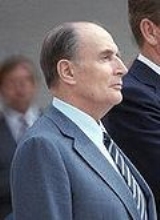
François Mitterrand

 
François Mitterrand

   Email Print
   Bookmark   Link


François Mitterrand


François Maurice Adrien Marie Mitterrand (26 October 1916 8 January 1996) served as President of France from 1981 to 1995, elected as representative of the Socialist Party (PS). First elected during the May 1981 presidential election, he became the first socialist president of the Fifth Republic
French Fifth Republic

The Fifth Republic is the fifth and current Republicanism Constitution of France of France, which was introduced on October 5, 1958. The Fifth Republic emerged from the collapse of the French Fourth Republic, replacing a parliamentary government with a semi-presidential system....
 and the first left-wing head of state since 1957. He is to date the only member of the Socialist Party to be elected President of France.


Discussion
Ask a question about 'François Mitterrand'
Start a new discussion about 'François Mitterrand'
Answer questions from other users
Full Discussion Forum


Encyclopedia


François Maurice Adrien Marie Mitterrand (26 October 1916 8 January 1996) served as President of France from 1981 to 1995, elected as representative of the Socialist Party (PS). First elected during the May 1981 presidential election, he became the first socialist president of the Fifth Republic
French Fifth Republic

The Fifth Republic is the fifth and current Republicanism Constitution of France of France, which was introduced on October 5, 1958. The Fifth Republic emerged from the collapse of the French Fourth Republic, replacing a parliamentary government with a semi-presidential system....
 and the first left-wing head of state since 1957. He is to date the only member of the Socialist Party to be elected President of France. He was re-elected in 1988
French presidential election, 1988

Presidential elections were held in France on 24 April and 8 May 1988.In 1981, the Socialist Party leader, Fran?ois Mitterrand, was elected President of France and the Left won the French legislative election, 1981....
 and held office until 1995, before his death from prostate cancer
Prostate cancer

Prostate cancer is a disease in which cancer develops in the prostate, a gland in the male reproductive system. It occurs when cell s of the prostate Mutation and begin to multiply out of control....
 the following year. During each of his two terms, he dissolved the Parliament after his election to have a majority during the first five years of his term, and then each time his party lost the next legislative elections. He was consequently forced to "cohabit
Cohabitation (government)

Cohabitation in government occurs in semi-presidential systems, such as France's system, when the president of France is from a different political party than the majority of the members of parliament....
" during the two last years of each of his terms with conservative cabinets. They were led by Jacques Chirac
Jacques Chirac

Jacques Ren? Chirac served as the President of France from 17 May 1995 until 16 May 2007. As President he also served as an ex officio Co-Prince of Andorra and Grand Master of the French L?gion d'honneur....
 from 1986 until 1988, and Édouard Balladur
Édouard Balladur

?douard Balladur is a France right-wing politician. He served as Prime Minister of France during the second "cohabitation ", under Fran?ois Mitterrand, from 29 March 1993 to 10 May 1995....
 from 1993 to 1995.

he holds the record of longest serving (almost 14 years) President of France. He was also the oldest President of the Fifth Republic
French Fifth Republic

The Fifth Republic is the fifth and current Republicanism Constitution of France of France, which was introduced on October 5, 1958. The Fifth Republic emerged from the collapse of the French Fourth Republic, replacing a parliamentary government with a semi-presidential system....
, leaving office aged 78 years and six months. He died on 8 January 1996, shortly after returning from a Christmas holiday in Egypt.

Mitterrand's family

Mitterrand was born on 12 October 1916 in Jarnac
Jarnac

Jarnac is a Communes of France in the France Departments of France of Charente.It was the site of the myth of the legendary strike , in a judicial duel, Le Coup de Jarnac, on the July 10, 1547, between Guy I Chabot de Jarnac and Francois de Vivonne de la Ch?taigneraie, and the Battle of Jarnac in 1569....
, Charente
Charente

Charente is a departments of France in western France named after the Charente River....
, and baptised François Maurice Adrien Marie Mitterrand. His family was devoutly Roman Catholic and very conservative. His father, Joseph Gilbert Félix, worked as an engineer for la Compagnie Paris Orléans, his stepfather worked as a vinegar maker and later served as president of the federation of vinegar makers union (Fédération des syndicats de fabricants de vinaigre). Joseph's maternal grandmother was a noblewoman, a descendant of both Fernando III of Castile and Jean de Brienne of Jerusalem. Mitterrand's mother was Marie Gabrielle Yvonne Lorrain, a remote niece of Pope
Pope

The Pope is the Bishop of Rome, the leader of the Roman Catholic Church and head of state of Vatican City. The current pope is Pope Benedict XVI, who was elected April 19, 2005 in Papal conclave, 2005....
 John XXII. He had three brothers (Robert, Jacques and Philippe) and four sisters. His wife, Danielle Mitterrand
Danielle Mitterrand

Danielle Mitterrand is the widow of Fran?ois Mitterrand and president of the foundation :fr:France Libert?s Fondation Danielle Mitterrand....
 née Gouze, came from a socialist background and has worked for various left-wing causes. They married on 24 October 1944 and had three sons: Pascal (10 June 1945 17 September 1945), Jean-Christophe
Jean-Christophe Mitterrand

Jean-Christophe Mitterrand is the son of former France president Fran?ois Mitterrand. He was an advisor to his father on African affairs from 1986 to 1992, and earned the nickname Papamadit in Africa....
, born in 1946, and Gilbert Mitterrand, born on 4 February 1949. He also had a daughter Mazarine
Mazarine Pingeot

Mazarine Marie Pingeot , who changed her name to Mazarine Marie Pingeot-Mitterrand in 2005, is a writer and the daughter of former President of France Fran?ois Mitterrand and his mistress Anne Pingeot....
 with Anne Pingeot. His nephew Frédéric Mitterrand
Frédéric Mitterrand

Fr?d?ric Mitterrand is a France actor, screenwriter, television presenter, writer, producer and director. He is the nephew of the former President of France Fran?ois Mitterrand and the son of Edith Cahier, the niece of Eug?ne Deloncle, co-founder of La Cagoule....
 is a journalist (and supporter of right-wing Jacques Chirac
Jacques Chirac

Jacques Ren? Chirac served as the President of France from 17 May 1995 until 16 May 2007. As President he also served as an ex officio Co-Prince of Andorra and Grand Master of the French L?gion d'honneur....
, former president of France), and his brother-in-law Roger Hanin
Roger Hanin

Roger Hanin is a France actor , best known for his assumption of the title role in the 1989-2006 TV crime series Navarro.He is the brother in law of former President of France Fran?ois Mitterrand....
 is a well-known actor.

Early life

Mitterrand studied from 1925 to 1934 in the collège Saint-Paul in Angoulême
Angoulême

Angoul?me is a communes of France in western France and capital of the Charente Departments of France....
, where he became a member of the JEC
Jec

JEC may refer to:* Jonsson Engineering Center, in New York State* Jorhat Engineering College, in India* Jewish Educational Center, in New Jersey...
 (Jeunesse étudiante chrétienne), the student organisation of Action catholique
Catholic Action

Catholic Action was the name of many groups of laity Catholics who were attempting to encourage a Catholic influence on society.They were especially active in the nineteenth century in historically Catholic countries that fell under anti-clerical regimes such as Italy, Bavaria, France and Belgium....
. Arriving in Paris in autumn 1934, he then went to the École Libre des Sciences Politiques
École Libre des Sciences Politiques

?cole Libre des Sciences Politiques , often referred to as the ?cole des Sciences Politiques or simply Sciences Po was created in Paris in February 1872 by a group of European intellectuals, politicians and businessmen, which included Hippolyte Taine, Ernest Renan, Albert Sorel, Pierre Paul Leroy-Beaulieu, Fran?ois Guizot, and le...
 until 1937, where he obtained his diploma in July of that year. Mitterrand took membership for about a year in the Volontaires nationaux (National Volunteers), an organisation related to François de la Rocque
François de la Rocque

Fran?ois de La Rocque was leader of the French right-wing league named the Croix de Feu from 1930-1936, before forming the more moderate Parti Social Fran?ais , seen as a precursor of Gaullism ....
's far-right league, the Croix de Feu; the league had just participated in the 6 February 1934 riots which led to the fall of the second Cartel des Gauches
Cartel des Gauches

The Cartel des gauches was the name of the governmental alliance between the Radical-Socialist Party and the socialist SFIO after World War I , which lasted until the end of the Popular Front ....
 (Left-Wing Coalition).. Contrary to what has been said, he never took his card at the Parti Social Français (PSF) which succeeded to the Croix de Feu and may be considered as the first French right-wing mass party. However, he did write news articles in the L'Echo de Paris newspaper, close to the PSF. He participated in the xenophobic demonstrations against the "métèque invasion" in February 1935 and then in those against law teacher Gaston Jèze
Gaston Jèze

Gaston J?ze was a France professor of law and president of the International Institute of Law.He was largely responsible for promoting the establishment of finance as a separate discipline in the universities of France and contributed to the shift in thinking from the notion of power in the public sphere to the idea of public service....
, who had been nominated as juridical counsellor of Ethopia's Negus
Negus

Negus is a title in Ge'ez language, Tigrinya, Tigre and Amharic language, used for a king and at times also a vassal ruler in pre-1974 Ethiopia and pre-1890 Eritrea....
, in January 1936. When his involvement in these nationalist movements came to be known in the 1990s, he attributed his actions to the milieu of his youth. Mitterrand furthermore had some personal and family relations with members of the Cagoule
Cagoule

Cagoule is French language for "a monk's hood " or "cowl". It may refer to:*Cagoule , a type of raincoat*La Cagoule, fascist French group from the 1930s...
, a far-right terrorist group in the 1930s. In a logical way for his then nationalist ideas, he was disturbed by Nazi expansionism during the Anschluss
Anschluss

The ' , also known as the ', was the 1938 unification of Austria into Gro?deutschland by Nazi Germany.Austria was merged into Nazi Germany on 12 March 1938....
.

Mitterrand then served his conscription
Conscription

Conscription is a general term for involuntary labor demanded by an established authority. It is most often used in the specific sense of government policies that require citizens to serve in the military....
 from 1937 to 1939 in the 23rd régiment d'infanterie coloniale. In 1938, he became the best friend of Georges Dayan, a Jewish socialist, whom he saved from anti-Semite aggressions by the national-royalist movement Action française
Action Française

The Action Fran?aise is a France Monarchist counter-revolutionary movement and periodical founded by Maurice Pujo and Henri Vaugeois and whose principal ideologist was Charles Maurras....
. His friendship with Dayan caused Mitterrand to begin to question his nationalist ideas. Finishing his law studies, he was sent to the Maginot line
Maginot Line

The Maginot Line , named after French Minister of Defence Andr? Maginot, was a line of concrete fortifications, tank obstacles, artillery casemates, machine gun posts, and other defenses, which France constructed along its borders with Germany and Italy, in the light of experience from World War I, and in the run-up to World War II....
 in September 1939, with the rank of Sergeant-chief (infantry sergeant), near Montmédy
Montmédy

Montm?dy is a Communes of France in the Meuse Departments of France in Lorraine in northeastern France....
. He became engaged to Marie-Louise Terrasse (future actress Catherine Langeais
Catherine Langeais

Catherine Langeais, was a France television presenter and actress.She was born Marie-Louise Terrasse in Valence , France, and died in Paris....
) in May 1940 (but she broke it off in January 1942).

Second World War

François Mitterrand's actions during World War II were the cause of much controversy in France in the 1980s and 1990s.

Mitterrand was at the end of his national service when the war broke out. He fought as an infantry sergeant and was injured and captured by the Germans on 14 June 1940. He was held prisoner at Stalag
Stalag

In Germany, Stalag was a term used for prisoner-of-war camps. Stalag is an abbreviation for "Stammlager", itself a short form of the full name "Mannschaftsstamm und -straflager"....
 IXA near Ziegenhain (today called Trutzhain, a village near Kassel
Kassel

Kassel is a city situated along the Fulda River in northern Hessen, Germany, one of the two sources of the Weser river . It is the administrative seat of the Kassel and of the Kassel of the same name....
 in Hesse
Hesse

Hesse is a States of Germany of Germany with an area of 21,110 km? and just over six million inhabitants. The state capital is Wiesbaden. Hesse's largest city is nearby Frankfurt am Main....
). Mitterrand became involved in the social organisation for the POWs in the camp. He claims this, and the influence of the people he met there, began to change his political ideas, moving them towards the left. He had two failed escape attempt in March and November 1941 and finally escaped on 10 December 1941, returning to France on foot. In December 1941 he arrived home in the unoccupied zone controlled by the French. With help from a friend of his mother he got a job as a mid-level functionary of the Vichy government
Vichy France

Vichy France, or the Vichy regime are the common terms used to describe the government of France from July 1940 to August 1944. This government, which succeeded the French Third Republic, officially called itself the French State , in contrast with the previous designation, "French Republic." Marshal of France Philippe P?tain pro...
, looking after the interests of POWs. This was very unusual for an escaped prisoner, and he later claimed to have served as a spy for the Free French Forces
Free French Forces

File:Croix de Lorraine2.svgThe Free French Forces were France fighters in World War II who decided to continue fighting against Axis powers of World War II forces after the Armistice with France and subsequent German occupation of France in World War II....
.

Mitterrand worked from January to April 1942 for the Légion française des combattants et des volontaires de la révolution nationale (Legion of French combatants and volunteers of the national revolution) as a civil servant on a temporary contract. He worked under Favre de Thierrens who was a spy for the British secret service. He then moved to the Commissariat au reclassement des prisonniers de guerre (Service for the orientation of POWS). During this period, Mitterrand was aware of Thierrens's activities and may have helped in his disinformation campaign. At the same time, he published an article detailing his time as a POW in the magazine France, revue de l'État nouveau (the magazine was published as propaganda by the Vichy Regime).

Mitterrand has been called a "Vichysto-résistant" (an expression used by the historian Jean-Pierre Azéma to describe people who believed in Pétain before 1943, but subsequently rejected the Vichy Regime).

From spring 1942, he met other escaped POWs Jean Roussel, Max Varenne, and Dr. Guy Fric, under whose influence he slowly became involved with the resistance. In April, Mitterrand and Fric caused a major disturbance in a public meeting held by the collaborator Georges Claude
Georges Claude

The France engineer, chemist, and inventor Georges Claude , was the first to apply an electrical discharge to a sealed tube of neon gas to create a lamp....
. From mid-1942, he sent false papers to POWs in Germany and on 12 June and 15 August 1942, he joined meetings at the Château de Montmaur which formed the base of his future network for the resistance. From September, he made contact with France libre, but failed to get on with Michel Cailliau, General de Gaulle's nephew. On 15 October 1942, Mitterrand and Marcel Barrois (a member of the resistance deported in 1944) met Maréchal Pétain along with other members of the Comité d'entraide aux prisonniers rapatriés de l'Allier (Help group for repatriated POWs in the department of Allier). By the end of 1942, Mitterrand met up with an old friend from his days with the "Cagoule" Pierre Guillain de Bénouville. Bénouville was a member of the resistance groups Combat and Noyautage des administrations publiques (NAP).

In late 1942, the non-occupied zone was invaded by the Germans. Mitterrand left the Commissariat in January 1943, when his boss Maurice Pinot, another vichysto-résistant, was replaced by the collaborator André Masson, but he remained in charge of the centres d'entraides. In the spring of 1943, along with Gabriel Jeantet, a member of Maréchal Pétain's cabinet, and Simon Arbellot (both former members of "la Cagoule"), Mitterrand received the Ordre de la francisque (the honorific distinction of the Vichy Regime). Debate rages in France as to the significance of this. When Mitterrand's Vichy past was exposed in the 1950s, he initially denied having received the Francisque (some sources say he was designated for the award, but never actually received the medal because he went into hiding before the ceremony could take place) Some say he was ordered to accept the medal as cover for his work in the resistance. Others, such as Pierre Moscovici
Pierre Moscovici

Pierre Moscovici is a France politician, a member of the Departmental Council of Doubs and a Member of the French Parliament. He is a member of the Socialist Party ; part of the Party of European Socialists....
 and Jacques Attali
Jacques Attali

Jacques Attali is a France economist and scholar.From 1981 to 1991, he was an advisor to President Fran?ois Mitterrand.He subsequently cast doubt on Mitterand's past as a mid-level Vichy government functionary in his retrospective of Mitterrand's career, C'?tait Fran?ois Mitterrand, published in 2005....
 remain sceptical of Mitterrand's true beliefs at this time, accusing him of having at best a "foot in each camp" until he was sure who the winner would be, citing Mitterrand friendship with René Bousquet
René Bousquet

Ren? Bousquet was a high-ranking France civil servant, who served as secretary general to the Vichy France police from May 1942 to 31 December 1943....
 and the wreaths he placed on Pétain's tomb as examples of his ambivalent attitude.

Mitterrand set about building up a resistance network, composed mainly of former POWs like himself. The POWs National Rally (Rassemblement national des prisonniers de guerre or RNPG) was affiliated with General Henri Giraud
Henri Giraud

Henri Honor? Giraud was a France general who fought in World War I and World War II. Captured in both wars, he escaped each time. After his second escape, he joined the Free French Forces....
, a former POW who had escaped from a German prison and made his way across Germany back to the Allied forces. Giraud was then contesting the leadership of the French Resistance
French Resistance

File:Croix de Lorraine2.svgThe French Resistance is the collective name used for the French resistance movements which fought against the Nazi Germany German occupation of France in World War II and the collaborationist Vichy Regime during World War II....
 with General de Gaulle
Charles de Gaulle

Charles Andr? Joseph Marie de Gaulle , , was a French people general and statesman who led the Free French Forces during World War II. He later founded the French Fifth Republic in 1958 and served as its first President of France from 1959 to 1969....
. From the beginning of 1943, Mitterrand became involved with setting up a powerful resistance group called the Organisation de résistance de l'armée (ORA). He obtained finance for his own RNPG network, which he set up with Pinot in February. From this time on, Mitterrand was a member of the ORA . In March, Mitterrand met Henri Frenay
Henri Frenay

Henri Frenay was a French military officer and French resistance member.Henri Frenay was born in Lyon, France on 11 November 1905, into a Catholic family with a military tradition....
, who encouraged the resistance in France to support Mitterrand over Michel Cailliau, but 28 May 1943, when Mitterrand met with Gaullist Philippe Dechartre, is generally taken as the date Mitterrand split with Vichy.

During 1943, the RNPG gradually changed its focus from providing false papers to information-gathering for France libre. Pierre de Bénouville said, " Mitterrand created a true spy network in the POW camps which gave us information, often decisive, about what was going on behind the German borders.". On 10 July Mitterrand and Piatzook (a militant communist) interrupted a public meeting at in the Salle Wagram in Paris. The meeting was about allowing French POWs to go home if they were replaced by young French men forced to go and work in Germany" (in French this is called "la relève"). When André Masson began to talk about "la trahison des gaullistes" (the Gaulist treason), Mitterrand stood up in the audience and shouted him down, saying Mason had no right to talk on behalf of POWs and calling "la relève" a con. Mitterrand avoided arrest as Piatzook covered his escape. .

In November 1943 the Sicherheitsdienst
Sicherheitsdienst

The Sicherheitsdienst was primarily the intelligence service of the Schutzstaffel and the NSDAP. The organization was the first Nazi Party intelligence organization to be established and was often considered a "sister organization" with the Gestapo, which the SS had infiltrated heavily after 1934....
 (SD) raided a flat in Vichy
Vichy

Vichy is a Communes of France in the Departments of France of Allier in Auvergne in central France. It is known as a Spa town and resort town....
 where they hoped to arrest François Morland, a member of the resistance.. "Morland" was Mitterrand's cover name. He also used Purgon, Monnier, Laroche, capitaine François, Arnaud et Albre as cover names. The man they arrested was Pol Pilven, a member of the resistance who was to survive the war in a concentration camp. Mitterrand was in Paris at the time. Warned by his friends, he escaped to London aboard a Lysander
Westland Lysander

The Westland Lysander was a United Kingdom army co-operation and liaison aircraft produced by Westland Aircraft. It was used during the World War II and was renowned for its ability to operate from small, unprepared airstrips....
 plane on 15 November 1943. From there he went to Algiers
Algiers

Algiers Nicknamed El-Bahdja or Alger la Blanche for the glistening white of its buildings as seen rising up from the sea, Algiers is situated on the west side of a bay of the Mediterranean Sea....
, where he met Charles de Gaulle
Charles de Gaulle

Charles Andr? Joseph Marie de Gaulle , , was a French people general and statesman who led the Free French Forces during World War II. He later founded the French Fifth Republic in 1958 and served as its first President of France from 1959 to 1969....
, who was now the uncontested leader of the Free French. The two men did not get along. Mitterrand refused to merge his group with other POW movements if Cailliau was to be the leader. Under the influence of Henri Frenay, de Gaulle finally agreed to merge his nephews network and the RNPG with Mitterrand in charge.. He later returned to France via England by boat. In Paris, the three Resistance groups made up of POWs (communists, gaullists, RNPG) finally merged as the POWs and Deportees National Movement (Mouvement national des prisonniers de guerre et déportés or MNPGD) and Mitterrand took the lead. In his memoires he states that he had started this organisation whilst he was still officially working for the Vichy Regime. From 27 November 1943 Mitterrand ran the Bureau central de renseignements et d'action
Bureau Central de Renseignements et d'Action

The Bureau Central de Renseignements et d'Action , commonly referred as just BCRA is the World War II era forerunner of the SDECE France intelligence service....
 . . In December 1943 Mitterrand ordered the execution of Henri Marlin ( who was about to order attacks on the "maquis") by Jacques Paris et Jean Munier who later hid out with Mitterrand's father. After a second visit to London in February 1944 Mitterrand took part in the liberation of Paris. When de Gaulle entered Paris following the Liberation
Liberation of Paris

The Liberation of Paris took place during World War II from 19 August 1944 until the surrender of the occupying German garrison on the 25th and is accounted as the last battle in the Operation Overlord and the transitional conclusion of the Allied invasion breakout in Operation Overlord into a broad-fronted general offensive....
, he was introduced to various men who were to be part of the provisional government. Among them was Mitterrand, as secretary general of POWs. When they came face to face, de Gaulle is said to have muttered: "You again!" Mitterrand was dismissed 2 weeks later.

In October 1944 Mitterrand and Jacques Foccart
Jacques Foccart

Jacques Foccart was French President Charles de Gaulle's and then Georges Pompidou's chief adviser for African policy, who founded in 1959 the Gaullist Party organization Service d'Action Civique with Charles Pasqua, which specialized in shady operations....
 put together a plan to liberate the POW and concentration camps. This was called operation Viacarage and in April 1945 Mitterrand accompanied General Lewis as the French representative at the liberation of the camps at Kaufering
Kaufering

Kaufering is a municipality in the district of Landsberg in Bavaria in Germany.During World War II, a Kaufering concentration camp was located here....
 and Dachau
Dachau

Dachau is a Town#Germany in Upper Bavaria, in the southern part of Germany. It is a major district town?a Gro?e Kreisstadt?of the Regierungsbezirk of Upper Bavaria, about 20 km north-west of Munich....
  on the orders of de Gaulle. By chance Mitterrand discovered his friend and member of his network Robert Antelme
Robert Antelme

Robert Antelme was a French writer. During the Second World War he was involved in the French Resistance and deported.In 1939 he married Marguerite Duras....
 suffering from typhus. Antelme was ordered to remain in the camp to prevent the spread of disease so Mitterrand arranged for his "escape" and sent him back to France for treatment., .

Fourth Republic

After the war he quickly moved back into politics. At the June 1946 legislative election, he led the list of the Rally of the Republican Lefts (Rassemblement des gauches républicaines or RGR) in the Western suburb of Paris, but he failed to be elected. The RGR was an electoral entity composed of the Radical Party
Radical Party

Radical Party may refer to:Europe*Radical Democratic Party *Det Radikale Venstre , or Danish Social Liberal Party, DenmarkFrance...
, the centrist Democratic and Socialist Union of the Resistance
Democratic and Socialist Union of the Resistance

The Democratic and Socialist Union of the Resistance was a French right-of-center political party found at the Liberation and in activity during the French Fourth Republic ....
 (Union démocratique et socialiste de la Résistance or UDSR) and several conservative groupings. It opposed to the policy of the "Three-parties
Three-parties

The Three-parties alliance was a coalition which governed in France from 1944 to 1947, composed of the Communists , the Socialists and the Christian-Democrats , which at the beginning regrouped Gaullism....
 alliance" (Communists, Socialists and Christian Democrats).

In the November 1946 legislative election, he succeeded in winning a seat as deputy in the Nièvre
Nièvre

Ni?vre is a departments of France in the center of France named after the Ni?vre ....
 département. To be elected, he had to win a seat at the expense of the French Communist Party
French Communist Party

The French Communist Party is a political party in France which advocates the principles of communism. Although its electoral support has greatly declined in recent decades, it remains the largest party in France advocating communist views, and retains a large membership and considerable influence in French politics....
 (PCF). As leader of the RGR list, he led a very anti-communist campaign. He then became a member of the UDSR party. In January 1947, he joined the cabinet as War Veterans Minister. He held various offices in the Fourth Republic
French Fourth Republic

The Fourth Republic was the republicanism government of France between 1946 and 1958, governed by the fourth republican Constitution of France. It was in many ways a revival of the French Third Republic, which was in place before World War II, and suffered many of the same problems....
 as a Deputy and as a Minister (holding eleven different portfolios in total).

In May 1948 Mitterrand participated, together with Konrad Adenauer
Konrad Adenauer

Konrad Hermann Josef Adenauer , 5 January 1876 ? 19 April 1967) was a Germany statesman.Although his political career spanned sixty years, beginning as early as 1906, he is most noted for his role as the Chancellor of Germany of West Germany from 1949?1963 and chairman of the Christian Democratic Union from 1950 to 1966....
, Winston Churchill
Winston Churchill

Sir Winston Leonard Spencer-Churchill, Order of the Garter, Order of Merit, Order of the Companions of Honour, Territorial Decoration, Fellow of the Royal Society, Her Majesty's Most Honourable Privy Council, Queen's Privy Council for Canada was a Politics of the United Kingdom known chiefly for his leadership of the United King...
, Harold Macmillan
Harold Macmillan

Harold Macmillan, 1st Earl of Stockton, Order of Merit, Her Majesty's Most Honourable Privy Council was a British Conservative Party politician and Prime Minister of the United Kingdom from 10 January 1957 to 18 October 1963....
, Paul-Henri Spaak
Paul-Henri Spaak

Paul Henri Charles Spaak was a Belgium Socialist politician and statesman....
, Albert Coppé
Albert Coppé

Albert Copp? was a Belgium and European Union politician and economist. He was a founding member of the Christian Democratic and Flemish party and served in the European Commission as Commissioner for Social Affairs, Transport & Budget under the Malfatti Commission & Mansholt Commission Commissions....
 and Altiero Spinelli
Altiero Spinelli

Altiero Spinelli was an Italy political theory and a European Federalism. Spinelli is referred to as one of the "Founding Fathers of the European Union" due to his co-authorship of the Ventotene Manifesto , his founding role in the European federalist movement, his strong influence on the first few decades of post-World War II European int...
, in the Congress of The Hague, which originated the European Movement.

As Overseas Minister (1950-1951), he opposed the colonial lobby to propose a reform programme. He connected with the left when he resigned from the cabinet after the arrest of Morocco
Morocco

Morocco , officially the Kingdom of Morocco , is a country located in North Africa with a population of nearly 34 million and an area just under 447,000 km2....
's sultan (1953). As leader of the progressive wing of the UDSR, he took the head of the party in 1953, replacing the conservative René Pleven
René Pleven

Ren? Pleven was a notable French politician of the French Fourth Republic. A member of the Free French, he helped found the Democratic and Socialist Union of the Resistance , a political party that was meant to be a successor to the wartime Resistance movement....
.

As Interior Minister
List of Interior Ministers of France

This page is a list of Minister of the Interior ....
 in Pierre Mendès-France
Pierre Mendès-France

Pierre Mend?s France , France politician, was born in Paris, into a family of "mixed" Portugal - Sephardic and Ashkenazi Jewish origin....
's cabinet (1954-1955), he was faced with the launching of the Algerian War of Independence
Algerian War of Independence

The Algerian War , also known as Algerian War of Independence, led to Algeria's independence from France. An important decolonization war, it was a complex conflict characterized by guerrilla warfare, maquis fighting, terrorism against civilians, use of torture on both sides and counter-terrorism operations by the French Army....
. He claimed: "Algeria is France." He was also suspected of being the informer of the Communist Party in the cabinet. This rumour was spread by the former Paris police prefect, who had been dismissed by him. The suspicions were dismissed by subsequent investigations.

The UDSR joined the Republican Front
Republican Front (France)

The Republican Front was a French center-left coalition which won the French legislative election, 1956. In the context of the Algerian War, behind Pierre Mend?s-France, it gathered the Socialist party SFIO, the Radical Party , the Democratic and Socialist Union of the Resistance and the Gaullist Party which came from a split of the Gaullist...
, a center-left coalition, which won the 1956 legislative election
French legislative election, 1956

French legislative elections to elect the 3rd National Assembly of the Fourth Republic took place on 2 January 1956 using party-list proportional representation....
. As Justice Minister
List of Justice Ministers of France

File:Guillaume_Jouvenel_des_Ursins.jpgThis page is a list of Minister of Justice .Under the ancien r?gime, the French minister responsible for the judiciary was the Chancellor of France....
 (1956-1957), he allowed the expansion of martial law in the Algerian conflict. Unlike other ministers (including Mendès-France), who criticised the repressive policy in Algeria, he remained in Guy Mollet
Guy Mollet

Guy Mollet was a France Socialist politician. He led the French Section of the Workers' International party from 1946 to 1969 and was Prime Minister of France in 1956-1957....
's cabinet until its end.

As Minister of Justice he was an official representative of France during the wedding of Prince of Monaco
Prince of Monaco

The Reigning Prince or Princess of Monaco is the sovereignty monarch and head of state of the Monaco. All Princes or Princesses thus far have taken the name of the House of Grimaldi, but have belonged to various other houses in male line....
 Rainier III and actress Grace Kelly
Grace Kelly

Grace Patricia Kelly was an Academy Award-winning United States film and Stage actor and fashion icon. Upon marrying Rainier III, Prince of Monaco in 1956, she became Her Serene Highness The Princess of Monaco, but was generally known as Princess Grace of Monaco....
.

Under the Fourth Republic he was representative of a generation of young ambitious politicians. He appeared as a possible future Prime Minister.

Fifth Republic and opposition to de Gaulle


His "crossing of the desert"

In 1958, Mitterrand was one of the few to object to the nomination of Charles de Gaulle
Charles de Gaulle

Charles Andr? Joseph Marie de Gaulle , , was a French people general and statesman who led the Free French Forces during World War II. He later founded the French Fifth Republic in 1958 and served as its first President of France from 1959 to 1969....
 as head of government, and to de Gaulle's plan for a French Fifth Republic
French Fifth Republic

The Fifth Republic is the fifth and current Republicanism Constitution of France of France, which was introduced on October 5, 1958. The Fifth Republic emerged from the collapse of the French Fourth Republic, replacing a parliamentary government with a semi-presidential system....
. He justified his opposition by the circumstances of de Gaulle's comeback: the 13 May 1958 quasi-putsch and military pressure. In September 1958, determinedly opposed to Charles de Gaulle, Mitterrand made an appeal to vote "no" in the referendum over the Constitution
French constitutional referendum, 1958

Following the political crisis that marked the end of the French Fourth Republic in 1958, a referendum on the adoption of a constitution for the French Fifth Republic was held....
, which was nevertheless adopted on 4 October 1958. This defeated coalition of the "No" was composed of the PCF and some left-wing republican politicians (such as Mendès-France and Mitterrand).

This attitude may have been a factor in Mitterrand's losing his seat in the 1958 elections
French legislative election, 1958

The French legislative elections took place on November 23 and 30, 1958 to elect the 1st National Assembly of the Fifth Republic.Since 1954, the Fourth Republic had been mired in the Algerian War....
, beginning a long "crossing of the desert" (this term is usually applied to de Gaulle's decline in influence for a similar period). Indeed, in the second round of the legislative election, Mitterrand was supported by the Communists but the SFIO
Sfio

Sfio, or Safe/Fast String/File I/O, is a C I/O Library developed by David Korn and Kiem-Phong Vo AT&T Labs Research, intended as a replacement for the standard C stdio.h....
 Socialist Party refused to withdraw its candidate. This division caused the election of the Gaullist
Gaullist Party

In France, the Gaullist Party is usually used to refer to the largest party professing to be Gaullist. Gaullism claimed to transcend the left/right rift ....
 candidate. One year later, he was elected to represent Nièvre
Nièvre

Ni?vre is a departments of France in the center of France named after the Ni?vre ....
 in the Senate
French Senate

The Senate is the upper house of the Parliament of France, presided over by a List of Presidents of the French Senate.The Senate enjoys less prominence than the lower house, the directly elected National Assembly of France; debates in the Senate tend to be less tense and enjoy generally less media coverage....
, where he was part of the Group of the Democratic Left. At the same time, he was not admitted to the ranks of the Unified Socialist Party
Unified Socialist Party (France)

The Unified Socialist Party was a Socialism political party in France, founded on April 3 1960. It was led by ?douard Depreux , and by Michel Rocard ....
 (Parti socialiste unifié, PSU) which was created by Mendès-France, former internal opponents of Mollet and reform-minded former members of the Communist Party. The PSU leaders justified their decision by referring to his non-resignation from Mollet's cabinet and by his past in Vichy.

Also in that same year, on the Avenue de l'Observatoire in Paris, Mitterrand claimed to have escaped an assassin's bullet by diving behind a hedge. The incident brought him a great deal of publicity, initially boosting his political ambitions. Some of his critics claimed that he had staged the incident himself, resulting in a backlash against Mitterrand. He said he was victim of a plot and accused Prime Minister Michel Debré
Michel Debré

Michel Debr? was a French Gaullism politician. He is considered the "father" of the current Constitution of France, and was the first List of Prime Ministers of France of the French Fifth Republic....
 to be its instigator. Prosecution was initiated against Mitterrand but was later dropped.

In the 1962 election
French legislative election, 1962

French legislative elections took place on 18 November and 25 November 1962 to elect the 2nd National Assembly of the Fifth Republic.Since 1959 and the change of Algerian policy , France faced bomb attacks by the Secret Armed Organization which opposed the independence of Algeria, negotiated by the FLN with the March 1962 Evian agreements...
, he regained his seat in the National Assembly with the support of the PCF and the SFIO. Practicing left unity in Nièvre, he advocated the rallying of left-wing forces at the national level, including the PCF, in order to challenge Gaullist domination. Two years later, he became President (chairman) of the General Council of Nièvre. While the opposition to De Gaulle organised in clubs, he founded his own group, the Convention of Republican Institutions (Convention des institutions républicaines or CIR). He reinforced his position as a left-wing opponent to Charles de Gaulle
Charles de Gaulle

Charles Andr? Joseph Marie de Gaulle , , was a French people general and statesman who led the Free French Forces during World War II. He later founded the French Fifth Republic in 1958 and served as its first President of France from 1959 to 1969....
 in publishing Le Coup d'État permanent (The permanent coup, 1964), which criticised de Gaulle's personal power, the weaknesses of Parliament and of the government, the President's exclusive control of foreign affairs and defence, etc.

1965 presidential election and aftermath

In 1965, he was the first left-wing politician who saw the presidential election
French presidential election, 1965

The 1965 French presidential election was the first presidential election by direct universal suffrage of the French Fifth Republic. It was also the first presidential election by direct universal suffrage since French Second Republic....
 by universal suffrage as a way to defeat the opposition leadership. Not a member of any specific political party, his candidacy for presidency was accepted by all left-wing parties (the SFIO
Section française de l'Internationale ouvrière

The French Section of the Workers' International , founded in 1905, was a French Socialism political party, designed as the local section of the Second International ....
, PCF
French Communist Party

The French Communist Party is a political party in France which advocates the principles of communism. Although its electoral support has greatly declined in recent decades, it remains the largest party in France advocating communist views, and retains a large membership and considerable influence in French politics....
, PR
Radical-Socialist Party (France)

The Radical Party is a liberalism and centrism list of political parties in France. Founded in 1901 as Republican, Radical and Radical-Socialist Party , it is the oldest active political party in France....
 and PSU
Unified Socialist Party (France)

The Unified Socialist Party was a Socialism political party in France, founded on April 3 1960. It was led by ?douard Depreux , and by Michel Rocard ....
). He ended the cordon sanitaire
Cordon sanitaire

Cordon sanitaire is a French language phrase that, literally translated, means quarantine line. Though in French it originally denoted a barrier implemented to stop the spread of disease, its use in English is almost always metaphorical and political, and refers to attempts to prevent the spread of an ideology deemed unwanted or dange...
 of the PCF which the party had been subject to since 1947. For the SFIO leader Guy Mollet
Guy Mollet

Guy Mollet was a France Socialist politician. He led the French Section of the Workers' International party from 1946 to 1969 and was Prime Minister of France in 1956-1957....
, Mitterrand's candidacy prevented Gaston Defferre
Gaston Defferre

Gaston Defferre was a French socialism politician.Lawyer and member of the SFIO Socialist Party , he was a member of the Brutus Network, a French Resistance group during World War II....
, his rival in the SFIO, from running for the presidency. Furthemore, Mitterrand was a lone figure so he did not appear as a danger to the left-wing parties' staff.

De Gaulle was expected to win in the first round, but Mitterrand got 31.72% of the vote, denying De Gaulle a first round victory. Mitterrand was supported in the second round by the left and other anti-Gaullists: centrist Jean Monnet
Jean Monnet

Jean Omer Marie Gabriel Monnet is regarded by many as a chief architect of European Unity. Never elected to public office, Monnet worked behind the scenes of American and European governments as a well-connected pragmatic internationalist....
, moderate conservative Paul Reynaud
Paul Reynaud

Paul Reynaud was a France politician and lawyer prominent in the interwar period, noted for his stances on economic liberalism and militant opposition to Germany....
 and Jean-Louis Tixier-Vignancour
Jean-Louis Tixier-Vignancour

Jean-Louis Tixier-Vignancour was a lawyer and French nationalism politician. He was a candidate in the French presidential election, 1965 when his campaign manager was Jean-Marie Le Pen....
, an extreme right-winger, who defended Raoul Salan
Raoul Salan

Raoul Albin Louis Salan was a French Army general and the fourth France commanding general during the First Indochina War. Salan was one of four generals who organized the 1961 Algiers putsch of 1961 operation and then founded the Organisation de l'arm?e secr?te....
, one of the four Generals who had organized the 1961 Algiers putsch
Algiers putsch

File:Raoul Salan on TIME Magazine, 26 January 1962-cropped.jpgThe Algiers putsch , also known as the Generals' putsch , took place from the afternoon of 21 April to the 26 April 1961 in the midst of the Algerian War ....
 during the Algerian War.

Mitterrand gained 44.8% of votes in the second round and de Gaulle was thus elected for another term, but this defeat was regarded as honourable, for no one was expected to beat de Gaulle. He took the lead of a centre-left alliance: the Federation of the Democratic and Socialist Left
Federation of the Democratic and Socialist Left

The Federation of the Democratic and Socialist Left was a conglomerate of France left-wing non-French Communist Party forces. It was founded to support Fran?ois Mitterrand's candidature at the French presidential election, 1965 and to couter-balance the Communist preponderance over the French left....
 (Fédération de la gauche démocrate et socialiste or FGDS). It was composed of the SFIO, the Radicals and several left-wing republican clubs (such the CIR of Mitterrand).

In the legislative election of March 1967, the system where all candidates who failed to pass a 10% threshold in the first round were eliminated from the second round favoured the pro-Gaullist majority, which faced a split opposition (PCF, FGDS and centrists of Jacques Duhamel). Nevertheless, the parties of the left managed to gain 63 seats more than before for a total of 194. The Communists remained the largest left-wing group with 22.5% of votes. The governing coalition won with its majority reduced by only one seat (247 seats out of 487).

In Paris, the Left (FGDS, PSU, PCF) managed to win more votes in the first round than the two governing parties (46% against 42.6%) while the Democratic Centre
Democratic Centre

The Democratic Centre is a Croatian political party.The Party was formed in 2000 by Mate Granic and Vesna ?kare O?bolt who left the Croatian Democratic Union after their loss on legislative elections and Mate Granic's presidential elections loss....
 of Duhamel got 7% of votes. But with 38% of votes, de Gaulle's Union for the Fifth Republic
Union des Démocrates pour la République

Union of Democrats for the Republic was a Gaullist political party of France from 1971 to 1976.It was the successor to Charles de Gaulle's earlier party, Rally of the French People, and was organised in 1958, along with the founding of the French Fifth Republic as the Union pour la nouvelle R?publique , and in 1962 merged with the Democrat...
 remained the leading French party.

During the May 1968 crisis, Mitterrand held a press conference to announce his candidacy if a new presidential election was held. But after the Gaullist demonstration on the Champs-Elysées
Champs-Élysées

The Avenue des Champs-?lys?es is the most prestigious Avenue in Paris. With its movie theaters, caf?s, and luxury specialty shops, the Avenue des Champs-?lys?es is one of the most famous streets in the world, and with rents as high as $1.50 million 1000 square feet of space, it remains the most expensive strip of real estate in Europe....
, de Gaulle dissolved the Assembly and called for a legislative election instead. In this election
French legislative election, 1968

French legislative elections took place on June 23 and 30, 1968 to elect the 4th National Assembly of the Fifth Republic. They were held in the aftermath of the events of May 1968....
, the right won their biggest majority since the Bloc National in 1919
French legislative election, 1919

The 1919 legislative election, the first election held after World War I, was held on November 16 and 30, 1919.Proportional representation by Departments of France replaced the Two-round system by Arrondissements of France in use since 1889....
.

Mitterrand was accused of being responsible for this defeat and the FGDS split. In 1969, he could not run for the presidency: Guy Mollet
Guy Mollet

Guy Mollet was a France Socialist politician. He led the French Section of the Workers' International party from 1946 to 1969 and was Prime Minister of France in 1956-1957....
 refused to give him the support of the SFIO. The left was eliminated in the first round, with the Socialist candidate Gaston Defferre winning a humiliating five percent of the vote. Georges Pompidou
Georges Pompidou

Georges Jean Raymond Pompidou was a France politician. He was Prime Minister of France from 1962 to 1968, holding the longest tenure in this position, and later President of the French Republic from 1969 until his death in 1974....
 faced centrist Alain Poher
Alain Poher

Alain ?mile Louis Marie Poher was a French centrist politician, affiliated first with the Popular Republican Movement and later with the Democratic Centre ....
 in the second round
French presidential election, 1969

The 1969 French presidential election took place on 1 June and 15 June 1969. It occurred due to the resignation of President Charles de Gaulle on 28 April 1969....
.

Socialist Party leader

After the FGDS implosion, he turned to the Socialist Party (Parti socialiste or PS). In June 1971, at the time of the Epinay Congress
Epinay Congress

The Epinay Congress was the third national congress of the French Socialist Party , which took place on 11, 12 and 13 June 1971, in the town of ?pinay-sur-Seine....
, the CIR joined the PS, which had replaced the SFIO in 1969. The executive of the PS was then dominated by Guy Mollet
Guy Mollet

Guy Mollet was a France Socialist politician. He led the French Section of the Workers' International party from 1946 to 1969 and was Prime Minister of France in 1956-1957....
's supporters. They proposed an "ideological dialogue" with the Communists. For Mitterrand, an electoral alliance was necessary to rise to power. With this project, Mitterrand obtained the support of all the internal opponents to Mollet's faction and he was elected first secretary of the PS.

In June 1972 he signed the Common Programme of Government with the Communist Georges Marchais and the Left Radical
Left Radical Party

The Radical Party of the Left is a minor Social liberalism and social democracy list of political parties in France.The PRG retains some support among middle-class voters and in traditional Radical areas in the South-West, but it only gains parliamentary representation by courtesy of the Socialist Party , with which it has been in close al...
 Robert Fabre. With this programme, he led the 1973 legislative campaign
French legislative election, 1973

French legislative elections took place on March 4 and 11, 1973 to elect the 5th National Assembly of the French Fifth Republic.In order to end the May 68 crisis, President De Gaulle dissolved the National Assembly and his party, the Gaullist Party, obtained the absolute majority of the seats....
 of the "Union of the Left".

At the 1974 presidential election
French presidential election, 1974

Presidential elections were held in France in 1974, following the death of President Georges Pompidou. They went to a second round, and were won by Val?ry Giscard d'Estaing by a margin of 1.6%....
, Mitterrand obtained 43.20% of the vote in the first round, as common candidate of the Left. He then faced Valéry Giscard d'Estaing
Valéry Giscard d'Estaing

Val?ry Marie Ren? Georges Giscard d'Estaing,Constitutional Council of France , is a France centrism-conservatism politician who was President of France of the French Fifth Republic from 1974 until 1981....
 in the second round. During the TV debate, Giscard d'Estaing criticised him as being "a man of the past", due to his long political career. Mitterrand was defeated in a near tie by Giscard d'Estaing, Mitterrand scoring (49.19%) and Giscard (50.81%).

In 1977, the Communist and Socialist parties failed to update the Common Programme, then lost the 1978 legislative election
French legislative election, 1978

The French legislative elections took place on March 12 and March 19, 1978 to elect the 6th National Assembly of the French Fifth Republic.On April 2 1974 President Georges Pompidou died....
. Whilst the Socialists took the leading role on the left, in obtaining more votes than the Communists for the first time since 1936
French legislative election, 1936

French legislative elections to elect the 16th legislature of the French Third Republic were held on April 26 and May 3,1936. This was the last legislature of the Third Republic and the last election before the Second World War....
, the leadership of Mitterrand was challenged by an internal opposition led by Michel Rocard
Michel Rocard

Michel Rocard is a French politician, member of the Socialist Party . He served as Prime Minister of France under Fran?ois Mitterrand from 1988 to 1991, during which he created the Revenu minimum d'insertion , a social minimum welfare program for indigents, and led the Matignon Agreements regarding the status of New Caledonia....
 who criticised the programme of the PS as being "archaic" and "unrealistic". The polls indicated Rocard was more popular than Mitterrand. Nevertheless, Mitterrand won the vote at the Party's Metz Congress
Metz Congress

The Metz Congress was the seventh national congress of the French Socialist Party which took place on 6, 7 and 8 April 1979. The debate was influenced by the failure to update the Common Programme with the French Communist Party , and the unexpected defeat of the "Union of Left" at the French legislative election, 1978....
 (1979) and Rocard renounced his candidacy for the 1981 presidential election
French presidential election, 1981

The French presidential election of 1981 was won by Fran?ois Mitterrand, the first Socialist president of the French Fifth Republic. In the first round of voting, 10 candidates stood for election, from both the Left and Right of French politics....
.

For his third candidacy for presidency, Mitterrand was not supported by the PCF but only by the PS. He projected a reassuring image with the slogan "the quiet force". He campaigned for "another politics", based on the 110 Propositions for France
110 Propositions for France

110 Propositions for France was the name of the Socialist Party 's program for the French presidential election, 1981 during which the Socialist Party's candidate, Fran?ois Mitterrand, was elected by 51.76% of the people....
 Socialist program, and denounced the performance of the incumbent president. Furthemore, he benefited from the conflict in the right-wing majority. He obtained 25.85% of votes in the first round (against 15% for the PCF candidate Georges Marchais) then defeated President Giscard d'Estaing in the second round, with 51.76%. He became the first left-wing politician elected President of France by universal suffrage.

Presidency


1st term

In the presidential election of 1981
French presidential election, 1981

The French presidential election of 1981 was won by Fran?ois Mitterrand, the first Socialist president of the French Fifth Republic. In the first round of voting, 10 candidates stood for election, from both the Left and Right of French politics....
, Mitterrand became the first socialist President of the Fifth Republic, and his government became the first left-wing government in 23 years. He named Pierre Mauroy
Pierre Mauroy

Pierre Mauroy is a France French Socialist Party politician. He served as Prime Minister of France under Fran?ois Mitterrand from 1981 to 1984 and also served as Mayor of Lille from 1973 to 2001....
 as Prime Minister and organised a new legislative election
French legislative election, 1981

French legislative elections took place on 14 June and 21 June 1981 to elect the 7th National Assembly of the Fifth Republic.On 10 May 1981 Fran?ois Mitterrand was elected President of France....
. The Socialists obtained an absolute parliamentary majority, and four Communists joined the cabinet.

The beginning of his first term was marked by a left-wing economic policy
Economic policy

Economic policy refers to the actions that governments take in the economics. It covers the systems for setting interest rates and government deficit as well as the labour market, nationalization, and many other areas of government....
 based on the 110 Propositions for France
110 Propositions for France

110 Propositions for France was the name of the Socialist Party 's program for the French presidential election, 1981 during which the Socialist Party's candidate, Fran?ois Mitterrand, was elected by 51.76% of the people....
 and the 1972 Common Programme between the Socialist Party, the Communist Party and the Left Radical Party
Left Radical Party

The Radical Party of the Left is a minor Social liberalism and social democracy list of political parties in France.The PRG retains some support among middle-class voters and in traditional Radical areas in the South-West, but it only gains parliamentary representation by courtesy of the Socialist Party , with which it has been in close al...
. This included several nationalization
Nationalization

Nationalization, also spelled nationalisation, is the act of taking an industry or assets into the public ownership of a national government or state....
s, a 10% increase of the minimum wage
Minimum wage

A minimum wage is the lowest hourly, daily, or monthly wage that employers may legally pay to employees or workers. Equivalently, it is the lowest wage at which workers may sell their labor....
 (SMIC), a 39 hour work week, 5 weeks holiday
Holiday

The words holiday or vacation have related meanings in different English language countries and continents, but will usually refer to one of the following activities or events:...
 per year, the creation of the solidarity tax on wealth
Solidarity tax on wealth

The solidarity tax on wealth is a France Year direct wealth tax on those having assets in excess of ?770,000 . It was one of the Socialist Party 's 1981 electoral program's measures, titled 110 Propositions for France....
, an increase in social benefits, and the extension of workers' rights to consultation and information about their employers (through the Auroux Act). The objective was to boost economic demand and thus economic activity (Keynesianism). However, unemployment continued to grow and three devaluations of the franc
French franc

The franc is a former currency of France. Between 1360 and 1641, it was the name of coins worth 1 livre tournois and it remained in common parlance as a term for this amount of money....
 were decided upon. This policy more or less came to an end with the March 1983 liberal turn
Neoliberalism

Neoliberalism is a political philosophy, actually a continuance and redefinition of classical liberalism, influenced by the neoclassical economics....
. Priority was given to the struggle against inflation in order to remain competitive in the European Monetary System
European Monetary System

There are three stages of monetary cooperation in the European Union....
.

With respect to social and cultural policies, Mitterrand abrogated the death penalty as soon as he took office (via the Badinter Act
Robert Badinter

Robert Badinter is a high-profile France Criminal law lawyer, university professor and politician mainly known for his struggle against the death penalty and life without parole....
), as well as the "anti-casseurs Act" which instituted collective responsibility for acts of violence during demonstration
Demonstration

Demonstration may refer to:*Demonstration , a political rally or protest*Demonstration , conclusive mathematical proof*Scientific demonstration, a scientific experiment carried out for the purposes of illustrating principles, rather than for hypothesis testing or knowledge gathering...
s. He also dissolved the Cour de sûreté, a special high court and enacted a massive regularization of illegal aliens
Illegal immigration

Illegal immigration refers to immigration across national borders in a way that violates the immigration laws of the destination country. In politics, the term may imply a larger set of social issues and time constraints with disputed consequences in areas such as economy, social welfare, education, health care, slavery, prostitution, legal p...
. Mitterrand passed the first decentralization
Decentralization

__FORCETOC__Decentralization or Decentralisation is the process of dispersing decision-making governance closer to the people or citizen....
s laws (Defferre Act
Gaston Defferre

Gaston Defferre was a French socialism politician.Lawyer and member of the SFIO Socialist Party , he was a member of the Brutus Network, a French Resistance group during World War II....
) and liberalized
Liberalization

In general, liberalization refers to a relaxation of previous government restrictions, usually in areas of social or economic policy. Liberalization of autocratic regimes may precede democratization ....
 the media, created the CSA
Conseil supérieur de l'audiovisuel

The Conseil sup?rieur de l'audiovisuel is a French institution, created in 1989, whose role is to regulate the various electronic media in France, such as radio and television, including through eventual censorship....
 media regulation agency, and authorized pirate radio and the first private TV (Canal+
Canal+

Canal+ is a French premium pay television channel launched in 1984. It is owned by the Canal+ Group, which in turn is owned by Vivendi SA. The channel broadcasts several kinds of programming and mostly encrypted, but does broadcast some programs without encryption....
), giving rise to the private broadcasting sector. In 1983, Mitterrand became a honorary citizen of Belgrade
Belgrade

Belgrade is the capital and largest city of Serbia. The city lies on international waterway, at the confluence of the Sava River and Danube rivers, where the Pannonian Plain meets the Balkan Peninsula....
.

The Left lost the 1983 municipal elections and the 1984 European Parliament election. At the same time, the Savary Bill
Alain Savary

Alain Savary was a French Socialist politician, deputy during the French Fourth Republic and French Fifth Republic, chairman of the Socialist Party and who held ministerial functions in the 1950s and in 1981, when he was nominated by President Fran?ois Mitterrand as Minister of National Education....
 to limit the financing of private schools by local communities, caused a political crisis. It was abandoned and Mauroy resigned in July 1984. Laurent Fabius
Laurent Fabius

Laurent Fabius is a former French Socialist Party List of Prime Ministers of France. He led the government from 17 July 1984 to 20 March 1986. He was 37 years old when he was appointed and is, so far, the youngest Prime Minister of the Fifth Republic....
 succeeded him. The Communists left the cabinet.

Cohabitation (1986-1988)


Before the 1986 legislative campaign
French legislative election, 1986

The French legislative elections took place on March 16 1986 to elect the 8th National Assembly of the Fifth Republic. Contrary to other legislative elections of the Fifth Republic, the electoral system used was that of Party-list proportional representation....
, proportional representation
Proportional representation

Proportional representation , sometimes referred to as full representation, is a category of voting systems aimed at a close match between the percentage of votes that groups of candidates obtain in elections and the percentage of seats they receive ....
 was instituted in accordance with the 110 Propositions. It did not prevent, however, the victory of the RPR
Gaullist Party

In France, the Gaullist Party is usually used to refer to the largest party professing to be Gaullist. Gaullism claimed to transcend the left/right rift ....
/UDF
Union for French Democracy

The Union for French Democracy was a Politics of France Centrism political party. It was founded in 1978 as an electoral alliance to support President Val?ry Giscard d'Estaing in order to counterbalance the Rally for the Republic preponderance over the right-wing politics....
 coalition. Mitterrand thus named the RPR leader Jacques Chirac
Jacques Chirac

Jacques Ren? Chirac served as the President of France from 17 May 1995 until 16 May 2007. As President he also served as an ex officio Co-Prince of Andorra and Grand Master of the French L?gion d'honneur....
 as Prime Minister. This period of government, with a President and a Prime Minister who came from two opposite coalitions, was the first time that such a combination had occurred under the Fifth Republic, and came to be known as "Cohabitation
Cohabitation (government)

Cohabitation in government occurs in semi-presidential systems, such as France's system, when the president of France is from a different political party than the majority of the members of parliament....
".

Chirac handled mostly domestic policy while Mitterrand concentrated on his "reserved domain": foreign affairs and defence. However, several conflicts opposed the two heads of the executive power. In this, Mitterrand refused to sign decrees of liberalization, obligating Chirac to pass by the parliamentary way. He supported covertly the social movements, notably the student revolt against the university reform (Devaquet Bill) . Benefiting from the difficulties of Chirac's cabinet, his popularity increased.

The polls being positive for him, he announced his candidacy in the 1988 presidential election
French presidential election, 1988

Presidential elections were held in France on 24 April and 8 May 1988.In 1981, the Socialist Party leader, Fran?ois Mitterrand, was elected President of France and the Left won the French legislative election, 1981....
. He proposed a moderate programme (promising "neither nationalisations nor liberalisation") and advocated a "united France". He obtained 34% of votes in the first round, then was opposed to Chirac in the second, and was re-elected with 54% of votes. Mitterrand was the first President to be elected twice by universal suffrage.

2nd term

After his re-election, he named Michel Rocard
Michel Rocard

Michel Rocard is a French politician, member of the Socialist Party . He served as Prime Minister of France under Fran?ois Mitterrand from 1988 to 1991, during which he created the Revenu minimum d'insertion , a social minimum welfare program for indigents, and led the Matignon Agreements regarding the status of New Caledonia....
 as Prime Minister, in spite of their poor relations. Rocard led the moderate wing of the PS and he was the most popular of the Socialist politicians. Mitterrand decided to organize a new legislative election
French legislative election, 1988

French legislative elections took place on 5 June and 12 June, 1988 to elect the 9th National Assembly of the Fifth Republic, one month after the re-election of Fran?ois Mitterrand as President of France....
. The PS obtained a relative parliamentary majority. Four centre-right politicians joined the cabinet.

The second term was marked by the Matignon Agreements concerning New Caledonia
New Caledonia

New Caledonia , is a "sui generis collectivity" of France located in the subregion of Melanesia in the Oceania. It comprises a main island , the Loyalty Islands, and several smaller islands....
, the creation of the Insertion Minimum Revenue
Revenu minimum d'insertion

The Revenu minimum d'insertion is a France form of social welfare. It is aimed at people without any income who are of workforce but don't have any other rights to unemployment benefit ....
 (RMI), which ensured a minimum level of income to those deprived of any other form of income, the restoring of the solidarity tax on wealth, which had been abolished by Chirac's cabinet, the institution of the Generalized social tax, the reform of the Common Agricultural Policy
Common Agricultural Policy

The Common Agricultural Policy is a system of European Union agricultural subsidies and programmes. It represents 46.7% of the European Union Budget, ?49.8 billion in 2006 ....
, the 1990 Gayssot Act on hate speech
Hate speech

Hate speech is a term for speech intended to degrade, intimidate, or incite violence or prejudicial action against a person or group of people based on their Race , gender, age, ethnicity, nationality, religion, sexual orientation, gender identity, disability, language ability, ideology, social class, list of occupations, appearance , mental...
 and Holocaust denial
Holocaust denial

Holocaust denial is the claim that the genocide of Jews during World War II?usually referred to as the Holocaust?did not occur in the manner or to the extent described by current scholarship....
, the Arpaillange Act on the financing of political parties, the reform of the penal code
Penal code

A penal code is a portion of a state's laws defining crimes and specifying the punishment. Other parts of the laws of a given state can define crimes and punishments, such as a traffic code or a Building code, or laws addressing natural environmental resources by regulating hunting, fishing, or forestry....
 and the Evin Act
Claude Évin

Claude Evin is a French politician and lawyer.He was first elected in 1978. Prior to becoming a Member of Parliament, Claude Evin was the deputy mayor of Saint-Nazaire, a post he held until 1989....
 on smoking in public places. Several large architectural works were pursued, with the building of the Louvre Pyramid
Louvre Pyramid

The Louvre Pyramid is a large glass and metal pyramid, surrounded by three smaller ones, in the courtyard of the Louvre Museum in Paris, France....
, the Channel Tunnel
Channel Tunnel

The Channel Tunnel , also known by the portmanteau Chunnel, is a undersea rail transport tunnel linking Folkestone, Kent, Kent in England with Coquelles near Calais in northern France beneath the English Channel at the Strait of Dover....
, the Grande Arche
Grande Arche

The Grande Arche de la Fraternit? is a monument in the business district of La D?fense to the west of Paris. It is usually known as the Arche de la D?fense or simply as La Grande Arche....
  at La Défense
La Défense

La D?fense is a major business district for the Communes of France of Paris, bordering Neuilly-sur-Seine, west of the city itself. It is centered in an oval freeway loop straddling the Hauts-de-Seine departments of France commune in France of Nanterre, Courbevoie and Puteaux....
, the Bastille Opera, the Finance Ministry in Bercy
Bercy

Bercy is an area in the east of the city of Paris, France, north of the river Seine.The area features two well-known large buildings:* The Minister of the Economy, Finance and Industry , built in the 1980s; the extremity of the building plunges into the river Seine, where two fast boats dedicated to VIP transportation are moored....
, the National Library of France
Bibliothèque nationale de France

The Biblioth?que nationale de France is the National library of France, located in Paris. It is intended to be the repository of all that is published in France....
.

But the second term was also marked by the rivalries in the PS and the split of the Mitterrandist group (at the Rennes Congress
Rennes Congress

The Rennes Congress was the thirteenth national congress of the French Socialist Party . It took place from 15 to 18 March 1990.In 1988, Fran?ois Mitterrand was re-elected President of France but the PS obtained only a relative majority in the National Assembly....
, where supporters of Laurent Fabius
Laurent Fabius

Laurent Fabius is a former French Socialist Party List of Prime Ministers of France. He led the government from 17 July 1984 to 20 March 1986. He was 37 years old when he was appointed and is, so far, the youngest Prime Minister of the Fifth Republic....
 and Lionel Jospin
Lionel Jospin

Lionel Jospin is a French politics who served as Prime Minister of France, during the third "cohabitation ", under Jacques Chirac, from 1997 to 2002....
 clashed bitterly for control of the party), the scandals about financing of the party, the contaminated blood scandal which implicated Laurent Fabius and former ministers Georgina Dufoix and Emond Hervé, and the Elysée wiretaps affairs.

Disappointed with Rocard's failure to enact the Socialists' programme, Mitterrand dismissed Rocard in 1991 and appointed Edith Cresson
Édith Cresson

?dith Cresson is a Politics of France. She was the first and so far only woman to have held the office of Prime Minister of France....
 to replace him. She was the first woman to become Prime Minister in France, but was forced to resign after the disaster of the 1992 regional elections. Her successor Pierre Bérégovoy
Pierre Bérégovoy

Pierre Eug?ne B?r?govoy was a France French Socialist Party politician of Ukraine origin. He served as Prime Minister of France under Fran?ois Mitterrand from 1992 to 1993....
 promised to fight unemployment and corruption but he could not prevent the catastrophic defeat of the left in the 1993 legislative election
French legislative election, 1993

French legislative elections took place on March 21 and 28, 1993 to elect the 10th National Assembly of the Fifth Republic.Since 1988, President Fran?ois Mitterrand and his Socialist cabinets had relied on a relative parliamentary majority....
. He committed suicide on 1 May 1993.

On 16 February 1993, President Mitterrand inaugurated in Fréjus
Fréjus

Fr?jus is a coastal town on the C?te d'Azur and Communes of France in the Var Departments of France, in the Provence-Alpes-C?te d'Azur regions of France of southern France....
 a Memorial to the Wars in Indochina.

Mitterrand named the former RPR Finance Minister Edouard Balladur
Édouard Balladur

?douard Balladur is a France right-wing politician. He served as Prime Minister of France during the second "cohabitation ", under Fran?ois Mitterrand, from 29 March 1993 to 10 May 1995....
 as Prime Minister. The second "cohabitation" was less contentious than the first, because the two men knew they were not rivals for the next presidential election. Mitterrand was weakened by his cancer, the scandal about his past in Vichy, and the suicide of his friend François de Grossouvre
François de Grossouvre

Fran?ois de Grossouvre was a France politician charged in 1981 by newly-elected president Fran?ois Mitterrand with overseeing national security and other sensitive matters, in particular those concerning Lebanon, Syria, Tunisia, Morocco, Gabon, the Gulf countries, Pakistan and the two Koreas....
. His second and last term ended in French presidential election, 1995
French presidential election, 1995

Presidential elections took place in France on 23 April and 7 May 1995, to elect the fifth president of the French Fifth Republic.The incumbent French Socialist Party president, Fran?ois Mitterrand, did not stand for a third term....
 in May 1995 with the election of Jacques Chirac
Jacques Chirac

Jacques Ren? Chirac served as the President of France from 17 May 1995 until 16 May 2007. As President he also served as an ex officio Co-Prince of Andorra and Grand Master of the French L?gion d'honneur....
.

Mitterrand died of prostate cancer on 8 January 1996 at the age of 79.

Foreign policy


East/West relations

Mitterrand supported closer European collaboration and the preservation of France's special relationship with its former colonies, which he feared were falling under "Anglo-Saxon
Anglosphere

The word Anglosphere describes a concept of a group of anglophone nations which share historical, political, and cultural characteristics rooted in or attributed to the historical experience of the United Kingdom....
 influence." His drive to preserve French power in Africa led to controversies concerning Paris' role during the Rwandan Genocide
Rwandan Genocide

The Rwandan Genocide was the 1994 mass killing of hundreds of thousands of Rwanda's Tutsis and Hutu political moderates by Hutus under the Hutu Power ideology....
. In no way did France approach the USSR, when Mitterrand made his visit to the USSR (in November 1988) the Soviet media could mark 'leaving aside the virtually wasted decade and the loss of Soviet-French 'special relations' of the Gaullist era'.

Mitterrand was worried by the rapidity of the Soviet block's collapse. He made a controversial visit to East Germany after the fall of Berlin Wall
Berlin Wall

The Berlin Wall was a physical separation barrier separating West Berlin from the German Democratic Republic , including East Berlin. The longer inner German border demarcated the border between East and West Germany....
. He was opposed to the swift recognition of Croatia
Croatia

Croatia , officially the Republic of Croatia , is a Central European country at the crossroads of Pannonian Plain, Balkans, and the Mediterranean Sea....
 and Slovenia
Slovenia

Slovenia , officially the Republic of Slovenia , is a country in southern Central Europe bordering Italy to the west, the Adriatic Sea to the southwest, Croatia to the south and east, Hungary to the northeast, and Austria to the north....
, which he thought would lead to the violent implosion of Yugoslavia.

France participated in the Gulf War
Gulf War

"Persian Gulf War" and "First Gulf War" redirect here. For other uses, see Persian Gulf War .The Persian Gulf War was a United Nations-authorized military conflict between Iraq and a Coalition of Gulf War from 34 nations commissioned with expelling Iraqi forces from Kuwait after Iraq's Invasion of Kuwait of Kuwait in August 1990....
 (1990-1991) with the U.N. coalition
Gulf War

"Persian Gulf War" and "First Gulf War" redirect here. For other uses, see Persian Gulf War .The Persian Gulf War was a United Nations-authorized military conflict between Iraq and a Coalition of Gulf War from 34 nations commissioned with expelling Iraqi forces from Kuwait after Iraq's Invasion of Kuwait of Kuwait in August 1990....
.

European policy

His major achievements came internationally, especially in the European Economic Community
European Economic Community

The European Economic Community was an international organisation created in 1957 to bring about economic integration between Belgium, France, Germany, Italy, Luxembourg and the Netherlands....
. He supported the enlargement of the Community to include Spain and Portugal (which both joined in January 1986). In February 1986 he helped the Single European Act
Single European Act

The Single European Act was the first major revision of the 1957 Treaty of Rome. The Act set the European Community an objective of establishing a Single Market by 31 December 1992, and codified European Political Cooperation, the forerunner of the European Union's Common Foreign and Security Policy....
 come into effect. He worked well with Helmut Kohl
Helmut Kohl

Helmut Josef Michael Kohl is a German conservative politician and statesman. He was Chancellor of Germany from 1982 to 1998 and the chairman of the Christian-Democratic Union of Germany from 1973 to 1998....
 and improved Franco-German relations significantly. Together they fathered the Maastricht Treaty
Maastricht Treaty

The Maastricht Treaty was signed on 7 February 1992 in Maastricht, the Netherlands after final negotiations on December 9, 1991 between the members of the European Community and entered into force on 1 November 1993 during the Delors Commission....
, which was signed on 7 February 1992. It was ratified by referendum, approved by just over 51% of the voters.

1990 speech at La Baule

Responding to a democratic movement in Africa after the 1989 fall of the Berlin Wall
Berlin Wall

The Berlin Wall was a physical separation barrier separating West Berlin from the German Democratic Republic , including East Berlin. The longer inner German border demarcated the border between East and West Germany....
, he made his famous La Baule speech in June 1990 which tied development aid
Development aid

Development aid or development cooperation is aid given by governmental and economic agencies to support the economic, social and political International development of developing countries....
 to democratic efforts from former French colonies, and during which he opposed the devaluation of the CFA Franc
CFA franc

The CFA franc is a currency used in twelve formerly France-ruled African countries, as well as in Guinea-Bissau and in Equatorial Guinea . The ISO 4217s are XAF for the Central African CFA franc and XOF for the West African CFA franc....
. Seeing an "East wind" blowing in the former Soviet Union and Eastern Europe, he stated that a "Southern wind" was also blowing in Africa, and that state leaders had to respond to the populations' wishes and aspirations by a "democratic opening", which included a representative system
Representative democracy

File:Electoral democracies.pngRepresentative democracy is a form of government founded on the principle of Election individuals representing the people, as opposed to either autocracy or direct democracy....
, free election
Election

An election is a decision-making process by which a population chooses an individual to hold formal office. This is the usual mechanism by which modern Representative democracy fills offices in the legislature, sometimes in the executive and judiciary, and for regional government and local government....
s, multipartyism, freedom of the press
Freedom of the press

Freedom of the press consists ofconstitutional or Statute protections pertaining to the Mass media and published materials.With respect to governmental information, any government distinguishes which materials are public or protected from disclosure to the public based on classified information as sensitive, classified or secret and being...
, an independent judiciary, and abolition of censorship
Censorship

Censorship is the suppression of freedom of speech or deletion of communicative material which may be considered objectionable, harmful or sensitive, as determined by a censor....
. Recalling that France was the country making the most important effort concerning development aid, he announced that Least Developed Countries
Least Developed Countries

Least Developed Countries are countries which according to the United Nations exhibit the lowest indicators of socioeconomic International development, with the lowest Human Development Index ratings of list of countries....
 (LDCs) would receive only donations (in order to stop the massive increase of the Third World debt during the 1980s, and limited the interest rate
Interest rate

An interest rate is the price a borrower pays for the use of money they do not own, for instance a small company might borrow from a bank to kick start their business, and the return a lender receives for deferring the use of funds, by lending it to the borrower....
 to 5% for intermediary countries (that is, Côte d'Ivoire
Côte d'Ivoire

, formerly Ivory Coast, officially the , is a country in West Africa. The government officially discourages the use of the name Ivory Coast in English, preferring the French name to be used in all languages ....
, Congo
Democratic Republic of the Congo

The Democratic Republic of the Congo , is a country in central Africa with a small length of Atlantic coastline. It is the third largest list of African countries in order of geographical area....
, Cameroon
Cameroon

The Republic of Cameroon is a unitary state of central and western Africa. It is bordered by Nigeria to the west; Chad to the northeast; the Central African Republic to the east; and Equatorial Guinea, Gabon, and the Republic of the Congo to the south....
 and Gabon
Gabon

Gabon is a country in west central Africa sharing borders with the Gulf of Guinea to the west, Equatorial Guinea to the northwest, and Cameroon to the north, with the Republic of the Congo curving around the east and south....
). In a clear allusion to the shady system known as Françafrique
Françafrique

Fran?afrique is a term that refers to France's relationship with Africa. It was first used in a positive sense by President F?lix Houphou?t-Boigny of C?te d'Ivoire, who advocated maintaining a close relationship with Europe and the West, France in particular....
, he also criticised interventionism in sovereign matters, which was according to him only another form of "colonialism
Colonialism

Colonialism is the extension of a nation's sovereignty over Territory beyond its borders by the establishment of either settler or exploitation colony in which Indigenous people populations are direct rule, Population transfers, or Genocide....
." However, according to Mitterrand, this did not induce lesser concern of Paris for its former colonies, Mitterrand hence continuing with the African policy of de Gaulle inaugurated in 1960, which followed the relative failure of the 1958 creation of the French Community
French Community

The French Community was the political entity that replaced the French Union, in 1958. The French Union was the descendant of the French colonial empires following the World War II....
. All in all, Mitterrand's La Baule speech, which marked a relative turning in France's policy concerning its former colonies, has been compared with the 1956 loi-cadre Defferre
Gaston Defferre

Gaston Defferre was a French socialism politician.Lawyer and member of the SFIO Socialist Party , he was a member of the Brutus Network, a French Resistance group during World War II....
 which was responding to anti-colonialist feelings. However, African heads of state themselves reacted at most with indifference. Omar Bongo
Omar Bongo

El Hadj Omar Bongo Ondimba became Heads of state of Gabon of Gabon in 1967. At age 31, he was Africa's fourth youngest president at the time, after Michel Micombero of Burundi and Gnassingb? Eyad?ma of Togo....
, President of Gabon, declared that he rather had "events counsel him;" Abdou Diouf
Abdou Diouf

Abdou Diouf was the second List of Presidents of Senegal of Senegal, serving from 1981 to 2000. Diouf is notable both for coming to power by peaceful succession, and leaving willingly after losing the Senegalese presidential election, 2000 to Abdoulaye Wade....
, President of Senegal, said that according to him, the best solution was a "strong government" and a "good faith opposition;" the President of Chad, Hissène Habré
Hissène Habré

Hiss?ne Habr? , also spelled Hissen Habr?, was the leader of Chad from 1982 until he was deposed in 1990....
 (nicknamed the "African Pinochet") claimed that it was contradictory to demand that African states should simultaneously carry on a "democratic policy" and "social and economic policies which limited their sovereignty", (in a clear allusion to the IMF and the World Bank
World Bank

The World Bank is a bank that provides financial and technical assistance to developing countries for development programs with the stated goal of reducing poverty....
's "structural adjustment programs
Structural adjustment

Structural adjustment is a term used to describe the policy changes implemented by the International Monetary Fund and the World Bank in developing countries....
." Hassan II, the former king of Morocco, said for his part that "Africa was too open to the world to remain indifferent to what was happening around it", but that Western countries should "help young democracies open out, without putting a knife under their throat, without a brutal transition to multipartyism." All in all, the La Baule speech has been said to be on one hand "one of the foundations of political renewal in Africa French speaking area", and on the other hand "cooperation with France", this despite "incoherence and inconsistency, like any public policy
Policy

A policy is typically described as a deliberate plan of action to guide decisions and achieve rational outcome. However, the term may also be used to denote what is actually done, even though it is unplanned....
"

Discovery of HIV

Controversy surrounding the discovery of the Human Immunodeficiency Virus (HIV
HIV

Human immunodeficiency virus is a lentivirus that can lead to AIDS , a condition in humans in which the immune system begins to fail, leading to life-threatening opportunistic infections....
) was intense after American researcher Robert Gallo
Robert Gallo

Robert Charles Gallo is a U.S. biomedical researcher. He is best known for his co-discovery of the Human Immunodeficiency Virus , the pathogen responsible for the Acquired Immune Deficiency Syndrome , and he has been a major contributor to subsequent HIV research....
 and French scientist Luc Montagnier
Luc Montagnier

Luc Montagnier is a France virology and joint recipient with Fran?oise Barr?-Sinoussi and Harald zur Hausen of the 2008 Nobel Prize in Physiology or Medicine....
 both claimed to have discovered it. The two scientists had given the new virus different names. The controversy
List of scientific priority disputes

This is a list of scientific priority in science and science-related fields .*Oxygen: Joseph Priestley, Carl Wilhelm Scheele, Antoine Laurent Lavoisier...
 was eventually settled by an agreement (helped along by the mediation of Dr Jonas Salk
Jonas Salk

Jonas Salk was an American medical researcher and virologist, best known for his discovery and development of the first safe and effective polio vaccine....
) between President Ronald Reagan
Ronald Reagan

Ronald Wilson Reagan was the List of Presidents of the United States President of the United States and the 33rd Governor of California . Born in Illinois, Reagan moved to Los Angeles, California in the 1930s, where he was an actor, president of the Screen Actors Guild , and a spokesman for General Electric ....
 and Mitterrand which gave equal credit to both men and their teams.

Co-prince of Andorra

On 2 February 1993, in his capacity as co-prince of Andorra
Andorra

Andorra , officially the Principality of Andorra , also called the Principality of the Valleys of Andorra, is a small landlocked country in western Europe, located in the eastern Pyrenees mountains and bordered by Spain and France....
, Mitterrand and Joan Martí Alanis
Joan Martí Alanis

Joan Mart? i Alanis is a former Bishop of Urgell and hence former co-Prince of Andorra. He was Bishop of Urgell from 1971 to 2003. He was a co-signatory, along with Fran?ois Mitterrand, of Andorra's new Constitution of Andorra in 1993....
, who was Bishop of Urgell and therefore Andorra's other co-prince, signed Andorra's new constitution
Constitution of Andorra

The Constitution of Andorra is the supreme law of the Principality of Andorra. It was adopted on 2 February 1993 and given assent by the Andorran people in a referendum on 14 March 1993....
, which was later approved by referendum
Referendum

A referendum , ballot question, or plebiscite is a direct vote in which an entire Constituency is asked to either accept or reject a particular proposal....
 in the principality
Principality

A principality is a monarchy feudatory or sovereign state, ruled or reigned over by a monarch with the title of prince or princess, or a monarch with another title within the generic use of the term prince....
.

List of prime ministers during Mitterrand's presidency


Scandals and controversies of Mitterrand's presidency


Medical Secrecy

Following his death, a controversy erupted when his former physician, Dr Claude Gubler, wrote a book called Le Grand Secret ("The Great Secret") explaining that Mitterrand had had false health reports published since November 1981, hiding his cancer. Mitterrand's family then prosecuted Gubler and his publisher for violating medical secrecy.

Pétain

Mitterrand came under fire in 1992 when it was revealed that he had arranged for the laying of a wreath of flowers on the grave of Philippe Pétain
Philippe Pétain

Henri Philippe Benoni Omer Joseph P?tain , generally known as Philippe P?tain or Marshal P?tain , was a France general who reached the distinction of Marshal of France, later Head of state of Vichy France , from 1940 to 1944....
 each Armistice Day
Armistice Day

Armistice Day is the anniversary of the symbolic end of World War I on 11 November 1918. It commemorates the Armistice with Germany signed between the Allies of World War I and Germany at Rethondes, France, for the cessation of hostilities on the Western Front , which took effect at eleven o'clock in the morning — the "eleventh hour...
 since 1987. The placing of such a wreath was not without precedent: Presidents Charles de Gaulle
Charles de Gaulle

Charles Andr? Joseph Marie de Gaulle , , was a French people general and statesman who led the Free French Forces during World War II. He later founded the French Fifth Republic in 1958 and served as its first President of France from 1959 to 1969....
 and Valéry Giscard d'Estaing
Valéry Giscard d'Estaing

Val?ry Marie Ren? Georges Giscard d'Estaing,Constitutional Council of France , is a France centrism-conservatism politician who was President of France of the French Fifth Republic from 1974 until 1981....
 had wreaths placed on Pétain's grave to commemorate the 50th and 60th anniversaries of the end of World War I
World War I

World War I, or the First World War , was a global military conflict which involved the Great powers, organized into two opposing military alliances: the Allies of World War I and the Central Powers....
. Pétain had been the leader of French forces at the dramatic Battle of Verdun
Battle of Verdun

The Battle of Verdun was one of the most critical List of World War I Battles in World War I on the Western Front . It was fought between the German Army and France armies, from 21 February to 15 December 1916, on hilly terrain north of the city of Verdun in northeastern France....
 in World War I, for which he was revered by his contemporaries. Later, however, he became leader of Vichy France
Vichy France

Vichy France, or the Vichy regime are the common terms used to describe the government of France from July 1940 to August 1944. This government, which succeeded the French Third Republic, officially called itself the French State , in contrast with the previous designation, "French Republic." Marshal of France Philippe P?tain pro...
 after the French defeat to Germany
Germany

Germany , officially the Federal Republic of Germany , is a country in Central Europe. It is bordered to the north by the North Sea, Denmark, and the Baltic Sea; to the east by Poland and the Czech Republic; to the south by Austria and Switzerland; and to the west by France, Luxembourg, Belgium, and the Netherlands....
 in World War II
World War II

World War II, or the Second World War , was a global military conflict which involved a Participants in World War II, including all of the great powers, organised into two opposing military alliances: the Allies of World War II and the Axis powers....
, collaborating with Nazi Germany
Nazi Germany

Nazi Germany and the Third Reich are the colloquial English names for Germany under the regime of Adolf Hitler and the Nazi Party , which established a Totalitarianism dictatorship that existed from 1933 to 1945....
 and putting anti-semitic
Anti-Semitism

Antisemitism is prejudice against or hostility towards Jews.This prejudice or hostility is usually characterized by a combination of Religion, Race , cultural and ethnic group biases....
 measures into place.

Similarly, President Georges Pompidou
Georges Pompidou

Georges Jean Raymond Pompidou was a France politician. He was Prime Minister of France from 1962 to 1968, holding the longest tenure in this position, and later President of the French Republic from 1969 until his death in 1974....
 had a wreath placed in 1973 when Pétain's remains were returned to the Ile d'Yeu
Île d'Yeu

The ?le d'Yeu is an island just off the Vend?e coast of western France. It covers an area of and had a population in 1999 of 4,788.The island's two harbours, Port-Joinville in the north and Port de la Meule, located in a rocky inlet of the southern granite coast, are famous for the fishing of tuna and crayfish....
 after being stolen. But Mitterrand's annual tributes marked a departure from those of his predecessors, and offended sensibilities at a time when France was re-examining its role in the Holocaust.

Urba

The Urba consultancy was established in 1971 by the Socialist Party
Socialist Party (France)

The Socialist Party is the largest left-wing politics political party in France. It replaced the French Section of the Workers' International in 1969....
 to advise Socialist-led communes
Communes of France

The commune is the lowest level of administrative divisions in the France. The French word commune appeared in the 12th century, from Medieval Latin Medieval commune, meaning a small gathering of people sharing a common life, from Latin communis, things held in common....
 on infrastructure projects and public works. The Urba affair
Urba affair

The Urba affair was an incident of political corruption in France pertaining to skimming receipts from public works for use for party campaigning during the 1970s and 1980s....
 became public in 1989 when two police officers investigating the Marseille
Marseille

"Marseille" is the second-largest city of France and forms the third-largest aire urbaine, after those of Paris and Lyon, with a population recorded to be 1,516,340 at the 1999 census and estimated to be 1,605,000 in 2007....
 regional office of Urba discovered detailed minutes of the organisation's contracts and division of proceeds between the party and elected officials. Although the minutes proved a direct link between Urba and graft activity, an edict from the office of Mitterrand, himself listed as a recipient, prevented further investigation. The Mitterrand election campaign of 1988 was directed by Henri Nallet
Henri Nallet

Henri Nallet is a French politician. He is a member of the Socialist Party .He was twice Minister of Agriculture between 1985 and 1986, and between 1988 and 1990. He also was the Minister of Justice between 1990 and 1992....
, who then became Justice Minister
Minister of Justice (France)

The French Minister of Justice is an important French government ministers in the Government of France. The current Minister of Justice is Rachida Dati....
 and therefore in charge of the investigation at national level. In 1990 Mitterrand declared an amnesty for those under investigation, thus ending the affair. Socialist Party treasurer Henri Emmanuelli
Henri Emmanuelli

Henri Emmanuelli is a French politician.A member of the Socialist Party , he has been deputy for Landes from 1978 to 1981, from 1986 to 1997 and since 2000....
 was tried in 1997 for corruption offences, for which he received a two year suspended sentence.

Mazarine

Mitterrand had numerous extramarital affairs, one of which was with mistress Anne Pingeot
Anne Pingeot

Anne Pingeot was the mistress of Fran?ois Mitterrand, the former President of the French Republic. She is the mother of Mazarine Pingeot, illegitimate daughter of Mitterrand....
; they had a daughter, Mazarine
Mazarine Pingeot

Mazarine Marie Pingeot , who changed her name to Mazarine Marie Pingeot-Mitterrand in 2005, is a writer and the daughter of former President of France Fran?ois Mitterrand and his mistress Anne Pingeot....
. Mitterrand sought secrecy on that issue, which lasted until November 1994, when Mitterrand's failing health and impending retirement meant he could no longer count on the fear and respect he had once engendered among French journalists. Also, Mazarine, a college student, had reached an age where her identity could no longer be protected as a minor.

Wiretaps

From 1982 to 1986, Mitterrand established an "anti-terror cell" installed as a service of the President of the Republic. This was a fairly unusual set-up, since such law enforcement missions against terrorism are normally left to the National Police
French National Police

The National Police , formerly the S?ret?, is one of two national police forces and the main civil law enforcement agency of France, with primary jurisdiction in cities and large towns....
 and Gendarmerie, run under the cabinet and the Prime Minister, and under the supervision of the judiciary. The cell was largely made from members of these services, but it bypassed the normal line of command and safeguards. 3000 conversations concerning 150 people (7 for reasons judged to be contestable by the ensuing court process) were recorded between January 1983 and March 1986 by this anti terrorist cell at the Elysée Palace. Most markedly, it appears that the cell, under illegal presidential orders, obtained wiretaps on journalist
Journalist

A journalist is a person who practices journalism, the gathering and dissemination of information about current events, trends, issues, and people while striving for viewpoints that aren't biased....
s, politicians and other personalities who may have been an impediment for Mitterrand's personal life. The illegal wiretapping was revealed in 1993 by Libération
Libération

Lib?ration is a France daily newspaper founded in Paris in 1973 by Jean-Paul Sartre, Pierre Victor alias Benny L?vy and Serge July in the wake of the protest movements of May 1968....
; the case against members of the cell went to trial in November 2004.

It took 20 years for the 'affaire' to come before the courts because the instructing judge Jean-Paul Vallat was at first thwarted by the 'affaire' being classed a defence secret but in December 1999 la Commission consultative du secret de la défense nationale declassified part of the files concerned. The Judge finished his investigation in 2000, but it still took another four years before coming to court on 15 November 2004 before the 16th chamber of the tribunal correctionnel de Paris. 12 people were charged with "atteinte à la vie privée" (breach of privacy) and one with selling computer files. 7 were given suspended sentences and fines and 4 were found not guilty.

The 'affaire' finally ended before the Tribunal correctionnel de Paris with the court's judgement on 9 November 2005. 7 members of the President's anti-terrorist unit were condemned and Mitterrand was designated as the "inspirator and essentially the controller of the operation.". The courts judgement revealed that Mitterrand was motivated by keeping elements of his private life secret from the general public, such as the existence of his illegitimate daughter Mazarine Pingeot
Mazarine Pingeot

Mazarine Marie Pingeot , who changed her name to Mazarine Marie Pingeot-Mitterrand in 2005, is a writer and the daughter of former President of France Fran?ois Mitterrand and his mistress Anne Pingeot....
 (which the writer Jean-Edern Hallier
Jean-Edern Hallier

Jean-Edern Hallier was a French author....
, was threatening to reveal), his cancer of the prostate which was diagnosed in 1981 and the elements of his past in the Vichy Régime which were not already public knowledge. The court judged that certain people were tapped for "obscure" reasons, such as Carole Bouquet's companion, a lawyer with family in the Middle East, Edwy Plenel, a journalist for le Monde who covered the Rainbow Warrior story and the lawyer Antoine Comte. The court declared " Les faits avaient été commis sur ordre soit du président de la République, soit des ministres de la Défense successifs qui ont mis à la disposition de (Christian Prouteau
Christian Prouteau

Christian Prouteau is a France officer of the Gendarmerie Nationale . He was involved in the organisation of the Groupe d'Intervention de la Gendarmerie Nationale and the Groupe de S?curit? de la Pr?sidence de la R?publique....
) tous les moyens de l'État afin de les exécuter (these actions were committed following orders from the French President or his various Defence Ministers who gave Christian Prouteau
Christian Prouteau

Christian Prouteau is a France officer of the Gendarmerie Nationale . He was involved in the organisation of the Groupe d'Intervention de la Gendarmerie Nationale and the Groupe de S?curit? de la Pr?sidence de la R?publique....
 full access to the state machinery so he could execute the orders)" The court stated that Mitterrand was the principal instigator of the wire taps (l'inspirateur et le décideur de l'essentiel) and that he had ordered some of the taps and turned a blind eye to others and that none of the 3000 wiretaps carried out by the cell were legally obtained.

On 13 March 2007 the Court of Appeal in Paris awarded 1€ damages to the actress Carole Bouquet and 5000€ to Lieutenant-Colonel Jean-Michel Beau for breach of privacy..

The case was taken to the European Court of Human Rights
European Court of Human Rights

The European Court of Human Rights in Strasbourg was established under the European Convention on Human Rights of 1950 to monitor compliance by Contracting Parties....
, which gave judgement on 7 June 2007 that the rights of free expression of the journalists involved in the case were not respected.

In 2008 the French state was ordered by the courts to give Jean-Edern Hallier's family compensation.

Rwanda

Paris assisted Rwanda
Rwanda

The Republic of Rwanda is a small landlocked country in the Great Lakes region of east-central Africa, bordered by Uganda, Burundi, the Democratic Republic of the Congo and Tanzania....
's president Juvénal Habyarimana
Juvénal Habyarimana

Juv?nal Habyarimana is the former President of Rwanda. He was President of Rwanda from 1973 until he was killed when his airplane, carrying also the President of Burundi, Cyprien Ntaryamira, was shot down in 1994....
, who was assassinated on 6 April 1994 while travelling in a Dassault Falcon 50 given to him as a personal gift of Mitterrand. Through the offices of the 'Cellule Africaine', a Presidential office headed by Mitterrand's son, Jean-Christophe
Jean-Christophe Mitterrand

Jean-Christophe Mitterrand is the son of former France president Fran?ois Mitterrand. He was an advisor to his father on African affairs from 1986 to 1992, and earned the nickname Papamadit in Africa....
, he provided the Hutu regime with financial and military support in the early 1990s. With French assistance, the Rwandan army grew from a force of 9,000 men in October 1990 to 28,000 in 1991. France also provided training staff, experts and massive quantities of weaponry and facilitated arms contracts with Egypt and South Africa. It also financed, armed and trained Habyrimana's Presidential Guard. French troops were deployed under Opération Turquoise
Opération Turquoise

Op?ration Turquoise was a France military operation in Rwanda in 1994 under the mandate of the United Nations....
, a military operation carried out under a United Nations
United Nations

The United Nations is an international organization whose stated aims are to facilitate cooperation in international law, international security, economic development, Social change, human rights and achieving world peace....
 (UN) mandate. The operation is currently the object of political and historical debate.

Mitterrand is quoted as having remarked about Rwanda, "in such countries, genocide is not too important…"

Suicide of François de Grossouvre

Roger-Patrice Pelat, who had died naturally in 1989, was also one of Mitterrand's closest friends; one of the few people who could address him in the familiar ("tu") rather than the formal ("vous") way of the French language. They had first met in a POW camp in Germany and Pelat had been Mitterrand's best man. Pelat had the free run of the Elysée Palace, and even on one occasion walked into Mitterrand's office when he was having a private conversation with Soviet leader Mikhail Gorbachev
Mikhail Gorbachev

Mikhail Sergeyevich Gorbachev is a Russian politician. He was the last General Secretary of the Communist Party of the Soviet Union, serving from 1985 until 1991, and also the last head of state of the USSR, serving from 1988 until its collapse in 1991....
. According to pamphletist Jean Montaldo, the latter was astonished when Mitterrand simply introduced Pelat to him as a close friend. Pelat died of a heart attack shortly after the opening of a judiciary investigation into his affairs on charges of insider dealing.

After he was notified of Juvenal Habyarimana
Juvénal Habyarimana

Juv?nal Habyarimana is the former President of Rwanda. He was President of Rwanda from 1973 until he was killed when his airplane, carrying also the President of Burundi, Cyprien Ntaryamira, was shot down in 1994....
's assassination on 7 April 1994 the body of François de Grossouvre
François de Grossouvre

Fran?ois de Grossouvre was a France politician charged in 1981 by newly-elected president Fran?ois Mitterrand with overseeing national security and other sensitive matters, in particular those concerning Lebanon, Syria, Tunisia, Morocco, Gabon, the Gulf countries, Pakistan and the two Koreas....
 was found in his office at the Elysée, with two bullets in his head. Grossouvre had been Mitterrand's friend and confidant for over 40 years. Working in the President's shadow, he was deeply involved in the most secret affairs of state, foreign policy and family. He was also the godfather of Mazarine Pingeot
Mazarine Pingeot

Mazarine Marie Pingeot , who changed her name to Mazarine Marie Pingeot-Mitterrand in 2005, is a writer and the daughter of former President of France Fran?ois Mitterrand and his mistress Anne Pingeot....
, Mitterrand's illegitimate daughter. Officially de Grossouvre's death was declared a suicide.

According to interim Prime Minister Jean Kambanda
Jean Kambanda

Jean Kambanda was the Prime Minister of Rwanda in the caretaker government of Rwanda from the start of the 1994 Rwandan Genocide. He is the only head of government to plead guilty to genocide, in the first group of such convictions since the Convention on the Prevention and Punishment of the Crime of Genocide came into effect in 1951....
's confession to the ICTR, President Mobutu Sese Seko
Mobutu Sese Seko

Mobutu Sese Seko Nkuku Ngbendu wa Za Banga , commonly known as Mobutu, or Mobutu Sese Seko , born Joseph-D?sir? Mobutu, was the Heads of state of the Democratic Republic of the Congo of Zaire for 32 years after deposing Joseph Kasavubu....
 of neighbouring Zaire
Zaire

The Republic of Zaire was the name of the present Democratic Republic of the Congo between 27 October 1971, and 17 May 1997. The name of Zaire derives from the , itself an adaptation of the Kongo language word nzere or nzadi, or "the river that swallows all rivers", and is often still used to refer to that state, perhaps because "Zai...
, (now DRC) had warned Habyarimana not to go to Dar-es-Salaam on 6 April. Mobutu said this warning had come from a very senior official in the Elysée Palace in Paris. There was a link between this warning, said Mobutu, and the subsequent suicide in the Elysée of de Grossouvre.

Suicide of Pierre Bérégovoy


In 2008 French TV broadcast an inquiry report for Mitterrand's last Prime Minister Pierre Bérégovoy
Pierre Bérégovoy

Pierre Eug?ne B?r?govoy was a France French Socialist Party politician of Ukraine origin. He served as Prime Minister of France under Fran?ois Mitterrand from 1992 to 1993....
, who committed suicide on 1 May 1993, supposedly due to depression. There have been many inconsistencies between the official police reports and those from people close to the scene who reported having heard two shots. The external signs on the body featured a small hole in his front head side supposedly done by his guard's Magnum 357 gun; however, at point-blank range such a weapon is capable of blowing away half the head. There was also no full investigation report provided to the Bérégovoy family. Bérégovoy's personal agenda had also disappeared where the names of people to meet on the day of his death were displayed. The same inquiry made references to Mitterrand's intimate friend Roger-Patrice Pelat involved in a number of secret economic affairs and some more recent ones of which Bérégovoy was aware. One writer published a book denying that Bérégovoy had any reason or had shown any signs to intend to commit suicide this very date.

The bombing of the Rainbow Warrior and murder of Fernando Pereira


The Rainbow Warrior
Rainbow Warrior (1978)

The Rainbow Warrior was a former UK Ministry of Agriculture, Fisheries and Food Commercial trawler later purchased by the environmental pressure group Greenpeace....
, a Greenpeace
Greenpeace

Greenpeace is an international non-governmental organization for the protection and conservation of the environment. Greenpeace utilizes direct action, lobbying and research to achieve its goals....
 vessel, was in New Zealand
New Zealand

New Zealand is an island country in the south-western Pacific Ocean comprising two main landmasses , and numerous Islands of New Zealand, most notably Stewart Island/Rakiura and the Chatham Islands....
 preparing to protest against French nuclear testing in the South Pacific when an explosion sank the ship. Photographer Fernando Pereira
Fernando Pereira

Fernando Pereira was a freelance Netherlands photographer, of Portugal origin, who drowned when France intelligence used two underwater mines to sink the ship Rainbow Warrior , owned by the environmental organisation Greenpeace on July 10, 1985 ....
 drowned in the ensuing chaos as he tried to retrieve his equipment. The New Zealand government called the bombing the first terrorist attack in the country. In mid-1985, Defense Minister Charles Hernu
Charles Hernu

Charles Hernu was a French people politician, most notably serving as Minister of Defense from 1981 to 1985, until forced to resign over the bombing of a Greenpeace ship in New Zealand....
 was forced to resign after the discovery of the French implication in the attack against the Rainbow Warrior
Rainbow Warrior (1978)

The Rainbow Warrior was a former UK Ministry of Agriculture, Fisheries and Food Commercial trawler later purchased by the environmental pressure group Greenpeace....
.

On the twentieth anniversary of the sinking
Sinking of the Rainbow Warrior

The sinking of the Rainbow Warrior, codenamed Op?ration Satanique, was an operation by the "action" branch of the France foreign intelligence services, the Direction G?n?rale de la S?curit? Ext?rieure , carried out on July 10 1985....
 it was revealed that Mitterrand had personally authorised the bombing. Admiral Pierre Lacoste, the former head of the DGSE, made a statement saying Pereira's death weighed heavily on his conscience. Also on that anniversary, Television New Zealand (TVNZ) sought to access a video recording made at the preliminary hearing where two French agents pleaded guilty, a battle they won in 2006.

Political offices held by Mitterrand


Fourth Republic

  • Deputy for the Nièvre
    Nièvre

    Ni?vre is a departments of France in the center of France named after the Ni?vre ....
     département (1946-1958)
  • General Secretary for Prisoners of War (Charles de Gaulle's cabinet (2)) (26 August - 10 September 1944)
  • Minister of Veterans and War Victims (Paul Ramadier's cabinet) (1)) (22 January - 22 October 1947)
  • Minister of Veterans and War Victims (Robert Schuman's cabinet (1))) (24 November 1947 - 26 July 1948)
  • Secretary of State on information (André Marie's cabinet) (26 July - 5 September 1948)
  • Secretary of State to the Vice-president of the Council of Ministers (Robert Schuman
    Robert Schuman

    Robert Schuman was a noted France statesman. Schuman was a Christian Democrat and an independent political thinker and activist. Twice Prime Minister of France, a reformist Minister of Finance and a Foreign Minister, he was instrumental in building post-war European and trans-Atlantic institutions and is regarded as one of the founders of t...
    's cabinet (2)) (5 September - 11 September 1948)
  • Secretary of State to the President of the Council (Henri Queuille
    Henri Queuille

    Henri Queuille was a France Radical-Socialist Party politician prominent in the French Third Republic and French Fourth Republic Republics. After World War II, he served three times as Prime Minister of France....
    's cabinet (1)) (11 September 1948 - 28 October 1949)
  • Minister of France d'Outre mer
    Département d'outre-mer

    Overseas department is a designation under the 1946 Constitution of France of the French Fourth Republic that was given to the French colonial empire of Algeria in North Africa , Guadeloupe and Martinique in the Caribbean, French Guiana in South America and R?union in the Indian Ocean....
     (1) (12 July 1950 - 10 March 1951)
  • Minister of France d'Outre mer
    Département d'outre-mer

    Overseas department is a designation under the 1946 Constitution of France of the French Fourth Republic that was given to the French colonial empire of Algeria in North Africa , Guadeloupe and Martinique in the Caribbean, French Guiana in South America and R?union in the Indian Ocean....
     (Henri Queuille's cabinet (3)) (10 March - 11 August 1951)
  • Minister of State (Edgar Faure
    Edgar Faure

    Edgar Faure was a France politician, essayist, historian, and memoirist....
    's cabinet (1)) (20 January - 8 March 1952)
  • Minister-Delegate at the Council of Europe
    Council of Europe

    The Council of Europe is the oldest international organisation working towards European integration, having been founded in 1949. It has a particular emphasis on legal standards, human rights, democracy development, the rule of law and cultural co-operation....
     (Joseph Laniel's cabinet (1)) (28 June - 4 September 1953)
  • Minister of the Interior (Pierre Mendès-France
    Pierre Mendès-France

    Pierre Mend?s France , France politician, was born in Paris, into a family of "mixed" Portugal - Sephardic and Ashkenazi Jewish origin....
    's cabinet) (19 June 1954 - 23 February 1955)
  • State Minister of Justice (Guy Mollet
    Guy Mollet

    Guy Mollet was a France Socialist politician. He led the French Section of the Workers' International party from 1946 to 1969 and was Prime Minister of France in 1956-1957....
    's cabinet) (1 February 1956 - 13 June 1957)


Fifth Republic

  • Mayor of Château-Chinon
    Château-Chinon (Ville)

    Ch?teau-Chinon is a commune in France in the Ni?vre Departement in France in France. It is a sub-prefecture of the department.The villages around the town are grouped in another commune named Ch?teau-Chinon....
     (1959-1981)
  • Senator
    French Senate

    The Senate is the upper house of the Parliament of France, presided over by a List of Presidents of the French Senate.The Senate enjoys less prominence than the lower house, the directly elected National Assembly of France; debates in the Senate tend to be less tense and enjoy generally less media coverage....
     for the Nièvre
    Nièvre

    Ni?vre is a departments of France in the center of France named after the Ni?vre ....
     département (1959-1962)
  • Deputy for the Nièvre
    Nièvre

    Ni?vre is a departments of France in the center of France named after the Ni?vre ....
     département (1962-1981)
  • President of the General Council of Nièvre (1964-1981)
  • President of the Democratic and Socialist Federation of the Left (1965-1968)
  • First Secretary of the French Socialist Party (1971-1981)
  • President of the Republic (1981-1995)


External links

  • (1996) in The Nation