

Four Color

Encyclopedia
Four Color, also known as Four Color Comics and One Shots, was a long-running American
comic book anthology
series published by Dell Comics
between 1939 and 1962. The title is a reference to the four basic colors
used when printing comic books (cyan
, magenta
, yellow
and black
at the time).
More than 1,000 issues were published, usually with multiple titles released every month. An exact accounting of the actual number of unique issues produced is difficult because occasional issue numbers were skipped and a number of reprint issues were also included, although the Overstreet Comic Book Price Guide
nonetheless lists well over 1,000 individual issues, ending with #1354, but some numbers were skipped. It currently holds the record for most issues produced of an American comic book; its nearest rivals, Action Comics
ended at 904 issues and Detective Comics
ended after 877 issues. The first 25 issues are known as "series 1"; after they were published, the numbering began again and "series 2" began. Four Color is notable for having published many of the first comics featuring characters licensed from Walt Disney
.
and movie serial hero Dick Tracy
; the last (issue number 1,354, series 2) was based upon the TV series Calvin and the Colonel
.
The primary purpose behind Four Color was as a try-out showcase for potential new Dell Comics series. For example Tarzan and Little Lulu
in early 1948 launched their own titles (starting with no. 1) after proving themselves via a number of Four Color try-out issues. However, during the 1940s, the transition was not always so prompt, as a number of prominent funny animal characters starred in 20-30 issues of Four Color (these include Mickey Mouse
, Donald Duck
and Porky Pig
). Comic book historian Michael Barrier
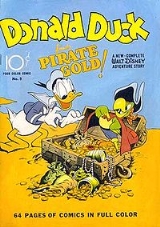
notes that by the early 1950s, Dell seemed to be giving more emphasis to subscription sales (promoted via premium giveaways as part of the Dell Comics Club), which necessitated stable series instead of one-shots. At one point in 1951, some issues of Four Color were double-numbered, reflecting the issuances for particular characters; thus issues 318 and 328, featuring Donald Duck, carried the notation "nos. 1-2" on the cover underneath the Four Color series number. This may indicate thought at that point was being given to the eventual transition of these characters from one-shots to their own titles. Indeed, beginning in the early 1950s, it became more prevalent than previously for Four Color titles, if they proved popular enough, to become ongoing, independent series. In some cases, the issue numbering of these spin-offs took into account any previous Four Color issues (albeit sometimes miscounting the one-shots; Donald Duck started with #26 despite the publication of twenty-eight Four Color issues with the character preceding it).
Identifying Four Color comics can be a challenge, as only issues published between c.1940 and 1946 actually carried the title Four Color Comics on the cover.
Documenting the extent of the Four Color series was among the bibliographic tasks undertaken in the early 1960s by emerging comic book fandom. Fans Donald and Maggie Thompson
took the lead in this endeavor and, in 1968, finally issued A Listing of Dell Special Series Comic Books (and a Few Others) as Bibliographic Supplement no. 1 to their fanzine Comic Art. In its 35 pages, it listed not only individual titles of comic books published in the Color/Four Color series, but those in these series: Black and White, Large Feature, United Feature Single Series, Comics on Parade, McKay Feature Books, Stories by Famous Authors Illustrated, and Classics Illustrated
(Classic Comics).
United States
The United States of America is a federal constitutional republic comprising fifty states and a federal district...
comic book anthology
Comics anthology
Comics anthologies collect works in the medium of comics that are too short for standalone publication.- U.S. :- UK :British comics have a long tradition publishing comics anthologies, often weekly...
series published by Dell Comics
Dell Comics
Dell Comics was the comic book publishing arm of Dell Publishing, which got its start in pulp magazines. It published comics from 1929 to 1973. At its peak, it was the most prominent and successful American company in the medium...
between 1939 and 1962. The title is a reference to the four basic colors
CMYK color model
The CMYK color model is a subtractive color model, used in color printing, and is also used to describe the printing process itself. CMYK refers to the four inks used in some color printing: cyan, magenta, yellow, and key...
used when printing comic books (cyan
Cyan
Cyan from , transliterated: kýanos, meaning "dark blue substance") may be used as the name of any of a number of colors in the blue/green range of the spectrum. In reference to the visible spectrum cyan is used to refer to the color obtained by mixing equal amounts of green and blue light or the...
, magenta
Magenta
Magenta is a color evoked by light stronger in blue and red wavelengths than in yellowish-green wavelengths . In light experiments, magenta can be produced by removing the lime-green wavelengths from white light...
, yellow
Yellow
Yellow is the color evoked by light that stimulates both the L and M cone cells of the retina about equally, with no significant stimulation of the S cone cells. Light with a wavelength of 570–590 nm is yellow, as is light with a suitable mixture of red and green...
and black
Black
Black is the color of objects that do not emit or reflect light in any part of the visible spectrum; they absorb all such frequencies of light...
at the time).
More than 1,000 issues were published, usually with multiple titles released every month. An exact accounting of the actual number of unique issues produced is difficult because occasional issue numbers were skipped and a number of reprint issues were also included, although the Overstreet Comic Book Price Guide
Overstreet Comic Book Price Guide
The Overstreet Comic Book Price Guide is an annually published comic book price guide widely considered the primary authority on the subject of American comic book grading and pricing in the hobby/industry....
nonetheless lists well over 1,000 individual issues, ending with #1354, but some numbers were skipped. It currently holds the record for most issues produced of an American comic book; its nearest rivals, Action Comics
Action Comics
Action Comics is an American comic book series that introduced Superman, the first major superhero character as the term is popularly defined...
ended at 904 issues and Detective Comics
Detective Comics
Detective Comics is an American comic book series published monthly by DC Comics since 1937, best known for introducing the iconic superhero Batman in Detective Comics #27 . It is, along with Action Comics, the book that launched with the debut of Superman, one of the medium's signature series, and...
ended after 877 issues. The first 25 issues are known as "series 1"; after they were published, the numbering began again and "series 2" began. Four Color is notable for having published many of the first comics featuring characters licensed from Walt Disney
Walt Disney
Walter Elias "Walt" Disney was an American film producer, director, screenwriter, voice actor, animator, entrepreneur, entertainer, international icon, and philanthropist, well-known for his influence in the field of entertainment during the 20th century. Along with his brother Roy O...
.
History
Unlike most comic book series of the day, which were either devoted to one character, or were anthologies with collections of stories starring the cartoon characters of a particular studio, Four Color instead devoted each individual issue to different characters. One issue might feature a popular cartoon character, while the next might be an adaptation of a popular movie or TV series. Thus the phrase "one shot" which was used in the publisher's code in the first interior page of the first story. For example issue 223 (1949) was denoted DDOS 223 which translates as Donald Duck One-Shot #223. Most Four Color titles featured licensed properties; relatively few original characters were created for the line. The first Four Color comic featured comic stripComic strip
A comic strip is a sequence of drawings arranged in interrelated panels to display brief humor or form a narrative, often serialized, with text in balloons and captions....
and movie serial hero Dick Tracy
Dick Tracy
Dick Tracy is a comic strip featuring Dick Tracy, a hard-hitting, fast-shooting and intelligent police detective. Created by Chester Gould, the strip made its debut on October 4, 1931, in the Detroit Mirror. It was distributed by the Chicago Tribune New York News Syndicate...
; the last (issue number 1,354, series 2) was based upon the TV series Calvin and the Colonel
Calvin and the Colonel
Calvin and the Colonel was an animated cartoon television series in 1961 about Colonel Montgomery J. Klaxon, a shrewd fox and Calvin T. Burnside, a dumb bear. Their lawyer was Oliver Wendell Clutch, who was a weasel . The colonel lived with his wife Maggie Belle and her sister Sue, who did not...
.
The primary purpose behind Four Color was as a try-out showcase for potential new Dell Comics series. For example Tarzan and Little Lulu
Little Lulu
"Little Lulu" is the nickname for Lulu Moppett, a comic strip character created in the mid-1930s by Marjorie Henderson Buell. The character debuted in The Saturday Evening Post on February 23, 1935 in a single panel, appearing as a flower girl at a wedding and strewing the aisle with banana peels...
in early 1948 launched their own titles (starting with no. 1) after proving themselves via a number of Four Color try-out issues. However, during the 1940s, the transition was not always so prompt, as a number of prominent funny animal characters starred in 20-30 issues of Four Color (these include Mickey Mouse
Mickey Mouse
Mickey Mouse is a cartoon character created in 1928 by Walt Disney and Ub Iwerks at The Walt Disney Studio. Mickey is an anthropomorphic black mouse and typically wears red shorts, large yellow shoes, and white gloves...
, Donald Duck
Donald Duck
Donald Fauntleroy Duck is a cartoon character created in 1934 at Walt Disney Productions and licensed by The Walt Disney Company. Donald is an anthropomorphic white duck with a yellow-orange bill, legs, and feet. He typically wears a sailor suit with a cap and a black or red bow tie. Donald is most...
and Porky Pig
Porky Pig
Porky Pig is an animated cartoon character in the Warner Bros. Looney Tunes and Merrie Melodies series of cartoons. He was the first character created by the studio to draw audiences based on his star power, and the animators created many critically acclaimed shorts using the fat little pig...
). Comic book historian Michael Barrier
Michael Barrier (historian)
Michael Barrier is an American animation historian. Barrier was the founder and editor of Funnyworld, the first magazine exclusively devoted to comics and animation. It began as a contribution to the CAPA-Alpha amateur press association...
notes that by the early 1950s, Dell seemed to be giving more emphasis to subscription sales (promoted via premium giveaways as part of the Dell Comics Club), which necessitated stable series instead of one-shots. At one point in 1951, some issues of Four Color were double-numbered, reflecting the issuances for particular characters; thus issues 318 and 328, featuring Donald Duck, carried the notation "nos. 1-2" on the cover underneath the Four Color series number. This may indicate thought at that point was being given to the eventual transition of these characters from one-shots to their own titles. Indeed, beginning in the early 1950s, it became more prevalent than previously for Four Color titles, if they proved popular enough, to become ongoing, independent series. In some cases, the issue numbering of these spin-offs took into account any previous Four Color issues (albeit sometimes miscounting the one-shots; Donald Duck started with #26 despite the publication of twenty-eight Four Color issues with the character preceding it).
Identifying Four Color comics can be a challenge, as only issues published between c.1940 and 1946 actually carried the title Four Color Comics on the cover.
Documenting the extent of the Four Color series was among the bibliographic tasks undertaken in the early 1960s by emerging comic book fandom. Fans Donald and Maggie Thompson
Maggie Thompson
Margaret "Maggie" Thompson , is the editor of Comics Buyer's Guide, a monthly comic book industry news magazine...
took the lead in this endeavor and, in 1968, finally issued A Listing of Dell Special Series Comic Books (and a Few Others) as Bibliographic Supplement no. 1 to their fanzine Comic Art. In its 35 pages, it listed not only individual titles of comic books published in the Color/Four Color series, but those in these series: Black and White, Large Feature, United Feature Single Series, Comics on Parade, McKay Feature Books, Stories by Famous Authors Illustrated, and Classics Illustrated
Classics Illustrated
Classics Illustrated is a comic book series featuring adaptations of literary classics such as Moby Dick, Hamlet, and The Iliad. Created by Albert Kanter, the series began publication in 1941 and finished its first run in 1971, producing 169 issues. Following the series' demise, various companies...
(Classic Comics).