


Foster Auditorium

Encyclopedia
Foster Auditorium is a multi-purpose facility at the University of Alabama
in Tuscaloosa, Alabama
. It was built in 1939 and has been used for Alabama basketball, women's sports (in the 1970s and 1980s), graduations, lectures, concerts, and other large gatherings, including registration. Its status as the largest indoor building on campus came to an end in 1968 with the opening of the Memorial Coliseum
. The building housed the Department of Kinesiology until 2006. In April 2009, the University announced a major renovation for the auditorium. After the renovation, the Crimson Tide women's basketball and volleyball programs moved back to Foster Auditorium, their original home.
The building was declared a National Historic Landmark
on April 5, 2005.
, and is commemorated at the Naismith Memorial Basketball Hall of Fame. A brass marker was placed in the gym floor to indicate the location of the shot.
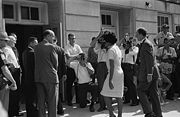 More than any other event, Foster Auditorium is known as the site of the "Stand in the Schoolhouse Door
" incident. On June 11, 1963, Governor George C. Wallace, making good on a campaign pledge to not allow integration of the University, stood in the doorway of the building on the day of registration. He was attempting to block two black students, Vivian Malone and James Hood
, from enrolling at the University. President John F. Kennedy
called on the Alabama National Guard
to forcibly allow the students to enter the building if need be. Calling it "an unwelcomed, unwanted, unwarranted and force-induced intrusion upon the campus," Wallace denounced the actions, but, seeing as he could not win against the combined efforts of the Guard, federal marshals and Deputy United States Attorney General
Nicholas Katzenbach
, stepped aside, returning to the state capital
as Malone and Hood entered for registration. The incident is seen as one of the seminal events in the Civil Rights Movement
in America. This is where the building got its name, after Autherine Lucy Foster, a Civil Rights activist.
The scene was depicted (with artistic liberties taken) in the 1994 film Forrest Gump
.
University of Alabama
The University of Alabama is a public coeducational university located in Tuscaloosa, Alabama, United States....
in Tuscaloosa, Alabama
Tuscaloosa, Alabama
Tuscaloosa is a city in and the seat of Tuscaloosa County in west central Alabama . Located on the Black Warrior River, it is the fifth-largest city in Alabama, with a population of 90,468 in 2010...
. It was built in 1939 and has been used for Alabama basketball, women's sports (in the 1970s and 1980s), graduations, lectures, concerts, and other large gatherings, including registration. Its status as the largest indoor building on campus came to an end in 1968 with the opening of the Memorial Coliseum
Coleman Coliseum
Coleman Coliseum is a 15,316-seat multi-purpose arena in Tuscaloosa, Alabama and is home to the University of Alabama Crimson Tide men's basketball and gymnastics teams. It has also been home to the Alabama women's basketball and women's volleyball programs in the past.Before 1988, the building...
. The building housed the Department of Kinesiology until 2006. In April 2009, the University announced a major renovation for the auditorium. After the renovation, the Crimson Tide women's basketball and volleyball programs moved back to Foster Auditorium, their original home.
The building was declared a National Historic Landmark
National Historic Landmark
A National Historic Landmark is a building, site, structure, object, or district, that is officially recognized by the United States government for its historical significance...
on April 5, 2005.
Sports history
Foster Auditorium was the site of a full court shot during the January 4, 1955 basketball game between the University of Alabama and the University of North Carolina. Alabama player George Linn made the 84 feet 11 inch shot at the end of the first half. The shot was featured in Sports IllustratedSports Illustrated
Sports Illustrated is an American sports media company owned by media conglomerate Time Warner. Its self titled magazine has over 3.5 million subscribers and is read by 23 million adults each week, including over 18 million men. It was the first magazine with circulation over one million to win the...
, and is commemorated at the Naismith Memorial Basketball Hall of Fame. A brass marker was placed in the gym floor to indicate the location of the shot.
Stand in the Schoolhouse Door
Stand in the Schoolhouse Door
The Stand in the Schoolhouse Door took place at Foster Auditorium at the University of Alabama on June 11, 1963. George Wallace, the Governor of Alabama, in a symbolic attempt to keep his inaugural promise of "segregation now, segregation tomorrow, segregation forever" and stop the desegregation of...
" incident. On June 11, 1963, Governor George C. Wallace, making good on a campaign pledge to not allow integration of the University, stood in the doorway of the building on the day of registration. He was attempting to block two black students, Vivian Malone and James Hood
James Hood
James Hood was one of the first African Americans to enroll at the University of Alabama in 1963 and was made famous when Alabama Governor George Wallace blocked him from enrolling at the all-white university....
, from enrolling at the University. President John F. Kennedy
John F. Kennedy
John Fitzgerald "Jack" Kennedy , often referred to by his initials JFK, was the 35th President of the United States, serving from 1961 until his assassination in 1963....
called on the Alabama National Guard
United States National Guard
The National Guard of the United States is a reserve military force composed of state National Guard militia members or units under federally recognized active or inactive armed force service for the United States. Militia members are citizen soldiers, meaning they work part time for the National...
to forcibly allow the students to enter the building if need be. Calling it "an unwelcomed, unwanted, unwarranted and force-induced intrusion upon the campus," Wallace denounced the actions, but, seeing as he could not win against the combined efforts of the Guard, federal marshals and Deputy United States Attorney General
United States Attorney General
The United States Attorney General is the head of the United States Department of Justice concerned with legal affairs and is the chief law enforcement officer of the United States government. The attorney general is considered to be the chief lawyer of the U.S. government...
Nicholas Katzenbach
Nicholas Katzenbach
Nicholas deBelleville Katzenbach is an American lawyer who served as United States Attorney General during the Lyndon B. Johnson administration.-Early life:...
, stepped aside, returning to the state capital
Montgomery, Alabama
Montgomery is the capital of the U.S. state of Alabama, and is the county seat of Montgomery County. It is located on the Alabama River southeast of the center of the state, in the Gulf Coastal Plain. As of the 2010 census, Montgomery had a population of 205,764 making it the second-largest city...
as Malone and Hood entered for registration. The incident is seen as one of the seminal events in the Civil Rights Movement
Civil rights movement
The civil rights movement was a worldwide political movement for equality before the law occurring between approximately 1950 and 1980. In many situations it took the form of campaigns of civil resistance aimed at achieving change by nonviolent forms of resistance. In some situations it was...
in America. This is where the building got its name, after Autherine Lucy Foster, a Civil Rights activist.
The scene was depicted (with artistic liberties taken) in the 1994 film Forrest Gump
Forrest Gump
Forrest Gump is a 1994 American epic comedy-drama romance film based on the 1986 novel of the same name by Winston Groom. The film was directed by Robert Zemeckis, starring Tom Hanks, Robin Wright and Gary Sinise...
.