


Fosse Way

Encyclopedia
The Fosse Way was a Roman road
in England that linked Exeter
(Isca Dumnoniorum
) in South West England
to Lincoln
(Lindum Colonia
) in Lincolnshire
, via Ilchester
(Lindinis
), Bath (Aquae Sulis
), Cirencester
(Corinium
) and Leicester
(Ratae Corieltauvorum
).
It joined Akeman Street
and Ermin Way
at Cirencester, crossed Watling Street
at Venonis (High Cross
) south of Leicester, and joined Ermine Street
at Lincoln.
The word Fosse is derived from the Latin
fossa, meaning ditch. For the first few decades after the Roman invasion of Britain in AD 43
, the Fosse Way marked the western frontier of Roman rule in Iron Age Britain
. It is possible that the road began as a defensive ditch that was later filled in and converted into a road, or possibly a defensive ditch ran alongside the road for at least some of its length.
It is remarkable for its extremely direct route: from Lincoln to Ilchester in Somerset
, a distance of 182 miles (292.9 km), it is never more than 6 miles (9.7 km) from a straight line.
, district or county
boundaries.
Several place names on the route have the suffix -cester or -chester, which is from the Latin castra
meaning military camp. Some settlements are named after the road itself, such as Fosse-, or -on-Fosse, while others have a more generic form, such as Street, Strete, -le-Street, Stratton, Stretton, Stratford, and Stretford, from the Latin strata, meaning paved road. The route runs from 50.73°N 3.48°W in Exeter to 53.23°N 0.54°W in Lincoln.
the A46
follows the route of the Fosse Way. The A46 deviates from Fosse Way at East Goscote
, to follow the Leicester Western Bypass. The original alignment, which is still visible as an unclassified road called Fosse Way, passes through Syston
, continuing as the minor road Melton Road through Thurmaston
, before merging with the A607 (the old A46), continuing into the city centre on the old alignment, first as Melton Road then Belgrave Road and Belgrave Gate. The alignment terminates at the Clock Tower
, and picks up again at Narborough Road (the A5460), on the other side of the River Soar
. A 19 miles (30.6 km) stretch of the road between Widmerpool & Newark-on-Trent
is currently subject to a major upgrade to Dual-carriageway and will be completed in 2012. The new route deviates in several sections off the historic road line.
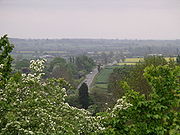 south of Leicester
, apart from a short deviation near Narborough where the original course is no longer visible, the B4114 (originally the A46 but renumbered when the M69
was opened) follows the route. A short distance north of the A5, the B4114 diverges from the line of the Fosse Way to pass through the village of Sharnford
. For 2 miles (3.2 km) the route of the Fosse Way is followed by a minor road which, although single track, runs along a much wider and slightly domed strip of land with deep ditches either side (the agger).
The modern road ends at a picnic site car park, and a further 1.5 miles (2.4 km) southwards can be explored on foot.
The junction with Watling Street
, now the A5, is at High Cross (Roman name Venonis). Watling Street
is the county boundary between Leicestershire
and Warwickshire
.
The Fosse Way follows the B4455 across Warwickshire
, through Street Ashton, Stretton-under-Fosse
, Brinklow, Bretford, Stretton-on-Dunsmore
, Princethorpe and the site of a Roman town near Chesterton
, until it joins the A429
near the boundary with Gloucestershire
. The route then follows the A429
through Stretton-on-Fosse, Moreton-in-Marsh
, Stow-on-the-Wold
, Northleach
and Fossebridge, to Cirencester
, where it crosses Akeman Street
and Ermin Way
.
, across the old airfield at RAF Kemble
, then becomes fragmented sections of country lanes; two sections on this stretch are byway
s rather than maintained roads, and at points on these routes it widens to as much as 60 feet (18.3 m).
It passes near the Iron Age
hill fort
of Bury Camp and becomes another section of the county boundary, crossing first the South Wales railway, next the site of an old chapel and spring at Fosse Lodge in Dunley, and then the M4. Thereafter it passes through The Shoe
and Netteton Shrub where remains of a posting-station have been found, and arrives at Batheaston
. Thereupon it turns due west to follow the river Avon into Bath.
the line of the Fosse Way follows parts of the A367, through Radstock
, Westfield
and Stratton-on-the-Fosse
. It runs across open country and farm tracks parallel to the A37
north of Shepton Mallet, near the Iron Age
hill fort
of Maesbury
. At Beacon Hill south of Oakhill
, it crossed the Roman road along the Mendip
ridgeway from Old Sarum
to the lead and silver mines at Charterhouse
. The Fosse Way passes through the eastern suburbs of Shepton Mallet
on a short stretch of the A361 to Cannard's Grave, where it picks up the A37.
The Fosse Way follows the A37 through Street-on-the-Fosse and Lydford-on-Fosse
on a direct route to Ilchester
. The route leaves the A37 at the A303
junction just north of Ilchester, and follows a small track, before picking up the B3151 through the town.
The Roman road from Ilchester to Dorchester, Dorset continues on the line of A37 through Yeovil
to the south east. Other minor Roman roads lead from Ilchester and Lydford-on-Fosse towards Street
and the A39
route along the Polden Hills
, leading to Roman salt works on the Somerset Levels
, and ports at Combwich
, Crandon Bridge and Highbridge
.
under the ramparts of the Iron Age
hill fort
of Ham Hill, occupied by the Second Legion
after the conquest of the Durotriges
in Dorset.
The alignment leaves major roads after Petherton Bridge over the River Parrett
, and follows country lanes to Over Stratton and Dinnington
, where in 2002 members of the Channel 4
television programme Time Team
uncovered a mosaic
next to the road.
The route crosses a stream called Stretford Water, climbs the ridge, and follows a short section of the A30
at Windwhistle Hill. Then it turns on to the B3167 through the hamlets of Street and Perry Street, joins the A358, crosses the River Axe at what used to be called Stratford (now called Weycroft), and on to Axminster
.
Now we come to the difficult question of where the Fosse Way ends. There are further alignments on the A358 at Ball's Farm and Musbury
south of Axminster, which imply a Roman road did continue along the River Axe toward Axmouth
and Seaton
. These sections are labelled Fosse Way on Ordnance Survey
maps.
However, the main route for Exeter
would have followed the Dorchester road west from Axminster to Honiton
. The crossroads in Axminster was controlled by a Roman fort at Woodbury Farm
, now on the southern edge of the town. The route to the west crosses the Rivers Axe and Yarty to Kilmington
, continuing on segments of the A35
and minor local lanes to Honiton.
From Honiton the route leads south-west along the old A30, to Strete Ralegh, where there is a short break, then a clear alignment along a minor road towards Exeter.
It is also likely that one or more side roads split from the Fosse Way at Lopen Head or Dinnington
, passing around Ilminster
, then following the line of the current A303/A30 from Horton
to Honiton. For example, there are villages called Crock Street and Street Ash on or near these routes. So in the later years of Roman occupation, there would probably have been a choice of routes from Ilchester to Honiton.
Roman road
The Roman roads were a vital part of the development of the Roman state, from about 500 BC through the expansion during the Roman Republic and the Roman Empire. Roman roads enabled the Romans to move armies and trade goods and to communicate. The Roman road system spanned more than 400,000 km...
in England that linked Exeter
Exeter
Exeter is a historic city in Devon, England. It lies within the ceremonial county of Devon, of which it is the county town as well as the home of Devon County Council. Currently the administrative area has the status of a non-metropolitan district, and is therefore under the administration of the...
(Isca Dumnoniorum
Isca Dumnoniorum
Isca Dumnoniorum was a town in the Roman province of Britannia and the capital of Dumnonia in the sub-Roman period. Today it is known as Exeter, located in the English county of Devon.-Fortress:...
) in South West England
South West England
South West England is one of the regions of England defined by the Government of the United Kingdom for statistical and other purposes. It is the largest such region in area, covering and comprising Bristol, Gloucestershire, Somerset, Dorset, Wiltshire, Devon, Cornwall and the Isles of Scilly. ...
to Lincoln
Lincoln, Lincolnshire
Lincoln is a cathedral city and county town of Lincolnshire, England.The non-metropolitan district of Lincoln has a population of 85,595; the 2001 census gave the entire area of Lincoln a population of 120,779....
(Lindum Colonia
Lindum Colonia
Lindum Colonia was a town in the Roman province of Britannia. Today it is called Lincoln, in the English county of Lincolnshire.-Fort and name:...
) in Lincolnshire
Lincolnshire
Lincolnshire is a county in the east of England. It borders Norfolk to the south east, Cambridgeshire to the south, Rutland to the south west, Leicestershire and Nottinghamshire to the west, South Yorkshire to the north west, and the East Riding of Yorkshire to the north. It also borders...
, via Ilchester
Ilchester
Ilchester is a village and civil parish, situated on the River Yeo or Ivel, five miles north of Yeovil, in the English county of Somerset. The parish, which includes the village of Sock Dennis and the old parish of Northover, has a population of 2,021...
(Lindinis
Lindinis
Lindinis was a small town in the Roman province of Britannia. Today it is known as Ilchester, located in the English county of Somerset....
), Bath (Aquae Sulis
Aquae Sulis
Aquae Sulis was a small town in the Roman province of Britannia. Today it is known as Bath, located in the English county of Somerset.-Baths and temple complex:...
), Cirencester
Cirencester
Cirencester is a market town in east Gloucestershire, England, 93 miles west northwest of London. Cirencester lies on the River Churn, a tributary of the River Thames, and is the largest town in the Cotswold District. It is the home of the Royal Agricultural College, the oldest agricultural...
(Corinium
Corinium Dobunnorum
Corinium Dobunnorum was the second largest town in the Roman province of Britannia. Today it is known as Cirencester, located in the English county of Gloucestershire.-Fortress:...
) and Leicester
Leicester
Leicester is a city and unitary authority in the East Midlands of England, and the county town of Leicestershire. The city lies on the River Soar and at the edge of the National Forest...
(Ratae Corieltauvorum
Ratae Corieltauvorum
Ratae Corieltauvorum was a town in the Roman province of Britannia. Today it is known as Leicester, located in the English county of Leicestershire.-Name:...
).
It joined Akeman Street
Akeman Street
Akeman Street was a major Roman road in England that linked Watling Street with the Fosse Way. Its junction with Watling Steet was just north of Verulamium and that with the Fosse Way was at Corinium Dobunnorum...
and Ermin Way
Ermin Street
Ermin Street or Ermin Way is one of the great Roman roads of Britain. It runs from Gloucester via Cirencester to Silchester . Much of it is now covered by the modern A417, A419 and B4000 roads....
at Cirencester, crossed Watling Street
Watling Street
Watling Street is the name given to an ancient trackway in England and Wales that was first used by the Britons mainly between the modern cities of Canterbury and St Albans. The Romans later paved the route, part of which is identified on the Antonine Itinerary as Iter III: "Item a Londinio ad...
at Venonis (High Cross
High Cross, Leicestershire
High Cross is the name given to the former crossroads of the Roman roads of Watling Street and Fosse Way in Leicestershire, England. It is located about a mile west of the village of Claybrooke Magna and was located in the hundred of Guthlaxton...
) south of Leicester, and joined Ermine Street
Ermine Street
Ermine Street is the name of a major Roman road in England that ran from London to Lincoln and York . The Old English name was 'Earninga Straete' , named after a tribe called the Earningas, who inhabited a district later known as Armingford Hundred, around Arrington, Cambridgeshire and Royston,...
at Lincoln.
The word Fosse is derived from the Latin
Latin
Latin is an Italic language originally spoken in Latium and Ancient Rome. It, along with most European languages, is a descendant of the ancient Proto-Indo-European language. Although it is considered a dead language, a number of scholars and members of the Christian clergy speak it fluently, and...
fossa, meaning ditch. For the first few decades after the Roman invasion of Britain in AD 43
43
Year 43 was a common year starting on Tuesday of the Julian calendar. At the time, it was known as the Year of the Consulship of Caesar and Vitellius...
, the Fosse Way marked the western frontier of Roman rule in Iron Age Britain
British Iron Age
The British Iron Age is a conventional name used in the archaeology of Great Britain, referring to the prehistoric and protohistoric phases of the Iron-Age culture of the main island and the smaller islands, typically excluding prehistoric Ireland, and which had an independent Iron Age culture of...
. It is possible that the road began as a defensive ditch that was later filled in and converted into a road, or possibly a defensive ditch ran alongside the road for at least some of its length.
It is remarkable for its extremely direct route: from Lincoln to Ilchester in Somerset
Somerset
The ceremonial and non-metropolitan county of Somerset in South West England borders Bristol and Gloucestershire to the north, Wiltshire to the east, Dorset to the south-east, and Devon to the south-west. It is partly bounded to the north and west by the Bristol Channel and the estuary of the...
, a distance of 182 miles (292.9 km), it is never more than 6 miles (9.7 km) from a straight line.
Today's route
Many sections of the Fosse Way form parts of modern roads and lanes, and parishParish
A parish is a territorial unit historically under the pastoral care and clerical jurisdiction of one parish priest, who might be assisted in his pastoral duties by a curate or curates - also priests but not the parish priest - from a more or less central parish church with its associated organization...
, district or county
County
A county is a jurisdiction of local government in certain modern nations. Historically in mainland Europe, the original French term, comté, and its equivalents in other languages denoted a jurisdiction under the sovereignty of a count A county is a jurisdiction of local government in certain...
boundaries.
Several place names on the route have the suffix -cester or -chester, which is from the Latin castra
Castra
The Latin word castra, with its singular castrum, was used by the ancient Romans to mean buildings or plots of land reserved to or constructed for use as a military defensive position. The word appears in both Oscan and Umbrian as well as in Latin. It may have descended from Indo-European to Italic...
meaning military camp. Some settlements are named after the road itself, such as Fosse-, or -on-Fosse, while others have a more generic form, such as Street, Strete, -le-Street, Stratton, Stretton, Stratford, and Stretford, from the Latin strata, meaning paved road. The route runs from 50.73°N 3.48°W in Exeter to 53.23°N 0.54°W in Lincoln.
Lincoln to Leicester
Between Lincoln and LeicesterLeicester
Leicester is a city and unitary authority in the East Midlands of England, and the county town of Leicestershire. The city lies on the River Soar and at the edge of the National Forest...
the A46
A46 road
The A46 is an A road in England. It starts east of Bath, Somerset and ends in Cleethorpes, North East Lincolnshire, but it does not form a continuous route. Large portions of the old road have been lost, bypassed, or replaced by motorway development...
follows the route of the Fosse Way. The A46 deviates from Fosse Way at East Goscote
East Goscote
East Goscote is a village and civil parish in the Charnwood district of Leicestershire, England, just north of Syston. It is a medium sized village with a population of approximately 3,000. The village is twinned with Fleury-sur-Andelle, France....
, to follow the Leicester Western Bypass. The original alignment, which is still visible as an unclassified road called Fosse Way, passes through Syston
Syston
Syston is a town and civil parish in the district of Charnwood in Leicestershire, England. The population is 11,508 as of the 2001 Census.-Overview:...
, continuing as the minor road Melton Road through Thurmaston
Thurmaston
Thurmaston is a village and civil parish within the Charnwood borough of Leicestershire, England. As of the 2001 census its population was 8,945...
, before merging with the A607 (the old A46), continuing into the city centre on the old alignment, first as Melton Road then Belgrave Road and Belgrave Gate. The alignment terminates at the Clock Tower
Clock Tower (Leicester)
The Haymarket Memorial Clock Tower is a major landmark and popular meeting point in Leicester, United Kingdom. It is located roughly in the middle of the area inside the ring-road, and is at the point where five major streets meet, and also close by to the junction with Cheapside.The Clock Tower...
, and picks up again at Narborough Road (the A5460), on the other side of the River Soar
River Soar
The River Soar is a tributary of the River Trent in the English East Midlands.-Description:It rises near Hinckley in Leicestershire and is joined by the River Sence near Enderby before flowing through Leicester , Barrow-on-Soar, beside Loughborough and Kegworth, before joining the Trent near...
. A 19 miles (30.6 km) stretch of the road between Widmerpool & Newark-on-Trent
Newark-on-Trent
Newark-on-Trent is a market town in Nottinghamshire in the East Midlands region of England. It stands on the River Trent, the A1 , and the East Coast Main Line railway. The origins of the town are possibly Roman as it lies on an important Roman road, the Fosse Way...
is currently subject to a major upgrade to Dual-carriageway and will be completed in 2012. The new route deviates in several sections off the historic road line.
Leicester to Cirencester
Leicester
Leicester is a city and unitary authority in the East Midlands of England, and the county town of Leicestershire. The city lies on the River Soar and at the edge of the National Forest...
, apart from a short deviation near Narborough where the original course is no longer visible, the B4114 (originally the A46 but renumbered when the M69
M69 motorway
The M69 is a lightly used dual three lane dual carriageway motorway in Leicestershire and Warwickshire, England connecting Leicester and Coventry. It opened in 1977.-History:...
was opened) follows the route. A short distance north of the A5, the B4114 diverges from the line of the Fosse Way to pass through the village of Sharnford
Sharnford
Sharnford is a village and civil parish in Blaby of Leicestershire. The parish has a population of about 1,000. The village is about four miles east of Hinckley, and is near to Aston Flamville, Wigston Parva and Sapcote....
. For 2 miles (3.2 km) the route of the Fosse Way is followed by a minor road which, although single track, runs along a much wider and slightly domed strip of land with deep ditches either side (the agger).
The modern road ends at a picnic site car park, and a further 1.5 miles (2.4 km) southwards can be explored on foot.
The junction with Watling Street
Watling Street
Watling Street is the name given to an ancient trackway in England and Wales that was first used by the Britons mainly between the modern cities of Canterbury and St Albans. The Romans later paved the route, part of which is identified on the Antonine Itinerary as Iter III: "Item a Londinio ad...
, now the A5, is at High Cross (Roman name Venonis). Watling Street
Watling Street
Watling Street is the name given to an ancient trackway in England and Wales that was first used by the Britons mainly between the modern cities of Canterbury and St Albans. The Romans later paved the route, part of which is identified on the Antonine Itinerary as Iter III: "Item a Londinio ad...
is the county boundary between Leicestershire
Leicestershire
Leicestershire is a landlocked county in the English Midlands. It takes its name from the heavily populated City of Leicester, traditionally its administrative centre, although the City of Leicester unitary authority is today administered separately from the rest of Leicestershire...
and Warwickshire
Warwickshire
Warwickshire is a landlocked non-metropolitan county in the West Midlands region of England. The county town is Warwick, although the largest town is Nuneaton. The county is famous for being the birthplace of William Shakespeare...
.
The Fosse Way follows the B4455 across Warwickshire
Warwickshire
Warwickshire is a landlocked non-metropolitan county in the West Midlands region of England. The county town is Warwick, although the largest town is Nuneaton. The county is famous for being the birthplace of William Shakespeare...
, through Street Ashton, Stretton-under-Fosse
Stretton-under-Fosse
Stretton-under-Fosse is a village and civil parish in the English county of Warwickshire. In 2001 its population was recorded as 185.The village contains a number of old cottages along its main street. Just outside Stretton is an old manor house Newbold Revel, which is now used as a training...
, Brinklow, Bretford, Stretton-on-Dunsmore
Stretton-on-Dunsmore
Stretton-on-Dunsmore is a village and civil parish in the English county of Warwickshire. Its population in the 2001 census was recorded as 1,143 - in the 19th century the population was 634. It is situated just south of the A45 trunk road, roughly half way between Rugby and Coventry...
, Princethorpe and the site of a Roman town near Chesterton
Chesterton, Warwickshire
Chesterton is a small village in Warwickshire, England. It is about five miles south of Leamington Spa, near the villages of Harbury and Lighthorne.-Parish:...
, until it joins the A429
A429 road
The A429 is a main road in England that runs in a north-northeasterly direction from junction 17 of the M4 motorway to Coventry in the West Midlands, by way of Malmesbury, Cirencester, Stow-on-the-Wold, Moreton-in-Marsh, east of Stratford-upon-Avon, Warwick, and Kenilworth.For much of its length...
near the boundary with Gloucestershire
Gloucestershire
Gloucestershire is a county in South West England. The county comprises part of the Cotswold Hills, part of the flat fertile valley of the River Severn, and the entire Forest of Dean....
. The route then follows the A429
A429 road
The A429 is a main road in England that runs in a north-northeasterly direction from junction 17 of the M4 motorway to Coventry in the West Midlands, by way of Malmesbury, Cirencester, Stow-on-the-Wold, Moreton-in-Marsh, east of Stratford-upon-Avon, Warwick, and Kenilworth.For much of its length...
through Stretton-on-Fosse, Moreton-in-Marsh
Moreton-in-Marsh
Moreton-in-Marsh is a town and civil parish in northeastern Gloucestershire, England. The town is at the crossroads of the Fosse Way Roman road and the A44. The parish and environs are relatively flat and low-lying compared with the surrounding Cotswold Hills...
, Stow-on-the-Wold
Stow-on-the-Wold
Stow-on-the-Wold is a market town and civil parish in Gloucestershire, England. It is situated on top of an 800 ft hill, at the convergence of a number of major roads through the Cotswolds, including the Fosse Way . The town was founded as a planned market place by Norman lords to take...
, Northleach
Northleach
Northleach is a small Cotswold market town in Gloucestershire, England. It constitutes the major part of the civil parish of Northleach with Eastington.The nearest railway stations are Moreton-in-Marsh, Kingham and Shipton on the Cotswold Line....
and Fossebridge, to Cirencester
Cirencester
Cirencester is a market town in east Gloucestershire, England, 93 miles west northwest of London. Cirencester lies on the River Churn, a tributary of the River Thames, and is the largest town in the Cotswold District. It is the home of the Royal Agricultural College, the oldest agricultural...
, where it crosses Akeman Street
Akeman Street
Akeman Street was a major Roman road in England that linked Watling Street with the Fosse Way. Its junction with Watling Steet was just north of Verulamium and that with the Fosse Way was at Corinium Dobunnorum...
and Ermin Way
Ermin Street
Ermin Street or Ermin Way is one of the great Roman roads of Britain. It runs from Gloucester via Cirencester to Silchester . Much of it is now covered by the modern A417, A419 and B4000 roads....
.
Cirencester to Bath
South of Cirencester the Fosse Way follows a short section of the A433, then goes cross country, forming the county boundary between Gloucestershire and WiltshireWiltshire
Wiltshire is a ceremonial county in South West England. It is landlocked and borders the counties of Dorset, Somerset, Hampshire, Gloucestershire, Oxfordshire and Berkshire. It contains the unitary authority of Swindon and covers...
, across the old airfield at RAF Kemble
RAF Kemble
RAF Kemble was a Royal Air Force airfield that was linked from 1966 with the Red Arrows, the RAF Aerobatic display team; which operated Gnat and laterly Hawk trainers from there...
, then becomes fragmented sections of country lanes; two sections on this stretch are byway
Byway
A byway is a less-traveled side road, as in:*Byway , a minor secondary or tertiary road in the UK*National Scenic Byway, a road recognized by the United States Department of Transportation for its historical qualities...
s rather than maintained roads, and at points on these routes it widens to as much as 60 feet (18.3 m).
It passes near the Iron Age
Iron Age
The Iron Age is the archaeological period generally occurring after the Bronze Age, marked by the prevalent use of iron. The early period of the age is characterized by the widespread use of iron or steel. The adoption of such material coincided with other changes in society, including differing...
hill fort
Hill fort
A hill fort is a type of earthworks used as a fortified refuge or defended settlement, located to exploit a rise in elevation for defensive advantage. They are typically European and of the Bronze and Iron Ages. Some were used in the post-Roman period...
of Bury Camp and becomes another section of the county boundary, crossing first the South Wales railway, next the site of an old chapel and spring at Fosse Lodge in Dunley, and then the M4. Thereafter it passes through The Shoe
The Shoe
The Shoe is a hamlet in the parish of North Wraxall, in the north-west of Wiltshire in England. It is situated a few miles north of Bath, at the junction of the Fosse Way and the A420 .-Facilities:There is a natural spring, which could suggest a historical settlement of some sort...
and Netteton Shrub where remains of a posting-station have been found, and arrives at Batheaston
Batheaston
Batheaston is a village and civil parish east of Bath, England , on the north bank of the River Avon. The parish has a population of 2,625...
. Thereupon it turns due west to follow the river Avon into Bath.
Bath to Ilchester
Between Bath and Shepton MalletShepton Mallet
Shepton Mallet is a small rural town and civil parish in the Mendip district of Somerset in South West England. Situated approximately south of Bristol and east of Wells, the town is estimated to have a population of 9,700. It contains the administrative headquarters of Mendip District Council...
the line of the Fosse Way follows parts of the A367, through Radstock
Radstock
Radstock is a town in Somerset, England, south west of Bath, and north west of Frome. It is within the unitary authority of Bath and North East Somerset and had a population of 5,275 according to the 2001 Census...
, Westfield
Westfield, Somerset
Westfield is a settlement lying on the Fosse Way between Radstock and Midsomer Norton in Somerset, England. In 2011 it was raised to the status of a civil parish....
and Stratton-on-the-Fosse
Stratton-on-the-Fosse
Stratton-on-the-Fosse is a village and civil parish located on the edge of the Mendip Hills, south-west of Westfield, north-east of Shepton Mallet, and from Frome, in Somerset, England. It has a population 1,045, and has a rural agricultural landscape, although it was part of the once-thriving...
. It runs across open country and farm tracks parallel to the A37
A37 road
The A37 is a major road in southern England. It runs north from the A35 at Dorchester in Dorset into Somerset through Yeovil and Shepton Mallet before terminating at the Three Lamps junction with the A4 in central Bristol...
north of Shepton Mallet, near the Iron Age
Iron Age
The Iron Age is the archaeological period generally occurring after the Bronze Age, marked by the prevalent use of iron. The early period of the age is characterized by the widespread use of iron or steel. The adoption of such material coincided with other changes in society, including differing...
hill fort
Hill fort
A hill fort is a type of earthworks used as a fortified refuge or defended settlement, located to exploit a rise in elevation for defensive advantage. They are typically European and of the Bronze and Iron Ages. Some were used in the post-Roman period...
of Maesbury
Maesbury Castle
Maesbury Castle is an Iron Age hill fort within the parish of Croscombe on the Mendip Hills, just north of Shepton Mallet, Somerset, England. It has been listed as Scheduled Ancient Monument....
. At Beacon Hill south of Oakhill
Oakhill
Oakhill, Somerset is a village located approximately north of Shepton Mallet between the A37 and the A367 . Oakhill is today is mainly a commuter village of in size, but it is more famous for its past activities which include its brewing....
, it crossed the Roman road along the Mendip
Mendip Hills
The Mendip Hills is a range of limestone hills to the south of Bristol and Bath in Somerset, England. Running east to west between Weston-super-Mare and Frome, the hills overlook the Somerset Levels to the south and the Avon Valley to the north...
ridgeway from Old Sarum
Old Sarum
Old Sarum is the site of the earliest settlement of Salisbury, in England. The site contains evidence of human habitation as early as 3000 BC. Old Sarum is mentioned in some of the earliest records in the country...
to the lead and silver mines at Charterhouse
Charterhouse, Somerset
Charterhouse, also known as Charterhouse-on-Mendip, is a hamlet in the Mendip Hills Area of Outstanding Natural Beauty in the English county of Somerset...
. The Fosse Way passes through the eastern suburbs of Shepton Mallet
Shepton Mallet
Shepton Mallet is a small rural town and civil parish in the Mendip district of Somerset in South West England. Situated approximately south of Bristol and east of Wells, the town is estimated to have a population of 9,700. It contains the administrative headquarters of Mendip District Council...
on a short stretch of the A361 to Cannard's Grave, where it picks up the A37.
The Fosse Way follows the A37 through Street-on-the-Fosse and Lydford-on-Fosse
Lydford-on-Fosse
Lydford-on-Fosse is a village and civil parish in the Mendip district of Somerset, England. The parish includes the hamlet of East Lydford.-History:...
on a direct route to Ilchester
Ilchester
Ilchester is a village and civil parish, situated on the River Yeo or Ivel, five miles north of Yeovil, in the English county of Somerset. The parish, which includes the village of Sock Dennis and the old parish of Northover, has a population of 2,021...
. The route leaves the A37 at the A303
A303 road
The A303 is a 92-mile long trunk road in England. It is the main road between Basingstoke in Hampshire and Honiton in Devon. The M3, the A303 and the A30 together make up one of the main routes from London to South West England, running from London to Land's End in Cornwall...
junction just north of Ilchester, and follows a small track, before picking up the B3151 through the town.
The Roman road from Ilchester to Dorchester, Dorset continues on the line of A37 through Yeovil
Yeovil
Yeovil is a town and civil parish in south Somerset, England. The parish had a population of 27,949 at the 2001 census, although the wider urban area had a population of 42,140...
to the south east. Other minor Roman roads lead from Ilchester and Lydford-on-Fosse towards Street
Street, Somerset
Street is a small village and civil parish in the county of Somerset, England. It is situated on a dry spot in the Somerset Levels, at the end of the Polden Hills, south-west of Glastonbury. The 2001 census records the village as having a population of 11,066...
and the A39
A39 road
The A39 is an A road in south west England. It runs south-west from Bath in Somerset through Wells, Glastonbury, Street and Bridgwater. It then follows the north coast of Somerset and Devon through Williton, Minehead, Porlock, Lynmouth, Barnstaple, Bideford, Stratton, Camelford, Wadebridge and St...
route along the Polden Hills
Polden Hills
The Polden Hills in Somerset, England are a long, low ridge, extending for , and separated from the Mendip Hills, to which they are nearly parallel, by a marshy tract, known as the Somerset Levels...
, leading to Roman salt works on the Somerset Levels
Somerset Levels
The Somerset Levels, or the Somerset Levels and Moors as they are less commonly but more correctly known, is a sparsely populated coastal plain and wetland area of central Somerset, South West England, between the Quantock and Mendip Hills...
, and ports at Combwich
Combwich
Combwich is a village in the parish of Otterhampton within the Sedgemoor district of Somerset, between Bridgwater and the Steart Peninsula.The village lies on Combwich Reach as the River Parrett flows to the sea and was the site of an ancient ferry crossing. In the Domesday book it was known as...
, Crandon Bridge and Highbridge
Highbridge, Somerset
Highbridge is a small market town situated on the edge of the Somerset Levels near the mouth of the River Brue. It is in the County of Somerset, and is approximately north west of Taunton, the county town of Somerset. Highbridge is in the District of Sedgemoor, being situated approximately north...
.
Ilchester to Exeter
After Ilchester the Fosse Way is followed by a section of the A303A303 road
The A303 is a 92-mile long trunk road in England. It is the main road between Basingstoke in Hampshire and Honiton in Devon. The M3, the A303 and the A30 together make up one of the main routes from London to South West England, running from London to Land's End in Cornwall...
under the ramparts of the Iron Age
Iron Age
The Iron Age is the archaeological period generally occurring after the Bronze Age, marked by the prevalent use of iron. The early period of the age is characterized by the widespread use of iron or steel. The adoption of such material coincided with other changes in society, including differing...
hill fort
Hill fort
A hill fort is a type of earthworks used as a fortified refuge or defended settlement, located to exploit a rise in elevation for defensive advantage. They are typically European and of the Bronze and Iron Ages. Some were used in the post-Roman period...
of Ham Hill, occupied by the Second Legion
Legio II Augusta
Legio secunda Augusta , was a Roman legion, levied by Gaius Vibius Pansa Caetronianus in 43 BC, and still operative in Britannia in the 4th century...
after the conquest of the Durotriges
Durotriges
The Durotriges were one of the Celtic tribes living in Britain prior to the Roman invasion. The tribe lived in modern Dorset, south Wiltshire and south Somerset...
in Dorset.
The alignment leaves major roads after Petherton Bridge over the River Parrett
River Parrett
The River Parrett flows through the counties of Dorset and Somerset in South West England, from its source in the Thorney Mills springs in the hills around Chedington in Dorset...
, and follows country lanes to Over Stratton and Dinnington
Dinnington, Somerset
Dinnington is a village and civil parish in English county of Somerset, situated north of Crewkerne in the South Somerset district. The village has a population of 65.-History:The name Dinnington means the settlement of Dynne's people....
, where in 2002 members of the Channel 4
Channel 4
Channel 4 is a British public-service television broadcaster which began working on 2 November 1982. Although largely commercially self-funded, it is ultimately publicly owned; originally a subsidiary of the Independent Broadcasting Authority , the station is now owned and operated by the Channel...
television programme Time Team
Time Team
Time Team is a British television series which has been aired on Channel 4 since 1994. Created by television producer Tim Taylor and presented by actor Tony Robinson, each episode features a team of specialists carrying out an archaeological dig over a period of three days, with Robinson explaining...
uncovered a mosaic
Mosaic
Mosaic is the art of creating images with an assemblage of small pieces of colored glass, stone, or other materials. It may be a technique of decorative art, an aspect of interior decoration, or of cultural and spiritual significance as in a cathedral...
next to the road.
The route crosses a stream called Stretford Water, climbs the ridge, and follows a short section of the A30
A30 road
The 284 miles A30 road from London to Land's End, historically known as the Great South West Road used to provide the most direct route from London to the south west; more recently the M3 motorway and A303 road performs this function for much of the route and only parts of A30 now retain trunk...
at Windwhistle Hill. Then it turns on to the B3167 through the hamlets of Street and Perry Street, joins the A358, crosses the River Axe at what used to be called Stratford (now called Weycroft), and on to Axminster
Axminster
Axminster is a market town and civil parish on the eastern border of Devon in England. The town is built on a hill overlooking the River Axe which heads towards the English Channel at Axmouth, and is in the East Devon local government district. It has a population of 5,626. The market is still...
.
Now we come to the difficult question of where the Fosse Way ends. There are further alignments on the A358 at Ball's Farm and Musbury
Musbury
Musbury is a village and civil parish in the East Devon district of Devon, England. It lies approximately 2 miles away from Colyton and 2.5 miles away from Axminster, the nearest towns. Musbury is served by the A358 road and lies on the route of the East Devon Way, a 40-mile footpath following the...
south of Axminster, which imply a Roman road did continue along the River Axe toward Axmouth
Axmouth
Axmouth is a village and civil parish in the East Devon district of Devon, England, near the mouth of the River Axe. The village itself is about 1 km inland, although the parish extends to the sea. The village is near Seaton and Beer...
and Seaton
Seaton, Devon
Seaton is a seaside town in East Devon on the south coast of England. It faces onto Lyme Bay, to the west of the mouth of the River Axe with red cliffs to one side and white cliffs on the other. Axmouth and Beer are nearby...
. These sections are labelled Fosse Way on Ordnance Survey
Ordnance Survey
Ordnance Survey , an executive agency and non-ministerial government department of the Government of the United Kingdom, is the national mapping agency for Great Britain, producing maps of Great Britain , and one of the world's largest producers of maps.The name reflects its creation together with...
maps.
However, the main route for Exeter
Exeter
Exeter is a historic city in Devon, England. It lies within the ceremonial county of Devon, of which it is the county town as well as the home of Devon County Council. Currently the administrative area has the status of a non-metropolitan district, and is therefore under the administration of the...
would have followed the Dorchester road west from Axminster to Honiton
Honiton
Honiton is a town and civil parish in East Devon, situated close to the River Otter, north east of Exeter in the county of Devon. The town's name is pronounced in two ways, and , each pronunciation having its adherents...
. The crossroads in Axminster was controlled by a Roman fort at Woodbury Farm
Woodbury Farm Roman Fort
Moridunum was a fort and small town in the Roman province of Britannia. Its remains are located at Woodbury Farm, immediately south of Axminster in the English county of Devon....
, now on the southern edge of the town. The route to the west crosses the Rivers Axe and Yarty to Kilmington
Kilmington, Devon
Kilmington is a village near Axminster in East Devon off the A35 road.It includes Coryton, a brick house with Portland stone dressings built in 1754-6 by Benedictus Marwood Tucker, sheriff of Devon in 1763. Some remains of the older mansion can also be seen at Old Coryton.The parish church of St...
, continuing on segments of the A35
A35 road
The A35 is a trunk road in southern England, running from Honiton in Devon, that then passes through Dorset and terminates in Southampton, Hampshire...
and minor local lanes to Honiton.
From Honiton the route leads south-west along the old A30, to Strete Ralegh, where there is a short break, then a clear alignment along a minor road towards Exeter.
It is also likely that one or more side roads split from the Fosse Way at Lopen Head or Dinnington
Dinnington, Somerset
Dinnington is a village and civil parish in English county of Somerset, situated north of Crewkerne in the South Somerset district. The village has a population of 65.-History:The name Dinnington means the settlement of Dynne's people....
, passing around Ilminster
Ilminster
Ilminster is a country town and civil parish in the countryside of south west Somerset, England, with a population of 4,781. Bypassed a few years ago, the town now lies just east of the intersection of the A303 and the A358...
, then following the line of the current A303/A30 from Horton
Horton, Somerset
Horton is a village and civil parish in Somerset, England, situated north of Chard in the South Somerset district. The village has a population of 788.-History:...
to Honiton. For example, there are villages called Crock Street and Street Ash on or near these routes. So in the later years of Roman occupation, there would probably have been a choice of routes from Ilchester to Honiton.
External links
- Roman Roads of Britain: Chapter 7: The Foss Way , Thomas Codrington (1903)
- 'The Fosse Way - A Journey through Roman Britain' web page by the BBCBBCThe British Broadcasting Corporation is a British public service broadcaster. Its headquarters is at Broadcasting House in the City of Westminster, London. It is the largest broadcaster in the world, with about 23,000 staff...