
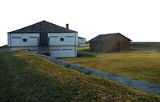
Fort York is a historic site of military fortifications and related buildings on the west side of downtown
TorontoToronto is the provincial capital of Ontario and the largest city in Canada. It is located in Southern Ontario on the northwestern shore of Lake Ontario. A relatively modern city, Toronto's history dates back to the late-18th century, when its land was first purchased by the British monarchy from...
,
OntarioOntario is a province of Canada, located in east-central Canada. It is Canada's most populous province and second largest in total area. It is home to the nation's most populous city, Toronto, and the nation's capital, Ottawa....
,
CanadaCanada is a North American country consisting of ten provinces and three territories. Located in the northern part of the continent, it extends from the Atlantic Ocean in the east to the Pacific Ocean in the west, and northward into the Arctic Ocean...
. The fort was built by the
BritishThe former Kingdom of Great Britain, sometimes described as the 'United Kingdom of Great Britain', That the Two Kingdoms of Scotland and England, shall upon the 1st May next ensuing the date hereof, and forever after, be United into One Kingdom by the Name of GREAT BRITAIN. was a sovereign...
ArmyThe British Army is the land warfare branch of Her Majesty's Armed Forces in the United Kingdom. It came into being with the unification of the Kingdom of England and Scotland into the Kingdom of Great Britain in 1707. The new British Army incorporated Regiments that had already existed in England...
and Canadian
militiaThe term militia is commonly used today to refer to a military force composed of ordinary citizens to provide defense, emergency law enforcement, or paramilitary service, in times of emergency without being paid a regular salary or committed to a fixed term of service. It is a polyseme with...
troops in the late 18th and early 19th centuries, to defend the settlement and the new capital of the
Upper CanadaThe Province of Upper Canada was a political division in British Canada established in 1791 by the British Empire to govern the central third of the lands in British North America and to accommodate Loyalist refugees from the United States of America after the American Revolution...
region from the threat of a military attack, principally from the newly independent
United StatesThe United States of America is a federal constitutional republic comprising fifty states and a federal district...
. It was designated a National Historic Site of Canada in 1923.
Founding
In 1793,
Lieutenant GovernorA lieutenant governor or lieutenant-governor is a high officer of state, whose precise role and rank vary by jurisdiction, but is often the deputy or lieutenant to or ranking under a governor — a "second-in-command"...
John Graves SimcoeJohn Graves Simcoe was a British army officer and the first Lieutenant Governor of Upper Canada from 1791–1796. Then frontier, this was modern-day southern Ontario and the watersheds of Georgian Bay and Lake Superior...
authorized a garrison on the present site of Fort York, just west of the mouth of
Garrison CreekGarrison Creek was a short stream about long that flowed southeast into the west side of Toronto Harbour in Ontario, Canada.It has been largely covered over and filled in, but geographical traces of the creek can still be found. The natural amphitheatre known as Christie Pits is one such remnant;...
on the north eastern shore of
Lake OntarioLake Ontario is one of the five Great Lakes of North America. It is bounded on the north and southwest by the Canadian province of Ontario, and on the south by the American state of New York. Ontario, Canada's most populous province, was named for the lake. In the Wyandot language, ontarío means...
. Simcoe recognized Toronto was an ideal site for settlement and defence because of its natural harbour and relative longer distance from the United States. Fort York guards the western (at the time of construction, the only) entrance to the bay. Simcoe had decided to make Toronto (which he renamed
YorkYork was the name of Old Toronto between 1793 and 1834. It was the second capital of Upper Canada.- History :The town was established in 1793 by Governor John Graves Simcoe, with a new 'Fort York' on the site of the last French 'Fort Toronto'...
) the capital of Upper Canada, and the government, the first
parliamentThe Legislative Council of Upper Canada was the upper house governing the province of Upper Canada. Modelled after the British House of Lords, it was created by the Constitutional Act of 1791. It was specified that the council should consist of at least seven members. Members were appointed for...
buildings and the town were established one and a half miles east of the fort (near the foot of the present Parliament Street).
Buildings
In 1797 a garrison was built east of modern day Bathurst Street, on the east bank of Garrison Creek. This fort was destroyed in the
Battle of YorkThe Battle of York was a battle of the War of 1812 fought on 27 April 1813, at York, Upper Canada . An American force supported by a naval flotilla landed on the lake shore to the west, defeated the defending British force and captured the town and dockyard...
, 1813 (see below). Today's Fort York was largely built by
Royal EngineersThe Corps of Royal Engineers, usually just called the Royal Engineers , and commonly known as the Sappers, is one of the corps of the British Army....
immediately after the war of 1812. The rebuilt Fort York is located on the original fort site west of Bathurst, at the time on the west bank of Garrison Creek. Fort York's buildings are among the oldest buildings in Toronto today. The original fort buildings were all wood, whereas the current structures are a mix of brick and wood.
A list of current structures at the fort:
- Stone Powder Magazine
Magazine is the name for an item or place within which ammunition is stored. It is taken from the Arabic word "makahazin" meaning "warehouse".-Ammunition storage areas:...
- North and South Soldier Barracks
Barracks are specialised buildings for permanent military accommodation; the word may apply to separate housing blocks or to complete complexes. Their main object is to separate soldiers from the civilian population and reinforce discipline, training and esprit de corps. They were sometimes called...
- Blockhouse
In military science, a blockhouse is a small, isolated fort in the form of a single building. It serves as a defensive strong point against any enemy that does not possess siege equipment or, in modern times, artillery...
s 1 and 2
- Officer's Quarters
Barracks are specialised buildings for permanent military accommodation; the word may apply to separate housing blocks or to complete complexes. Their main object is to separate soldiers from the civilian population and reinforce discipline, training and esprit de corps. They were sometimes called...
- Blue Barracks
Barracks are specialised buildings for permanent military accommodation; the word may apply to separate housing blocks or to complete complexes. Their main object is to separate soldiers from the civilian population and reinforce discipline, training and esprit de corps. They were sometimes called...
- Brick Powder Magazine
Magazine is the name for an item or place within which ammunition is stored. It is taken from the Arabic word "makahazin" meaning "warehouse".-Ammunition storage areas:...

Additional buildings located outside the fort were mainly star shaped blockhouses or magazines:
- Spadina Blockhouse 1838/1839-1860s - near College Street and Spadina Avenue (at present day Knox College)
- Sherbourne Blockhouse 1838/1839-1865 - Sherborne Avenue and Bloor Street
- Yonge Blockhouse at Belmont Street 1838/1839-1860s
The War of 1812 and after
During the
War of 1812The War of 1812 was a military conflict fought between the forces of the United States of America and those of the British Empire. The Americans declared war in 1812 for several reasons, including trade restrictions because of Britain's ongoing war with France, impressment of American merchant...
, on April 27, 1813 combined
U.S. armyThe United States Army is the main branch of the United States Armed Forces responsible for land-based military operations. It is the largest and oldest established branch of the U.S. military, and is one of seven U.S. uniformed services...
and naval forces attacked York from
Lake OntarioLake Ontario is one of the five Great Lakes of North America. It is bounded on the north and southwest by the Canadian province of Ontario, and on the south by the American state of New York. Ontario, Canada's most populous province, was named for the lake. In the Wyandot language, ontarío means...
, overrunning Fort York (see
Battle of YorkThe Battle of York was a battle of the War of 1812 fought on 27 April 1813, at York, Upper Canada . An American force supported by a naval flotilla landed on the lake shore to the west, defeated the defending British force and captured the town and dockyard...
). As the British abandoned the fort, they set the powder magazine to blow up, killing or wounding several hundred U.S. soldiers (including General
Zebulon PikeZebulon Montgomery Pike Jr. was an American officer and explorer for whom Pikes Peak in Colorado is named. As a United States Army captain in 1806-1807, he led the Pike Expedition to explore and document the southern portion of the Louisiana Purchase and to find the headwaters of the Red River,...
, for whom
Pikes PeakPikes Peak is a mountain in the Front Range of the Rocky Mountains, west of Colorado Springs, Colorado, in El Paso County in the United States of America....
is named). The explosion was heard as far away as
Fort GeorgeFort George National Historic Site is a historic military structure at Niagara-on-the-Lake, Ontario, that was the scene of several battles during the War of 1812...
, rivaled only by an explosion of black powder the British set off when they were unable to bring with them said powder in their
retreat from CorunnaThe Battle of Corunna refers to a battle of the Peninsular War. On January 16, 1809, a French army under Marshal Soult attacked the British under Sir John Moore...
under
MooreLieutenant-General Sir John Moore, KB was a British soldier and General. He is best known for his military training reforms and for his death at the Battle of Corunna, in which his force was defeated but gained a tactical advantage over a French army under Marshal Soult during the Peninsular...
around the same time in the
Napoleonic campaignThe Napoleonic Wars were a series of wars declared against Napoleon's French Empire by opposing coalitions that ran from 1803 to 1815. As a continuation of the wars sparked by the French Revolution of 1789, they revolutionised European armies and played out on an unprecedented scale, mainly due to...
in Europe. The U.S. destroyed what was left of Fort York and burned much of the settlement of York, including the Parliament Buildings during their five–day occupation. They had defeated outnumbered British, Canadian, and
First NationsFirst Nations is a term that collectively refers to various Aboriginal peoples in Canada who are neither Inuit nor Métis. There are currently over 630 recognised First Nations governments or bands spread across Canada, roughly half of which are in the provinces of Ontario and British Columbia. The...
forces, but with the loss of many more men. Following several more U.S. raids over the summer, the British garrison returned to York and rebuilt the fortifications, most of which are still standing today. The rebuilt fort was sufficient to repel a further attempted invasion in 1814.
The British Army occupied Fort York from 1793 to the 1850s and transferred it to
CanadaCanada is a North American country consisting of ten provinces and three territories. Located in the northern part of the continent, it extends from the Atlantic Ocean in the east to the Pacific Ocean in the west, and northward into the Arctic Ocean...
, which used it until 1932. However, the City of Toronto owned the Fort from 1903 onwards.
Fort York was used as a military establishment until 1880, and again during the
FirstWorld War I , which was predominantly called the World War or the Great War from its occurrence until 1939, and the First World War or World War I thereafter, was a major war centred in Europe that began on 28 July 1914 and lasted until 11 November 1918...
and
Second World WarsWorld War II, or the Second World War , was a global conflict lasting from 1939 to 1945, involving most of the world's nations—including all of the great powers—eventually forming two opposing military alliances: the Allies and the Axis...
.
Artillery
Fort York was defended by cannons on the west, north and south:
- 2 ~ 12 pounders - north side
- 1 ~ 14 pounder - west side
- 9 ~ 12 pounders - south side
Units
British
- 13th Hussars
- 19th Light Dragoons
The 19th Light Dragoons was a cavalry regiment of the British Army created in 1781 for service in British India. The regiment served in India until 1806, and in North America during the War of 1812, and was disbanded in Britain in 1821.-Formation:...
- Royal Artillery
The Royal Regiment of Artillery, commonly referred to as the Royal Artillery , is the artillery arm of the British Army. Despite its name, it comprises a number of regiments.-History:...
- Royal Engineers
The Corps of Royal Engineers, usually just called the Royal Engineers , and commonly known as the Sappers, is one of the corps of the British Army....
(Sappers and Miners)
- 1st Regiment of Foot
- 6th Regiment of Foot
- 8th Regiment of Foot
- 15th Regiment of Foot
- 16th Regiment of Foot
- 17th Regiment of Foot
- 23rd Regiment of Foot
- 24th Regiment of Foot
- 29th Regiment of Foot
The 29th Regiment of Foot was, from 1694 to 1881, an infantry regiment of the British Army. It now forms part of the Mercian Regiment.-Formation:...
- 30th Regiment of Foot
- 32nd Regiment of Foot
The 32nd Regiment of Foot of the British Army was first raised in 1702 as a regiment of marines to fight in the War of Spanish Succession.It won its first battle honour in 1705 for the siege and capture of Gibraltar....
- 37th Regiment of Foot
- 41st Regiment of Foot
- 43rd Regiment of Foot
- 47th Regiment of Foot
The 47th Regiment of Foot was an infantry regiment of the British Army. First raised in 1741 in Scotland, the regiment saw service over a period of 140 years, before it was amalgamated with another regiment to become The Loyal North Lancashire Regiment in 1881...
- 49th Regiment of Foot
- 60th Regiment of Foot
- 66th Regiment of Foot
- 68th Regiment of Foot
- 70th Regiment of Foot
- 71st Regiment of Foot
- 73rd Regiment of Foot
The 73rd Regiment of Foot also known as MacLeod's Highlanders after its founder John Mackenzie, Lord MacLeod, was an infantry regiment of the British Army.- History :- First raising :...
- 76th Regiment of Foot
The 76th Regiment of Foot was originally raised as Lord Harcourt's Regiment on 17 November 1745 and disbanded in June 1746. Following the loss of Minorca to the French, it was raised again in November 1756 as the 61st Regiment, but renumbered to 76th, by General Order in 1758, and again disbanded...
- 79th Regiment of Foot
79th Regiment of Foot may refer to:* 79th Regiment of Foot , took part in the Seven Years' War* 79th Regiment of Foot , saw service in the West Indies during the American Revolution...
- 81st Regiment of Foot
- 82nd Regiment of Foot
- 83rd Regiment of Foot
The 83rd Regiment of Foot was a British infantry regiment that served in the American Revolutionary War...
- 85th Regiment of Foot
Three regiments of the British Army have been numbered the 85th Regiment of Foot:*85th Regiment of Foot , raised in 1759*85th Regiment of Foot , raised in 1779*85th Regiment of Foot , raised in 1793...
- 89th Regiment of Foot
The 89th Regiment of Foot was a regiment of the British Army, formed on 3 December 1793.Its nickname was 'Blayney's Bloodhounds'...
- 92nd Regiment of Foot
92nd Regiment of Foot may refer to:* 92nd Regiment of Foot , a British Army regiment 1760–1763* 92nd Regiment of Foot , a British Army regiment 1779–1783* 92nd Regiment of Foot , a British Army regiment 1793–1795...
- 93rd Regiment of Foot
The 93rd Regiment of Foot was a Line Infantry Regiment of the British Army . In 1881 during the Childers Reforms it was united with the 91st Regiment of Foot to form the Argyll and Sutherland Highlanders .- The 93rd Regiment :The 93rd Regiment was raised three times before it became the...
- 97th Regiment of Foot
- 100th Regiment of Foot
100th Regiment of Foot may refer to:Regiments of the British Army:*100th Regiment of Foot , raised in 1760*100th Regiment of Foot , raised in 1780...
- Rifle Brigade
Canadian Militia
- Royal Newfoundland Regiment
- Glengarry Light Infantry
The Glengarry Light Infantry Fencibles were a light infantry unit, raised chiefly in the Glengarry District of Upper Canada shortly before the outbreak of the Anglo-American War of 1812...
- Royal Canadian Rifle Regiment
- Queen's Rangers
The Queen's Rangers was a military unit who fought on the Loyalist side during the American War of Independence. After the war they moved to Nova Scotia and disbanded, but were reformed again in Upper Canada before disbanding again, in 1802, a decade prior to the War of 1812.-French and Indian...
- Royal Canadian Veteran Battalion
- Royal Canadian Volunteer Regiment
- 3rd Battalion Military Train
- York Militia
- Royal Canadian Dragoons
- HM Canadian Regiment of Fencible Infantry - current unit represented at the fort
- 7th Regiment
- 104th Regiment
- 6th Westmeath
- 26th Regiment
- 56th Regiment
- 103rd Regiment
- Royal Fusiliers
- New Brunswick Regiment
- Irish Militia Regiment
- Cameronians Regiment of Foot
- West Essex Regiment of Foot
- Regiment of Foot
- Marine and/Navy
- Canadian Voltigeurs
- Royal Canadian Artillery
- Royal Newfoundland Fencibles
- Military Train
- 2nd Battalion of Provisional Militia
- 3rd Battalion of Provisional Militia
- 6th Battalion of Provisional Militia
- 10th Royal Grenadiers
- 48th Highlanders of Canada
The 48th Highlanders of Canada is a Canadian Forces Primary Reserve infantry regiment based in Toronto, parading out of Moss Park Armoury. The regiment is part of Land Force Central Area's 32 Canadian Brigade Group....
- Durham Militia
- Enrolled Pensioners
- Garrison Battery of Artillery
- Home Guards
- Incorporated Militia
- Queen's Lancers
- RCA Dragoons
- Toronto Cavalry
- York Militia and Colours
- Toronto Field Battery
Fort York National Historic Site
Fort York National Historic Site houses Canada's largest collection of original War of 1812 period buildings. The fort, operated as a museum of the City of Toronto, offers casual visitors and booked groups a number of exciting services year round. During the summer months, the site comes alive with the colour and the pageantry of the
Fort York GuardFort York Guard is a ceremonial unit at Fort York. The unit represents the Canadian Regiment of Fencible Infantry or the 8th Regiment of Foot, one of many units once stationed at the fort....
and is complimented with tours by professional historical interpreters. In the off-season months, the fort is busy providing educational programs for booked tour groups including school, scout, guide, and day care groups.
In the 1950s Fort York was almost torn down to make way for the
Gardiner ExpresswayThe Frederick G. Gardiner Expressway, colloquially referred to as "the Gardiner", is a municipal expressway in the Canadian province of Ontario, connecting downtown Toronto with its western suburbs...
, but Highway planners eventually rerouted the elevated highway to the south of the grounds.
The reclaimed lands to the south of the fort are in the process of being developed, with new condo towers eventually limiting any possible reconnection with Lake Ontario.
From 1995 to 2008, Fort York hosted
Toronto's annual Festival of BeerThe Toronto Festival of Beer , also known as Beerfest, is an annual event that takes place at Exhibition Place, Bandshell Park in Toronto, Ontario, Canada. The festival celebrates Canada’s rich brewing history by featuring more than 120 brands around the world and many . The event has become...
.
Paranormal activity
Fort York is also known as a site with a fair amount of
paranormalParanormal is a general term that designates experiences that lie outside "the range of normal experience or scientific explanation" or that indicates phenomena understood to be outside of science's current ability to explain or measure...
activity, which is presumably attributed to its military history (and the associated deaths which took place there when it was attacked on various occasions by
AmericanThe United States of America is a federal constitutional republic comprising fifty states and a federal district...
forces during the
War of 1812The War of 1812 was a military conflict fought between the forces of the United States of America and those of the British Empire. The Americans declared war in 1812 for several reasons, including trade restrictions because of Britain's ongoing war with France, impressment of American merchant...
). Visitors have reported peculiar noises on the grounds and in the buildings, as well as sightings of apparitions of soldiers.
Fort York Armoury
The southwest of Fort York is
Fort York Armoury, a two–storey structure occupied by the
Canadian ForcesThe Canadian Forces , officially the Canadian Armed Forces , are the unified armed forces of Canada, as constituted by the National Defence Act, which states: "The Canadian Forces are the armed forces of Her Majesty raised by Canada and consist of one Service called the Canadian Armed Forces."...
Primary Reserve; The Queen's York Rangers, The Royal Regiment of Canada, The Toronto Scottish Regiment (Queen Elizabeth the Queen Mother's Own), and the 709 (Toronto) Communication Regiment and formerly 2 Field Engineer Regiment and the 1st Battalion Irish Regiment. The building is a training facility for CF Reservists. In addition to being the headquarters of the four active units of the Army Reserve, the Armoury is also home to several thriving Cadet organizations.
The Armoury was built in 1933 with private funds and boasts the largest lattice wood arched roof in
CanadaCanada is a North American country consisting of ten provinces and three territories. Located in the northern part of the continent, it extends from the Atlantic Ocean in the east to the Pacific Ocean in the west, and northward into the Arctic Ocean...
. It was designed by Toronto architects Marani, Lawson and Morris.
There are three small regimental museums within the Armoury. Overlooking Lake Ontario there are a series of regimental Officers' Messes. These are excellent examples of the traditional British form. The exceptional architectural feature of Fort York Armoury is a parabolic Lamella roof. It provides an uninterrupted span of nearly 125 feet (38.1 m), roofing for parades, military vehicles and the training of soldiers. The main entrance to the Armoury has pilasters of rusticated masonry with a large carved coat-of-arms. This is the coat-of-arms of the Dominion of Canada. It appears above the flat keyed arch of the entrance. The cap badges of each original regiment are carved in stone set in the parapet over doorways opening to ornamental iron balconies.
Affiliations
The Museum is affiliated with:
CMAThe Canadian Museums Association is a national organization for the promotion of museums in Canada.The Canadian Museums Association is the national organization for the advancement of the Canadian museum sector, representing Canadian museum professionals both within Canada and internationally. The...
,
CHINThe Canadian Heritage Information Network is a Canadian government-supported organization that provides a networked interface to Canada's heritage, largely through the World Wide Web. It aims to give access to Canada's heritage for both Canadians and a worldwide audience, by supporting the...
, and
Virtual Museum of CanadaThe Virtual Museum of Canada is Canada's national virtual museum. With a directory of over 3,000 Canadian heritage institutions and a database of over 600 virtual exhibits, the VMC brings together Canada's museums regardless of size or geographical location.The VMC includes virtual exhibits,...
.
See also
- New Fort York
New Fort York was built to replace Toronto's original Fort York at the mouth of Garrison Creek as the primary military base for the settlement. Unlike the older fort, it was not made of wood.-History:...
- Fort York Armoury
Fort York Armoury is a Canadian Forces facility located near the grounds of the Canadian National Exhibition in Toronto, Ontario, Canada. It is located at the intersection of Fleet Street and Fort York Blvd, close to the historic Fort York site in the neighbourhood of Fort York...
- Trinity Bellwoods Park
Trinity Bellwoods Park is located on the west side of downtown Toronto, Ontario Canada, bordered by Queen Street West on the south and Dundas Street on the north. The western boundary of the park is Crawford Street, running north to within a short block of Dundas, where the park extends further...
- Fort Rouillé
Fort Rouillé or Fort Toronto was a French trading post located in Toronto, Ontario, Canada, that was established around 1750 but abandoned in 1759. The fort site is now part of the public lands of Exhibition Place...
- The first fort to be established in Toronto (about 1 km West of Fort York)
- List of oldest buildings and structures in Toronto
- Chronology of the War of 1812
-Origins:-1812:-1813:-1814:-1815:-External links:********...
- War of 1812 Campaigns
The following is a synopsis of the Land Campaigns of the War of 1812. The source is the United States Army Center of Military History-Canada, 18 June 1812 — 17 February 1815:...
- War of 1812
The War of 1812 was a military conflict fought between the forces of the United States of America and those of the British Empire. The Americans declared war in 1812 for several reasons, including trade restrictions because of Britain's ongoing war with France, impressment of American merchant...
- Upper Canada
The Province of Upper Canada was a political division in British Canada established in 1791 by the British Empire to govern the central third of the lands in British North America and to accommodate Loyalist refugees from the United States of America after the American Revolution...
External links