


Fort Presque Isle

Encyclopedia
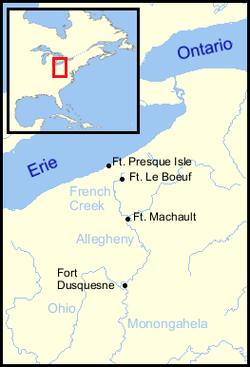
Fort Presque Isle was a fort built by French soldiers in 1753 along Presque Isle Bay
at present-day Erie
, Pennsylvania
. The fort was part of a line that included Fort Le Boeuf
, Fort Machault
, and Fort Duquesne
.
The fort was built as part of the French military occupation of the Ohio Country
; rival claims to the area by the British led to the French and Indian War
. After the 1759 British victory at the Battle of Fort Niagara
, the French burned the fort and retreated from the area.
 The British built a new Fort Presque Isle, which was captured by American Indians
during Pontiac's Rebellion
. On June 19, 1763, the fort was surrounded by about 250 Ottawas
, Ojibwa
s, Wyandots, and Senecas
. After holding out for two days, the garrison of approximately sixty men surrendered on the condition that they could return to Fort Pitt
. Most were instead killed after emerging from the fort.
General Anthony Wayne
first arrived in the area of Presque Isle in 1786. In 1795, 200 Federal troops from Wayne's army, under the direction of Captain John Grubb, built a blockhouse on Garrison Hill, in present-day Erie, Pennsylvania
. Also named Fort Presque Isle, the blockhouse was used as part of a defense against Native American
uprisings. It was also used during the War of 1812. General Wayne was stricken ill at Fort Presque Isle and died there in 1796. At his request, his body was buried under the flagpole of the northwest blockhouse of the fort. This blockhouse burned in 1852. In 1880, the Commonwealth of Pennsylvania reconstructed the blockhouse at Second and Ash Streets, Erie
, as a memorial to General Wayne. The Pennsylvania Historical and Museum Commission
has recognized the reconstructed blockhouse as eligible for placement on the National Register of Historic Places
.
Presque Isle Bay
Presque Isle Bay is a natural bay located off the coast of Erie, Pennsylvania, United States. Its embayment is about in length, about across at its widest point, and an average depth of about . The bay is bounded on the north and west by a recurved peninsula that makes up Presque Isle State Park...
at present-day Erie
Erie, Pennsylvania
Erie is a city located in northwestern Pennsylvania in the United States. Named for the lake and the Native American tribe that resided along its southern shore, Erie is the state's fourth-largest city , with a population of 102,000...
, Pennsylvania
Pennsylvania
The Commonwealth of Pennsylvania is a U.S. state that is located in the Northeastern and Mid-Atlantic regions of the United States. The state borders Delaware and Maryland to the south, West Virginia to the southwest, Ohio to the west, New York and Ontario, Canada, to the north, and New Jersey to...
. The fort was part of a line that included Fort Le Boeuf
Fort Le Boeuf
Fort Le Boeuf, , was a fort established by the French in 1753 on a fork of French Creek, in present-day Waterford, in northwest Pennsylvania...
, Fort Machault
Fort Machault
Fort Machault was a fort built by the French in 1754 near the confluence of French Creek with the Allegheny River, at present-day Franklin, in northwest Pennsylvania. The fort was part of a line that included Fort Presque Isle, Fort Le Boeuf, and Fort Duquesne.- Description:The fort was built on a...
, and Fort Duquesne
Fort Duquesne
Fort Duquesne was a fort established by the French in 1754, at the junction of the Allegheny and Monongahela rivers in what is now downtown Pittsburgh in the state of Pennsylvania....
.
The fort was built as part of the French military occupation of the Ohio Country
Ohio Country
The Ohio Country was the name used in the 18th century for the regions of North America west of the Appalachian Mountains and in the region of the upper Ohio River south of Lake Erie...
; rival claims to the area by the British led to the French and Indian War
French and Indian War
The French and Indian War is the common American name for the war between Great Britain and France in North America from 1754 to 1763. In 1756, the war erupted into the world-wide conflict known as the Seven Years' War and thus came to be regarded as the North American theater of that war...
. After the 1759 British victory at the Battle of Fort Niagara
Battle of Fort Niagara
The Battle of Fort Niagara was a siege late in the French and Indian War, the North American theatre of the Seven Years' War. The British siege of Fort Niagara in July 1759 was part of a campaign to remove French control of the Great Lakes and Ohio Valley regions, making possible a western invasion...
, the French burned the fort and retreated from the area.
Native Americans in the United States
Native Americans in the United States are the indigenous peoples in North America within the boundaries of the present-day continental United States, parts of Alaska, and the island state of Hawaii. They are composed of numerous, distinct tribes, states, and ethnic groups, many of which survive as...
during Pontiac's Rebellion
Pontiac's Rebellion
Pontiac's War, Pontiac's Conspiracy, or Pontiac's Rebellion was a war that was launched in 1763 by a loose confederation of elements of Native American tribes primarily from the Great Lakes region, the Illinois Country, and Ohio Country who were dissatisfied with British postwar policies in the...
. On June 19, 1763, the fort was surrounded by about 250 Ottawas
Ottawa (tribe)
The Odawa or Ottawa, said to mean "traders," are a Native American and First Nations people. They are one of the Anishinaabeg, related to but distinct from the Ojibwe nation. Their original homelands are located on Manitoulin Island, near the northern shores of Lake Huron, on the Bruce Peninsula in...
, Ojibwa
Ojibwa
The Ojibwe or Chippewa are among the largest groups of Native Americans–First Nations north of Mexico. They are divided between Canada and the United States. In Canada, they are the third-largest population among First Nations, surpassed only by Cree and Inuit...
s, Wyandots, and Senecas
Seneca nation
The Seneca are a group of indigenous people native to North America. They were the nation located farthest to the west within the Six Nations or Iroquois League in New York before the American Revolution. While exact population figures are unknown, approximately 15,000 to 25,000 Seneca live in...
. After holding out for two days, the garrison of approximately sixty men surrendered on the condition that they could return to Fort Pitt
Fort Pitt (Pennsylvania)
Fort Pitt was a fort built at the location of Pittsburgh, Allegheny County, Pennsylvania.-French and Indian War:The fort was built from 1759 to 1761 during the French and Indian War , next to the site of former Fort Duquesne, at the confluence the Allegheny River and the Monongahela River...
. Most were instead killed after emerging from the fort.
General Anthony Wayne
Anthony Wayne
Anthony Wayne was a United States Army general and statesman. Wayne adopted a military career at the outset of the American Revolutionary War, where his military exploits and fiery personality quickly earned him a promotion to the rank of brigadier general and the sobriquet of Mad Anthony.-Early...
first arrived in the area of Presque Isle in 1786. In 1795, 200 Federal troops from Wayne's army, under the direction of Captain John Grubb, built a blockhouse on Garrison Hill, in present-day Erie, Pennsylvania
Erie, Pennsylvania
Erie is a city located in northwestern Pennsylvania in the United States. Named for the lake and the Native American tribe that resided along its southern shore, Erie is the state's fourth-largest city , with a population of 102,000...
. Also named Fort Presque Isle, the blockhouse was used as part of a defense against Native American
Native Americans in the United States
Native Americans in the United States are the indigenous peoples in North America within the boundaries of the present-day continental United States, parts of Alaska, and the island state of Hawaii. They are composed of numerous, distinct tribes, states, and ethnic groups, many of which survive as...
uprisings. It was also used during the War of 1812. General Wayne was stricken ill at Fort Presque Isle and died there in 1796. At his request, his body was buried under the flagpole of the northwest blockhouse of the fort. This blockhouse burned in 1852. In 1880, the Commonwealth of Pennsylvania reconstructed the blockhouse at Second and Ash Streets, Erie
Erie, Pennsylvania
Erie is a city located in northwestern Pennsylvania in the United States. Named for the lake and the Native American tribe that resided along its southern shore, Erie is the state's fourth-largest city , with a population of 102,000...
, as a memorial to General Wayne. The Pennsylvania Historical and Museum Commission
Pennsylvania Historical and Museum Commission
The Pennsylvania Historical and Museum Commission is the governmental agency of the Commonwealth of Pennsylvania responsible for the collection, conservation and interpretation of Pennsylvania's historic heritage...
has recognized the reconstructed blockhouse as eligible for placement on the National Register of Historic Places
National Register of Historic Places
The National Register of Historic Places is the United States government's official list of districts, sites, buildings, structures, and objects deemed worthy of preservation...
.
Sources
- "The Frontier Forts of Western Pennsylvania," Albert, George Dallas, C. M. Busch, state printer, Harrisburg, PA, 1896. Tracing of plan of Erie, on pg. 536b, shows the "old French fort" between Front Street and Second Street, on the northeast side of Parade Street.
- Google Earth indicates this position is 42.137085 -80.079374