
All Topics  
Fort Mims massacre

 
Fort Mims Massacre

   Email Print
   Bookmark   Link


Fort Mims massacre


The Fort Mims massacre occurred on 30 August, 1813, when a force of Creeks
Creek people

The Muscogee , their original name they use to identify themselves today, also known as the Creek, are an American Indians in the United States people originally from the Southern United States....
, belonging to the "Red Sticks
Red Sticks

Red Sticks is the English term for a traditionalist faction of Creek people who led a resistance movement which culminated in the outbreak of the Creek War in 1813....
" faction under the command of Peter McQueen
Peter McQueen

Peter McQueen was the son of a Scottish trader and a Creek woman. He was known for playing a set of bagpipes during each battle that he fought....
 and William Weatherford
William Weatherford

William "Red Eagle" Weatherford, , was a Creek Indian in the United States who led the Creek War offensive against the United States. William Weatherford, like many of the high-ranking members of the Creek nation, was a mixture of Scottish and Creek Indian....
 "Red Eagle", his cousin by marriage, killed hundreds of settlers, mixed-blood Creeks, and militia
Militia

The term militia is commonly used today to refer to a military force composed of ordinary citizens to provide defense, emergency law enforcement, or paramilitary service, in times of emergency without being paid a regular salary or committed to a fixed term of service....
 in Fort Mims.

Background
At the start of the Creek Civil War
Creek War

The Creek War , also known as the Red Stick War and the Creek Civil War, began as a civil war within the Creek people nation. It is sometimes considered to be part of the War of 1812....
, settlers north of Mobile, Alabama
Mobile, Alabama

Mobile is the third most populous city in the Southern United States United States state of Alabama and is the county seat of Mobile County, Alabama....
, particularly mixed-blood Creeks from the lower towns, began to take refuge with the American settlers in the stockades of Fort Mims. About 517 settlers, including 265 armed militia
Militia

The term militia is commonly used today to refer to a military force composed of ordinary citizens to provide defense, emergency law enforcement, or paramilitary service, in times of emergency without being paid a regular salary or committed to a fixed term of service....
, were gathered at Fort Mims, which was located about 35 to 45 miles (50-70 km) north of Mobile on the eastern side of the Alabama River
Alabama River

The Alabama River, in the United States state of Alabama, is formed by the Tallapoosa River and Coosa River rivers, which unite about six miles above Montgomery, Alabama....
.

Upon learning that Peter McQueen's party of Red Sticks were in Pensacola, Florida
Pensacola, Florida

Pensacola is the westernmost city in the Florida Panhandle and the county seat of Escambia County, Florida. As of the United States 2000 Census, the city had a total population of 56,255 and as of 2006, the estimated population was 53,248....
, obtaining arms from the Spanish
Spain

Spain or the Kingdom of Spain , is a country located in Southern Europe on the Iberian Peninsula.The Spanish constitution does not establish any official denomination of the country, even though Espa?a , Estado espa?ol and Naci?n espa?ola are used interchangeably....
, Major Daniel Beasley, Captain Dixon Bailey, and Colonel Caller, led a disorganized force to intercept the Red Sticks.


Discussion
Ask a question about 'Fort Mims massacre'
Start a new discussion about 'Fort Mims massacre'
Answer questions from other users
Full Discussion Forum


Encyclopedia


The Fort Mims massacre occurred on 30 August, 1813, when a force of Creeks
Creek people

The Muscogee , their original name they use to identify themselves today, also known as the Creek, are an American Indians in the United States people originally from the Southern United States....
, belonging to the "Red Sticks
Red Sticks

Red Sticks is the English term for a traditionalist faction of Creek people who led a resistance movement which culminated in the outbreak of the Creek War in 1813....
" faction under the command of Peter McQueen
Peter McQueen

Peter McQueen was the son of a Scottish trader and a Creek woman. He was known for playing a set of bagpipes during each battle that he fought....
 and William Weatherford
William Weatherford

William "Red Eagle" Weatherford, , was a Creek Indian in the United States who led the Creek War offensive against the United States. William Weatherford, like many of the high-ranking members of the Creek nation, was a mixture of Scottish and Creek Indian....
 "Red Eagle", his cousin by marriage, killed hundreds of settlers, mixed-blood Creeks, and militia
Militia

The term militia is commonly used today to refer to a military force composed of ordinary citizens to provide defense, emergency law enforcement, or paramilitary service, in times of emergency without being paid a regular salary or committed to a fixed term of service....
 in Fort Mims.

Background


At the start of the Creek Civil War
Creek War

The Creek War , also known as the Red Stick War and the Creek Civil War, began as a civil war within the Creek people nation. It is sometimes considered to be part of the War of 1812....
, settlers north of Mobile, Alabama
Mobile, Alabama

Mobile is the third most populous city in the Southern United States United States state of Alabama and is the county seat of Mobile County, Alabama....
, particularly mixed-blood Creeks from the lower towns, began to take refuge with the American settlers in the stockades of Fort Mims. About 517 settlers, including 265 armed militia
Militia

The term militia is commonly used today to refer to a military force composed of ordinary citizens to provide defense, emergency law enforcement, or paramilitary service, in times of emergency without being paid a regular salary or committed to a fixed term of service....
, were gathered at Fort Mims, which was located about 35 to 45 miles (50-70 km) north of Mobile on the eastern side of the Alabama River
Alabama River

The Alabama River, in the United States state of Alabama, is formed by the Tallapoosa River and Coosa River rivers, which unite about six miles above Montgomery, Alabama....
.

Upon learning that Peter McQueen's party of Red Sticks were in Pensacola, Florida
Pensacola, Florida

Pensacola is the westernmost city in the Florida Panhandle and the county seat of Escambia County, Florida. As of the United States 2000 Census, the city had a total population of 56,255 and as of 2006, the estimated population was 53,248....
, obtaining arms from the Spanish
Spain

Spain or the Kingdom of Spain , is a country located in Southern Europe on the Iberian Peninsula.The Spanish constitution does not establish any official denomination of the country, even though Espa?a , Estado espa?ol and Naci?n espa?ola are used interchangeably....
, Major Daniel Beasley, Captain Dixon Bailey, and Colonel Caller, led a disorganized force to intercept the Red Sticks. The resulting ambush is known as the Battle of Burnt Corn
Battle of Burnt Corn

The Battle of Burnt Corn was an encounter between United States armed forces and Creek that took place July 27, 1813 in present-day southern Alabama, near Monroeville, Alabama....
.

Weatherford eventually agreed to take part in the attack, with the hopes of preventing a slaughter of the women and children in the Fort, and to seek vengeance upon his personal enemy, Captain Dixon Bailey. Captain Bailey, a native of the town of Auttose, was a half-breed Creek, who had been educated at Philadelphia under the provisions of the treaty of New York of 1790.

Impending doom


On August 29, 1813, two African American
African American

African Americans or Black Americans are citizens or residents of the United States who have origins in any of the Black people populations of Africa....
 slaves who were tending cattle outside the stockade reported that "painted warriors" were in the vicinity. However, mounted scouts from the fort found no signs of the war party, and Beasley had the second slave flogged for raising a "false alarm".

The Attack


Although Major Beasley, the commander, stated that he could "maintain the post against any number of Indians", the stockade was poorly-defended, and at the time of the attack, the East gate was partially blocked open by drifting sand. According to anecdotal evidence the gate was open "...when the officers all got drunk and were playing cards and left the gate open, and it rained and washed the sand in the gate so it could not be shut and Father left with Mother and the children, and the Indians killed all that stayed."

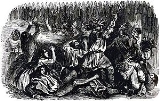
The attack occurred the next day during the mid-day meal, when no American scouts were out. The "Red Sticks" rushed the fort and tomahawked Beasley, who was desperately trying to close the blocked gate. They then seized the loopholes and the outer enclosure. The settlers, under Captain Bailey, held the inner enclosure, and fought on for a time. However, the Red Sticks set fire to a house in the center, which spread to the rest of the stockade.

The warriors then forced their way into the inner enclosure and, despite the attempts of William Weatherford, massacred most of the mixed-blood Creeks and white settlers. 500 people were dead, and 250 scalps had been taken. Most of the African Americans were spared, to become slaves of the Red Sticks. About 36 people escaped, including Bailey, who was mortally wounded.

Aftermath


The Red Sticks' victory at Fort Mims spread panic throughout the Southeastern United States
Southeastern United States

The US Southeast is the eastern portion of the Southern United States, but the Census Bureau does not provide a standard definition of a "Southeast" region of the United States, and organizations that need to subdivide the US are free to define a "Southeast" region to fit their needs....
 frontier. The massacre marked the transition from a civil war
Civil war

A civil war is a war between organized groups to take control of a nation or region, or to change government policies. It is high-intensity conflict, often involving Regular Army, that is sustained, organized and large-scale....
 within the Creek tribe (Moscoge) to a war between the United States and the Red Stick warriors of the Upper Creek Nation.

Since Federal troops were occupied with the northern front of the War of 1812
War of 1812

The War of 1812, between the United States of America and the British Empire , was fought from 1812 to 1815.There were several immediate stated causes for the U.S....
, Tennessee
Tennessee

Tennessee is a U.S. state located in the Southern United States United States. In 1796, it became the sixteenth state to join the United States....
, Georgia
Georgia (U.S. state)

Georgia is a U.S. state in the United States and was one of the original Thirteen Colonies that revolted against United Kingdom rule in the American Revolution....
, and the Mississippi Territory
Mississippi Territory

Mississippi Territory was a historic, organized territory of the United States from April 7, 1798, and expanded twice , until it extended from the Gulf of Mexico to the southern border of Tennessee....
 mobilized their militias to move against the Upper Creek towns that had supported the Red Sticks' cause. After several battles, the Battle of Horseshoe Bend
Battle of Horseshoe Bend

The Battle of Horseshoe Bend was fought during the War of 1812 in central Alabama. On March 27, 1814, United States forces and Native Americans in the United States allies under General Andrew Jackson defeated the Red Sticks, a part of the Creek people Indian tribe inspired by the Shawnee leader Tecumseh, effectively ending the Creek War....
 ended the Creek War.

Today the site is maintained by the Alabama Historical Commission
Alabama Historical Commission

The Alabama Historical Commission is the historic preservation agency for the United States state of Alabama. The agency was created by an act of the state legislature in 1966 with a mission of safeguarding Alabama?s historic buildings and sites....
.

See also

  • Mississippi Rifles
    Mississippi Rifles

    The "Mississippi Rifles" or the 155th Infantry Regiment , is Mississippi's oldest National Guard unit. Its history predates statehood, back to June 1799, and it is the seventh oldest infantry regiment in the United States Army....


External links


  • from the PCL Map Collection at the Universtity of Texas at Austin.
  • For an expanded narrative, select The Story at