


Fort Detroit

Encyclopedia
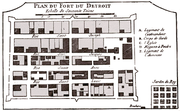
Fort Pontchartrain du Détroit or Fort Détroit was a fort established by the French
officer Antoine de la Mothe Cadillac in 1701. The location of the former fort is now in the city of Detroit
in the U.S. state
of Michigan
, an area bounded by Larned Street, Griswold Street, and the Civic Center.
built to try to keep the British
from moving west of New England
and to monopolize the fur trade
in North America
. Before he built Fort Detroit, Cadillac was commandant of Fort de Buade
, another French outpost in North America
. Fort de Buade was abandoned in 1697 due to conflicts with religious leaders over the trading of alcohol
to the Native Americans
. Cadillac then persuaded his superiors to let him build a new settlement. He reached the Detroit River on July 23, 1701.
When he landed on the site he held a celebration to formally take control of the area. In honor of Louis Phélypeaux, Comte de Pontchartrain
(or his son, Jerome
), Minister of Marine to Louis XIV he named the new settlement Fort Ponchartrain du Detroit. The storehouse and the stockade were started immediately, but the first building completed was Ste. Anne's Church
. The stockade came next and was made of logs rising about 12 feet into the sky with towers in each corner.
 The first major conflict of Fort Detroit occurred in March 1706 while Cadillac was away. The Ottawas
heard a rumor about a Huron tribe ambush. The Ottawas then attacked and killed several members of the Miami tribe. The Miamis then went inside the fort and were defended by the soldiers. About 30 Ottawas were killed when they attacked the fort. After the battle the Miamies attacked an Ottawa village.
A priest and a French sergeant outside the walls were killed. This has been called Detroit's first murder.
The fort was commanded by Étienne de Veniard, Sieur de Bourgmont
. Bourgmont was criticized for his handling of the incident. When Cadillac returned, Bourgmont and some soldiers from the fort deserted. The French captured one of the deserters who testified that the deserting party had shot and killed one of its own and cannibalized him.
Bourgmont remained on the lam
living with the Native Americans and taking a Native American wife and having a child. In 1718 he was decorated with the Cross of St. Louis
and given an order of nobility for being the first European to map the Missouri
and Platte
Rivers and for enlisting the Native Americans to side with the French against the Spanish.
In 1712, as Cadillac was removed under a cloud of greed and replaced by Dubuisson. The Fox heard of this and planned an attack on the fort (after some of Cadillac's supporters had left). They besieged the fort in late April, with a force of about 1,000 Fox, Sac and Mascouten
s. The Ottawas and the Hurons were out on a raid
and so could not help the French. Jean Baptiste Bissot, Sieur de Vincennes
, commander of the French outpost at Kekionga
(now Fort Wayne, Indiana
) and seven fur traders came to the fort, sneaking through Fox lines. Dubuisson sent messengers, and the Ottawa and Huron Indians came to the fort's aid. When the warriors came, the Fox were then caught between the French and their Allies and were themselves besieged until the end of May. They fled to what is now Windmill Point, where the French and Huron Indians pursued them. After four days siege there, the Fox surrendered so their families would be spared. The French agreed, but after the Fox were disarmed, they attacked and killed all the Fox. This event is known in the Grosse Pointe area as the Fox Indian Massacre. This siege of Fort Detroit was the opening incident in the Fox Wars
.
After a few years the British
and the French conflict over North America came to a head in the French and Indian War
. Detroit was far removed from the main areas of conflict and did not see combat. On November 29, 1760, Fort Detroit was turned over to the British Army's Rogers' Rangers
, two months after the capitulation of the French at Montreal. British rule differed in several major ways from French rule. The British required greater taxes and confiscated weapons from "unfriendly" settlers while refusing to sell ammunition to them or to the natives. This limited their ability to trap and hunt, as well as rendering them less of a threat. The British did not emphasize maintaining good relationships with the Native Americans. After the French left the conflict, Chief Pontiac
of the Ottawas rallied several tribes in Pontiac's Rebellion
and attempted to capture Detroit from the British on May 7, 1763. They failed to capture the fort, as the British were forewarned of the attack, but did lay siege to it (see the Siege of Fort Detroit
). The British force in the fort consisted of 130 soldiers with two 6-pound cannons, one 3-pound cannon, and three mortars. As well, the 6-gun schooner Huron was anchored in the Detroit River. Two months into the siege, on July 29, 1763, the British brought a large relief force into the area. Skirmishing in the area, including the Battle of Bloody Run
, continued until mid-November when the Indians dispersed.
During the American Revolutionary War
, Detroit was far to the west of the main area of action. The fort's main contribution was to arm American Indian raiding parties who attacked American settlements to the southeast. American revolutionaries, particularly George Rogers Clark
, hoped to mount an expedition to Detroit in order to neutralize these operations, but could not raise enough men to make the attempt. Clark did manage to capture Henry Hamilton, the Lieutenant-Governor of Canada and senior officer at Fort Detroit. While Hamilton was a prisoner of war, in late 1778 Captain Richard B. Lernoult began construction on a new fortification a few hundred yards to the south of the original fortification. It was named Fort Lernoult on 3 October 1779.
Under terms negotiated in the Jay Treaty
, Fort Detroit, Fort Lernoult and the surrounding settlement was surrendered by the British to the Americans on July 11, 1796, 13 years after the Treaty of Paris
ended the war and gave the area to the United States.
It is claimed that only Fort Lernoult survived the 1805 fire which destroyed Detroit, so presumably no parts of the original Fort Detroit remained after this time. Fort Lernoult was renamed Fort Detroit in 1805, then renamed Fort Shelby in 1813.
During the course of the War of 1812
, both the Americans and British launched invasions of each other's territory, all of which were unsuccessful or gained only temporary success. At the end of the war, the British held parts of Maine and some outposts in the sparsely populated West while the Americans held Canadian territory near Detroit, but these occupied territories were restored at the end of the war.
France
The French Republic , The French Republic , The French Republic , (commonly known as France , is a unitary semi-presidential republic in Western Europe with several overseas territories and islands located on other continents and in the Indian, Pacific, and Atlantic oceans. Metropolitan France...
officer Antoine de la Mothe Cadillac in 1701. The location of the former fort is now in the city of Detroit
Detroit, Michigan
Detroit is the major city among the primary cultural, financial, and transportation centers in the Metro Detroit area, a region of 5.2 million people. As the seat of Wayne County, the city of Detroit is the largest city in the U.S. state of Michigan and serves as a major port on the Detroit River...
in the U.S. state
U.S. state
A U.S. state is any one of the 50 federated states of the United States of America that share sovereignty with the federal government. Because of this shared sovereignty, an American is a citizen both of the federal entity and of his or her state of domicile. Four states use the official title of...
of Michigan
Michigan
Michigan is a U.S. state located in the Great Lakes Region of the United States of America. The name Michigan is the French form of the Ojibwa word mishigamaa, meaning "large water" or "large lake"....
, an area bounded by Larned Street, Griswold Street, and the Civic Center.
Background and construction
Fort Detroit began on the Detroit RiverDetroit River
The Detroit River is a strait in the Great Lakes system. The name comes from the French Rivière du Détroit, which translates literally as "River of the Strait". The Detroit River has served an important role in the history of Detroit and is one of the busiest waterways in the world. The river...
built to try to keep the British
Great Britain
Great Britain or Britain is an island situated to the northwest of Continental Europe. It is the ninth largest island in the world, and the largest European island, as well as the largest of the British Isles...
from moving west of New England
New England
New England is a region in the northeastern corner of the United States consisting of the six states of Maine, New Hampshire, Vermont, Massachusetts, Rhode Island, and Connecticut...
and to monopolize the fur trade
Fur trade
The fur trade is a worldwide industry dealing in the acquisition and sale of animal fur. Since the establishment of world market for in the early modern period furs of boreal, polar and cold temperate mammalian animals have been the most valued...
in North America
North America
North America is a continent wholly within the Northern Hemisphere and almost wholly within the Western Hemisphere. It is also considered a northern subcontinent of the Americas...
. Before he built Fort Detroit, Cadillac was commandant of Fort de Buade
Fort de Buade
Fort de Buade was a French fort at the present site of St. Ignace in the U.S. state of Michigan. It was garrisoned between 1683 and 1701.-The mission:...
, another French outpost in North America
North America
North America is a continent wholly within the Northern Hemisphere and almost wholly within the Western Hemisphere. It is also considered a northern subcontinent of the Americas...
. Fort de Buade was abandoned in 1697 due to conflicts with religious leaders over the trading of alcohol
Alcohol
In chemistry, an alcohol is an organic compound in which the hydroxy functional group is bound to a carbon atom. In particular, this carbon center should be saturated, having single bonds to three other atoms....
to the Native Americans
Native Americans in the United States
Native Americans in the United States are the indigenous peoples in North America within the boundaries of the present-day continental United States, parts of Alaska, and the island state of Hawaii. They are composed of numerous, distinct tribes, states, and ethnic groups, many of which survive as...
. Cadillac then persuaded his superiors to let him build a new settlement. He reached the Detroit River on July 23, 1701.
When he landed on the site he held a celebration to formally take control of the area. In honor of Louis Phélypeaux, Comte de Pontchartrain
Louis Phélypeaux (1643-1727)
Louis Phélypeaux , marquis de Phélypeaux , comte de Maurepas , comte de Pontchartrain , known as the chancellor de Pontchartrain, was a French politician....
(or his son, Jerome
Jérôme Phélypeaux
Jérôme Phélypeaux , comte de Pontchartrain, was a French politician, son of Louis Phélypeaux.He served as a councillor to the parlement of Paris from 1692, and served with his father as Secretary of State of the Maison du Roi and Navy Minster from 1699 onwards...
), Minister of Marine to Louis XIV he named the new settlement Fort Ponchartrain du Detroit. The storehouse and the stockade were started immediately, but the first building completed was Ste. Anne's Church
Ste. Anne de Detroit Catholic Church
Ste. Anne de Détroit, founded July 26, 1701, is the second oldest continuously operating Roman Catholic parish in the United States. The current church, built in 1886, is located at 1000 Ste. Anne St. in Detroit, Michigan near the Richard-Hubbard neighborhood area, the Ambassador Bridge, and the...
. The stockade came next and was made of logs rising about 12 feet into the sky with towers in each corner.
Military conflicts
Ottawa (tribe)
The Odawa or Ottawa, said to mean "traders," are a Native American and First Nations people. They are one of the Anishinaabeg, related to but distinct from the Ojibwe nation. Their original homelands are located on Manitoulin Island, near the northern shores of Lake Huron, on the Bruce Peninsula in...
heard a rumor about a Huron tribe ambush. The Ottawas then attacked and killed several members of the Miami tribe. The Miamis then went inside the fort and were defended by the soldiers. About 30 Ottawas were killed when they attacked the fort. After the battle the Miamies attacked an Ottawa village.
A priest and a French sergeant outside the walls were killed. This has been called Detroit's first murder.
The fort was commanded by Étienne de Veniard, Sieur de Bourgmont
Étienne de Veniard, Sieur de Bourgmont
Étienne de Veniard, Sieur de Bourgmont was a French explorer who documented his travels on the Missouri and Platte rivers in North America and made the first European maps of these areas. He wrote two accounts of his travels, which included descriptions of the Native American tribes he encountered...
. Bourgmont was criticized for his handling of the incident. When Cadillac returned, Bourgmont and some soldiers from the fort deserted. The French captured one of the deserters who testified that the deserting party had shot and killed one of its own and cannibalized him.
Bourgmont remained on the lam
On the Lam
"On the Lam" is a song by Kele Okereke, lead singer and rhythm guitarist of the band Bloc Party, released as the third single from his debut solo album The Boxer. The music video was released on October 8, 2010, with the digital EP being released on October 25....
living with the Native Americans and taking a Native American wife and having a child. In 1718 he was decorated with the Cross of St. Louis
Order of Saint Louis
The Royal and Military Order of Saint Louis was a military Order of Chivalry founded on 5 April 1693 by Louis XIV and named after Saint Louis . It was intended as a reward for exceptional officers, and is notable as the first decoration that could be granted to non-nobles...
and given an order of nobility for being the first European to map the Missouri
Missouri River
The Missouri River flows through the central United States, and is a tributary of the Mississippi River. It is the longest river in North America and drains the third largest area, though only the thirteenth largest by discharge. The Missouri's watershed encompasses most of the American Great...
and Platte
Platte River
The Platte River is a major river in the state of Nebraska and is about long. Measured to its farthest source via its tributary the North Platte River, it flows for over . The Platte River is a tributary of the Missouri River, which in turn is a tributary of the Mississippi River which flows to...
Rivers and for enlisting the Native Americans to side with the French against the Spanish.
In 1712, as Cadillac was removed under a cloud of greed and replaced by Dubuisson. The Fox heard of this and planned an attack on the fort (after some of Cadillac's supporters had left). They besieged the fort in late April, with a force of about 1,000 Fox, Sac and Mascouten
Mascouten
The Mascouten were a tribe of Algonquian-speaking native Americans who are believed to have dwelt on both sides of the Mississippi River adjacent to the present-day Wisconsin-Illinois border....
s. The Ottawas and the Hurons were out on a raid
Raid (military)
Raid, also known as depredation, is a military tactic or operational warfare mission which has a specific purpose and is not normally intended to capture and hold terrain, but instead finish with the raiding force quickly retreating to a previous defended position prior to the enemy forces being...
and so could not help the French. Jean Baptiste Bissot, Sieur de Vincennes
Jean Baptiste Bissot, Sieur de Vincennes
Jean Baptiste Bissot, Sieur de Vincennes, was a Canadian soldier, explorer, and friend to the Miami Nation.Vincennes was born in Quebec on January 19, 1668. His father, tanner François Bissot, was granted a seigniory for his tannery on the St. Lawrence River in 1672...
, commander of the French outpost at Kekionga
Kekionga
Kekionga, also known as Kiskakon or Pacan's Village, was the capital of the Miami tribe at the confluence of the Saint Joseph, Saint Marys and Maumee rivers on the western edge of the Great Black Swamp...
(now Fort Wayne, Indiana
Fort Wayne, Indiana
Fort Wayne is a city in the US state of Indiana and the county seat of Allen County. The population was 253,691 at the 2010 Census making it the 74th largest city in the United States and the second largest in Indiana...
) and seven fur traders came to the fort, sneaking through Fox lines. Dubuisson sent messengers, and the Ottawa and Huron Indians came to the fort's aid. When the warriors came, the Fox were then caught between the French and their Allies and were themselves besieged until the end of May. They fled to what is now Windmill Point, where the French and Huron Indians pursued them. After four days siege there, the Fox surrendered so their families would be spared. The French agreed, but after the Fox were disarmed, they attacked and killed all the Fox. This event is known in the Grosse Pointe area as the Fox Indian Massacre. This siege of Fort Detroit was the opening incident in the Fox Wars
Fox Wars
The Fox Wars were two 18th-century wars between the Fox Indians and the French , which occurred in territories that are now the states of Michigan and Wisconsin, U.S.A.. The First Fox War broke out with the French when the Fox numbered some 3,500. After the Second Fox War , the remaining 1,500...
.
After a few years the British
Kingdom of Great Britain
The former Kingdom of Great Britain, sometimes described as the 'United Kingdom of Great Britain', That the Two Kingdoms of Scotland and England, shall upon the 1st May next ensuing the date hereof, and forever after, be United into One Kingdom by the Name of GREAT BRITAIN. was a sovereign...
and the French conflict over North America came to a head in the French and Indian War
French and Indian War
The French and Indian War is the common American name for the war between Great Britain and France in North America from 1754 to 1763. In 1756, the war erupted into the world-wide conflict known as the Seven Years' War and thus came to be regarded as the North American theater of that war...
. Detroit was far removed from the main areas of conflict and did not see combat. On November 29, 1760, Fort Detroit was turned over to the British Army's Rogers' Rangers
Rogers' Rangers
Rogers' Rangers was an independent company of colonial militia, attached to the British Army during the Seven Years War . The unit was informally trained by Major Robert Rogers as a rapidly deployable light infantry force tasked with reconnaissance and conducting special operations against distant...
, two months after the capitulation of the French at Montreal. British rule differed in several major ways from French rule. The British required greater taxes and confiscated weapons from "unfriendly" settlers while refusing to sell ammunition to them or to the natives. This limited their ability to trap and hunt, as well as rendering them less of a threat. The British did not emphasize maintaining good relationships with the Native Americans. After the French left the conflict, Chief Pontiac
Chief Pontiac
Pontiac or Obwandiyag , was an Ottawa leader who became famous for his role in Pontiac's Rebellion , an American Indian struggle against the British military occupation of the Great Lakes region following the British victory in the French and Indian War. Historians disagree about Pontiac's...
of the Ottawas rallied several tribes in Pontiac's Rebellion
Pontiac's Rebellion
Pontiac's War, Pontiac's Conspiracy, or Pontiac's Rebellion was a war that was launched in 1763 by a loose confederation of elements of Native American tribes primarily from the Great Lakes region, the Illinois Country, and Ohio Country who were dissatisfied with British postwar policies in the...
and attempted to capture Detroit from the British on May 7, 1763. They failed to capture the fort, as the British were forewarned of the attack, but did lay siege to it (see the Siege of Fort Detroit
Siege of Fort Detroit
The Siege of Fort Detroit was an ultimately unsuccessful attempt by North American Indians to capture Fort Detroit during Pontiac's Rebellion. The siege was led primarily by Pontiac, an Ottawa war leader.-Background:...
). The British force in the fort consisted of 130 soldiers with two 6-pound cannons, one 3-pound cannon, and three mortars. As well, the 6-gun schooner Huron was anchored in the Detroit River. Two months into the siege, on July 29, 1763, the British brought a large relief force into the area. Skirmishing in the area, including the Battle of Bloody Run
Battle of Bloody Run
The Battle of Bloody Run was fought during Pontiac's Rebellion on July 31, 1763. In an attempt to break Pontiac's siege of Fort Detroit, about 250 British troops attempted to make a surprise attack on Pontiac's encampment....
, continued until mid-November when the Indians dispersed.
During the American Revolutionary War
American Revolutionary War
The American Revolutionary War , the American War of Independence, or simply the Revolutionary War, began as a war between the Kingdom of Great Britain and thirteen British colonies in North America, and ended in a global war between several European great powers.The war was the result of the...
, Detroit was far to the west of the main area of action. The fort's main contribution was to arm American Indian raiding parties who attacked American settlements to the southeast. American revolutionaries, particularly George Rogers Clark
George Rogers Clark
George Rogers Clark was a soldier from Virginia and the highest ranking American military officer on the northwestern frontier during the American Revolutionary War. He served as leader of the Kentucky militia throughout much of the war...
, hoped to mount an expedition to Detroit in order to neutralize these operations, but could not raise enough men to make the attempt. Clark did manage to capture Henry Hamilton, the Lieutenant-Governor of Canada and senior officer at Fort Detroit. While Hamilton was a prisoner of war, in late 1778 Captain Richard B. Lernoult began construction on a new fortification a few hundred yards to the south of the original fortification. It was named Fort Lernoult on 3 October 1779.
Under terms negotiated in the Jay Treaty
Jay Treaty
Jay's Treaty, , also known as Jay's Treaty, The British Treaty, and the Treaty of London of 1794, was a treaty between the United States and Great Britain that is credited with averting war,, resolving issues remaining since the Treaty of Paris of 1783, which ended the American Revolution,, and...
, Fort Detroit, Fort Lernoult and the surrounding settlement was surrendered by the British to the Americans on July 11, 1796, 13 years after the Treaty of Paris
Treaty of Paris (1783)
The Treaty of Paris, signed on September 3, 1783, ended the American Revolutionary War between Great Britain on the one hand and the United States of America and its allies on the other. The other combatant nations, France, Spain and the Dutch Republic had separate agreements; for details of...
ended the war and gave the area to the United States.
It is claimed that only Fort Lernoult survived the 1805 fire which destroyed Detroit, so presumably no parts of the original Fort Detroit remained after this time. Fort Lernoult was renamed Fort Detroit in 1805, then renamed Fort Shelby in 1813.
During the course of the War of 1812
War of 1812
The War of 1812 was a military conflict fought between the forces of the United States of America and those of the British Empire. The Americans declared war in 1812 for several reasons, including trade restrictions because of Britain's ongoing war with France, impressment of American merchant...
, both the Americans and British launched invasions of each other's territory, all of which were unsuccessful or gained only temporary success. At the end of the war, the British held parts of Maine and some outposts in the sparsely populated West while the Americans held Canadian territory near Detroit, but these occupied territories were restored at the end of the war.
Further reading
- Farmer, Silas. (1884) (Jul 1969) The history of Detroit and Michigan, or, The metropolis illustrated: a chronological cyclopaedia of the past and present: including a full record of territorial days in Michigan, and the annuals of Wayne County, in various formats at Open LibraryOpen LibraryOpen Library is an online project intended to create “one web page for every book ever published”. Open Library is a project of the non-profit Internet Archive and has been funded in part by a grant from the California State Library and the Kahle/Austin Foundation.-Books for the blind and...
.