

Formicariidae

Encyclopedia
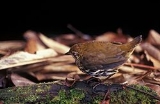
The Formicariidae, formicariids, or ground antbirds are a family
of smallish passerine
bird
s of subtropical and tropical Central
and South America
. They are between 10 and 20 cm (4–8 in) in length, and are related to the antbird
s, Thamnophilidae, and gnateater
s, Conopophagidae. This family contains probably (see below) some 100–120 species
in 1 or 2 large and a number of fairly small genera
.
These are forest birds that tend to feed on insects at or near the ground since many are specialist ant
eaters. Most are drab in appearance with shades of (rusty) brown, black, and white being their dominant tones. Compared to other birds that specialize in following ants, this family is the most tied to the ground. The long, powerful legs (which lend the birds a distinctive upright posture) and an essentially vestigial tail aid this lifestyle.
They lay two or three eggs in a nest in a tree, both sexes incubating.
Formicarius and Chamaeza are similar in appearance to small rails
. Their sexes are alike in plumage, and they walk like starling
s. The thrush part of the name refers only to the similarity in size (and in Chamaeza also coloration) to true thrushes
, not to an evolution
ary relationship.
The antpittas in the genera Grallaria, Hylopezus, Myrmothera and Grallaricula are also sexually monomorphic; they resemble the true pittas in that they are virtually tailess; they hop like some thrushes
, and are much easier to hear than see – although their vocalizations may be rather atypical for perching birds.
Recent research (Irestedt et al. 2002, Rice 2005a,b) indicates that the Formicariidae as previously delimited are highly paraphyletic, judging from comparison of several mt and nDNA sequences
. The aberrant bar-bellied "antpittas" of the genus Pittasoma
, which were formerly placed here, belong to the gnateater
family (which initially was also considered part of the Formicariidae); as the gnateaters proper, they are sexually dichromatic. On the other hand, at least a large proportion of the Rhinocryptidae (tapaculos), including the type genus
Rhinocrypta, seem to be closer to the antthrushes than these are to the antpittas.
Very little molecular data is currently available for rhinocryptids, which are moreover rather non-diagnostic morphologically. As relationships with related groups such as ovenbirds have not been fully resolved, it is certain that the systematics of the group will be revised soon, but it is not clear how exactly the new systematic lineup will be. On the other hand, morphological, behavioral and molecular analyses of the true antpittas agree astoundingly well as regards their internal systematics, considering the high amount of lifestyle-related homoplasies in the birds discussed here.
Barring a closer relationship of any of the three groups – antthrushes, tapaculos, and antpittas – to other suboscines, three basic approaches are possible:
Altogether, a layout with two families and four subfamilies (option 1) or an analogous one with two subfamilies and four tribes (option 2) seems to represent the phylogeny of these birds best; a three-lineage approach (option 3) might be warranted if some other families are also part of the Formicariidae-Rhinocryptidae clade
. Whether the typical antthrushes and tapaculos should be separated from the antpittas at the family level is not yet clear. It depends on whether or not the gnateaters and true antbird
s are closer to the true antpittas than to the antthrush-tapaculo clade
; there is some – albeit very tentative – indication that splitting off the true antpittas as a distinct family (option 2) is indeed more warranted (Rice 2005a).
Tapaculo
s – possibly tribe Rhinocryptini/subfamily Rhinocryptinae (tentatively placed here)
and probably other genera
Lesser antpittas – possibly tribe Myrmotherini/subfamily Myrmotherinae
(8 species) Genus Myrmothera
(2 species)
Genus Grallaricula
(8 species)
Family (biology)
In biological classification, family is* a taxonomic rank. Other well-known ranks are life, domain, kingdom, phylum, class, order, genus, and species, with family fitting between order and genus. As for the other well-known ranks, there is the option of an immediately lower rank, indicated by the...
of smallish passerine
Passerine
A passerine is a bird of the order Passeriformes, which includes more than half of all bird species. Sometimes known as perching birds or, less accurately, as songbirds, the passerines form one of the most diverse terrestrial vertebrate orders: with over 5,000 identified species, it has roughly...
bird
Bird
Birds are feathered, winged, bipedal, endothermic , egg-laying, vertebrate animals. Around 10,000 living species and 188 families makes them the most speciose class of tetrapod vertebrates. They inhabit ecosystems across the globe, from the Arctic to the Antarctic. Extant birds range in size from...
s of subtropical and tropical Central
Central America
Central America is the central geographic region of the Americas. It is the southernmost, isthmian portion of the North American continent, which connects with South America on the southeast. When considered part of the unified continental model, it is considered a subcontinent...
and South America
South America
South America is a continent situated in the Western Hemisphere, mostly in the Southern Hemisphere, with a relatively small portion in the Northern Hemisphere. The continent is also considered a subcontinent of the Americas. It is bordered on the west by the Pacific Ocean and on the north and east...
. They are between 10 and 20 cm (4–8 in) in length, and are related to the antbird
Antbird
The antbirds are a large family, Thamnophilidae, of passerine birds found across subtropical and tropical Central and South America, from Mexico to Argentina. There are more than 200 species, known variously as antshrikes, antwrens, antvireos, fire-eyes, bare-eyes and bushbirds...
s, Thamnophilidae, and gnateater
Gnateater
The gnateaters are a bird family, Conopophagidae, consisting of ten small passerine species in two genera, which occur in South and Central America...
s, Conopophagidae. This family contains probably (see below) some 100–120 species
Species
In biology, a species is one of the basic units of biological classification and a taxonomic rank. A species is often defined as a group of organisms capable of interbreeding and producing fertile offspring. While in many cases this definition is adequate, more precise or differing measures are...
in 1 or 2 large and a number of fairly small genera
Genus
In biology, a genus is a low-level taxonomic rank used in the biological classification of living and fossil organisms, which is an example of definition by genus and differentia...
.
These are forest birds that tend to feed on insects at or near the ground since many are specialist ant
Ant
Ants are social insects of the family Formicidae and, along with the related wasps and bees, belong to the order Hymenoptera. Ants evolved from wasp-like ancestors in the mid-Cretaceous period between 110 and 130 million years ago and diversified after the rise of flowering plants. More than...
eaters. Most are drab in appearance with shades of (rusty) brown, black, and white being their dominant tones. Compared to other birds that specialize in following ants, this family is the most tied to the ground. The long, powerful legs (which lend the birds a distinctive upright posture) and an essentially vestigial tail aid this lifestyle.
They lay two or three eggs in a nest in a tree, both sexes incubating.
Systematics
The Formicariidae are traditionally divided into two groups, which are supported by a wide range of morphological, molecular and other evidence. The antthrushes in the generaGenus
In biology, a genus is a low-level taxonomic rank used in the biological classification of living and fossil organisms, which is an example of definition by genus and differentia...
Formicarius and Chamaeza are similar in appearance to small rails
Rallidae
The rails, or Rallidae, are a large cosmopolitan family of small to medium-sized birds. The family exhibits considerable diversity and the family also includes the crakes, coots, and gallinules...
. Their sexes are alike in plumage, and they walk like starling
Starling
Starlings are small to medium-sized passerine birds in the family Sturnidae. The name "Sturnidae" comes from the Latin word for starling, sturnus. Many Asian species, particularly the larger ones, are called mynas, and many African species are known as glossy starlings because of their iridescent...
s. The thrush part of the name refers only to the similarity in size (and in Chamaeza also coloration) to true thrushes
Thrush (bird)
The thrushes, family Turdidae, are a group of passerine birds that occur worldwide.-Characteristics:Thrushes are plump, soft-plumaged, small to medium-sized birds, inhabiting wooded areas, and often feed on the ground or eat small fruit. The smallest thrush may be the Forest Rock-thrush, at and...
, not to an evolution
Evolution
Evolution is any change across successive generations in the heritable characteristics of biological populations. Evolutionary processes give rise to diversity at every level of biological organisation, including species, individual organisms and molecules such as DNA and proteins.Life on Earth...
ary relationship.
The antpittas in the genera Grallaria, Hylopezus, Myrmothera and Grallaricula are also sexually monomorphic; they resemble the true pittas in that they are virtually tailess; they hop like some thrushes
Thrush (bird)
The thrushes, family Turdidae, are a group of passerine birds that occur worldwide.-Characteristics:Thrushes are plump, soft-plumaged, small to medium-sized birds, inhabiting wooded areas, and often feed on the ground or eat small fruit. The smallest thrush may be the Forest Rock-thrush, at and...
, and are much easier to hear than see – although their vocalizations may be rather atypical for perching birds.
Recent research (Irestedt et al. 2002, Rice 2005a,b) indicates that the Formicariidae as previously delimited are highly paraphyletic, judging from comparison of several mt and nDNA sequences
DNA sequence
The sequence or primary structure of a nucleic acid is the composition of atoms that make up the nucleic acid and the chemical bonds that bond those atoms. Because nucleic acids, such as DNA and RNA, are unbranched polymers, this specification is equivalent to specifying the sequence of...
. The aberrant bar-bellied "antpittas" of the genus Pittasoma
Pittasoma
Pittasoma is a genus of birds in the gnateater family. Its two members breed in subtropical or tropical moist forest in South and Central America, specifically the Chocó, and Panama and Costa Rica...
, which were formerly placed here, belong to the gnateater
Gnateater
The gnateaters are a bird family, Conopophagidae, consisting of ten small passerine species in two genera, which occur in South and Central America...
family (which initially was also considered part of the Formicariidae); as the gnateaters proper, they are sexually dichromatic. On the other hand, at least a large proportion of the Rhinocryptidae (tapaculos), including the type genus
Type genus
In biological classification, a type genus is a representative genus, as with regard to a biological family. The term and concept is used much more often and much more formally in zoology than it is in botany, and the definition is dependent on the nomenclatural Code that applies:* In zoological...
Rhinocrypta, seem to be closer to the antthrushes than these are to the antpittas.
Very little molecular data is currently available for rhinocryptids, which are moreover rather non-diagnostic morphologically. As relationships with related groups such as ovenbirds have not been fully resolved, it is certain that the systematics of the group will be revised soon, but it is not clear how exactly the new systematic lineup will be. On the other hand, morphological, behavioral and molecular analyses of the true antpittas agree astoundingly well as regards their internal systematics, considering the high amount of lifestyle-related homoplasies in the birds discussed here.
Barring a closer relationship of any of the three groups – antthrushes, tapaculos, and antpittas – to other suboscines, three basic approaches are possible:
- Some or all Rhinocryptidae would be merged into the Formicariidae. "Rhinocryptidae" would have to be abolished as a family-level taxonTaxon|thumb|270px|[[African elephants]] form a widely-accepted taxon, the [[genus]] LoxodontaA taxon is a group of organisms, which a taxonomist adjudges to be a unit. Usually a taxon is given a name and a rank, although neither is a requirement...
, and if that group is not entirely merged into the Formicariidae, the remaining genera would receive a new familyFamily (biology)In biological classification, family is* a taxonomic rank. Other well-known ranks are life, domain, kingdom, phylum, class, order, genus, and species, with family fitting between order and genus. As for the other well-known ranks, there is the option of an immediately lower rank, indicated by the...
name. The Formicariidae would then contain an antthrush-tapaculo subfamily, possibly with two separate tribesTribe (biology)In biology, a tribe is a taxonomic rank between family and genus. It is sometimes subdivided into subtribes.Some examples include the tribes: Canini, Acalypheae, Hominini, Bombini, and Antidesmeae.-See also:* Biological classification* Rank...
, and one or two antpitta tribes as per option 2 in another subfamily. - It is alternatively possible to split the group into two families, of which one would contain the antthrushes and some or all tapaculos and their allies in two subfamilies and bear the name Formicariidae. The other family would contain the antpittas and receive a new name; it would also contain two subfamilies, one consisting of the typical Grallaria antpittas and the other of the usually smaller species of the remaining genera.
- Finally, all three major lineages – antthrushes, tapaculos and allies, and antpittas – could be considered separate families. PhylogeneticallyPhylogeneticsIn biology, phylogenetics is the study of evolutionary relatedness among groups of organisms , which is discovered through molecular sequencing data and morphological data matrices...
, it might even be deemed appropriate to split the antpittas into two families (one containing only Grallaria and the other the remaining genera) though this would probably be considered oversplitting.
Altogether, a layout with two families and four subfamilies (option 1) or an analogous one with two subfamilies and four tribes (option 2) seems to represent the phylogeny of these birds best; a three-lineage approach (option 3) might be warranted if some other families are also part of the Formicariidae-Rhinocryptidae clade
Clade
A clade is a group consisting of a species and all its descendants. In the terms of biological systematics, a clade is a single "branch" on the "tree of life". The idea that such a "natural group" of organisms should be grouped together and given a taxonomic name is central to biological...
. Whether the typical antthrushes and tapaculos should be separated from the antpittas at the family level is not yet clear. It depends on whether or not the gnateaters and true antbird
Antbird
The antbirds are a large family, Thamnophilidae, of passerine birds found across subtropical and tropical Central and South America, from Mexico to Argentina. There are more than 200 species, known variously as antshrikes, antwrens, antvireos, fire-eyes, bare-eyes and bushbirds...
s are closer to the true antpittas than to the antthrush-tapaculo clade
Clade
A clade is a group consisting of a species and all its descendants. In the terms of biological systematics, a clade is a single "branch" on the "tree of life". The idea that such a "natural group" of organisms should be grouped together and given a taxonomic name is central to biological...
; there is some – albeit very tentative – indication that splitting off the true antpittas as a distinct family (option 2) is indeed more warranted (Rice 2005a).
Antthrushes and Tapaculos (Formicariidae sensu stricto)
Typical antthrushes - tribe Formicariini/subfamily Formicariinae- Genus FormicariusFormicarius (genus)Formicarius is a genus of passerine birds in the Formicariidae family. These birds are all found in the tropical New World, from southern Mexico south to Central America and northern South America. All are named as antthrushes, and are insectivorous forest birds...
(5 species) - Genus ChamaezaChamaezaChamaeza is a genus of South American birds in the Formicariidae family.It contains the following species:* Short-tailed Antthrush * Cryptic Antthrush * Barred Antthrush...
(6 species)
Tapaculo
Tapaculo
The tapaculos are a group of small suboscine passeriform birds with numerous species, found mainly in South America and with the highest diversity in the Andean regions...
s – possibly tribe Rhinocryptini/subfamily Rhinocryptinae (tentatively placed here)
- Genus PteroptochosPteroptochosPteroptochos is a genus of bird in the Rhinocryptidae family.It contains the following species:* Chestnut-throated Huet-huet * Black-throated Huet-huet...
- Genus ScytalopusScytalopusScytalopus is a genus of small passerine birds belonging to the tapaculo group. They are found in South and Central America from Tierra del Fuego to Costa Rica, but are absent from the Amazon Basin. They inhabit dense vegetation at or near ground-level and are mainly found in mountainous regions,...
- Genus Rhinocrypta
- Genus Liosceles
and probably other genera
True antpittas (possibly own family N.N.)
Typical antpittas – tribe Grallariini/subfamily Grallariinae- Genus GrallariaGrallariaGrallaria is a large genus of birds in the Formicariidae family.It contains the following 32 species:* Undulated Antpitta, Grallaria squamigera* Giant Antpitta, Grallaria gigantea* Great Antpitta, Grallaria excelsa...
(32 species)
Lesser antpittas – possibly tribe Myrmotherini/subfamily Myrmotherinae
Hylopezus
Hylopezus is a genus of bird in the Formicariidae family.It contains the following eight species:* Masked Antpitta * Amazonian Antpitta * Thicket Antpitta...
(8 species)
Myrmothera
Myrmothera is a genus of bird in the Formicariidae family.It contains the following species:* Thrush-like Antpitta * Tepui Antpitta...
(2 species)
Grallaricula
Grallaricula is a genus of bird in the Formicariidae family.It contains the following eight species:* Ochre-breasted Antpitta, Grallaricula flavirostris* Rusty-breasted Antpitta, Grallaricula ferrugineipectus...
(8 species)
External links
- Formicariidae videos, photos and sounds on the Internet Bird Collection