

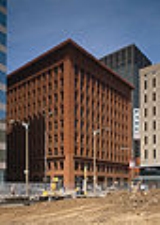
Form follows function

Encyclopedia
Form follows function is a principle associated with modern architecture
and industrial design
in the 20th century. The principle is that the shape of a building or object should be primarily based upon its intended function or purpose.
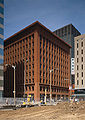
, whose thinking to a large extent predates the later functionalist
approach to architecture. It was, however, the American architect Louis Sullivan
who coined the phrase, in 1896, in his article «The Tall Office Building Artistically Considered». Here Sullivan actually said 'form ever follows function', but the simpler (and less emphatic) phrase is the one usually remembered. For Sullivan this was distilled wisdom, an aesthetic credo, the single "rule that shall permit of no exception". The full quote is thus:
Sullivan developed the shape of the tall steel skyscraper
in late 19th Century Chicago
at the very moment when technology, taste and economic forces converged violently and made it necessary to drop the established styles of the past. If the shape of the building wasn't going to be chosen out of the old pattern book something had to determine form, and according to Sullivan it was going to be the purpose of the building. It was 'form follows function', as opposed to 'form follows precedent'. Sullivan's assistant Frank Lloyd Wright
adopted and professed the same principle in slightly different form—perhaps because shaking off the old styles gave them more freedom and latitude.
famously proclaimed that architectural ornament was criminal, and his essay
on that topic would become foundational to Modernism
and eventually trigger the careers of Le Corbusier
, Walter Gropius
, Alvar Aalto
, Mies van der Rohe and Gerrit Rietveld
. The Modernists adopted both of these equations—form follows function, ornament is a crime—as moral principles, and they celebrated industrial artifacts like steel water towers as brilliant and beautiful examples of plain, simple design integrity.
These two principles—form follows function, ornament is crime—are often invoked on the same occasions for the same reasons, but they do not mean the same thing. If ornament on a building may have social usefulness like aiding wayfinding
, announcing the identity of the building, signaling scale, or attracting new customers inside, then ornament can be seen as functional, which puts those two articles of dogma
at odds with each other.
Conversely the argument ‘ornament is crime’ doesn’t say anything about function. It is an aesthetic preference inspired by the Machine Age
. While human performance may be enhanced by a sense of well-being endowed by aesthetic pleasure, machines have no such need of beauty to perform their work tirelessly. Ornament becomes an unnecessary relic, or worse, an impediment to optimal engineering design and equipment maintenance. Other stylistic ‘non-functional’ features may rest untouched (e.g., the feeling of space, the composition of the volumes) as we can see in the subsequent abstracted and non-ornamented styles. Much of the confusion between these two concepts comes from the fact that ornament traditionally derives from a function becoming a stylistic character (e.g., the gargoyle
from Gothic
cathedrals).
Modernism
in architecture began as a disciplined effort to allow the shape and organization of a building to be determined only by functional requirements, instead of by traditional aesthetic concepts. It assumes that the designer will determine empirically (or decide arbitrarily) what is or is not a functional requirement. The resulting architecture tended to be shockingly simpler, flatter, and lighter than its older neighbors, possibly due to the limited number of functional requirements upon which the designs were based; their functionality and refreshing nakedness looked as honest and inevitable as an airplane. Modernists believed, perhaps incorrectly, that airplane design did not involve any aesthetic decisions by the airplane designers. A recognizable Modern vocabulary began to develop.
's phrase "form (ever) follows function" became a battle-cry of Modernist architects after the 1930s. The credo was taken to imply that decorative elements, which architects call "ornament," were superfluous in modern buildings. However, Sullivan himself neither thought nor designed along such dogmatic lines during the peak of his career. Indeed, while his buildings could be spare and crisp in their principal masses, he often punctuated their plain surfaces with eruptions of lush Art Nouveau
and something like Celtic Revival
decorations, usually cast in iron or terra cotta, and ranging from organic forms like vines and ivy, to more geometric designs, and interlace, inspired by his Irish design heritage. Probably the most famous example is the writhing green ironwork that covers the entrance canopies of the Carson Pirie Scott department store on South State Street in Chicago. These ornaments, often executed by the talented younger draftsman in Sullivan's employ, would eventually become Sullivan's trade mark; to students of architecture, they are his instantly-recognizable signature.
, when the American auto industry temporarily halted attempts to introduce optimal aerodynamic forms into mass manufacture. Some carmakers thought that aerodynamic efficiency would result in a single optimal auto-body shape, a "teardrop" shape, which would not be good for unit sales. GM thereafter adopted two different positions on streamlining, one meant for its internal engineering community, the other meant for its customers. Like the annual model year change, so-called aerodynamic styling is often meaningless in terms of technical performance. Subsequently drag coefficient
has become both a marketing tool and a means of improving the saleability of a car by reducing its fuel consumption, slightly, and its top speed, markedly.
The American industrial designers of the 1930s and '40s like Raymond Loewy
, Norman bel Geddes
and Henry Dreyfuss
grappled with the inherent contradictions of 'form follows function' as they redesigned blenders and locomotives and duplicating machines for mass-market consumption. Loewy formulated his ‘MAYA’ (Most Advanced Yet Acceptable) principle to express that product designs are bounded by functional constraints of math and materials and logic, but their acceptance is constrained by social expectations.
By honestly applying ‘form follows function’, industrial designers had the potential to advance their clients right out of business. Some simple single-purpose objects like screwdrivers and pencils and teapots might be reducible to a single optimal form, and through the eyes of a teapot maker that’s simply unacceptable. Some objects made too durable would prevent sales of replacements. From the standpoint of functionality some products are flatly unnecessary, and through the eyes of an electric carving knife
maker that’s quite unacceptable.
Victor Papanek
(died 1999) was an influential recent designer and design philosopher who taught and wrote as a proponent of "form follows function."
The principle can also be applied to Enterprise Application Architectures of modern business where 'function' is the Business processes which should be assisted by the enterprise architecture, or 'form'. If the architecture dictates how the business operates then the business is likely to suffer from inflexibility unable to adapt to change. SOA Service-Oriented Architecture
have enabled Enterprise Architect
to rearrange the 'form' of the architecture to meet the functional requirements of a business by adopting standards based communication protocols which enable interoperability.

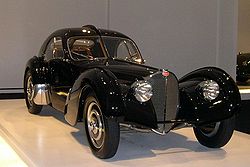
, Rembrandt
, and Jean
Bugatti
.
, anatomy will be structured according to functions associated with use; for instance, giraffe
s are taller to reach the leaves of tree
s. By contrast, in Darwinian evolution
, form (variation
) precedes function (as determined by selection
). That is to say in Lamarckian evolution the form is altered by the required function, whereas in Darwinian evolution small variations in form allow some parts of the population to function 'better', and are therefore more successful reproductively.
Modern architecture
Modern architecture is generally characterized by simplification of form and creation of ornament from the structure and theme of the building. It is a term applied to an overarching movement, with its exact definition and scope varying widely...
and industrial design
Industrial design
Industrial design is the use of a combination of applied art and applied science to improve the aesthetics, ergonomics, and usability of a product, but it may also be used to improve the product's marketability and production...
in the 20th century. The principle is that the shape of a building or object should be primarily based upon its intended function or purpose.
Origins of the phrase
The authorship of the phrase is often, though wrongly, ascribed to the American sculptor Horatio GreenoughHoratio Greenough
Horatio Greenough was an American sculptor best known for his United States government commissions The Rescue and George Washington .-Biography:...
, whose thinking to a large extent predates the later functionalist
Functionalism (architecture)
Functionalism, in architecture, is the principle that architects should design a building based on the purpose of that building. This statement is less self-evident than it first appears, and is a matter of confusion and controversy within the profession, particularly in regard to modern...
approach to architecture. It was, however, the American architect Louis Sullivan
Louis Sullivan
Louis Henri Sullivan was an American architect, and has been called the "father of skyscrapers" and "father of modernism" He is considered by many as the creator of the modern skyscraper, was an influential architect and critic of the Chicago School, was a mentor to Frank Lloyd Wright, and an...
who coined the phrase, in 1896, in his article «The Tall Office Building Artistically Considered». Here Sullivan actually said 'form ever follows function', but the simpler (and less emphatic) phrase is the one usually remembered. For Sullivan this was distilled wisdom, an aesthetic credo, the single "rule that shall permit of no exception". The full quote is thus:
It is the pervading law of all things organic and inorganic,
Of all things physical and metaphysical,
Of all things human and all things super-human,
Of all true manifestations of the head,
Of the heart, of the soul,
That the life is recognizable in its expression,
That form ever follows function. This is the law.
Sullivan developed the shape of the tall steel skyscraper
Skyscraper
A skyscraper is a tall, continuously habitable building of many stories, often designed for office and commercial use. There is no official definition or height above which a building may be classified as a skyscraper...
in late 19th Century Chicago
Chicago
Chicago is the largest city in the US state of Illinois. With nearly 2.7 million residents, it is the most populous city in the Midwestern United States and the third most populous in the US, after New York City and Los Angeles...
at the very moment when technology, taste and economic forces converged violently and made it necessary to drop the established styles of the past. If the shape of the building wasn't going to be chosen out of the old pattern book something had to determine form, and according to Sullivan it was going to be the purpose of the building. It was 'form follows function', as opposed to 'form follows precedent'. Sullivan's assistant Frank Lloyd Wright
Frank Lloyd Wright
Frank Lloyd Wright was an American architect, interior designer, writer and educator, who designed more than 1,000 structures and completed 500 works. Wright believed in designing structures which were in harmony with humanity and its environment, a philosophy he called organic architecture...
adopted and professed the same principle in slightly different form—perhaps because shaking off the old styles gave them more freedom and latitude.
Is ornamentation 'functional'?
In 1908 the Austrian architect Adolf LoosAdolf Loos
Adolf Franz Karl Viktor Maria Loos was a Moravian-born Austro-Hungarian architect. He was influential in European Modern architecture, and in his essay Ornament and Crime he repudiated the florid style of the Vienna Secession, the Austrian version of Art Nouveau...
famously proclaimed that architectural ornament was criminal, and his essay
Ornament and Crime
Ornament and Crime is an essay written in 1908 by the influential and self-consciously "modern" Austrian architect Adolf Loos under the German title Ornament und Verbrechen...
on that topic would become foundational to Modernism
Modern architecture
Modern architecture is generally characterized by simplification of form and creation of ornament from the structure and theme of the building. It is a term applied to an overarching movement, with its exact definition and scope varying widely...
and eventually trigger the careers of Le Corbusier
Le Corbusier
Charles-Édouard Jeanneret, better known as Le Corbusier , was a Swiss-born French architect, designer, urbanist, writer and painter, famous for being one of the pioneers of what now is called modern architecture. He was born in Switzerland and became a French citizen in 1930...
, Walter Gropius
Walter Gropius
Walter Adolph Georg Gropius was a German architect and founder of the Bauhaus School who, along with Ludwig Mies van der Rohe and Le Corbusier, is widely regarded as one of the pioneering masters of modern architecture....
, Alvar Aalto
Alvar Aalto
Hugo Alvar Henrik Aalto was a Finnish architect and designer. His work includes architecture, furniture, textiles and glassware...
, Mies van der Rohe and Gerrit Rietveld
Gerrit Rietveld
Gerrit Thomas Rietveld was a Dutch furniture designer and architect. One of the principal members of the Dutch artistic movement called De Stijl, Rietveld is famous for his Red and Blue Chair and for the Rietveld Schröder House, which is a UNESCO World Heritage Site.-Biography:Rietveld was born in...
. The Modernists adopted both of these equations—form follows function, ornament is a crime—as moral principles, and they celebrated industrial artifacts like steel water towers as brilliant and beautiful examples of plain, simple design integrity.
These two principles—form follows function, ornament is crime—are often invoked on the same occasions for the same reasons, but they do not mean the same thing. If ornament on a building may have social usefulness like aiding wayfinding
Wayfinding
Wayfinding encompasses all of the ways in which people and animals orient themselves in physical space and navigate from place to place.-Historical:...
, announcing the identity of the building, signaling scale, or attracting new customers inside, then ornament can be seen as functional, which puts those two articles of dogma
Dogma
Dogma is the established belief or doctrine held by a religion, or a particular group or organization. It is authoritative and not to be disputed, doubted, or diverged from, by the practitioners or believers...
at odds with each other.
Conversely the argument ‘ornament is crime’ doesn’t say anything about function. It is an aesthetic preference inspired by the Machine Age
Machine Age
The Machine Age is a term associated mostly with the early 20th century, sometimes also including the late 19th century. An approximate dating would be about 1880 to 1945. Considered to be at a peak in the time between the first and second world wars, it forms a late part of the Industrial Age...
. While human performance may be enhanced by a sense of well-being endowed by aesthetic pleasure, machines have no such need of beauty to perform their work tirelessly. Ornament becomes an unnecessary relic, or worse, an impediment to optimal engineering design and equipment maintenance. Other stylistic ‘non-functional’ features may rest untouched (e.g., the feeling of space, the composition of the volumes) as we can see in the subsequent abstracted and non-ornamented styles. Much of the confusion between these two concepts comes from the fact that ornament traditionally derives from a function becoming a stylistic character (e.g., the gargoyle
Gargoyle
In architecture, a gargoyle is a carved stone grotesque, usually made of granite, with a spout designed to convey water from a roof and away from the side of a building thereby preventing rainwater from running down masonry walls and eroding the mortar between...
from Gothic
Gothic architecture
Gothic architecture is a style of architecture that flourished during the high and late medieval period. It evolved from Romanesque architecture and was succeeded by Renaissance architecture....
cathedrals).
Modernism
Modernism
Modernism, in its broadest definition, is modern thought, character, or practice. More specifically, the term describes the modernist movement, its set of cultural tendencies and array of associated cultural movements, originally arising from wide-scale and far-reaching changes to Western society...
in architecture began as a disciplined effort to allow the shape and organization of a building to be determined only by functional requirements, instead of by traditional aesthetic concepts. It assumes that the designer will determine empirically (or decide arbitrarily) what is or is not a functional requirement. The resulting architecture tended to be shockingly simpler, flatter, and lighter than its older neighbors, possibly due to the limited number of functional requirements upon which the designs were based; their functionality and refreshing nakedness looked as honest and inevitable as an airplane. Modernists believed, perhaps incorrectly, that airplane design did not involve any aesthetic decisions by the airplane designers. A recognizable Modern vocabulary began to develop.
Utilitarianism
Utilitarianism in architecture can mean several things.- The belief that the value of a feature is determined by its utility. The quality of being utilitarian: housing of bleak utilitarianism.
- The aesthetic of exposing necessary materials and features, such as metal or heating pipes, which are normally included in a design for their utility rather than their aesthetic appeal.
Architecture
Louis SullivanLouis Sullivan
Louis Henri Sullivan was an American architect, and has been called the "father of skyscrapers" and "father of modernism" He is considered by many as the creator of the modern skyscraper, was an influential architect and critic of the Chicago School, was a mentor to Frank Lloyd Wright, and an...
's phrase "form (ever) follows function" became a battle-cry of Modernist architects after the 1930s. The credo was taken to imply that decorative elements, which architects call "ornament," were superfluous in modern buildings. However, Sullivan himself neither thought nor designed along such dogmatic lines during the peak of his career. Indeed, while his buildings could be spare and crisp in their principal masses, he often punctuated their plain surfaces with eruptions of lush Art Nouveau
Art Nouveau
Art Nouveau is an international philosophy and style of art, architecture and applied art—especially the decorative arts—that were most popular during 1890–1910. The name "Art Nouveau" is French for "new art"...
and something like Celtic Revival
Celtic Revival
Celtic Revival covers a variety of movements and trends, mostly in the 19th and 20th centuries, which drew on the traditions of Celtic literature and Celtic art, or in fact more often what art historians call Insular art...
decorations, usually cast in iron or terra cotta, and ranging from organic forms like vines and ivy, to more geometric designs, and interlace, inspired by his Irish design heritage. Probably the most famous example is the writhing green ironwork that covers the entrance canopies of the Carson Pirie Scott department store on South State Street in Chicago. These ornaments, often executed by the talented younger draftsman in Sullivan's employ, would eventually become Sullivan's trade mark; to students of architecture, they are his instantly-recognizable signature.
Product design
One episode in the history of the inherent conflict between functional design and the demands of the marketplace happened in 1935, after the introduction of the streamlined Chrysler AirflowChrysler Airflow
The Chrysler Airflow is an automobile produced by the Chrysler Corporation from 1934-1937. The Airflow was the first full-size American production car to use streamlining as a basis for building a sleeker automobile, one less susceptible to air resistance...
, when the American auto industry temporarily halted attempts to introduce optimal aerodynamic forms into mass manufacture. Some carmakers thought that aerodynamic efficiency would result in a single optimal auto-body shape, a "teardrop" shape, which would not be good for unit sales. GM thereafter adopted two different positions on streamlining, one meant for its internal engineering community, the other meant for its customers. Like the annual model year change, so-called aerodynamic styling is often meaningless in terms of technical performance. Subsequently drag coefficient
Drag coefficient
In fluid dynamics, the drag coefficient is a dimensionless quantity that is used to quantify the drag or resistance of an object in a fluid environment such as air or water. It is used in the drag equation, where a lower drag coefficient indicates the object will have less aerodynamic or...
has become both a marketing tool and a means of improving the saleability of a car by reducing its fuel consumption, slightly, and its top speed, markedly.
The American industrial designers of the 1930s and '40s like Raymond Loewy
Raymond Loewy
Raymond Loewy was an industrial designer, and the first to be featured on the cover of Time Magazine, on October 31, 1949. Born in France, he spent most of his professional career in the United States...
, Norman bel Geddes
Norman Bel Geddes
Norman Melancton Bel Geddes was an American theatrical and industrial designer who focused on aerodynamics....
and Henry Dreyfuss
Henry Dreyfuss
Henry Dreyfuss was an American industrial designer.-Career:Dreyfuss was a native of Brooklyn, New York. As one of the celebrity industrial designers of the 1930s and 1940s, Dreyfuss dramatically improved the look, feel, and usability of dozens of consumer products...
grappled with the inherent contradictions of 'form follows function' as they redesigned blenders and locomotives and duplicating machines for mass-market consumption. Loewy formulated his ‘MAYA’ (Most Advanced Yet Acceptable) principle to express that product designs are bounded by functional constraints of math and materials and logic, but their acceptance is constrained by social expectations.
By honestly applying ‘form follows function’, industrial designers had the potential to advance their clients right out of business. Some simple single-purpose objects like screwdrivers and pencils and teapots might be reducible to a single optimal form, and through the eyes of a teapot maker that’s simply unacceptable. Some objects made too durable would prevent sales of replacements. From the standpoint of functionality some products are flatly unnecessary, and through the eyes of an electric carving knife
Electric knife
An electric knife or electric carving knife is an electrical kitchen device used for slicing foods. An electric knife requires less physical effort than an ordinary knife and produces neater slices. The device consists of two serrated blades that are clipped together...
maker that’s quite unacceptable.
Victor Papanek
Victor Papanek
Victor Papanek was a designer and educator who became a strong advocate of the socially and ecologically responsible design of products, tools, and community infrastructures. He disapproved of manufactured products that were unsafe, showy, maladapted, or essentially useless...
(died 1999) was an influential recent designer and design philosopher who taught and wrote as a proponent of "form follows function."
Software engineering
It has been argued that the structure and internal quality attributes of a working, non-trivial software artifact will represent first and foremost the engineering requirements of its construction, with the influence of process being marginal, if any. This does not mean that process is irrelevant, but that processes compatible with an artifact's requirements lead to roughly similar results.The principle can also be applied to Enterprise Application Architectures of modern business where 'function' is the Business processes which should be assisted by the enterprise architecture, or 'form'. If the architecture dictates how the business operates then the business is likely to suffer from inflexibility unable to adapt to change. SOA Service-Oriented Architecture
Service-oriented architecture
In software engineering, a Service-Oriented Architecture is a set of principles and methodologies for designing and developing software in the form of interoperable services. These services are well-defined business functionalities that are built as software components that can be reused for...
have enabled Enterprise Architect
Enterprise architect
Enterprise architects are practitioners of enterprise architecture; an information technology management discipline that operates within organizations.-Role of enterprise architects:...
to rearrange the 'form' of the architecture to meet the functional requirements of a business by adopting standards based communication protocols which enable interoperability.
Automobile designing
If the design of an automobile conforms to its function, as in its aerodynamic shape or wide stance for better vehicle dynamics, then its form is said to follow its function. "Form follows function" can also be an aesthetic point of view that a design can heighten, as often seen in the work of EttoreEttore Bugatti
right|thumb|Ettore Bugatti in 1932Ettore Arco Isidoro Bugatti was an Italian-born and French naturalized citizen automobile designer and manufacturer....
, Rembrandt
Rembrandt Bugatti
Rembrandt Bugatti was an Italian sculptor, known primarily for his bronze sculptures of wildlife subjects.- Early life :...
, and Jean
Jean Bugatti
Jean Bugatti was an French/Italian automotive designer and test engineer.Born Gianoberto Maria Carlo Bugatti in Cologne, Germany, he was the eldest son of Ettore Bugatti. Soon after his birth the family moved to the village of Dorlisheim near Molsheim in Alsace where his father built the new...
Bugatti
Bugatti
Automobiles E. Bugatti was a French car manufacturer founded in 1909 in Molsheim, Alsace, as a manufacturer of high-performance automobiles by Italian-born Ettore Bugatti....
.
Evolution
According to Lamarck's long-discredited theory of evolutionLamarckism
Lamarckism is the idea that an organism can pass on characteristics that it acquired during its lifetime to its offspring . It is named after the French biologist Jean-Baptiste Lamarck , who incorporated the action of soft inheritance into his evolutionary theories...
, anatomy will be structured according to functions associated with use; for instance, giraffe
Giraffe
The giraffe is an African even-toed ungulate mammal, the tallest of all extant land-living animal species, and the largest ruminant...
s are taller to reach the leaves of tree
Tree
A tree is a perennial woody plant. It is most often defined as a woody plant that has many secondary branches supported clear of the ground on a single main stem or trunk with clear apical dominance. A minimum height specification at maturity is cited by some authors, varying from 3 m to...
s. By contrast, in Darwinian evolution
Evolution
Evolution is any change across successive generations in the heritable characteristics of biological populations. Evolutionary processes give rise to diversity at every level of biological organisation, including species, individual organisms and molecules such as DNA and proteins.Life on Earth...
, form (variation
Mutation
In molecular biology and genetics, mutations are changes in a genomic sequence: the DNA sequence of a cell's genome or the DNA or RNA sequence of a virus. They can be defined as sudden and spontaneous changes in the cell. Mutations are caused by radiation, viruses, transposons and mutagenic...
) precedes function (as determined by selection
Natural selection
Natural selection is the nonrandom process by which biologic traits become either more or less common in a population as a function of differential reproduction of their bearers. It is a key mechanism of evolution....
). That is to say in Lamarckian evolution the form is altered by the required function, whereas in Darwinian evolution small variations in form allow some parts of the population to function 'better', and are therefore more successful reproductively.
See also
- Ornament and CrimeOrnament and CrimeOrnament and Crime is an essay written in 1908 by the influential and self-consciously "modern" Austrian architect Adolf Loos under the German title Ornament und Verbrechen...
- AestheticsAestheticsAesthetics is a branch of philosophy dealing with the nature of beauty, art, and taste, and with the creation and appreciation of beauty. It is more scientifically defined as the study of sensory or sensori-emotional values, sometimes called judgments of sentiment and taste...
- The Grammar of Ornament, Owen Jones (architect)Owen Jones (architect)Owen Jones was a London-born architect and designer of Welsh descent. He was a versatile architect and designer, and one of the most influential design theorists of the nineteenth century...
- http://www.bc.edu/bc_org/avp/cas/fnart/fa267/grammar/propositions.html
External links
- "Form, function, foolishness" by Bruce Price
- "Form follows WHAT? The modernist notion of function as a carte blanche" by Jan Michl
(an alternative history and interpretation of the form-follows-function doctrine) - "E. H. Gombrich’s adoption of the formula form follows function: A case of mistaken identity?" by Jan Michl
- "How form functions: On esthetics and Gestalt theory" by Roy E. Behrens