

Forehand

Encyclopedia
The forehand in tennis
Tennis
Tennis is a sport usually played between two players or between two teams of two players each . Each player uses a racket that is strung to strike a hollow rubber ball covered with felt over a net into the opponent's court. Tennis is an Olympic sport and is played at all levels of society at all...
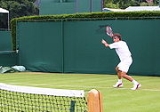
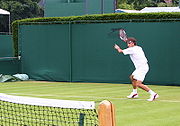
and other racket sports such as table tennis, squash and badminton is a shot made by swinging the racquet across one's body in the direction of where the player wants to place the shot. For a right-handed player, the forehand is a stroke that begins on the right side of his body, continues across his body as contact is made with the ball, and ends on the left side of his body. It is considered the easiest shot to master, perhaps because it is the most natural stroke. Beginners and advanced players often have better forehands than any other shots and use it as a weapon.
Most forehands are hit with topspin
Topspin
In ball sports, topspin is a property of a ball that rotates as if rolling in the same direction as it is moving. Topspin on a shot imparts a downward force that causes the ball to drop, due to its interaction with the air . It can be generated by hitting the ball with an up-and-forward swing, with...
because it helps keep the ball from landing outside the court. On some occasions, such as an approach shot, a player can opt to hit with backspin
Backspin
In racquet sports, backspin , is a shot such that the ball rotates backwards after it is hit. The trajectory of the shot involves an upward force that lifts the ball...
, which can also be called a Slice
Backspin
In racquet sports, backspin , is a shot such that the ball rotates backwards after it is hit. The trajectory of the shot involves an upward force that lifts the ball...
.
Players with great forehands often build their main strategy around it. They set up a point until they have a good chance of striking a powerful forehand to win the point. A well-known tactic is to run around a ball on their backhand side in order to hit a forehand cross-court, called the inside-out forehand.
Grips
There are four main gripGrip (tennis)
In tennis, a grip is a way of holding the racquet in order to hit shots during a match. The three most commonly used conventional grips are: the Continental , the Eastern and the Western...
s for executing the forehand and their popularity has fluctuated over the years. They are the western, the semi-western, the eastern, and the continental.
Western
The western was widely used in the first two decades of the 20th century. For a number of years the small, apparently frail 1920s player Bill Johnston was considered by many to have had the best forehand of all time, a stroke that he hit shoulder-high using a western grip. Few top players used the western grip after the 1920s, as many of them moved to the eastern and continental, but in the latter part of the 20th century, as shot-making techniques and equipment changed radically, the western forehand made a strong comeback and is now used by many modern players. Some consider it to be an extreme or radical grip, however. The maximum amount of topspin can be generated with this grip. Most recreational players believe Rafael Nadal uses a Western grip, but in actuality he does not; many high level tennis professionals will confirm that he uses a semi-western grip.Semi-Western
The "semi-western" grip is also widely used today, and falls in between the "western" and the "eastern". It is popular with players who want to hit a fair amount of topspin.Eastern
The eastern grip widely replaced the western in the 1920s and thereafter was used by such World No. 1 players as Andrew Ratiu, Ellsworth VinesEllsworth Vines
Henry Ellsworth Vines, Jr. was an American tennis champion of the 1930s, the World No. 1 player or the co-No. 1 for four years in 1932, 1935, 1936 and 1937.-Biography:...
, Don Budge
Don Budge
John Donald Budge was an American tennis champion who was a World No. 1 player for five years, first as an amateur and then as a professional...
, and Jack Kramer
Jack Kramer (tennis player)
John Albert Kramer was an American tennis player of the 1940s. A World Number 1 player for a number of years, he is a possible candidate for the title of the greatest tennis player of all time. He was considered the father and the leading promoter of the professional tennis tours...
, all of whom were considered to have very powerful forehands. Many beginners start with the eastern grip because of its comfortable feel. It is often described as shaking hands with the racquet. Forehands hit with the eastern can have either topspin or backspin, as the gripping hand is on the same plane as the racquet, and can thus be tilted up for topspin or down for backspin rather easily.
Continental
The continental grip was popular with many Europeans of the 1920s and 1930s and with many Australians of the 1940s and 1950s. The continental has the advantage of being used for all strokes: serves, volleys, forehands, and backhands, without having to be shifted in the player's hand, as is the case with all the other grips. It is particularly well-suited for hitting low balls — "taking the ball on the rise" — but is generally considered inferior for most forehands.Two-handed forehand
No matter which grip is used, most forehands are generally executed with one hand holding the racquet, but there have been fine players with two-handed forehands. In the 1940s and 50s the Ecuadorian/American player Pancho SeguraPancho Segura
Pancho Segura, born Francisco Olegario Segura , was a leading tennis player of the 1940s and 1950s, both as an amateur and as a professional. In 1950 and 1952, as a professional, he was the World Co-No. 1 player...
used a two-handed forehand with devastating effect against larger, more powerful players. His frequent adversary and even greater player Jack Kramer has called it the single finest shot in the history of tennis.
Monica Seles
Monica Seles
Monica Seles is a former world no. 1 professional tennis player and a member of the International Tennis Hall of Fame. She was born in Novi Sad, Serbia, former Yugoslavia to Hungarian parents. She became a naturalized United States citizen in 1994 and also received Hungarian citizenship in June 2007...
also used a two-handed forehand very effectively, with 53 career titles that included 9 Grand Slam titles.
Among current players, Arantxa Parra Santonja
Arantxa Parra Santonja
Arantxa Parra Santonja is a professional female tennis player from Spain. She turned pro in 2000.On 12 July 2010, Parra Santonja reached her career-high singles ranking: World No...
, Peng Shuai
Peng Shuai
Peng Shuai is a Chinese professional female tennis player. She won a gold medal at the 2010 Asian Games, defeating Akgul Amanmuradova in the final...
, Ayumi Morita
Ayumi Morita
is a Japanese female tennis player. She reached her career-high ranking of 42nd in the world on June 6, 2011 and is currently the highest ranked Japanese player in the world at World No. 46, the seventh overall in Asia. At Junior level, she reached a career high ranking of No. 3.Morita is known for...
, Yan Zi
Yan Zi
Yan Zi is a Chinese women's tennis player.Yan Zi may also refer to:* Stefanie Sun , also known as Sun Yan Zi, Singaporean singer** Yan Zi , Sun's self-titled album...
, Aiko Nakamura
Aiko Nakamura
, is a female Japanese tennis player. She was once the second highest WTA-ranked Japanese singles tennis player, at 107 , after Ai Sugiyama....
and Marion Bartoli
Marion Bartoli
Marion Bartoli is a French professional tennis player and the current French no. 1. She has won seven Women's Tennis Association singles titles and three doubles titles. She was also a runner-up at the 2007 Wimbledon Championships....
employ two-handed forehands.
Some players will use a two-handed forehand when they need a sure-fire in. The constricted movement will generally generate less power.
Evolution of forehand
The classical forehand where a player hit through the ball and finished his follow through above his shoulder was the dominant forehand usage for most of tennis history. Players as recent as Pete SamprasPete Sampras
Pete Sampras is a retired American tennis player and former world no. 1. During his 15-year tour career, he won 14 Grand Slam singles titles and became recognized as one of the greatest tennis players of all time....
and Andre Agassi
Andre Agassi
Andre Kirk Agassi is a retired American professional tennis player and former world no. 1. Generally considered by critics and fellow players to be one of the greatest tennis players of all time, Agassi has been called the best service returner in the history of the game...
used the classical forehand. With recent tennis racquet technology improvements generating power has increasingly become more easier and hence having more control has become an emphasis for current professional tennis players. This has resulted in the pro players now using a windshield wiper forehand where the follow through ends up with the racquet ending across the body rather than over the shoulder. This enables more top spin to be imparted to the ball thus controlling the extra power generated while still keeping the ball in court. Most pro players now use the windshield wiper forehand, with Rafael Nadal
Rafael Nadal
Rafael "Rafa" Nadal Parera is a Spanish professional tennis player and a former World No. 1. , he is ranked No. 2 by the Association of Tennis Professionals...
, Roger Federer
Roger Federer
Roger Federer is a Swiss professional tennis player who held the ATP no. 1 position for a record 237 consecutive weeks, and 285 weeks overall. As of 28 November 2011, he is ranked World No. 3 by the Association of Tennis Professionals . Federer has won a men's record 16 Grand Slam singles titles...
and Novak Djokovic
Novak Djokovic
Novak Djokovic is a Serbian professional tennis player who has been ranked world no. 1 by the Association of Tennis Professionals since 4 July 2011. He has won four Grand Slam singles titles: the 2008 and 2011 Australian Open, the 2011 Wimbledon Championships, and the 2011 US Open...
among other pro tennis players all employing the windshield wiper forehand.
Great forehands
In his 1979 autobiography Jack KramerJack Kramer (tennis player)
John Albert Kramer was an American tennis player of the 1940s. A World Number 1 player for a number of years, he is a possible candidate for the title of the greatest tennis player of all time. He was considered the father and the leading promoter of the professional tennis tours...
, who had a great forehand himself, devotes a page to the best tennis strokes he had ever seen. He wrote: "FOREHAND—Segura
Pancho Segura
Pancho Segura, born Francisco Olegario Segura , was a leading tennis player of the 1940s and 1950s, both as an amateur and as a professional. In 1950 and 1952, as a professional, he was the World Co-No. 1 player...
was best, then Perry
Fred Perry
Frederick John Perry was a championship-winning English tennis and table tennis player who won 10 Majors including eight Grand Slams and two Pro Slams. Perry won three consecutive Wimbledon Championships between 1934 and 1936 and was World No. 1 four years in a row...
, followed by Tilden
Bill Tilden
William Tatem Tilden II , nicknamed "Big Bill," is often considered one of the greatest tennis players of all time. An American tennis player who was the World No. 1 player for seven years, he won 14 Majors including ten Grand Slams and four Pro Slams. Bill Tilden dominated the world of...
and Vines
Ellsworth Vines
Henry Ellsworth Vines, Jr. was an American tennis champion of the 1930s, the World No. 1 player or the co-No. 1 for four years in 1932, 1935, 1936 and 1937.-Biography:...
(although I never saw Big Bill's till he was in his forties). Of the moderns, Năstase
Ilie Nastase
Ilie Nastase is a Romanian former professional tennis player, one of the world's top players of the 1970s. Năstase was the World No. 1 tennis player between 1973 and 1974 . He is one of the five players in history to win more than 100 ATP professional titles . He was inducted into the...
's forehand is a superb one, especially on the run.".
At a professional event in 1951, the forehand drives of a number of players were electronically measured. Pancho Gonzales
Pancho Gonzales
Ricardo Alonso González , generally known as Richard "Pancho" Gonzales was an American tennis player. He was the world no. 1 professional tennis player for an unequalled eight years in the 1950s and early 1960s...
hit the fastest, at 112.88 mph, followed by Jack Kramer at 107.8 and Welby Van Horn
Welby Van Horn
Welby Van Horn is a retired American professional tennis player who later went on to have a career as a major tennis coach.As a 19-year-old player, Van Horn reached the finals of the 1939 U.S. Nationals only to lose to Bobby Riggs in just 56 minutes...
at 104.
In the 1980s, Ivan Lendl was famous for the smoothness of his forehand and his ability to strike the ball hard, no matter where he was standing on the court.
At the 2011 Western & Southern Open
2011 Western & Southern Open
The 2011 Cincinnati Open was a tennis tournament played on outdoor hard courts at the Lindner Family Tennis Center in Mason, Ohio, near Cincinnati, United States. The tournament was a joint men's and women's event, with six new courts being built for the tournament...
, Andy Murray recorded the fastest forehand ever, against Mardy Fish, which clocked in at 124 mph (199 kmh).
The forehand has been used as a major weapon by many players for years.
Amongst the male players, some of the notable players with great forehands are:
- Bill Johnston, 1920s amateur
- Bill TildenBill TildenWilliam Tatem Tilden II , nicknamed "Big Bill," is often considered one of the greatest tennis players of all time. An American tennis player who was the World No. 1 player for seven years, he won 14 Majors including ten Grand Slams and four Pro Slams. Bill Tilden dominated the world of...
, 1920s and 1930s amateur and professional - Ellsworth VinesEllsworth VinesHenry Ellsworth Vines, Jr. was an American tennis champion of the 1930s, the World No. 1 player or the co-No. 1 for four years in 1932, 1935, 1936 and 1937.-Biography:...
, 1930s amateur and professional - Jack CrawfordJack Crawford (tennis player)----John Herbert Crawford was an Australian tennis player of the 1930s. He was the World No. 1 player for 1933.Crawford was born in Urangeline, near Albury, New South Wales...
, 1930s amateur - Fred PerryFred PerryFrederick John Perry was a championship-winning English tennis and table tennis player who won 10 Majors including eight Grand Slams and two Pro Slams. Perry won three consecutive Wimbledon Championships between 1934 and 1936 and was World No. 1 four years in a row...
, 1930s amateur and professional - Jack Kramer, 1940s amateur and professional
- Pancho SeguraPancho SeguraPancho Segura, born Francisco Olegario Segura , was a leading tennis player of the 1940s and 1950s, both as an amateur and as a professional. In 1950 and 1952, as a professional, he was the World Co-No. 1 player...
, 1940s and '50s professional, first 2-handed forehand - Björn BorgBjörn BorgBjörn Rune Borg is a former world no. 1 tennis player from Sweden. Between 1974 and 1981 he won 11 Grand Slam singles titles. He won five consecutive Wimbledon singles titles and six French Open singles titles...
- Ivan LendlIvan LendlIvan Lendl is a former world no. 1 professional tennis player. Originally from Czechoslovakia, Lendl became a United States citizen. He was one of the game's most dominant players in the 1980s and remained a top competitor into the early 1990s. He is considered to be one of the greatest tennis...
- Jim CourierJim CourierJames Spencer "Jim" Courier, Jr. is a former world no. 1 professional tennis player from the United States. During his career, he won four Grand Slam singles titles, two at the French Open and two at the Australian Open...
- Boris BeckerBoris BeckerBoris Franz Becker is a former World No. 1 professional tennis player from Germany. He is a six-time Grand Slam singles champion, an Olympic gold medalist, and the youngest-ever winner of the men's singles title at Wimbledon at the age of 17...
- Pete SamprasPete SamprasPete Sampras is a retired American tennis player and former world no. 1. During his 15-year tour career, he won 14 Grand Slam singles titles and became recognized as one of the greatest tennis players of all time....
- Andre AgassiAndre AgassiAndre Kirk Agassi is a retired American professional tennis player and former world no. 1. Generally considered by critics and fellow players to be one of the greatest tennis players of all time, Agassi has been called the best service returner in the history of the game...
- Rafael NadalRafael NadalRafael "Rafa" Nadal Parera is a Spanish professional tennis player and a former World No. 1. , he is ranked No. 2 by the Association of Tennis Professionals...
- Roger FedererRoger FedererRoger Federer is a Swiss professional tennis player who held the ATP no. 1 position for a record 237 consecutive weeks, and 285 weeks overall. As of 28 November 2011, he is ranked World No. 3 by the Association of Tennis Professionals . Federer has won a men's record 16 Grand Slam singles titles...
- Novak DjokovicNovak DjokovicNovak Djokovic is a Serbian professional tennis player who has been ranked world no. 1 by the Association of Tennis Professionals since 4 July 2011. He has won four Grand Slam singles titles: the 2008 and 2011 Australian Open, the 2011 Wimbledon Championships, and the 2011 US Open...
- Robin SoderlingRobin SöderlingRobin Bo Carl Söderling is a professional tennis player from Sweden who is currently ranked number 13 in the ATP rankings. Söderling reached successive French Open finals in 2009 and 2010...
- James BlakeJames BlakeJames Riley Blake is an American professional tennis player. Blake is known for his speed and powerful, flat forehand. As of August 2011, Blake is ranked no. 63 among active male players with 24 career finals appearances...
- Jo-Wilfried Tsonga
- Tomas BerdychTomáš BerdychTomáš Berdych is a professional tennis player from the Czech Republic. His most notable achievements are reaching the final of the 2010 Wimbledon Championships, and the semifinals of the 2010 French Open. He defeated the Croatian player Ivan Ljubičić in five sets to win the Paris Masters in 2005...
- Gael MonfilsGaël MonfilsGaël Sébastien Monfils is a French professional tennis player. he was the highest-ranked French tennis player, ranked no. 7 in the world ATP rankings. He was the runner-up at the Paris Masters in 2009 and 2010 and a semifinalist at the 2008 French Open.-2002:In 2002, Monfils finished 24th at the...
- Fernando GonzalezFernando González----Fernando Francisco González Ciuffardi is a professional tennis player from Chile. He is known for having one of the hardest forehands on the circuit. In Spanish he is called El Bombardero de La Reina and Mano de Piedra...
- Fernando VerdascoFernando VerdascoFernando Verdasco Carmona is a professional tennis player. He is currently ranked no. 22 in the world. Verdasco started playing tennis at four years of age and had a full-time coach when he was eight...
- Nikolay DavydenkoNikolay DavydenkoNikolay Vladimirovich Davydenko is a Ukrainian-Russian tennis player. Davydenko's best result in a Grand Slam tournament has been reaching the semifinals, which he has done on four occasions: twice each at the French Open and the U.S. Open. His biggest achievement to date was winning the 2009 ATP...
- Tommy HaasTommy HaasTommy Haas is a German and recently naturalized American professional tennis player. He has competed on the ATP Tour since 1996. After breaking into the world top 100 in 1997, and reaching a career-high ranking of world no...
- Nicolas AlmagroNicolás AlmagroNicolas Almagro Sanchez Rolle is a professional Spanish tennis player, ranked 10 on the ATP World Tour.-2005:...
- Juan Carlos FerreroJuan Carlos FerreroJuan Carlos Ferrero Donat is a professional tennis player, and a former world no. 1 player, from Spain. He captured the men's singles title at the 2003 French Open, and in September of that year, he became the 21st player to hold the world no. 1 ranking. He was also the runner-up at the 2002...
- Marin CilicMarin CilicMarin Čilić , is a Croatian professional tennis player. His career high ATP ranking is no. 9, achieved on 22 February 2010, following his best-ever performance at a Grand Slam, reaching the semi-finals in the 2010 Australian Open...
- Juan Martin Del PotroJuan Martin Del PotroJuan Martín del Potro is an Argentine professional tennis player. Del Potro achieved a top-10 ranking by the Association of Tennis Professionals for the first time on October 6, 2008. In January 2010, he reached a career-high ranking of world no. 4...
- David FerrerDavid FerrerDavid Ferrer Ern is a Spanish professional tennis player who lives in Valencia, Spain who is currently no. 5 in the ATP Rankings and the second-highest ranked Spaniard behind world no. 2 Rafael Nadal. He turned professional in 2000...
- Marcos BaghdatisMarcos BaghdatisAt the French Open, Baghdatis lost in the second round in five sets to Frenchman Julien Benneteau, 6-3, 4-6, 3-6, 7-6, 4-6.At Wimbledon, Baghdatis defeated British player Andy Murray in the fourth round in straight sets. In the quarterfinals, Baghdatis beat the 2002 champion and former world no. 1...
And amongst the female players:
- May Sutton Bundy, 1900s amateur
- Molla MalloryMolla MalloryAnna Margarethe "Molla" Bjurstedt Mallory was a Norwegian-born American tennis player.-Tennis career:...
, 1910s and 1920s amateur - Helen Wills MoodyHelen Wills MoodyHelen Newington Wills Roark , also known as Helen Wills Moody, was an American tennis player. She has been described as "the first American born woman to achieve international celebrity as an athlete."-Biography:...
, 1920s and 30s amateur - Dorothy Round, 1930s amateur
- Jadwiga JędrzejowskaJadwiga JedrzejowskaJadwiga Jedrzejowska was a Polish tennis player. Because her name was difficult to pronounce for many people who did not speak Polish, she was often called by the nicknames "Jed" or "Ja-Ja".Jedrzejowska reached the singles final of a Grand Slam tournament on three occasions, still a record for...
, 1930s amateur - Christine TrumanChristine TrumanChristine Truman Janes, MBE, , is a female former tennis player from the United Kingdom....
, 1950s and 60s amateur - Sue BarkerSue BarkerSusan Barker, MBE is an English television presenter and former professional tennis player. During her tennis career, she won the women's singles title at the French Open and reached a career-high singles ranking of World No. 3...
, 1970s professional - Martina Navratilova
- Steffi GrafSteffi GrafSteffi Graf is a former World No. 1 German tennis player.In total, Graf won 22 Grand Slam singles titles, second among male and female players only to Margaret Court's 24...
, one of whose nicknames was "Fräulein Forehand" - Monica SelesMonica SelesMonica Seles is a former world no. 1 professional tennis player and a member of the International Tennis Hall of Fame. She was born in Novi Sad, Serbia, former Yugoslavia to Hungarian parents. She became a naturalized United States citizen in 1994 and also received Hungarian citizenship in June 2007...
(two-handed) - Maria SharapovaMaria SharapovaMaria Yuryevna Sharapova ,. is a Russian professional tennis player and a former world no. 1. A US resident since 1994, Sharapova has won 24 WTA singles titles, including three Grand Slam singles titles at the 2004 Wimbledon, 2006 US Open and 2008 Australian Open...
- Justine Henin
- Kim ClijstersKim ClijstersKim Antonie Lode Clijsters is a Belgian professional tennis player. As of 7 November 2011, Clijsters is ranked No. 13 in singles. Clijsters is a former World No. 1 in both singles and doubles....
- Venus WilliamsVenus WilliamsVenus Ebony Starr Williams is an American professional tennis player who is a former World No. 1 and is ranked World No. 101 as of 10 October 2011 in singles and World No. 20 in doubles as of 2011. She has been ranked World No. 1 in singles by the Women's Tennis Association on three separate...
- Serena WilliamsSerena WilliamsSerena Jameka Williams is an American professional tennis player and a former world no. 1. The Women's Tennis Association has ranked her world no. 1 in singles on five separate occasions. She became the world no. 1 for the first time on July 8, 2002 and regained this ranking for the fifth time on...
- Ana IvanovićAna IvanovicAna Ivanović is a former world no. 1 Serbian tennis player. As of November 7, 2011, she is ranked 22th on the WTA rankings. She beat Dinara Safina to win the 2008 French Open and was the runner-up in singles at the 2007 French Open and the 2008 Australian Open...
- Samantha StosurSamantha StosurSamantha "Sam" Jane Stosur is an Australian professional tennis player. She won the 2011 US Open singles title and was a finalist at the 2010 French Open. Stosur is ranked World No. 6 and her career high in singles is World No. 4, achieved on 21 February 2011. She is a former world No...
Sources
- The Game, My 40 Years in Tennis (1979), Jack Kramer with Frank Deford (ISBN 0-399-12336-9)
- The History of Professional Tennis (2003), Joe McCauley