
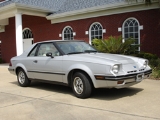
The
FordThe Ford Motor Company is an American multinational corporation based in Dearborn, Michigan, a suburb of Detroit. The automaker was founded by Henry Ford and incorporated on June 16, 1903. In addition to the Ford, Lincoln, and Mercury brands, Ford also owns Volvo Cars of Sweden, and a small stake...
EXP and
MercuryMercury is an automobile marque of the Ford Motor Company founded in 1939 by Edsel Ford, son of Henry Ford, to market entry-level-luxury cars slotted between Ford-branded regular models and Lincoln-branded luxury vehicles, similar to General Motors' Buick brand and Chrysler's namesake brand....
LN7 were the first two-seaters that Ford offered in 25 years. The coupes shared the wheelbase and mechanicals of the
Ford EscortOver the years, the name 'Ford Escort' has been used for several models.For more information, see:* Ford Escort Estate Car* Ford Escort * Ford Escort...
with a longer, more stylish body. It was first shown at the
Chicago Auto ShowThe Chicago Auto Show is held annually in February at Chicago's McCormick Placeconvention complex. At , with over 1,000 vehicles on display, it is the largest auto show in North America and the third largest in the world .The event, first produced in 1901, has been staged more times than any other...
and introduced in April 1981 as an early 1982 model.
Comparing the EXP to the original
ThunderbirdThe Thunderbird , is an automobile manufactured by the Ford Motor Company in the United States over thirteen model generations from 1955 through to 2005...
, Ford Division General Manager Louis E. Latalf said: "We’re introducing another two-seater with the same flair, but the EXP will be a very affordable, very fuel efficient car matched to the lifestyles of the eighties."
Ford's marketing strategy at the time was based on their perception of American lifestyle in the early 1980s. Ford felt that the growing number of one and two person households, combined with the lifestyle of the younger target audience who desired a small sporty car, led them to the conclusion that Americans wanted a "lively little car that is dependable, efficient, and good-looking".
Ford's feeling was that if a customer wanted room for four or five passengers, they would buy an Escort or a
FairmontThe Ford Fairmont was a North American compact car, produced between 1978 and 1983.The 1978 Ford Fairmont was the first vehicle built on the Ford Fox platform, which would be the basis for a variety of other models, including the 1980 to 1988 Thunderbird, the 1981 to 1982 American Ford Granada, the...
. The marketing philosophy for the EXP's seating was rather like that of a European
grand tourerA grand tourer is a high-performance luxury automobile designed for long-distance driving. The most common format is a two-door coupé with either a two-seat or a 2+2 arrangement....
; a personal vehicle for two, with a cargo area in back for emergency transport of anything or anyone else. While it was moderately successful in sales for a two seater, it not only lacked performance but its styling still described as "a sound beating with the ugly stick ... unbelievably awkward, oddly proportioned lines and a curious headlight treatment". Although the EXP still has its fans, it never gained the cult following of cars such as the
Pontiac FieroThe Pontiac Fiero was a mid-engined sports car that was built by the Pontiac division of General Motors from 1984 to 1988. The Fiero — meaning "proud" in Italian and "fierce" or "ferocious" in Spanish — was designed by Hulki Aldikacti as a Pontiac sports car...
or
Toyota MR2The Toyota MR2 is a two-seat, mid-engined, rear wheel drive sports car produced by Toyota from 1984 until July 2007 when production stopped in Japan. Sales in the USA ended in 2005. There are three different generations of the MR2, often referred to as MKI , MKII , and MKIII .Some car historians...
which were built and styled around their own unique platforms. It ultimately would be dropped in favor of the 2+2 Ford Probe.
Name origin
For a long time, some were adamant that the letters stood for “EXPerimental"; others said that Ford marketing executives just thought it was an interesting combination of letters that did not have a meaning. However, according to an article published in
Popular MechanicsPopular Mechanics is an American magazine devoted to science and technology. It was first published January 11, 1902 by H. H. Windsor, and has been owned since 1958 by the Hearst Corporation...
(March 1981), the letters EXP were supposed to stand for
Erika Project Personal car, where project cars are designated X. The "Erika" came from the code-name from the European Escort.
First generation (1982-1985)
There had been a push by automobile manufacturers around the world to make small, fuel efficient cars. This was precipitated by the O.P.E.C. oil embargo of
OctoberOctober is the tenth month of the year in the Gregorian Calendar and one of seven Gregorian months with a length of 31 days. The eighth month in the old Roman calendar, October retained its name after July and August, after Julius and Augustus Caesar respectively; when the calendar was originally...
17, 1973-1974. This embargo included a 70% increase in
oilAn oil is any substance that is liquid at ambient temperatures and is hydrophobic but soluble in organic solvents. Oils have a high carbon and hydrogen content and are nonpolar substances. The general definition above includes compound classes with otherwise unrelated chemical structures,...
prices, causing long lines at gasoline filling stations, and sky-rocketing prices for gasoline. People wanted, demanded more miles for their gasoline dollars. Ultimately this led
DetroitDetroit is the largest city in the U.S. state of Michigan and the seat of Wayne County. Detroit is a major port city on the Detroit River, in the Midwest region of the United States. Located north of Windsor, Ontario, Detroit is the only major U.S. city that looks south to Canada. It was founded...
,
Tokyo, officially , is one of the 47 prefectures of Japan and is located on the eastern side of the main island Honshū. The twenty-three special wards of Tokyo, each governed as a city, cover the area that was once the city of Tokyo in the eastern part of the prefecture, totaling over 8 million people....
and
GermanyGermany , officially the Federal Republic of Germany , is a country in Central Europe. It is bordered to the north by the North Sea, Denmark, and the Baltic Sea; to the east by Poland and the Czech Republic; to the south by Austria and Switzerland; and to the west by France, Luxembourg, Belgium,...
to rethink the adage that “bigger is better”.
The world would respond with smaller cars. Relations with the middle-east did not improve very much during
Jimmy CarterJames Earl "Jimmy" Carter, Jr. served as the 39th President of the United States from 1977 to 1981 and was the recipient of the 2002 Nobel Peace Prize, the only U.S. President to have received the Prize after leaving office...
’s presidency 1977-1981 and a population wanting fuel efficient automobiles continued. Ford studied a two seater commuter car called the Super Gnat. It was to have a three-cylinder engine with a wheelbase of just 78 inches. Ford also produced as a concept the Mustang RSX, which was a slightly smaller two-seat derivative of the Mustang.
Lee Iacocca leadership at Ford had previously introduced one of its most successful cars, the Mustang. The Mustang [1964 ½] originally was no more than a Falcon with a different, more sports-car like body. Similarly, Ford would adapt their newest economy cars, the
Ford EscortOver the years, the name 'Ford Escort' has been used for several models.For more information, see:* Ford Escort Estate Car* Ford Escort * Ford Escort...
and
Mercury LynxThe Mercury Lynx was a compact car produced by the Ford Motor Company for its Mercury division from 1981 to 1987. It was a rebadged version of the Ford Escort. In 1987, the Lynx was dropped after slumping sales . In 1988, Mercury launched the Tracer as the Lynx's replacement...
by putting a sporty body on top and removing the rear seats to produce the EXP and LN7.
The EXP's rakish non-boxy body rode on the Escort's 94.2 inch (2393 mm) wheelbase, with that car's front-wheel drive running gear, four-wheel
independent suspensionIndependent suspension is a broad term for any automobile suspension system that allows each wheel on the same axle to move vertically independently of each other. This is contrasted with a beam axle, live axle or deDion axle system in which the wheels are linked - movement on one side affects...
, and dashboard. The EXP was longer, lower, and sportier than the Escort.
Performance wasn't the car's strong suit however, since the EXP weighed about 200 pounds more than Escort but carried the same small 1.6 L
CVHThe letters CVH denote a particular type of 4-cylinder internal combustion engine produced by the Ford Motor Company during the 1980s and 1990s....
I4The inline-four engine or straight-four engine is a four-cylinder internal combustion engine with all four cylinders mounted in a straight line, or plane along the crankcase. The single bank of cylinders may be oriented in either a vertical or an inclined plane with all the pistons driving a...
engine rated at 70 hp (52 kW) and a standard 4-speed IB4 manual transaxle. Nevertheless, the March 1981 issue of
Car and DriverCar and Driver is an American automotive enthusiast magazine. Its total circulation is 1.31 million. It is owned by Hachette Filipacchi Magazines. Originally headquartered in New York City, the magazine has been based in Ann Arbor, Michigan since the late 1970s.-History:Car and Driver was founded...
reported that their EXP with a
manual transmissionA manual transmission, or manual gearbox is a type of transmission used in motor vehicle applications...
reached 44 MPG on the highway, a figure comparable to modern hybrid cars.
Both the Ford EXP and the Mercury LN7 had a sharply-sloped windshield, wheel arches with prominent lips, and wide body side moldings not far below the top of the wheel well. The biggest difference was the rear fascia.
The EXP was a
notchbackNotchback is a form of car body style; in different parts of the world the precise definition varies. The term is common in the United States where it refers to the typical "three-box" design of sedans.- Design :...
with a lift-up hatch, while the LN7 used a big “bubbleback” back window. The EXP's minimalist grille consisted merely of twin horizontal slats on the sloped front panel (the LN7 had ten).
Priced considerably higher than the Escort, the EXP carried an ample list of standard equipment. It included power brakes, tachometer, engine gauges, full carpeting, electric back window defroster, power hatchback release, a digital clock, and a cargo area security shade. Models with a manual transmission had a sport-tuned exhaust. Automatic models had a wide-open throttle cutout switch for the optional air conditioning compressor clutch.
As the full 1982 model year began, Ford offered an optional (at no extra cost) 4.05:1 final drive for better performance. Later came a close-ratio transmission with 3.59:1 final drive ratio intended for the same purpose.
Finally, in March 1982, an 80 hp (59
kWThe watt is a derived unit of power in the International System of Units . It measures rate of energy conversion. One watt is equivalent to 1 joule of energy per second....
) version of the CVH engine became available. It had higher (9.0:1) compression, a larger air cleaner intake, lower-restriction exhaust, a dual-outlet exhaust manifold, larger carburetor venturis, and a higher-lift camshaft.
The two-seater LN7 never had found enough customers and dropped out after 1983 due to sluggish sales. Many of the LN7's distinct styling characteristics, such as the "bubbleback" window, were later adopted to the EXP's design.
EXP Turbo Coupe
By 1984, Ford was trying hard to conquer the youth market, especially the affluent young motorist with offerings such as the Mustang SVO, Thunderbird Turbo Coupe, and the new EXP Turbo Coupe.
The turbocharged 1.6 L
CVHThe letters CVH denote a particular type of 4-cylinder internal combustion engine produced by the Ford Motor Company during the 1980s and 1990s....
engine, available for the Escort and EXP, featured a high-lift camshaft and EEC-IV electronic controls. It delivered boost up to 8 psi, raising power to 120 hp (89 kW), a gain of some 35 percent over the naturally-aspirated models.
The Turbo Coupe had a unique front air dam and rear decklid spoiler, with a taped "Turbo" badge on the rear bumper. It also had two-tone paint with a black lower section, a unique C-pillar appliqué featuring the EXP lettering, black wheel flares, and black rocker panel moldings.
Return of the EXP
By the mid 1980s, two-seaters were all the rage. Cars such as the
Pontiac FieroThe Pontiac Fiero was a mid-engined sports car that was built by the Pontiac division of General Motors from 1984 to 1988. The Fiero — meaning "proud" in Italian and "fierce" or "ferocious" in Spanish — was designed by Hulki Aldikacti as a Pontiac sports car...
and
Toyota MR2The Toyota MR2 is a two-seat, mid-engined, rear wheel drive sports car produced by Toyota from 1984 until July 2007 when production stopped in Japan. Sales in the USA ended in 2005. There are three different generations of the MR2, often referred to as MKI , MKII , and MKIII .Some car historians...
(both mid-engined, rear-wheel drive sports cars) were so popular that even
CadillacCadillac is a luxury vehicle marque owned by General Motors Company. Cadillac vehicles are sold in over 50 countries and territories, but mainly in North America....
was considering producing one. Yet despite their popularity, Ford EXP sales were sluggish. Its styling was stale, and for a sports car, its performance was generally regarded as less than adequate.
The employees, with a bit of assistance from the plant manager, went down to the body shop and pirated parts from the other models and put together what they thought was a much better-looking EXP.
The result was the 1985½ Escort EXP, and after a brief absence from the lineup after the end of the 1985 model year, the EXP returned with a new look and a re-badged nameplate. During its first three months it posted steadily increasing sales, but even the new styling and upgraded power plant wasn’t enough to save EXP.
Second generation (1985½-1988½)
A reworked Escort had appeared as a mid-year 1986 model, but the restyled EXP wouldn't arrive until later in the 1986 model year. After a brief absence from the lineup, the EXP returned in resulted form with a sleek new front-end design, including an air dam and flush-mounted headlamps. Also new was a bubbleback styled rear hatch with integral spoiler. Otherwise, the new four-window couple design looked similar to the original EXP at the rear, but markedly different up front.
Gone were the distinctive "frog-eye" headlights, replaced by flush-mounted headlamps with wraparound marker lenses and parking lamps mounted below in the bumper region alongside a wide center slot. Ford's blue script oval stood prominently above a single-slot grille. Large ‘EXP’ recessed lettering was easy to spot on the wide C-pillar. Wraparound full-width taillamps (split by the license plate's recessed housing) were divided into upper/lower segments and tapered downward to a point on each quarter panel.
Luxury Coupe
The Luxury Coupe had a
throttle-body injectedFuel injection is a system for mixing fuel with air in an internal combustion engine. It has become the primary fuel delivery system used in gasoline automotive engines, having almost completely replaced carburetors in the late 1980s....
version of the 1.9 L engine rated at 90 hp (67 kW), along with a tachometer and trip odometer, reclining low-back bucket seats trimmed in cloth/vinyl (or all vinyl), AM/FM stereo radio, overhead console, and left remote mirror.
Sport Coupe
A fuel-injected high-output version of the 1.9 L
CVHThe letters CVH denote a particular type of 4-cylinder internal combustion engine produced by the Ford Motor Company during the 1980s and 1990s....
engine rated at 106 hp (79 kW) went into the Sport Coupe, which also had special handling components, performance bucket seats, center console with graphic systems monitor, fog lamps dual electric mirrors, and low-profile 15 inch handling tires on cast aluminum wheels. The 1987 model year saw the Sport Coupe's power rating increased to 115 hp (85 kW).
Discontinuation
From the beginning, sales of the EXP were never as strong as the marketing executives had hoped they would be. This can be partially attributed to the fact that it never delivered the performance that a car in the two-seat market segment required. An additional and totally unrelated situation faced by Ford may have also hastened the demise of the EXP.
In 1982 as gas prices soared, Ford began work on what was to be the new fourth generation Mustang. The goal was to replace the rear-wheel drive muscle car design with a sleek, fuel-efficient, front-wheel drive “design of tomorrow”. It was also an attempt to counter General Motors' GM80 plan, which was to offer a front-wheel drive
Chevrolet CamaroThe Chevrolet Camaro is an automobile manufactured by the Chevrolet division of General Motors, classified as a pony car. The "F" Body owes its creation to John Delorean who wanted to build a "sport car" called "Banshee" it was much like the Chevy "vette" but for Pontiac Motor Division, after a...
and
Pontiac FirebirdThe Pontiac Firebird was built by the Pontiac division of General Motors between 1967 and 2002. The Firebird was introduced the same year as its platform-sharing cousin, the Chevrolet Camaro...
by 1990.
When Mustang loyalists got wind that Ford was ditching their beloved pony car in favor of a Japanese-derived front-wheel drive car, criticism quickly mounted against it. The current Mustang's sales began to rise and the future of the rear-wheel drive Mustang was no longer questioned. With easing gas prices and under the strain of a massive letter writing campaign from Mustang enthusiasts, Ford reconsidered the decision.
By this time, Ford had invested a significant amount of time and money in the new design and they were unwilling to simply cut their losses and scrap it. With the upcoming dealer debut already planned for August 1987, Ford turned to its inventory of already owned names. They picked one they had been using on a series of radically designed, aerodynamically advanced concept cars, from which the car’s design was originally premiered. The new car was renamed the
Ford ProbeThe Ford Probe was a coupe produced by Ford, introduced in 1989 to replace the Ford EXP as the company's sport compact car. The Probe was fully based on the Mazda G-platform using unique sheetmetal and interior. The instrument cluster and pop-up headlight mechanisms are borrowed from the FC RX-7...
.
But this left Ford with a difficult problem, as they did not have the market for three sport coupes. The logical choice was to drop the one that had the poorest sales figures. By October 1988, and after more than 225,000 EXPs and LN7s had been produced, the last of the EXPs was rolled off of the assembly line and into obscurity.