

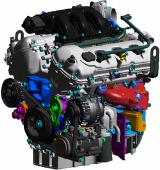
Ford Cyclone engine

Encyclopedia
The Cyclone engine is Ford Motor Company
's latest DOHC V6 family of gasoline engines. It will gradually replace the Mondeo
family of V6 engines over the next several years. The first version, a 3.5 L Duratec V6, appeared in September 2006 in the Lincoln MKZ
. Mazda
badges its versions of the Cyclone MZI as it did with its versions of the Mondeo V6.
Notable Cyclone features include a capacity for displacements ranging up to 4.0 L, DOHC 4-valve per cylinder heads, direct acting mechanical bucket (DAMB) camshaft tappets, variable cam timing
(iVCT) on the intake camshafts, and twin-independent variable cam timing (Ti-VCT) on some later versions. Features such as Gasoline direct injection
and turbocharging were considerations in the design phase and have been added to the engine as part of EcoBoost. The Duratec 35 is ULEV-II
compliant and is capable of meeting the PZEV requirement.
) in the 2008 model year. Production began in 2006 for the Ford Edge
, Lincoln MKX
, and Lincoln MKZ
. Ford expects the engine to be available in 20% of its vehicles by the end of the decade.
Official SAE certified engine output is 265 hp and 250 lbft on 87 octane gas. This is a substantial upgrade in power from the Duratec 30 and bested all comparable 87 octane rated V6 engines at the time of its launch. For 2011, the 3.5 L received Ti-VCT, helping to boost output to 285 hp and 253 lbft.
The engine is assembled at Lima Engine
in Lima, Ohio
, with expansion planned in Cleveland Engine Plant #1.
The Duratec 35 was on the Ward's 10 Best Engines
list for 2007.
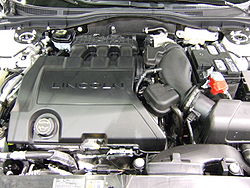
A Hiroshima
, Japan
assembled Mazda MZI 3.7 was installed in the 2008 Mazda CX-9
and was the first 3.7 L Cyclone V6 to see production. The first Duratec 37 saw production in the 2009 Lincoln MKS
.
A few days before the 2009 Los Angeles International Auto Show
, Ford unveiled a new version of the Duratec 37 for the 2011 Mustang, making it the first Duratec-badged V6 since the Lincoln LS
to be used in a production rear-wheel drive car. This version of the 3.7 L features Twin Independent Variable Cam Timing
(Ti-VCT); delivers 31 miles per US gallon highway mileage in the Mustang, and was the first production engine to deliver in excess of 300 hp and 30 MPG.
, gasoline direct injected (GTDI)
version of the Duratec 35.
Ford Motor Company
Ford Motor Company is an American multinational automaker based in Dearborn, Michigan, a suburb of Detroit. The automaker was founded by Henry Ford and incorporated on June 16, 1903. In addition to the Ford and Lincoln brands, Ford also owns a small stake in Mazda in Japan and Aston Martin in the UK...
's latest DOHC V6 family of gasoline engines. It will gradually replace the Mondeo
Ford Mondeo V6 engine
Ford Motor Company's modern 2.5 L and 3.0 L V6 automobile engines are evolutions of the same design, first used in the 1994 Ford Mondeo. This line is sold under the brand name "Duratec", as are many other engines....
family of V6 engines over the next several years. The first version, a 3.5 L Duratec V6, appeared in September 2006 in the Lincoln MKZ
Lincoln MKZ
The Lincoln MKZ, initially named the Lincoln Zephyr, is a mid-size, entry-level luxury car from the Lincoln division of the Ford Motor Company. Lincoln revived the Zephyr name in the fall of 2005 as a platform-mate for the Ford Fusion and Mercury Milan; the vehicles were based on the CD3 platform,...
. Mazda
Mazda
is a Japanese automotive manufacturer based in Fuchū, Aki District, Hiroshima Prefecture, Japan.In 2007, Mazda produced almost 1.3 million vehicles for global sales...
badges its versions of the Cyclone MZI as it did with its versions of the Mondeo V6.
Notable Cyclone features include a capacity for displacements ranging up to 4.0 L, DOHC 4-valve per cylinder heads, direct acting mechanical bucket (DAMB) camshaft tappets, variable cam timing
Variable valve timing
In internal combustion engines, variable valve timing , also known as Variable valve actuation , is a generalized term used to describe any mechanism or method that can alter the shape or timing of a valve lift event within an internal combustion engine...
(iVCT) on the intake camshafts, and twin-independent variable cam timing (Ti-VCT) on some later versions. Features such as Gasoline direct injection
Gasoline direct injection
In internal combustion engines, gasoline direct injection , also known as petrol direct injection or direct petrol injection, is a variant of fuel injection employed in modern two-stroke and four-stroke gasoline engines...
and turbocharging were considerations in the design phase and have been added to the engine as part of EcoBoost. The Duratec 35 is ULEV-II
Ultra Low Emission Vehicle
An ultra-low-emission vehicle is a motor vehicle that emits extremely low levels of motor vehicle emissions compared to other vehicles...
compliant and is capable of meeting the PZEV requirement.
Duratec 35
The Duratec 35 displaces 3.5 L (3496 cc, 213 CID) with a 92.5 mm (3.64 in) bore and 86.7 mm (3.41 in) stroke. Due to packaging differences (primarily the relocation of the water pump to the valley), the 3.5 L engine will fit into any engine bay the smaller Mondeo 3.0 L will, and replaced it in some applications (notably the Ford TaurusFord Taurus
The Ford Taurus is an automobile manufactured by the Ford Motor Company in the United States. Originally introduced in the 1986 model year, it has remained in near-continuous production for more than two decades, making it the fourth oldest nameplate that is currently sold in the North American...
) in the 2008 model year. Production began in 2006 for the Ford Edge
Ford Edge
The Ford Edge is a mid-size crossover SUV manufactured by Ford, based on the Ford CD3 platform shared with previous generation Mazda6 and marketed in rebadged form as the Lincoln MKX...
, Lincoln MKX
Lincoln MKX
The Lincoln MKX is a mid-size luxury crossover from Ford's Lincoln division and a de facto successor to the Lincoln Aviator luxury SUV. It debuted as a 2007 model in December 2006 as a production version of the Lincoln Aviator Concept shown at the 2004 North American International Auto Show...
, and Lincoln MKZ
Lincoln MKZ
The Lincoln MKZ, initially named the Lincoln Zephyr, is a mid-size, entry-level luxury car from the Lincoln division of the Ford Motor Company. Lincoln revived the Zephyr name in the fall of 2005 as a platform-mate for the Ford Fusion and Mercury Milan; the vehicles were based on the CD3 platform,...
. Ford expects the engine to be available in 20% of its vehicles by the end of the decade.
Official SAE certified engine output is 265 hp and 250 lbft on 87 octane gas. This is a substantial upgrade in power from the Duratec 30 and bested all comparable 87 octane rated V6 engines at the time of its launch. For 2011, the 3.5 L received Ti-VCT, helping to boost output to 285 hp and 253 lbft.
The engine is assembled at Lima Engine
Lima Engine
Lima Engine is a Ford Motor Company automobile engine plant located in Lima, Ohio. The factory was opened in 1957 as the site of production of Ford's MEL V8 for the Edsel car...
in Lima, Ohio
Lima, Ohio
Lima is a city in and the county seat of Allen County, Ohio, United States. The municipality is located in northwestern Ohio along Interstate 75 approximately north of Dayton and south-southwest of Toledo....
, with expansion planned in Cleveland Engine Plant #1.
The Duratec 35 was on the Ward's 10 Best Engines
Ward's 10 Best Engines
Ward's 10 Best Engines is an annual list of the ten "best" automobile engines available in the U.S. market, that are selected by Ward's AutoWorld magazine. The list was started in 1994, and has been drawn every year since then....
list for 2007.
Applications
at 6250 rpm and 250 lbft at 4500 rpm-
- 2007–2010 Ford EdgeFord EdgeThe Ford Edge is a mid-size crossover SUV manufactured by Ford, based on the Ford CD3 platform shared with previous generation Mazda6 and marketed in rebadged form as the Lincoln MKX...
- 2007–2010 Lincoln MKXLincoln MKXThe Lincoln MKX is a mid-size luxury crossover from Ford's Lincoln division and a de facto successor to the Lincoln Aviator luxury SUV. It debuted as a 2007 model in December 2006 as a production version of the Lincoln Aviator Concept shown at the 2004 North American International Auto Show...
at 6250 rpm and 249 lbft at 4500 rpm - 2007–present Lincoln MKZLincoln MKZThe Lincoln MKZ, initially named the Lincoln Zephyr, is a mid-size, entry-level luxury car from the Lincoln division of the Ford Motor Company. Lincoln revived the Zephyr name in the fall of 2005 as a platform-mate for the Ford Fusion and Mercury Milan; the vehicles were based on the CD3 platform,...
- 2007 Mazda CX-9Mazda CX-9The Mazda CX-9 is a full-size crossover SUV manufactured by Mazda at their Ujina 1 plant in Hiroshima Prefecture, Japan.The CX-9 is built on the Ford CD3 Platform shared with the Ford Edge, and it uses the same 3.7L V6 engine used in the Ford lineup. Although outwardly similar, the CX-9 and Mazda...
(MZI) - 2008–present Ford TaurusFord TaurusThe Ford Taurus is an automobile manufactured by the Ford Motor Company in the United States. Originally introduced in the 1986 model year, it has remained in near-continuous production for more than two decades, making it the fourth oldest nameplate that is currently sold in the North American...
- 2008–2009 Ford Taurus XFord Taurus XThe Ford Taurus X was a 6- or 7-passenger full-size crossover SUV that was produced by Ford Motor Company in the United States. It was originally introduced in 2005 as the Ford Freestyle, before being renamed Taurus X for the 2008 model year. In Ford's lineup, it replaced the Ford Taurus station...
- 2008–2009 Mercury SableMercury SableThe Sable was a very important sedan for both Mercury and the American auto industry.Ford had lagged in introducing mid-size front wheel drive cars to compete against General Motors' Chevrolet Citation and its best-selling Chevrolet Celebrity/Pontiac 6000/Oldsmobile Cutlass/Buick Century quartet as...
- 2010 Ford Fusion Sport at 6250 rpm and 248 lbft at 4500 rpm
- 2009–present Ford FlexFord FlexThe Ford Flex is a full-size crossover manufactured by Ford Motor Company. Its styling is based on the Ford Fairlane concept unveiled at the 2005 North American International Auto Show. The production vehicle made its debut at the 2007 New York International Auto Show. Sales of the Flex began in...
- 2007–2010 Ford Edge
- Ti-VCT 285 hp at 6500 rpm and 253 lbft at 4000 rpm
- 2011 Ford EdgeFord EdgeThe Ford Edge is a mid-size crossover SUV manufactured by Ford, based on the Ford CD3 platform shared with previous generation Mazda6 and marketed in rebadged form as the Lincoln MKX...
- 2011 Ford Edge
- Ti-VCT 290 hp and 255 lbft
- 2011 Ford ExplorerFord ExplorerThe Ford Explorer is a sport-utility vehicle sold in North America and built by the Ford Motor Company since 1990, as a replacement for the smaller but related Ford Bronco II. It is manufactured in Chicago, Illinois...
- 2011 Ford Explorer
Duratec 37
The Duratec 37 is a 3.7 L (3721 cc/227 CID) version of the Cyclone V6 intended to power heavier or premium vehicles. The Duratec 37's additional displacement comes from an increase in bore diameter to 95.5 mm (3.76 in), stroke remains identical to the Duratec 35s at 86.7 mm (3.41 in).A Hiroshima
Hiroshima
is the capital of Hiroshima Prefecture, and the largest city in the Chūgoku region of western Honshu, the largest island of Japan. It became best known as the first city in history to be destroyed by a nuclear weapon when the United States Army Air Forces dropped an atomic bomb on it at 8:15 A.M...
, Japan
Japan
Japan is an island nation in East Asia. Located in the Pacific Ocean, it lies to the east of the Sea of Japan, China, North Korea, South Korea and Russia, stretching from the Sea of Okhotsk in the north to the East China Sea and Taiwan in the south...
assembled Mazda MZI 3.7 was installed in the 2008 Mazda CX-9
Mazda CX-9
The Mazda CX-9 is a full-size crossover SUV manufactured by Mazda at their Ujina 1 plant in Hiroshima Prefecture, Japan.The CX-9 is built on the Ford CD3 Platform shared with the Ford Edge, and it uses the same 3.7L V6 engine used in the Ford lineup. Although outwardly similar, the CX-9 and Mazda...
and was the first 3.7 L Cyclone V6 to see production. The first Duratec 37 saw production in the 2009 Lincoln MKS
Lincoln MKS
The Lincoln MKS is a full-size luxury sedan from the Lincoln division of the Ford Motor Company. The MKS first appeared in concept form at the North American International Auto Show in January 2006 with the production version, a 2009 model, appearing later at the Los Angeles International Auto...
.
A few days before the 2009 Los Angeles International Auto Show
LA Auto Show
The LA Auto Show is an annual auto show held at the Los Angeles Convention Center in late November/early December. The LA Auto Show is an OICA sanctioned international exhibition and also endorsed by the Greater Los Angeles New Car Dealers Association...
, Ford unveiled a new version of the Duratec 37 for the 2011 Mustang, making it the first Duratec-badged V6 since the Lincoln LS
Lincoln LS
The Lincoln LS is a mid-size, rear wheel drive sedan from Lincoln. For its production run from 1999 until 2006, it was based on the Ford DEW98 platform, which was shared with the Jaguar S-Type and Ford Thunderbird...
to be used in a production rear-wheel drive car. This version of the 3.7 L features Twin Independent Variable Cam Timing
Variable Cam Timing
Variable Camshaft Timing is an automobile variable valve timing technology developed by Ford. It uses electronically controlled hydraulic valves that direct high pressure engine oil into the camshaft phaser cavity. These oil control solenoids are bolted into the cylinder heads towards the front of...
(Ti-VCT); delivers 31 miles per US gallon highway mileage in the Mustang, and was the first production engine to deliver in excess of 300 hp and 30 MPG.
Applications
at 6250 rpm and 270 lbft at 4250 rpm-
- 2008–present Mazda CX-9Mazda CX-9The Mazda CX-9 is a full-size crossover SUV manufactured by Mazda at their Ujina 1 plant in Hiroshima Prefecture, Japan.The CX-9 is built on the Ford CD3 Platform shared with the Ford Edge, and it uses the same 3.7L V6 engine used in the Ford lineup. Although outwardly similar, the CX-9 and Mazda...
(MZI) at 6250 rpm and 269 lbft at 4250 rpm - 2009–present Mazda 6 (MZI) at 6250 rpm and 276 lbft at 4250 rpm
- 2009 Lincoln MKSLincoln MKSThe Lincoln MKS is a full-size luxury sedan from the Lincoln division of the Ford Motor Company. The MKS first appeared in concept form at the North American International Auto Show in January 2006 with the production version, a 2009 model, appearing later at the Los Angeles International Auto...
at 6250 rpm and 267 lbft at 4250 rpm - 2010 Lincoln MKTLincoln MKTThe Lincoln MKT is a full-size luxury crossover utility vehicle, first unveiled as a concept vehicle at the 2008 North American International Auto Show. It entered production at the Oakville Assembly plant in July 2009 as a 2010 model. It shares the same crossover D4 platform as the Ford Flex and...
- 2008–present Mazda CX-9
- Ti-VCT 302 hp at 6500 rpm and 278 lbft at 4000 rpm
- 2011 Ford F-150
- Ti-VCT 305 hp at 6500 rpm and 280 lbft at 4250 rpm
- 2011 Ford MustangFord MustangThe Ford Mustang is an automobile manufactured by the Ford Motor Company. It was initially based on the second generation North American Ford Falcon, a compact car. Introduced early on April 17, 1964, as a "1964½" model, the 1965 Mustang was the automaker's most successful launch since the Model A...
- 2011 Lincoln MKXLincoln MKXThe Lincoln MKX is a mid-size luxury crossover from Ford's Lincoln division and a de facto successor to the Lincoln Aviator luxury SUV. It debuted as a 2007 model in December 2006 as a production version of the Lincoln Aviator Concept shown at the 2004 North American International Auto Show...
- 2011 Ford EdgeFord EdgeThe Ford Edge is a mid-size crossover SUV manufactured by Ford, based on the Ford CD3 platform shared with previous generation Mazda6 and marketed in rebadged form as the Lincoln MKX...
Sport
- 2011 Ford Mustang
EcoBoost
It is a twin turbochargedTurbocharger
A turbocharger, or turbo , from the Greek "τύρβη" is a centrifugal compressor powered by a turbine that is driven by an engine's exhaust gases. Its benefit lies with the compressor increasing the mass of air entering the engine , thereby resulting in greater performance...
, gasoline direct injected (GTDI)
Gasoline direct injection
In internal combustion engines, gasoline direct injection , also known as petrol direct injection or direct petrol injection, is a variant of fuel injection employed in modern two-stroke and four-stroke gasoline engines...
version of the Duratec 35.