
Food energy
Food energy is the amount of
energy in food that is available through
digestion. The values for food energy are expressed in kilocalories and kilojoules .
One large calorie or food
calorie is the amount of energy to raise the temperature of one kilogram of water one degree Celsius. Some advocate the convention of the capitalizing the
C in these so that one Calorie is equal to 1000 lowercase calories, but that is not a convention generally followed, and it is useless when the word starts a sentence. The large calorie is sometimes abbeviated kcal, to indicate that is 1000 times as large as the calorie.
Encyclopedia
Food energy is the amount of
energy in food that is available through
digestion. The values for food energy are expressed in kilocalories and kilojoules .
One large calorie or food
calorie is the amount of energy to raise the temperature of one kilogram of water one degree Celsius. Some advocate the convention of the capitalizing the
C in these so that one Calorie is equal to 1000 lowercase calories, but that is not a convention generally followed, and it is useless when the word starts a sentence. The large calorie is sometimes abbeviated kcal, to indicate that is 1000 times as large as the calorie. Consequently, the prefix kilo- is not used with the large calories outside that use in the symbol. Food calories might be called kilocalories on the basis of the small calorie usage, but the term
kilocalorie is never used 1,000 large calories.
The International System of Units unit kilojoule is becoming more common. In some countries only the kilojoule is normally used. Some types of food contain more food energy than others:
fats and
sugars have particularly high values for food energy. One
Calorie is approximately equal to 4.1868 kilojoules.
Measuring food energy
In the early twentieth century, the United States Department of Agriculture developed a procedure for measuring food energy that remains in use today.
The food being measured is completely burned in a
calorimeter so that the
heat released through combustion can be accurately measured. This amount is used to determine the
gross energy value of the particular food. This number is then multiplied by a coefficient which is based on how the human body actually digests the food.
For example, pure sugar releases about 3.95 kilocalories per gram of
gross energy but the digestibility coefficient of sugar is about 98% in humans, so the
food energy of sugar is 0.98 × 3.95 = 3.87 kilocalories per gram of sugar. Note, the digestibility coefficient is likely to vary between individuals based on genetic predisposition, and possibly may be affected by state of physical fitness of the individuals measured, but the mean digestibility for most people is around 98%.
Nutrition and food labels
The "Calorie" has become a common household term, because dietitians recommend in cases of
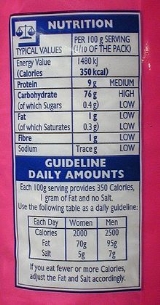
obesity to reduce body weight by increasing exercise and reducing energy intake. Many governments require food manufacturers to label the energy content of their products, to help consumers control their energy intake. In
Europe, manufacturers of prepackaged food must label the nutritional energy of their products in both kilocalories and kilojoules . In the
United States, the equivalent mandatory labels display only "Calories" ; an additional kilojoules figure is optional. The energy content of food is usually given on labels for 100 g and for a typical serving size.
The amount of food energy in a particular food could be measured by completely burning the dried food in a
bomb calorimeter, a method known as direct calorimetry . However, the values given on food labels are not determined this way, because it overestimates the amount of energy that the human digestive system can extract, by also burning dietary fiber. Instead, standardized chemical tests and an analysis of the recipe are used to estimate the product's digestable constitutents . These results are then converted into an equivalent energy value based on a standardized table of energy densities:
Other substances found in food do not contribute to this calculated energy density.
Recommended daily energy intake values for young adults are: 2500 kcal/
d for men and 2000 kcal/d for women. Children, sedentary and older people require less energy, physically active people more.
See also
References