

Flying frog

Encyclopedia
Frog
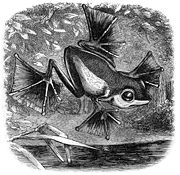
Frogs are amphibians in the order Anura , formerly referred to as Salientia . Most frogs are characterized by a short body, webbed digits , protruding eyes and the absence of a tail...
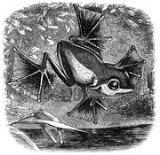
that has the ability to glide. That is, it can descend at an angle of less than 45° relative to the horizontal. Arboreal frogs (non-flying frogs) can also descend vertically, but only at angles greater than 45°, which is referred to as parachuting. Flying frogs have evolved independently among 3,400 species of frogs from both New World
New World
The New World is one of the names used for the Western Hemisphere, specifically America and sometimes Oceania . The term originated in the late 15th century, when America had been recently discovered by European explorers, expanding the geographical horizon of the people of the European middle...
(Hyla
Hyla
The genus Hyla is one of approximately 38 genera in the New World family of tree frogs . The word Hyla translates to "tree," and tree frogs are indeed arboreal...
) and Old World
Old World
The Old World consists of those parts of the world known to classical antiquity and the European Middle Ages. It is used in the context of, and contrast with, the "New World" ....
(Rhacophoridae
Rhacophoridae
Rhacophoridae is a family of frog species, which occur in tropical regions of Asia and Africa. They are commonly known as shrub frogs, or more ambiguously as "moss frogs" or "bush frogs". Some Rhacophoridae are called "tree frogs"...
) families and their evolution is seen as an adaptation to their life in trees, high above the ground. Characteristics of the Old World
Old World
The Old World consists of those parts of the world known to classical antiquity and the European Middle Ages. It is used in the context of, and contrast with, the "New World" ....
species include "enlarged hands and feet, full webbing between all fingers and toes, lateral skin flaps on the arms and legs, and reduced weight per snout-vent length". These morphological changes contribute to the flying frog's aerodynamic abilities. Alfred Russel Wallace
Alfred Russel Wallace
Alfred Russel Wallace, OM, FRS was a British naturalist, explorer, geographer, anthropologist and biologist...
made one of the earliest reports of the flying frog, from observations in the Indo-Malayan region. The species he observed was later termed Wallace's Flying Frog (Rhacophorus nigropalmatus
Rhacophorus nigropalmatus
The Abah River Flying Frog , commonly known as Wallace's Flying Frog, is a moss frog found at least from to Malay Peninsula into western Indonesia. It is named for the biologist, Alfred R. Wallace, who collected the first specimen to be formally identified.R. dennysii, R...
).
They have suction pads on their webbed feet which helps their balance in the high trees that they live in.
Habitat
The environment and temperatures of these areas that they live in are not extreme. They have to have slow moving temperatures or they will not be able to survive. There is normally a very moist rain forest or tropical land. They survive by being the same color as their surroundings. They spend most of their time hanging on trees and eating at night.Species
There are many different species of flying frogs; here is a small portion of the very interesting types of these amazing animals:Annam flying frog, Rhacophorus Annamensis, inhabit in the annamese jungles in Southeast Asia.Chinese Gliding Tree Frog, Polypedates Dennysi, inhabit in China.
Javan Gliding Frog, Rhacophorus Reinwardtii, inhabits Indonesia, parts of China, Malaysia, Vietnam, and Laos.Wallace frog, Racophorus nigropalmatus, inhabits the jungles of Malay Peninsula, and Indonesia. They spend their life entirely in trees only coming down to mate and lay their eggs in small ponds or waterways.
Diet
Flying frogs are carnivorous; their diet consists of insects that inhabit the jungle. These jungles include: the jungles of Malaysia, Borneo and many others.Descriptions of Flying Frogs
Wallaces' Flying Frog (Rhacophorus nigropalmatusRhacophorus nigropalmatus
The Abah River Flying Frog , commonly known as Wallace's Flying Frog, is a moss frog found at least from to Malay Peninsula into western Indonesia. It is named for the biologist, Alfred R. Wallace, who collected the first specimen to be formally identified.R. dennysii, R...
)
This frog usually grows to be about 4 inches or about 10 centimeters. Wallaces flying frog can be distinguished from other frogs because they have black marks between the webbing in their feet. These frogs are usually a bright green color with yellow sides.
Chinese gliding tree frog (Polypedates dennysi)
This males of this species can grow to be 3.5 inches (8.9 cm), the females can grow to be 4 inches (10.2 cm). They have large black eyes. This frog is also a bright green color. On their sides they have black and white markings on their sides, but on frogs younger than one year these are just white lines.
Annam flying frog (Rhacophorus annamensis
Rhacophorus annamensis
Rhacophorus annamensis is a species of frog in the Rhacophoridae family.It is found in Cambodia and Vietnam.Its natural habitats are subtropical or tropical moist lowland forests, subtropical or tropical moist montanes, and rivers....
)
Like in the Chinese flying frog the females of this species are a little bigger around 4 inches (10.2 cm). This frog is usually a light gray color but you can also find them to be brown or a dark red color, and in some cases bright yellow.
Javan gliding frog or (Rhacophorus reinwardtii)
Also like the other two frogs the females grow to be a bit larger but they only grow to be 3.5 inches (8.9 cm). They can be either light green or dark green colors and they have black spots around the back and the head. Males can have more colors on the sides of the abdomen like orange,green,purple,black and yellow. Their eyes can be light green,light yellow or light grey. They have horizontal pupils.