

Flora of Australia

Encyclopedia
Australia
Australia , officially the Commonwealth of Australia, is a country in the Southern Hemisphere comprising the mainland of the Australian continent, the island of Tasmania, and numerous smaller islands in the Indian and Pacific Oceans. It is the world's sixth-largest country by total area...
comprises a vast assemblage of plant species estimated to over 20,000 vascular
Vascular plant
Vascular plants are those plants that have lignified tissues for conducting water, minerals, and photosynthetic products through the plant. Vascular plants include the clubmosses, Equisetum, ferns, gymnosperms and angiosperms...
and 14,000 non-vascular plant
Non-vascular plant
Non-vascular plants is a general term for those plants without a vascular system . Although non-vascular plants lack these particular tissues, a number of non-vascular plants possess tissues specialized for internal transport of water....
s, 250,000 species of fungi and over 3,000 lichen
Lichen
Lichens are composite organisms consisting of a symbiotic organism composed of a fungus with a photosynthetic partner , usually either a green alga or cyanobacterium...
s. The flora has strong affinities with the flora of Gondwana
Gondwana
In paleogeography, Gondwana , originally Gondwanaland, was the southernmost of two supercontinents that later became parts of the Pangaea supercontinent. It existed from approximately 510 to 180 million years ago . Gondwana is believed to have sutured between ca. 570 and 510 Mya,...
, and below the family
Family (biology)
In biological classification, family is* a taxonomic rank. Other well-known ranks are life, domain, kingdom, phylum, class, order, genus, and species, with family fitting between order and genus. As for the other well-known ranks, there is the option of an immediately lower rank, indicated by the...
level has a highly endemic
Endemic (ecology)
Endemism is the ecological state of being unique to a defined geographic location, such as an island, nation or other defined zone, or habitat type; organisms that are indigenous to a place are not endemic to it if they are also found elsewhere. For example, all species of lemur are endemic to the...
angiosperm flora whose diversity was shaped by the effects of continental drift
Continental drift
Continental drift is the movement of the Earth's continents relative to each other. The hypothesis that continents 'drift' was first put forward by Abraham Ortelius in 1596 and was fully developed by Alfred Wegener in 1912...
and climate change since the Cretaceous
Cretaceous
The Cretaceous , derived from the Latin "creta" , usually abbreviated K for its German translation Kreide , is a geologic period and system from circa to million years ago. In the geologic timescale, the Cretaceous follows the Jurassic period and is followed by the Paleogene period of the...
. Prominent features of the Australian flora are adaptations to aridity and fire which include scleromorphy
Sclerophyll
Sclerophyll is the term for a type of vegetation that has hard leaves and short internodes . The word comes from the Greek sclero and phyllon ....
and serotiny
Serotiny
Serotiny is an ecological adaptation exhibited by some seed plants, in which seed release occurs in response to an environmental trigger, rather than spontaneously at seed maturation. The most common and best studied trigger is fire, and the term serotiny is often used to refer to this specific case...
. These adaptations are common in species from the large and well-known families Proteaceae
Proteaceae
Proteaceae is a family of flowering plants distributed in the Southern Hemisphere. The family comprises about 80 genera with about 1600 species. Together with the Platanaceae and Nelumbonaceae they make up the order Proteales. Well known genera include Protea, Banksia, Embothrium, Grevillea,...
(Banksia
Banksia
Banksia is a genus of around 170 species in the plant family Proteaceae. These Australian wildflowers and popular garden plants are easily recognised by their characteristic flower spikes and fruiting "cones" and heads. When it comes to size, banksias range from prostrate woody shrubs to trees up...
), Myrtaceae
Myrtaceae
The Myrtaceae or Myrtle family are a family of dicotyledon plants, placed within the order Myrtales. Myrtle, clove, guava, feijoa, allspice, and eucalyptus belong here. All species are woody, with essential oils, and flower parts in multiples of four or five...
(Eucalyptus
Eucalyptus
Eucalyptus is a diverse genus of flowering trees in the myrtle family, Myrtaceae. Members of the genus dominate the tree flora of Australia...
- gum trees), and Fabaceae
Fabaceae
The Fabaceae or Leguminosae, commonly known as the legume, pea, or bean family, is a large and economically important family of flowering plants. The group is the third largest land plant family, behind only the Orchidaceae and Asteraceae, with 730 genera and over 19,400 species...
(Acacia
Acacia
Acacia is a genus of shrubs and trees belonging to the subfamily Mimosoideae of the family Fabaceae, first described in Africa by the Swedish botanist Carl Linnaeus in 1773. Many non-Australian species tend to be thorny, whereas the majority of Australian acacias are not...
- wattle).
The settlement of Australia by Indigenous Australians
Indigenous Australians
Indigenous Australians are the original inhabitants of the Australian continent and nearby islands. The Aboriginal Indigenous Australians migrated from the Indian continent around 75,000 to 100,000 years ago....
more than 61,000 years ago +9,000/-13,000 years, and by Europeans
History of Australia (1788-1850)
The history of Australia from 1788–1850 covers the early colonies period of Australia's history, from the arrival of the First Fleet of British ships at Sydney to establish the penal colony of New South Wales in 1788 to the European exploration of the continent and establishment of other colonies...
from 1788, has had a significant impact on the flora. The use of fire-stick farming
Fire-stick farming
Fire-stick farming is a term coined by Australian archaeologist Rhys Jones in 1969 to describe the practice of Indigenous Australians where fire was used regularly to burn vegetation to facilitate hunting and to change the composition of plant and animal species in an area.Fire-stick farming had...
by the Aborigines led to significant changes in the distribution of plant species over time, and the large-scale modification or destruction of vegetation for agriculture and urban development since 1788 has altered the composition of most terrestrial ecosystems, leading to the extinction of 61 plant species and endangering over 1000 more.
Origins

Australia was part of the southern supercontinent Gondwana
Gondwana
In paleogeography, Gondwana , originally Gondwanaland, was the southernmost of two supercontinents that later became parts of the Pangaea supercontinent. It existed from approximately 510 to 180 million years ago . Gondwana is believed to have sutured between ca. 570 and 510 Mya,...
, which also included South America
South America
South America is a continent situated in the Western Hemisphere, mostly in the Southern Hemisphere, with a relatively small portion in the Northern Hemisphere. The continent is also considered a subcontinent of the Americas. It is bordered on the west by the Pacific Ocean and on the north and east...
, Africa
Africa
Africa is the world's second largest and second most populous continent, after Asia. At about 30.2 million km² including adjacent islands, it covers 6% of the Earth's total surface area and 20.4% of the total land area...
, India
India
India , officially the Republic of India , is a country in South Asia. It is the seventh-largest country by geographical area, the second-most populous country with over 1.2 billion people, and the most populous democracy in the world...
and Antarctica. Most of the modern Australian flora had their origin in Gondwana during the Cretaceous
Cretaceous
The Cretaceous , derived from the Latin "creta" , usually abbreviated K for its German translation Kreide , is a geologic period and system from circa to million years ago. In the geologic timescale, the Cretaceous follows the Jurassic period and is followed by the Paleogene period of the...
when Australia was covered in subtropical rainforest. Australian ferns and gymnosperm bear strong resemblance to their Gondwanan ancestors, and prominent members of the early Gondwanan angiosperm flora such as the Nothofagus
Nothofagus
Nothofagus, also known as the southern beeches, is a genus of 35 species of trees and shrubs native to the temperate oceanic to tropical Southern Hemisphere in southern South America and Australasia...
, Myrtaceae
Myrtaceae
The Myrtaceae or Myrtle family are a family of dicotyledon plants, placed within the order Myrtales. Myrtle, clove, guava, feijoa, allspice, and eucalyptus belong here. All species are woody, with essential oils, and flower parts in multiples of four or five...
and Proteaceae
Proteaceae
Proteaceae is a family of flowering plants distributed in the Southern Hemisphere. The family comprises about 80 genera with about 1600 species. Together with the Platanaceae and Nelumbonaceae they make up the order Proteales. Well known genera include Protea, Banksia, Embothrium, Grevillea,...
were also present in Australia.
Oligocene
The Oligocene is a geologic epoch of the Paleogene Period and extends from about 34 million to 23 million years before the present . As with other older geologic periods, the rock beds that define the period are well identified but the exact dates of the start and end of the period are slightly...
Australia separated from Antarctica, and was relatively isolated until the collision of the Indo-Australian Plate
Indo-Australian Plate
The Indo-Australian Plate is a major tectonic plate that includes the continent of Australia and surrounding ocean, and extends northwest to include the Indian subcontinent and adjacent waters...
with Asia in the Miocene
Miocene
The Miocene is a geological epoch of the Neogene Period and extends from about . The Miocene was named by Sir Charles Lyell. Its name comes from the Greek words and and means "less recent" because it has 18% fewer modern sea invertebrates than the Pliocene. The Miocene follows the Oligocene...
era 5.3 MYA. As Australia drifted
Continental drift
Continental drift is the movement of the Earth's continents relative to each other. The hypothesis that continents 'drift' was first put forward by Abraham Ortelius in 1596 and was fully developed by Alfred Wegener in 1912...
, local and global climate change
Climate change
Climate change is a significant and lasting change in the statistical distribution of weather patterns over periods ranging from decades to millions of years. It may be a change in average weather conditions or the distribution of events around that average...
had a significant and lasting effect: a circumpolar oceanic current developed, atmospheric circulation increased as Australia moved away from Antarctica, precipitation fell, there was a slow warming of the continent and arid
Arid
A region is said to be arid when it is characterized by a severe lack of available water, to the extent of hindering or even preventing the growth and development of plant and animal life...
conditions started to develop. These conditions of geographic isolation and aridity led to the development of a more complex flora. From 25-10 MYA pollen records suggest the rapid radiation of species like Eucalyptus
Eucalyptus
Eucalyptus is a diverse genus of flowering trees in the myrtle family, Myrtaceae. Members of the genus dominate the tree flora of Australia...
, Casuarina
Casuarina
Casuarina is a genus of 17 species in the family Casuarinaceae, native to Australasia, southeast Asia, and islands of the western Pacific Ocean. It was once treated as the sole genus in the family, but has been split into three genera .They are evergreen shrubs and trees growing to 35 m tall...
, Allocasuarina
Allocasuarina
Allocasuarina is a genus of trees in the flowering plant family Casuarinaceae. They are endemic to Australia, occurring primarily in the south. Like the closely related genus Casuarina, they are commonly called sheoaks or she-oaks, they are notable for their long, segmented branchlets that...
, Banksia
Banksia
Banksia is a genus of around 170 species in the plant family Proteaceae. These Australian wildflowers and popular garden plants are easily recognised by their characteristic flower spikes and fruiting "cones" and heads. When it comes to size, banksias range from prostrate woody shrubs to trees up...
and the pea-flowered legumes
Faboideae
Faboideae is a subfamily of the flowering plant family Fabaceae or Leguminosae. One acceptable alternative name for the subfamily is Papilionoideae....
, and the development of open forest; grasslands started to develop from the Eocene
Eocene
The Eocene Epoch, lasting from about 56 to 34 million years ago , is a major division of the geologic timescale and the second epoch of the Paleogene Period in the Cenozoic Era. The Eocene spans the time from the end of the Palaeocene Epoch to the beginning of the Oligocene Epoch. The start of the...
. Collision with the Eurasian Plate
Eurasian Plate
The Eurasian Plate is a tectonic plate which includes most of the continent of Eurasia , with the notable exceptions of the Indian subcontinent, the Arabian subcontinent, and the area east of the Chersky Range in East Siberia...
also led to additional South-east Asian and cosmopolitan
Cosmopolitan distribution
In biogeography, a taxon is said to have a cosmopolitan distribution if its range extends across all or most of the world in appropriate habitats. For instance, the killer whale has a cosmopolitan distribution, extending over most of the world's oceans. Other examples include humans, the lichen...
elements entering the flora like the Lepidium
Lepidium
Lepidium is a genus of plants in the mustard family Brassicaceae. It includes about 175 species found worldwide, including cress and pepperweed; additional common names include peppercress, peppergrass, and pepperwort...
and Chenopodioideae
Chenopodioideae
The Chenopodioideae is a subfamily of the flowering plant family Amaranthaceae, formerly classified in family Chenopodiaceae.Food species include several Chenopodium species , Orache , and Spinach .-Genera:The subfamily includes about 25 genera.* Tribus Atripliceae C. A...
.
The development of aridity and the old and nutrient poor soils of the continent led to some unique adaptations in the Australian flora and evolutionary radiation of genera – like Acacia
Acacia
Acacia is a genus of shrubs and trees belonging to the subfamily Mimosoideae of the family Fabaceae, first described in Africa by the Swedish botanist Carl Linnaeus in 1773. Many non-Australian species tend to be thorny, whereas the majority of Australian acacias are not...
and Eucalyptus
Eucalyptus
Eucalyptus is a diverse genus of flowering trees in the myrtle family, Myrtaceae. Members of the genus dominate the tree flora of Australia...
– that adapted to those conditions. Hard leaves with a thick outer layer, a condition known as scleromorphy
Sclerophyll
Sclerophyll is the term for a type of vegetation that has hard leaves and short internodes . The word comes from the Greek sclero and phyllon ....
, and C4
C4 carbon fixation
C4 carbon fixation is one of three biochemical mechanisms, along with and CAM photosynthesis, used in carbon fixation. It is named for the 4-carbon molecule present in the first product of carbon fixation in these plants, in contrast to the 3-carbon molecule products in plants. fixation is an...
and CAM
Crassulacean acid metabolism
Crassulacean acid metabolism, also known as CAM photosynthesis, is a carbon fixation pathway that evolved in some plants as an adaptation to arid conditions. The stomata in the leaves remain shut during the day to reduce evapotranspiration, but open at night to collect carbon dioxide...
carbon fixation which reduce water loss during photosynthesis are two common adaptations in Australian arid-adapted dicot and monocot species respectively. Rising aridity also increased the frequency of fires in Australia. Fire is thought to have played a role in the development and distribution of fire-adapted species from the Late Pleistocene
Late Pleistocene
The Late Pleistocene is a stage of the Pleistocene Epoch. The beginning of the stage is defined by the base of the Eemian interglacial phase before the final glacial episode of the Pleistocene 126,000 ± 5,000 years ago. The end of the stage is defined exactly at 10,000 Carbon-14 years BP...
. An increase in charcoal in sediment around 38,000 years ago coincides with dates for the inhabitation of Australia by the Indigenous Australians
Indigenous Australians
Indigenous Australians are the original inhabitants of the Australian continent and nearby islands. The Aboriginal Indigenous Australians migrated from the Indian continent around 75,000 to 100,000 years ago....
and suggests that man-made fires, from practices like fire-stick farming
Fire-stick farming
Fire-stick farming is a term coined by Australian archaeologist Rhys Jones in 1969 to describe the practice of Indigenous Australians where fire was used regularly to burn vegetation to facilitate hunting and to change the composition of plant and animal species in an area.Fire-stick farming had...
, have played an important role in the establishment and maintenance of sclerophyll forest, especially on the east coast of Australia. Adaptations to fire include lignotuber
Lignotuber
A lignotuber is a starchy swelling of the root crown possessed by some plants as a protection against destruction of the plant stem by fire. The crown contains buds from which new stems may sprout, and a sufficient store of nutrients to support a period of growth in the absence of...
s and epicormic buds in Eucalyptus and Banksia species that allow fast regeneration following fire. Some genera also exhibit serotiny
Serotiny
Serotiny is an ecological adaptation exhibited by some seed plants, in which seed release occurs in response to an environmental trigger, rather than spontaneously at seed maturation. The most common and best studied trigger is fire, and the term serotiny is often used to refer to this specific case...
, the release of seed only in response to heat and/or smoke. Xanthorrhoea
Xanthorrhoea
Xanthorrhoea is a genus of flowering plants native to Australia and a member of family Xanthorrhoeaceae, being the only member of subfamily Xanthorrhoeoideae. The Xanthorrhoeaceae are monocots, part of order Asparagales. There are 28 species and five subspecies of Xanthorrhoea.-Description:All are...
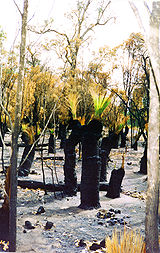
grass trees and some species of orchids only flower after fire.
Vegetation types
Vegetation
Vegetation is a general term for the plant life of a region; it refers to the ground cover provided by plants. It is a general term, without specific reference to particular taxa, life forms, structure, spatial extent, or any other specific botanical or geographic characteristics. It is broader...
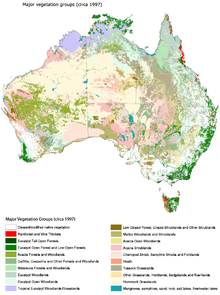
groups. The most important determinant is rainfall, followed by temperature which affects water availability. Several schemes of varying complexity have been created, the most recent scheme developed by the Natural Heritage Trust
Natural Heritage Trust
The Natural Heritage Trust was set up by the Australian Government in 1997 to help restore and conserve Australia's environment and natural resources....
divides Australia's terrestrial flora into 30 Major Vegetation Groups, and 67 Major Vegetation Subgroups.
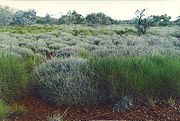
According to the scheme the most common vegetation types are those that are adapted to arid conditions where the area has not been significantly reduced by human activities such as land clearing for agriculture. The dominant vegetation type in Australia is the hummock grasslands that occur extensively in arid Western Australia, South Australia and the Northern Territory. It accounts for 23% of the native vegetation, the predominant species of which are from the genus Triodia
Triodia (plant genus)
Triodia is a large genus of hummock-forming grass endemic to Australia; they are commonly known as spinifex, although they are not a part of the coastal genus Spinifex. There are currently 64 recognised species...
. Zygochloa
Zygochloa
Zygochloa is a monotypic genus of grass endemic to Australia. Its only species is Zygochloa paradoxa. It occurs in extremely arid areas such as the Simpson Desert.-References:*Watson, L., and Dallwitz, M.J. 1992 onwards...
also occurs in inland sandy areas like the Simpson Desert
Simpson Desert
The Simpson Desert is a large area of dry, red sandy plain and dunes in Northern Territory, South Australia and Queensland in central Australia. It is the fourth largest Australian desert, with an area of 176,500 km² ....
.
A further 39% of native vegetation is covered by a combination of:
- Eucalypt woodlands found at the transition between hummock grasslands and higher rainfall areas where conditions still limit tree growth; the woodland may have a grass or shrubby understory. The most common species is Eucalyptus camaldulensis which occurs along the majority of inland waterways and creeklines in Australia. The largest area is in Queensland.
- Acacia forests and woodlands that occur in semi-arid areas where tree growth is stunted. The dominant Acacia species varies with the location, and may include lancewood, bendee, mulgaMulgaAcacia aneura, commonly known as Mulga or True Mulga, is a shrub or small tree native to arid outback Australia of areas such as the Western Australian Mulga shrublands.-Description:...
, gidgeeAcacia cambageiAcacia cambagei, commonly known as Gidgee , Stinking wattle or Stinking gidgee is an endemic tree of Australia. It is found primarily in semi-arid and arid Queensland but extends into the Northern Territory, South Australia and north-western New South Wales. It can reach up to 12 meters in height...
and brigalowAcacia harpophyllaAcacia harpophylla, commonly known as the Brigalow , Brigalow Spearwood or Orkor is an endemic tree of Australia. It is found in central and coastal Queensland to northern New South Wales. It can reach up to 25 meters tall and forms extensive open-forest communities on clay soils.Two species,...
. The largest area is in Western Australia. - Acacia shrublands in semi arid and arid regions. The most common are mulga shrublands; the largest area is in Western Australia.
- Tussock grasslands that occur in semi-arid and some temperate parts of Australia; they host a large variety of grasses from more than 10 genera. The largest area is in Queensland.
- Chenopod/samphire shrubs and forblands that are widespread in the near-estuarine, arid and semi-arid areas. Species in chenopod communities are drought and salt tolerantHalophyteA halophyte is a plant that grows where it is affected by salinity in the root area or by salt spray, such as in saline semi-deserts, mangrove swamps, marshes and sloughs, and seashores. An example of a halophyte is the salt marsh grass Spartina alterniflora . Relatively few plant species are...
and include the Sclerolaena, AtriplexAtriplexAtriplex is a plant genus of 100-200 species, known by the common names of saltbush and orache . The genus is quite variable and widely distributed. It includes many desert and seashore plants and halophytes, as well as plants of moist environments...
, MaireanaMaireanaMaireana is a genus of around 57 species of perennial shrubs and herbs in the family Amaranthaceae which are endemic to Australia. Species in this genus were formerly classified within the genus Kochia...
, ChenopodiumChenopodiumChenopodium is a genus of about 150 species of perennial or annual herbaceous flowering plants known as the goosefoots, which occur almost anywhere in the world. It is placed in the family Amaranthaceae in the APG II system; older classifications separate it and its relatives as Chenopodiaceae, but...
and RhagodiaRhagodiaRhagodia is a genus of shrubs native to Australia. They are common in salt marsh and may be succulent, like other salt tolerant species its members are commonly known as saltbushes.Species include:...
genera while samphire representatives include Tecticornia, Salicornia, Sclerostegia and SarcocorniaSarcocorniaSarcocornia is a genus of succulent salt tolerant coastal plants.-Species:*S. alpini*S. blackiana *S. fruticosa*Sarcocornia globosa...
. Both South and Western Australia have large areas with this vegetation type.
Other groups with restricted areas of less than 70,000 square kilometres include tropical or temperate rainforest and vine thickets, tall or open eucalypt forests, callitris
Callitris
Callitris is a genus of coniferous trees in the Cupressaceae . There are 15 species in the genus, of which 13 are native to Australia and the other two native to New Caledonia. Traditionally the most widely used common name is cypress-pine, a name shared by the closely related genus Actinostrobus...
and Casuarina forests, and woodlands and heath.
Vascular plants
Australia has over 30,000 described species of vascular plants, these include the angiosperms, seed-bearing non-angiosperms (like the conifers and cycads), and the spore-bearing ferns and fern allies. Of these about 11% are naturalised species; the remainder are native or endemic. The vascular plant flora has been extensively catalogued, the work being published in the ongoing Flora of AustraliaFlora of Australia (series)
The Flora of Australia is a 59 volume series describing the vascular plants, bryophytes and lichens present in Australia and its external territories...
series. A list of vascular plant families represented in Australia using the Cronquist system
Cronquist system
The Cronquist system is a taxonomic classification system of flowering plants. It was developed by Arthur Cronquist in his texts An Integrated System of Classification of Flowering Plants and The Evolution and Classification of Flowering Plants .Cronquist's system places flowering plants into two...
is also available.
At the higher taxonomic levels the Australian flora is similar to that of the rest of the world; most vascular plant families are represented within the native flora, with the exception of the cacti
Cactus
A cactus is a member of the plant family Cactaceae. Their distinctive appearance is a result of adaptations to conserve water in dry and/or hot environments. In most species, the stem has evolved to become photosynthetic and succulent, while the leaves have evolved into spines...
, birch
Betulaceae
Betulaceae, or the Birch Family, includes six genera of deciduous nut-bearing trees and shrubs, including the birches, alders, hazels, hornbeams and hop-hornbeams, numbering about 130 species...
and a few others, while 9 families occur only in Australia. Australia's vascular flora is estimated to be 85% endemic; this high level of vascular plant endemism is largely attributable to the radiation of some families like the Proteaceae
Proteaceae
Proteaceae is a family of flowering plants distributed in the Southern Hemisphere. The family comprises about 80 genera with about 1600 species. Together with the Platanaceae and Nelumbonaceae they make up the order Proteales. Well known genera include Protea, Banksia, Embothrium, Grevillea,...
, Myrtaceae
Myrtaceae
The Myrtaceae or Myrtle family are a family of dicotyledon plants, placed within the order Myrtales. Myrtle, clove, guava, feijoa, allspice, and eucalyptus belong here. All species are woody, with essential oils, and flower parts in multiples of four or five...
, and Fabaceae
Fabaceae
The Fabaceae or Leguminosae, commonly known as the legume, pea, or bean family, is a large and economically important family of flowering plants. The group is the third largest land plant family, behind only the Orchidaceae and Asteraceae, with 730 genera and over 19,400 species...
.
Angiosperms
| Family | % of total flora1 | Notable genera |
|---|---|---|
| Fabaceae Fabaceae The Fabaceae or Leguminosae, commonly known as the legume, pea, or bean family, is a large and economically important family of flowering plants. The group is the third largest land plant family, behind only the Orchidaceae and Asteraceae, with 730 genera and over 19,400 species... |
12.0 | Pultenaea Pultenaea Pultenaea is a genus of flowering plants in the family Fabaceae-Faboideae that are native to Australia.Pultenaea is commonly known as “egg and bacon”, “golden” or “bush peas”.The genus is found in south west Western Australia and the eastern states... , Daviesia Daviesia Daviesia is a genus of flowering plants in the family Fabaceae that are native to Australia. The genus is named in honour of Hugh Davies, a Welsh botanist.Species include:... , Bossiaea Bossiaea Bossiaea is a genus in the pea family consisting of about 70 species which are native to Australia. The genus is named in honour of Bossieu de la Martinière, a botanist on La Pérouse's expedition to Australia.Species include:... |
| Myrtaceae Myrtaceae The Myrtaceae or Myrtle family are a family of dicotyledon plants, placed within the order Myrtales. Myrtle, clove, guava, feijoa, allspice, and eucalyptus belong here. All species are woody, with essential oils, and flower parts in multiples of four or five... |
9.3 | Callistemon, Eucalyptus Eucalyptus Eucalyptus is a diverse genus of flowering trees in the myrtle family, Myrtaceae. Members of the genus dominate the tree flora of Australia... , Melaleuca Melaleuca Melaleuca is a genus of plants in the myrtle family Myrtaceae known for its natural soothing and cleansing properties. There are well over 200 recognised species, most of which are endemic to Australia... , Leptospermum Leptospermum Leptospermum is a genus of about 80-86 species of plants in the myrtle family Myrtaceae. Most species are endemic to Australia, with the greatest diversity in the south of the continent; but one species extends to New Zealand, another to Malaysia, and L. recurvum is endemic to Malaysia.They... |
| Asteraceae Asteraceae The Asteraceae or Compositae , is an exceedingly large and widespread family of vascular plants. The group has more than 22,750 currently accepted species, spread across 1620 genera and 12 subfamilies... |
8.0 | Brachyscome Brachyscome Brachyscome is a genus of around 70 species of mostly annual and perennial herbs and a few subshrubs in the daisy family Asteraceae. 65 of these are endemic to Australia, the remainder being found in New Zealand and New Guinea... , Olearia Olearia Olearia is a genus of flowering plants belonging to the family Asteraceae. There are about 130 different species within the genus found mostly in Australia, New Guinea and New Zealand... |
| Poaceae Poaceae The Poaceae is a large and nearly ubiquitous family of flowering plants. Members of this family are commonly called grasses, although the term "grass" is also applied to plants that are not in the Poaceae lineage, including the rushes and sedges... |
6.5 | Triodia Triodia (plant genus) Triodia is a large genus of hummock-forming grass endemic to Australia; they are commonly known as spinifex, although they are not a part of the coastal genus Spinifex. There are currently 64 recognised species... |
| Proteaceae Proteaceae Proteaceae is a family of flowering plants distributed in the Southern Hemisphere. The family comprises about 80 genera with about 1600 species. Together with the Platanaceae and Nelumbonaceae they make up the order Proteales. Well known genera include Protea, Banksia, Embothrium, Grevillea,... |
5.6 | Banksia Banksia Banksia is a genus of around 170 species in the plant family Proteaceae. These Australian wildflowers and popular garden plants are easily recognised by their characteristic flower spikes and fruiting "cones" and heads. When it comes to size, banksias range from prostrate woody shrubs to trees up... , Hakea Hakea Hakea is a genus of 149 species of shrubs and small trees in the Proteaceae, native to Australia. They are found throughout the country, with the highest species diversity being found in the south west of Western Australia.... , Grevillea Grevillea Grevillea is a diverse genus of about 360 species of evergreen flowering plants in the protea family Proteaceae, native to Australia, New Guinea, New Caledonia, and Sulawesi. It was named in honour of Charles Francis Greville. The species range from prostrate shrubs less than 0.5 m tall to trees... |
| Cyperaceae Cyperaceae Cyperaceae are a family of monocotyledonous graminoid flowering plants known as sedges, which superficially resemble grasses or rushes. The family is large, with some 5,500 species described in about 109 genera. These species are widely distributed, with the centers of diversity for the group... |
3.3 | Cyperus Cyperus Cyperus is a large genus of about 600 species of sedges, distributed throughout all continents in both tropical and temperate regions. They are annual or perennial plants, mostly aquatic and growing in still or slow-moving water up to 0.5 m deep. The species vary greatly in size, with small species... |
| Orchidaceae Orchidaceae The Orchidaceae, commonly referred to as the orchid family, is a morphologically diverse and widespread family of monocots in the order Asparagales. Along with the Asteraceae, it is one of the two largest families of flowering plants, with between 21,950 and 26,049 currently accepted species,... |
3.0 | Caladenia Caladenia The genus Caladenia belongs to the subfamily Orchidoideae of the orchid family . The abbreviation Calda. is often used in trade journals to indicate the genus.... , Pterostylis Pterostylis Pterostylis is a terrestrial deciduous genus of some 100 or so species of orchids found mainly in New Zealand, Australia, Papua New Guinea and New Caledonia. The common name of this orchid is Greenhood - a number of species have green flowers with the dorsal sepal forming a "hood" over the rest of... |
| Ericaceae Ericaceae The Ericaceae, commonly known as the heath or heather family, is a group of mostly calcifuge flowering plants. The family is large, with roughly 4000 species spread across 126 genera, making it the 14th most speciose family of flowering plants... |
2.1 | Leucopogon Leucopogon Leucopogon is a genus of about 150-160 species of shrubby flowering plants belonging to the family Ericaceae, in the section of that family formerly treated as the separate family Epacridaceae. They are native to Australia, New Zealand, New Caledonia, the western Pacific Islands and Malaysia, with... , Epacris Epacris Epacris is a genus of about 35-40 species of flowering plants in the family Ericaceae, though formerly often treated in a separate family Epacridaceae. The genus is native to eastern and southeastern Australia , New Caledonia and New Zealand... |
| Euphorbiaceae Euphorbiaceae Euphorbiaceae, the Spurge family are a large family of flowering plants with 300 genera and around 7,500 species. Most are herbs, but some, especially in the tropics, are also shrubs or trees. Some are succulent and resemble cacti.... |
2.0 | Ricinocarpos Ricinocarpos Ricinocarpos is a plant genus of the family Euphorbiaceae. One species is native to New Caledonia, the others endemic to Australia.Species include:*Ricinocarpos bowmanii F.Muell. *Ricinocarpos brevis R.J.F.Hend. & Mollemans... |
| Rutaceae Rutaceae Rutaceae, commonly known as the rue or citrus family, is a family of flowering plants, usually placed in the order Sapindales.Species of the family generally have flowers that divide into four or five parts, usually with strong scents... |
1.8 | Boronia, Correa Correa Correa is a genus of mainly eastern Australian plants with distinctive bell-shaped flowers. Correa is in the family Rutaceae, and like many in this family the crushed leaves have a distinctive scent. There are ca. 11 species in the genus, though natural hybridisation between the species makes... , Citrus Citrus Citrus is a common term and genus of flowering plants in the rue family, Rutaceae. Citrus is believed to have originated in the part of Southeast Asia bordered by Northeastern India, Myanmar and the Yunnan province of China... |
| 1 Based on total number of species Data from Orchard modified to AGPII APG II system The APG II system of plant classification is the second, now obsolete, version of a modern, mostly molecular-based, system of plant taxonomy that was published in April 2003 by the Angiosperm Phylogeny Group. It was a revision of the first APG system, published in 1998, and was superseded in 2009... classifications. |
||
The native Australian flora contains many monocotyledons. The family with the most species is the Poaceae
Poaceae
The Poaceae is a large and nearly ubiquitous family of flowering plants. Members of this family are commonly called grasses, although the term "grass" is also applied to plants that are not in the Poaceae lineage, including the rushes and sedges...
which includes a huge variety of species, from the tropical bamboo Bambusa arnhemica
Bambusa arnhemica
Bambusa arnhemica is one of three bamboo species native to Australia. It grows in the northwestern areas of the Northern territory, and is common on riverbanks in Kakadu. Stems turn orange yellow as they harden. Upper stems and branches arch gracefully. Height to approx 8 metres.The plant was first...
to the ubiquitous spinifex that thrives in arid Australia from the genera Triodia
Triodia (plant genus)
Triodia is a large genus of hummock-forming grass endemic to Australia; they are commonly known as spinifex, although they are not a part of the coastal genus Spinifex. There are currently 64 recognised species...
and Plectrachne
Plectrachne
Plectrachne is a type of grass in the Poaceae family....
. There are more than 800 described species of orchid
Orchidaceae
The Orchidaceae, commonly referred to as the orchid family, is a morphologically diverse and widespread family of monocots in the order Asparagales. Along with the Asteraceae, it is one of the two largest families of flowering plants, with between 21,950 and 26,049 currently accepted species,...
in Australia. About one quarter of these are epiphytes; epiphytic orchids occur along the east coast and in Tasmania and do not occur in South or Western Australia. The terrestrial orchids occur across most of Australia, the majority of species being deciduous
Deciduous
Deciduous means "falling off at maturity" or "tending to fall off", and is typically used in reference to trees or shrubs that lose their leaves seasonally, and to the shedding of other plant structures such as petals after flowering or fruit when ripe...
– their aboveground parts die back during the dry season and they re-sprout from a tuber when it rains.
Other families with well-known representatives include the alpine Tasmanian button grass
Gymnoschoenus sphaerocephalus
Gymnoschoenus sphaerocephalus, commonly known as button grass, is a species of tussock-forming grass from southeastern Australia. It forms part of a unique habitat in Tasmania....
, which form tussock-like mounds from the Cyperaceae
Cyperaceae
Cyperaceae are a family of monocotyledonous graminoid flowering plants known as sedges, which superficially resemble grasses or rushes. The family is large, with some 5,500 species described in about 109 genera. These species are widely distributed, with the centers of diversity for the group...
; the genus Patersonia
Patersonia
Patersonia is a genus of the Iridaceae with about 20 species in Australia and several in the Malesian region. The genus name is a tribute to the first Lieutenant Governor of New South Wales in Australia, William Paterson....
of temperate iris-like grasses from the Iridaceae
Iridaceae
The Iris family or Iridaceae is a family of perennial, herbaceous and bulbous plants included in the monocot order Asparagales, taking its name from the genus Iris. Almost worldwide in distribution and one of the most important families in horticulture, it includes more than 2000 species...
; and, the kangaroo paws
Anigozanthos
Anigozanthos is a small genus of Australian plants in the Bloodwort family Haemodoraceae. The 11 species and several subspecies are commonly known as kangaroo paw and catspaw depending on the shape of their flowers...
from the family Haemodoraceae
Haemodoraceae
Haemodoraceae is a family of flowering plants. It is sometimes known as the "Bloodwort family". Primarily a Southern Hemisphere family, they are found in South Africa, Australia and New Guinea, and in the Americas Haemodoraceae is a family of flowering plants. It is sometimes known as the...
. The Xanthorrhoea
Xanthorrhoea
Xanthorrhoea is a genus of flowering plants native to Australia and a member of family Xanthorrhoeaceae, being the only member of subfamily Xanthorrhoeoideae. The Xanthorrhoeaceae are monocots, part of order Asparagales. There are 28 species and five subspecies of Xanthorrhoea.-Description:All are...
grass trees, the screw palm
Pandanus
Pandanus is a genus of monocots with about 600 known species. They are numerous palmlike dioecious trees and shrubs native of the Old World tropics and subtropics. They are classified in the order Pandanales, family Pandanaceae.-Overview:...
s of the Pandanaceae
Pandanaceae
Pandanaceae is a family of flowering plants native to the tropics of the Old World. Such a family has been widely recognized by taxonomists.Pandanaceae are trees or climbing or scrambling shrubs distributed in the Old World tropics and are adapted from sea level in salted beaches to mountain cloud...
and palms
Arecaceae
Arecaceae or Palmae , are a family of flowering plants, the only family in the monocot order Arecales. There are roughly 202 currently known genera with around 2600 species, most of which are restricted to tropical, subtropical, and warm temperate climates...
are large moncots present in Australia. There are about 57 native palms; 79% of these only occur in Australia. Livistonia is unusual amongst the palm genera in Australia; rather than humid habitats, its members are found in inland gorges and open forest.
The dicots
Dicotyledon
The dicotyledons, also known as dicots, are a group of flowering plants whose seed typically has two embryonic leaves or cotyledons. There are around 199,350 species within this group...
are the most diverse group of angiosperms. Australia's best known species come from three large and very diverse dicot families: the Fabaceae
Fabaceae
The Fabaceae or Leguminosae, commonly known as the legume, pea, or bean family, is a large and economically important family of flowering plants. The group is the third largest land plant family, behind only the Orchidaceae and Asteraceae, with 730 genera and over 19,400 species...
, the Myrtaceae
Myrtaceae
The Myrtaceae or Myrtle family are a family of dicotyledon plants, placed within the order Myrtales. Myrtle, clove, guava, feijoa, allspice, and eucalyptus belong here. All species are woody, with essential oils, and flower parts in multiples of four or five...
and the Proteaceae
Proteaceae
Proteaceae is a family of flowering plants distributed in the Southern Hemisphere. The family comprises about 80 genera with about 1600 species. Together with the Platanaceae and Nelumbonaceae they make up the order Proteales. Well known genera include Protea, Banksia, Embothrium, Grevillea,...
. The Myrtaceae is represented by a variety of woody species; gum trees from the genera Eucalyptus
Eucalyptus
Eucalyptus is a diverse genus of flowering trees in the myrtle family, Myrtaceae. Members of the genus dominate the tree flora of Australia...
, Corymbia
Corymbia
Corymbia is a genus of about 113 species of tree that were classified as Eucalyptus species until the mid-1990s. It includes the bloodwoods, ghost gums and spotted gums. The bloodwoods had been recognised as a distinct group within the large and diverse Eucalyptus genus since 1867...
and Angophora
Angophora
Angophora is a genus of ten species of trees or large shrubs in the myrtle family , native to eastern Australia. It is closely related to Corymbia and Eucalyptus, and all three are often referred to as "eucalypts". The differences are that Angophora have opposite leaves rather than alternate, and...
, Lillipillies (Syzygium
Syzygium
Syzygium is a genus of flowering plants that belongs to the myrtle family, Myrtaceae. The genus comprises about 1100 species, and has a native range that extends from Africa and Madagascar through southern Asia east through the Pacific...
), the water-loving Melaleuca
Melaleuca
Melaleuca is a genus of plants in the myrtle family Myrtaceae known for its natural soothing and cleansing properties. There are well over 200 recognised species, most of which are endemic to Australia...
and Bottlebrush and the shrubby Darwinia
Darwinia (plant)
Darwinia is a genus of about 70 species of evergreen shrubs in the family Myrtaceae, endemic to southeastern and southwestern Australia. The majority are native to southern Western Australia, but a few species occur in South Australia, New South Wales and Victoria. The genus was named in honour of...
and Leptospermum
Leptospermum
Leptospermum is a genus of about 80-86 species of plants in the myrtle family Myrtaceae. Most species are endemic to Australia, with the greatest diversity in the south of the continent; but one species extends to New Zealand, another to Malaysia, and L. recurvum is endemic to Malaysia.They...
, commonly known as teatrees, and Geraldton wax. Australia is also a centre of diversity for the Proteaceae, with woody, well-known genera such as Banksia
Banksia
Banksia is a genus of around 170 species in the plant family Proteaceae. These Australian wildflowers and popular garden plants are easily recognised by their characteristic flower spikes and fruiting "cones" and heads. When it comes to size, banksias range from prostrate woody shrubs to trees up...
, Dryandra
Dryandra
Banksia ser. Dryandra is a series of 94 species of shrub to small tree in the plant genus Banksia. It was considered a separate genus named Dryandra until early 2007, when it was merged into Banksia on the basis of extensive molecular and morphological evidence that Banksia was paraphyletic with...
, Grevillea
Grevillea
Grevillea is a diverse genus of about 360 species of evergreen flowering plants in the protea family Proteaceae, native to Australia, New Guinea, New Caledonia, and Sulawesi. It was named in honour of Charles Francis Greville. The species range from prostrate shrubs less than 0.5 m tall to trees...
, Hakea
Hakea
Hakea is a genus of 149 species of shrubs and small trees in the Proteaceae, native to Australia. They are found throughout the country, with the highest species diversity being found in the south west of Western Australia....
, the waratah
Waratah
Waratah is a genus of five species of large shrubs or small trees in the Proteaceae, native to the southeastern parts of Australia...
and Australia's only commercial native food crop, the macadamia
Macadamia
Macadamia is a genus of nine species of flowering plants in the family Proteaceae, with a disjunct distribution native to eastern Australia , New Caledonia and Sulawesi in Indonesia ....
. Australia also has representatives of all three legume subfamilies. Caesalpinioideae
Caesalpinioideae
Caesalpinioideae is a botanical name at the rank of subfamily, placed in the large family Fabaceae or Leguminosae. Its name is formed from the generic name Caesalpinia....
is notably represented by Cassia
Cassia (genus)
Cassia is a genus of Fabaceae in the subfamily Caesalpinioideae. Commonly called cassias, "cassia" is also the English name of Cinnamomum aromaticum in the Lauraceae , and some other species of Cinnamomum...
trees. The Faboideae
Faboideae
Faboideae is a subfamily of the flowering plant family Fabaceae or Leguminosae. One acceptable alternative name for the subfamily is Papilionoideae....
or pea-flowered legumes are common and many are well-known for their flowers, including the golden peas
Mirbelieae
Mirbelieae, commonly known as the bush, golden or egg-and-bacon peas are a legume tribe endemic to Australia. Phylogenetic analysis suggests that Mirbelieae is paraphyletic with respect to Bossiaeeae....
, Glycine
Glycine (plant)
Glycine is a genus in the bean family Fabaceae. The best known species is the soybean . While the majority of the species are found only in Australia, the soybean's native range is in East Asia. A few species extend from Australia to East Asia Glycine is a genus in the bean family Fabaceae. The...
species and the Sturt's desert pea
Sturt's desert pea
Swainsona formosa, Sturt's Desert Pea, is an Australian plant in the genus Swainsona, named after English botanist Isaac Swainson, famous for its distinctive blood-red leaf-like flowers, each with a bulbous black centre, or "boss". It is one of Australia's best known wildflowers...
. The Mimosoideae
Mimosoideae
Mimosoideae is a subfamily of the flowering plant family Fabaceae characterized by flowers with small petals and numerous prominent stamens...
is best known for the huge genus Acacia
Acacia
Acacia is a genus of shrubs and trees belonging to the subfamily Mimosoideae of the family Fabaceae, first described in Africa by the Swedish botanist Carl Linnaeus in 1773. Many non-Australian species tend to be thorny, whereas the majority of Australian acacias are not...
which includes Australia's floral emblem the golden wattle
Golden Wattle
Acacia pycnantha is Australia's floral emblem. It is a tree which flowers in late winter and spring, producing a mass of fragrant, fluffy, golden flowers.-Description:...
.
Many plant families that occur in Australia are known for their floral displays that follow seasonal rains. The Asteraceae
Asteraceae
The Asteraceae or Compositae , is an exceedingly large and widespread family of vascular plants. The group has more than 22,750 currently accepted species, spread across 1620 genera and 12 subfamilies...
is well represented by its subfamily Gnaphalieae
Gnaphalieae
Gnaphalieae is a tribe of flowering plants in the family Asteraceae.-Characteristics:This group is most diverse in South America, Southern Africa and Australia. It is sometimes commonly called the pussy's-toes tribe...
, which included the paper or everlasting daisies; this group has its greatest diversity in Australia. Other families with flowering shrubs include the Rutaceae
Rutaceae
Rutaceae, commonly known as the rue or citrus family, is a family of flowering plants, usually placed in the order Sapindales.Species of the family generally have flowers that divide into four or five parts, usually with strong scents...
, with the fragrant Boronia and Eriostemon
Eriostemon
Eriostemon is a genus of flowering plants belonging to the family Rutaceae. It is native to eastern Australia and includes just two species. Eriostemon australasius occurs between Fraser Island and Nowra, and is a shrub of heathlands and low open woodlands. It is also frequently cultivated in...
, the Myoporaceae
Myoporaceae
Myoporaceae is a family of plants, found mostly in Australia, which includes the following genera:* Diocirea* Eremophila, also known as Emu Bush* Myoporum, also known as Boobiala...
with the Eremophila
Eremophila (plant)
Eremophila is a genus of plants of the family Scrophulariaceae, with species known by the common names of Emu Bush, Poverty Bush or Fuchsia Bush. Currently, there are 215 recognised species, all of which are endemic to Australia...
, and members of the Ericaceae
Ericaceae
The Ericaceae, commonly known as the heath or heather family, is a group of mostly calcifuge flowering plants. The family is large, with roughly 4000 species spread across 126 genera, making it the 14th most speciose family of flowering plants...
with Victoria's Floral Emblem Epacris impressa.
Amongst the most ancient species of flowering hardwood trees are the Casuarinaceae
Casuarinaceae
Casuarinaceae is a family of dicotyledonous flowering plants placed in the order Fagales, consisting of 3 or 4 genera and approximately 70 species of trees and shrubs native to the Old World tropics , Australia, and the Pacific Islands...
, including beach, swamp and river oaks, and Fagaceae
Fagaceae
The family Fagaceae, or beech family, comprises about 900 species of both evergreen and deciduous trees and shrubs, which are characterized by alternate simple leaves with pinnate venation, unisexual flowers in the form of catkins, and fruit in the form of cup-like nuts. Fagaceous leaves are often...
represented in Australia by three species of Nothofagus
Nothofagus
Nothofagus, also known as the southern beeches, is a genus of 35 species of trees and shrubs native to the temperate oceanic to tropical Southern Hemisphere in southern South America and Australasia...
. Trees of the Rosales
Rosales
Rosales is an order of flowering plants. It is one of the four orders in the nitrogen fixing clade of the fabids and is sister to a clade consisting of Fagales and Cucurbitales. It contains about 7700 species, distributed into about 260 genera. Rosales comprises nine families, the type family...
are notably representented by the Moraceae
Moraceae
Moraceae — often called the mulberry family or fig family — are a family of flowering plants comprising about 40 genera and over 1000 species. Most are widespread in tropical and subtropical regions, less so in temperate climates...
whose species include the Moreton Bay Fig
Moreton Bay Fig
Ficus macrophylla, commonly known as the Moreton Bay Fig, is a large evergreen banyan tree of the Moraceae family that is a native of most of the eastern coast of Australia, from the Atherton Tableland in the north to the Illawarra in New South Wales, and Lord Howe Island. Its common name is...
and the Port Jackson Fig
Port Jackson Fig
Ficus rubiginosa, the Rusty Fig, Port Jackson Fig, or Little-leaf Fig, is a tree in the family Moraceae that is native to eastern Australia...
, and the Urticaceae
Urticaceae
Urticaceae, or the nettle family, is a family of flowering plants. The family name comes from the genus Urtica . Urticaceae includes a number of well-known and useful plants, including the aforementioned nettles, Ramie , māmaki , and ajlai .The family includes approximately 2600 species, grouped...
whose members include several tree sized stinging nettles; Dendrocnide moroides
Dendrocnide moroides
Dendrocnide moroides, also known as the Gympie Gympie, moonlighter, or stinger, is a large shrub native to rainforest areas in northeastern Australia, the Moluccas and Indonesia. It is best known for stinging hairs which cover the whole plant and deliver a potent neurotoxin when touched. It is the...
is the most virulent. There are also numerous sandalwood
Santalaceae
Santalaceae is a widely distributed family of flowering plants which, like other members of Santalales, are partially parasitic on other plants...
species including the quandong
Quandong
Quandong, quandang or quondong, is a common name for the species Santalum acuminatum , especially its edible fruit, but may also refer to* Aceratium concinnum...
s and native cherry, Exocarpus cupressiformis
Exocarpus cupressiformis
Exocarpos cupressiformis, is an Australian endemic plant species commonly known as the native cherry or cherry ballart. The species is found in sclerophyll forest on the east coast of Australia. It is also commonly found in the Mount Lofty Ranges in South Australia.It is a small tree ,...
. The bottle tree of the Sterculiaceae
Sterculiaceae
Sterculiaceae is a botanical name for a group of flowering plants at the rank of family, which is now considered obsolete. As is true for any botanical name, the circumscription, status and placement of the taxon has varied with taxonomic point of view...
is one of 30 tree species from the Brachychiton
Brachychiton
Brachychiton is a genus of 31 species of trees and large shrubs, native to Australia , and New Guinea . Fossils from New South Wales and New Zealand are estimated to be 50 million years old, corresponding to the Tertiary.They grow to 4 – 30m tall, and some are dry-season deciduous...
. There are about 75 native mistletoes
Loranthaceae
Loranthaceae is a family of flowering plants, which has been universally recognized by taxonomists. It consists of about 75 genera and 1,000 species of woody plants, many of them hemi-parasites, all of them except three having the mistletoe habit...
that parasitise
Parasitic plant
A parasitic plant is one that derives some or all of its sustenance from another plant. About 4,100 species in approximately 19 families of flowering plants are known. Parasitic plants have a modified root, the haustorium, that penetrates the host plant and connects to the xylem, phloem, or...
Australian tree species, including two terrestrial parasitic trees, one of which is the spectacular Western Australian Christmas tree
Western Australian Christmas tree
Nuytsia floribunda is a hemiparasitic plant found in Western Australia. The species is known locally as the Christmas Tree, displaying bright orange flowers during the Christmas season.-Description:...
.
Australia's salt marshes and wetlands are covered by a large variety of salt and drought tolerant species from the Amaranthaceae
Amaranthaceae
The flowering plant family Amaranthaceae, the Amaranth family, contains about 176 genera and 2,400 species.- Description :Most of these species are herbs or subshrubs; very few are trees or climbers. Some species are succulent....
which include the saltbushes (Atriplex
Atriplex
Atriplex is a plant genus of 100-200 species, known by the common names of saltbush and orache . The genus is quite variable and widely distributed. It includes many desert and seashore plants and halophytes, as well as plants of moist environments...
) and bluebushes (Maireana
Maireana
Maireana is a genus of around 57 species of perennial shrubs and herbs in the family Amaranthaceae which are endemic to Australia. Species in this genus were formerly classified within the genus Kochia...
and Chenopodium
Chenopodium
Chenopodium is a genus of about 150 species of perennial or annual herbaceous flowering plants known as the goosefoots, which occur almost anywhere in the world. It is placed in the family Amaranthaceae in the APG II system; older classifications separate it and its relatives as Chenopodiaceae, but...
). Many of these plants have succulent leaves; other native succulents are from the genera Carpobrotus
Carpobrotus
Carpobrotus is a genus of ground-creeping plants, with succulent leaves and large daisy-like flowers. The name refers to the edible fruits. It comes from the Greek "karpos" and "brota" .There are about 25 species in this genus, having a disperse distribution worldwide...
,Calandrinia
Calandrinia
Calandrinia is a plant genus that contains many species of purslane, including the redmaids. The genus was named for Jean Louis Calandrini, an 18th century Swiss botanist. It includes around 150 species of annual herbs which bear colorful flowers in shades of red to purple and white...
and Portulaca
Portulaca
Portulaca is the type genus of the flowering plant family Portulacaceae, comprising about 40-100 species found in the tropics and warm temperate regions. They are also sometimes known as Rose Moss or more commonly Moss Roses....
. Succulent stems are present in many of the Euphorbiaceae
Euphorbiaceae
Euphorbiaceae, the Spurge family are a large family of flowering plants with 300 genera and around 7,500 species. Most are herbs, but some, especially in the tropics, are also shrubs or trees. Some are succulent and resemble cacti....
in Australia, though the best known members are the non-succulent looking fragrant Wedding bushes of the genus Ricinocarpos
Ricinocarpos
Ricinocarpos is a plant genus of the family Euphorbiaceae. One species is native to New Caledonia, the others endemic to Australia.Species include:*Ricinocarpos bowmanii F.Muell. *Ricinocarpos brevis R.J.F.Hend. & Mollemans...
. Carnivorous plants which favour damp habitats are represented by four families including the sundews
Droseraceae
Droseraceae is the botanical name for a family of flowering plants. The family is also known under its common name, the sundew family.It consists of carnivorous plants: besides the sundews, the genus Drosera, it also contains the even more-famous Venus fly trap Dionaea muscipula...
, bladderworts
Lentibulariaceae
Lentibulariaceae is a family of carnivorous plants containing three genera, Genlisea, the corkscrew plants, Pinguicula, the butterworts, and Utricularia, the bladderworts....
, pitcher-plants from the Cephalotaceae, which are endemic to Western Australia
Western Australia
Western Australia is a state of Australia, occupying the entire western third of the Australian continent. It is bounded by the Indian Ocean to the north and west, the Great Australian Bight and Indian Ocean to the south, the Northern Territory to the north-east and South Australia to the south-east...
, and the Nepenthaceae.
Aquatic moncots and dicots both occur in Australian waters. Australia has about 51,000 square kilometres of seagrass
Seagrass
Seagrasses are flowering plants from one of four plant families , all in the order Alismatales , which grow in marine, fully saline environments.-Ecology:...
meadows and the most diverse group seagrass species in the world. There are 22 species found in temperate waters and 15 in tropical waters out of a known 70 species worldwide. Aquatic dicots include the mangroves; in Australia there are 39 mangrove species that cover 11,500 square kilometres and comprise the third largest area of mangroves in the world. Other native aquatic dicots here include water lilies
Nymphaeaceae
Nymphaeaceae is a family of flowering plants. Members of this family are commonly called water lilies and live in freshwater areas in temperate and tropical climates around the world. The family contains eight genera. There are about 70 species of water lilies around the world. The genus...
and water milfoils
Myriophyllum
Myriophyllum is a genus of about 69 species of freshwater aquatic plants, with a cosmopolitan distribution. The center of diversity for Myriophyllum is Australia with 43 recognized species...
.
Non-angiosperms
Seed bearing non-angiosperms present in Australia include the cycads and conifers. There are 69 species of cycad from 4 genera and 3 families – they are all endemic and their distribution is confined to forests of eastern and northern Australia, with a few in south-western Western Australia and central Australia. Native pines are distributed through 3 families, 14 genera and 43 species, of which 39 are endemic. Most species are present in wetter mountainous areas consistent with their Gondwanan origins, including the genera AthrotaxisAthrotaxis
Athrotaxis is a genus of two to three species of conifers in the cypress family, Cupressaceae. The genus is endemic to western Tasmania, where they grow in high altitude temperate rainforests....
, Actinostrobus
Actinostrobus
Actinostrobus is a genus of coniferous trees in the Cupressaceae . Common names include cypress, sandplain-cypress and cypress-pine, the last of these shared by the closely related genus Callitris...
, Microcachrys
Microcachrys
Microcachrys tetragona is a species of dioecious conifers belonging to the podocarp family . It is the sole species of the genus Microcachrys. The plant originates from western Tasmania, where it is a low shrub growing to 1 m tall at high altitudes...
, Microstrobos
Microstrobos
Microstrobos is a genus of plant belonging to the podocarp family . Its name comes from Greek . It has 2 species, which are evergreen dioecious shrubs.-Taxonomy:...
, Diselma
Diselma
Diselma archeri is a species of plant of the family Cupressaceae and the sole species in the genus Diselma. It is found in Tasmania, on the western coast ranges and Lake St. Clair, at an altitude ranging from 910-1220 m.It is a dioecious shrub or rarely a small tree, growing to 1-6 m...
and the Tasmanian Huon pine
Lagarostrobos franklinii
The species Lagarostrobos franklinii is a species of conifer native to the wet southwestern corner of Tasmania, Australia; it is the sole species in Lagarostrobos; one other species L. colensoi formerly included has been transferred to a new genus Manoao. The genus was also formerly included in a...
, sole member of the genus Lagarostrobos. Callitris
Callitris
Callitris is a genus of coniferous trees in the Cupressaceae . There are 15 species in the genus, of which 13 are native to Australia and the other two native to New Caledonia. Traditionally the most widely used common name is cypress-pine, a name shared by the closely related genus Actinostrobus...
is a notable exception; species from this genus are found mainly in drier open woodlands. The most recently discovered species of conifer is the living fossil
Living fossil
Living fossil is an informal term for any living species which appears similar to a species otherwise only known from fossils and which has no close living relatives, or a group of organisms which have long fossil records...
Wollemi pine, which was first described in 1994.
Spore bearing vascular plants include the fern
Fern
A fern is any one of a group of about 12,000 species of plants belonging to the botanical group known as Pteridophyta. Unlike mosses, they have xylem and phloem . They have stems, leaves, and roots like other vascular plants...
s and fern allies
Fern ally
Fern allies are a diverse group of seedless vascular plants that are not true ferns. Like ferns, a fern ally disperses by shedding spores to initiate an alternation of generations.-Classification:...
. True ferns are found over most of the country and are most abundant in tropical and subtropical areas with high rainfall. Australia has a native flora of 30 families, 103 genera and 390 species of ferns, with another 10 species being naturalised. The fern allies are represented by 44 native species of psilophytes, horsetail
Horsetail
Equisetum is the only living genus in the Equisetaceae, a family of vascular plants that reproduce by spores rather than seeds.Equisetum is a "living fossil", as it is the only living genus of the entire class Equisetopsida, which for over one hundred million years was much more diverse and...
s and lycophytes
Lycopodiophyta
The Division Lycopodiophyta is a tracheophyte subdivision of the Kingdom Plantae. It is the oldest extant vascular plant division at around 410 million years old, and includes some of the most "primitive" extant species...
. Ferns prefer a cool and damp environment since water is required for reproduction, the majority of Australian species are found in bushland and rainforest, there are aquatic, epiphytic (Platycerium
Platycerium
Platycerium is a genus of about 18 fern species in the polypod family, Polypodiaceae. Ferns in this genus are widely known as staghorn or elkhorn ferns due to their uniquely-shaped fronds...
, Huperzia and Asplenium
Asplenium
Asplenium is a genus of about 700 species of ferns, often treated as the only genus in the family Aspleniaceae, though other authors consider Hymenasplenium separate, based on molecular phylogenetic analysis of DNA sequences, a different chromosome count, and structural differences in the rhizomes...
), and terrestrial species including large tree ferns from the genera Cyathea
Cyathea
Cyathea is a genus of tree ferns, the type genus of the fern order Cyatheales. They are mostly terrestrial ferns, usually with a single tall stem. Rarely, the trunk may be branched or creeping. Many species also develop a fibrous mass of roots at the base of the trunk. The genus has a pantropical...
and Dicksonia
Dicksonia
Dicksonia is a genus of tree ferns in the order Cyatheales. It is regarded as related to Cyathea, but is considered more primitive, dating back at least to the Jurassic and Cretaceous periods. The fossil record includes stems, pinnules, and spores....
.
Non-vascular plants
The algaeAlgae
Algae are a large and diverse group of simple, typically autotrophic organisms, ranging from unicellular to multicellular forms, such as the giant kelps that grow to 65 meters in length. They are photosynthetic like plants, and "simple" because their tissues are not organized into the many...
are a large and diverse group of photosynthetic organisms. Many studies of algae include the cyanobacteria, in addition to micro and macro eukaryotic
Eukaryote
A eukaryote is an organism whose cells contain complex structures enclosed within membranes. Eukaryotes may more formally be referred to as the taxon Eukarya or Eukaryota. The defining membrane-bound structure that sets eukaryotic cells apart from prokaryotic cells is the nucleus, or nuclear...
types that inhabit both fresh and saltwater. Currently, about 10,000 to 12,000 species of algae are known for Australia. The algal flora of Australia is unevenly documented: northern Australia remains largely uncollected for seaweeds and marine phytoplankton, descriptions of freshwater algae are patchy, and the collection of terrestrial algae has been almost completely neglected.
The bryophytes – moss
Moss
Mosses are small, soft plants that are typically 1–10 cm tall, though some species are much larger. They commonly grow close together in clumps or mats in damp or shady locations. They do not have flowers or seeds, and their simple leaves cover the thin wiry stems...
es, liverworts
Marchantiophyta
The Marchantiophyta are a division of bryophyte plants commonly referred to as hepatics or liverworts. Like other bryophytes, they have a gametophyte-dominant life cycle, in which cells of the plant carry only a single set of genetic information....
and hornwort
Hornwort
Hornworts are a group of bryophytes, or non-vascular plants, comprising the division Anthocerotophyta. The common name refers to the elongated horn-like structure, which is the sporophyte. The flattened, green plant body of a hornwort is the gametophyte plant.Hornworts may be found worldwide,...
s – are primitive, usually terrestrial, plants that inhabit the tropics, cool-temperate regions and montane areas; there are some specialised members that are adapted to semi-arid and arid Australia. There are slightly fewer that 1,000 recognised species of moss in Australia. The five largest genera are the Fissidens
Fissidens
Fissidens is a genus of moss in family Fissidentaceae.Selected species:* Fissidens adianthoides, Hedw.* Fissidens allenianus* Fissidens appalachensis* Fissidens arcticus* Fissidens bryoides* Fissidens clebschii...
, Bryum, Campylopus, Macromitrium and Andreaea
Andreaea
Andreaea is a genus of rock mosses with about 45 species.- External links :* Zander, Richard H. 2007. Bryophyte Flora of North America:...
. There are also over 800 species of liver- and horn-worts in 148 genera in Australia.
Fungi
The fungal flora of Australia is not well characterised; Australia is estimated to have about 250,000 fungal species of which roughly 5% have been described. Knowledge of distribution, substrates and habitats is poor for most species, with the exception of common plant pathogens.Lichens
LichenLichen
Lichens are composite organisms consisting of a symbiotic organism composed of a fungus with a photosynthetic partner , usually either a green alga or cyanobacterium...
s are composite organisms comprising, in most cases, an Ascomycete fungus and a unicellular green alga, their classification is based on the type of fungi. The lichen flora of Australia and its island territories, including Christmas Island
Christmas Island
The Territory of Christmas Island is a territory of Australia in the Indian Ocean. It is located northwest of the Western Australian city of Perth, south of the Indonesian capital, Jakarta, and ENE of the Cocos Islands....
, Heard Island
Heard Island and McDonald Islands
The Heard Island and McDonald Islands are an Australian external territory and volcanic group of barren Antarctic islands, about two-thirds of the way from Madagascar to Antarctica. The group's overall size is in area and it has of coastline...
, Macquarie Island
Macquarie Island
Macquarie Island lies in the southwest corner of the Pacific Ocean, about half-way between New Zealand and Antarctica, at 54°30S, 158°57E. Politically, it has formed part of the Australian state of Tasmania since 1900 and became a Tasmanian State Reserve in 1978. In 1997 it became a world heritage...
and Norfolk Island
Norfolk Island
Norfolk Island is a small island in the Pacific Ocean located between Australia, New Zealand and New Caledonia. The island is part of the Commonwealth of Australia, but it enjoys a large degree of self-governance...
, currently comprises 3,238 species and infra-specific taxa in 422 genera, 34% of which are considered to be endemic.
Use by humans
Willem de Vlamingh
Willem Hesselsz de Vlamingh was a Dutch sea-captain who explored the central west coast of Australia in the late 17th century.- Vlamingh and the VOC :...
. This was followed by Cook's expedition making landfall at what is now Botany bay in April 1770, and the early work of Banks, Solander and Parkinson. Botanical exploration was enabled by the
founding of the permanent colony at Port Jackson in 1788, and the subsequent expeditions along Australia's coastline.
The Australia flora was utilised by the Indigenous inhabitants
Indigenous Australians
Indigenous Australians are the original inhabitants of the Australian continent and nearby islands. The Aboriginal Indigenous Australians migrated from the Indian continent around 75,000 to 100,000 years ago....
of Australia. They used hundreds of species for food, medicine, shelter, tools and weapons. For example, the starchy roots of Clematis microphylla
Clematis microphylla
Clematis microphylla is one of 8 Clematis species native to Australia. It occurs in all states and the ACT, but not in the Northern Territory.It is a common small-leaved climbing species. There are two variants,...
were used in western Victoria to make a dough that was baked, and the leaves of the plant were used as a poultice applied to skin irritations and blisters.
Since European colonisation
Economic exploitation of the flora by settlers since 1788 has not been extensive; forestry has been the most extensive use of the flora. Forestry species include a number of eucalypts used for paper and timber, huon pineLagarostrobos franklinii
The species Lagarostrobos franklinii is a species of conifer native to the wet southwestern corner of Tasmania, Australia; it is the sole species in Lagarostrobos; one other species L. colensoi formerly included has been transferred to a new genus Manoao. The genus was also formerly included in a...
, hoop pine
Araucaria cunninghamii
Araucaria cunninghamii is a species of Araucaria known as Moreton Bay Pine, or Hoop Pine. Other less commonly used names include Colonial Pine, Richmond River Pine, Queensland Pine, Alloa, Ningwik, or Pien, the wood is sometimes called Arakaria)...
, cypress pine
Callitris columellaris
Callitris columellaris is a species of coniferous tree in the family Cupressaceae , native to most of Australia. Common names include White Cypress-pine, Murray River Cypress-pine, and Northern Cypress-pine....
, Australian Blackwood
Australian Blackwood
Acacia melanoxylon, commonly known as the Australian Blackwood, is an Acacia species native in eastern Australia. The species is also known as Sally Wattle, Lightwood, Hickory, Mudgerabah, Tasmanian Blackwood or Black Wattle . This tree species grows fast and tall, up to 45 m height...
, and sandalwood from Santalum spicatum
Santalum spicatum
Santalum spicatum, a species known as Australian sandalwood, is a tree native to semi-arid areas at the edge of Southwest Australia. It is traded as sandalwood and its valuable oil has been used as an aromatic, a medicine and a food source. S...
and S. lanceolatum
Santalum lanceolatum
Santalum lanceolatum is an Australian tree of the family Santalaceae. It is commonly known as Desert Quandong, Northern Sandalwood, Sandalwood or True Sandalwood and in some restricted areas as Burdardu. The height of this plant is variable, from 1 to 7 metres...
are also timber producing species. A significant area used by the pastoral industry is based on native pasture species including Mitchell grass
Astrebla
Astrebla is a small genus of xerophytic grasses endemic to Australia. They are commonly known as Mitchell Grass.Species in this genera are:*Astrebla elymoides; Hoop Mitchell Grass*Astrebla lappacea; Curly Mitchell Grass...
, saltbush
Atriplex
Atriplex is a plant genus of 100-200 species, known by the common names of saltbush and orache . The genus is quite variable and widely distributed. It includes many desert and seashore plants and halophytes, as well as plants of moist environments...
, bluebush
Maireana sedifolia
Maireana sedifolia, also known as the bluebush or pearl bluebrush is a compact shrub endemic to Australia. It is used in pasture and as a garden plant where it popular due to its distinctive grey foliage.-References:*...
, wallaby grass
Austrodanthonia
Austrodanthonia is a genus of 28 grass species found in Australia, New Guinea and New Zealand.Species include:*Austrodanthonia acerosa H.P.Linder*Austrodanthonia alpicola H.P.Linder – Crag Wallaby-grass...
, spear grass
Heteropogon
Heteropogon is a small genus of annual and perennial grasses known generally as tangleheads. They are erect tussock grasses found in tropical regions worldwide, and some species grow in warmer temperate areas as well. The inflorescences hold paired spikelets...
, tussock grasses
Poa
Poa is a genus of about 500 species of grasses, native to the temperate regions of both hemispheres. Common names include meadow-grass , bluegrass , tussock , and speargrass. "Poa" is Greek for fodder...
and kangaroo grass
Themeda triandra
Themeda triandra is a perennial grass widespread in Africa, Australia, Asia and the Pacific. In Australia it is commonly known as kangaroo grass, in East and South Africa it is known as "red oat grass" or red grass, in Afrikaans, rooigras.The species has a tuffted habit and can reach up to 1.5 m...
.
Commercial use
Until recently the macadamia nutMacadamia
Macadamia is a genus of nine species of flowering plants in the family Proteaceae, with a disjunct distribution native to eastern Australia , New Caledonia and Sulawesi in Indonesia ....
and Tetragonia tetragonoides
Tetragonia tetragonoides
Tetragonia tetragonioides is a leafy groundcover also known as New Zealand Spinach, Warrigal Greens, Kokihi , Sea Spinach, Botany Bay Spinach, Tetragon and Cook's Cabbage...
were the only Australian food plant species widely cultivated. Although commercial cultivation of macadamia started in Australia in the 1880s, it became an established large-scale crop in Hawaii
Hawaii
Hawaii is the newest of the 50 U.S. states , and is the only U.S. state made up entirely of islands. It is the northernmost island group in Polynesia, occupying most of an archipelago in the central Pacific Ocean, southwest of the continental United States, southeast of Japan, and northeast of...
. The development of a range of native food crops began in the late 1970s with the assessment of species for commercial potential
Bushfood industry history
The modern Australian native food industry, also called the bushfood industry had its initial beginnings in the late 1970s and early 1980s, when regional enthusiasts and researchers started to target local native species for cropping....
. In the mid-1980s restaurants and wholesalers started to market various native food plant products. These included wattles
Acacia
Acacia is a genus of shrubs and trees belonging to the subfamily Mimosoideae of the family Fabaceae, first described in Africa by the Swedish botanist Carl Linnaeus in 1773. Many non-Australian species tend to be thorny, whereas the majority of Australian acacias are not...
for their edible seeds; Davidson's Plum
Davidsonia
Davidsonia is a genus containing three rainforest tree species, that are commonly known as the Davidson or Davidson's Plum. The fruits superficially resemble the European plum, but are not closely related...
, desert lime, finger lime, quandong
Santalum acuminatum
Santalum acuminatum, the desert quandong, is a hemiparasitic plant in the Sandalwood family Santalaceae, widely dispersed throughout the central deserts and southern areas of Australia....
, riberry, Kakadu plum
Terminalia ferdinandiana
Terminalia ferdinandiana, also called the gubinge, billygoat plum, Kakadu plum or murunga is a flowering plant in the family Combretaceae, native to Australia, widespread throughout the tropical woodlands from northwestern Australia to eastern Arnhem Land.Its vitamin C concentration may be as high...
, muntries, bush tomato, Illawarra plum
Podocarpus elatus
Podocarpus elatus, known as the Plum Pine, or the Brown Pine is a species of Podocarpus endemic to the east coast of Australia, in eastern New South Wales and eastern Queensland....
for fruit; warrigal greens
Tetragonia tetragonoides
Tetragonia tetragonioides is a leafy groundcover also known as New Zealand Spinach, Warrigal Greens, Kokihi , Sea Spinach, Botany Bay Spinach, Tetragon and Cook's Cabbage...
as a leaf vegetable; and, lemon aspen
Lemon Aspen
Lemon aspen, Acronychia acidula is a small to medium sized rainforest tree of Queensland, Australia. The aromatic and acidic fruit is harvested as a bushfood....
, lemon myrtle
Lemon myrtle
Backhousia citriodora is a flowering plant in the family Myrtaceae, genus Backhousia. It is endemic to subtropical rainforests of central and south-eastern Queensland, Australia, with a natural distribution from Mackay to Brisbane...
, mountain pepper
Tasmannia lanceolata
Tasmannia lanceolata , commonly known as the Mountain Pepper , or Cornish Pepper Leaf , is a shrub native to woodlands and cool temperate rainforest of south-eastern Australia. The shrub varies from 2 to 10 m high...
as spices. A few Australian native plants are used by the pharmaceutical industry, such as two scopolamine
Scopolamine
Scopolamine, also known as levo-duboisine, and hyoscine, is a tropane alkaloid drug with muscarinic antagonist effects. It is among the secondary metabolites of plants from Solanaceae family of plants, such as henbane, jimson weed and Angel's Trumpets , and corkwood...
and hyoscyamine
Hyoscyamine
Hyoscyamine is a tropane alkaloid. It is a secondary metabolite found in certain plants of the Solanaceae family, including henbane , mandrake , jimsonweed , tomato and deadly nightshade...
producing Duboisia
Duboisia
Duboisia is a genus of small perennial shrubs to trees about 14 m tall, with extremely light wood and a thick corky bark. There are four species; all occur in Australia, and one also occurs in New Caledonia....
species and Solanum aviculare and S. laciniatum for the steroid solasodine
Solasodine
Solasodine is a poisonous glycoalkaloid chemical compound that occurs in plants of the Solanaceae family.It is commercially used as a precursor for the production of complex steroidal compounds such as contraceptive pills....
. Essential oils from Melaleuca
Melaleuca
Melaleuca is a genus of plants in the myrtle family Myrtaceae known for its natural soothing and cleansing properties. There are well over 200 recognised species, most of which are endemic to Australia...
, Callitris
Callitris
Callitris is a genus of coniferous trees in the Cupressaceae . There are 15 species in the genus, of which 13 are native to Australia and the other two native to New Caledonia. Traditionally the most widely used common name is cypress-pine, a name shared by the closely related genus Actinostrobus...
, Prostanthera
Prostanthera
Prostanthera, commonly known as Mintbush, is a genus of plants of the family Lamiaceae. There are about 90 species within the genus, all of which are endemic to Australia. The word is derived from the Greek, which refers to an appendage...
, Eucalyptus and Eremophila
Eremophila (plant)
Eremophila is a genus of plants of the family Scrophulariaceae, with species known by the common names of Emu Bush, Poverty Bush or Fuchsia Bush. Currently, there are 215 recognised species, all of which are endemic to Australia...
are also used medicinally. Due to the wide variety of flowers and foliage, Australian plant species are also popular for floriculture internationally.
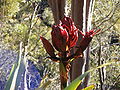
Conservation
Modification of the Australian environment by Indigenous Australians and following European settlement has affected the extent and the distribution of the flora. The changes since 1788 have been rapid and significant: displacement of Indigenous Australians disrupted fire régimes that had been in place for thousands of years; forestry practices have modified the structure of native forests; wetlands have been filled in; and broad scale land-clearing for crops, grazing and urban development has reduced native vegetation cover and led to landscape salinisation, increased sediment, nutrient and salt loads in rivers and streams, loss of habitat and a decline in biodiversity. The intentional and unintentional release of invasiveInvasive species in Australia
Invasive species are a serious threat to the native biodiversity of Australia and are an ongoing cost to Australian agriculture.Management and the prevention of the introduction of new invasive species are key environmental and agricultural policy issues for the Australian federal and state...
plant and animal species into delicate ecosystems is a major threat to floral biodiversity; 20 introduced species have been declared weeds of national significance. Since European settlement of Australia, 61 plant species are known to have become extinct; a further 1,239 species are presently considered threatened.
Protected areas
Protected areas of Australia
Protected areas of Australia include Commonwealth and off-shore protected areas managed by the Australian government, as well as protected areas within each of the six states of Australia and two self-governing territories , which are managed by the eight state and territory...
have been created in every state and territory to protect and preserve the country's unique ecosystems. These protected areas include national parks and other reserves, as well as 64 wetlands registered under the Ramsar Convention
Ramsar Convention
The Ramsar Convention is an international treaty for the conservation and sustainable utilization of wetlands, i.e., to stem the progressive encroachment on and loss of wetlands now and in the future, recognizing the fundamental ecological functions of wetlands and their economic, cultural,...
and 16 World Heritage Site
World Heritage Site
A UNESCO World Heritage Site is a place that is listed by the UNESCO as of special cultural or physical significance...
s. As of 2002, 10.8% (774,619.51 km²) of the total land area of Australia is within protected areas. Protected marine zones have been created in many areas to preserve marine biodiversity; as of 2002, these areas cover about 7% (646,000 km²) of Australia's marine jurisdiction. The Australian Government's Threatened Species Scientific Committee has identified 15 biodiversity hotspot
Biodiversity hotspot
A biodiversity hotspot is a biogeographic region with a significant reservoir of biodiversity that is under threat from humans.The concept of biodiversity hotspots was originated by Norman Myers in two articles in “The Environmentalist” , revised after thorough analysis by Myers and others in...
s in Australian and 85 characteristic ecosystems, as classified by the Interim Biogeographic Regionalisation for Australia, cover the continent; some effort is being made to ensure each is represented within a protected area under Australia's Biodiversity Action Plan
Biodiversity Action Plan
A Biodiversity Action Plan is an internationally recognized program addressing threatened species and habitats and is designed to protect and restore biological systems. The original impetus for these plans derives from the 1992 Convention on Biological Diversity...
.
See also
- List of Australian floral emblems
- List of extinct flora of Australia
- List of flora on stamps of Australia
- List of threatened flora of Australia
- Systematic Census of Australian PlantsSystematic Census of Australian PlantsThe Systematic census of Australian plants, with chronologic, literary and geographic annotations, more commonly known as the Systematic Census of Australian Plants, also known by its standard botanic abbreviation Syst. Census Austral...
Region specific articles
- Flora of the Australian Capital TerritoryFlora of the Australian Capital TerritoryThe Flora of the Australian Capital Territory is the plants that grow naturally in the Australian Capital Territory . The environments range from Alpine area on the higher mountains, sclerophyll forest, to woodland. Much of the ACT has been cleared for grazing, and is also burnt off by bushfires...
- Flora of Western AustraliaFlora of Western AustraliaThe flora of Western Australia comprises 9,437 published native vascular plant species of 1,543 genera within 226 families; there are also 1,171 naturalised alien or invasive plant species more commonly known as weeds...
- List of Nature Conservation Act endangered flora of Queensland
- List of Nature Conservation Act extinct in the wild flora of Queensland
- List of Nature Conservation Act rare flora of Queensland
- List of Nature Conservation Act vulnerable flora of Queensland
External links
- National Vegetation Information System
- Flora of Australia Online
- Australia's Virtual Herbarium
- What's its name? A database for the Australian Plant Name Index
- Census of Freshwater Algae in Australia
- Australian Marine Algal Name Index
- Australian National Botanic Gardens Fungi Web Site
- Prehistoric Life - Plant Fossils of Australia Museum Victoria
- ASGAP - Association of Societies for Growing Australian Plants