
All Topics  
Flexography

 
Flexography

   Email Print
   Bookmark   Link


Flexography


Flexography (often abbreviated to flexo) is a form of printing
Printing

Printing is a process for reproducing text and image, typically with ink on paper using a printing press. It is often carried out as a large-scale industrial process, and is an essential part of publishing and transaction printing....
 process which utilizes a flexible relief plate. It is basically an updated version of letterpress that can be used for printing on almost any type of substrate including plastic, metallic films, cellophane, and paper.


Discussion
Ask a question about 'Flexography'
Start a new discussion about 'Flexography'
Answer questions from other users
Full Discussion Forum


Recent Posts


Encyclopedia


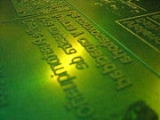
Flexography Platecloseup
Flexography (often abbreviated to flexo) is a form of printing
Printing

Printing is a process for reproducing text and image, typically with ink on paper using a printing press. It is often carried out as a large-scale industrial process, and is an essential part of publishing and transaction printing....
 process which utilizes a flexible relief plate. It is basically an updated version of letterpress that can be used for printing on almost any type of substrate including plastic, metallic films, cellophane, and paper. That's why it's widely used for printing on the non-porous substrates required for various types of food packaging (it is also well suited for printing large areas of solid color).

=History=

The process of flexography was then dubbed “aniline printing,” named for the aniline
Aniline

Aniline, phenylamine or aminobenzene is an organic compound with the Chemical formula C6H7N. It is the simplest and one of the most important aromatic amines, being used as a precursor to more complex chemicals....
 oil used in the ink
Ink

An ink is a liquid containing various pigments and/or dyes used for coloring a surface to produce an , writing, or design. Ink is used for drawing and/or writing with a pen, brush or quill....
, that would be jetted out by the use of Anliox roll. In 1890, the first patented press was built in England
England

native_name =|conventional_long_name = England|common_name = England|image_flag = Flag of England.svg|image_coat = England COA.svg|symbol_type = Royal Coat of Arms...
 by Bibby, Baron and Sons. The water-based ink smeared easily, leading the device to be known as “Bibby’s Folly”. In the early 1900’s, other European presses were developed using rubber printing plates. But by the 1920s, most presses were made in Germany
Germany

Germany , officially the Federal Republic of Germany , is a country in Central Europe. It is bordered to the north by the North Sea, Denmark, and the Baltic Sea; to the east by Poland and the Czech Republic; to the south by Austria and Switzerland; and to the west by France, Luxembourg, Belgium, and the Netherlands....
, where the process was called “gummidruck”.

During the early part of the 20th century, the technique was used extensively in food packaging in the United States
United States

The United States of America is a Federal government constitutional republic comprising U.S. state and a federal district. The country is situated mostly in central North America, where its Contiguous United States and Washington, D.C., the Capital districts and territories, lie between the Pacific Ocean and Atlantic Oceans, Borders of the U...
. However, in the 1940’s, the Food and Drug Administration
Food and Drug Administration

The U.S. Food and Drug Administration is an Government agency of the United States Department of Health and Human Services and is responsible for regulating and supervising the safety of foods, dietary supplements, Medications, vaccines, Biopharmaceutical, blood transfusion, medical devices, Electromagnetic radiation-emitting devices, veteri...
 classified aniline dyes as unsuitable for food packaging. Printing sales plummeted. Individual firms tried using new names for the process, such as “Lustro Printing” and “Transglo Printing,” but met with limited success. Even after the government approved the aniline process, sales continued to decline. Intent on re-popularizing aniline printing by changing its name, Franklin Moss, president of Mosstype Corporation, surveyed the industry in 1951 and received over 200 different name suggestions. In October 1952, the new name was announced; “flexography.”

Evolution


Originally flexographic printing was basic in quality. Labels requiring high quality have generally been printed using the offset
Offset printing

Offset printing is a commonly used printing technique where the inked image is transferred from a plate to a rubber blanket, then to the printing surface....
 process until recently. In the last few years great advances have been made to the quality of flexographic printing presses.

The greatest advances in flexographic printing have been in the area of photopolymer
Photopolymer

A photopolymer is a polymer that cures, or becomes solid, when exposed to light, often in the ultraviolet spectrum. These polymers are useful in dentistry for Dental fillings and in rapid prototyping in the stereolithography and 3D printing processes....
 printing plates, including improvements to the plate material and the method of plate creation.

Digital direct to plate systems have dominated the industry recently with their better resolution and the ability to print four color process (or more) as well as offset. Companies like Dupont, MacDermid, Kodak and Esko have pioneered the latest technologies with advances in FAST washout and the latest screening technology, even companies who make plates in house are going to trade shops to get these high quality plates.

Laser-etched anilox
Anilox

In printing, anilox is a method used to provide a measured amount of ink to a flexography printing plate.An anilox roll is a hard cylinder, usually constructed of a steel or aluminum core which is coated by an industrial ceramic whose surface contains millions of very fine dimples, known as cells....
 rolls also play a part in the improvement of print quality. Full color picture printing is now possible, and some of the finer presses available today, in combination with a skilled operator, allow quality that rivals the lithographic
Lithography

Lithography is a method for printing using a stone or a metal plate with a completely smooth surface. By contrast, in intaglio a plate is engraving, etching or mezzotint to make cavities to contain the printing ink, and in woodblock printing and letterpress ink is applied to the raised surfaces of letters or images....
 process. One ongoing improvement has been the increasing ability to reproduce highlight tonal values, thereby providing a workaround for the very high dot gain
Dot gain

Dot gain is a phenomenon in printing and graphic arts whereby printed dots are perceived and actually printed bigger than intended. This causes a darkening of the screened images or textures, especially in the mid tones and shadows....
 associated with flexographic printing.

=Process Overview=

1. Platemaking
The first method of plate development uses light-sensitive polymer
Polymer

A polymer is a large molecule composed of repeating structural units typically connected by covalent chemical bonds. While polymer in popular usage suggests plastic, the term actually refers to a large class of natural and synthetic materials with a variety of properties....
. A film negative is placed over the plate, which is exposed to ultra-violet light. The polymer hardens where light passes through the film. The remaining polymer has the consistency of chewed gum. It is washed away in a tank of either water or solvent. Brushes scrub the plate to facilitate the "washout" process. The process can differ depending on whether solid sheets of photopolymer or liquid photopolymer are used, but the principle is still the same. The second method used a computer-guided laser to etche the image onto the printing plate. Such a direct laser engraving
Laser engraving

Laser engraving is the practice of using lasers to engraving or mark an object. The technique can be very technical and complex, and often a computer system is used to drive the movements of the laser head....
 process is called digital platemaking. The third method is to go through a molding process. The first step is to create a metal plate out of the negative of our initial image through an exposition process (followed by an acid bath). This metal plate in relief is then used in the second step to create the mold that could be in bakelite
Bakelite

Bakelite is a material based on the thermosetting plastic phenol formaldehyde resin polyoxybenzylmethylenglycolanhydride, developed in 1907?1909 by Demographics of Belgium Dr....
 board or even glass or plastic, through a first molding process. Once cooled, this master mold will press the rubber or plastic compound (under both controlled temperature and pressure) through a second molding process to come up with the printing plate.

2. Printing
A flexographic print is made by creating a positive mirrored master of the required image as a 3D
Three-dimensional space

Three-dimensional space is a geometric model of the physical universe in which we live. The three dimensions are commonly called length, width, and depth , although any three mutually perpendicular directions can serve as the three dimensions....
 relief
Relief

A relief is a sculptured artwork where a modelled form is raised, or in sunken-relief lowered, from a flatish background plane without being disconnected from it....
 in a rubber
Rubber

Natural rubber is an elastomer?an Elasticity_ hydrocarbon polymer?that was originally derived from a milky colloidal suspension, or latex , found in the sap of some plants....
 or polymer
Polymer

A polymer is a large molecule composed of repeating structural units typically connected by covalent chemical bonds. While polymer in popular usage suggests plastic, the term actually refers to a large class of natural and synthetic materials with a variety of properties....
 material. Flexographic plates can be created with analog and digital platemaking processes. The image areas are raised above the non image areas on the rubber or polymer plate. The ink is transferred from the ink roll which is partially immerged in the ink tank. Then it transfers to the anilox
Anilox

In printing, anilox is a method used to provide a measured amount of ink to a flexography printing plate.An anilox roll is a hard cylinder, usually constructed of a steel or aluminum core which is coated by an industrial ceramic whose surface contains millions of very fine dimples, known as cells....
 roll (or meter roll) whose texture holds a specific amount of ink since it's covered with thousands of small wells or cups that enable it to meter ink to the printing plate in a uniform thickness evenly and quickly (the number of cells per linear inch can vary according to the type of print job and the quality required). To avoid getting a final product with a smudgy or lumpy look it must be ensured that the amount of ink on the printing plate is not excessive. This is achived by using a scraper, called a doctor blade. The doctor blade removes excess ink from anilox roller before inking the printing plate. The substrate is finally sandwiched between the plate and the impression cylinder to transfer the image.

Flexographic printing inks

The nature and demands of the printing process and the application of the printed product determine the fundamental properties required of flexographic inks. Measuring the physical properties of inks and understanding how these are affected by the choice of ingredients is a large part of ink technology. Formulation of inks requires a detailed knowledge of the physical and chemical properties of the raw materials composing the inks, and how these ingredients affect or react with each other as well as with the environment. Flexographic printing inks are primarily formulated to remain compatible with the wide variety of substrates used in the process. Each formulation component individually fulfils a special function and the proportion and composition will vary according to the substrate.

There are four types of inks that can be used in flexography: Solvent-based Inks, Water-based Inks, EB (Electron Beam) curing inks and UV(ultraviolet) Curing Inks.

=Applications=

Flexo has an advantage over lithography in that it can use a wider range of inks, water based rather than oil based inks, and is good at printing on a variety of different materials like plastic, foil, acetate film, brown paper, and other materials used in packaging. Typical products printed using flexography include brown corrugated boxes, flexible packaging including retail and shopping bags, food and hygiene bags and sacks, milk and beverage cartons, flexible plastics, self adhesive labels, disposable cups and containers, envelopes and wallpaper. A number of newspapers now eschew the more common offset lithography process in favour of flexo. Flexographic inks, like those used in gravure and unlike those used in lithography, generally have a low viscosity
Viscosity

Viscosity is a measure of the Drag of a fluid which is being deformed by either shear stress or extensional stress. In everyday terms , viscosity is "thickness"....
. This enables faster drying and, as a result, faster production, which results in lower costs.

Printing press speeds of up to 600 meters per minute (2000 feet per minute) are achieveable now with modern technology high-end printers, like Flexotecnica , which introduced the world's first 12-color central impression (CI) drum press at Drupa 2008. This groundbreaking technology won the prestigious FlexoTech (UK) Innovation Award in 2008 .

Other press formats, such as in-line and stack presses, are available from Tresu and other suppliers.

=Education=

The Flexo in Education Program, formerly The Flexo in High School Program, was started at South Mecklenburg High School in Charlotte, North Carolina
Charlotte, North Carolina

Charlotte is the largest city in the state of North Carolina and the seat of Mecklenburg County, North Carolina. The List of United States cities by population in the United States....
 by the Flexographic Technical Association in 1993. Since its inception many other high school programs have been started. For example Asheville High School in Asheville, NC, The Applied Technology Center in Rock Hill, SC, Fort Mill High School in Fort Mill, SC, and others. The program has even gone international with the inclusion of Gordon Graydon Memorial Secondary School
Gordon Graydon Memorial Secondary School

Gordon Graydon Memorial Secondary School, "Gordon Graydon" or simply "Graydon" or "GGMSS" for short, is a high school serving Grades 9 to 12, located at at 1490 Ogden Avenue in Mississauga, Ontario, Canada....
 in Mississauga, Ontario, Canada. The program was re-named to become The Flexo in Education Program because post-secondary institutions began to participate in the program. Many technical colleges and universities incorporate flexography into their curriculum. For example and at , , , , the Graphic Communications Management
Heidelberg Centre - School of Graphic Communications Management

The Heidelberg Centre is the home of the School of Graphic Communications Management at Ryerson University.The 5-storey building at 125 Bond Street cost $10.61 million to build and was designed by Moffat Kinoshita Architects....
 program at Ryerson University
Ryerson University

Ryerson University is a public research university located in downtown Toronto, Canada. It has 24,000 full-time students, and offers undergraduate and graduate degree programs....
, , and others include flexography in their curriculum.

Sadly, Charlotte-Mecklenburg Schools, the school district where Flexo in Education got its start, announced in 2008 that the first ever Flexo in High School program at South Mecklenburg High School would be discontinued. The building where their flexography lab was located was demolished Monday, July 7, 2008, to make way for a new 3-story building to house the school's science and technology department. The school district determined that it would be too difficult and expensive to move, store, and re-install press and equipment in the old lab. It was, instead, donated to another school in North Carolina to start a new flexo program.

Footnotes


Notations


External Links

FlexoGlobal http://www.flexoglobal.com