

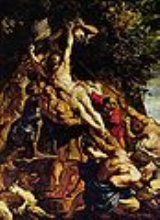
Flemish Baroque painting

Encyclopedia
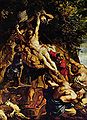
Southern Netherlands
Southern Netherlands were a part of the Low Countries controlled by Spain , Austria and annexed by France...
between about 1585, when the Dutch Republic
Dutch Republic
The Dutch Republic — officially known as the Republic of the Seven United Netherlands , the Republic of the United Netherlands, or the Republic of the Seven United Provinces — was a republic in Europe existing from 1581 to 1795, preceding the Batavian Republic and ultimately...
was split from the Habsburg Spain
Habsburg Spain
Habsburg Spain refers to the history of Spain over the 16th and 17th centuries , when Spain was ruled by the major branch of the Habsburg dynasty...
regions to the south by the recapturing of Antwerp by the Spanish, until about 1700, when Habsburg authority ended with the death of King Charles II
Charles II of Spain
Charles II was the last Habsburg King of Spain and the ruler of large parts of Italy, the Spanish territories in the Southern Low Countries, and Spain's overseas Empire, stretching from the Americas to the Spanish East Indies...
. Antwerp, home to the prominent artists Peter Paul Rubens, Anthony van Dyck
Anthony van Dyck
Sir Anthony van Dyck was a Flemish Baroque artist who became the leading court painter in England. He is most famous for his portraits of Charles I of England and his family and court, painted with a relaxed elegance that was to be the dominant influence on English portrait-painting for the next...
, and Jacob Jordaens
Jacob Jordaens
Jacob Jordaens was one of three Flemish Baroque painters, along with Peter Paul Rubens and Anthony van Dyck, to bring prestige to the Antwerp school of painting. Unlike those contemporaries he never traveled abroad to study Italian painting, and his career is marked by an indifference to their...
, was the artistic nexus, while other notable cities include Brussels
Brussels
Brussels , officially the Brussels Region or Brussels-Capital Region , is the capital of Belgium and the de facto capital of the European Union...
and Ghent
Ghent
Ghent is a city and a municipality located in the Flemish region of Belgium. It is the capital and biggest city of the East Flanders province. The city started as a settlement at the confluence of the Rivers Scheldt and Lys and in the Middle Ages became one of the largest and richest cities of...
.
Rubens, in particular, had a strong influence on seventeenth-century visual culture. His innovations helped define Antwerp as one of Europe's major artistic cities, especially for Counter Reformation imagery, and his student Van Dyck was instrumental in establishing new directions in English portraiture. Other developments in Flemish Baroque
Baroque
The Baroque is a period and the style that used exaggerated motion and clear, easily interpreted detail to produce drama, tension, exuberance, and grandeur in sculpture, painting, literature, dance, and music...
painting are similar to those found in Dutch Golden Age painting
Dutch Golden Age painting
Dutch Golden Age painting is the painting of the Dutch Golden Age, a period in Dutch history generally spanning the 17th century, during and after the later part of the Eighty Years War for Dutch independence. The new Dutch Republic was the most prosperous nation in Europe, and led European trade,...
, with artists specializing in such areas as history painting
History painting
History painting is a genre in painting defined by subject matter rather than an artistic style, depicting a moment in a narrative story, rather than a static subject such as a portrait...
, portraiture
Portrait painting
Portrait painting is a genre in painting, where the intent is to depict the visual appearance of the subject. Beside human beings, animals, pets and even inanimate objects can be chosen as the subject for a portrait...
, genre painting
Genre painting
Genre works, also called genre scenes or genre views, are pictorial representations in any of various media that represent scenes or events from everyday life, such as markets, domestic settings, interiors, parties, inn scenes, and street scenes. Such representations may be realistic, imagined, or...
, landscape painting, and still life
Still life
A still life is a work of art depicting mostly inanimate subject matter, typically commonplace objects which may be either natural or man-made...
.
General characteristics
"Flemish", in the context of this and artistic periods such as Flemish Primitives, often includes the regions not associated with modern FlandersFlanders
Flanders is the community of the Flemings but also one of the institutions in Belgium, and a geographical region located in parts of present-day Belgium, France and the Netherlands. "Flanders" can also refer to the northern part of Belgium that contains Brussels, Bruges, Ghent and Antwerp...
, including the Duchy of Brabant
Duchy of Brabant
The Duchy of Brabant was a historical region in the Low Countries. Its territory consisted essentially of the three modern-day Belgian provinces of Flemish Brabant, Walloon Brabant and Antwerp, the Brussels-Capital Region and most of the present-day Dutch province of North Brabant.The Flag of...
and the autonomous Prince-Bishopric of Liège. By the seventeenth-century, however, Antwerp was the main city for innovative artistic production, largely due to the presence of Rubens. Brussels was important as the location of the court, attracting David Teniers the Younger
David Teniers the Younger
David Teniers the Younger was a Flemish artist born in Antwerp, the son of David Teniers the Elder. His son David Teniers III and his grandson David Teniers IV were also painters...
later in the century.
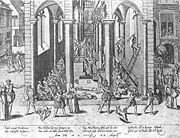
Late Mannerism
Although paintings produced at the end of the 16th century belong to general Northern Mannerist and Late RenaissanceRenaissance
The Renaissance was a cultural movement that spanned roughly the 14th to the 17th century, beginning in Italy in the Late Middle Ages and later spreading to the rest of Europe. The term is also used more loosely to refer to the historical era, but since the changes of the Renaissance were not...
approaches that were common throughout Europe, artists such as Otto van Veen
Otto van Veen
Otto van Veen, also known by his Latinized name Otto Venius or Octavius Vaenius, was a painter, draughtsman, and humanist active primarily in Antwerp and Brussels in the late sixteenth and early seventeenth century...
, Adam van Noort
Adam van Noort
Adam van Noort was a Flemish painter and draughtsman.Van Noort was born and died in Antwerp. He was the teacher to both Peter Paul Rubens and Jacob Jordaens, the latter of whom became his son-in-law. Van Noort was dean of the Guild of St. Luke from 1597 until 1602...
, Marten de Vos
Marten de Vos
Marten de Vos , also Maarten, was a leading Antwerp painter and draughtsman in the late sixteenth century.-Biography:Like Frans Floris, he travelled to Italy and adopted the mannerist style popular at the time. De Vos was also highly influenced by the colors of Venetian painting, and might have...
, and the Francken
Francken
In the Francken family of Antwerp in the 16th and 17th centuries were 11 painters. Many bore the same Christian name in succession. Hence there is confusion in the classification of paintings not differing widely in style or execution...
family were particularly instrumental in setting the stage for the local Baroque. Between 1585 and the early 17th century they made many new altarpiece
Altarpiece
An altarpiece is a picture or relief representing a religious subject and suspended in a frame behind the altar of a church. The altarpiece is often made up of two or more separate panels created using a technique known as panel painting. It is then called a diptych, triptych or polyptych for two,...
s to replace those destroyed during the iconoclastic
Iconoclasm
Iconoclasm is the deliberate destruction of religious icons and other symbols or monuments, usually with religious or political motives. It is a frequent component of major political or religious changes...
outbreaks of 1566
Beeldenstorm
Beeldenstorm in Dutch, roughly translatable to "statue storm", or Bildersturm in German , also the Iconoclastic Fury, is a term used for outbreaks of destruction of religious images that occurred in Europe in the 16th century...
. Also during this time Frans Francken the Younger
Frans Francken the Younger
Frans Francken the Younger , was a Flemish Baroque painter and the best-known member of the large Francken family of artists....
and Jan Brueghel the Elder
Jan Brueghel the Elder
Jan Brueghel the Elder was a Flemish painter, son of Pieter Bruegel the Elder and father of Jan Brueghel the Younger. Nicknamed "Velvet" Brueghel, "Flower" Brueghel, and "Paradise" Brueghel, of which the latter two were derived from his floral still lifes which were his favored subjects, while the...
became important for their small cabinet painting
Cabinet painting
A cabinet painting is a small painting, typically no larger than about two feet in either dimension, but often much smaller. The term is especially used of paintings that show full-length figures at a small scale, as opposed to say a head painted nearly life-size, and that are painted very...
s, often depicting mythological
Mythology
The term mythology can refer either to the study of myths, or to a body or collection of myths. As examples, comparative mythology is the study of connections between myths from different cultures, whereas Greek mythology is the body of myths from ancient Greece...
and history subjects.
"The Age of Rubens"
Peter Paul Rubens (1577–1640), a student of both Otto van Veen and Adam van Noort, spent eight years in Italy (1600–1608), during which time he studied examples of classical antiquityClassical antiquity
Classical antiquity is a broad term for a long period of cultural history centered on the Mediterranean Sea, comprising the interlocking civilizations of ancient Greece and ancient Rome, collectively known as the Greco-Roman world...
, the Italian Renaissance
Italian Renaissance
The Italian Renaissance began the opening phase of the Renaissance, a period of great cultural change and achievement in Europe that spanned the period from the end of the 13th century to about 1600, marking the transition between Medieval and Early Modern Europe...
, and contemporaries Adam Elsheimer
Adam Elsheimer
Adam Elsheimer was a German artist working in Rome who died at only thirty-two, but was very influential in the early 17th century. His relatively few paintings were small scale, nearly all painted on copper plates, of the type often known as cabinet paintings. They include a variety of light...
and Caravaggio
Caravaggio
Michelangelo Merisi da Caravaggio was an Italian artist active in Rome, Naples, Malta, and Sicily between 1593 and 1610. His paintings, which combine a realistic observation of the human state, both physical and emotional, with a dramatic use of lighting, had a formative influence on the Baroque...
. Following his return to Antwerp he set up an important studio, training students such as Anthony van Dyck, and generally exerting a strong influence on the direction of Flemish art. Most artists active in the city during the first half of the 17th century were directly influenced by Rubens.
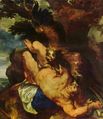
Specializations and collaborations
Flemish art is notable for the large amount of collaboration that took place between independent masters, which was partly related to the local tendency to specialize in a particular area. Frans Snyders, for example, was an animal painter and Jan Brueghel the Elder was admired for his landscapes and paintings of plants. Both artists worked with Rubens, who often usually painted the figures, and other artists to create collaborative pieces.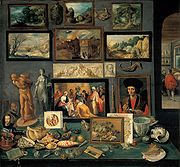
Innovations
Flower still lifeStill life
A still life is a work of art depicting mostly inanimate subject matter, typically commonplace objects which may be either natural or man-made...
painting, which developed around 1600 by artists such as Jan Brueghel the Elder, was partially a Flemish innovation, echoed in the Dutch Republic in the works of the Antwerp-born Ambrosius Bosschaert the Elder (1573–1621). In Antwerp, however, this new genre also developed into a specifically Catholic
Catholic
The word catholic comes from the Greek phrase , meaning "on the whole," "according to the whole" or "in general", and is a combination of the Greek words meaning "about" and meaning "whole"...
type of painting, the flower garland. Other types of paintings closely associated with Flemish Baroque include the monumental hunting scenes by Rubens and Snyders, and gallery paintings by artists such as Willem van Haecht
Willem van Haecht
Willem van Haecht was a Flemish Baroque painter best known for his gallery pictures and the son of the landscape painter Tobias Verhaecht. He studied under Peter Paul Rubens, worked in Paris from 1615 to 1619, and then travelled to Italy for about seven years. Van Haecht became a master in...
and David Teniers the Younger
David Teniers the Younger
David Teniers the Younger was a Flemish artist born in Antwerp, the son of David Teniers the Elder. His son David Teniers III and his grandson David Teniers IV were also painters...
.
History painting
History painting, which includes biblical, mythological and historical subjects, was considered by seventeenth-century theoreticians as the most noble art. Abraham JanssensAbraham Janssens
Abraham Janssens van Nuyssen was a Flemish Baroque painter.He was born at Antwerp, in a year variously reported between 1567 and 1576. He studied under Jan Snellinck, was a master in 1602, and in 1607 was dean of the master-painters...
was an important history painter in Antwerp between 1600 and 1620, although after 1609 Rubens was the leading figure. Both Van Dyck and Jacob Jordaens
Jacob Jordaens
Jacob Jordaens was one of three Flemish Baroque painters, along with Peter Paul Rubens and Anthony van Dyck, to bring prestige to the Antwerp school of painting. Unlike those contemporaries he never traveled abroad to study Italian painting, and his career is marked by an indifference to their...
were active painting monumental history scenes. Following Rubens's death, Jordaens became the most important Flemish painter. Other notable artists working in the idiom of Rubens include Gaspar de Crayer, who was active in Brussels, Artus Wolffort
Artus Wolffort
Artus Wolffort , also Wolffaert, was a Flemish Baroque painter from Antwerp.-Biography:He studied first in Dordrecht, where his family had emigrated in 1581, and after his return to Antwerp around 1615 in the studio of Otto van Veen...
, Cornelis de Vos
Cornelis de Vos
right|thumb|Cornelis de Vos, Family portrait, 1631, 165 x 235 cm, Oil on canvas, [[Royal Museum of Fine Arts, Antwerp]]Cornelis de Vos , was a Flemish Baroque painter best known for his portraiture....
, Jan Cossiers
Jan Cossiers
Jan Cossiers was a Flemish Baroque painter whose earliest works were Caravaggesque genre scenes and later specialized in histories and religious subjects.-Biography:...
, Theodoor van Thulden
Theodoor van Thulden
Theodoor van Thulden was a Dutch Baroque artist from 's-Hertogenbosch in North Brabant who was active in that city and in Antwerp.-Biography:...
, Abraham van Diepenbeeck
Abraham van Diepenbeeck
Abraham van Diepenbeeck was an erudite and accomplished Dutch painter of the Flemish School.-Biography:...
, and Jan Boeckhorst
Jan Boeckhorst
Jan Boeckhorst , was a German-born Flemish Baroque painter whose style was heavily influenced by Peter Paul Rubens, Anthony van Dyck and Jacob Jordaens.-Biography:...
. During the second half of the century, history painters combined a local influence from Rubens with knowledge of classicism
Classicism
Classicism, in the arts, refers generally to a high regard for classical antiquity, as setting standards for taste which the classicists seek to emulate. The art of classicism typically seeks to be formal and restrained: of the Discobolus Sir Kenneth Clark observed, "if we object to his restraint...
and Italian Baroque
Baroque
The Baroque is a period and the style that used exaggerated motion and clear, easily interpreted detail to produce drama, tension, exuberance, and grandeur in sculpture, painting, literature, dance, and music...
qualities. Artists in the vein include Erasmus Quellinus the Younger, Jan van den Hoecke
Jan van den Hoecke
Jan van den Hoecke , also known as Johannes or Giovanni and van Hoek, van Hoeck, or Vanhoek, was a Flemish Baroque painter and draughtsman. He was born and died in Antwerp.-Biography:...
, Pieter van Lint
Pieter van Lint
Pieter van Lint was a Flemish Baroque painter, active in Antwerp and Italy, who painted both religious subjects and genre scenes.-Biography:...
, Cornelis Schut
Cornelis Schut
Cornelis Schut was a Flemish Baroque painter, draughtsman and engraver active in Italy and Antwerp.-Biography:...
, and Thomas Willeboirts Bosschaert. Later in the century, many painters turned to Anthony van Dyck as a major influence. Among them were Pieter Thijs
Pieter Thijs
Pieter Thijs, or Peeter Tysens was a Flemish Baroque painter whose work was heavily influenced by the courtly and elegant style of Anthony van Dyck.-Biography:...
, Lucas Franchoys the Younger
Lucas Franchoys the Younger
Lucas Franchoys the Younger or Francois was a Flemish Baroque painter from Mechelen, a town for which he painted numerous altarpieces influenced by the works of Anthony van Dyck.-Biography:...
, and artists who were also inspired by Late Baroque theatricality such as Theodoor Boeyermans
Theodoor Boeyermans
Theodoor Boeyermans was a Flemish Baroque painter from Antwerp who painted classicizing works informed by the tradition of Peter Paul Rubens. In addition he made numerous altarpieces for Flemish churches, group portraits, and allegories. Boeyermans's work also shares a close affinity with his...
and Jan-Erasmus Quellinus
Jan-Erasmus Quellinus
Jan-Erasmus Quellinus was a Flemish Baroque painter of large altarpieces and histories influenced by Paolo Veronese and his father Erasmus Quellinus the Younger.-Biography:...
. Additionally, a Flemish variant of Caravaggism was expressed by Theodoor Rombouts
Theodoor Rombouts
Theodoor Rombouts was a Flemish Baroque painter specializing in Caravaggesque genre scenes of card players and musicians.-Biography:...
and Gerard Seghers
Gerard Seghers
Gerard Seghers , also Zegers, was a Flemish Baroque painter and one of the leading Caravaggisti in the Southern Netherlands.-Biography:...
.
Religious painting
Rubens is closely associated with the development of the Baroque altarpieceAltarpiece
An altarpiece is a picture or relief representing a religious subject and suspended in a frame behind the altar of a church. The altarpiece is often made up of two or more separate panels created using a technique known as panel painting. It is then called a diptych, triptych or polyptych for two,...
. Painted for the Arquebusiers' guild
Guild
A guild is an association of craftsmen in a particular trade. The earliest types of guild were formed as confraternities of workers. They were organized in a manner something between a trade union, a cartel, and a secret society...
, the Descent from the Cross
Descent from the Cross
The Descent from the Cross , or Deposition of Christ, is the scene, as depicted in art, from the Gospels' accounts of Joseph of Arimathea and Nicodemus taking Christ down from the cross after his crucifixion . In Byzantine art the topic became popular in the 9th century, and in the West from the...
triptych
Triptych
A triptych , from tri-= "three" + ptysso= "to fold") is a work of art which is divided into three sections, or three carved panels which are hinged together and can be folded shut or displayed open. It is therefore a type of polyptych, the term for all multi-panel works...
(1611–14; Cathedral of Our Lady, Antwerp
Cathedral of Our Lady, Antwerp
The Cathedral of Our Lady is a Roman Catholic cathedral in Antwerp, Belgium. Today's see of the Diocese of Antwerp was started in 1352 and, although the first stage of construction was ended in 1521, has never been 'completed'. In Gothic style, its architects were Jan and Pieter Appelmans...
)—with side wings depicting the Visitation and Presentation in the Temple
Presentation of Jesus at the Temple
The Presentation of Jesus at the Temple, which falls on 2 February, celebrates an early episode in the life of Jesus. In the Eastern Orthodox Church and some Eastern Catholic Churches, it is one of the twelve Great Feasts, and is sometimes called Hypapante...
, and exterior panels showing St. Christopher and the Hermit—is an important reflection of Counter-Reformation ideas about art combined with Baroque naturalism, dynamism and monumentality. Roger de Piles
Roger de Piles
Roger de Piles was a French painter, engraver, art critic and diplomat.-Life:Born in Clamecy, Roger de Piles started his career in art as a pupil of Claude François....
explains that "the painter has entered so fully into the expression of his subject that the sight of this work has the power to touch a hardened soul and cause it to experience the sufferings endured by Jesus Christ in order to redeem it."
Portraiture
Although not predominately a portrait painter, Rubens's contributions include early works such as his Portrait of Brigida Spinola-Doria (1606, National Gallery of ArtNational Gallery of Art
The National Gallery of Art and its Sculpture Garden is a national art museum, located on the National Mall between 3rd and 9th Streets at Constitution Avenue NW, in Washington, DC...
, Washington, D.C.
Washington, D.C.
Washington, D.C., formally the District of Columbia and commonly referred to as Washington, "the District", or simply D.C., is the capital of the United States. On July 16, 1790, the United States Congress approved the creation of a permanent national capital as permitted by the U.S. Constitution....
), paintings of his wives (the Honeysuckle Bower
Honeysuckle Bower
The Honeysuckle Bower is a self-portrait of the Flemish Baroque painter Peter Paul Rubens and his first wife Isabella Brant. They wed on October 3, 1609, in St. Michael's Abbey in Antwerp, shortly after he had returned to the city after eight years in Italy.The painting is a full-length double...
and Het Pelsken), and numerous portraits of friends and nobility. He also exerted a strong influence on Baroque portraiture through his student Anthony van Dyck
Anthony van Dyck
Sir Anthony van Dyck was a Flemish Baroque artist who became the leading court painter in England. He is most famous for his portraits of Charles I of England and his family and court, painted with a relaxed elegance that was to be the dominant influence on English portrait-painting for the next...
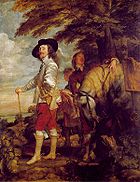
. Van Dyck became court painter for Charles I of England
Charles I of England
Charles I was King of England, King of Scotland, and King of Ireland from 27 March 1625 until his execution in 1649. Charles engaged in a struggle for power with the Parliament of England, attempting to obtain royal revenue whilst Parliament sought to curb his Royal prerogative which Charles...
and was influential on subsequent English portraiture. Other successful portraitists include Cornelis de Vos
Cornelis de Vos
right|thumb|Cornelis de Vos, Family portrait, 1631, 165 x 235 cm, Oil on canvas, [[Royal Museum of Fine Arts, Antwerp]]Cornelis de Vos , was a Flemish Baroque painter best known for his portraiture....
and Jacob Jordaens
Jacob Jordaens
Jacob Jordaens was one of three Flemish Baroque painters, along with Peter Paul Rubens and Anthony van Dyck, to bring prestige to the Antwerp school of painting. Unlike those contemporaries he never traveled abroad to study Italian painting, and his career is marked by an indifference to their...
. Although most Flemish portraiture is life-sized or monumental, Gonzales Coques and Gillis van Tilborch
Gillis van Tilborch
Gillis van Tilborch was a Flemish Baroque painter who specialised in group portraits and both "low-life" and elegant genre paintings. He possibly studied under David Teniers the Younger, and joined the Brussels painters' guild in 1654. HIs portraits of bourgeois sitters are similar to those of...
specialized in small-scale group portraiture.
Genre painting
Genre paintingGenre painting
Genre works, also called genre scenes or genre views, are pictorial representations in any of various media that represent scenes or events from everyday life, such as markets, domestic settings, interiors, parties, inn scenes, and street scenes. Such representations may be realistic, imagined, or...
s, or scenes of everyday life, are common in the 17th century. Many artists follow the tradition of Pieter Bruegel the Elder in depicting "low-life" peasant themes, although elegant "high-life" subjects featuring fashionably-dressed couples at balls
Ball (dance)
A ball is a formal dance. The word 'ball' is derived from the Latin word "ballare", meaning 'to dance'; the term also derived into "bailar", which is the Spanish and Portuguese word for dance . In Catalan it is the same word, 'ball', for the dance event.Attendees wear evening attire, which is...
or in gardens of love are also common. Adriaen Brouwer
Adriaen Brouwer
Adriaen Brouwer was a Flemish genre painter active in Flanders and the Dutch Republic in the seventeenth century.-Biography:...
, whose small paintings often show peasants fighting and drinking, was particularly influential on subsequent artists. Images of woman performing household tasks, popularized in the northern Netherlands by Pieter de Hooch
Pieter de Hooch
Pieter de Hooch was a genre painter during the Dutch Golden Age. He was a contemporary of Dutch Master Jan Vermeer, with whom his work shared themes and style.-Biography:...
and Jan Vermeer, is not a significant subject in the south, although artists such as Jan Siberechts
Jan Siberechts
Jan Siberechts was a Flemish Baroque landscape painter. He was born in Antwerp, the son of a sculptor with the same name. After establishing himself as an artist in Flanders, he moved to England during his forties.He died in London.-References:...
explored these themes to some degree.
Bruegel tradition
Flemish genre painting is strongly tied to the traditions of Pieter Bruegel the Elder and was a style that continued directly into the 17th century through copies and new compositions made by his sons Pieter Brueghel the YoungerPieter Brueghel the Younger
Pieter Brueghel the Younger /ˈpitəɾ ˈbɾøːxəl/ was a Flemish painter, known for numerous copies after his father Pieter Brueghel the Elder's paintings and nicknamed "Hell Brueghel" for his fantastic treatments of fire and grotesque imagery.-Life:Pieter Brueghel the Younger was the oldest son of the...
and Jan Brueghel the Elder
Jan Brueghel the Elder
Jan Brueghel the Elder was a Flemish painter, son of Pieter Bruegel the Elder and father of Jan Brueghel the Younger. Nicknamed "Velvet" Brueghel, "Flower" Brueghel, and "Paradise" Brueghel, of which the latter two were derived from his floral still lifes which were his favored subjects, while the...
. Many of these are kermis paintings and scenes of peasants partaking other outdoor enjoyments viewed from an elevated viewpoint. Artists in the Dutch Republic, such as the Flemish-born David Vinckboons
David Vinckboons
David Vinckboons was a Dutch Golden Age painter of Flemish origin.-Biography:Vinckboons was one of the most prolific and popular painters and print designers in the Netherlands...
and Roelandt Savery, also made similar works, popularizing rustic scenes of everyday life closely associated with Dutch and Flemish painting.
Adriaen Brouwer and his followers
Adriaen BrouwerAdriaen Brouwer
Adriaen Brouwer was a Flemish genre painter active in Flanders and the Dutch Republic in the seventeenth century.-Biography:...
(1605 or 1606–1638) typically painted small scenes of ragged peasants fighting, gaming, drinking and generally expressing exaggerated and rude behaviour. Born in the Southern Netherlands, Brouwer spent the 1620s in Amsterdam
Amsterdam
Amsterdam is the largest city and the capital of the Netherlands. The current position of Amsterdam as capital city of the Kingdom of the Netherlands is governed by the constitution of August 24, 1815 and its successors. Amsterdam has a population of 783,364 within city limits, an urban population...
and Haarlem
Haarlem
Haarlem is a municipality and a city in the Netherlands. It is the capital of the province of North Holland, the northern half of Holland, which at one time was the most powerful of the seven provinces of the Dutch Republic...
, where he came under the influence of Frans
Frans Hals
Frans Hals was a Dutch Golden Age painter. He is notable for his loose painterly brushwork, and helped introduce this lively style of painting into Dutch art. Hals was also instrumental in the evolution of 17th century group portraiture.-Biography:Hals was born in 1580 or 1581, in Antwerp...
and Dirk Hals and other artists working in a loose painterly
Painterly
Painterliness is a translation of the German term , a word popularized by Swiss art historian Heinrich Wölfflin in order to help focus, enrich and standardize the terms being used by art historians of his time to characterize works of art...
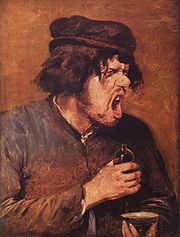
manner. Upon his return to Antwerp around 1631 or 1632 he introduced a new, influential format in which the subjects were painted as interior, instead of exterior, scenes. He also painted expressive facial studies like The Bitter Drink (illustrated), a genre called tronie
Tronie
A tronie is a common type, or group of types, of works of Dutch Golden Age painting and Flemish Baroque painting that shows an exaggerated facial expression or a stock character in costume...
s ("faces"). Brouwer's art was recognized in his own lifetime and had a powerful impact on Flemish art. Rubens owned more works by him at the time of his death than any other painter, and artists such as David Teniers the Younger
David Teniers the Younger
David Teniers the Younger was a Flemish artist born in Antwerp, the son of David Teniers the Elder. His son David Teniers III and his grandson David Teniers IV were also painters...
, Jan van de Venne
Jan van de Venne
Jan van de Venne , also Van de Vinnen and formally identified as the Dutch or Flemish painter Pseudo van de Venne, was a Flemish Baroque painter who specialized in "low-life" genre scenes of tooth-pullers, card-players and hurdy-gurdy musicians similar to the themes and styles of his contemporary...
, Joos van Craesbeeck
Joos van Craesbeeck
'Joos van Craesbeeck' was a Flemish painter who specialized in tavern interiors, tronies, and other works similar to his teacher Adriaen Brouwer. Born in Neerlinter , he became a master in Antwerp's guild of St...
and David Ryckaert III
David Ryckaert III
David Ryckaert III, sometimes called The Younger was a Flemish painter.-Biography:...
continued to work in a similar manner.
Elegant company scenes
Paintings of elegant couples in the latest fashions, often with underlying themes of love or the five senses, were commonly painted by Hieronymous Francken the YoungerFrancken
In the Francken family of Antwerp in the 16th and 17th centuries were 11 painters. Many bore the same Christian name in succession. Hence there is confusion in the classification of paintings not differing widely in style or execution...
, Louis de Caullery
Louis de Caullery
Louis de Caullery was one of the pioneers of the genre of courtly gatherings in Flemish painting of the 17th century.-Biography:According to the RKD he was born in Caulery, which is a small town near Cambrai...
, Simon de Vos
Simon de Vos
Simon de Vos was a Flemish Baroque painter of genre and cabinet pictures.-Biography:De Vos studied with Cornelis de Vos , to whom he is not related, from 1615 until 1620. In 1620 he joined Antwerp's guild of St...
, David Teniers the Younger
David Teniers the Younger
David Teniers the Younger was a Flemish artist born in Antwerp, the son of David Teniers the Elder. His son David Teniers III and his grandson David Teniers IV were also painters...
and David Ryckaert III
David Ryckaert III
David Ryckaert III, sometimes called The Younger was a Flemish painter.-Biography:...
. Rubens's Garden of Love (c. 1634–5; Prado Museum) belongs to these traditions.
Monumental genre scenes
Whereas elegant company scenes and works by Brouwer and his followers were often small in scale, other artists looked to CaravaggioCaravaggio
Michelangelo Merisi da Caravaggio was an Italian artist active in Rome, Naples, Malta, and Sicily between 1593 and 1610. His paintings, which combine a realistic observation of the human state, both physical and emotional, with a dramatic use of lighting, had a formative influence on the Baroque...
for inspiration and painted large-scale, theatrically inspired scenes in which musicians, cardplayers, and fortune tellers are pushed to the foreground of the composition. These paintings, like others by Caravaggisti, are generally illuminated by strong lighting effects. Adam de Coster
Adam de Coster
Adam de Coster was a Flemish Baroque painter working under the influence of Caravaggism.-Biography:Originally from Mechelen, he is listed in Antwerp's guild of St. Luke as a master in 1607–1608...
, Gerard Seghers
Gerard Seghers
Gerard Seghers , also Zegers, was a Flemish Baroque painter and one of the leading Caravaggisti in the Southern Netherlands.-Biography:...
and Theodoor Rombouts
Theodoor Rombouts
Theodoor Rombouts was a Flemish Baroque painter specializing in Caravaggesque genre scenes of card players and musicians.-Biography:...
were the main exponents of this popular style in the early 17th century, which was popularized by Italian followers of Caravaggio like Bartolomeo Manfredi
Bartolomeo Manfredi
Bartolomeo Manfredi was an Italian painter, a leading member of the Caravaggisti of the early 17th century.Manfredi was born in Ostiano, near Cremona...
and Utrecht Caravaggisti like Gerrit van Honthorst. Rombouts was also influenced by his teacher Abraham Janssens
Abraham Janssens
Abraham Janssens van Nuyssen was a Flemish Baroque painter.He was born at Antwerp, in a year variously reported between 1567 and 1576. He studied under Jan Snellinck, was a master in 1602, and in 1607 was dean of the master-painters...
, who began incorporating Caravaggesque influences into his history paintings from first decade of the 17th century
.
Jacob Jordaens
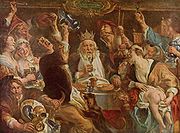
Jacob Jordaens, who became Antwerp's most important artist after Rubens's death in 1640, is well-known for his monumental genre paintings of subjects such as The King Drinks and As the Old Sing, So Pipe the Young. Many of these paintings use compositional and lighting influences similar to those of the Caravaggisti, while the treatment of the subjects inspired Dutch artists like Jan SteenJan Steen
Jan Havickszoon Steen was a Dutch genre painter of the 17th century . Psychological insight, sense of humour and abundance of colour are marks of his trade.-Life:...
.
Battle scenes
Another popular type of painting invented in the Low CountriesLow Countries
The Low Countries are the historical lands around the low-lying delta of the Rhine, Scheldt, and Meuse rivers, including the modern countries of Belgium, the Netherlands, Luxembourg and parts of northern France and western Germany....
was landscapes with historical and fictional battles, as well as skirmishes and robberies. Sebastiaen Vrancx and his pupil Pieter Snayers
Pieter Snayers
Pieter Snayers was a Flemish Baroque painter known for representations of historical battle scenes.Born in Antwerp, he studied under Sebastiaen Vrancx before joining Antwerp's Guild of St. Luke in 1612...
specialized in this genre, and Snayer's student Adam-Frans van der Meulen continued painting them in Antwerp, Brussels and Paris
Paris
Paris is the capital and largest city in France, situated on the river Seine, in northern France, at the heart of the Île-de-France region...
until the end of the century.
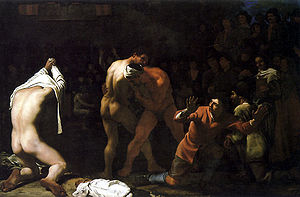
Bamboccianti and Italian classicism
Following a time-honoured tradition, many northern artists travelled to Italy in the 17th century. Flemish artists such as Jan MielJan Miel
Jan Miel was a Flemish painter, active in Italy, emerging from the circle of genre painters influenced by Pieter van Laer and the so-called Bamboccianti painters. He was born in Beveren-Waas near Antwerp, but had traveled to Rome by 1636. Surprisingly, he briefly collaborating with Andrea Sacchi,...
(1599–1664) and Michael Sweerts (1618–1664) settled in Rome and adopted the style of the Dutch painter Pieter van Laer
Pieter van Laer
Pieter van Laer was a Dutch Golden Age painter of genre scenes, active for over a decade in Rome, where his nickname was Il Bamboccio...
. Known as the Bamboccianti
Bamboccianti
The Bamboccianti were genre painters active in Rome from about 1625 until the end of the seventeenth century. Most were Dutch and Flemish artists who brought existing traditions of depicting peasant subjects from sixteenth-century Netherlandish art with them to Italy, and generally created small...
they specialized in rustic scenes of everyday life in Rome and its countryside. These paintings are inspired by the colors of the Roman Campagna and study of classical sculpture. In general, genre painting was not as accepted in Italy, especially by official organizations such as the Academy of St. Luke, so many of the painters also joined the Bentvueghels
Bentvueghels
The Bentvueghels were a society of mostly Dutch and Flemish artists active in Rome from about 1620 to 1720. They are also known as the Schildersbent .-Activities:...
. It acted loosely as a guild (but is better-known for the "bohemian
Bohemian
A Bohemian is a resident of the former Kingdom of Bohemia, either in a narrow sense as the region of Bohemia proper or in a wider meaning as the whole country, now known as the Czech Republic. The word "Bohemian" was used to denote the Czech people as well as the Czech language before the word...
" lifestyles of its members and drunken festivities), bringing together Dutch and Flemish painters with similar interests and traditions.
Early landscape painting
Gillis van ConinxlooGillis van Coninxloo
Gillis van Coninxloo was a Dutch painter of forest landscapes, the most famous member of a large family of artists. He travelled through France, and lived in Germany for several years to avoid religious persecution....
was an innovative landscape painter in Antwerp in the late 16th century, who introduced a more natural view instead of the traditional universal landscape popularized by earlier painters such as Joachim Patiner. He left a strong influence on northern landscape painting in general through his period in Amsterdam
Amsterdam
Amsterdam is the largest city and the capital of the Netherlands. The current position of Amsterdam as capital city of the Kingdom of the Netherlands is governed by the constitution of August 24, 1815 and its successors. Amsterdam has a population of 783,364 within city limits, an urban population...
and as a founding member of the Frankenthal School. Forest and mountain landscapes were painted by Abraham Govaerts
Abraham Govaerts
Abraham Govaerts was a Flemish Baroque painter who specialized in small cabinet-sized forest landscapes in the manner of Jan Brueghel the Elder and Gillis van Coninxloo. He became a master in Antwerp's guild of St. Luke in 1607–1608, and subsequently trained several other painters in including...
, Alexander Keirincx
Alexander Keirincx
Alexander Keirincx was a Flemish Baroque painter who spent his later career in the Dutch Republic. He became a master in Antwerp's guild of St. Luke in 1619, and like his teacher Abraham Govaerts he initially specialized in small cabinet-sized forest landscapes in the manner of Jan Brueghel the...
, Gijsbrecht Leytens
Gijsbrecht Leytens
Gijsbrecht Leytens , also known as The Master of the Winter Landscapes, was a Flemish Baroque painter who specialized in winter landscapes influenced by Jan Brueghel the Elder and Gillis van Coninxloo. He became a master in Antwerp's guild of St. Luke in 1611, but little else is known of his career...
, Tobias Verhaecht
Tobias Verhaecht
Tobias Verhaecht was a painter and draughtsman active in Antwerp, Florence and Rome. Primarily a landscape painter, his style is indebted to mannerist world landscapes of artists like Joachim Patinir with high viewpoints, fantastic distant perspectives and three-colour scheme. Before Verhaecht...
and Joos de Momper
Joos de Momper
Joos de Momper the Younger , also known as Josse de Momper, is one of the most important Flemish landscape painters between Pieter Brueghel the Elder and Peter Paul Rubens...
. Paul Bril settled in Rome, where he specialized as a landscape painter decorating Roman villas and creating small cabinet painting
Cabinet painting
A cabinet painting is a small painting, typically no larger than about two feet in either dimension, but often much smaller. The term is especially used of paintings that show full-length figures at a small scale, as opposed to say a head painted nearly life-size, and that are painted very...
s.
Rubens and later painters
Jan WildensJan Wildens
Jan Wildens was a Flemish Baroque painter and draughtsman specializing in landscapes.-Biography:Jan Wildens was born in Antwerp in 1586 and at the age of ten was apprenticed to Pieter Verhulst and entered Antwerp's guild of St. Luke in 1604 as a master...
and Lucas van Uden
Lucas van Uden
Lucas van Uden was a Flemish Baroque painter specializing in landscapes.-Biography:Lucas van Uden was born in Antwerp, where he entered the guild of St. Luke in 1626–27. Although he was never part of Peter Paul Rubens's studio, his works are partly indebted to that master. Van Uden even made...
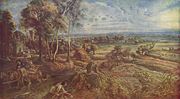
painted natural landscapes inspired by Rubens, and frequently collaborated with figure painters or animal specialists to paint the backgrounds. Rubens turned to landscape painting in the 1630s, focusing on the area around his chateau, Het Steen. A well-known example is the Landscape with a view of 'Het Steen (National Gallery of London).
Marine painting
Small seascapes (zeekens) were another popular theme. Artists such as Bonaventura PeetersBonaventura Peeters
Bonaventura Peeters was a Flemish Baroque painter who specialized in seascapes and shipwrecks, known as Zeekens .-Biography:...
painted shipwrecks and atmospheric views of ships at sea, as well as imaginary views of exotic ports. Hendrik van Minderhout
Hendrik van Minderhout
Hendrik van Minderhout was a Dutch-born painter of seascapes who was primarily active in the Southern Netherlands cities of Bruges and Antwerp. He arrived in Bruges in 1652, and in 1663 he joined the city's Guild of St. Luke. Subsequently, from 1672 until his death in 1696 Minderhout lived in...
, who was from Rotterdam
Rotterdam
Rotterdam is the second-largest city in the Netherlands and one of the largest ports in the world. Starting as a dam on the Rotte river, Rotterdam has grown into a major international commercial centre...
and settled in Antwerp, continued this latter theme contemporaneous with developments of marine painting in the Dutch Republic.
Architectural painting
Interior architectural views, usually of churches, developed out of the late sixteenth-century works of Hans Vredeman de VriesHans Vredeman de Vries
Hans Vredeman de Vries was a Dutch Renaissance architect, painter, and engineer. Vredeman de Vries is known for his publication in 1583 on garden design and his books with many examples on ornaments and perspective ....
. Many were actual locations. Pieter Neeffs I
Pieter Neeffs I
Pieter Neeffs I was a Flemish Baroque painter who specialized in architectural interiors of churches. Active in Antwerp, he was influenced by the works of Hendrik van Steenwijk I and Hendrik van Steenwijk II. His own contribution to the genre was nocturnal church interior lit by two light sources...
, for example, made numerous interiors of the Cathedral of Our Lady, Antwerp
Cathedral of Our Lady, Antwerp
The Cathedral of Our Lady is a Roman Catholic cathedral in Antwerp, Belgium. Today's see of the Diocese of Antwerp was started in 1352 and, although the first stage of construction was ended in 1521, has never been 'completed'. In Gothic style, its architects were Jan and Pieter Appelmans...
. Hendrik van Steenwijk II
Hendrik van Steenwijk II
Hendrik van Steenwijck II was a Baroque painter mostly of architectural interiors, but also of biblical scenes and still lifes....
, on the other hand, followed Vredeman's precedent in painting imaginary interiors. The genre continued in the later seventeenth-century by Anton Ghering
Anton Ghering
Anton Ghering was a Flemish Baroque painter who specialized in architectural church interiors. He is best-known for his interior of the Antwerp church of St. Walburgis which records the original placement along with the frame and predella paintings of Peter Paul Rubens's Raising of the...
and Willem Schubart von Ehrenberg
Willem Schubart von Ehrenberg
Willem Schubart von Ehrenberg was a Flemish Baroque painter who specialized in architectural church interiors. Paintings such as his Interior of the Jesuit Church at Antwerp emphasize the Baroque architecture of the space depicted, but are more artificial than Dutch Golden Age contemporaries such...
, but the Flemish examples do not demonstrate the same level of innovation found in the Dutch perspectives of Pieter Jansz Saenredam
Pieter Jansz Saenredam
Pieter Jansz. Saenredam was a painter of the Dutch Golden Age, known for his distinctive paintings of whitewashed church interiors.-Biography:...
or Emanuel de Witte
Emanuel de Witte
Emanuel de Witte was a Dutch perspective painter. In contrast to Pieter Jansz Saenredam, who emphasized architectural accuracy, De Witte was more concerned with the atmosphere of his interiors. Though few in number, de Witte also produced genre paintings.-Life:De Witte was born in Alkmaar and...
.
Gallery and art collection painting
Gallery paintings appeared in Antwerp around 1610, and developed—like architectural interiors—from the compositions of Hans Vredeman de VriesHans Vredeman de Vries
Hans Vredeman de Vries was a Dutch Renaissance architect, painter, and engineer. Vredeman de Vries is known for his publication in 1583 on garden design and his books with many examples on ornaments and perspective ....
. One of the earliest innovators of this new genre was Frans Francken the Younger
Frans Francken the Younger
Frans Francken the Younger , was a Flemish Baroque painter and the best-known member of the large Francken family of artists....
, who introduced the type of work known as the Preziosenwand (wall of treasures). In these, prints, paintings, sculptures, drawings, as well as collectable objects from the natural world like shells and flowers are collected together in the foreground against a wall that imitates encyclopedic cabinets of curiosities
Cabinet of curiosities
A cabinet of curiosities was an encyclopedic collection in Renaissance Europe of types of objects whose categorical boundaries were yet to be defined. They were also known by various names such as Cabinet of Wonder, and in German Kunstkammer or Wunderkammer...
. A similar variation of these collections of artistic wealth are the series of the five senses created by Jan Brueghel the Elder
Jan Brueghel the Elder
Jan Brueghel the Elder was a Flemish painter, son of Pieter Bruegel the Elder and father of Jan Brueghel the Younger. Nicknamed "Velvet" Brueghel, "Flower" Brueghel, and "Paradise" Brueghel, of which the latter two were derived from his floral still lifes which were his favored subjects, while the...
and Rubens (Prado Museum, Madrid
Madrid
Madrid is the capital and largest city of Spain. The population of the city is roughly 3.3 million and the entire population of the Madrid metropolitan area is calculated to be 6.271 million. It is the third largest city in the European Union, after London and Berlin, and its metropolitan...
). Willem van Haecht
Willem van Haecht
Willem van Haecht was a Flemish Baroque painter best known for his gallery pictures and the son of the landscape painter Tobias Verhaecht. He studied under Peter Paul Rubens, worked in Paris from 1615 to 1619, and then travelled to Italy for about seven years. Van Haecht became a master in...
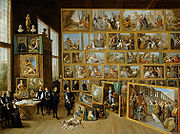
(1593–1637) developed another variation in which illustrations of actual artworks are displayed in a fantasy art gallery, while connoisseurs and art lovers admire them. Later in the century, David Teniers the Younger
David Teniers the Younger
David Teniers the Younger was a Flemish artist born in Antwerp, the son of David Teniers the Elder. His son David Teniers III and his grandson David Teniers IV were also painters...
, working in the capacity of court painter to Archduke Leopold Wilhelm of Austria
Archduke Leopold Wilhelm of Austria
Archduke Leopold Wilhelm of Austria was an Austrian military commander, Governor of the Spanish Netherlands from 1647 to 1656, and a patron of the arts.-Biography:...
, documented the archduke's collection of Italian paintings in Brussels as gallery painters as well as in a printed catalogue–the Theatrum Pictorium. Flemish Gallery and art collection paintings have been interpreted as a kind of visual theory of art. Such paintings continued to be made in Antwerp by Gerard Thomas
Gerard Thomas
Gerard Thomas was a late Flemish Baroque painter who specialized in studio and picture gallery interiors. He became a master in Antwerp's Guild of St. Luke in 1688–89, and was dean twice...
(1663–1721) and Balthasar van den Bossche
Balthasar van den Bossche
Balthasar van den Bossche was a late Flemish Baroque painter who specialized in histories, genre and picture gallery interiors.-Life:...
(1681–1715), and foreshadow the development of the veduta
Veduta
A veduta is a highly detailed, usually large-scale painting of a cityscape or some other vista....
in Italy and the galleries of Giovanni Paolo Pannini
Giovanni Paolo Pannini
Giovanni Paolo Panini or Pannini was a painter and architect, who worked in Rome and is mainly known as one of the vedutisti ....
.
.jpg)
Flower painting
Jan Brueghel the ElderJan Brueghel the Elder
Jan Brueghel the Elder was a Flemish painter, son of Pieter Bruegel the Elder and father of Jan Brueghel the Younger. Nicknamed "Velvet" Brueghel, "Flower" Brueghel, and "Paradise" Brueghel, of which the latter two were derived from his floral still lifes which were his favored subjects, while the...
was one of the important innovators of the floral still life around 1600. These paintings, which presented immaculately observed arrangements and compositions, were imaginary creations of flowers that bloom at different times of the years. They were popular with leading patrons and nobility across Europe, and generally have an underlying Vanitas
Vanitas
In the arts, vanitas is a type of symbolic work of art especially associated with Northern European still life painting in Flanders and the Netherlands in the 16th and 17th centuries, though also common in other places and periods. The word is Latin, meaning "emptiness" and loosely translated...
motif. The compositions of Brueghel's paintings were also influential on later Dutch flower pieces. Brueghel's sons Jan Brueghel the Younger
Jan Brueghel the Younger
Jan Brueghel the Younger was a Flemish Baroque painter, and the son of Jan Brueghel the Elder.He was trained by his father and spent his career producing works in a similar style. Along with his brother Ambrosius, he produced landscapes, allegorical scenes and other works of meticulous detail. ...
and Ambrosius Brueghel
Ambrosius Brueghel
Ambrose Brueghel or Ambrosius Brueghel /ɑmˈbɾoːsɪus ˈbɾøːxəl/ was a Flemish Baroque painter who specialized in landscapes and flower paintings. His work is similar to that of his half-brother, Jan Brueghel the Younger, and his nephew, Abraham Brueghel...
were also flower specialists. Osias Beert
Osias Beert
Osias Beert was a Flemish Baroque painter who specialized in flower and "breakfast"-type still lifes. He joined the city's Guild of St. Luke in 1608, and trained Frans van der Borch, Frans IJkens, Paulus Pontius and Jan Willemssen. Beerts's floral paintings, often showing a vase of flowers in a...
(1580–1624) was another flower painter at the beginning of the 17th century. His paintings share many similarities with northern contemporaries such as Ambrosius Bosschaert the Elder.
Garland painting
Closely related to the flower still life is the flower garland genre of painting that was invented by Jan Brueghel in collaboration with cardinalCardinal (Catholicism)
A cardinal is a senior ecclesiastical official, usually an ordained bishop, and ecclesiastical prince of the Catholic Church. They are collectively known as the College of Cardinals, which as a body elects a new pope. The duties of the cardinals include attending the meetings of the College and...
Federico Borromeo
Federico Borromeo
Federico Borromeo was an Italian ecclesiastic, cardinal and archbishop of Milan.-Biography:Federico Borromeo was born in Milan as the second son of Giulio Cesare Borromeo, Count of Arona, and Margherita Trivulzio...
in Milan
Milan
Milan is the second-largest city in Italy and the capital city of the region of Lombardy and of the province of Milan. The city proper has a population of about 1.3 million, while its urban area, roughly coinciding with its administrative province and the bordering Province of Monza and Brianza ,...
. The early versions of these paintings, such as the collaboration by Breughel and Rubens in Munich (Alte Pinakothek
Alte Pinakothek
The Alte Pinakothek is an art museum situated in the Kunstareal in Munich, Germany. It is one of the oldest galleries in the world and houses one of the most famous collections of Old Master paintings...
, Munich
Munich
Munich The city's motto is "" . Before 2006, it was "Weltstadt mit Herz" . Its native name, , is derived from the Old High German Munichen, meaning "by the monks' place". The city's name derives from the monks of the Benedictine order who founded the city; hence the monk depicted on the city's coat...
) show the Virgin Mary and Christ
Christ
Christ is the English term for the Greek meaning "the anointed one". It is a translation of the Hebrew , usually transliterated into English as Messiah or Mashiach...
child surrounded by a garland of flowers. They have been interpreted as distinctly Counter Reformation images, with the flowers emphasizing the delicacy of the Virgin and Child–images of which were destroyed in large numbers during the iconoclastic
Iconoclasm
Iconoclasm is the deliberate destruction of religious icons and other symbols or monuments, usually with religious or political motives. It is a frequent component of major political or religious changes...
outbreaks of 1566. Brueghel's student, the Jesuit painter Daniel Seghers
Daniel Seghers
Daniel Seghers was a Jesuit brother and Flemish Baroque painter who specialized in flower still lifes, and is particularly well-known for his contributions to the genre of "flower garland" painting. His paintings were collected enthusiastically by courtly patrons and he had numerous imitators...
, also painted many of these types of works for an international clientele. In later versions, the fleshy Madonna and Child gave way to sculptural niches and even pagan themes.
Breakfast and banquet still life
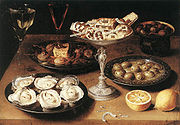
The ontbijtje, or "little breakfast", is a type of still life that was popular in both the northern and southern Netherlands showing a variety of eating and drinking vessels and foods such as cheese and bread against a neutral background. Osias BeertOsias Beert
Osias Beert was a Flemish Baroque painter who specialized in flower and "breakfast"-type still lifes. He joined the city's Guild of St. Luke in 1608, and trained Frans van der Borch, Frans IJkens, Paulus Pontius and Jan Willemssen. Beerts's floral paintings, often showing a vase of flowers in a...
, Clara Peeters
Clara Peeters
Clara Peeters was a Flemish painter noted for painting still lifes, particularly of breakfast scenes and florals.-Life:Few details of her life are known. She was baptized in Antwerp in 1594, and married there in 1639. She is known to have lived in Amsterdam and The Hague. Her first known work was...
, Cornelis Mahu
Cornelis Mahu
Cornelis Mahu was a Flemish Baroque painter who painted monochromatic "breakfast" still-lifes similar to those made in Haarlem by Dutch artists such as Pieter Claesz and Willem Claeszoon Heda.-Sources:...
and Jacob van Es
Jacob van Es
Jacob van Es was a Flemish Baroque still life painter active in Antwerp. His restrained ontbijt pieces share many similarities to contemporaries Osias Beert and Clara Peeters, and typically show various foods on a sharply angled table in the foreground.-Sources:*Mulders, Christine van...
(c. 1596–1666) were all artists who made these types of painting. More elaborate are the pronk, or "sumptuous", still life. This style developed in the Dutch Republic, and was brought to Antwerp by Jan Davidsz de Heem. They show, on a larger scale than earlier works, complex compositions of expensive items, rare foods, and fleshy, peeling fruit. These paintings are related to vanitas
Vanitas
In the arts, vanitas is a type of symbolic work of art especially associated with Northern European still life painting in Flanders and the Netherlands in the 16th and 17th centuries, though also common in other places and periods. The word is Latin, meaning "emptiness" and loosely translated...
and transience motifs.
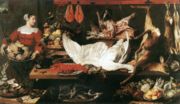
Animal still life
Frans Snyders (1579–1657) painted large still lifes focusing on dead game and animals. His compositions, along with those of his follower Adriaen van UtrechtAdriaen van Utrecht
Adriaen van Utrecht was a celebrated Flemish Baroque still life painter of the Antwerp school.-Career:Adriaen van Utrecht was, contrary to the suggestion of his name, a native of Antwerp. In 1614 he joined the studio of Herman de Neyt, painter and art dealer, as an apprentice, and was early...
(1599–1652). look back to the sixteenth-century paintings of Pieter Aertsen
Pieter Aertsen
Pieter Aertsen , called Lange Pier because of his height, was a Dutch historical painter. He was born and died in Amsterdam, and painted there and in Antwerp, though his genre scenes were influential in Italy.-Biography:...
and Joachim Beuckelaer
Joachim Beuckelaer
Joachim Beuckelaer was a Flemish painter.A native of Antwerp, he studied under his uncle, Pieter Aertsen. Many of his paintings contain scenes of kitchen and markets, with religious allusions in the background. His Four Elements series exemplifies this theme on a large scale...
, but instill that tradition with a High Baroque monumentality. Subsequent artists, Jan Fyt
Jan Fyt
Jan Fyt was a Flemish Baroque animal painter and etcher.-Life:...
and Pieter Boel
Pieter Boel
Pieter Boel was a Flemish Baroque painter who specialised in lavish still lifes.-Biography:Boel was born in Antwerp. He probably went to Italy in 1650. In 1668, he worked for Charles Le Brun in his first tapestry making studio...
further elaborated on this type by including a noticeable mixture of living animals and dead game. These latter paintings are closely related to images of the hunt, which came into fashion in Flemish painting during the 17th century.
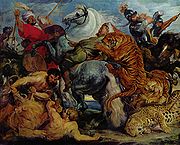
Hunting scenes
Rubens introduced the monumental hunt to Flemish art, depicting on a large scale a close battle inspired by his study of classical antiquity and Leonardo da VinciLeonardo da Vinci
Leonardo di ser Piero da Vinci was an Italian Renaissance polymath: painter, sculptor, architect, musician, scientist, mathematician, engineer, inventor, anatomist, geologist, cartographer, botanist and writer whose genius, perhaps more than that of any other figure, epitomized the Renaissance...
's Battle of Anghiari
The Battle of Anghiari (painting)
The Battle of Anghiari is a lost painting by Leonardo da Vinci at times referred to as "The Lost Leonardo", which some commentators believe to be still hidden beneath later frescoes in the Hall of Five Hundred in the Palazzo Vecchio, Florence...
. These works show both noble hunts, such as the Wolf and Fox Hunt (Metropolitan Museum of Art
Metropolitan Museum of Art
The Metropolitan Museum of Art is a renowned art museum in New York City. Its permanent collection contains more than two million works, divided into nineteen curatorial departments. The main building, located on the eastern edge of Central Park along Manhattan's Museum Mile, is one of the...
), and exotic hunts, such as the Lion Hunt (Alte Pinakothek
Alte Pinakothek
The Alte Pinakothek is an art museum situated in the Kunstareal in Munich, Germany. It is one of the oldest galleries in the world and houses one of the most famous collections of Old Master paintings...
, Munich
Munich
Munich The city's motto is "" . Before 2006, it was "Weltstadt mit Herz" . Its native name, , is derived from the Old High German Munichen, meaning "by the monks' place". The city's name derives from the monks of the Benedictine order who founded the city; hence the monk depicted on the city's coat...
). Frans Snyders and Paul de Vos
Paul de Vos
Paul de Vos was a Flemish Baroque painter.De Vos was born in Hulst near Antwerp, now in the Dutch province of Zeeland. Like his older brother Cornelis and younger brother Jan, he studied under the little-known painter David Remeeus...
created similarly large paintings which are
distinct from Rubens's works in their focus on the animals and absence of human participation.
Cabinet painting
Small, intricate paintings, usually depicting history and biblical subjects, were produced in great numbers in the Southern Netherlands throughout the 17th century. Many were created by anonymous artists, however artists such as Jan Brueghel the ElderJan Brueghel the Elder
Jan Brueghel the Elder was a Flemish painter, son of Pieter Bruegel the Elder and father of Jan Brueghel the Younger. Nicknamed "Velvet" Brueghel, "Flower" Brueghel, and "Paradise" Brueghel, of which the latter two were derived from his floral still lifes which were his favored subjects, while the...
, Hendrik van Balen, Frans Francken the Younger
Frans Francken the Younger
Frans Francken the Younger , was a Flemish Baroque painter and the best-known member of the large Francken family of artists....
and Hendrik de Clerck
Hendrik de Clerck
Hendrick de Clerck was a Flemish painter active in Rome and Brussels during the late sixteenth and early seventeenth centuries. Stylistically he belongs to the late Mannerist generation of artists preceding Peter Paul Rubens and the Flemish Baroque, and his paintings are very similar to his...
were all successful cabinet painters
Cabinet painting
A cabinet painting is a small painting, typically no larger than about two feet in either dimension, but often much smaller. The term is especially used of paintings that show full-length figures at a small scale, as opposed to say a head painted nearly life-size, and that are painted very...
during the first half of the 17th century. These artists, as well as followers of Adam Elsheimer
Adam Elsheimer
Adam Elsheimer was a German artist working in Rome who died at only thirty-two, but was very influential in the early 17th century. His relatively few paintings were small scale, nearly all painted on copper plates, of the type often known as cabinet paintings. They include a variety of light...
like David Teniers the Elder
David Teniers the Elder
David Teniers the Elder , Flemish painter, was born at Antwerp.-Biography:Having received his first training in the painter's art from his brother Juliaen, he studied under Rubens in Antwerp, and subsequently under Elsheimer in Rome; he became a member of the Antwerp guild of painters in...
, remained partly shaped by continued mannerist stylistic tendencies. However, Rubens influenced a number of later artists who incorporated his Baroque style into the small context of these works. Among them are Frans Wouters
Frans Wouters
Frans Wouters was a Flemish Baroque painter who translated the monumental Baroque style of Peter Paul Rubens into the small context of cabinet paintings.-Biography:...
, Jan Thomas van Ieperen
Jan Thomas van Ieperen
Jan Thomas van Ieperen was a Flemish Baroque painter and engraver active in Antwerp and at the Habsburg court in Vienna....
, Simon de Vos
Simon de Vos
Simon de Vos was a Flemish Baroque painter of genre and cabinet pictures.-Biography:De Vos studied with Cornelis de Vos , to whom he is not related, from 1615 until 1620. In 1620 he joined Antwerp's guild of St...
, Pieter van Lint
Pieter van Lint
Pieter van Lint was a Flemish Baroque painter, active in Antwerp and Italy, who painted both religious subjects and genre scenes.-Biography:...
, and Willem van Herp
Willem van Herp
Willem van Herp was a Flemish Baroque painter specializing in small cabinet paintings of "low-life" genre scenes and religious paintings.-Life and works:...
. These small paintings were traded widely throughout Europe, and by way of Spain to Latin America
Latin America
Latin America is a region of the Americas where Romance languages – particularly Spanish and Portuguese, and variably French – are primarily spoken. Latin America has an area of approximately 21,069,500 km² , almost 3.9% of the Earth's surface or 14.1% of its land surface area...
.
Sources
- Belkin, Kristin Lohse (1998). Rubens. London: Phaidon PressPhaidon PressPhaidon Press is a British publisher of books on the visual arts, including art, architecture, photography, and design worldwide.As of 2009, Phaidon's headquarters are in London, UK, though they were in Oxford for many years, with offices in New York City, Paris, Berlin, Milan, and Tokyo...
. ISBN 0714834122 - Martin, J. R. (1977). Baroque. New York: Harper & Row. ISBN 006435332X
- Slive, S. (1995). Dutch painting 1600-1800. Yale University Press Pelican history of art. New Haven, Conn: Yale University PressYale University PressYale University Press is a book publisher founded in 1908 by George Parmly Day. It became an official department of Yale University in 1961, but remains financially and operationally autonomous....
. ISBN 0300064187 - Sutton, P. C., & Wieseman, M. E. (1993). The Age of Rubens. Boston: Museum of Fine ArtsMuseum of Fine Arts, BostonThe Museum of Fine Arts in Boston, Massachusetts, is one of the largest museums in the United States, attracting over one million visitors a year. It contains over 450,000 works of art, making it one of the most comprehensive collections in the Americas...
in association with Ghent. ISBN 0810919354 - Vlieghe, Hans (1998). Flemish Art and Architecture, 1585-1700. Yale University Press Pelican history of art. New Haven: Yale University Press. ISBN 0-300-07038-1