

Flavius Aëtius

Encyclopedia
Flavius Aëtius dux
et patricius, was a Roman
general of the closing period of the Western Roman Empire
. He was an able military commander and the most influential man in the Western Roman Empire for two decades (433-454). He managed policy in regard to the attacks of barbarian
peoples pressing on the Empire. Notably, he gathered a large Roman and barbarian army to win the Battle of the Catalaunian Plains, ending the famous Hunnic
invasion of Attila in 451
.
Along with his rival Count Boniface
, he has often been called "the last of the Romans". Edward Gibbon
refers to him as "the man universally celebrated as the terror of Barbarians and the support of the Republic" for his victory at the Catalaunian Plains.
, Bulgaria
), around 390
. His father was Flavius Gaudentius
, a Roman soldier of Scythian origin. His mother, whose name is unknown, was a wealthy aristocratic woman of Italian
ancestry. Before 425
Aëtius married the daughter of Carpilio, who gave him a son, also named Carpilio. Later he married Pelagia
, widow of Bonifacius
, from whom he had a son, Gaudentius
. It is possible that he had also a daughter, wife of Thraustila who avenged Aëtius' death by killing emperor Valentinian III
.
and 408
he was kept as hostage
at the court of Alaric I
, king of the Visigoths. In 408 Alaric asked to keep Aëtius as a hostage, but was refused, as Aëtius was sent to the court of Rugila
, king of the Huns
. Aëtius's upbringing amongst militaristic peoples gave him a martial vigour not common in Roman generals of the time.
In 423
the Western Emperor Honorius
died. The most influential man in the West, Castinus
, chose as his successor Joannes
, a high ranking officer. Joannes was not part of the Theodosian dynasty
and he did not receive the recognition of the eastern court. The Eastern Emperor Theodosius II
organized a military expedition westward, led by Ardaburius and his son Aspar
, to put his cousin, the young Valentinian III
(who was a nephew of Honorius), on the western throne. Aëtius entered the service of the usurper as cura palatii and was sent by Joannes to ask the Huns
for assistance. Joannes lacked a strong army and fortified himself in his capital, Ravenna
, where he was killed in the summer of 425. Shortly afterwards, Aëtius returned to Italy with a large force of Huns to find that power in the west was now in the hands of Valentinian III and his mother Galla Placidia
. After fighting against Aspar's army, Aëtius managed to compromise with Galla Placidia. He sent back his army of Huns and in return obtained the rank of comes et magister militum
per Gallias, the commander in chief of the Roman army in Gaul
.
, Aëtius arrived in southern Gaul with an army of roughly 40,000 to find Arelate, an important city in Septimania
near the mouth of the Rhone
, under siege from the Visigoths led by their king Theodoric I
. Aëtius defeated Theodoric, lifted the Siege of Arelate, and drove the Visigoths back to their holdings in Aquitania
. In 428
he fought the Salian Franks
at the Battle of Vicus Helenae, defeating their king Chlodio and recovering some territory they had occupied along the Rhine. In 429
he was elevated to the rank of magister militum; this was probably the iunior of the two offices of magister militum praesentalis, as the senior is known to have been the patrician Flavius Felix
, the most influential man in those years, supporter of Galla Placidia
. In 430
the Visigoths led by Anaolsus attacked Arelate again but were defeated by Aëtius at the Battle of Mons Colubrarius, establishing a peace treaty. In May 430, Aëtius accused Felix of plotting against him and had him and his wife killed. Once Felix was dead, Aëtius was probably the most prominent among the magistri militum, even if he had not yet been granted the title of patrician. During late 430 and 431 Aëtius was in Raetia
and Noricum
, and is attested in the city of Vindelicia
, re-establishing Roman rule on the Danube
frontier and campaigning against the Juthungi
. In 431 he returned to Gaul, he received Hydatius
, bishop of Aquae Flaviae
, who complained about the attacks of the Suebi
. In 432
Aëtius again defeated the Franks
, making peace with them, and he sent back Hydatius to the Suebi in Hispania.
, and emperor Valentinian
's mother and regent Galla Placidia
. After the execution of Felix, Aëtius and Bonifacius remained as the empire's most influential generals, both constantly vying for the favor of Placidia. In 427
while Bonifacius was away as governor (comes
) of Africa
, Aëtius caused him to fall into disfavour with Placidia. Bonifacius was eventually returned to favor by Placidia, but not before revolting and causing the loss of most of Africa to the Vandals
.
In 432
Aëtius held the consul
ate, but Bonifacius was recalled to Italy and received warmly by Placidia. Bonifacius was given the rank of patrician, while Aëtius was stripped of his military command, which was given to Bonifacius. Aëtius, believing his fall now imminent, marched against Bonifacius and fought him at the Battle of Rimini. Boniface won the battle but was mortally wounded, dying a few months later. Aëtius escaped to Dalmatia
and traveled to the court of his friend, Rugila, the king of the Huns. With their help he returned to power, receiving the title of magister utriusque militiae; he had Bonifacius' son-in-law, Sebastianus
, who had succeeded to Bonifacius as magister militum praesentalis, exiled from Italy to Constantinople
, bought the properties of Bonifacius and married his widow Pelagia
.
and Valentinian III
while the Emperor was still young. At the same time he continued to devote attention to Gaul. In 436, the Burgundians
of King Gunther
were defeated and obliged to accept peace by Aëtius, who, however, the following year sent the Huns
to destroy them; 20,000 Burgundians were killed in a slaughter which became the basis of the Nibelungenlied
, a German epic
. That same 436 Aetius was probably in Armorica
with Litorius to suppress a rebellion of the Bacaudae. Year 437 saw his second consul
ship and the wedding of Valentinian and Licinia Eudoxia
in Constantinople
; it is probable that Aetius attended at the ceremony that marked the beginning of the direct rule of the Emperor. The following two years were occupied by a campaign against the Suebi
and by the war against the Visigoths; in 438 Aetius won a major battle (probably the battle of Mons Colubrarius), but in 439 the Visigoths defeated and killed his general Lictorius and obtained a peace treaty. On his return to Italy, he was honoured by a statue erected by the Senate and the People of Rome by order of the Emperor; this was probably the occasion for the panegyric written by Merobaudes
.
In 443, Aëtius settled the remaining Burgundians in Savoy
, south of Lake Geneva
. His most pressing concern in the 440s was with problems in Gaul and Iberia
, mainly with the Bagaudae
. He settled Alans
around Valence
and Orléans
to contain unrest around present-day Brittany
.
The Alans settled in Armorica
caused problems in 447 or 448. It was probably in that period that he fought a battle near Tours
, followed by a Frankish
attack under Clodio
to the region near Arras
, in Belgica Secunda; the invaders were stopped by a battle around a river-crossing near Vicus Helena, where Aëtius directed the operations while his commander Majorian
(later Emperor) fought with the cavalry. However, in 450 Aëtius had already returned in good terms with the Franks. In that year, in fact, the king of the Franks died, and the patricius supported his younger son's claim to the throne, adopting him as his own son and sending him from Rome, where he had been sent as ambassador, to the Frankish court with many presents.
 Before 449 Aëtius had signed an agreement with the Huns
, allowing some of them to settle in Pannonia
, along the Sava River
; he also sent to Attila, the king of the Huns, a man called Constantius as a secretary. In 449, Attila was angry for an alleged theft of a golden plate, and Aëtius sent him an embassy under Romulus to calm him; Attila sent him as a present a dwarf, Zerco, whom Aëtius gave back to his original owner, Aspar
.
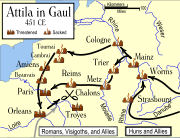
However, the good terms between Romans and Huns did not last, as Attila wanted to attack Gaul
; he knew that Aëtius was a serious obstacle to his enterprise, and tried to have him removed, but in 451, when the Huns attacked, Aëtius was the commander of the Roman army in Gaul. The large Hunnish army captured several cities, and proceeded towards Orléans.
When the Alans living in the region were ready to defect to Attila, Aëtius, with the help of the influential Gallo-Roman senator Avitus
, convinced the Visigoths of king Theodoric I
to join him against the external menace; he also succeeded in preventing Sangiban
us, a possible ally for Attila, from combining his army with the Hunnish one. Then the joint Roman and Visigothic armies moved to relieve the besieged city of Orléans, forcing the Huns to abandon the siege and retreat to open country.
On September 20, 451 (some sources place the date at June 20, 451), Aëtius and Theodoric defeated Attila and his allies at the Battle of the Catalaunian Plains. Theodoric died in the battle, and Aëtius suggest his son Thorismund
to quickly reach Toulouse
(capital of the Kingdom of the Visigoths) to secure his throne; for this reason it is said that Aëtius kept all of the booty for his army.
Attila returned in 452 to again press his claim of marriage to Honoria
; Aëtius did not take the necessary precautions to block the Alpine passes, and Attila invaded and ravaged Italy, sacking numerous cities and razing Aquileia
completely, leaving no trace of it behind. Valentinian III
fled from Ravenna
to Rome; Aëtius remained in the field but lacked the strength to offer battle. Gibbon however says Aëtius never showed his greatness more clearly in managing to harass and slow Attila's advance with only a shadow force. Attila finally halted at the Po
, where he met an embassy including the prefect
Trigetius, the ex-consul
Gennadius Avienus
, and Pope Leo I
. After the meeting he turned his army back, having gained neither Honoria's hand nor the territories he desired.
's daughter Placidia, Valentinian felt intimidated by Aëtius, who had once supported Joannes against him and who Valentinian believed wanted to place his son upon the imperial throne. The Roman senator Petronius Maximus
and the chamberlain Heraclius were therefore able to enlist Valentinian in a plot to assassinate Aëtius. On September 21, 454, when at court in Ravenna
delivering a financial account, Aëtius was slain by Valentinian's own hand. Edward Gibbon
credits Sidonius Apollinaris
with the famous observation, "I am ignorant, sir, of your motives or provocations; I only know that you have acted like a man who has cut off his right hand with his left."
Maximus expected to be made patrician in place of Aëtius, but was blocked by Heraclius. Seeking revenge, Maximus arranged with two Hun friends of Aëtius, Optila and Thraustila, to assassinate both Valentinian III
and Heraclius. On March 16, 455, Optila stabbed the emperor in the temple as he dismounted in the Campus Martius and prepared for a session of archery practice. As the stunned emperor turned to see who had struck him, Optila finished him off with another thrust of his blade. Meanwhile, Thraustila stepped forward and killed Heraclius. Most of the soldiers standing close by had been faithful followers of Aëtius and none lifted a hand to save the emperor.
John Julius Norwich
caustically referred to the assassination of Valentinian III
by his own guards as an act that Valentinian brought on himself by his foolish execution of Aëtius, the "Empire's greatest commander." Certainly Aëtius' military legacy is defined by Châlons, even though he effectively ruled the western empire from 433-450, and attempted to stabilize its European borders under a deluge of barbarians, including foremost, Attila and the Huns.
One of his greatest achievements was the assembling of the coalition against Attila. On this Arther Ferrill says:
While J. B. Bury
viewed Aëtius as a great military commander, and giant figure of history, he did not consider that the battle itself was particularly decisive. He argues that Aëtius attacked the Huns when they were already retreating from Orléans
(so the danger to Gaul was departing anyway); and he declined to renew the attack on the Huns next day, precisely in order to preserve the balance of power. (Others suggest that the Huns may have abandoned the siege of Orléans because Aëtius's armies were advancing on them.)
Bury suggests that the German victory over the Huns at the Battle of Nedao
, three years later, was more important. This determined that there would be no long-term Hunnic Empire in Europe, which Bury thinks would have been unlikely even if they had crushed the Germans on that occasion. For Bury, the result of the battle of the Catalaunian Plains determined chiefly that Attila spent his last year looting Italy, rather than Gaul.
Bury's view remains in the minority, and the battle is considered crucial by virtually every other major historian.
. The two best Roman generals of their time, both were killed by jealous emperors, and both left the Empire significantly weaker when they died. The main difference between the two was that all major historians hail Aëtius as a loyal Roman and a pillar of the Empire, while Bury finds Stilicho an unwitting traitor. While Stilicho was succeeded by Aëtius, the Empire simply had no one to take Aëtius's place. At the time of Aëtius's death, all the Roman provinces in western Europe had a significant barbarian presence. This had begun a full three generations earlier, when the barbarians were allowed to stay inside the Empire's borders in exchange for peace and their military service. Edward Gibbon maintains that Aëtius could not have expelled them if he had wanted to, as he lacked Roman troops to do the task, and the barbarians were the only army he had to keep the peace. Gibbon argues in great detail that Roman citizens had lost their martial vigour, with the consequence that the only troops available to Stilicho or Aëtius were mostly barbarians.
Gibbon views Aëtius in a positive light, as do Norwich, Creasy, Ferrill, and Watson. In 1980, Robert F. Pennel wrote in Ancient Rome from the Earliest Times Down to 476 A.D.
Gibbon believes it was not indifference but rather preoccupation with the Huns and other barbarians that led Aëtius to neglect the navy. The subsequent loss of Africa came after Boniface invited the Vandals. Gibbon makes clear that Aëtius simply lacked the means to preserve the declining Western Empire in its entirety, while Norwich concludes that he guarded the Empire for three decades and that the after-effects of Aëtius's death lie at the feet of the Emperor who foolishly killed him. At a time when Romans did little or none of their own fighting, and no effective navy existed in the West, Aëtius had done all he could to preserve some vestige of order in continental Europe.
One could argue that later Emperors Majorian
, Leo I
and Anthemius
saw the necessity of regaining the African provinces. Should Aëtius have concentrated his efforts on saving Africa, to the detriment of maintaining some vestige of Empire in Europe? Michael Grant in his History of Rome states flatly that Aëtius was powerless to stop the loss of Africa. Aëtius had begun to move against the Vandals when the forces he sent had to be recalled to fight Attila. Since Aëtius relied on barbarian federates, and as no other Roman General had the respect of those barbarian troops, his death left the Empire bereft of virtually any army in the west.
It is notable that Bury, whilst not believing the Battle of Châlons
was significant, did believe in the significance of Aëtius's rule in general, saying "From the end of the regency to his own death, Aëtius was master of the Empire in the west, and it must be imputed to his policy and arms that Imperial rule did not break down in all the provinces by the middle of the fifth century."
In the end, there is some disagreement among historians as to the historical place of Aëtius. Was he the protector of Rome for three decades described by Gibbon, Norwich and Bury, the hero of Châlons described by Sir Edward Creasy, or should he be condemned for the loss of Africa, though most historians say he was powerless to stop that loss? Although Bury is cited as a critic of Aëtius, he was not, and said of Aëtius's death: "Who was now to save Italy from the Vandals?" The answer was no one. There was not one figure in the Empire able to take Aëtius's place as the champion and defender of the West. The certain thing about Aëtius's place in history is that he will forever be remembered as the last great Western Roman General, and the General who defeated the dreaded Attila the Hun. http://www.standin.se/fifteen06a.htm
(Italian for Aetius), as well as Verdi
's opera Attila
.
Aëtius is played by Powers Boothe
in the 2001 American TV Miniseries Attila
. Here he is portrayed as an antagonist
whose methods are contrasted with Attila. Aëtius is portrayed as the heroic 'Last of the Romans' in William Napier's Attila trilogy (2005), uniting the Romans and the Goths in one final, titanic battle to stop the Huns in their tracks, in the epochal Battle of the Catalaunian Fields.
While he does not appear in person, Aëtius' battle with Attila is documented in detail in Jack Whyte
's book The Eagle, during a conversation between King Arthur
and Seur Clothar.
Aëtius, Galla Placidia and Stilicho all appear as central characters in Jose Gomez-Rivera's historical novel Flavius Aëtius: The Last Conqueror, published in 2004.
Aëtius, Attila and Theodoric all appear in Michael Curtis Ford
's fourth novel entitled The Sword of Attila, published by Thomas Dunne Books in 2005.
Aëtius, Attila, Honoria, Leo and others figure in Louis de Wohl
's vivid historical novel Throne of the World (1946), later republished with the alternative title Attila the Hun.
Dux
Dux is Latin for leader and later for Duke and its variant forms ....
et patricius, was a Roman
Roman Empire
The Roman Empire was the post-Republican period of the ancient Roman civilization, characterised by an autocratic form of government and large territorial holdings in Europe and around the Mediterranean....
general of the closing period of the Western Roman Empire
Western Roman Empire
The Western Roman Empire was the western half of the Roman Empire after its division by Diocletian in 285; the other half of the Roman Empire was the Eastern Roman Empire, commonly referred to today as the Byzantine Empire....
. He was an able military commander and the most influential man in the Western Roman Empire for two decades (433-454). He managed policy in regard to the attacks of barbarian
Barbarian
Barbarian and savage are terms used to refer to a person who is perceived to be uncivilized. The word is often used either in a general reference to a member of a nation or ethnos, typically a tribal society as seen by an urban civilization either viewed as inferior, or admired as a noble savage...
peoples pressing on the Empire. Notably, he gathered a large Roman and barbarian army to win the Battle of the Catalaunian Plains, ending the famous Hunnic
Huns
The Huns were a group of nomadic people who, appearing from east of the Volga River, migrated into Europe c. AD 370 and established the vast Hunnic Empire there. Since de Guignes linked them with the Xiongnu, who had been northern neighbours of China 300 years prior to the emergence of the Huns,...
invasion of Attila in 451
451
Year 451 was a common year starting on Monday of the Julian calendar. At the time, it was known as the Year of the Consulship of Marcianus and Adelfius...
.
Along with his rival Count Boniface
Bonifacius
Comes Bonifacius was a Roman general and governor of the Diocese of Africa. Along with his rival, Flavius Aëtius, he is sometimes termed "the last of the Romans."...
, he has often been called "the last of the Romans". Edward Gibbon
Edward Gibbon
Edward Gibbon was an English historian and Member of Parliament...
refers to him as "the man universally celebrated as the terror of Barbarians and the support of the Republic" for his victory at the Catalaunian Plains.
Origins and Family
Aëtius was born at Durostorum in Moesia Inferior (modern SilistraSilistra
Silistra is a port city of northeastern Bulgaria, lying on the southern bank of the lower Danube at the country's border with Romania. Silistra is the administrative centre of Silistra Province and one of the important cities of the historical region of Southern Dobrudzha...
, Bulgaria
Bulgaria
Bulgaria , officially the Republic of Bulgaria , is a parliamentary democracy within a unitary constitutional republic in Southeast Europe. The country borders Romania to the north, Serbia and Macedonia to the west, Greece and Turkey to the south, as well as the Black Sea to the east...
), around 390
390
Year 390 was a common year starting on Tuesday of the Julian calendar. At the time, it was known as the Year of the Consulship of Augustus and Neoterius...
. His father was Flavius Gaudentius
Flavius Gaudentius
Flavius Gaudentius was the father of the Roman magister militum Flavius Aetius. It is said that he was of Scythian birth.Gaudentius served under the Eastern Roman Emperor Theodosius I against the usurper Eugenius...
, a Roman soldier of Scythian origin. His mother, whose name is unknown, was a wealthy aristocratic woman of Italian
Italy
Italy , officially the Italian Republic languages]] under the European Charter for Regional or Minority Languages. In each of these, Italy's official name is as follows:;;;;;;;;), is a unitary parliamentary republic in South-Central Europe. To the north it borders France, Switzerland, Austria and...
ancestry. Before 425
425
Year 425 was a common year starting on Thursday of the Julian calendar. At the time, it was known as the Year of the Consulship of Theodosius and Valentinianus...
Aëtius married the daughter of Carpilio, who gave him a son, also named Carpilio. Later he married Pelagia
Pelagia
Pelagia can refer to:* Saint Pelagia, of Antioch, who leapt to her death from a housetop* Pelagia of Tarsus, who was burnt to death* Pelagia was the secular name of Marina the Monk* Sister Pelagia, heroine of novels by Boris Akunin...
, widow of Bonifacius
Bonifacius
Comes Bonifacius was a Roman general and governor of the Diocese of Africa. Along with his rival, Flavius Aëtius, he is sometimes termed "the last of the Romans."...
, from whom he had a son, Gaudentius
Gaudentius (son of Aëtius)
Gaudentius was the son of Flavius Aetius. F.M. Clover has persuasively argued that his mother was Pelagia, a Gothic noblewoman and the widow of Bonifacius....
. It is possible that he had also a daughter, wife of Thraustila who avenged Aëtius' death by killing emperor Valentinian III
Valentinian III
-Family:Valentinian was born in the western capital of Ravenna, the only son of Galla Placidia and Flavius Constantius. The former was the younger half-sister of the western emperor Honorius, and the latter was at the time Patrician and the power behind the throne....
.
Early years and service under Joannes
As a boy, Aëtius was at the service of the imperial court, enrolled in the military unit of the tribuni praetoriani partis militaris. Between 405405
Year 405 was a common year starting on Sunday of the Julian calendar. At the time, it was known as the Year of the Consulship of Stilicho and Anthemius...
and 408
408
Year 408 was a leap year starting on Wednesday of the Julian calendar. At the time, it was known as the Year of the Consulship of Bassus and Philippus...
he was kept as hostage
Hostage
A hostage is a person or entity which is held by a captor. The original definition meant that this was handed over by one of two belligerent parties to the other or seized as security for the carrying out of an agreement, or as a preventive measure against certain acts of war...
at the court of Alaric I
Alaric I
Alaric I was the King of the Visigoths from 395–410. Alaric is most famous for his sack of Rome in 410, which marked a decisive event in the decline of the Roman Empire....
, king of the Visigoths. In 408 Alaric asked to keep Aëtius as a hostage, but was refused, as Aëtius was sent to the court of Rugila
Rugila
Rugila also referred to as Rua, Ruhas, Ruga and Rona , was a warlord who was a major factor in the Huns' early victories over the Roman Empire. He served as an important forerunner to Attila the Hun during the fifth century AD. Initially he had ruled together with his brother Octar , who died ca....
, king of the Huns
Huns
The Huns were a group of nomadic people who, appearing from east of the Volga River, migrated into Europe c. AD 370 and established the vast Hunnic Empire there. Since de Guignes linked them with the Xiongnu, who had been northern neighbours of China 300 years prior to the emergence of the Huns,...
. Aëtius's upbringing amongst militaristic peoples gave him a martial vigour not common in Roman generals of the time.
In 423
423
Year 423 was a common year starting on Monday of the Julian calendar. At the time, it was known as the Year of the Consulship of Marinianus and Asclepiodotus...
the Western Emperor Honorius
Honorius (emperor)
Honorius , was Western Roman Emperor from 395 to 423. He was the younger son of emperor Theodosius I and his first wife Aelia Flaccilla, and brother of the eastern emperor Arcadius....
died. The most influential man in the West, Castinus
Castinus
Flavius Castinus held the position of patricius in the court of Roman Emperor Honorius at the time of the Emperor's death, and most likely for some time before. He also served as consul for the year 424.- Career :...
, chose as his successor Joannes
Joannes
Ioannes, known in English as Joannes, was a Roman usurper against Valentinian III.On the death of the Emperor Honorius , Theodosius II, the remaining ruler of the House of Theodosius hesitated in announcing his uncle's death...
, a high ranking officer. Joannes was not part of the Theodosian dynasty
Theodosian dynasty
The Theodosian dynasty was a Roman family that rose to eminence in the waning days of the Roman Empire.-History:Its founding father was Flavius Theodosius , a great general who had saved Britannia from the Great Conspiracy...
and he did not receive the recognition of the eastern court. The Eastern Emperor Theodosius II
Theodosius II
Theodosius II , commonly surnamed Theodosius the Younger, or Theodosius the Calligrapher, was Byzantine Emperor from 408 to 450. He is mostly known for promulgating the Theodosian law code, and for the construction of the Theodosian Walls of Constantinople...
organized a military expedition westward, led by Ardaburius and his son Aspar
Aspar
Flavius Ardabur Aspar was an Alan patrician and magister militum of the Eastern Roman Empire. Aspar's family exerted a great influence on the Eastern Roman Emperors for half a century, from the 420s to his death in 471, over Theodosius II, Marcian and Leo I, who, in the end, had him killed.Alans...
, to put his cousin, the young Valentinian III
Valentinian III
-Family:Valentinian was born in the western capital of Ravenna, the only son of Galla Placidia and Flavius Constantius. The former was the younger half-sister of the western emperor Honorius, and the latter was at the time Patrician and the power behind the throne....
(who was a nephew of Honorius), on the western throne. Aëtius entered the service of the usurper as cura palatii and was sent by Joannes to ask the Huns
Huns
The Huns were a group of nomadic people who, appearing from east of the Volga River, migrated into Europe c. AD 370 and established the vast Hunnic Empire there. Since de Guignes linked them with the Xiongnu, who had been northern neighbours of China 300 years prior to the emergence of the Huns,...
for assistance. Joannes lacked a strong army and fortified himself in his capital, Ravenna
Ravenna
Ravenna is the capital city of the Province of Ravenna in the Emilia-Romagna region of Italy and the second largest comune in Italy by land area, although, at , it is little more than half the size of the largest comune, Rome...
, where he was killed in the summer of 425. Shortly afterwards, Aëtius returned to Italy with a large force of Huns to find that power in the west was now in the hands of Valentinian III and his mother Galla Placidia
Galla Placidia
Aelia Galla Placidia , daughter of the Roman Emperor Theodosius I, was the Regent for Emperor Valentinian III from 423 until his majority in 437, and a major force in Roman politics for most of her life...
. After fighting against Aspar's army, Aëtius managed to compromise with Galla Placidia. He sent back his army of Huns and in return obtained the rank of comes et magister militum
Magister militum
Magister militum was a top-level military command used in the later Roman Empire, dating from the reign of Constantine. Used alone, the term referred to the senior military officer of the Empire...
per Gallias, the commander in chief of the Roman army in Gaul
Roman Gaul
Roman Gaul consisted of an area of provincial rule in the Roman Empire, in modern day France, Belgium, Luxembourg, and western Germany. Roman control of the area lasted for less than 500 years....
.
First Gallic campaigns
In 427427
Year 427 was a common year starting on Saturday of the Julian calendar. At the time, it was known as the Year of the Consulship of Hierus and Ardabur...
, Aëtius arrived in southern Gaul with an army of roughly 40,000 to find Arelate, an important city in Septimania
Septimania
Septimania was the western region of the Roman province of Gallia Narbonensis that passed under the control of the Visigoths in 462, when Septimania was ceded to their king, Theodoric II. Under the Visigoths it was known as simply Gallia or Narbonensis. It corresponded roughly with the modern...
near the mouth of the Rhone
Rhône
Rhone can refer to:* Rhone, one of the major rivers of Europe, running through Switzerland and France* Rhône Glacier, the source of the Rhone River and one of the primary contributors to Lake Geneva in the far eastern end of the canton of Valais in Switzerland...
, under siege from the Visigoths led by their king Theodoric I
Theodoric I
Theodoric I sometimes called Theodorid and in Spanish, Portuguese and Italian Teodorico, was the King of the Visigoths from 418 to 451. An illegitimate son of Alaric, Theodoric is famous for defeating Attila at the Battle of the Catalaunian Plains in 451, where he was mortally wounded.-Early...
. Aëtius defeated Theodoric, lifted the Siege of Arelate, and drove the Visigoths back to their holdings in Aquitania
Aquitania
Aquitania may refer to:* the territory of the Aquitani, a people living in Roman times in what is now Aquitaine, France* Aquitaine, a region of France roughly between the Pyrenees, the Atlantic ocean and the Garonne, also a former kingdom and duchy...
. In 428
428
Year 428 was a leap year starting on Sunday of the Julian calendar. At the time, it was known as the Year of the Consulship of Felix and Taurus...
he fought the Salian Franks
Salian Franks
The Salian Franks or Salii were a subgroup of the early Franks who originally had been living north of the limes in the area above the Rhine. The Merovingian kings responsible for the conquest of Gaul were Salians. From the 3rd century on, the Salian Franks appear in the historical records as...
at the Battle of Vicus Helenae, defeating their king Chlodio and recovering some territory they had occupied along the Rhine. In 429
429
Year 429 was a common year starting on Tuesday of the Julian calendar. At the time, it was known as the Year of the Consulship of Florentius and Dionysius...
he was elevated to the rank of magister militum; this was probably the iunior of the two offices of magister militum praesentalis, as the senior is known to have been the patrician Flavius Felix
Flavius Felix
Flavius Felix was a politician of the Western Roman Empire, who reached the prominent rank of patrician before being killed by order of Flavius Aetius. For his consulate, in 428, he issued some consular diptychs, one of which has been preserved until modern times.Felix served during the reign of...
, the most influential man in those years, supporter of Galla Placidia
Galla Placidia
Aelia Galla Placidia , daughter of the Roman Emperor Theodosius I, was the Regent for Emperor Valentinian III from 423 until his majority in 437, and a major force in Roman politics for most of her life...
. In 430
430
Year 430 was a common year starting on Wednesday of the Julian calendar. At the time, it was known as the Year of the Consulship of Theodosius and Valentinianus...
the Visigoths led by Anaolsus attacked Arelate again but were defeated by Aëtius at the Battle of Mons Colubrarius, establishing a peace treaty. In May 430, Aëtius accused Felix of plotting against him and had him and his wife killed. Once Felix was dead, Aëtius was probably the most prominent among the magistri militum, even if he had not yet been granted the title of patrician. During late 430 and 431 Aëtius was in Raetia
Raetia
Raetia was a province of the Roman Empire, named after the Rhaetian people. It was bounded on the west by the country of the Helvetii, on the east by Noricum, on the north by Vindelicia, on the west by Cisalpine Gaul and on south by Venetia et Histria...
and Noricum
Noricum
Noricum, in ancient geography, was a Celtic kingdom stretching over the area of today's Austria and a part of Slovenia. It became a province of the Roman Empire...
, and is attested in the city of Vindelicia
Vindelicia
In the pre-Roman geography of Europe, Vindelicia identifies the country inhabited by the Vindelici, a region bounded on the north by the Danube and the Hadrian's Limes Germanicus, on the east by the Oenus , on the south by Raetia and on the west by the territory of the Helvetii...
, re-establishing Roman rule on the Danube
Danube
The Danube is a river in the Central Europe and the Europe's second longest river after the Volga. It is classified as an international waterway....
frontier and campaigning against the Juthungi
Juthungi
The Juthungi were a Germanic tribe in the region north of the rivers Danube and Altmühl in the modern German state of Bavaria....
. In 431 he returned to Gaul, he received Hydatius
Hydatius
Hydatius or Idacius , bishop of Aquae Flaviae in the Roman province of Gallaecia was the author of a chronicle of his own times that provides us with our best evidence for the history of the Iberian Peninsula in the 5th century.-Life:Hydatius was born around the year 400 in the...
, bishop of Aquae Flaviae
Aquae Flaviae
Aquæ Flaviæ is the ancient Roman name for the current city of Chaves, Portugal.-Pre-roman ocupation:The city was a center of pre-roman occupation, being the main town of the Turodi people.-Roman domain:...
, who complained about the attacks of the Suebi
Suebi
The Suebi or Suevi were a group of Germanic peoples who were first mentioned by Julius Caesar in connection with Ariovistus' campaign, c...
. In 432
432
Year 432 was a leap year starting on Friday of the Julian calendar. At the time, it was known as the Year of the Consulship of Aetius and Valerius...
Aëtius again defeated the Franks
Franks
The Franks were a confederation of Germanic tribes first attested in the third century AD as living north and east of the Lower Rhine River. From the third to fifth centuries some Franks raided Roman territory while other Franks joined the Roman troops in Gaul. Only the Salian Franks formed a...
, making peace with them, and he sent back Hydatius to the Suebi in Hispania.
War with Bonifacius
While Aëtius was campaigning in Gaul, there was an ongoing power struggle between Aëtius, generals Felix and BonifaciusBonifacius
Comes Bonifacius was a Roman general and governor of the Diocese of Africa. Along with his rival, Flavius Aëtius, he is sometimes termed "the last of the Romans."...
, and emperor Valentinian
Valentinian III
-Family:Valentinian was born in the western capital of Ravenna, the only son of Galla Placidia and Flavius Constantius. The former was the younger half-sister of the western emperor Honorius, and the latter was at the time Patrician and the power behind the throne....
's mother and regent Galla Placidia
Galla Placidia
Aelia Galla Placidia , daughter of the Roman Emperor Theodosius I, was the Regent for Emperor Valentinian III from 423 until his majority in 437, and a major force in Roman politics for most of her life...
. After the execution of Felix, Aëtius and Bonifacius remained as the empire's most influential generals, both constantly vying for the favor of Placidia. In 427
427
Year 427 was a common year starting on Saturday of the Julian calendar. At the time, it was known as the Year of the Consulship of Hierus and Ardabur...
while Bonifacius was away as governor (comes
Comes
Comes , plural comites , is the Latin word for companion, either individually or as a member of a collective known as comitatus, especially the suite of a magnate, in some cases large and/or formal enough to have a specific name, such as a cohors amicorum. The word comes derives from com- "with" +...
) of Africa
Diocese of Africa
The Diocese of Africa was a diocese of the later Roman Empire, incorporating the provinces of North Africa, except Mauretania Tingitana. Its seat was at Carthage, and it was subordinate to the Praetorian prefecture of Italy....
, Aëtius caused him to fall into disfavour with Placidia. Bonifacius was eventually returned to favor by Placidia, but not before revolting and causing the loss of most of Africa to the Vandals
Vandals
The Vandals were an East Germanic tribe that entered the late Roman Empire during the 5th century. The Vandals under king Genseric entered Africa in 429 and by 439 established a kingdom which included the Roman Africa province, besides the islands of Sicily, Corsica, Sardinia and the Balearics....
.
In 432
432
Year 432 was a leap year starting on Friday of the Julian calendar. At the time, it was known as the Year of the Consulship of Aetius and Valerius...
Aëtius held the consul
Consul
Consul was the highest elected office of the Roman Republic and an appointive office under the Empire. The title was also used in other city states and also revived in modern states, notably in the First French Republic...
ate, but Bonifacius was recalled to Italy and received warmly by Placidia. Bonifacius was given the rank of patrician, while Aëtius was stripped of his military command, which was given to Bonifacius. Aëtius, believing his fall now imminent, marched against Bonifacius and fought him at the Battle of Rimini. Boniface won the battle but was mortally wounded, dying a few months later. Aëtius escaped to Dalmatia
Dalmatia (Roman province)
Dalmatia was an ancient Roman province. Its name is probably derived from the name of an Illyrian tribe called the Dalmatae which lived in the area of the eastern Adriatic coast in Classical antiquity....
and traveled to the court of his friend, Rugila, the king of the Huns. With their help he returned to power, receiving the title of magister utriusque militiae; he had Bonifacius' son-in-law, Sebastianus
Sebastianus (magister militum)
Sebastianus was a general of the Western Roman Empire, son-in-law of Bonifacius.A good soldier and advisor, and an orthodox catholic, Sebastianus was son-in-law of the powerful Bonifacius, comes Africae in 420s, nominated magister militum praesentalis and patrician by the Empress Galla Placidia in...
, who had succeeded to Bonifacius as magister militum praesentalis, exiled from Italy to Constantinople
Constantinople
Constantinople was the capital of the Roman, Eastern Roman, Byzantine, Latin, and Ottoman Empires. Throughout most of the Middle Ages, Constantinople was Europe's largest and wealthiest city.-Names:...
, bought the properties of Bonifacius and married his widow Pelagia
Pelagia
Pelagia can refer to:* Saint Pelagia, of Antioch, who leapt to her death from a housetop* Pelagia of Tarsus, who was burnt to death* Pelagia was the secular name of Marina the Monk* Sister Pelagia, heroine of novels by Boris Akunin...
.
Campaigns against Burgundians, Bagaudae, and Visigoths
From 433 to 450, Aëtius was the dominant personality in the Western Empire, obtaining the patrician rank (5 September 435) and playing the role of "protector" of Galla PlacidiaGalla Placidia
Aelia Galla Placidia , daughter of the Roman Emperor Theodosius I, was the Regent for Emperor Valentinian III from 423 until his majority in 437, and a major force in Roman politics for most of her life...
and Valentinian III
Valentinian III
-Family:Valentinian was born in the western capital of Ravenna, the only son of Galla Placidia and Flavius Constantius. The former was the younger half-sister of the western emperor Honorius, and the latter was at the time Patrician and the power behind the throne....
while the Emperor was still young. At the same time he continued to devote attention to Gaul. In 436, the Burgundians
Burgundians
The Burgundians were an East Germanic tribe which may have emigrated from mainland Scandinavia to the island of Bornholm, whose old form in Old Norse still was Burgundarholmr , and from there to mainland Europe...
of King Gunther
Gunther
Gunther is the German name of a semi-legendary king of Burgundy of the early 5th century...
were defeated and obliged to accept peace by Aëtius, who, however, the following year sent the Huns
Huns
The Huns were a group of nomadic people who, appearing from east of the Volga River, migrated into Europe c. AD 370 and established the vast Hunnic Empire there. Since de Guignes linked them with the Xiongnu, who had been northern neighbours of China 300 years prior to the emergence of the Huns,...
to destroy them; 20,000 Burgundians were killed in a slaughter which became the basis of the Nibelungenlied
Nibelungenlied
The Nibelungenlied, translated as The Song of the Nibelungs, is an epic poem in Middle High German. The story tells of dragon-slayer Siegfried at the court of the Burgundians, how he was murdered, and of his wife Kriemhild's revenge....
, a German epic
Epic poetry
An epic is a lengthy narrative poem, ordinarily concerning a serious subject containing details of heroic deeds and events significant to a culture or nation. Oral poetry may qualify as an epic, and Albert Lord and Milman Parry have argued that classical epics were fundamentally an oral poetic form...
. That same 436 Aetius was probably in Armorica
Armorica
Armorica or Aremorica is the name given in ancient times to the part of Gaul that includes the Brittany peninsula and the territory between the Seine and Loire rivers, extending inland to an indeterminate point and down the Atlantic coast...
with Litorius to suppress a rebellion of the Bacaudae. Year 437 saw his second consul
Consul
Consul was the highest elected office of the Roman Republic and an appointive office under the Empire. The title was also used in other city states and also revived in modern states, notably in the First French Republic...
ship and the wedding of Valentinian and Licinia Eudoxia
Licinia Eudoxia
Licinia Eudoxia was a Roman Empress, daughter of Eastern Emperor Theodosius II and wife of the Western Emperors Valentinian III and Petronius Maximus.- Family :...
in Constantinople
Constantinople
Constantinople was the capital of the Roman, Eastern Roman, Byzantine, Latin, and Ottoman Empires. Throughout most of the Middle Ages, Constantinople was Europe's largest and wealthiest city.-Names:...
; it is probable that Aetius attended at the ceremony that marked the beginning of the direct rule of the Emperor. The following two years were occupied by a campaign against the Suebi
Suebi
The Suebi or Suevi were a group of Germanic peoples who were first mentioned by Julius Caesar in connection with Ariovistus' campaign, c...
and by the war against the Visigoths; in 438 Aetius won a major battle (probably the battle of Mons Colubrarius), but in 439 the Visigoths defeated and killed his general Lictorius and obtained a peace treaty. On his return to Italy, he was honoured by a statue erected by the Senate and the People of Rome by order of the Emperor; this was probably the occasion for the panegyric written by Merobaudes
Flavius Merobaudes
Flavius Merobaudes was a 5th-century Latin rhetorician and poet, probably a native of Baetica in Spain.He was the official laureate of Valentinian III and Aetius...
.
In 443, Aëtius settled the remaining Burgundians in Savoy
Savoy
Savoy is a region of France. It comprises roughly the territory of the Western Alps situated between Lake Geneva in the north and Monaco and the Mediterranean coast in the south....
, south of Lake Geneva
Lake Geneva
Lake Geneva or Lake Léman is a lake in Switzerland and France. It is one of the largest lakes in Western Europe. 59.53 % of it comes under the jurisdiction of Switzerland , and 40.47 % under France...
. His most pressing concern in the 440s was with problems in Gaul and Iberia
Iberian Peninsula
The Iberian Peninsula , sometimes called Iberia, is located in the extreme southwest of Europe and includes the modern-day sovereign states of Spain, Portugal and Andorra, as well as the British Overseas Territory of Gibraltar...
, mainly with the Bagaudae
Bagaudae
In the time of the later Roman Empire bagaudae were groups of peasant insurgents who emerged during the "Crisis of the Third Century", and persisted particularly in the less-Romanised areas of Gallia and Hispania, where they were "exposed to the depredations of the late Roman state, and the great...
. He settled Alans
Alans
The Alans, or the Alani, occasionally termed Alauni or Halani, were a group of Sarmatian tribes, nomadic pastoralists of the 1st millennium AD who spoke an Eastern Iranian language which derived from Scytho-Sarmatian and which in turn evolved into modern Ossetian.-Name:The various forms of Alan —...
around Valence
Valence, Drôme
Valence is a commune in southeastern France, the capital of the Drôme department, situated on the left bank of the Rhône, south of Lyon on the railway to Marseilles.Its inhabitants are called Valentinois...
and Orléans
Orléans
-Prehistory and Roman:Cenabum was a Gallic stronghold, one of the principal towns of the Carnutes tribe where the Druids held their annual assembly. It was conquered and destroyed by Julius Caesar in 52 BC, then rebuilt under the Roman Empire...
to contain unrest around present-day Brittany
Brittany
Brittany is a cultural and administrative region in the north-west of France. Previously a kingdom and then a duchy, Brittany was united to the Kingdom of France in 1532 as a province. Brittany has also been referred to as Less, Lesser or Little Britain...
.
The Alans settled in Armorica
Armorica
Armorica or Aremorica is the name given in ancient times to the part of Gaul that includes the Brittany peninsula and the territory between the Seine and Loire rivers, extending inland to an indeterminate point and down the Atlantic coast...
caused problems in 447 or 448. It was probably in that period that he fought a battle near Tours
Tours
Tours is a city in central France, the capital of the Indre-et-Loire department.It is located on the lower reaches of the river Loire, between Orléans and the Atlantic coast. Touraine, the region around Tours, is known for its wines, the alleged perfection of its local spoken French, and for the...
, followed by a Frankish
Franks
The Franks were a confederation of Germanic tribes first attested in the third century AD as living north and east of the Lower Rhine River. From the third to fifth centuries some Franks raided Roman territory while other Franks joined the Roman troops in Gaul. Only the Salian Franks formed a...
attack under Clodio
Clodio
Chlodio was a king of the Salian Franks from the Merovingian dynasty. He was known as the Long-Haired King and lived in Thuringian territory at the castle of Duisburg. He became chief of the Thérouanne area in 414 AD...
to the region near Arras
Arras
Arras is the capital of the Pas-de-Calais department in northern France. The historic centre of the Artois region, its local speech is characterized as a Picard dialect...
, in Belgica Secunda; the invaders were stopped by a battle around a river-crossing near Vicus Helena, where Aëtius directed the operations while his commander Majorian
Majorian
Majorian , was the Western Roman Emperor from 457 to 461.A prominent general of the Late Roman army, Majorian deposed Emperor Avitus in 457 and succeeded him. Majorian was one of the last emperors to make a concerted effort to restore the Western Roman Empire...
(later Emperor) fought with the cavalry. However, in 450 Aëtius had already returned in good terms with the Franks. In that year, in fact, the king of the Franks died, and the patricius supported his younger son's claim to the throne, adopting him as his own son and sending him from Rome, where he had been sent as ambassador, to the Frankish court with many presents.
Victory over Attila at the Catalaunian Plains
Huns
The Huns were a group of nomadic people who, appearing from east of the Volga River, migrated into Europe c. AD 370 and established the vast Hunnic Empire there. Since de Guignes linked them with the Xiongnu, who had been northern neighbours of China 300 years prior to the emergence of the Huns,...
, allowing some of them to settle in Pannonia
Pannonia
Pannonia was an ancient province of the Roman Empire bounded north and east by the Danube, coterminous westward with Noricum and upper Italy, and southward with Dalmatia and upper Moesia....
, along the Sava River
Sava River
The Sava is a river in Southeast Europe, a right side tributary of the Danube river at Belgrade. Counting from Zelenci, the source of Sava Dolinka, it is long and drains of surface area. It flows through Slovenia, Croatia, along the northern border of Bosnia and Herzegovina, and through Serbia....
; he also sent to Attila, the king of the Huns, a man called Constantius as a secretary. In 449, Attila was angry for an alleged theft of a golden plate, and Aëtius sent him an embassy under Romulus to calm him; Attila sent him as a present a dwarf, Zerco, whom Aëtius gave back to his original owner, Aspar
Aspar
Flavius Ardabur Aspar was an Alan patrician and magister militum of the Eastern Roman Empire. Aspar's family exerted a great influence on the Eastern Roman Emperors for half a century, from the 420s to his death in 471, over Theodosius II, Marcian and Leo I, who, in the end, had him killed.Alans...
.
However, the good terms between Romans and Huns did not last, as Attila wanted to attack Gaul
Gaul
Gaul was a region of Western Europe during the Iron Age and Roman era, encompassing present day France, Luxembourg and Belgium, most of Switzerland, the western part of Northern Italy, as well as the parts of the Netherlands and Germany on the left bank of the Rhine. The Gauls were the speakers of...
; he knew that Aëtius was a serious obstacle to his enterprise, and tried to have him removed, but in 451, when the Huns attacked, Aëtius was the commander of the Roman army in Gaul. The large Hunnish army captured several cities, and proceeded towards Orléans.
When the Alans living in the region were ready to defect to Attila, Aëtius, with the help of the influential Gallo-Roman senator Avitus
Avitus
Eparchius Avitus was Western Roman Emperor from July 8 or July 9, 455 to October 17, 456. A Gallic-Roman aristocrat, he was a senator and a high-ranking officer both in the civil and military administration, as well as Bishop of Piacenza.A representative of the Gallic-Roman aristocracy, he...
, convinced the Visigoths of king Theodoric I
Theodoric I
Theodoric I sometimes called Theodorid and in Spanish, Portuguese and Italian Teodorico, was the King of the Visigoths from 418 to 451. An illegitimate son of Alaric, Theodoric is famous for defeating Attila at the Battle of the Catalaunian Plains in 451, where he was mortally wounded.-Early...
to join him against the external menace; he also succeeded in preventing Sangiban
Sangiban
Sangiban was a fifth-century Alan king at the time of Attila's invasion of Gaul . He was the successor of Goar as king of the Alan foederati settled in the region around Aurelianum . According to Jordanes, Sangiban had promised Attila before the Battle of Châlons to open the city gates and deliver...
us, a possible ally for Attila, from combining his army with the Hunnish one. Then the joint Roman and Visigothic armies moved to relieve the besieged city of Orléans, forcing the Huns to abandon the siege and retreat to open country.
On September 20, 451 (some sources place the date at June 20, 451), Aëtius and Theodoric defeated Attila and his allies at the Battle of the Catalaunian Plains. Theodoric died in the battle, and Aëtius suggest his son Thorismund
Thorismund
Thorismund became king of the Visigoths after his father Theodoric was killed in the Battle of Châlons in 451 CE...
to quickly reach Toulouse
Toulouse
Toulouse is a city in the Haute-Garonne department in southwestern FranceIt lies on the banks of the River Garonne, 590 km away from Paris and half-way between the Atlantic Ocean and the Mediterranean Sea...
(capital of the Kingdom of the Visigoths) to secure his throne; for this reason it is said that Aëtius kept all of the booty for his army.
Attila returned in 452 to again press his claim of marriage to Honoria
Justa Grata Honoria
Justa Grata Honoria, commonly referred to during her lifetime as Honoria, was the older sister of the Western Roman Emperor Valentinian III. Coins attest that she was granted the title of Augusta not long after the ascension of her brother in 426....
; Aëtius did not take the necessary precautions to block the Alpine passes, and Attila invaded and ravaged Italy, sacking numerous cities and razing Aquileia
Aquileia
Aquileia is an ancient Roman city in what is now Italy, at the head of the Adriatic at the edge of the lagoons, about 10 km from the sea, on the river Natiso , the course of which has changed somewhat since Roman times...
completely, leaving no trace of it behind. Valentinian III
Valentinian III
-Family:Valentinian was born in the western capital of Ravenna, the only son of Galla Placidia and Flavius Constantius. The former was the younger half-sister of the western emperor Honorius, and the latter was at the time Patrician and the power behind the throne....
fled from Ravenna
Ravenna
Ravenna is the capital city of the Province of Ravenna in the Emilia-Romagna region of Italy and the second largest comune in Italy by land area, although, at , it is little more than half the size of the largest comune, Rome...
to Rome; Aëtius remained in the field but lacked the strength to offer battle. Gibbon however says Aëtius never showed his greatness more clearly in managing to harass and slow Attila's advance with only a shadow force. Attila finally halted at the Po
Po River
The Po |Ligurian]]: Bodincus or Bodencus) is a river that flows either or – considering the length of the Maira, a right bank tributary – eastward across northern Italy, from a spring seeping from a stony hillside at Pian del Re, a flat place at the head of the Val Po under the northwest face...
, where he met an embassy including the prefect
Prefect
Prefect is a magisterial title of varying definition....
Trigetius, the ex-consul
Consul
Consul was the highest elected office of the Roman Republic and an appointive office under the Empire. The title was also used in other city states and also revived in modern states, notably in the First French Republic...
Gennadius Avienus
Gennadius Avienus
Gennadius Avienus was an influential politician of the Western Roman Empire.- Biography :Avienus was member of an ancient and noble Roman family, which traced back its origins to the Consul of year 59, Marcus Valerius Messalla Corvinus...
, and Pope Leo I
Pope Leo I
Pope Leo I was pope from September 29, 440 to his death.He was an Italian aristocrat, and is the first pope of the Catholic Church to have been called "the Great". He is perhaps best known for having met Attila the Hun in 452, persuading him to turn back from his invasion of Italy...
. After the meeting he turned his army back, having gained neither Honoria's hand nor the territories he desired.
Assassination
Although in 453 Aëtius had been able to betroth his son Gaudentius to ValentinianValentinian III
-Family:Valentinian was born in the western capital of Ravenna, the only son of Galla Placidia and Flavius Constantius. The former was the younger half-sister of the western emperor Honorius, and the latter was at the time Patrician and the power behind the throne....
's daughter Placidia, Valentinian felt intimidated by Aëtius, who had once supported Joannes against him and who Valentinian believed wanted to place his son upon the imperial throne. The Roman senator Petronius Maximus
Petronius Maximus
Flavius Petronius Maximus was Western Roman Emperor for two and a half months in 455. A wealthy senator and a prominent aristocrat, he was instrumental in the murders of the Western Roman magister militum, Flavius Aëtius, and the Western Roman Emperor Valentinian III...
and the chamberlain Heraclius were therefore able to enlist Valentinian in a plot to assassinate Aëtius. On September 21, 454, when at court in Ravenna
Ravenna
Ravenna is the capital city of the Province of Ravenna in the Emilia-Romagna region of Italy and the second largest comune in Italy by land area, although, at , it is little more than half the size of the largest comune, Rome...
delivering a financial account, Aëtius was slain by Valentinian's own hand. Edward Gibbon
Edward Gibbon
Edward Gibbon was an English historian and Member of Parliament...
credits Sidonius Apollinaris
Sidonius Apollinaris
Gaius Sollius Apollinaris Sidonius or Saint Sidonius Apollinaris was a poet, diplomat, and bishop. Sidonius is "the single most important surviving author from fifth-century Gaul" according to Eric Goldberg...
with the famous observation, "I am ignorant, sir, of your motives or provocations; I only know that you have acted like a man who has cut off his right hand with his left."
Maximus expected to be made patrician in place of Aëtius, but was blocked by Heraclius. Seeking revenge, Maximus arranged with two Hun friends of Aëtius, Optila and Thraustila, to assassinate both Valentinian III
Valentinian III
-Family:Valentinian was born in the western capital of Ravenna, the only son of Galla Placidia and Flavius Constantius. The former was the younger half-sister of the western emperor Honorius, and the latter was at the time Patrician and the power behind the throne....
and Heraclius. On March 16, 455, Optila stabbed the emperor in the temple as he dismounted in the Campus Martius and prepared for a session of archery practice. As the stunned emperor turned to see who had struck him, Optila finished him off with another thrust of his blade. Meanwhile, Thraustila stepped forward and killed Heraclius. Most of the soldiers standing close by had been faithful followers of Aëtius and none lifted a hand to save the emperor.
Military legacy
Aëtius is generally viewed as a great military commander, indeed he was held in such high esteem by the Eastern Roman Empire, that he became known as the last true Roman of the west. Most historians also consider the Battle of the Catalaunian Plains as decisively important, crippling Attila by destroying his aura of invincibility. Gibbon eloquently states the majority view:John Julius Norwich
John Julius Norwich
John Julius Cooper, 2nd Viscount Norwich CVO — known as John Julius Norwich — is an English historian, travel writer and television personality.-Early life:...
caustically referred to the assassination of Valentinian III
Valentinian III
-Family:Valentinian was born in the western capital of Ravenna, the only son of Galla Placidia and Flavius Constantius. The former was the younger half-sister of the western emperor Honorius, and the latter was at the time Patrician and the power behind the throne....
by his own guards as an act that Valentinian brought on himself by his foolish execution of Aëtius, the "Empire's greatest commander." Certainly Aëtius' military legacy is defined by Châlons, even though he effectively ruled the western empire from 433-450, and attempted to stabilize its European borders under a deluge of barbarians, including foremost, Attila and the Huns.
One of his greatest achievements was the assembling of the coalition against Attila. On this Arther Ferrill says:
While J. B. Bury
J. B. Bury
John Bagnell Bury , known as J. B. Bury, was an Irish historian, classical scholar, Byzantinist and philologist.-Biography:...
viewed Aëtius as a great military commander, and giant figure of history, he did not consider that the battle itself was particularly decisive. He argues that Aëtius attacked the Huns when they were already retreating from Orléans
Orléans
-Prehistory and Roman:Cenabum was a Gallic stronghold, one of the principal towns of the Carnutes tribe where the Druids held their annual assembly. It was conquered and destroyed by Julius Caesar in 52 BC, then rebuilt under the Roman Empire...
(so the danger to Gaul was departing anyway); and he declined to renew the attack on the Huns next day, precisely in order to preserve the balance of power. (Others suggest that the Huns may have abandoned the siege of Orléans because Aëtius's armies were advancing on them.)
Bury suggests that the German victory over the Huns at the Battle of Nedao
Battle of Nedao
The Battle of Nedao, named after the Nedava, a tributary of the Sava, was a battle fought in Pannonia in 454. After the death of Attila the Hun, allied forces of the Germanic subject peoples under the leadership of Ardaric, king of the Gepids, defeated the Hunnic forces of Ellac, the son of Attila,...
, three years later, was more important. This determined that there would be no long-term Hunnic Empire in Europe, which Bury thinks would have been unlikely even if they had crushed the Germans on that occasion. For Bury, the result of the battle of the Catalaunian Plains determined chiefly that Attila spent his last year looting Italy, rather than Gaul.
Bury's view remains in the minority, and the battle is considered crucial by virtually every other major historian.
Controversies
His legacy has been filled with controversy somewhat similar to that of StilichoStilicho
Flavius Stilicho was a high-ranking general , Patrician and Consul of the Western Roman Empire, notably of Vandal birth. Despised by the Roman population for his Germanic ancestry and Arian beliefs, Stilicho was in 408 executed along with his wife and son...
. The two best Roman generals of their time, both were killed by jealous emperors, and both left the Empire significantly weaker when they died. The main difference between the two was that all major historians hail Aëtius as a loyal Roman and a pillar of the Empire, while Bury finds Stilicho an unwitting traitor. While Stilicho was succeeded by Aëtius, the Empire simply had no one to take Aëtius's place. At the time of Aëtius's death, all the Roman provinces in western Europe had a significant barbarian presence. This had begun a full three generations earlier, when the barbarians were allowed to stay inside the Empire's borders in exchange for peace and their military service. Edward Gibbon maintains that Aëtius could not have expelled them if he had wanted to, as he lacked Roman troops to do the task, and the barbarians were the only army he had to keep the peace. Gibbon argues in great detail that Roman citizens had lost their martial vigour, with the consequence that the only troops available to Stilicho or Aëtius were mostly barbarians.
Gibbon views Aëtius in a positive light, as do Norwich, Creasy, Ferrill, and Watson. In 1980, Robert F. Pennel wrote in Ancient Rome from the Earliest Times Down to 476 A.D.
Gibbon believes it was not indifference but rather preoccupation with the Huns and other barbarians that led Aëtius to neglect the navy. The subsequent loss of Africa came after Boniface invited the Vandals. Gibbon makes clear that Aëtius simply lacked the means to preserve the declining Western Empire in its entirety, while Norwich concludes that he guarded the Empire for three decades and that the after-effects of Aëtius's death lie at the feet of the Emperor who foolishly killed him. At a time when Romans did little or none of their own fighting, and no effective navy existed in the West, Aëtius had done all he could to preserve some vestige of order in continental Europe.
One could argue that later Emperors Majorian
Majorian
Majorian , was the Western Roman Emperor from 457 to 461.A prominent general of the Late Roman army, Majorian deposed Emperor Avitus in 457 and succeeded him. Majorian was one of the last emperors to make a concerted effort to restore the Western Roman Empire...
, Leo I
Leo I (emperor)
Leo I was Byzantine Emperor from 457 to 474. A native of Dacia Aureliana near historic Thrace, he was known as Leo the Thracian ....
and Anthemius
Anthemius
Procopius Anthemius was Western Roman Emperor from 467 to 472. Perhaps the last capable Western Roman Emperor, Anthemius attempted to solve the two primary military challenges facing the remains of the Western Roman Empire: the resurgent Visigoths, under Euric, whose domain straddled the Pyrenees;...
saw the necessity of regaining the African provinces. Should Aëtius have concentrated his efforts on saving Africa, to the detriment of maintaining some vestige of Empire in Europe? Michael Grant in his History of Rome states flatly that Aëtius was powerless to stop the loss of Africa. Aëtius had begun to move against the Vandals when the forces he sent had to be recalled to fight Attila. Since Aëtius relied on barbarian federates, and as no other Roman General had the respect of those barbarian troops, his death left the Empire bereft of virtually any army in the west.
It is notable that Bury, whilst not believing the Battle of Châlons
Battle of Chalons
The Battle of the Catalaunian Plains , also called the Battle of Châlons sur Marne, took place in AD 451 between a coalition led by the Visigothic king Theodoric I and the Roman general Flavius Aëtius, against the Huns and their allies commanded by their leader Attila...
was significant, did believe in the significance of Aëtius's rule in general, saying "From the end of the regency to his own death, Aëtius was master of the Empire in the west, and it must be imputed to his policy and arms that Imperial rule did not break down in all the provinces by the middle of the fifth century."
In the end, there is some disagreement among historians as to the historical place of Aëtius. Was he the protector of Rome for three decades described by Gibbon, Norwich and Bury, the hero of Châlons described by Sir Edward Creasy, or should he be condemned for the loss of Africa, though most historians say he was powerless to stop that loss? Although Bury is cited as a critic of Aëtius, he was not, and said of Aëtius's death: "Who was now to save Italy from the Vandals?" The answer was no one. There was not one figure in the Empire able to take Aëtius's place as the champion and defender of the West. The certain thing about Aëtius's place in history is that he will forever be remembered as the last great Western Roman General, and the General who defeated the dreaded Attila the Hun. http://www.standin.se/fifteen06a.htm
Aëtius in the arts
Aëtius is the protagonist of several operas titled EzioEzio
Ezio can refer to:* Ezio, opera libretto by Metastasio, first officially set to music by Pietro Auletta and premièred in the Teatro delle Dame, Rome, on December 26, 1728; an unauthorized setting by Nicola Porpora had already been premièred a month earlier in Venice...
(Italian for Aetius), as well as Verdi
Giuseppe Verdi
Giuseppe Fortunino Francesco Verdi was an Italian Romantic composer, mainly of opera. He was one of the most influential composers of the 19th century...
's opera Attila
Attila (opera)
Attila is an opera in a prologue and three acts by Giuseppe Verdi to an Italian libretto by Temistocle Solera, based on the play Attila, König der Hunnen by Friedrich Ludwig Zacharias Werner. Initially, Verdi had enlisted Francesco Maria Piave to prepare the libretto, after Verdi's own scenario...
.
Aëtius is played by Powers Boothe
Powers Boothe
Powers Allen Boothe is an American television and film actor. Some of his most notable roles include his Emmy-winning 1980 portrayal of Jim Jones and his turn as Cy Tolliver on Deadwood, as well as Vice-President Noah Daniels on 24....
in the 2001 American TV Miniseries Attila
Attila (TV Miniseries)
Attila was an American TV miniseries set during the waning days of the Western Roman Empire, in particular during the invasions of the Huns in Europe.-Synopsis:...
. Here he is portrayed as an antagonist
Antagonist
An antagonist is a character, group of characters, or institution, that represents the opposition against which the protagonist must contend...
whose methods are contrasted with Attila. Aëtius is portrayed as the heroic 'Last of the Romans' in William Napier's Attila trilogy (2005), uniting the Romans and the Goths in one final, titanic battle to stop the Huns in their tracks, in the epochal Battle of the Catalaunian Fields.
While he does not appear in person, Aëtius' battle with Attila is documented in detail in Jack Whyte
Jack Whyte
Jack Whyte is a Scottish-Canadian novelist of historical fiction. Born and raised in Scotland, Whyte has been living in Canada since 1967. He resides in Kelowna, British Columbia....
's book The Eagle, during a conversation between King Arthur
King Arthur
King Arthur is a legendary British leader of the late 5th and early 6th centuries, who, according to Medieval histories and romances, led the defence of Britain against Saxon invaders in the early 6th century. The details of Arthur's story are mainly composed of folklore and literary invention, and...
and Seur Clothar.
Aëtius, Galla Placidia and Stilicho all appear as central characters in Jose Gomez-Rivera's historical novel Flavius Aëtius: The Last Conqueror, published in 2004.
Aëtius, Attila and Theodoric all appear in Michael Curtis Ford
Michael Curtis Ford
Michael Curtis Ford is an American historical novelist, writing novels about Ancient Rome and Ancient Greece. He has worked variously as a laborer, a ski patrolman, a musician, a consultant, a banker, a Latin teacher, and a translator. He holds degrees in Economics and Linguistics and lives in...
's fourth novel entitled The Sword of Attila, published by Thomas Dunne Books in 2005.
Aëtius, Attila, Honoria, Leo and others figure in Louis de Wohl
Louis de Wohl
Louis de Wohl, earlier Ludwig von Wohl was a German-British Catholic author, and an astrologer notable for his work with MI5 during World War II. Sixteen of his popular pre-war novels were the basis of movies...
's vivid historical novel Throne of the World (1946), later republished with the alternative title Attila the Hun.