

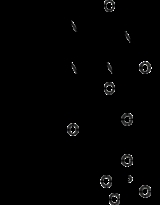
Flavin mononucleotide

Encyclopedia
Flavin mononucleotide or riboflavin-5′-phosphate, is a biomolecule
produced from riboflavin
(vitamin B2) by the enzyme riboflavin kinase
and functions as prosthetic group of various oxidoreductase
s including NADH dehydrogenase
as well as cofactor in biological blue-light photo receptors. During catalytic cycle, the reversible interconversion of oxidized (FMN), semiquinone (FMNH•) and reduced (FMNH2) forms occurs in the various oxidoreductases. FMN is a stronger oxidizing agent than NAD
and is particularly useful because it can take part in both one- and two-electron transfers. In its role as blue-light photo receptor, (oxidized) FMN stands out from the 'conventional' photo receptors as the signaling state and not an E/Z isomerization.
It is the principal form in which riboflavin is found in cell
s and tissues
. It requires more energy to produce, but is more soluble than riboflavin.
Designated with E number
E101a , it is used as a food dye.
E106, a very closely related food dye, is riboflavin-5′-phosphate sodium salt, which consists mainly of the monosodium salt
of the 5′-monophosphate ester
of riboflavin. It is rapidly turned to free riboflavin after ingestion
. It is found in many foods for babies and young children as well as jams, milk
products, and sweets and sugar
products.
Biomolecule
A biomolecule is any molecule that is produced by a living organism, including large polymeric molecules such as proteins, polysaccharides, lipids, and nucleic acids as well as small molecules such as primary metabolites, secondary metabolites, and natural products...
produced from riboflavin
Riboflavin
Riboflavin, also known as vitamin B2 or additive E101, is an easily absorbed micronutrient with a key role in maintaining health in humans and animals. It is the central component of the cofactors FAD and FMN, and is therefore required by all flavoproteins. As such, vitamin B2 is required for a...
(vitamin B2) by the enzyme riboflavin kinase
Riboflavin kinase
In enzymology, a riboflavin kinase is an enzyme that catalyzes the chemical reactionThus, the two substrates of this enzyme are ATP and riboflavin, whereas its two products are ADP and FMN....
and functions as prosthetic group of various oxidoreductase
Oxidoreductase
In biochemistry, an oxidoreductase is an enzyme that catalyzes the transfer of electrons from one molecule to another...
s including NADH dehydrogenase
NADH dehydrogenase
NADH dehydrogenase is an enzyme located in the inner mitochondrial membrane that catalyzes the transfer of electrons from NADH to coenzyme Q...
as well as cofactor in biological blue-light photo receptors. During catalytic cycle, the reversible interconversion of oxidized (FMN), semiquinone (FMNH•) and reduced (FMNH2) forms occurs in the various oxidoreductases. FMN is a stronger oxidizing agent than NAD
NAD
NAD may refer to:* No abnormality detected, a medical status description* No apparent distress, a status description in childbirth* NAD Electronics, a Canadian audio equipment manufacturer...
and is particularly useful because it can take part in both one- and two-electron transfers. In its role as blue-light photo receptor, (oxidized) FMN stands out from the 'conventional' photo receptors as the signaling state and not an E/Z isomerization.
It is the principal form in which riboflavin is found in cell
Cell (biology)
The cell is the basic structural and functional unit of all known living organisms. It is the smallest unit of life that is classified as a living thing, and is often called the building block of life. The Alberts text discusses how the "cellular building blocks" move to shape developing embryos....
s and tissues
Biological tissue
Tissue is a cellular organizational level intermediate between cells and a complete organism. A tissue is an ensemble of cells, not necessarily identical, but from the same origin, that together carry out a specific function. These are called tissues because of their identical functioning...
. It requires more energy to produce, but is more soluble than riboflavin.
Designated with E number
E number
E numbers are number codes for food additives that have been assessed for use within the European Union . They are commonly found on food labels throughout the European Union. Safety assessment and approval are the responsibility of the European Food Safety Authority...
E101a , it is used as a food dye.
E106, a very closely related food dye, is riboflavin-5′-phosphate sodium salt, which consists mainly of the monosodium salt
Salt
In chemistry, salts are ionic compounds that result from the neutralization reaction of an acid and a base. They are composed of cations and anions so that the product is electrically neutral...
of the 5′-monophosphate ester
Ester
Esters are chemical compounds derived by reacting an oxoacid with a hydroxyl compound such as an alcohol or phenol. Esters are usually derived from an inorganic acid or organic acid in which at least one -OH group is replaced by an -O-alkyl group, and most commonly from carboxylic acids and...
of riboflavin. It is rapidly turned to free riboflavin after ingestion
Ingestion
Ingestion is the consumption of a substance by an organism. In animals, it normally is accomplished by taking in the substance through the mouth into the gastrointestinal tract, such as through eating or drinking...
. It is found in many foods for babies and young children as well as jams, milk
Milk
Milk is a white liquid produced by the mammary glands of mammals. It is the primary source of nutrition for young mammals before they are able to digest other types of food. Early-lactation milk contains colostrum, which carries the mother's antibodies to the baby and can reduce the risk of many...
products, and sweets and sugar
Sugar
Sugar is a class of edible crystalline carbohydrates, mainly sucrose, lactose, and fructose, characterized by a sweet flavor.Sucrose in its refined form primarily comes from sugar cane and sugar beet...
products.