

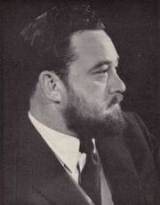
Flanders and Swann

Encyclopedia
The British duo Flanders and Swann were the actor and singer Michael Flanders
(1922–1975) and the composer, pianist and linguist Donald Swann
(1923–1994), who collaborated in writing and performing comic songs
.
Between 1956 and 1967 they performed some of their songs in their long-running two-man revue
s At the Drop of a Hat
and At the Drop of Another Hat
. Both revues were recorded in concert along with several studio-based tracks.
The wheelchair-using Flanders and composer Swann first worked together at a school revue in 1939, before becoming one of the greatest entertainment partnerships.
, where in July and August 1940 they staged a revue called Go To It, and Christ Church, Oxford
, two institutions linked by ancient tradition. The pair went their separate ways during World War II
, but a chance meeting in 1948 led to a musical partnership writing songs and light opera, Flanders providing the words and Swann composing the music. Their songs have been sung by performers such as Ian Wallace
and Joyce Grenfell
.
In December 1956, Flanders and Swann hired the New Lindsey Theatre, Notting Hill
, to perform their own two-man revue At the Drop of a Hat, which opened on New Year's Eve. Flanders sang a selection of the songs that they had written, interspersed with comic monologues, and accompanied by Swann on the piano. An unusual feature of their act was that, due to Flanders' having contracted poliomyelitis
in 1943, both men remained seated for their shows: Swann behind his piano, and Flanders in a wheelchair.
The show was successful and transferred the next month to the Fortune Theatre
, where it ran for over two years, before touring in the UK, the United States, Canada and Switzerland.
In 1963 Flanders and Swann opened in a second revue, At the Drop of Another Hat. Over the next four years they toured a combination of the two shows in the UK, Australia, New Zealand, Hong Kong
, the United States and Canada, before finishing up at the Booth Theatre
on Broadway
. On 9 April 1967, they performed their last live show together. Ten days later, they moved into a studio and recorded the show for television.
Over the course of eleven years, Flanders and Swann gave nearly 2,000 live performances. Although their performing partnership ended in 1967, they remained friends afterwards and collaborated on occasional projects.
They wrote over a hundred comic songs together. The following selection gives an indication of their range.
A very rare song, "Vendor Librorum Floreat" (Let the bookseller flourish), was released as a single in 1960. It was written for the annual American Booksellers Association, the only known time Flanders & Swann accepted a private commission.
Michael Flanders
Michael Henry Flanders OBE, was an English actor, broadcaster, and writer and performer of comic songs. He is best known to the general public for his partnership with Donald Swann performing as the duo Flanders and Swann....
(1922–1975) and the composer, pianist and linguist Donald Swann
Donald Swann
Donald Ibrahím Swann was a British composer, musician and entertainer. He is best known to the general public for his partnership of writing and performing comic songs with Michael Flanders .-Life:...
(1923–1994), who collaborated in writing and performing comic songs
Comedy
Comedy , as a popular meaning, is any humorous discourse or work generally intended to amuse by creating laughter, especially in television, film, and stand-up comedy. This must be carefully distinguished from its academic definition, namely the comic theatre, whose Western origins are found in...
.
Between 1956 and 1967 they performed some of their songs in their long-running two-man revue
Revue
A revue is a type of multi-act popular theatrical entertainment that combines music, dance and sketches. The revue has its roots in 19th century American popular entertainment and melodrama but grew into a substantial cultural presence of its own during its golden years from 1916 to 1932...
s At the Drop of a Hat
At the Drop of a Hat
At the Drop of a Hat is a musical revue by Flanders and Swann, described by them as "An After-Dinner Farrago". In the show, they both sang on a nearly bare stage, accompanied by Swann on the piano...
and At the Drop of Another Hat
At the Drop of Another Hat
At the Drop of Another Hat is musical revue by Flanders and Swann, similar in format to its long-running predecessor, At the Drop of a Hat . In the show, they both sang on a nearly bare stage, accompanied by Swann on the piano. The songs were linked by contemporary social commentary, mostly by...
. Both revues were recorded in concert along with several studio-based tracks.
The wheelchair-using Flanders and composer Swann first worked together at a school revue in 1939, before becoming one of the greatest entertainment partnerships.
Musical partnership
Flanders and Swann both attended Westminster SchoolWestminster School
The Royal College of St. Peter in Westminster, almost always known as Westminster School, is one of Britain's leading independent schools, with the highest Oxford and Cambridge acceptance rate of any secondary school or college in Britain...
, where in July and August 1940 they staged a revue called Go To It, and Christ Church, Oxford
Christ Church, Oxford
Christ Church or house of Christ, and thus sometimes known as The House), is one of the largest constituent colleges of the University of Oxford in England...
, two institutions linked by ancient tradition. The pair went their separate ways during World War II
World War II
World War II, or the Second World War , was a global conflict lasting from 1939 to 1945, involving most of the world's nations—including all of the great powers—eventually forming two opposing military alliances: the Allies and the Axis...
, but a chance meeting in 1948 led to a musical partnership writing songs and light opera, Flanders providing the words and Swann composing the music. Their songs have been sung by performers such as Ian Wallace
Ian Wallace (singer)
Ian Bryce Wallace OBE was a British bass-baritone opera and concert singer, actor and broadcaster of Scottish extraction....
and Joyce Grenfell
Joyce Grenfell
Joyce Irene Grenfell, OBE was an English actress, comedienne, diseuse and singer-songwriter.-Early life:...
.
In December 1956, Flanders and Swann hired the New Lindsey Theatre, Notting Hill
Notting Hill
Notting Hill is an area in London, England, close to the north-western corner of Kensington Gardens, in the Royal Borough of Kensington and Chelsea...
, to perform their own two-man revue At the Drop of a Hat, which opened on New Year's Eve. Flanders sang a selection of the songs that they had written, interspersed with comic monologues, and accompanied by Swann on the piano. An unusual feature of their act was that, due to Flanders' having contracted poliomyelitis
Poliomyelitis
Poliomyelitis, often called polio or infantile paralysis, is an acute viral infectious disease spread from person to person, primarily via the fecal-oral route...
in 1943, both men remained seated for their shows: Swann behind his piano, and Flanders in a wheelchair.
The show was successful and transferred the next month to the Fortune Theatre
Fortune Theatre
The Fortune Theatre is a 432 seat West End theatre in Russell Street, near Covent Garden, in the City of Westminster, built in 1922-4 by Ernest Schaufelberg for impresario Laurence Cowen. The façade is principally bush hammered concrete, with brick piers supporting the roof...
, where it ran for over two years, before touring in the UK, the United States, Canada and Switzerland.
In 1963 Flanders and Swann opened in a second revue, At the Drop of Another Hat. Over the next four years they toured a combination of the two shows in the UK, Australia, New Zealand, Hong Kong
Hong Kong
Hong Kong is one of two Special Administrative Regions of the People's Republic of China , the other being Macau. A city-state situated on China's south coast and enclosed by the Pearl River Delta and South China Sea, it is renowned for its expansive skyline and deep natural harbour...
, the United States and Canada, before finishing up at the Booth Theatre
Booth Theatre
The Booth Theatre is a Broadway theatre located at 222 West 45th Street in midtown-Manhattan, New York City.Architect Henry B. Herts designed the Booth and its companion Shubert Theatre as a back-to-back pair sharing a Venetian Renaissance-style façade...
on Broadway
Broadway theatre
Broadway theatre, commonly called simply Broadway, refers to theatrical performances presented in one of the 40 professional theatres with 500 or more seats located in the Theatre District centered along Broadway, and in Lincoln Center, in Manhattan in New York City...
. On 9 April 1967, they performed their last live show together. Ten days later, they moved into a studio and recorded the show for television.
Over the course of eleven years, Flanders and Swann gave nearly 2,000 live performances. Although their performing partnership ended in 1967, they remained friends afterwards and collaborated on occasional projects.
Timeline
| Date | Venue |
|---|---|
| 1956 | New Lindsey Theatre, Notting Hill |
| 1957–59 | Fortune Theatre (suspended one month because of Flanders' pneumonia) |
| 1959 | Edinburgh Festival "At the Drop of a Kilt" |
| 1959–60 | Golden Theater, New York |
| 1960–61 | 12-city tour of USA, plus Toronto |
| 1961 | Switzerland |
| 1962 | 9-city tour of UK, plus Toronto |
| 1963 | 9-city tour of UK |
| 1963 | Haymarket Theatre |
| 1964 | 4-city tour of Australia, 5 NZ, plus Hong Kong |
| 1965 | 3-city tour of UK |
| 1965 | Globe Theatre (now the Gielgud) |
| 1966 | 9-city tour of USA, plus Toronto |
| 1966–67 | New York |
EPs
- 1957 - Excerpts from At The Drop of a Hat (EPExtended playAn EP is a musical recording which contains more music than a single, but is too short to qualify as a full album or LP. The term EP originally referred only to specific types of vinyl records other than 78 rpm standard play records and LP records, but it is now applied to mid-length Compact...
) - 1957 - More Excerpts from At The Drop of a Hat (EP)
- 1957 - More out of the Hat! (EP)
- 1959 - Little Drummer Boy/The Storke Carol (EP)
- 1961 - The Bestiary of Flanders & Swann (EP)
- 1964 - Favourites from At The Drop of Another Hat (EP)
- 1964 - More out of the New Hat (EP)
LPs
- 1957 - At The Drop of a Hat (50th performance and one a few days later, PMC 1033)
- 1960 - At The Drop of a Hat (Final performance produced by George MartinGeorge MartinSir George Henry Martin CBE is an English record producer, arranger, composer and musician. He is sometimes referred to as "the Fifth Beatle"— a title that he often describes as "nonsense," but the fact remains that he served as producer on all but one of The Beatles' original albums...
) - 1964 - At The Drop of Another Hat (produced by George Martin)
- 1967 - The Bestiary of Flanders & Swann (produced by George Martin)
- 1975 - And Then We Wrote...
- 1977 - Tried by the Centre Court
Cassettes
- 1996 - EMI Comedy Classics (Hat and Another Hat on two cassettes)
- 1997 - More out of the Drop of a Hat - Again! (double cassette)
CDs
- 1994 - The Complete Flanders & Swann (first three albums in a boxed set)
- 1994 - A Transport of Delight: The Best of Flanders & Swann
- 1999 - The Flanders and Swann Collection
- 2000 - A Drop of Hilarity from Flanders & Swann
- 2007 - Hat Trick: Flanders & Swann Collector's Edition
Donald Swann solo
- 1951 - The Youth of the Heart (78 rpm)
- 1958 - London Sketches (Donald Swann & Sebastian ShawSebastian Shaw (actor)Sebastian Lewis Shaw was an English actor, director, novelist, playwright and poet. During his 65-year career, Shaw appeared in dozens of stage performances and more than 40 film and television productions....
) - 1963 - Festival Matins (EP)
- 1964 - Songs of Faith & Doubt (EP)
- 1965 - For The Love of Betjeman (Donald Swann & Sir John BetjemanJohn BetjemanSir John Betjeman, CBE was an English poet, writer and broadcaster who described himself in Who's Who as a "poet and hack".He was a founding member of the Victorian Society and a passionate defender of Victorian architecture...
, EP) - 1966 - Donald Swann & the Choir of the Friends' School, Saffron Walden (EP)
- 1967 - Tolkien: Poems & Songs of Middle Earth (Donald Swann & William Elvin)
- 1968 - Sing Round The Year (Boys of Westminster School and Girls of Mayfield Putney)
- 1970 - An Evening in Crete (Donald Swann & Lilli Malandraki)
- 1971 - The Song of Caedmon (Donald Swann & Arthur Scholey, EP)
- 1973 - A Crack in Time (The Swann Singers)
- 1973 - Wacky & His Fuddlejig (Donald Swann & Arthur Scholey, narrated by Peter UstinovPeter UstinovPeter Alexander Ustinov CBE was an English actor, writer and dramatist. He was also renowned as a filmmaker, theatre and opera director, stage designer, author, screenwriter, comedian, humourist, newspaper and magazine columnist, radio broadcaster and television presenter...
, EP) - 1973 - The Rope of Love (The Swann Singers)
- 1975 - The Parable of the Lost Sons (Donald Swann & The NairobiNairobiNairobi is the capital and largest city of Kenya. The city and its surrounding area also forms the Nairobi County. The name "Nairobi" comes from the Maasai phrase Enkare Nyirobi, which translates to "the place of cool waters". However, it is popularly known as the "Green City in the Sun" and is...
Youth Choir, EP) - 1980 - Radio Orwell (The Olive Quantrill Singers)
- 1981 - Swann with Topping (Donald Swann & Frank Topping)
- 1984 - Requiem for the Living (Donald Swann & Cecil Day-LewisCecil Day-LewisCecil Day-Lewis CBE was an Irish poet and the Poet Laureate from 1968 until his death in 1972. He also wrote mystery stories under the pseudonym of Nicholas Blake...
) - 1989 - Alphabetaphon (Donald Swann, 3 cassettes)
- 1992 - Amiscelleny (Donald Swann & John AmisJohn AmisJohn Preston Amis , is a British broadcaster, classical music critic, music administrator, and writer. He has been a frequent contributor for The Guardian and to BBC radio and television music programming....
) - 1994 - Swann in Jazz
- 1999 - The Isles of Greece
Michael Flanders solo
- 1953 - Three's Company (Michael Flanders & Anthony HopkinsAnthony HopkinsSir Philip Anthony Hopkins, KBE , best known as Anthony Hopkins, is a Welsh actor of film, stage and television...
) - 1954 - The Soldier's Tale (Michael Flanders & Sergei ProkofievSergei ProkofievSergei Sergeyevich Prokofiev was a Russian composer, pianist and conductor who mastered numerous musical genres and is regarded as one of the major composers of the 20th century...
) - 1959 - The Christmas Story (Michael Flanders & the Mike SammesMike SammesMichael William "Mike" Sammes was an English musician and vocal session arranger, performing backing vocals on pop music recorded in the UK from 1955 to the 1970s.-Career:...
Singers) - 1960 - Peter and the Wolf (Prokofiev, Michael Flanders narrator)
- 1962 - Touches of Sweet Harmony (Michael Flanders, reader)
- 1962 - Mark's Gospel (Michael Flanders, reader)
- 1963 - The Comedy of Errors (Michael Flanders, actor)
- 1963 - Elizabeth the Great (Michael Flanders, actor)
- 1972 - Captain Noah & His Floating Zoo (Michael Flanders & Joseph HorovitzJoseph HorovitzJoseph Horovitz is a British composer and conductor. Horovitz's family emigrated to England in 1938. He studied music and modern languages at New College, Oxford, and later attended the Royal College of Music in London, studying composition with Gordon Jacob. He then undertook a year of further...
)
Videography
- 1992 - The Only Flanders & Swann Video (recorded New York, 19 April 1967, 10 days after the close of At The Drop of Another Hat)
- 1998 - Flanders & Swann (recorded in New York, 1962 & 1967)
Songs of Flanders and Swann
Flanders and Swann's songs are characterised by wit, gentle satire, complex rhyming schemes, and memorable choruses. Flanders commented during the recorded performance of At the Drop of Another Hat,They wrote over a hundred comic songs together. The following selection gives an indication of their range.
- "All Gall"—a political satire based on the long career of Charles de GaulleCharles de GaulleCharles André Joseph Marie de Gaulle was a French general and statesman who led the Free French Forces during World War II. He later founded the French Fifth Republic in 1958 and served as its first President from 1959 to 1969....
. At the time of writing, de Gaulle had recently vetoed the UK's first application to join the European Economic CommunityEuropean Economic CommunityThe European Economic Community The European Economic Community (EEC) The European Economic Community (EEC) (also known as the Common Market in the English-speaking world, renamed the European Community (EC) in 1993The information in this article primarily covers the EEC's time as an independent...
. Sung to the tune of "This Old Man." - "Bedstead Men," a wry explanation for the rusty bedsteads dumped in ponds and lakes in the UK.
- "First and Second Law"—a jazzy setting of the first and second laws of thermodynamicsThermodynamicsThermodynamics is a physical science that studies the effects on material bodies, and on radiation in regions of space, of transfer of heat and of work done on or by the bodies or radiation...
. - "The Gasman Cometh"—a verse-and-chorus song in which a householder finds that no tradesman ever completes a job without creating another, related job for another tradesman.
- "The Hippopotamus"—one of Flanders and Swann's best known songs ("Mud, mud, glorious mud"), and one of a range of songs that they wrote about different beasts, including "The GnuThe Gnu"The Gnu" is a humorous song about a talking gnu by Flanders and Swann.The word gnu is consistently pronounced with two syllables as "g-noo", with the g clearly enunciated, and the n unpalatalised...
", "The Warthog" and "The Armadillo". It is among those Ian Wallace included in his repertoire. - "Ill Wind"—Flanders's words sung to a slightly cut version, with cadenzaCadenzaIn music, a cadenza is, generically, an improvised or written-out ornamental passage played or sung by a soloist or soloists, usually in a "free" rhythmic style, and often allowing for virtuosic display....
, of the rondo finale of Mozart'sWolfgang Amadeus MozartWolfgang Amadeus Mozart , baptismal name Johannes Chrysostomus Wolfgangus Theophilus Mozart , was a prolific and influential composer of the Classical era. He composed over 600 works, many acknowledged as pinnacles of symphonic, concertante, chamber, piano, operatic, and choral music...
Horn Concerto No. 4 in E flat majorHorn Concerto No. 4 (Mozart)Wolfgang Amadeus Mozart's Horn Concerto No. 4 in E-flat major, K. 495 was completed in 1786.- Structure :The work is in three movements:*I. Allegro moderato*II. Romance *III. Rondo 6/8...
, K. 495. It has to be sung since Flanders's French horn was apparently stolen. - "In The Desert" ("Верблюды", lit. "camelCamelA camel is an even-toed ungulate within the genus Camelus, bearing distinctive fatty deposits known as humps on its back. There are two species of camels: the dromedary or Arabian camel has a single hump, and the bactrian has two humps. Dromedaries are native to the dry desert areas of West Asia,...
s")—a "traditional Russian" song, performed by Donald Swann. He provides an English-languageEnglish languageEnglish is a West Germanic language that arose in the Anglo-Saxon kingdoms of England and spread into what was to become south-east Scotland under the influence of the Anglian medieval kingdom of Northumbria...
translation after every line. The song is extremely repetitive, rendering the translation largely redundant. - "In the D'Oyly Cart"—a satire about the D'Oyly Carte Opera CompanyD'Oyly Carte Opera CompanyThe D'Oyly Carte Opera Company was a professional light opera company that staged Gilbert and Sullivan's Savoy operas. The company performed nearly year-round in the UK and sometimes toured in Europe, North America and elsewhere, from the 1870s until it closed in 1982. It was revived in 1988 and...
. It was first performed in the revue Oranges and Lemons (1948) and revived in Penny Plain (1951). It was included as the first track on Flanders and Swann's 1974 album, And Then We Wrote. - "Have Some Madeira M'DearHave Some Madeira M'DearHave Some Madeira M'Dear is a darkly comic song by Flanders and Swann. It is a song about seduction and alcohol, containing complex and witty wordplay....
"—an old rouéRõueRõue is a village in Kehtna Parish, Rapla County in northern-central Estonia....
sings to an ingénueIngenue (stock character)See also Disingenuous, which is not quite the antonym that it may seem!The ingénue is a stock character in literature, film, and a role type in the theatre; generally a girl or a young woman who is endearingly innocent and wholesome. Ingenue may also refer to a new young actress or one typecast in...
about the merits of that wine, hinting that he has seduction in mind, with complex word-play, including three oft-quoted examples of syllepsis. - "Misalliance"—a political allegory concerning a love affair between a honeysuckleHoneysuckleHoneysuckles are arching shrubs or twining vines in the family Caprifoliaceae, native to the Northern Hemisphere. There are about 180 species of honeysuckle, 100 of which occur in China; Europe, India and North America have only about 20 native species each...
and a bindweedBindweedBindweed may refer to:* Convolvulaceae , a family including about 60 genera and more than 1,650 species** Calystegia , a genus of about 25 species of flowering plants...
. - "P** P* B**** B** D******" or "Pee Po Belly Bum Drawers"—a song comparing the use of profanityProfanityProfanity is a show of disrespect, or a desecration or debasement of someone or something. Profanity can take the form of words, expressions, gestures, or other social behaviors that are socially constructed or interpreted as insulting, rude, vulgar, obscene, desecrating, or other forms.The...
among the intelligentsia to playground swearing. - "The Reluctant Cannibal"—an argument between father and son, on the topic of cannibalism (Son: "Eating people is wrong", Father: "Must have been someone he ate"—"he used to be a regular anthropophaguy") The father says you might as well say "Don't fight people" and they agree: "Ridiculous!".
- "Slow TrainSlow Train"Slow Train" is a song by the British duo Flanders and Swann, written in 1963.It laments the loss of British stations and railway lines in that era, due to the Beeching cuts, and also the passing of a way of life, with the advent of motorways etc....
"—a nostalgic song about the railway stations on lines scheduled for closure by the Beeching AxeBeeching AxeThe Beeching Axe or the Beeching Cuts are informal names for the British Government's attempt in the 1960s to reduce the cost of running British Railways, the nationalised railway system in the United Kingdom. The name is that of the main author of The Reshaping of British Railways, Dr Richard...
in 1963. - "A Song of Patriotic Prejudice"—a Little EnglanderLittle EnglanderLittle Englander is an epithet applied in criticisms of English people who are regarded as "xenophobic" and/or overly nationalistic and are often accused of being "ignorant" and "boorish". It is applied to opponents of globalism; for instance those who are against membership of the European Union...
s song ("The English, the English, the English are best,/ I wouldn't give tuppence for all of the rest") - "A Song of Reproduction"—about the then topical mania for do-it-yourself hi-fiHigh fidelityHigh fidelity—or hi-fi—reproduction is a term used by home stereo listeners and home audio enthusiasts to refer to high-quality reproduction of sound or images, to distinguish it from the poorer quality sound produced by inexpensive audio equipment...
as an end in itself. (Making much of the jargon of the hobby - "woofer" "tweeter" "wow on your top" "flutter on your bottom" and in a line added for the stereo remake: "Raise the ceiling four feet, move the fireplace from that wall to that wall, you'll still only get the stereophonic effect if you sit in the bottom of that cupboard.") - "A Song of the Weather"—a parody of the 1834 poem "January Brings the Snow" by Sara ColeridgeSara ColeridgeSara Coleridge was an English author and translator. She was the fourth child and only daughter of Samuel Taylor Coleridge and his wife Sarah Fricker.-Early life:...
- "To Kokoraki" (Το Κοκοράκι, lit. "The Cockerel")—a modern-Greek children's song, something like "Old McDonald Had a FarmOld McDonald Had a Farm"Old MacDonald Had a Farm" is a children's song and nursery rhyme about a farmer named MacDonald and the various animals he keeps on his farm. Each verse of the song changes the name of the animal and its respective noise. In many versions, the song is cumulative, with the noises from all the...
", in which a different animal noise is added in each verse. Flanders, feigning impatience with it as Swann sings several more verses than strictly necessary, remarks sarcastically "We must have it in full some night. Alternate it with The Ring Cycle." - "A Transport of Delight"—with an increasing refrain about the "Big six-wheeler, scarlet-painted, London TransportLondon Transport BoardThe London Transport Board was the organisation responsible for public transport in London, UK, and its environs from 1963-1969. In common with all London transport authorities from 1933 to 2000, the public name and operational brand of the organisation was London Transport.-History:The...
, diesel-engined, ninety-seven–horse-power omnibus". - "20 Tons of TNT"—a song about thermonuclear weapons.
- "The War of 14–18"—a translation of a FrenchFrench languageFrench is a Romance language spoken as a first language in France, the Romandy region in Switzerland, Wallonia and Brussels in Belgium, Monaco, the regions of Quebec and Acadia in Canada, and by various communities elsewhere. Second-language speakers of French are distributed throughout many parts...
song by Georges BrassensGeorges BrassensGeorges Brassens , 22 October 1921 – 29 October 1981), was a French singer-songwriter and poet.Brassens was born in Sète, a town in southern France near Montpellier...
, this song 'celebrates' World War I. - "The Wompon"—a tale about a fictitious all-purpose creature/plant/raw material.
- "Twosome: Kang & Jag" (Kangaroo and Jaguar)—two more animal songs sung as a pair. The title recalls "Cav and Pag" i.e. Cavalleria rusticanaCavalleria rusticanaCavalleria rusticana is an opera in one act by Pietro Mascagni to an Italian libretto by Giovanni Targioni-Tozzetti and Guido Menasci, adapted from a play written by Giovanni Verga based on his short story. Considered one of the classic verismo operas, it premiered on May 17, 1890 at the Teatro...
and I Pagliacci, which are often performed together.
A very rare song, "Vendor Librorum Floreat" (Let the bookseller flourish), was released as a single in 1960. It was written for the annual American Booksellers Association, the only known time Flanders & Swann accepted a private commission.
Monologues
Flanders' comic monologues include:- "By Air"—about the vogue for air travel. "I agree with the old lady who said, 'If God had intended us to fly, He would never have given us the railways.'"
- "Tried by the Centre Court"—a WimbledonThe Championships, WimbledonThe Championships, Wimbledon, or simply Wimbledon , is the oldest tennis tournament in the world, considered by many to be the most prestigious. It has been held at the All England Club in Wimbledon, London since 1877. It is one of the four Grand Slam tennis tournaments, the other three Majors...
match between Miss L. Hammerfest and Miss Joan Hunter-DunnJoan JacksonJoan Jackson was the muse of Sir John Betjeman, best known from being the subject of his poem "A Subaltern's Love-song"....
. "They are bashing a ball with the gut of a cat". - "Greensleeves"—about the background to the composition of the famous English airGreensleeves"Greensleeves" is a traditional English folk song and tune, a ground of the form called a romanesca.A broadside ballad by this name was registered at the London Stationer's Company in September 1580 as "A New Northern Dittye of the Lady Greene Sleeves". It then appears in the surviving A Handful of...
. An annotated version, explaining all the jokes, is available online. - Los Olividados—describing a festival akin to bullfightingBullfightingBullfighting is a traditional spectacle of Spain, Portugal, southern France and some Latin American countries , in which one or more bulls are baited in a bullring for sport and entertainment...
, where the bull is replaced with an olive. The title is a reference to Los OlvidadosLos olvidadosLos Olvidados is a 1950 Mexican film directed by Spanish filmmaker Luis Buñuel....
, or The Forgotten Ones, a 1950 movie by the director Luis BuñuelLuis BuñuelLuis Buñuel Portolés was a Spanish-born filmmaker — later a naturalized citizen of Mexico — who worked in Spain, Mexico, France and the US..-Early years:...
. - "Built-up Area"—a prehistoric inhabitant of Salisbury PlainSalisbury PlainSalisbury Plain is a chalk plateau in central southern England covering . It is part of the Southern England Chalk Formation and largely lies within the county of Wiltshire, with a little in Hampshire. The plain is famous for its rich archaeology, including Stonehenge, one of England's best known...
complains about a new development: StonehengeStonehengeStonehenge is a prehistoric monument located in the English county of Wiltshire, about west of Amesbury and north of Salisbury. One of the most famous sites in the world, Stonehenge is composed of a circular setting of large standing stones set within earthworks...
.
External links
- Donald Swann's website
- Flanders and Swann web site
- Flanders and Swann: At the Drop of a Hippopotamus"—A show that tours UK theatres with a production of Flanders and Swann songs.
- A tribute to the songs and monologues of Flanders and Swann by actors Mark Marlowe and Jonathan Roberts
- Article by Stephanie Flanders about her father.