


Flaminio Vacca

Encyclopedia
Rome
Rome is the capital of Italy and the country's largest and most populated city and comune, with over 2.7 million residents in . The city is located in the central-western portion of the Italian Peninsula, on the Tiber River within the Lazio region of Italy.Rome's history spans two and a half...
, 1538 – Rome
Rome
Rome is the capital of Italy and the country's largest and most populated city and comune, with over 2.7 million residents in . The city is located in the central-western portion of the Italian Peninsula, on the Tiber River within the Lazio region of Italy.Rome's history spans two and a half...
, 1605) was an Italian sculptor. His sculptural work can be seen in Rome in the grandiose funeral chapel of Pope Pius V
Pope Pius V
Pope Saint Pius V , born Antonio Ghislieri , was Pope from 1566 to 1572 and is a saint of the Catholic Church. He is chiefly notable for his role in the Council of Trent, the Counter-Reformation, and the standardization of the Roman liturgy within the Latin Church...
designed by Domenico Fontana
Domenico Fontana
Domenico Fontana was a Swiss-born Italian architect of the late Renaissance.-Biography:200px|thumb|Fountain of Moses in Rome....
at the Basilica di Santa Maria Maggiore
Basilica di Santa Maria Maggiore
The Papal Basilica of Saint Mary Major , known also by other names, is the largest Roman Catholic Marian church in Rome, Italy.There are other churches in Rome dedicated to Mary, such as Santa Maria in Trastevere, Santa Maria in Aracoeli, Santa Maria sopra Minerva, but the greater size of the...
(Saint Francis), in the Church of the Gesù
Church of the Gesu
The Church of the Gesù is the mother church of the Society of Jesus, a Roman Catholic religious order also known as the Jesuits. Officially named , its facade is "the first truly baroque façade", introducing the baroque style into architecture ,. The church served as model for innumerable Jesuit...
(one of four marble angels in the third chapel on the right) and in the right transept of the Chiesa Nuova
Chiesa Nuova
Chiesa Nuova may refer to:*Santa Maria in Vallicella, a church in Rome, Italy*Chiesa Nuova , a church in Assisi, Italy*Chiesa Nuova , a Franciscan performing arts ministry based in Chicago, Illinois...
(Saint John the Evangelist and Saint John the Baptist, both signed). At the notoriously awkward fountain that marked the terminus of the Acqua Felice
Acqua Felice
The Acqua Felice is one of the aqueducts of Rome, completed in 1586 by Pope Sixtus V, whose birth name, which he never fully abandoned, was Felice Peretti. The first new aqueduct of Early Modern Rome, its source is at the springs at Pantano Borghese, off Via Casilina...
, Vacca contributed one of the angels (documented 1588-89,) supporting Sixtus V
Pope Sixtus V
Pope Sixtus V , born Felice Peretti di Montalto, was Pope from 1585 to 1590.-Early life:The chronicler Andrija Zmajević states that Felice's family originated from modern-day Montenegro...
's coat-of-arms that crown the attic, and a bas-relief Joshua Leading His People across the Jordan River; in these commissions for the fountain his partner in the documented payments was Pietro Paolo Olivieri.His self-portrait (1599) is conserved in the Protomoteca Capitolina on the Campidoglio. At the Villa Medici
Villa Medici
The Villa Medici is a mannerist villa and an architectural complex with a garden contiguous with the larger Borghese gardens, on the Pincian Hill next to Trinità dei Monti in Rome, Italy. The Villa Medici, founded by Ferdinando I de' Medici, Grand Duke of Tuscany and now property of the French...
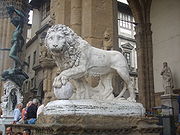
the two marble Medici lions
Medici lions
The Medici lions are two lion sculptures placed around 1600 at the Villa Medici, Rome, Italy, and since 1789 displayed at the Loggia dei Lanzi, Florence. The sculptures depict standing male lions with a sphere under one claw, looking to the side...
flank the staircase; one is Roman, its pendant, made to match it in 1600, was by Flaminio Vacca. Vacca's copy was replaced by a copy when Villa Medici was sold by the Grand Duke of Tuscany and moved the lions to Piazza della Signoria
Piazza della Signoria
Piazza della Signoria is an L-shaped square in front of the Palazzo Vecchio in Florence, Italy. It was named after the Palazzo della Signoria, also called Palazzo Vecchio....
, Florence, where with its ancient companion it flanks the steps to the Loggia dei Lanzi
Loggia dei Lanzi
The Loggia dei Lanzi, also called the Loggia della Signoria, is a building on a corner of the Piazza della Signoria in Florence, Italy, adjoining the Uffizi Gallery. It consists of wide arches open to the street, three bays wide and one bay deep. The arches rest on clustered pilasters with...
. In Santa Susanna
Santa Susanna
The Church of Saint Susanna at the baths of Diocletian is a Roman Catholic parish church on the Quirinal Hill in Rome, with a titulus associated to its site that dates back to about 280...
, the prophets Ezekiel and Daniel have been attributed to him.
Outside Rome his sculpture may be found at Spello
Spello
Spello is an ancient town and comune of Italy, in the province of Perugia in east central Umbria, on the lower southern flank of Mt. Subasio. It is 6 km NNW of Foligno and 10 km SSE of Assisi.The old walled town lies on a regularly NW-SE sloping ridge that eventually meets the plain...
(a tabernacle [1587] in the Capella del Sacramento, Church of San Lorenzo);
His Memorie di varie antichità trovate in diversi luogia della Città di Roma (Rome 1594, republished as a supplement to Famiano Nardini's Roma Antica [1666], reprinted by Carlo Fea, 1790) are a primary source of information and rich human detail on the discoveries of Roman sculpture and antiquities
Antiquities
Antiquities, nearly always used in the plural in this sense, is a term for objects from Antiquity, especially the civilizations of the Mediterranean: the Classical antiquity of Greece and Rome, Ancient Egypt and the other Ancient Near Eastern cultures...
in the later sixteenth century, and also on the destruction of antiquities, especially for the urbanistic programmes of Pope Sixtus V
Pope Sixtus V
Pope Sixtus V , born Felice Peretti di Montalto, was Pope from 1585 to 1590.-Early life:The chronicler Andrija Zmajević states that Felice's family originated from modern-day Montenegro...
. His pithy numbered anecdotal notes consistently begin Mi ricordo..., "I remember...".
Vacca's reputation at the time of his death made him a suitable candidate for insepulture in the Pantheon, Rome
Pantheon, Rome
The Pantheon ,Rarely Pantheum. This appears in Pliny's Natural History in describing this edifice: Agrippae Pantheum decoravit Diogenes Atheniensis; in columnis templi eius Caryatides probantur inter pauca operum, sicut in fastigio posita signa, sed propter altitudinem loci minus celebrata.from ,...
; there his modest epitaph reads, in translation, "Flaminius Vacca, Roman sculptor, who in his works never satisfied himself". Vacca had been one of the founding members of the Confraterità dei Virtuosi that was formed at the Pantheon by Desiderio da Segni, a canon of the church of Santa Maria ad Martyres that occupied and preserved the Pantheon, to ensure that worship was maintained in the Chapel of St Joseph in the Holy Land, Others among the first members were Antonio da Sangallo the younger
Antonio da Sangallo the Younger
thumb|250px|The church of Santa Maria di Loreto near the [[Trajan's Market]] in [[Rome]], considered Sangallo's masterwork.thumb|250px|View of St. Patrick's Well in [[Orvieto]]....
, Jacopo Meneghino, Giovanni Mangone, Taddeo Zuccari
Taddeo Zuccari
Taddeo Zuccari was an Italian painter, one of the most popular members of the Roman mannerist school.-Biography:...
and Domenico Beccafumi.
A modern account of his career is Sergio Lombardi, "Flaminio Vacca," in Roma di Sisto V: Le arti e la cultura, Maria Luisa Madonna, ed. (Rome: De Luca, 1993)