


Fishing reel

Encyclopedia
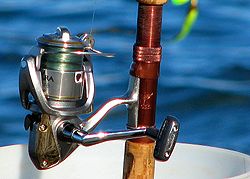
Angling
Angling is a method of fishing by means of an "angle" . The hook is usually attached to a fishing line and the line is often attached to a fishing rod. Fishing rods are usually fitted with a fishing reel that functions as a mechanism for storing, retrieving and paying out the line. The hook itself...
. They are most often used in conjunction with a fishing rod
Fishing rod
A fishing rod or a fishing pole is a tool used to catch fish, usually in conjunction with the pastime of angling, and can also be used in competition casting. . A length of fishing line is attached to a long, flexible rod or pole: one end terminates in a hook for catching the fish...
, though some specialized reels are mounted directly to boat gunwales or transoms. The earliest known illustration of a fishing reel is from Chinese paintings and records beginning about 1195 AD. Fishing reels first appeared in England around 1650 AD, and by the 1760s, London tackle shops were advertising multiplying or gear-retrieved reels. Paris, Kentucky
Paris, Kentucky
As of the census of 2000, there were 9,183 people, 3,857 households, and 2,487 families residing in the city. The population density was . There were 4,222 housing units at an average density of . The racial makeup of the city was 84.23% White, 12.71% African American, 0.16% Native American, 0.16%...
native George Snyder is generally given credit for inventing the first fishing reel in America around 1820, a bait casting design that quickly became popular with American anglers.
History

Ma Yuan (painter)
Ma Yuan was a Chinese painter of the Song Dynasty. His work, together with that of Xia Gui, formed the basis of the so-called Ma-Xia school of painting, and is considered among the finest from the period...
(c. 1160–1225) called "Angler on a Wintry Lake," showing a man sitting on a small sampan
Sampan
A sampan is a relatively flat bottomed Chinese wooden boat from long. Some sampans include a small shelter on board, and may be used as a permanent habitation on inland waters. Sampans are generally used for transportation in coastal areas or rivers, and are often used as traditional fishing boats...
boat while casting out his fishing line
Fishing line
A fishing line is a cord used or made for angling. Important parameters of a fishing line are its length, material, and weight...
. Another fishing reel was featured in a painting by Wu Zhen
Wu Zhen
Wu Zhen was a painter during the Yuan dynasty of China. He followed the Dong Yuan school of painting. Following along with trends of the time, Wu's works tended less toward naturalism and more toward abstraction, focusing on dynamic balance of elements, and personifying nature...
(1280–1354). The book Tianzhu lingqian (Holy Lections from Indian Sources), printed sometime between 1208 and 1224, features two different woodblock print illustrations
Woodcut
Woodcut—occasionally known as xylography—is a relief printing artistic technique in printmaking in which an image is carved into the surface of a block of wood, with the printing parts remaining level with the surface while the non-printing parts are removed, typically with gouges...
of fishing reels being used. An Armenia
Armenia
Armenia , officially the Republic of Armenia , is a landlocked mountainous country in the Caucasus region of Eurasia...
n parchment Gospel of the 13th century shows a reel (though not as clearly depicted as the Chinese ones). The Sancai Tuhui
Sancai Tuhui
The Sancai Tuhui, compiled by Shanghai natives Wang Qi and Wang Siyi , is a Chinese encyclopedia known at the time as a type of Book by category , completed in 1607 and published in 1609 during the Ming dynasty, featuring illustrations of subjects in the three worlds of heaven, earth, and...
, a Chinese encyclopedia published in 1609, features the next known picture of a fishing reel and vividly shows the windlass
Windlass
The windlass is an apparatus for moving heavy weights. Typically, a windlass consists of a horizontal cylinder , which is rotated by the turn of a crank or belt...
pulley of the device. These five pictures mentioned are the only ones which feature fishing reels before the year 1651 (when the first English
England
England is a country that is part of the United Kingdom. It shares land borders with Scotland to the north and Wales to the west; the Irish Sea is to the north west, the Celtic Sea to the south west, with the North Sea to the east and the English Channel to the south separating it from continental...
illustration was made); after that year they became commonly depicted in world art.
Fly Reel
Often used for fly fishing the fly reel or fly casting reel has traditionally been rather simple in terms of mechanical construction, little has changed from the design patented by Charles F. Orvis in 1874. However, in recent years improvements have been made with the development of better reels and drags for fighting larger fish. A fly reel is normally operated by stripping line off the reel with one hand, while casting the rod with the other hand. Early fly reels often had no drag at all, but merely a click/pawl mechanism intended to keep the reel from overrunning when line was pulled from the spool. To slow a fish, the angler simply applied hand pressure to the rim of the revolving spool (known as "palming the rim"). Later, these click/pawl mechanisms were modified to provide a limited adjustable drag. Although adequate for smaller fish, these did not possess a wide adjustment range or the power to slow larger fish.Modern fly reels typically have more sophisticated disc-type drag systems made of composite materials that feature increased adjustment range, consistency, and resistance to high temperatures from drag friction. Most of these fly reels also feature large-arbor spools designed to reduce line memory, maintain consistent drag and assist the quick retrieval of slack line in the event a hooked fish makes a sudden run towards the angler.
At one time, multiplier fly reels were widely available. These reels had a geared line retrieve of 2:1 or 3:1 that allowed faster retrieval of the fly line. However, their additional weight, complexity and expense did not justify the advantage of faster line retrieval in the eyes of many anglers. As a result, today they are rarely used.
Automatic fly reels use a coiled spring mechanism that pulls the line into the reel with the flick of a lever. Automatic reels tend to be heavy for their size, and have limited line capacity. Automatic fly reels peaked in popularity during the 1960s, and since that time they have been outsold many times over by manual fly reels.
Saltwater fly reels are designed specifically for use in an ocean environment. Saltwater fly reels are normally much larger in diameter than most freshwater fly reels in order to provide a large line and backing capacity designed for the long runs of powerful ocean game fish
Game fish
Game fish are fish pursued for sport by recreational anglers. They can be freshwater or marine fish. Game fish can be eaten after being caught, though increasingly anglers practise catch and release to improve fish populations. Some game fish are also targeted commercially, particularly...
. To prevent corrosion, saltwater fly reels often use aerospace aluminum frames and spools, electroplated and/or stainless steel
Stainless steel
In metallurgy, stainless steel, also known as inox steel or inox from French "inoxydable", is defined as a steel alloy with a minimum of 10.5 or 11% chromium content by mass....
components, with sealed and waterproof bearing and drive mechanisms.
Fly Reel Operation
Fly reels are normally manual, single-action designs. Rotating a handle on the side of the reel rotates the spool which retrieves the line, usually at a 1:1 ratio (i.e., one complete revolution of the handle equals one revolution of the spool).
Centrepin reel
The centrepin reel is one which runs freely enough on its axle (its "centrepin") to permit distance casting by allowing the line to be drawn off by the momentum of the cast from the rotating reel. Examples of models which have traditionally been taken to represent the type are the Nottingham and Scarborough. Makers have competed to devise refinements and today the term usually indicates relatively simple features, more elaborate models being assigned designations by makers.The centrepin reel is also historically and currently used for coarse fishing, it is undergoing a strong revival amongst contemporary coarse fish anglers, typically used in circumstances which don't demand long distance casting, a centrepin has the visceral advantage over a fixed spool reel in that it puts the angler in contact with the fish without the involvement of a slipping clutch. The angler's thumb typically, is instead used to control the fish. Fishing in the margins for carp or other heavy fish with relatively light tackle is very popular with a 'pin' and it is unbeatable as a tool for trotting on slow and fast flowing rivers. Many young anglers started their lifetime hobby fishing with a centrepin, fishing in small ponds the length and breadth of England. In the 1950s and 1960s, centrepins outsold all other types of reels and were mostly used by coarse anglers as the number of anglers using them for game fishing was relatively small and remains so when compared to the general fishing population.
Centerpin reels remain popular with anglers in Australia for all forms of fresh and saltwater fishing. Most common is the use of centerpin reels in Australia for surfcasting off the beach. A large diameter spool centerpin reel is attached in a low mount position on a 12–17 foot surfcasting pole by way of a bracket that allows the reel to be rotated 90° to the pole for casting and returned to a position to retrieve line. In the casting position the spool is perpendicular to the pole, opening the face of the reel allowing the line to run off the side of the spool when released in the cast. The surfcasting poles are specifically designed for use with these reels have the reel low mounted as the line is held and released during the cast by the lower hand on the rod, unlike fixed spool or multiplier surf reels, and the lowest ring is of large diameter and around halfway along the poles length.
Bait casting reel
Bait casting reels are multiplying reels in which line is stored on a bearing-supported revolving spool. The bait casting reel is mounted above the rod, hence its other name, the overhead reel - commonly used in New Zealand and Australia. The bait casting reel dates from at least the mid-17th century, but came into wide use by amateur anglers during the 1870s. Early bait casting reels were often constructed with brass or iron gears, with casings and spools made of brass, German silverNickel silver
Nickel silver, also known as German silver, Argentann, new silver, nickel brass, albata,, or alpacca, is a copper alloy with nickel and often zinc. The usual formulation is 60% copper, 20% nickel and 20% zinc. Nickel silver is named for its silvery appearance, but it contains no elemental silver...
, or hard rubber, and operated by inverting the reel and using back winding to retrieve line. For this reason, the reel crank handle was positioned on the right side of the reel. As a result, the right-hand crank position for bait casting reels has become customary over the years, though models with left-hand retrieve are now gaining in popularity. Many of today's bait casting reels are constructed using aluminum, stainless steel, and/or synthetic composite materials. They typically include a level-wind mechanism to prevent the line from being trapped under itself on the spool during rewind and interfering with subsequent casts. Many are also fitted with anti-reverse handles and drags designed to slow runs by large and powerful game fish. Because the momentum of the forward cast must rotate the spool as well as propel the fishing lure
Fishing lure
A fishing lure is an object attached to the end of a fishing line which is designed to resemble and move like the prey of a fish. The purpose of the lure is to use movement, vibration, and colour to catch the fish's attention so it bites the hook...
, bait casting designs normally require heavier lures (>1/4 oz.) for proper operation than with other types of reels. The gear ratio in bait casting reels was initially about 3/1, later standardized at 4/1 in most reels, but recent developments have seen many bait casting reels with gear ratios as high as 5.5/1 or even 7.1/1. Higher gear ratios allow much faster retrieval of line, but sacrifice some amount of power in exchange.
Spool tension on most modern bait casting reels can be adjusted with adjustable spool tension, a centrifugal brake, or a magnetic "cast control." This reduces spool overrun during a cast and the resultant line snare, known as backlash, colloquially called a "bird's nest". This backlash is a result of the angular momentum of the spool and line which is not present with a fixed spool or spinning reel. Each time a lure of a different weight is attached, the cast control must be adjusted for the difference in weight. The bait casting reel design will operate well with a wide variety of fishing lines, ranging from braided multifilament and heat-fused "superlines" to copolymer, fluorocarbon
Fluorocarbon
Fluorocarbons, sometimes referred to as perfluorocarbons or PFCs, are organofluorine compounds that contain only carbon and fluorine bonded together in strong carbon–fluorine bonds. Fluoroalkanes that contain only single bonds are more chemically and thermally stable than alkanes...
, and nylon monofilaments (see Fishing line
Fishing line
A fishing line is a cord used or made for angling. Important parameters of a fishing line are its length, material, and weight...
). Most bait casting reels can also easily be palmed or thumbed to increase the drag, set the hook, or to accurately halt the lure at a given point in the cast.
A variation of the bait casting reel is the big game reel. These are very large and robust fishing reels, designed and built for heavy saltwater species such as tuna, marlin, sailfish and sharks. Big game reels are not designed for casting, but used for trolling or fishing set baits and lures on the open ocean.
Bait casting reels are sometimes referred to as conventional reels in the U.S. They are known as multiplier reels in Europe, on account of their geared line retrieve (one turn of the handle resulting in multiple turns of the spool).
Bait Casting Reel Operation
A bait casting reel and rod is cast by moving the rod backward, then snapping it forward. The rod is held with the handles of the reel facing upward. During the forward cast, the weight of the lure pulls the line off the reel. The thumb is used to halt the lure at the desired location and to prevent spool overrun. Though modern centrifigal braking systems help to control backlash, using a bait casting reel still requires practice, and a certain amount of finesse on the part of the fisherman for best results.
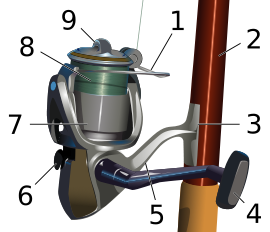
Spinning (fixed spool) reel
Reels utilizing a fixed spool were in use in North America as early as the 1870s. They were originally developed to allow the use of artificial flies, or other lures for trout or salmon, that were too light in weight to be easily cast by bait casting reels. Fixed spool reels are normally mounted below the rod. The fixed-spool reel solved the problem of backlash, as they did not have a rotating spool to overrun and foul the line. The earliest fixed-spool reels, known as "turnabouts" were used as centrepin reels in retrieving line but the spool was turned 90 degrees for casting and then turned back to retrieving position. In casting position, line comes off in coils over the leading edge of the fixed, non-rotating spool unless restrained. This restraint is usually imposed by a finger or thumb placed in contact with the leading edge of the spool.The name of Holden Illingworth, a textiles magnate, is associated with a class of reel with fixed spool that does not have different positions for casting and retrieval. In casting, line is drawn off the leading edge of the spool - as with the turnabout - but is then restrained and rewound by a device which orbits around the stationary spool. This reel gained popularity initially for very fine lines which has given rise to one of its designations - "threadline winder". It is also known as the Illingworth Reel after Holden Illingworth and the Spinning Reel owing to its popularity with anglers who practice the fishing style known as "spinning" (which is also practiced with other types of reel). The orbiting gismo has probably not contributed to the currency of this last designation. All reels have some component which spins.
In 1948, the Mitchell
Mitchell
Mitchell may refer to:* B-25 Mitchell, an American World War II-era bomber aircraft* Billy Mitchell Award, a Civil Air Patrol Cadet Program award* Mitchell , an automobile built in Racine, Wisconsin from 1903-1923...
Reel Company of Cluses
Cluses
Cluses is a commune in the Haute-Savoie department in the Rhône-Alpes region in south-eastern France.Citizens are known as Clusiens. The commune is situated in the Arve Valley, on the river which bears the same name...
, France introduced the Mitchell 300, a spinning reel with a design that oriented the face of the fixed spool forward in a permanently fixed position below the fishing rod. A mechanical line pickup was used to retrieve the cast line (eventually developed into a wire bail design), and an anti-reverse lever prevented the crank handle from rotating while a fish was pulling line from the spool. Because the line did not have to pull against a rotating spool, much lighter lures could be cast than with a bait casting reel. Conversely, halting the cast and stopping the lure at the desired position requires practice in learning to feather the line with the forefinger as it uncoils from the spool. Most spinning reels operate best with fairly limp, flexible fishing lines.
Though spinning reels do not suffer from backlash, the line can be trapped underneath itself on the spool or even detach from the reel in loose loops of line. Various oscillating spool mechanisms have been introduced over the years in an effort to solve this problem. Spinning reels also tend to have more issues with twisting of the fishing line. Line twist in spinning reels can occur from the spin of an attached lure, the action of the wire bail against the line when engaged by the crank handle, or even retrieval of line that is under load (spinning reel users normally pump the rod up and down, then retrieve the slack line to avoid line twist and stress on internal components). Most anglers who use a spinning reel also manually reposition the bail after each cast in order to minimize line twist.
Fixed Spool Reel Operation
Fixed spool reels are cast by opening the bail, grasping the line with the forefinger, and then using a backward snap of the rod followed by a forward cast while releasing the line with the forefinger at the same time. On the retrieve, the large rotating wire cage or bail (either manually or trigger-operated) serves as the line pickup, restoring the line to its original position on the spool.
Spin cast reel
The first commercial spin cast reels were introduced by the Denison-Johnson Reel Company and the Zero Hour Bomb Company (ZEBCO) in 1949. The spin cast reel is an attempt to solve the problem of backlash found in bait cast designs, while reducing line twist and snare complaints sometimes encountered with traditional spinning reel designs. Just as with the spinning reel, the line is thrown from a fixed spool and can therefore be used with relatively light lures and baits. However, the spin cast reel eliminates the large wire bail and line roller of the spinning reel in favor of one or two simple pickup pins and a metal cup to wind the line on the spool. Traditionally mounted above the rod, the spin cast reel is also fitted with an external nose cone that encloses and protects the fixed spool.With a fixed spool, spin cast reels can cast lighter lures than bait cast reels, although friction of the nose cone against the unspooling line slightly reduces casting distance compared to spinning reels. Spin cast reels also generally have narrow spools with less line capacity than either bait casting or spinning reels of equivalent size. However, this tends to reduce line snare issues. Like other types of reels, spin cast reels are frequently fitted with both anti-reverse mechanisms and friction drags, and some also have level-wind (oscillating spool) mechanisms. Most spin cast reels operate best with limp monofilament lines, though at least one spin cast reel manufacturer installs a thermally fused "superline" into one of its models as standard equipment. During the 1950s and into the mid-1960s, they were widely used and very popular, though the spinning reel has since eclipsed them in popularity in North America. They remain a favorite fishing tool for beginners.
Spin Cast Reel Operation
Pressing a button on the rear of the reel disengages the line pickup, and the button is then released during the forward cast to allow the line to fly off the spool. The button is pressed again to stop the lure at the position desired. Upon cranking the handle, the pickup pin immediately re-engages the line and spools it onto the reel.
Underspin reel
Underspin or Triggerspin reels are spin cast reels in which the reel is mounted underneath a standard spinning rod. With the reel's weight suspended beneath the rod, underspin reels are generally more comfortable to cast and hold for long periods, and the ability to use all standard spinning rods greatly increases its versatility compared to traditional spin cast reels.Underspin Reel Operation
A lever or trigger is grasped or rotated (usually by the forefinger) and this action suspends the line in place. During the forward cast, the lever/trigger is released, and the line flies off the fixed spool. When necessary, the lever can be activated once again to stop the lure at a given point in the cast.
Reel Mechanisms
Direct-drive reelDirect-drive reels have the spool and handle directly coupled. When the handle moves forwards, the spool moves forwards, and vice-versa. With a fast-running fish, this may have consequences for the angler's knuckles. Traditional fly reels are direct-drive.
Anti-reverse reel
In anti-reverse reels, a mechanism allows line to pay out while the handle remains stationary. Depending on the drag setting, line may also pay out, as with a running fish, while the angler reels in. Bait casting reels and many modern saltwater fly reels are examples of this design.
The mechanism works either with a 'dog' or 'pawl' design that engages into a cog wheel attached to the handle shaft. The latest design is Instant Anti-Reverse, or IAR. This system incorporates a one-way clutch bearing on the handle shaft to restrict handle movement to forward motion only.
Drag Mechanisms
Drag is a mechanical means of applying variable pressure to the turning spool in order to act as a friction brake against it. It can be as simple as a flat spring pressing against the edge of the spool, or as sophisticated as a complicated arrangement of leather and Teflon discs. In terms of spinning reels, there are two types of drag: Front and Rear. The front drag systems are generally seen on higher end reels and are considered superior to rear drag because the larger washers in the front drag systems allow for more control over the fish. Ascetically, the drag knobs on front drag systems are generally found atop the spool, while the rear drag systems drag knobs are attached to the bottom of the reel. Properly set drag allows larger and more powerful fish to be safely brought to boat and landed, as the drag will "slip" below the breaking point of the line, but in combination with the flex in the rod, drag will tire a fish by converting the energy from the fish into heat in the drag system. The drag is always set below the breaking strain of the line, although this is often not an issue as most reels will not be able to apply enough drag to break the line specified to be used with that reel. Drag is set as high as possible without risking tearing the fish's mouth or breaking the line. The drag mechanism is a very important component on modern reels as it allows for a wide range of fish sizes to be caught on one set-up. It is not uncommon for 10-20kg fish to be caught on 6-8kg or smaller tackle. Usually the main purpose for purchasing a higher end reel will be to have a more powerful drag from the same sized reel.On an overhead reel there are two main types of drag system commonly used; lever drag, and more commonly the star drag. They both work from the same principal of using rotating discs sliding against each other to provide friction, but they differ in how they apply this principal. The lever drag uses a cam to increase the pressure applied to the discs via a lever. To allow the spool to let line out freely the lever is pulled back far enough to reduce the pressure on the discs to zero, allowing the spool to let line out with the weight of the sinker or jig. This type of drag system is usually reserved for larger, more powerful reels for saltwater use and would rarely be seen on a lake. Star drag is the most common drag system fitted to smaller reels. A star like dial (like an oversize wing nut) is fitted to the threaded winding shaft. When rotated clockwise the nut or star pushes a collar against a series of friction washers that push on the main driving gear. To disengage the drag and allow the spool to be free, the main gear is disengaged from the spool via a lever or button. The main difference compared to the lever drag is that the spool can be disengaged completely from the drag, where with a lever drag the drag pressure is simply reduced to a point that the spool will move. The advantage of the lever drag system however is that the whole of the spool can be used to apply drag, not just the drive gear, allowing for a much larger surface to apply drag to.
Manufacturers
- Abu GarciaAbu GarciaABU Garcia, originally A B Urfabriken, then ABU Svängsta, is a fishing reel and fishing equipment company from Svängsta, Sweden, and is best known the manufacturer of the famous Ambassadeur bait casting reel.-Early history:...
- Daiwa Seiko CorporationDaiwa Seiko Corporationis a Japanese company that produces mainly fishing equipment in addition to golf and biking gear.-External links:* * *...
- OkumaOkumaOkuma or Ōkuma may refer to:a place name:Okuma, Okinawa Prefecture. site operated by the U.S. Air Force. Official name is Okuma Recreational Facility.*Ōkuma , a town located in Futaba District, Fukushima, Japan.a Japanese surname:...
- Scientific AnglersScientific AnglersScientific Anglers is a fly fishing company specializing in a variety of fly fishing tackle products. Scientific Anglers is noted for the invention of PVC coated floating fly line and continued innovations in fly line cores and coatings...
- ShimanoShimanoShimano, Inc. is a Japanese multinational manufacturer of cycling components, fishing tackle, and rowing equipment.In 2005, the company had net sales of US $1.4 billion. Bicycle components provided 75% of its sales income...
- Shakespeare Fishing TackleShakespeare Fishing TackleThe Shakespeare Company is a subsidiary of Jarden which manufactures fishing equipment. It was founded by William Shakespeare, Jr. in 1897. In June of 2005, approximately 438,000 of their children's fishing kits were recalled after being found to contain lead paint....
External links
- The Lost World of Mr Hardy – film on the art of the fishing tackle craftsman.
- http://www.upon-bamboo-fly-fishing-rods-and-reels.com/types-of-fishing-reels.html - types of fishing reels briefly categorized
- all fishing reels by brand http://www.upon-bamboo-fly-fishing-rods-and-reels.com/best-fishing-reel.html
- Take Me Fishing Guide on Reels