

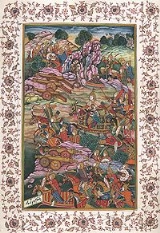
First battle of Panipat

Encyclopedia
The first battle of Panipat took place in Northern
India, and marked the beginning of the Mughal Empire
. This was one of the earliest battles involving gunpowder
firearms and field artillery
.
, the Timurid ruler of Kabulistan
, defeated the much larger Indian army of Ibrahim Lodi, Sultan of Delhi
.
The battle was fought on 21 April near the small village of Panipat
, in the present day Indian state of Haryana
, an area that has been the site of a number of decisive battles for the control of Northern India since the twelfth century.
It is estimated that Babur's forces numbered around 15,000 men and had between 20 to 24 pieces of field artillery. Babur estimated Lodi had around 100,000 men, though that number included camp followers, while the fighting force was around 30,000 to 40,000 men in total, along with at least 100 war elephant
s. Lodi's army was mostly Hindus although he and his dynasty was Muslim of Pashtun
ethnic background.
The advantage of guns at the time of war
It is generally told that Babur's guns proved decisive in battle, firstly because Ibrahim Lodi lacked any field artillery, but also because the sound of the cannon frightened Lodi's elephants, causing them to trample Lodi's own men. However a reading of the contemporary sources show that more than the gun, it was the tactics which helped in winning the day. The new war tactics introduced by Babur were the tulughma and the araba. Tulughma meant dividing the whole army into various units, viz. the Left, the Right and the Centre. The Left and Right divisions were further subdivided into Forward and Rear divisions. Through this a small army could be used to surround the enemy from all the sides. the Centre Forward division was then provided with carts (araba) which were placed in rows facing the enemy and tied to each other with animal hide ropes. Behind them were placed cannons protected and supported by mantelets which could be used to easily manoeuvre the canons. These two tactics made Babur's artillery lethal. The guns and cannons could be fired without any fear of being hit as they were shielded by the bullock carts which were held in place due to the hide ropes holding them together. the nozzle of the heavy cannons could also be easily changed as they could be manoeuvered by the mantelets which were provided with wheels.
Ibrahim Lodi died on the field of battle, abandoned by his feudatories and generals (many of whom were mercenaries
). Most of them changed their allegiance to the new master of Delhi. However had Sultan Ibrahim survived another hour of fighting he would have won, as Babur had no reserves and his troops were rapidly tiring .
Haryana°N date=December 2010°W
North India
North India, known natively as Uttar Bhārat or Shumālī Hindustān , is a loosely defined region in the northern part of India. The exact meaning of the term varies by usage...
India, and marked the beginning of the Mughal Empire
Mughal Empire
The Mughal Empire , or Mogul Empire in traditional English usage, was an imperial power from the Indian Subcontinent. The Mughal emperors were descendants of the Timurids...
. This was one of the earliest battles involving gunpowder
Gunpowder warfare
Early modern warfare is associated with the start of the widespread use of gunpowder and the development of suitable weapons to use the explosive, including artillery and handguns such as the arquebus and later the musket, and for this reason the era is also summarized as the age of gunpowder...
firearms and field artillery
Field artillery
Field artillery is a category of mobile artillery used to support armies in the field. These weapons are specialized for mobility, tactical proficiency, long range, short range and extremely long range target engagement....
.
Details
In 1526, the Mughal forces of BaburBabur
Babur was a Muslim conqueror from Central Asia who, following a series of setbacks, finally succeeded in laying the basis for the Mughal dynasty of South Asia. He was a direct descendant of Timur through his father, and a descendant also of Genghis Khan through his mother...
, the Timurid ruler of Kabulistan
Kabulistan
Kabulistan is a historical term referring to the eastern territories of Greater Khorasan that is centered around present-day Kabul, Afghanistan...
, defeated the much larger Indian army of Ibrahim Lodi, Sultan of Delhi
Delhi Sultanate
The Delhi Sultanate is a term used to cover five short-lived, Delhi based kingdoms or sultanates, of Turkic origin in medieval India. The sultanates ruled from Delhi between 1206 and 1526, when the last was replaced by the Mughal dynasty...
.
The battle was fought on 21 April near the small village of Panipat
Panipat
Panipat بَنِبَت is an ancient and historic city in Panipat district, Haryana state, India. It is 90 km north from Delhi and 169 km south of Chandigarh on NH-1. The three battles fought at the city were turning points in Indian history. The city is famous in India by the name of "City of...
, in the present day Indian state of Haryana
Haryana
Haryana is a state in India. Historically, it has been a part of the Kuru region in North India. The name Haryana is found mentioned in the 12th century AD by the apabhramsha writer Vibudh Shridhar . It is bordered by Punjab and Himachal Pradesh to the north, and by Rajasthan to the west and south...
, an area that has been the site of a number of decisive battles for the control of Northern India since the twelfth century.
It is estimated that Babur's forces numbered around 15,000 men and had between 20 to 24 pieces of field artillery. Babur estimated Lodi had around 100,000 men, though that number included camp followers, while the fighting force was around 30,000 to 40,000 men in total, along with at least 100 war elephant
War elephant
A war elephant was an elephant trained and guided by humans for combat. Their main use was to charge the enemy, trampling them and breaking their ranks. A division of war elephants is known as elephantry....
s. Lodi's army was mostly Hindus although he and his dynasty was Muslim of Pashtun
Pashtun people
Pashtuns or Pathans , also known as ethnic Afghans , are an Eastern Iranic ethnic group with populations primarily between the Hindu Kush mountains in Afghanistan and the Indus River in Pakistan...
ethnic background.
The advantage of guns at the time of war
It is generally told that Babur's guns proved decisive in battle, firstly because Ibrahim Lodi lacked any field artillery, but also because the sound of the cannon frightened Lodi's elephants, causing them to trample Lodi's own men. However a reading of the contemporary sources show that more than the gun, it was the tactics which helped in winning the day. The new war tactics introduced by Babur were the tulughma and the araba. Tulughma meant dividing the whole army into various units, viz. the Left, the Right and the Centre. The Left and Right divisions were further subdivided into Forward and Rear divisions. Through this a small army could be used to surround the enemy from all the sides. the Centre Forward division was then provided with carts (araba) which were placed in rows facing the enemy and tied to each other with animal hide ropes. Behind them were placed cannons protected and supported by mantelets which could be used to easily manoeuvre the canons. These two tactics made Babur's artillery lethal. The guns and cannons could be fired without any fear of being hit as they were shielded by the bullock carts which were held in place due to the hide ropes holding them together. the nozzle of the heavy cannons could also be easily changed as they could be manoeuvered by the mantelets which were provided with wheels.
Ibrahim Lodi died on the field of battle, abandoned by his feudatories and generals (many of whom were mercenaries
Mercenary
A mercenary, is a person who takes part in an armed conflict based on the promise of material compensation rather than having a direct interest in, or a legal obligation to, the conflict itself. A non-conscript professional member of a regular army is not considered to be a mercenary although he...
). Most of them changed their allegiance to the new master of Delhi. However had Sultan Ibrahim survived another hour of fighting he would have won, as Babur had no reserves and his troops were rapidly tiring .
External Links
- Battle of Panipat animated battle map by Jonathan Webb
See also
- Battle of Panipat (1556)
- Battle of Panipat (1761)
- BaburBaburBabur was a Muslim conqueror from Central Asia who, following a series of setbacks, finally succeeded in laying the basis for the Mughal dynasty of South Asia. He was a direct descendant of Timur through his father, and a descendant also of Genghis Khan through his mother...
Haryana°N date=December 2010°W