

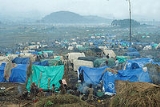
First Congo War

Encyclopedia
The First Congo War was a revolution in Zaire
that replaced President Mobutu Sésé Seko
, a decades-long dictator, with rebel leader Laurent-Désiré Kabila
. Destabilization in eastern Zaire that resulted from the Rwandan genocide
was the final factor that caused numerous internal and external actors to align against the corrupt and inept government in Kinshasa. The new government renamed the country the Democratic Republic of the Congo
, although it brought little true change. Kabila alienated his allies and failed to address the issues that had led to the war, ultimately allowing the Second Congo War
to begin in 1998, mere months after coming to power. In fact, some experts prefer to view the two conflicts as one war.
during the Cold War
. However, his authoritarian rule and policies allowed the Zairian state to decay, evidenced by a 65 percent decrease in Zairian GDP between independence in 1960 and the end of Mobutu's rule in 1997. Following the end of the Cold War, the United States stopped supporting Mobutu in favor of what it called a "new generation of African leaders," including Rwanda's Kagame
and Uganda's Museveni
.
A wave of democratization
swept through Africa in the early 1990s and, under substantial internal and external pressure for a democratic transition in Zaire, Mobutu promised reform. He officially ended the one-party system he had maintained since 1967 but was ultimately unwilling to implement broad reform, alienating allies both at home and abroad. In fact, the Zairian state had all but ceased to exist. The majority of the Zairian population relied on an informal economy for their subsistence, since the official economy was not reliable. Furthermore, the Zairian national army, Forces Armées Zaïroises (FAZ), was forced to prey upon the population for survival; Mobutu himself once asked FAZ soldiers why they needed pay when they were provided weapons.
There had been considerable internal resistance to Mobutu's rule and, given the weak central state, rebel groups were able to find refuge in Zaire's eastern provinces, far from the capital. Opposition included leftists who had supported Patrice Lumumba
as well as ethnic and regional minorities opposed to the dominance of the Kinshasa
region. Kabila, an ethnic Katangese who would eventually overthrow Mobutu, had been fighting the government since its inception. The inability of the Mobutuist regime to control rebel movements in its eastern provinces eventually allowed its internal and external foes to ally.
, meaning "from Mulenge," and were privy to citizenship under Zairian law. Tutsi who emigrated to Zaire following independence are known as Banyarwanda
, although the 'native' locals often fail to distinguish between the two, naming them both Banyamulenge and considering them foreigners.
After coming to power in 1965, Mobutu gave the Banyamulenge political power in the East in hopes that they, as a minority, would keep a tight grip on power and prevent the more populous ethnicities from forming an opposition. This understandably aggravated the existing ethnic tensions, which manifested itself in several events. From 1963 to 1966 the Hunde
and Nande ethnic groups fought against Rwandan emigrants — both Tutsi and Hutu
- in the Kanyarwandan War, which involved several massacres. In 1981 a restrictive citizenship law was adopted, which denied the Banyamulenge and Banyarwanda citizenship and therewith all political rights. From 1993 to 1996 Hunde, Nande, and Nyanga youth regularly attacked the Banyamulenge, leading to a total of 14,000 deaths. In 1995 the Zairian Parliament ordered all peoples of Rwandan or Burundian descent to be repatriated to their countries of origin, including the Banyamulenge. Due to political exclusion and ethnic violence, the Banyamulenge developed ties to the Rwandan Patriotic Front
(RPF), a mainly Tutsi rebel movement based in Uganda and with power aspirations in Rwanda, as early as 1991.
, which sparked a mass exodus of refugees known as the Great Lakes refugee crisis
. During the one-hundred-day genocide, hundreds of thousands of Rwandan Tutsi and sympathizers were massacred at the hands of predominantly Hutu aggressors. The genocide ended when the Hutu government in Kigali was overthrown by the Tutsi-dominated RPF
.
Of those who fled Rwanda during the Great Lakes refugee crisis, about 1.5 million settled in eastern Zaire. These refugees included those who fled the génocidaires
as well as those that fled the RPF fearing retaliation. Prominent among the latter group were the génocidaires themselves, such as elements of the former Rwandan Army, Forces Armées Rwandaises (FAR), and independent Hutu extremist groups known as Interahamwe
. They set up camps in eastern Zaire from which they attacked both the newly-arrived Rwandan Tutsi
as well as the Banyamulenge
and Banyarwanda
These attacks were the cause of about one hundred deaths a month during the first half of 1996. Furthermore, the newly arrived militants were intent on returning to power in Rwanda and began launching attacks against the new regime in Kigali, which represented a serious security threat to the infant state. Not only was the Mobutu government incapable of controlling the former génocidaires for previously mentioned reasons but actually supported them in training and supplying for an invasion of Rwanda, forcing Kigali to act.
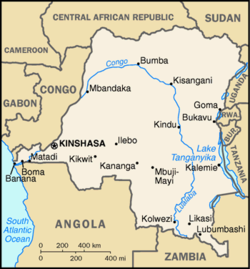
Given the exacerbated ethnic tensions
and the lack of government control in the East, Rwanda was to take action against the security threat posed by the génocidaires that had found refuge in eastern Zaire. The government in Kigali had begun forming Tutsi militia
s for operations in Zaire as early as 1995 and chose to act following an exchange of fire between Rwandan Tutsi and Zairian Green Berets that marked the outbreak of the Banyamulenge Rebellion on August 31, 1996. While there was general unrest in eastern Zaire, the rebellion was unlikely a grassroots movement; Uganda president Yoweri Museveni
, who supported and worked closely with Rwanda in the First Congo War, later recalled that the rebellion was incited by Zairian Tutsi who had been recruited by the Rwandan Patriotic Army (RPA).
The initial goal of the Banyamulenge Rebellion was to seize power in Zaire's eastern Kivu provinces and combat the extremist Hutu forces that were attempting to continue the genocide in their new home. However, the rebellion did not remain Tutsi-dominated for long. Mobutu's harsh and selfish rule had created enemies in virtually all sectors of Zairian society. As a result, the new rebellion benefited from massive public support and grew to be a general revolution rather than a mere Banyamulenge uprising.
Banyamulenge elements as well as non-Tutsi militias coalesced into the Alliance of Democratic Forces for the Liberation of Congo
(AFDL) under the leadership of Laurent-Désiré Kabila
, who had been a long-time opponent of the Mobutu government and was a leader of one of the three main rebel groups that founded the AFDL. While the AFDL was an ostensibly Zairian rebel movement, Rwanda had played a key role in its formation. Observers of the war, as well as the Rwandan Defense Minister and Vice President at the time, Paul Kagame
, claim that the AFDL was formed in and directed from Kigali and contained not only Rwandan-trained troops but also regulars of the RPA.
The first and foremost of these was the suppression of the génocidaires who had been launching attacks against the new Rwandan state from Zaire. Kagame claimed that Rwandan agents had discovered the plans to invade Rwanda with support from Mobutu; in response, Kigali began its intervention with the intention of dismantling the refugee camps in which the génocidaires often took refuge and destroying the structure of these anti-Rwandan elements.
A second goal that is cited by Kagame, and which is universally regarded as accurate, is the overthrow of Mobutu. While this was partially a means to minimizing the threat in eastern Zaire, it was also a chance for the new Rwandan state to set up a puppet-regime in Kinshasa. This goal was not particularly threatening to other states in the region because it was ostensibly a means to securing Rwandan security and because many of them were also opposed to Mobutu. Internationally Kigali was also aided by the tacit support of the United States, which supported Kagame as a member of the new generation of African leaders.
However, the true intentions of Rwanda are not entirely clear. Some authors have proposed that the dismantling of refugee camps was a means of replenishing Rwanda's depleted population and workforce following the genocide, because the destruction of camps was followed by the forced repatriation of Tutsi regardless of whether they were Rwandan or Zairian. The intervention may also have been motivated by revenge; the Rwandan forces, as well as the AFDL, massacred retreating Hutu refugees in several known instances. A commonly cited factor for Rwandan actions is that the RPF, which had recently come to power in Kigali, had come to see itself as the protector of the Tutsi nation and was therefore partially acting in defense of its Zairian brethren. There is also a distinct possibility that Rwanda harbored ambitions to annex portions of eastern Zaire. Pasteur Bizimungu
himself, President of Rwanda from 1994-2000, presented the then American Ambassador to Rwanda, Robert Gribbin, with the idea of a "Greater Rwanda." This falsified idea purports that the ancient state of Rwanda included parts of eastern Zaire that should actually belong to Rwanda. However, it appears that Rwanda never seriously attempted to annex these territories. The history of conflict in the Congo is often associated with illegal resource exploitation but, although Rwanda did benefit financially by plundering Zaire's wealth, this is almost universally denied as a motivation for Rwandan intervention in the First Congo War.
, the military wing of the rebel movement that brought Museveni to power, and French and Belgium intelligence reported that 15,000 Ugandan-trained Tutsi fought for the AFDL. However, Uganda did not support Rwanda in all aspects of the war. Museveni was reportedly much less inclined to overthrow Mobutu, preferring to keep the rebellion in the East where the former génocidaires were operating.
. It is unclear exactly how the government benefited from this relationship, other than personal enrichment for several officials, but it is certainly possible that Mobutu was unable to control the actions of some members of his government. Regardless of the reasoning in Kinshasa, Angola entered the war on the side of the rebels and was determined to overthrow the Mobutu government, as this would be the only way to address the threat posed by the Zairian-UNITA relationship.
, which had recently come under the rule of a pro-Tutsi leader, was supportive of Rwandan and Ugandan involvement in Zaire but provided very limited military support. Zambia
and Zimbabwe
also gave measured amounts of military support to the rebel movement. Likewise, Eritrea
, Ethiopia
, and the South Sudanese rebel army the SPLA
were all financial or moral supporters of the anti-Mobutu coalition. Other than from UNITA, Mobutu also received some aid from Sudan, whom Mobutu had long supported against the SPLA, though the exact amount of aid is unclear and ultimately was unable to hinder the advance of opposing forces. Zaire also employed foreign mercenaries from several African and European countries.
During this time, Rwanda was able to destroy refugee camps, which the génocidaires had been using as their safe-bases, and forcibly repatriate Tutsi to Rwanda. During this process, Rwandan and aligned forces committed multiple atrocities, mainly against Hutu refugees. The true extent of the abuses is unknown because the AFDL and RPF carefully managed NGO and press access to areas where atrocities were thought to have occurred.
somehow proved that "Mobutu intended to wage real war against Rwanda." According to this logic, Rwanda's initial concerns had been to manage the security threat in eastern Zaire but it was now forced to dispose of the hostile government in Kinshasa.
Throughout the rebel advance, there were attempts by the international community to negotiate a settlement. However, the AFDL did not take these negotiations seriously but instead partook so as to avoid international criticism for being unwilling to attempt a diplomatic solution while actually continuing its steady advance. The FAZ, which had been weak all along, was unable to mount any serious resistance to the strong AFDL and its foreign sponsors.
Throughout the month of April the AFDL made consistent progress down the river, and by May were on the outskirts of Kinshasa. On May 16, 1997, the multinational army headed by Kabila battled to secure Lubumbashi airport in the southeast of the country after peace talks broke down and Mobutu fled the country. Laurent-Désiré Kabila
proclaimed himself president on September 7, 1997, the same day that Mobutu died in Morocco
, and immediately ordered a violent crackdown to restore order. He then attempted to reorganize the nation as the Democratic Republic of the Congo
(DRC).
Kabila also came to be seen as an instrument of the foreign regimes that put him in power. In order to counter this image and increase domestic support, he began to turn against his allies abroad. This culminated in the expulsion of all foreign forces from the DRC on July 26, 1998. The states with armed forces still in the DRC begrudgingly complied although some of them saw this as undermining their interests, particularly Rwanda, which had hoped to install a proxy-regime in Kinshasa.
Several factors that led to the First Congo War remained in place after Kabila's accession to power. Prominent among these were ethnic tensions in eastern DRC, where the government still had little control. There the historical animosities remained and the opinion that Banyamulenge, as well as all Tutsi, were foreigners was reinforced by the foreign occupation in their defense. Furthermore, Rwanda had not been able to satisfactorily address its security concerns. By forcibly repatriating refugees, Rwanda had imported the conflict. This manifested itself in the form of a predominantly Hutu insurgency in Rwanda's western provinces that was supported by extremist elements in eastern DRC. Without troops in the DRC, Rwanda was unable to successfully combat the insurgents.
In the first days of August 1998, two brigades of the new Congolese army rebelled against the government and formed rebel groups that worked closely with Kigali and Kampala. This marked the beginning of the Second Congo War
.
Zaire
The Republic of Zaire was the name of the present Democratic Republic of the Congo between 27 October 1971 and 17 May 1997. The name of Zaire derives from the , itself an adaptation of the Kongo word nzere or nzadi, or "the river that swallows all rivers".-Self-proclaimed Father of the Nation:In...
that replaced President Mobutu Sésé Seko
Mobutu Sese Seko
Mobutu Sese Seko Nkuku Ngbendu wa Za Banga , commonly known as Mobutu or Mobutu Sese Seko , born Joseph-Désiré Mobutu, was the President of the Democratic Republic of the Congo from 1965 to 1997...
, a decades-long dictator, with rebel leader Laurent-Désiré Kabila
Laurent-Désiré Kabila
Laurent-Désiré Kabila was President of the Democratic Republic of the Congo from May 17, 1997, when he overthrew Mobutu Sese Seko, until his assassination by his bodyguards on January 18, 2001...
. Destabilization in eastern Zaire that resulted from the Rwandan genocide
Rwandan Genocide
The Rwandan Genocide was the 1994 mass murder of an estimated 800,000 people in the small East African nation of Rwanda. Over the course of approximately 100 days through mid-July, over 500,000 people were killed, according to a Human Rights Watch estimate...
was the final factor that caused numerous internal and external actors to align against the corrupt and inept government in Kinshasa. The new government renamed the country the Democratic Republic of the Congo
Democratic Republic of the Congo
The Democratic Republic of the Congo is a state located in Central Africa. It is the second largest country in Africa by area and the eleventh largest in the world...
, although it brought little true change. Kabila alienated his allies and failed to address the issues that had led to the war, ultimately allowing the Second Congo War
Second Congo War
The Second Congo War, also known as Coltan War and the Great War of Africa, began in August 1998 in the Democratic Republic of the Congo , and officially ended in July 2003 when the Transitional Government of the Democratic Republic of the Congo took power; however, hostilities continue to this...
to begin in 1998, mere months after coming to power. In fact, some experts prefer to view the two conflicts as one war.
Failing state
Mobutu came to power in Kinshasa in 1965 and enjoyed support from the United StatesUnited States
The United States of America is a federal constitutional republic comprising fifty states and a federal district...
during the Cold War
Cold War
The Cold War was the continuing state from roughly 1946 to 1991 of political conflict, military tension, proxy wars, and economic competition between the Communist World—primarily the Soviet Union and its satellite states and allies—and the powers of the Western world, primarily the United States...
. However, his authoritarian rule and policies allowed the Zairian state to decay, evidenced by a 65 percent decrease in Zairian GDP between independence in 1960 and the end of Mobutu's rule in 1997. Following the end of the Cold War, the United States stopped supporting Mobutu in favor of what it called a "new generation of African leaders," including Rwanda's Kagame
Paul Kagame
Paul Kagame is the sixth and current President of the Republic of Rwanda. He rose to prominence as the leader of the Rwandan Patriotic Front , whose victory over the incumbent government in July 1994 effectively ended the Rwandan genocide...
and Uganda's Museveni
Yoweri Museveni
Yoweri Kaguta Museveni is a Ugandan politician and statesman. He has been President of Uganda since 26 January 1986.Museveni was involved in the war that deposed Idi Amin Dada, ending his rule in 1979, and in the rebellion that subsequently led to the demise of the Milton Obote regime in 1985...
.
A wave of democratization
Democratization
Democratization is the transition to a more democratic political regime. It may be the transition from an authoritarian regime to a full democracy, a transition from an authoritarian political system to a semi-democracy or transition from a semi-authoritarian political system to a democratic...
swept through Africa in the early 1990s and, under substantial internal and external pressure for a democratic transition in Zaire, Mobutu promised reform. He officially ended the one-party system he had maintained since 1967 but was ultimately unwilling to implement broad reform, alienating allies both at home and abroad. In fact, the Zairian state had all but ceased to exist. The majority of the Zairian population relied on an informal economy for their subsistence, since the official economy was not reliable. Furthermore, the Zairian national army, Forces Armées Zaïroises (FAZ), was forced to prey upon the population for survival; Mobutu himself once asked FAZ soldiers why they needed pay when they were provided weapons.
There had been considerable internal resistance to Mobutu's rule and, given the weak central state, rebel groups were able to find refuge in Zaire's eastern provinces, far from the capital. Opposition included leftists who had supported Patrice Lumumba
Patrice Lumumba
Patrice Émery Lumumba was a Congolese independence leader and the first legally elected Prime Minister of the Republic of the Congo after he helped win its independence from Belgium in June 1960. Only ten weeks later, Lumumba's government was deposed in a coup during the Congo Crisis...
as well as ethnic and regional minorities opposed to the dominance of the Kinshasa
Kinshasa
Kinshasa is the capital and largest city of the Democratic Republic of the Congo. The city is located on the Congo River....
region. Kabila, an ethnic Katangese who would eventually overthrow Mobutu, had been fighting the government since its inception. The inability of the Mobutuist regime to control rebel movements in its eastern provinces eventually allowed its internal and external foes to ally.
Ethnic tensions
Tensions had existed between various ethnic groups in eastern Zaire for centuries, especially between the agrarian tribes native to Zaire and semi-nomadic Tutsi tribes that had emigrated from Rwanda at various times. In addition to some Tutsi who are native to eastern Congo, the earliest of these migrants arrived before colonization, followed by emigrants who were forcibly relocated to Congo to perform manual labor by the Belgian colonizers and another prominent wave of emigrants fleeing the social revolution of 1959 that brought the Hutu to power in Kigali. All Tutsi emigrants to Zaire before Congolese independence in 1960 are known as BanyamulengeBanyamulenge
The Banyamulenge is a term historically describing the ethnic Tutsi Rwandans concentrated on the High Plateau of South Kivu, in the eastern region of the Democratic Republic of the Congo , close to the Burundi-Congo-Rwanda border...
, meaning "from Mulenge," and were privy to citizenship under Zairian law. Tutsi who emigrated to Zaire following independence are known as Banyarwanda
Banyarwanda
Banyarwanda actually means the people of Hutu, Tutsi and Batwah. Some lived on the present territory of the DRC before colonization, while others have migrated from neighboring Rwanda in waves. They live in the provinces of North Kivu and South Kivu, Democratic Republic of Congo....
, although the 'native' locals often fail to distinguish between the two, naming them both Banyamulenge and considering them foreigners.
After coming to power in 1965, Mobutu gave the Banyamulenge political power in the East in hopes that they, as a minority, would keep a tight grip on power and prevent the more populous ethnicities from forming an opposition. This understandably aggravated the existing ethnic tensions, which manifested itself in several events. From 1963 to 1966 the Hunde
Hunde
The Hunde are an ethnolinguistic group of about 200,000 people located in the eastern region of the Democratic Republic of the Congo. The Hunde live in the province of Nord-Kivu and the regions of Masisi and Rutshuru. The language of the Hunde is Kihunde, and alternate names are Kobi and Rukobi...
and Nande ethnic groups fought against Rwandan emigrants — both Tutsi and Hutu
Hutu
The Hutu , or Abahutu, are a Central African people, living mainly in Rwanda, Burundi, and eastern DR Congo.-Population statistics:The Hutu are the largest of the three peoples in Burundi and Rwanda; according to the United States Central Intelligence Agency, 84% of Rwandans and 85% of Burundians...
- in the Kanyarwandan War, which involved several massacres. In 1981 a restrictive citizenship law was adopted, which denied the Banyamulenge and Banyarwanda citizenship and therewith all political rights. From 1993 to 1996 Hunde, Nande, and Nyanga youth regularly attacked the Banyamulenge, leading to a total of 14,000 deaths. In 1995 the Zairian Parliament ordered all peoples of Rwandan or Burundian descent to be repatriated to their countries of origin, including the Banyamulenge. Due to political exclusion and ethnic violence, the Banyamulenge developed ties to the Rwandan Patriotic Front
Rwandan Patriotic Front
The Rwandan Patriotic Front abbreviated as RPF is the current ruling political party of Rwanda, led by President Paul Kagame. It governs in a coalition with other parties...
(RPF), a mainly Tutsi rebel movement based in Uganda and with power aspirations in Rwanda, as early as 1991.
Rwandan genocide
The deciding event in precipitating the First Congo War was the Rwandan genocideRwandan Genocide
The Rwandan Genocide was the 1994 mass murder of an estimated 800,000 people in the small East African nation of Rwanda. Over the course of approximately 100 days through mid-July, over 500,000 people were killed, according to a Human Rights Watch estimate...
, which sparked a mass exodus of refugees known as the Great Lakes refugee crisis
Great Lakes refugee crisis
The Great Lakes refugee crisis is the common name for the situation beginning with the exodus in April 1994 of over two million Rwandans to neighboring countries of the Great Lakes region of Africa in the aftermath of the Rwandan Genocide...
. During the one-hundred-day genocide, hundreds of thousands of Rwandan Tutsi and sympathizers were massacred at the hands of predominantly Hutu aggressors. The genocide ended when the Hutu government in Kigali was overthrown by the Tutsi-dominated RPF
Rwandan Patriotic Front
The Rwandan Patriotic Front abbreviated as RPF is the current ruling political party of Rwanda, led by President Paul Kagame. It governs in a coalition with other parties...
.
Of those who fled Rwanda during the Great Lakes refugee crisis, about 1.5 million settled in eastern Zaire. These refugees included those who fled the génocidaires
Genocidaires
Genocidaires, from the French for ‘those who commit genocide’, refers to those guilty of the mass killings of the 1994 Rwandan Genocide, in which close to 1,000,000, primarily Tutsi Rwandans, were murdered by their Hutu neighbors...
as well as those that fled the RPF fearing retaliation. Prominent among the latter group were the génocidaires themselves, such as elements of the former Rwandan Army, Forces Armées Rwandaises (FAR), and independent Hutu extremist groups known as Interahamwe
Interahamwe
The Interahamwe is a Hutu paramilitary organization. The militia enjoyed the backing of the Hutu-led government leading up to, during, and after the Rwandan Genocide. Since the genocide, they have been forced out of Rwanda, and have sought asylum in Congo...
. They set up camps in eastern Zaire from which they attacked both the newly-arrived Rwandan Tutsi
Tutsi
The Tutsi , or Abatutsi, are an ethnic group in Central Africa. Historically they were often referred to as the Watussi or Watusi. They are the second largest caste in Rwanda and Burundi, the other two being the Hutu and the Twa ....
as well as the Banyamulenge
Banyamulenge
The Banyamulenge is a term historically describing the ethnic Tutsi Rwandans concentrated on the High Plateau of South Kivu, in the eastern region of the Democratic Republic of the Congo , close to the Burundi-Congo-Rwanda border...
and Banyarwanda
Banyarwanda
Banyarwanda actually means the people of Hutu, Tutsi and Batwah. Some lived on the present territory of the DRC before colonization, while others have migrated from neighboring Rwanda in waves. They live in the provinces of North Kivu and South Kivu, Democratic Republic of Congo....
These attacks were the cause of about one hundred deaths a month during the first half of 1996. Furthermore, the newly arrived militants were intent on returning to power in Rwanda and began launching attacks against the new regime in Kigali, which represented a serious security threat to the infant state. Not only was the Mobutu government incapable of controlling the former génocidaires for previously mentioned reasons but actually supported them in training and supplying for an invasion of Rwanda, forcing Kigali to act.
Banyamulenge Rebellion
Given the exacerbated ethnic tensions
Ethnic hatred
Ethnic hatred, inter-ethnic hatred, racial hatred, or ethnic tension refers to feelings and acts of prejudice and hostility towards an ethnic group in various degrees. See list of anti-ethnic and anti-national terms for specific cases....
and the lack of government control in the East, Rwanda was to take action against the security threat posed by the génocidaires that had found refuge in eastern Zaire. The government in Kigali had begun forming Tutsi militia
Militia
The term militia is commonly used today to refer to a military force composed of ordinary citizens to provide defense, emergency law enforcement, or paramilitary service, in times of emergency without being paid a regular salary or committed to a fixed term of service. It is a polyseme with...
s for operations in Zaire as early as 1995 and chose to act following an exchange of fire between Rwandan Tutsi and Zairian Green Berets that marked the outbreak of the Banyamulenge Rebellion on August 31, 1996. While there was general unrest in eastern Zaire, the rebellion was unlikely a grassroots movement; Uganda president Yoweri Museveni
Yoweri Museveni
Yoweri Kaguta Museveni is a Ugandan politician and statesman. He has been President of Uganda since 26 January 1986.Museveni was involved in the war that deposed Idi Amin Dada, ending his rule in 1979, and in the rebellion that subsequently led to the demise of the Milton Obote regime in 1985...
, who supported and worked closely with Rwanda in the First Congo War, later recalled that the rebellion was incited by Zairian Tutsi who had been recruited by the Rwandan Patriotic Army (RPA).
The initial goal of the Banyamulenge Rebellion was to seize power in Zaire's eastern Kivu provinces and combat the extremist Hutu forces that were attempting to continue the genocide in their new home. However, the rebellion did not remain Tutsi-dominated for long. Mobutu's harsh and selfish rule had created enemies in virtually all sectors of Zairian society. As a result, the new rebellion benefited from massive public support and grew to be a general revolution rather than a mere Banyamulenge uprising.
Banyamulenge elements as well as non-Tutsi militias coalesced into the Alliance of Democratic Forces for the Liberation of Congo
Alliance of Democratic Forces for the Liberation of Congo
The Alliance of Democratic Forces for the Liberation of Congo-Zaire was a coalition of Congolese dissidents, disgruntled minority groups and nations that toppled President Mobutu Sese Seko and brought Laurent Kabila to power in the First Congo War...
(AFDL) under the leadership of Laurent-Désiré Kabila
Laurent-Désiré Kabila
Laurent-Désiré Kabila was President of the Democratic Republic of the Congo from May 17, 1997, when he overthrew Mobutu Sese Seko, until his assassination by his bodyguards on January 18, 2001...
, who had been a long-time opponent of the Mobutu government and was a leader of one of the three main rebel groups that founded the AFDL. While the AFDL was an ostensibly Zairian rebel movement, Rwanda had played a key role in its formation. Observers of the war, as well as the Rwandan Defense Minister and Vice President at the time, Paul Kagame
Paul Kagame
Paul Kagame is the sixth and current President of the Republic of Rwanda. He rose to prominence as the leader of the Rwandan Patriotic Front , whose victory over the incumbent government in July 1994 effectively ended the Rwandan genocide...
, claim that the AFDL was formed in and directed from Kigali and contained not only Rwandan-trained troops but also regulars of the RPA.
Rwanda
According to expert observes as well as Kagame himself, Rwanda played the largest role of a foreign actor, if not the largest role of all, in the First Congo War. Kigali was instrumental in the formation of the AFDL and sent its own troops to fight alongside the rebels. While its actions were originally sparked by the security threat posed by the Zairian-based génocidaires, Kigali was pursuing multiple goals during its intervention in Zaire.The first and foremost of these was the suppression of the génocidaires who had been launching attacks against the new Rwandan state from Zaire. Kagame claimed that Rwandan agents had discovered the plans to invade Rwanda with support from Mobutu; in response, Kigali began its intervention with the intention of dismantling the refugee camps in which the génocidaires often took refuge and destroying the structure of these anti-Rwandan elements.
A second goal that is cited by Kagame, and which is universally regarded as accurate, is the overthrow of Mobutu. While this was partially a means to minimizing the threat in eastern Zaire, it was also a chance for the new Rwandan state to set up a puppet-regime in Kinshasa. This goal was not particularly threatening to other states in the region because it was ostensibly a means to securing Rwandan security and because many of them were also opposed to Mobutu. Internationally Kigali was also aided by the tacit support of the United States, which supported Kagame as a member of the new generation of African leaders.
However, the true intentions of Rwanda are not entirely clear. Some authors have proposed that the dismantling of refugee camps was a means of replenishing Rwanda's depleted population and workforce following the genocide, because the destruction of camps was followed by the forced repatriation of Tutsi regardless of whether they were Rwandan or Zairian. The intervention may also have been motivated by revenge; the Rwandan forces, as well as the AFDL, massacred retreating Hutu refugees in several known instances. A commonly cited factor for Rwandan actions is that the RPF, which had recently come to power in Kigali, had come to see itself as the protector of the Tutsi nation and was therefore partially acting in defense of its Zairian brethren. There is also a distinct possibility that Rwanda harbored ambitions to annex portions of eastern Zaire. Pasteur Bizimungu
Pasteur Bizimungu
Pasteur Bizimungu was the fifth President of Rwanda from 19 July 1994 until 23 March 2000. He is considered belonging to the Hutu caste/ethnic group and was born in the Gisenyi prefecture of Rwanda. Bizimungu worked within the Hutu MRND regime which ruled Rwanda , including as director general of...
himself, President of Rwanda from 1994-2000, presented the then American Ambassador to Rwanda, Robert Gribbin, with the idea of a "Greater Rwanda." This falsified idea purports that the ancient state of Rwanda included parts of eastern Zaire that should actually belong to Rwanda. However, it appears that Rwanda never seriously attempted to annex these territories. The history of conflict in the Congo is often associated with illegal resource exploitation but, although Rwanda did benefit financially by plundering Zaire's wealth, this is almost universally denied as a motivation for Rwandan intervention in the First Congo War.
Uganda
As a close ally of the RPF, Uganda also played a major role in the First Congo War. Museveni had allowed the RPF to use Uganda as its headquarters after it had fought alongside Ugandan rebels to bring Museveni to power. In 1994, Uganda was the base from which the RPF launched its attack against the genocidal government in Kigali. Given their historical ties, the Rwandan and Ugandan governments were closely allied and thus Museveni worked closely with Kagame throughout the First Congo War. Ugandan soldiers were present in Zaire throughout the conflict and Museveni likely helped Kagame plan and direct the AFDL. Lt. Col. James Kabarebe of the AFDL, for example, was a former member of Uganda's National Resistance ArmyNational Resistance Army
The National Resistance Army , the military wing of the National Resistance Movement , was a rebel army that waged a guerrilla war, commonly referred to as the Luwero War or "the war in the bush", against the government of Milton Obote, and later that of Tito Okello.NRA was supported by Muammar...
, the military wing of the rebel movement that brought Museveni to power, and French and Belgium intelligence reported that 15,000 Ugandan-trained Tutsi fought for the AFDL. However, Uganda did not support Rwanda in all aspects of the war. Museveni was reportedly much less inclined to overthrow Mobutu, preferring to keep the rebellion in the East where the former génocidaires were operating.
Angola
Angola remained on the sidelines until 1997 but its entrance into the fray greatly increased the already superior strength of anti-Mobutu forces. Angola chose to act primarily through Katangese Gendarmes called the Tigres, which were proxy groups formed from the decedents of police units that had been exiled from Zaire and thus were fighting for a return to their homeland. Luanda did also deploy regular troops. Angola chose to participate in the First Congo War because members of Mobutu's government were directly involved in supplying the Angolan rebel group UNITAUNITA
The National Union for the Total Independence of Angola is the second-largest political party in Angola. Founded in 1966, UNITA fought with the Popular Movement for the Liberation of Angola in the Angolan War for Independence and then against the MPLA in the ensuing civil war .The war was one...
. It is unclear exactly how the government benefited from this relationship, other than personal enrichment for several officials, but it is certainly possible that Mobutu was unable to control the actions of some members of his government. Regardless of the reasoning in Kinshasa, Angola entered the war on the side of the rebels and was determined to overthrow the Mobutu government, as this would be the only way to address the threat posed by the Zairian-UNITA relationship.
UNITA
Due to its ties to the Mobutu government, UNITA also participated in the First Congo War. The greatest impact that it had on the war was probably that it gave Angola reason to join the anti-Mobutu coalition. However, UNITA forces fought alongside FAZ forces in at least several instances. Among other examples, Kagame claimed that his forces fought a pitched battle against UNITA near Kinshasa towards the end of the war.Others
Numerous other external actors played lesser roles in the First Congo War. BurundiBurundi
Burundi , officially the Republic of Burundi , is a landlocked country in the Great Lakes region of Eastern Africa bordered by Rwanda to the north, Tanzania to the east and south, and the Democratic Republic of the Congo to the west. Its capital is Bujumbura...
, which had recently come under the rule of a pro-Tutsi leader, was supportive of Rwandan and Ugandan involvement in Zaire but provided very limited military support. Zambia
Zambia
Zambia , officially the Republic of Zambia, is a landlocked country in Southern Africa. The neighbouring countries are the Democratic Republic of the Congo to the north, Tanzania to the north-east, Malawi to the east, Mozambique, Zimbabwe, Botswana and Namibia to the south, and Angola to the west....
and Zimbabwe
Zimbabwe
Zimbabwe is a landlocked country located in the southern part of the African continent, between the Zambezi and Limpopo rivers. It is bordered by South Africa to the south, Botswana to the southwest, Zambia and a tip of Namibia to the northwest and Mozambique to the east. Zimbabwe has three...
also gave measured amounts of military support to the rebel movement. Likewise, Eritrea
Eritrea
Eritrea , officially the State of Eritrea, is a country in the Horn of Africa. Eritrea derives it's name from the Greek word Erethria, meaning 'red land'. The capital is Asmara. It is bordered by Sudan in the west, Ethiopia in the south, and Djibouti in the southeast...
, Ethiopia
Ethiopia
Ethiopia , officially known as the Federal Democratic Republic of Ethiopia, is a country located in the Horn of Africa. It is the second-most populous nation in Africa, with over 82 million inhabitants, and the tenth-largest by area, occupying 1,100,000 km2...
, and the South Sudanese rebel army the SPLA
Sudan People's Liberation Army
The Sudan People's Liberation Movement is a political party in South Sudan. It was initially founded as a rebel political movement with a military wing known as the Sudan People's Liberation Army estimated at 180,000 soldiers. The SPLM fought in the Second Sudanese Civil War against the Sudanese...
were all financial or moral supporters of the anti-Mobutu coalition. Other than from UNITA, Mobutu also received some aid from Sudan, whom Mobutu had long supported against the SPLA, though the exact amount of aid is unclear and ultimately was unable to hinder the advance of opposing forces. Zaire also employed foreign mercenaries from several African and European countries.
1996
With active support from Rwanda and Uganda, Kabila's AFDL was able to capture 800 x 100 km of territory along the border with Rwanda, Uganda, and Burundi by December 25, 1996. This occupation temporarily satisfied the rebels, because it gave them power in the East and allowed them to defend themselves against the former génocidaires. Likewise, the external actors had successfully crippled the ability of the same génocidaires to use Zaire as a base for attacks. There was a pause in the rebel advance following the acquisition of this buffer territory that lasted until Angola entered the war in February 1997.During this time, Rwanda was able to destroy refugee camps, which the génocidaires had been using as their safe-bases, and forcibly repatriate Tutsi to Rwanda. During this process, Rwandan and aligned forces committed multiple atrocities, mainly against Hutu refugees. The true extent of the abuses is unknown because the AFDL and RPF carefully managed NGO and press access to areas where atrocities were thought to have occurred.
1997
There are two explanations for the restart of the rebel advance in 1997. The first and most probable, is that Angola had joined the anti-Mobutu coalition, giving it numbers and strength far superior to the FAZ and demanding that Mobutu be removed from power. Kagame presents another, possibly secondary, reason for the march on Kinshasa: that the employment Serbian mercenaries in the battle for WalikaleWalikale
Walikale Territory is a territory located within the Congolese province of North Kivu, in the eastern regions of the Democratic Republic of the Congo. The locality is situated between Bukavu and Lubutu on DR Congo National Road No. 2 in the valley of the river Lowa, 135 km to the west of...
somehow proved that "Mobutu intended to wage real war against Rwanda." According to this logic, Rwanda's initial concerns had been to manage the security threat in eastern Zaire but it was now forced to dispose of the hostile government in Kinshasa.
Throughout the rebel advance, there were attempts by the international community to negotiate a settlement. However, the AFDL did not take these negotiations seriously but instead partook so as to avoid international criticism for being unwilling to attempt a diplomatic solution while actually continuing its steady advance. The FAZ, which had been weak all along, was unable to mount any serious resistance to the strong AFDL and its foreign sponsors.
Throughout the month of April the AFDL made consistent progress down the river, and by May were on the outskirts of Kinshasa. On May 16, 1997, the multinational army headed by Kabila battled to secure Lubumbashi airport in the southeast of the country after peace talks broke down and Mobutu fled the country. Laurent-Désiré Kabila
Laurent-Désiré Kabila
Laurent-Désiré Kabila was President of the Democratic Republic of the Congo from May 17, 1997, when he overthrew Mobutu Sese Seko, until his assassination by his bodyguards on January 18, 2001...
proclaimed himself president on September 7, 1997, the same day that Mobutu died in Morocco
Morocco
Morocco , officially the Kingdom of Morocco , is a country located in North Africa. It has a population of more than 32 million and an area of 710,850 km², and also primarily administers the disputed region of the Western Sahara...
, and immediately ordered a violent crackdown to restore order. He then attempted to reorganize the nation as the Democratic Republic of the Congo
Democratic Republic of the Congo
The Democratic Republic of the Congo is a state located in Central Africa. It is the second largest country in Africa by area and the eleventh largest in the world...
(DRC).
Aftermath
The new Congolese state under Kabila's rule proved to be disappointingly similar to Zaire under Mobutu. The economy remained in a state of severe disrepair and had even deteriorated further under Kabila's corrupt rule. Furthermore, he failed to improve the government, which continued to be weak and corrupt. Instead, Kabila began a vigorous centralization campaign, bringing renewed conflict with minority groups in the east who demanded autonomy.Kabila also came to be seen as an instrument of the foreign regimes that put him in power. In order to counter this image and increase domestic support, he began to turn against his allies abroad. This culminated in the expulsion of all foreign forces from the DRC on July 26, 1998. The states with armed forces still in the DRC begrudgingly complied although some of them saw this as undermining their interests, particularly Rwanda, which had hoped to install a proxy-regime in Kinshasa.
Several factors that led to the First Congo War remained in place after Kabila's accession to power. Prominent among these were ethnic tensions in eastern DRC, where the government still had little control. There the historical animosities remained and the opinion that Banyamulenge, as well as all Tutsi, were foreigners was reinforced by the foreign occupation in their defense. Furthermore, Rwanda had not been able to satisfactorily address its security concerns. By forcibly repatriating refugees, Rwanda had imported the conflict. This manifested itself in the form of a predominantly Hutu insurgency in Rwanda's western provinces that was supported by extremist elements in eastern DRC. Without troops in the DRC, Rwanda was unable to successfully combat the insurgents.
In the first days of August 1998, two brigades of the new Congolese army rebelled against the government and formed rebel groups that worked closely with Kigali and Kampala. This marked the beginning of the Second Congo War
Second Congo War
The Second Congo War, also known as Coltan War and the Great War of Africa, began in August 1998 in the Democratic Republic of the Congo , and officially ended in July 2003 when the Transitional Government of the Democratic Republic of the Congo took power; however, hostilities continue to this...
.
Further reading
- Reyntjens, Filip. The Great African War: Congo and Regional Geopolitics, 1996-2006. Cambridge: Cambridge UP, 2009.
- Gribbin, Robert E. In the Aftermath of Genocide: the U.S. Role in Rwanda. New York: IUniverse, 2005.
- Clark, John F. (2002) The African Stakes in the Congo War. New York: Palgrave Macmillan. ISBN 1-4039-6723-7.
- Edgerton, Robert G. (2002) The Troubled Heart of Africa: A History of the Congo St. Martin's Press. ISBN 0-312-30486-2.
- Gondola, Ch. Didier. (2002) The History of Congo, Greenwood Press, ISBN 0-313-31696-1. Covers events up to January 2002.
- Kennes, Erik. "The Democratic Republic of the Congo: Structures of Greed, Networks of Need." Rethinking the Economics of War. Ed. Cynthia J. Arnson and I. William Zartman. Washington, D.C.: Woodrow Wilson Center, 2005
- Michael Nest with François Grignon and Emizet F. Kisangani: The Democratic Republic of Congo: Economic Dimensions of War and Peace, Lynne Rienner, 2006 ISBN 1-588262332
- Prunier, Gérard. Africa's World War: Congo, the Rwandan Genocide, and the Making of a Continental Catastrophe. Oxford: Oxford UP, 2009.
- Vlassenroot, Koen. “Citizenship, Identity Formation & Conflict in South Kivu: The Case of the Banyamulenge.” Review of African Political Economy. 2002. 499-515.
- Vlassenroot, Koen. "Conflict & Malitia Formation in Eastern Congo." Ed. Preben Kaarsholm. Violence, Political Culture & Development in Africa. Athens: Ohio UP, 2006. 49-65.
- Lemarchand, René. The Dynamics of Violence in Central Africa. Philadelphia: University of Pennsylvania, 2009.
- Jackson, Stephen. ‘Making a Killing: Criminality & Coping in the Kivu War Economy.’ Review of African Political Economy. 2002.
- Samset, Ingrid. ‘Conflict of Interests or Interests in Conflict? Diamonds & War in the DRC.’ Review of African Political Economy. 2002. 463-480
- Auterresse, Séverine. “Hobbes and the Congo: Frames, Local Violence, and International Intervention.” International Organization. 2009. 249-80
- Reyntjens, Filip. "The Privatisation and Criminalisation of Public Space in the Geopolitics of the Great Lakes Region." Journal of Modern African Studies 43.4 (2005): 587-607.
- Autesserre, Severine. “The Trouble With Congo: How Local Disputes Fuel Regional Conflict.” Foreign Affairs. 2008. 87(3). 94-110.