

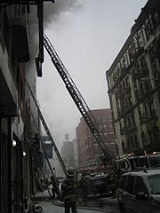
Fire apparatus

Encyclopedia
A fire apparatus, fire engine, fire truck, or fire appliance is a vehicle designed to assist in fighting fire
s by transporting firefighter
s to the scene and providing them with access to the fire, along with water or other equipment. In some areas, the terms fire engine and fire truck represent different types of firefighting apparatus.
A modern fire engine is usually a multi-purpose vehicle carrying professionals and equipment for a wide range of firefighting and rescue tasks. Therefore, most fire engines carry equipment such as ladder
s, pike pole
s, axe
s and cutting equipment, halligan bar
s, fire extinguisher
s, ventilating equipment, floodlights
, hose ramps, self-contained breathing apparatus (SCBA), and general tools. Many fire appliances are based on standard truck or lorry models with heavy duty suspensions, brakes, tires, alternator, transmission and cooling systems; audible
and visual warnings such as sirens, horns, and flashing lights; and a two-way radio.
The fire engine may have several methods of pumping water onto the fire, such as passing water obtained from a fire hydrant through hose
s or using a pumping "cannon" (also known as a monitor or deck gun); some trucks have an onboard water reservoir. Some fire engines may carry ladders to gain access to fires occurring in high-rise buildings and remove casualties, or hooks used to pull walls away to expose hidden fire or break windows. In some regions, a rescue unit is an EMS
truck with tools to carry out technical rescue
s of people from traffic collisions or structural collapses
.
Fire department
s covering large metropolitan areas may have specialist appliances for dealing with hazardous material
incidents. Some fire departments may utilise fireboat
s or airplanes
, depending on the local geography.
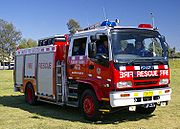 The conventional fire apparatus (also called a fire appliance, fire tender, fire engine, water ladder, pumper and pump-ladder) may have several methods of pumping water on to the fire. The most common method is to pass water from a pump through hose
s to the fire, from an array of valve
s. It may also have a fixed pumping "cannon" (also called a fire monitor
, or deck gun), which can direct the water as pointed by the operator. The horizontal and vertical range of the monitor arrangement usually is limited and appropriate only for specific tasks, such as airport fires. Monitors can also be used as water cannon
s for crowd control
. A fire engine may have an onboard water reservoir allowing firefighters to begin tackling the fire immediately, or it may be completely reliant on external sources, such as fire hydrant
s, water tender
s, natural sources such as rivers, or reservoirs by using draft water suction. A development is the use of an impulse fire-extinguishing system
(IFEX), in which the water is highly pressurized into a vaporous mist, creating a cooling effect that is more efficient than that of water alone. Some fire engines have been equipped with injectors for mixing foam into the pumped water stream creating a foam solution that is more effective than water alone. Some modern apparatus have included an air pump alongside foam injection to produce a compressed air foam product that further increases the efficiency of the water stream, cutting down dramatically on extinguishing time and water damage.
The name is derived from the fact that the large ladder is mounted on a turntable on the back of a truck
chassis, allowing it to pivot around a stable base, which in turn allows a much greater ladder length to be achieved. In order to increase its length, the ladder is telescopic. Modern TLs are either hydraulic or pneumatic in operation.
A ladder also can be mounted behind the cab. This is sometimes called "mid-ship" and the arrangement allows a shorter wheelbase for the truck, and also can be more stable in some conditions.
The key functions of a turntable ladder are:
While the traditional characteristic of a fire appliance was a lack of water pumping or storage, many modern TLs have a water pumping function built in (and some have their own onboard supply reservoir), and may have a pre-piped waterway running the length of the ladder, to allow a stream of water to the firefighters at the top. In some cases, there may also be a monitor at the top of the ladder for ease of use. Other appliances may simply have a trackway which will hold a manually run hose reel securely, and prevent it from falling to the ground.
Some turntable ladders may have a basket (sometimes known as a bucket) mounted at the top of the ladder, as on a hydraulic platform; these are called tower ladders. These appliances can provide a secure place for a firefighter to operate equipment from, and allow multiple people, including rescued persons, to be carried.
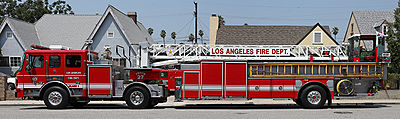 A tiller ladder, also known as a tractor-drawn aerial or hook-and-ladder truck, is a specialised turntable ladder mounted on a semi-trailer truck
. It has separate steering wheel
s for front and rear wheels. This truck is primarily used in the United States, especially in areas with narrow streets that prevent longer rigid-bodied trucks from entering such as San Francisco and Washington, DC. The hook-and-ladder concept started when taller skyscrapers and more city streets became a problem for fire departments. Larger ladders were needed to get to the upper stories of buildings, and the only way to move them was in this format.
In some areas of the United States, the turntable ladder may be known as a quint
or quad, as it is capable of performing multiple tasks (pump, water tank, fire hose, aerial device, and ground ladders) with each of these functions making up one of its four (Quad) or five (Quint) capabilities. The National Fire Protection Association
(NFPA) has certain specification that a turntable ladder has to meet to be officially considered a quint or quad (such as fire pump capacity, minimum amounts of equipment, etc.).
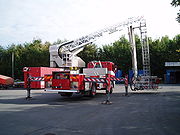 A hydraulic platform, also known as articulating booms, Snorkels, platform trucks, Bronto (used in Australia) or sometimes shortened to just HP, is a specialised aerial work platform
designed for firefighting use. They have a number of functions, which follow the same principles as the turntable ladder, providing high level access and elevated water pump positions.
Some hydraulic platforms are articulated, which allows the arm to bend in one or more places, giving it the ability to go "up and over" an obstacle (such as a building roof). There are non-articulated platforms, based on standard aerial work platforms, although the most common type is the tower ladder (mentioned above). HPs (articulated or not) may still have a ladder arrangement fitted to the arm, primarily as an emergency measure. In some jurisdictions these can be denoted ladder platforms.
Most HPs are designed to reach a height of around 33 metres (100 feet), although larger models are capable of reaching heights of over 100 metres (328 feet).
Many HPs are fitted with additional equipment in the platform itself, which can include a control panel, lighting equipment, a fixed water outlet or monitor, power outlets or compressed air outlets (allowing the fixing of rescue equipment, such as hydraulic rescue tools
). Many are also adapted or capable of carrying a stretcher
. Some units have video systems and remote control in case of dangerous chemical fires.
In an emergency, liquid-concrete pump
ing boom trucks can be temporarily repurposed for delivery of water for firefighting, as in the case of the Fukushima Daiichi nuclear disaster
in 2011.
apparatus. Essentially giant toolbox
es on wheels, they are primarily designed for technical rescue
situations such as vehicle extrication
s following traffic collisions, confined space rescue
s, rope rescue
s, swiftwater rescue
s, or building collapses
.
In the U.S., NFPA
regulations 1006 and 1670 provide guidelines and regulations for the operation of heavy rescue vehicles and also state that all "rescuers" must have medical training to perform any technical rescue operation, including cutting the vehicle itself. In most rescue environments, fire department personnel conduct rescue operations working hand-in-hand with medical personnel, such as EMTs or paramedics.
In addition to fire and rescue departments, tram
or railway companies may have their own dedicated heavy rescue squads. For example, railway rescue squads may carry very specialized equipment for railway accidents like hydraulic jacks with capacity for lifting locomotive
s or even move them horizontally, and equipment for tank car
accidents.
This first design did not include all the supply hose that is usually carried on a typical engine, but had the tool-carrying capacity of a heavy squad, including extrication equipment and the specialized rescue tools not carried on ladder trucks or engine companies.
The current design is more like a typical fire engine than a true rescue pumper. Today's rescue engine differs from the original unit concept Rescue Pumper, designed by Fire Chief S. E. Politano, which was simply to add more initial firefighting capabilities (onboard water and pumping capacity) to a heavy rescue squad, not bring heavy rescue squad capabilities to an engine company.
 Wildland firefighting requires unique vehicles that can easily negotiate difficult terrain and high-gradient roads, be self-reliant, and have high clearances for wheels and suspension. Wildland fire engine
s and wildland fire tender
s may have lower capacities to carry water, but can be deployed to fight fires in environments where urban fire apparatus would be unable to operate due to the terrain.
In heavily forested areas, a specialist brush truck may be used. These are usually trucks with off-road capabilities
for traversing rough terrain in order to reach the fire. Other vehicle models commonly used in the role of all-terrain fire engines include the Pinzgauer
and Unimog
.
Wildland or brush trucks are also distinguished from standard engines in that some models offer the ability to pump water while the apparatus is moving. This contrasts with standard engines or pumpers, which use the vehicle's engine to power the pumps, meaning that the vehicle must be stationary while the pump is in operation.
(HAZMAT). These are of several types, from those used to clean spilled oil on streets and highways, to full decontamination units, designed to clean victims and rescuers of contaminants after an incident.
Some fire departments may deploy a scientific support vehicle where required. Essentially a mobile laboratory, these units can attend a wide range of incidents, including chemical spills and fires, where early on-site scientific analysis and monitoring will speed up the detection process and allow firefighters and other emergency services to provide the correct response for the particular incident.
system. Hooklifts are sometimes only employed for seldom-used equipment; they can load a variety of different equipment containers very rapidly and act as a special unit with lower investment costs. For example, the Helsinki
Rescue Department has several hooklift trucks and more than 40 containers, including a water container, a hose container, and an oil destruction container. Containers may also carry a command post, salvage tools, foam barrels, hoses and pumps for wildfire
s, or even field hospital
s.
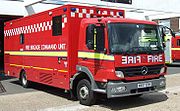 The advancement of technology and potential for very large-scale incidents has led to many fire departments utilising or increasing their use of mobile command support units.
A fundamental advantage of such an appliance is to accommodate the many different types of communication equipment needed at major incidents. In addition to the wide range of radio frequencies used, fire chief
s often need to communicate via landlines and send and receive information via satellite links and CCTV
of the ongoing situation. The command unit can essentially be used as an on-site conference centre for command personnel, mapping and planning firefighting operations and booking in and directing crews as they arrive.
or water bowser, is a specialist fire appliance with the primary purpose of transporting large amounts of water to the fireground to make it available for extinguishing operations. These are especially useful in rural areas where fire hydrants are not readily available and natural water resources are insufficient or difficult to exploit.
Most tankers have an on-board pumping system. This pump is often not of sufficient power to fight fires (as it is designed to be attached to a fire engine), but is more often used to draw water into the tender from hydrants or other water sources. In some areas, the tenders are used to pump water during floods, and may be fitted with a heavier duty pump for this purpose. Many tankers are equipped with fast-drain valves on the sides and back of the truck. This allows firefighters to empty thousands of gallons or several cubic meters of water into a portable water tank
in just a few seconds.
Most water tenders are designed to carry loads of 1000 US gal (3,785.4 l; 832.7 imp gal) or more. In the U.S., 1,000 U.S. gallons is the requirement in the NFPA standards. Some may carry up to or even upwards of 5000 US gal (4,163.4 imp gal; 18,927.1 l) of water.
s to extinguish fires on the trains, railroad track and adjacent territories - which otherwise may not be accessible by the roads. A fire train consists of specialist railcar
s (i.e. water tank, foam tank, water pump, electric generator etc.) and a professional firefighting team. In case of fire emergency, the train is coupled
by the nearest available locomotive
and quickly routed to the emergency site beyond schedule. Despite fulfilling all the necessary railway procedures, the fire trains sometimes arrive at the site faster than the road vehicles, bringing more water supply to tackle the fire.
Each fire train has its permanent base siding with exits at both directions and ajacent buildings facilitating the team. The base siding is always located in a major railway hub, where several locomotives are available at a time. e.g., there are two separate fire train units in the city of Kiev
. However, fire trains in itself are unlimited in their operation radius, protecting all country's railways in a network pattern.
Similar trains are found in Switzerland
and the United States
(with BNSF).
 An airport crash tender
is a fire engine designed for use at aerodrome
s and airport
s in aircraft
accidents. The features include a good acceleration, ability to move on rough terrain outside the runway
and airport area, large water capacity, a foam
tank, a high-capacity pump, and water/foam monitors with a good throw distance. Newer AR-FF vehicles also incorporate twin agent
nozzles/injection systems to inject a stream of Purple-K
dry chemical into the AFFF Aqueous Film Forming Fluroprotein foam stream "knocking-down" the fire faster. Some also have Halotron tanks with handlines for situations that require a clean agent to be utilized. These features give the airport crash tenders a capability to reach an airplane rapidly, and rapidly extinguish large fires with jet fuel
involved.
Some tenders have an elevated extended extinguishing arm called a Snozzle, giving a possibility to raise a water/foam cannon into the height of approximately 10–20 m (32.8–65.6 ft). Some arms have reinforced nozzles that can puncture through superficial structures of an aeroplane to fight a fire inside the fuselage.
The International Civil Aviation Organization
(ICAO) has given standards and recommended practices on rescue firefighting categories of civil aerodromes. National aviation authorities may have given even further requirements on aerodrome rescue and fire services.
The rescue fire services are based on a statistical analysis of movements (take-offs and landings) on the airport. The aerodrome category is based on the size of the biggest aircraft taking a movement on the aerodrome. In addition, the number of movements of the critical aircraft is calculated, and the category can be decreased by one if the number of movements is lower than the standard describes. There are also minimum category levels based on, for example, the number of seats in the critical aircraft.
Depending on the airport category, the standards determine the minimum number of rescue firefighting vehicles. In addition, requirements are given on the water and foam capacities, discharge rates for foam solutions, and minimum dry chemical powder (complementary agent) amounts, reserve stocks of fire fighting agents, ability to operate on rough terrain, and acceleration of the air crash tenders. The end of each runway must be reached in a response time of two minutes, and any part of the movement area has to be achieved in a response time not exceeding three minutes.
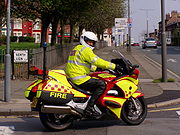 Motorcycles are sometimes equipped for fighting fires or to be used as a first responder
unit.
They are commonly used in Japan and Hong Kong, for example, in normal everyday duties. The motorcycles are useful for negotiating the small streets and heavy traffic in the large urban areas of Japanese cities. Having off-road motorcycles helps in responding to the difficult terrain that surround many urban centres. Some departments would likely have their crews in teams of two or three motorcycles. The firefighters who drive these motorcycles wear a light-weight fire suit. Their motorcycle's helmets are fireproof and equipped with a radio. A fire extinguisher
, fire blanket
, and a small hose are carried in the cargo truck and panniers. One of the motorcycles carries a first aid kit
and/or automated external defibrillator
. The other motorcycles in this team may carry fire fighting and rescue equipment. A self-contained breathing apparatus pack is also carried on one motorcycle and pre-setup for ready use. Most crews are firefighters with training in first response, first aid
, and/or paramedic
ine.
There are also fire fighting All-terrain vehicle
s
s or EMT
s to medical emergencies
because of their faster response times due to forward staging in the city compared to ambulances coming from hospitals Fire departments may also have lifeguards in places such as Los Angeles County, California
.
A fire appliance may undergo modifications such as adjustments for higher durability, removal of any speed limiter, and adjustments for long periods of idling at a higher temperature. This may be accomplished by heavy duty suspensions, brakes, tires, alternator, transmission and cooling systems. It is also usual to upgrade the capacity of the electrical system to accommodate additional electrical and electronic equipment.
Fire appliances have audible and visual warnings, to protect themselves from traffic, and make themselves visible to other units at an incident.
In many countries, use of the audible and visual warnings affords the driver a degree of exemption from road traffic laws (such as the right to exceed speed limits, treat red stop lights as give way etc.) and may also infer a duty on other motorists to move out of the direction of passage of the fire vehicle (or face possible prosecution).
designs which reflect light from headlights or torches. Patterns include "checker board" (alternate coloured squares, sometimes called "battenburg markings
", named after a type of cake), chevrons (arrowheads, often pointed towards the front of the vehicle if on the side, or pointing vertically upwards if on the rear) or stripes (along the side; these were the first type of retro-reflective devices introduced, as the original retro-reflective material came only in tape form). In some countries, in addition to retro-reflective markings, vehicles are now painted a bright yellow or orange, although in many other countries, red remains the colour for fire engines. In Australia a number of rural fire units are painted white, such as those used by the Country Fire Service
in South Australia, making them more visible in bushfire conditions.
Another passive marking is the word FIRE, RESCUE or local language variant spelled out in reverse on the front of the vehicle. This enables drivers of other vehicles to more easily identify a fire service vehicle in their rear view mirrors. The appliance may also display a telephone number which may be used to summon assistance, along with the name of the operating department or station identifier.
NFPA 1901 Standards for Automotive Fire Apparatus: 20.4 Aerial Ladder Operating Position
20.4.2 A system that is lighted and marked with labels shall be visible from the operator's position to indicate the elevation, extension, and rated capacities (see sample of boom angle indicator).
flashing lights, as they are low profile and consume less energy. See also Emergency vehicle equipment
.
s, which can alert people to the presence of an emergency vehicle
before they can be seen. The first audible warnings were mechanical bells, mounted on the front or roof of the truck. Most vehicles are now fitted with electronic sirens, which can produce a range of different sounds. Fire service driving training often includes the use of different sounds depending on traffic conditions and maneuver being performed. For instance, on a clear road, approaching a junction, the "wail" setting may be used, which gives a long up and down variation, with an unbroken tone, whereas, in heavy slow traffic, a "yelp" setting may be preferred, which is like a wail, but faster.
The speakers for modern sirens can be located in several places on the vehicle, including being integral to the lightbar, or hidden in the grille. Some vehicles may also be fitted with airhorn audible warnings. A number of North American fire departments have returned to the "acoustic" or "air" traditional siren, as its overtones help the public "locate" and avoid the firetruck—the newer electronic signals disperse almost pure electronic sine wave tones, which are hard to locate, especially in city "canyons" of buildings. In Chile, many vehicles are fitted with three types of audible warnings, which are sounded all at once: the classic "air" siren, the electronic "yelp", and the European two-tone air horns (sometimes newer vehicles are fitted with the electronic version of the latter, commonly called "Hi-Lo").
A development is the use of the RDS
system of car radio
s, whereby the vehicle can be fitted with a short range FM transmitter, set to RDS code 31, which interrupts the radio of all cars within range, in the manner of a traffic broadcast, but in such a way that the user of the receiving radio is unable to opt out of the message (as with traffic broadcasts). This feature is built in to all RDS radios for use in national emergency broadcast systems, but short range units on emergency vehicles can prove an effective means of alerting traffic to their presence, although is not able to alert pedestrians and non-RDS radio users.
, an engine carries the unit leader, an engineer, and one or two pairs of firefighters. Since firefighting takes places in a very hot and hostile environment with high risks, fire fighters work as pairs, and at least one more pair of firefighters is needed on scene for the safety and shifting.
In cities of the United States, firefighters are generally deployed into fire companies specializing in certain tasks. Most common are engine companies and ladder, or "truck", companies. In addition, large cities frequently staff rescue companies. By definition, each company is led by an officer (a captain or lieutenant) who commands several firefighters. Staffing of fire companies varies by jurisdiction and frequently by company type. In large cities, fire company staffing may vary from as few as three to as many as six personnel. In suburban and rural areas of the United States, the legal organization to which volunteers belong is usually called a company; one company may operate several pieces of apparatus. Duties of volunteers are often less specialized than those of city firefighters, because it is less predictable who will be available for a given emergency, so more flexibility is needed.
Other departments staff their fire engines as emergency response units. The staged layout of fires stations and apparatus around a city means that a fire engine dispatched from its station may reach a medical emergency call faster than an ambulance coming from a hospital. Therefore, firefighters are trained as EMT
s and paramedics. The usual complement includes 1 fire captain and a number of additional firefighters. The number of additional firefighters depends on the severity of the incidents it will respond to, the capacity of the fire truck in question, the nature of the call for assistance and the personal preference of the fire department. For example, a pumper truck might carry 1 captain, 2 FF/Es (Engineers) and 1 FF/P (paramedic). Both the captain and the engineers are trained as Emergency Medical Technicians.
Many departments staff all of their trucks as medical response units, while some use a mixture. Common units that are medical response units include: Pumper, Rescue, Search & Rescue, and Hazardous Materials Units. The advantage of Medical Response units is well worth the training expenses. 911 medical calls that are responded to by a fire truck places less strain on ambulances and certified first responders, enabling them to focus on more critical patients. The disadvantage includes training for the firefighters as EMTs and paramedics, which happens to be very expensive. Also, medical equipment must be carried by the fire truck, reducing storage space for some firefighting equipment.
In the United Kingdom
, firefighter
s are arranged in fire and rescue services
, historically known as brigades, and usually organized at county, city, or combined level. These are divided into either commands or areas, in some cases divisions, then stations, which range in size but in almost every instance have at least one pumping appliance. In addition, general purpose engine stations may have specialist vehicles, such as turntable ladders, hydraulic platforms, foam tenders, etc. The number of personnel at a station varies depending on the number of appliances, and whether it is full time, day manned, or retained. Generally, the crew of an average sized pump is around five, but in any case it can be no less than four and no more than six.
In New Zealand
the standard crew consists of four: the OIC (Officer in Charge, or Officer in Command), the driver, and two others. They are numbered OIC, 1, 2, and 3, with the OIC in the front passenger's seat and number 1 directly behind them; number 3 is the driver. The crew has specific tasks in a water drill, decided by where they are sitting. At call-outs, there may be five on an appliance, but only four have allotted tasks, with the fifth person being spare.
in 1518 and Nuremberg
in 1657. A book of 1655 inventions mentions a steam engine (called fire engine) pump used to "raise a column of water 40 feet [12 m]", but there was no mention of whether it was portable.
Colonial laws in America required each house to have a bucket of water on the front stoop during fires at night. These buckets were intended for use by the initial "bucket brigade" that would throw the water at fires. Philadelphia obtained a hand-pumped fire engine in 1719, years after Boston
's 1654 model appeared there, made by Joseph Jencks, but before New York's two engines arrived from London.
By 1730, Richard Newsham
, in London, had made successful fire engines; the first used in New York City
(in 1731) were of his make (six years before formation of the NYC volunteer fire department). The amount of manpower and skill necessary for firefighting prompted the institution of an organized fire company by Benjamin Franklin
in 1737. Thomas Lote built the first fire engine made in America in 1743. Ericsson made a similar one in New York in 1840. John Ericsson
is credited with building the first American steam-powered fire engine. George Braithwaite built the first steam fire-engine in Britain
.
Until the mid-19th century most fire engines were maneuvered by men, but the introduction of horse-drawn fire engines considerably improved the response time to incidents. The first self-propelled steam engine was built in New York in 1841. It was the target of sabotage
by firefighters and its use was discontinued, and motorized fire engines did not become commonplace until the early 20th century.
For many years firefighters sat on the sides of the fire engines, or even stood on the rear of the vehicles, exposed to the elements. This arrangement was uncomfortable and dangerous (some firefighters were thrown to their deaths when their fire engines made sharp turns on the road), and today nearly all fire engines have fully enclosed seating areas for their crews.
In 1905, the first modern fire engine was constructed by Knox Automobile
of Springfield, Massachusetts
, based on the standard truck model. A year later, the City of Springfield had the world's first modern fire department, supplied by Knox Fire Engines.
The longest turntable ladders have reached a height of 150 feet (45.7 m), requiring the aforementioned "tiller trucks" to carry such ladders.
After the Second World War
turntable ladders were supplemented by the aerial work platform
(sometimes called "cherry picker"), a platform or bucket attached onto a mechanically bending arm (or "snorkel") installed onto a fire truck. While these could not reach the height of similar turntable ladders, the platforms could extend into previously unreachable "dead corners" of a burning building.
Fire
Fire is the rapid oxidation of a material in the chemical process of combustion, releasing heat, light, and various reaction products. Slower oxidative processes like rusting or digestion are not included by this definition....
s by transporting firefighter
Firefighter
Firefighters are rescuers extensively trained primarily to put out hazardous fires that threaten civilian populations and property, to rescue people from car incidents, collapsed and burning buildings and other such situations...
s to the scene and providing them with access to the fire, along with water or other equipment. In some areas, the terms fire engine and fire truck represent different types of firefighting apparatus.
A modern fire engine is usually a multi-purpose vehicle carrying professionals and equipment for a wide range of firefighting and rescue tasks. Therefore, most fire engines carry equipment such as ladder
Ladder
A ladder is a vertical or inclined set of rungs or steps. There are two types: rigid ladders that can be leaned against a vertical surface such as a wall, and rope ladders that are hung from the top. The vertical members of a rigid ladder are called stringers or stiles . Rigid ladders are usually...
s, pike pole
Pike pole
Pike poles are long poles usually 4-12 feet in length used by firefighters to search for fires hidden behind the sheetrock in the walls and ceiling. These days they are made out of fiberglass with metal hooks on the end, and are used to pull items from an area of intense heat and flame, and...
s, axe
Axe
The axe, or ax, is an implement that has been used for millennia to shape, split and cut wood; to harvest timber; as a weapon; and as a ceremonial or heraldic symbol...
s and cutting equipment, halligan bar
Halligan bar
A Halligan bar is a special forcible entry tool commonly used by firefighters and law enforcement. It was designed by and named after Hugh Halligan, a First Deputy Fire Chief in the New York City Fire Department, in 1948...
s, fire extinguisher
Fire extinguisher
A fire extinguisher or extinguisher, flame entinguisher is an active fire protection device used to extinguish or control small fires, often in emergency situations...
s, ventilating equipment, floodlights
High-intensity discharge lamp
High-intensity discharge lamps are a type of electrical lamp which produces light by means of an electric arc between tungsten electrodes housed inside a translucent or transparent fused quartz or fused alumina arc tube. This tube is filled with both gas and metal salts. The gas facilitates the...
, hose ramps, self-contained breathing apparatus (SCBA), and general tools. Many fire appliances are based on standard truck or lorry models with heavy duty suspensions, brakes, tires, alternator, transmission and cooling systems; audible
Siren (noisemaker)
A siren is a loud noise making device. Most modern ones are civil defense or air raid sirens, tornado sirens, or the sirens on emergency service vehicles such as ambulances, police cars and fire trucks. There are two general types: pneumatic and electronic....
and visual warnings such as sirens, horns, and flashing lights; and a two-way radio.
The fire engine may have several methods of pumping water onto the fire, such as passing water obtained from a fire hydrant through hose
Firehose
A fire hose is a high-pressure hose used to carry water or other fire retardant to a fire to extinguish it. Outdoors, it is attached either to a fire engine or a fire hydrant. Indoors, it can be permanently attached to a building's standpipe or plumbing system...
s or using a pumping "cannon" (also known as a monitor or deck gun); some trucks have an onboard water reservoir. Some fire engines may carry ladders to gain access to fires occurring in high-rise buildings and remove casualties, or hooks used to pull walls away to expose hidden fire or break windows. In some regions, a rescue unit is an EMS
Emergency medical services
Emergency medical services are a type of emergency service dedicated to providing out-of-hospital acute medical care and/or transport to definitive care, to patients with illnesses and injuries which the patient, or the medical practitioner, believes constitutes a medical emergency...
truck with tools to carry out technical rescue
Technical rescue
Technical rescue refers to those aspects of saving life or property that employ the use of tools and skills that exceed those normally reserved for fire fighting, medical emergency, and rescue. These disciplines include rope rescue, swiftwater rescue, confined space rescue, ski rescue, cave rescue,...
s of people from traffic collisions or structural collapses
Structural failure
Structural failure refers to loss of the load-carrying capacity of a component or member within a structure or of the structure itself. Structural failure is initiated when the material is stressed to its strength limit, thus causing fracture or excessive deformations...
.
Fire department
Fire department
A fire department or fire brigade is a public or private organization that provides fire protection for a certain jurisdiction, which typically is a municipality, county, or fire protection district...
s covering large metropolitan areas may have specialist appliances for dealing with hazardous material
Dangerous goods
Dangerous goods are solids, liquids, or gases that can harm people, other living organisms, property, or the environment. They are often subject to chemical regulations. "HazMat teams" are personnel specially trained to handle dangerous goods...
incidents. Some fire departments may utilise fireboat
Fireboat
A fireboat is a specialized watercraft and with pumps and nozzles designed for fighting shoreline and shipboard fires. The first fireboats, dating to the late 18th century, were tugboats, retrofitted with firefighting equipment....
s or airplanes
Aerial firefighting
Aerial firefighting is the use of aircraft and other aerial resources to combat wildfires. The types of aircraft used include fixed-wing aircraft and helicopters. Smokejumpers and rappellers are also classified as aerial firefighters, delivered to the fire by parachute from a variety of fixed-wing...
, depending on the local geography.
Conventional fire apparatus
Firehose
A fire hose is a high-pressure hose used to carry water or other fire retardant to a fire to extinguish it. Outdoors, it is attached either to a fire engine or a fire hydrant. Indoors, it can be permanently attached to a building's standpipe or plumbing system...
s to the fire, from an array of valve
Valve
A valve is a device that regulates, directs or controls the flow of a fluid by opening, closing, or partially obstructing various passageways. Valves are technically pipe fittings, but are usually discussed as a separate category...
s. It may also have a fixed pumping "cannon" (also called a fire monitor
Deluge gun
A deluge gun, fire monitor, master stream, or deck gun is an aimable controllable high-capacity water jet used for manual firefighting or automatic fire protection systems. Fire monitors are often designed to accommodate foam which has been injected in the upstream piping...
, or deck gun), which can direct the water as pointed by the operator. The horizontal and vertical range of the monitor arrangement usually is limited and appropriate only for specific tasks, such as airport fires. Monitors can also be used as water cannon
Water cannon
A water cannon is a device that shoots a high-pressure stream of water. Typically, a water cannon can deliver a large volume of water, often over dozens of metres / hundreds of feet. They are used in firefighting and riot control. Most water cannon fall under the category of a fire...
s for crowd control
Crowd control
Crowd control is the controlling of a crowd, to prevent the outbreak of disorder and prevention of possible riot. Examples are at soccer matches, when a sale of goods has attracted an excess of customers, refugee control, or mass decontamination and mass quarantine situations . It calls for gentler...
. A fire engine may have an onboard water reservoir allowing firefighters to begin tackling the fire immediately, or it may be completely reliant on external sources, such as fire hydrant
Fire hydrant
A fire hydrant , is an active fire protection measure, and a source of water provided in most urban, suburban and rural areas with municipal water service to enable firefighters to tap into the municipal water...
s, water tender
Water tender
A water tender, also known as a tanker in some regions, is a specialized firefighting apparatus designed for transporting water from a water source to a fire scene...
s, natural sources such as rivers, or reservoirs by using draft water suction. A development is the use of an impulse fire-extinguishing system
Impulse Fire Extinguishing System
The Impulse Fire Extinguishing System is a series of firefighting equipment that uses small amounts of water fired in high velocity bursts to put out fires. Engineer Frans Steur began IFEX GmbH in 1994...
(IFEX), in which the water is highly pressurized into a vaporous mist, creating a cooling effect that is more efficient than that of water alone. Some fire engines have been equipped with injectors for mixing foam into the pumped water stream creating a foam solution that is more effective than water alone. Some modern apparatus have included an air pump alongside foam injection to produce a compressed air foam product that further increases the efficiency of the water stream, cutting down dramatically on extinguishing time and water damage.
Turntable ladder
A turntable ladder (TL) is perhaps the best-known form of specialised aerial apparatus, and is used to gain access to fires occurring at height using a large telescopic ladder, where conventional ladders carried on conventional appliances might not reach.The name is derived from the fact that the large ladder is mounted on a turntable on the back of a truck
Truck
A truck or lorry is a motor vehicle designed to transport cargo. Trucks vary greatly in size, power, and configuration, with the smallest being mechanically similar to an automobile...
chassis, allowing it to pivot around a stable base, which in turn allows a much greater ladder length to be achieved. In order to increase its length, the ladder is telescopic. Modern TLs are either hydraulic or pneumatic in operation.
A ladder also can be mounted behind the cab. This is sometimes called "mid-ship" and the arrangement allows a shorter wheelbase for the truck, and also can be more stable in some conditions.
The key functions of a turntable ladder are:
- Allowing access or egress of firefighters and casualties at height;
- Providing a high level water point for firefighting (elevated master stream);
- Providing a working platform from which tasks such as ventilation or overhaul can be executed.
While the traditional characteristic of a fire appliance was a lack of water pumping or storage, many modern TLs have a water pumping function built in (and some have their own onboard supply reservoir), and may have a pre-piped waterway running the length of the ladder, to allow a stream of water to the firefighters at the top. In some cases, there may also be a monitor at the top of the ladder for ease of use. Other appliances may simply have a trackway which will hold a manually run hose reel securely, and prevent it from falling to the ground.
Tower ladder
Some turntable ladders may have a basket (sometimes known as a bucket) mounted at the top of the ladder, as on a hydraulic platform; these are called tower ladders. These appliances can provide a secure place for a firefighter to operate equipment from, and allow multiple people, including rescued persons, to be carried.
Tiller ladder
Semi-trailer truck
A semi-trailer truck, also known as a semi, tractor-trailer, or articulated truck or articulated lorry, is an articulated vehicle consisting of a towing engine , and a semi-trailer A semi-trailer truck, also known as a semi, tractor-trailer, or (in the United Kingdom and Ireland) articulated truck...
. It has separate steering wheel
Steering wheel
A steering wheel is a type of steering control in vehicles and vessels ....
s for front and rear wheels. This truck is primarily used in the United States, especially in areas with narrow streets that prevent longer rigid-bodied trucks from entering such as San Francisco and Washington, DC. The hook-and-ladder concept started when taller skyscrapers and more city streets became a problem for fire departments. Larger ladders were needed to get to the upper stories of buildings, and the only way to move them was in this format.
Quint/quad
In some areas of the United States, the turntable ladder may be known as a quint
Quint (fire apparatus)
A quintuple combination pumper or quint is a fire service apparatus that serves the dual purpose of an engine and a ladder truck. The name quint is derived from the Latin prefix quinque-, meaning five, and refers to the five functions that a quint provides: pump, water tank, fire hose, aerial...
or quad, as it is capable of performing multiple tasks (pump, water tank, fire hose, aerial device, and ground ladders) with each of these functions making up one of its four (Quad) or five (Quint) capabilities. The National Fire Protection Association
National Fire Protection Association
The National Fire Protection Association is a United States trade association that creates and maintains private, copywrited, standards and codes for usage and adoption by local governments...
(NFPA) has certain specification that a turntable ladder has to meet to be officially considered a quint or quad (such as fire pump capacity, minimum amounts of equipment, etc.).
Hydraulic platform
Aerial work platform
An aerial work platform, also known as an aerial device or elevating work platform, is a mechanical device used to provide temporary access for people or equipment to inaccessible areas, usually at height...
designed for firefighting use. They have a number of functions, which follow the same principles as the turntable ladder, providing high level access and elevated water pump positions.
Some hydraulic platforms are articulated, which allows the arm to bend in one or more places, giving it the ability to go "up and over" an obstacle (such as a building roof). There are non-articulated platforms, based on standard aerial work platforms, although the most common type is the tower ladder (mentioned above). HPs (articulated or not) may still have a ladder arrangement fitted to the arm, primarily as an emergency measure. In some jurisdictions these can be denoted ladder platforms.
Most HPs are designed to reach a height of around 33 metres (100 feet), although larger models are capable of reaching heights of over 100 metres (328 feet).
Many HPs are fitted with additional equipment in the platform itself, which can include a control panel, lighting equipment, a fixed water outlet or monitor, power outlets or compressed air outlets (allowing the fixing of rescue equipment, such as hydraulic rescue tools
Hydraulic Rescue Tools
Hydraulic rescue tools are used by emergency rescue personnel to assist vehicle extrication of crash victims, as well as other rescues from small spaces. These tools include cutters, spreaders, door busters and rams...
). Many are also adapted or capable of carrying a stretcher
Stretcher
A stretcher is a medical device used to carry casualties or an incapacitated person from one place to another. It is a simple type of litter, and still called by that name in some cases....
. Some units have video systems and remote control in case of dangerous chemical fires.
In an emergency, liquid-concrete pump
Concrete pump
A concrete pump is a tool used for transferring liquid concrete by pumping. There are two types of concrete pumps.The first type of concrete pump is attached to a truck. It is known as a trailer-mounted concrete pump because it uses a remote-controlled articulating robotic arm to place concrete...
ing boom trucks can be temporarily repurposed for delivery of water for firefighting, as in the case of the Fukushima Daiichi nuclear disaster
Fukushima Daiichi nuclear disaster
The is a series of equipment failures, nuclear meltdowns, and releases of radioactive materials at the Fukushima I Nuclear Power Plant, following the Tōhoku earthquake and tsunami on 11 March 2011. The plant comprises six separate boiling water reactors originally designed by General Electric ,...
in 2011.
Aerial ladder platform
Some fire departments use aerial ladder platforms (ALPs), or aerial water towers, the purpose of which is to deploy an elevated master stream of water, although it does not provide any access for firefighters. In many departments however, this function is better performed by a HP or TL.Heavy rescue vehicle
A heavy rescue vehicle, sometimes referred to as a Rescue Company, Rescue Squad or Technical Rescue, is a type of specialty firefighting or EMSEmergency medical services
Emergency medical services are a type of emergency service dedicated to providing out-of-hospital acute medical care and/or transport to definitive care, to patients with illnesses and injuries which the patient, or the medical practitioner, believes constitutes a medical emergency...
apparatus. Essentially giant toolbox
Toolbox
A toolbox varies with the craft of the owner. The purpose of the toolbox is to organize, carry, and protect the owner's tools used for trade, hobby or DIY.-Types of toolboxes:...
es on wheels, they are primarily designed for technical rescue
Technical rescue
Technical rescue refers to those aspects of saving life or property that employ the use of tools and skills that exceed those normally reserved for fire fighting, medical emergency, and rescue. These disciplines include rope rescue, swiftwater rescue, confined space rescue, ski rescue, cave rescue,...
situations such as vehicle extrication
Vehicle extrication
Vehicle extrication is the process of removing the vehicle from around a person that has been involved in a motor vehicle accident, when conventional means of exit are impossible or unadvisable. A delicate approach is needed to minimize injury to the victim during the extrication...
s following traffic collisions, confined space rescue
Confined space rescue
Confined space rescue is a subset of technical rescue operations that involves the rescue and recovery of victims trapped in a confined space or in a place only accessible through confined spaces, such as underground vaults, storage silos, storage tanks, or sewers.Confined space rescues can be...
s, rope rescue
Rope rescue
Rope rescue is a subset of technical rescue that involves the use of static nylon kernmantle ropes, anchoring and belaying devices, friction rappel devices, various devices to utilize mechanical advantage for hauling systems, and other specialized equipment to reach victims and safely recover...
s, swiftwater rescue
Swiftwater rescue
Swiftwater rescue is a subset of technical rescue dealing in whitewater river conditions. Due to the added pressure of moving water, swiftwater rescue involves the use of specially trained personnel, ropes and mechanical advantage systems that are often much more robust than those used in standard...
s, or building collapses
Structural failure
Structural failure refers to loss of the load-carrying capacity of a component or member within a structure or of the structure itself. Structural failure is initiated when the material is stressed to its strength limit, thus causing fracture or excessive deformations...
.
In the U.S., NFPA
National Fire Protection Association
The National Fire Protection Association is a United States trade association that creates and maintains private, copywrited, standards and codes for usage and adoption by local governments...
regulations 1006 and 1670 provide guidelines and regulations for the operation of heavy rescue vehicles and also state that all "rescuers" must have medical training to perform any technical rescue operation, including cutting the vehicle itself. In most rescue environments, fire department personnel conduct rescue operations working hand-in-hand with medical personnel, such as EMTs or paramedics.
In addition to fire and rescue departments, tram
Tram
A tram is a passenger rail vehicle which runs on tracks along public urban streets and also sometimes on separate rights of way. It may also run between cities and/or towns , and/or partially grade separated even in the cities...
or railway companies may have their own dedicated heavy rescue squads. For example, railway rescue squads may carry very specialized equipment for railway accidents like hydraulic jacks with capacity for lifting locomotive
Locomotive
A locomotive is a railway vehicle that provides the motive power for a train. The word originates from the Latin loco – "from a place", ablative of locus, "place" + Medieval Latin motivus, "causing motion", and is a shortened form of the term locomotive engine, first used in the early 19th...
s or even move them horizontally, and equipment for tank car
Tank car
A tank car is a type of railroad rolling stock designed to transport liquid and gaseous commodities.-Timeline:...
accidents.
Rescue engine/pumper
A rescue pumper or rescue engine is a purpose-built unit of fire apparatus beyond a typical NFPA Class A rated engine company. The original concept was to marry the capabilities of a heavy rescue squad and that of a class A rated pumper, that is to add 1,000 gpm or greater fire pump and 500 gallons of water. This is a newer concept that first began in the late 1980s and early 1990s.This first design did not include all the supply hose that is usually carried on a typical engine, but had the tool-carrying capacity of a heavy squad, including extrication equipment and the specialized rescue tools not carried on ladder trucks or engine companies.
The current design is more like a typical fire engine than a true rescue pumper. Today's rescue engine differs from the original unit concept Rescue Pumper, designed by Fire Chief S. E. Politano, which was simply to add more initial firefighting capabilities (onboard water and pumping capacity) to a heavy rescue squad, not bring heavy rescue squad capabilities to an engine company.
Wildland fire apparatus
Wildland fire engine
Wildland fire engines use special equipment to spray water, foam, and chemicals. The engines are able to carry up to of water. Many wildland fire engines are also equipped with four wheel drive and special equipment for off-road use.*...
s and wildland fire tender
Wildland fire tender
A wildland fire tender is a specialized vehicle capable of bringing water, foam, or dry chemicals to fire trucks in the field that are engaged on the fireline...
s may have lower capacities to carry water, but can be deployed to fight fires in environments where urban fire apparatus would be unable to operate due to the terrain.
In heavily forested areas, a specialist brush truck may be used. These are usually trucks with off-road capabilities
Off-roading
Off-roading is a term for driving a vehicle on unsurfaced roads or tracks, made of materials such as sand, gravel, riverbeds, mud, snow, rocks, and other natural terrain.-Off-road vehicle:...
for traversing rough terrain in order to reach the fire. Other vehicle models commonly used in the role of all-terrain fire engines include the Pinzgauer
Pinzgauer High Mobility All-Terrain Vehicle
The Pinzgauer is a family of high-mobility all-terrain 4WD and 6WD military utility vehicles. They were manufactured in Guildford, Surrey, United Kingdom, by BAE Systems Land & Armaments. The vehicle was originally developed in the late 1960s by Steyr-Daimler-Puch of Graz, Austria, and was named...
and Unimog
Unimog
Unimog is a range of multi-purpose auto four wheel drive medium trucks produced by Mercedes-Benz, a division of Daimler AG. The name Unimog is pronounced in German and is an acronym for the German "UNIversal-MOtor-Gerät", Gerät being the German word for machine or device...
.
Wildland or brush trucks are also distinguished from standard engines in that some models offer the ability to pump water while the apparatus is moving. This contrasts with standard engines or pumpers, which use the vehicle's engine to power the pumps, meaning that the vehicle must be stationary while the pump is in operation.
Hazardous materials apparatus
Many fire departments covering large metropolitan areas or those containing many high-risk hazards keep specialist appliances for dealing with hazardous materialsDangerous goods
Dangerous goods are solids, liquids, or gases that can harm people, other living organisms, property, or the environment. They are often subject to chemical regulations. "HazMat teams" are personnel specially trained to handle dangerous goods...
(HAZMAT). These are of several types, from those used to clean spilled oil on streets and highways, to full decontamination units, designed to clean victims and rescuers of contaminants after an incident.
Some fire departments may deploy a scientific support vehicle where required. Essentially a mobile laboratory, these units can attend a wide range of incidents, including chemical spills and fires, where early on-site scientific analysis and monitoring will speed up the detection process and allow firefighters and other emergency services to provide the correct response for the particular incident.
Logistical support apparatus
Many fire departments operate a number of vehicles in specialised logistical functions. These can be stand-alone vehicles, or may be modular, such as with the use of a hook-liftTractor unit
A tractor unit, prime mover , road tractor, or traction unit is a heavy-duty commercial vehicle within the large goods vehicle category, usually with a large displacement diesel engine, and several axles. The tractor unit serves as a method of moving trailers...
system. Hooklifts are sometimes only employed for seldom-used equipment; they can load a variety of different equipment containers very rapidly and act as a special unit with lower investment costs. For example, the Helsinki
Helsinki
Helsinki is the capital and largest city in Finland. It is in the region of Uusimaa, located in southern Finland, on the shore of the Gulf of Finland, an arm of the Baltic Sea. The population of the city of Helsinki is , making it by far the most populous municipality in Finland. Helsinki is...
Rescue Department has several hooklift trucks and more than 40 containers, including a water container, a hose container, and an oil destruction container. Containers may also carry a command post, salvage tools, foam barrels, hoses and pumps for wildfire
Wildfire
A wildfire is any uncontrolled fire in combustible vegetation that occurs in the countryside or a wilderness area. Other names such as brush fire, bushfire, forest fire, desert fire, grass fire, hill fire, squirrel fire, vegetation fire, veldfire, and wilkjjofire may be used to describe the same...
s, or even field hospital
Field hospital
A field hospital is a large mobile medical unit that temporarily takes care of casualties on-site before they can be safely transported to more permanent hospital facilities...
s.
Command support unit
A fundamental advantage of such an appliance is to accommodate the many different types of communication equipment needed at major incidents. In addition to the wide range of radio frequencies used, fire chief
Fire chief
Fire Chief is a top executive rank or commanding officer in a fire department, either elected or appointed...
s often need to communicate via landlines and send and receive information via satellite links and CCTV
Closed-circuit television
Closed-circuit television is the use of video cameras to transmit a signal to a specific place, on a limited set of monitors....
of the ongoing situation. The command unit can essentially be used as an on-site conference centre for command personnel, mapping and planning firefighting operations and booking in and directing crews as they arrive.
Tanker truck
A tanker truck, which can also be known as a water tenderWater tender
A water tender, also known as a tanker in some regions, is a specialized firefighting apparatus designed for transporting water from a water source to a fire scene...
or water bowser, is a specialist fire appliance with the primary purpose of transporting large amounts of water to the fireground to make it available for extinguishing operations. These are especially useful in rural areas where fire hydrants are not readily available and natural water resources are insufficient or difficult to exploit.
Most tankers have an on-board pumping system. This pump is often not of sufficient power to fight fires (as it is designed to be attached to a fire engine), but is more often used to draw water into the tender from hydrants or other water sources. In some areas, the tenders are used to pump water during floods, and may be fitted with a heavier duty pump for this purpose. Many tankers are equipped with fast-drain valves on the sides and back of the truck. This allows firefighters to empty thousands of gallons or several cubic meters of water into a portable water tank
Portable water tank
A portable water tank is a collapsible temporary tank designed for the reserve storage of water in firefighting, emergency relief, and military applications. These tanks can be either supported or unsupported. The supported tanks have a steel or aluminum frame and range in size from 600 to 5000 US...
in just a few seconds.
Most water tenders are designed to carry loads of 1000 US gal (3,785.4 l; 832.7 imp gal) or more. In the U.S., 1,000 U.S. gallons is the requirement in the NFPA standards. Some may carry up to or even upwards of 5000 US gal (4,163.4 imp gal; 18,927.1 l) of water.
Hose layer
In some fire departments, a similar function may be performed by a hose layer, which carries large-capacity high-pressure hose wagons to incidents where hydrants or other water sources are not close enough to the fireground. It will lay out its hose at the nearest hydrant or water source then drive to the fireground with the hose laying off the back; upon arrival it will connect to a fire appliance to supply it with the water needed for the firefighting operations.Foam tender
Foam tenders carry large amounts of foam to be used at incidents where water is ineffective or cannot be used to tackle a blaze. They may take the form of a tanker, or a truck carrying foam packets or barrels.Fireboat
Some fire departments that protect a body of water, such as a major city harbor or coastline, may utilise fireboats to combat fires on watercraft and waterfront areas. Such fireboats pump water from under them, so they can theoretically provide water indefinitely. In some places, fire boats are not just designed for firefighting, they can also be used to perform rescue missions, and transport divers and other equipment to the scene.Fire train
Railways of the former Soviet Union widely use permanent-readiness fire trainTrain
A train is a connected series of vehicles for rail transport that move along a track to transport cargo or passengers from one place to another place. The track usually consists of two rails, but might also be a monorail or maglev guideway.Propulsion for the train is provided by a separate...
s to extinguish fires on the trains, railroad track and adjacent territories - which otherwise may not be accessible by the roads. A fire train consists of specialist railcar
Railcar
A railcar, in British English and Australian English, is a self-propelled railway vehicle designed to transport passengers. The term "railcar" is usually used in reference to a train consisting of a single coach , with a driver's cab at one or both ends. Some railways, e.g., the Great Western...
s (i.e. water tank, foam tank, water pump, electric generator etc.) and a professional firefighting team. In case of fire emergency, the train is coupled
Coupling (railway)
A coupling is a mechanism for connecting rolling stock in a train. The design of the coupler is standard, and is almost as important as the railway gauge, since flexibility and convenience are maximised if all rolling stock can be coupled together.The equipment that connects the couplings to the...
by the nearest available locomotive
Locomotive
A locomotive is a railway vehicle that provides the motive power for a train. The word originates from the Latin loco – "from a place", ablative of locus, "place" + Medieval Latin motivus, "causing motion", and is a shortened form of the term locomotive engine, first used in the early 19th...
and quickly routed to the emergency site beyond schedule. Despite fulfilling all the necessary railway procedures, the fire trains sometimes arrive at the site faster than the road vehicles, bringing more water supply to tackle the fire.
Each fire train has its permanent base siding with exits at both directions and ajacent buildings facilitating the team. The base siding is always located in a major railway hub, where several locomotives are available at a time. e.g., there are two separate fire train units in the city of Kiev
Kiev
Kiev or Kyiv is the capital and the largest city of Ukraine, located in the north central part of the country on the Dnieper River. The population as of the 2001 census was 2,611,300. However, higher numbers have been cited in the press....
. However, fire trains in itself are unlimited in their operation radius, protecting all country's railways in a network pattern.
Similar trains are found in Switzerland
Switzerland
Switzerland name of one of the Swiss cantons. ; ; ; or ), in its full name the Swiss Confederation , is a federal republic consisting of 26 cantons, with Bern as the seat of the federal authorities. The country is situated in Western Europe,Or Central Europe depending on the definition....
and the United States
United States
The United States of America is a federal constitutional republic comprising fifty states and a federal district...
(with BNSF).
Airport crash tender
Airport Crash Tender
An airport crash tender is a specialised fire engine designed for use at aerodromes and airports in aircraft accidents.Airport Crash Tenders are extremely powerful machines...
is a fire engine designed for use at aerodrome
Aerodrome
An aerodrome, airdrome or airfield is a term for any location from which aircraft flight operations take place, regardless of whether they involve cargo, passengers or neither...
s and airport
Airport
An airport is a location where aircraft such as fixed-wing aircraft, helicopters, and blimps take off and land. Aircraft may be stored or maintained at an airport...
s in aircraft
Aircraft
An aircraft is a vehicle that is able to fly by gaining support from the air, or, in general, the atmosphere of a planet. An aircraft counters the force of gravity by using either static lift or by using the dynamic lift of an airfoil, or in a few cases the downward thrust from jet engines.Although...
accidents. The features include a good acceleration, ability to move on rough terrain outside the runway
Runway
According to ICAO a runway is a "defined rectangular area on a land aerodrome prepared for the landing and take-off of aircraft." Runways may be a man-made surface or a natural surface .- Orientation and dimensions :Runways are named by a number between 01 and 36, which is generally one tenth...
and airport area, large water capacity, a foam
Foam
-Definition:A foam is a substance that is formed by trapping gas in a liquid or solid in a divided form, i.e. by forming gas regions inside liquid regions, leading to different kinds of dispersed media...
tank, a high-capacity pump, and water/foam monitors with a good throw distance. Newer AR-FF vehicles also incorporate twin agent
Twin agent fire extinguishing system
A twin-agent fire extinguishing system incorporates the benefits of dry chemical and foam . Most commonly used for AR-FF operations and in industrial areas with high class B hazards....
nozzles/injection systems to inject a stream of Purple-K
Purple-K
Purple-K is a dry-chemical fire suppression agent used in some dry powder fire extinguishers. It is the most effective dry chemical in fighting class B fires, and can be used against some energized electrical equipment fires...
dry chemical into the AFFF Aqueous Film Forming Fluroprotein foam stream "knocking-down" the fire faster. Some also have Halotron tanks with handlines for situations that require a clean agent to be utilized. These features give the airport crash tenders a capability to reach an airplane rapidly, and rapidly extinguish large fires with jet fuel
Jet fuel
Jet fuel is a type of aviation fuel designed for use in aircraft powered by gas-turbine engines. It is clear to straw-colored in appearance. The most commonly used fuels for commercial aviation are Jet A and Jet A-1 which are produced to a standardized international specification...
involved.
Some tenders have an elevated extended extinguishing arm called a Snozzle, giving a possibility to raise a water/foam cannon into the height of approximately 10–20 m (32.8–65.6 ft). Some arms have reinforced nozzles that can puncture through superficial structures of an aeroplane to fight a fire inside the fuselage.
The International Civil Aviation Organization
International Civil Aviation Organization
The International Civil Aviation Organization , pronounced , , is a specialized agency of the United Nations. It codifies the principles and techniques of international air navigation and fosters the planning and development of international air transport to ensure safe and orderly growth...
(ICAO) has given standards and recommended practices on rescue firefighting categories of civil aerodromes. National aviation authorities may have given even further requirements on aerodrome rescue and fire services.
The rescue fire services are based on a statistical analysis of movements (take-offs and landings) on the airport. The aerodrome category is based on the size of the biggest aircraft taking a movement on the aerodrome. In addition, the number of movements of the critical aircraft is calculated, and the category can be decreased by one if the number of movements is lower than the standard describes. There are also minimum category levels based on, for example, the number of seats in the critical aircraft.
Depending on the airport category, the standards determine the minimum number of rescue firefighting vehicles. In addition, requirements are given on the water and foam capacities, discharge rates for foam solutions, and minimum dry chemical powder (complementary agent) amounts, reserve stocks of fire fighting agents, ability to operate on rough terrain, and acceleration of the air crash tenders. The end of each runway must be reached in a response time of two minutes, and any part of the movement area has to be achieved in a response time not exceeding three minutes.
Aircraft
Fire departments may also deploy airplanes and helicopters to attack fire from the air. Such aircraft are fitted with large tanks that drop water or fire retardant chemicals onto the fire.Motorcycle
Certified first responder
A certified first responder is a person who has completed a course and received certification in providing pre-hospital care for medical emergencies. They have more skill than someone who is trained in basic first aid but they are not a substitute for advanced medical care rendered by emergency...
unit.
They are commonly used in Japan and Hong Kong, for example, in normal everyday duties. The motorcycles are useful for negotiating the small streets and heavy traffic in the large urban areas of Japanese cities. Having off-road motorcycles helps in responding to the difficult terrain that surround many urban centres. Some departments would likely have their crews in teams of two or three motorcycles. The firefighters who drive these motorcycles wear a light-weight fire suit. Their motorcycle's helmets are fireproof and equipped with a radio. A fire extinguisher
Fire extinguisher
A fire extinguisher or extinguisher, flame entinguisher is an active fire protection device used to extinguish or control small fires, often in emergency situations...
, fire blanket
Fire blanket
A fire blanket is a safety device designed to extinguish small incipient fires. It consists of a sheet of fire retardant material which is placed over a fire in order to smother it ....
, and a small hose are carried in the cargo truck and panniers. One of the motorcycles carries a first aid kit
First aid kit
A first aid kit is a collection of supplies and equipment for use in giving first aid, and can put together for the purpose , or purchased complete...
and/or automated external defibrillator
Automated external defibrillator
An automated external defibrillator or AED is a portable electronic device that automatically diagnoses the potentially life threatening cardiac arrhythmias of ventricular fibrillation and ventricular tachycardia in a patient, and is able to treat them through defibrillation, the application of...
. The other motorcycles in this team may carry fire fighting and rescue equipment. A self-contained breathing apparatus pack is also carried on one motorcycle and pre-setup for ready use. Most crews are firefighters with training in first response, first aid
First aid
First aid is the provision of initial care for an illness or injury. It is usually performed by non-expert, but trained personnel to a sick or injured person until definitive medical treatment can be accessed. Certain self-limiting illnesses or minor injuries may not require further medical care...
, and/or paramedic
Paramedic
A paramedic is a healthcare professional that works in emergency medical situations. Paramedics provide advanced levels of care for medical emergencies and trauma. The majority of paramedics are based in the field in ambulances, emergency response vehicles, or in specialist mobile units such as...
ine.
There are also fire fighting All-terrain vehicle
All-terrain vehicle
An all-terrain vehicle , also known as a quad, quad bike, three wheeler, or four wheeler, is defined by the American National Standards Institute as a vehicle that travels on low pressure tires, with a seat that is straddled by the operator, along with handlebars for steering control...
s
Other apparatus
Other fire apparatus include:- Fire PoliceFire PoliceFire Police are Volunteer Fire Brigade/Company members who have sworn police powers. They receive special police training and are responsible for traffic control, crowd control, fire and incident scene security, apparatus security, and station security during calls for service.They also assist...
Unit - Fire/Arson Investigation Unit
- Dive/Marine Rescue Unit
- Operational Support Unit
- Animal Rescue Unit
- Rescue and firefighting robot
- Crane trucks
- Squad/Utility Unit
- Tracked vehicleTracked vehicleA tracked vehicle is a vehicle that runs on continuous tracks instead of wheels...
- Other watercraft support such as rigid-hulled inflatable boatRigid-hulled inflatable boatA rigid-hulled inflatable boat, or rigid-inflatable boat is a light-weight but high-performance and high-capacity boat constructed with a solid, shaped hull and flexible tubes at the gunwale. The design is stable and seaworthy...
s, hovercraftHovercraftA hovercraft is a craft capable of traveling over surfaces while supported by a cushion of slow moving, high-pressure air which is ejected against the surface below and contained within a "skirt." Although supported by air, a hovercraft is not considered an aircraft.Hovercraft are used throughout...
or hydrocopterHydrocopterA hydrocopter is an amphibious aircraft-propelled catamaran. The vehicle has a boat-like hull, small wheels and pontoon skids . An aircraft engine with aircraft propeller and air rudder pushes the hydrocopter across water, ice, snow and land.It is very useful in arctic coastal regions during...
s
Other functions
In some communities a fire apparatus, often a paramedic engine, will be used to carry first responder firefighters, paramedicParamedic
A paramedic is a healthcare professional that works in emergency medical situations. Paramedics provide advanced levels of care for medical emergencies and trauma. The majority of paramedics are based in the field in ambulances, emergency response vehicles, or in specialist mobile units such as...
s or EMT
Emergency medical technician
Emergency Medical Technician or Ambulance Technician are terms used in some countries to denote a healthcare provider of emergency medical services...
s to medical emergencies
Medical emergency
A medical emergency is an injury or illness that is acute and poses an immediate risk to a person's life or long term health. These emergencies may require assistance from another person, who should ideally be suitably qualified to do so, although some of these emergencies can be dealt with by the...
because of their faster response times due to forward staging in the city compared to ambulances coming from hospitals Fire departments may also have lifeguards in places such as Los Angeles County, California
Los Angeles County, California
Los Angeles County is a county in the U.S. state of California. As of 2010 U.S. Census, the county had a population of 9,818,605, making it the most populous county in the United States. Los Angeles County alone is more populous than 42 individual U.S. states...
.
Design and construction
Many fire appliances around the world are based on standard truck or lorry models, which are upgraded to the specifications required by the purchasing department. In the United States, a majority of fire trucks are specially designed from the chassis to the cab and body. This has led to the use of the term custom fire truck, as opposed to a commercial chassis and cab.A fire appliance may undergo modifications such as adjustments for higher durability, removal of any speed limiter, and adjustments for long periods of idling at a higher temperature. This may be accomplished by heavy duty suspensions, brakes, tires, alternator, transmission and cooling systems. It is also usual to upgrade the capacity of the electrical system to accommodate additional electrical and electronic equipment.
Fire appliances have audible and visual warnings, to protect themselves from traffic, and make themselves visible to other units at an incident.
In many countries, use of the audible and visual warnings affords the driver a degree of exemption from road traffic laws (such as the right to exceed speed limits, treat red stop lights as give way etc.) and may also infer a duty on other motorists to move out of the direction of passage of the fire vehicle (or face possible prosecution).
Visual warnings
Visual warnings on a fire appliance can be of two types: either passive or active.Passive visual warnings
The passive visual warnings involve the use of high contrast patterns. Older vehicles (and those in developing countries) are more likely to have their patterns painted on, whereas modern appliances often carry retro-reflectiveRetroreflector
A retroreflector is a device or surface that reflects light back to its source with a minimum scattering of light. An electromagnetic wave front is reflected back along a vector that is parallel to but opposite in direction from the wave's source. The device or surface's angle of incidence is...
designs which reflect light from headlights or torches. Patterns include "checker board" (alternate coloured squares, sometimes called "battenburg markings
Battenburg markings
Battenburg refers to a pattern of high-visibility markings used to maximise conspicuity, primarily used on vehicles of the emergency services, but also in other applications such as uniforms...
", named after a type of cake), chevrons (arrowheads, often pointed towards the front of the vehicle if on the side, or pointing vertically upwards if on the rear) or stripes (along the side; these were the first type of retro-reflective devices introduced, as the original retro-reflective material came only in tape form). In some countries, in addition to retro-reflective markings, vehicles are now painted a bright yellow or orange, although in many other countries, red remains the colour for fire engines. In Australia a number of rural fire units are painted white, such as those used by the Country Fire Service
Country Fire Service
The SA Country Fire Service is a volunteer based fire service in the state of South Australia in Australia. Many parts of Australia are sparsely populated whilst at the same time they are under significant risk of bushfire. Due to economics, it is prohibitively expensive for each Australian town...
in South Australia, making them more visible in bushfire conditions.
Another passive marking is the word FIRE, RESCUE or local language variant spelled out in reverse on the front of the vehicle. This enables drivers of other vehicles to more easily identify a fire service vehicle in their rear view mirrors. The appliance may also display a telephone number which may be used to summon assistance, along with the name of the operating department or station identifier.
NFPA 1901 Standards for Automotive Fire Apparatus: 20.4 Aerial Ladder Operating Position
20.4.2 A system that is lighted and marked with labels shall be visible from the operator's position to indicate the elevation, extension, and rated capacities (see sample of boom angle indicator).
Active visual warnings
The active visual warnings are usually in the form of flashing coloured lights (also known as "beacons" or "lightbars"). These flash to attract the attention of other road users as the fire appliance approaches, or to provide warning to motorists approaching a stopped appliance in a dangerous position on the road. Common colours for fire warning beacons are blue and red. The beacons can be made to flash, the original method was to place a spinning mirror which moves around a light bulb, called a "rotating beacon". More modern methods include the use of strobe lights, which are usually brighter, and can be programmed to produce specific patterns (such as a left -> right pattern when parked on the left hand side of the road, indicating to other road users that they should move out away from the vehicle). There is also the more widespread use of LEDLEd
LEd is a TeX/LaTeX editing software working under Microsoft Windows. It is a freeware product....
flashing lights, as they are low profile and consume less energy. See also Emergency vehicle equipment
Emergency vehicle equipment
Emergency vehicle equipment is the equipment fitted to, or carried by, an emergency vehicle, which is additional to any equipment such as headlights, steering wheels or windshield/windscreens that a standard non-emergency vehicle is fitted with....
.
Audible warnings
In addition to visual warnings, most appliances are also fitted with audible warnings, sometimes known as sirenSiren (noisemaker)
A siren is a loud noise making device. Most modern ones are civil defense or air raid sirens, tornado sirens, or the sirens on emergency service vehicles such as ambulances, police cars and fire trucks. There are two general types: pneumatic and electronic....
s, which can alert people to the presence of an emergency vehicle
Emergency vehicle
An emergency vehicle is any vehicle that is designated and authorized to respond to an emergency. These vehicles are usually operated by designated agencies, often part of the government, but also run by charities, non-governmental organizations and some commercial companies...
before they can be seen. The first audible warnings were mechanical bells, mounted on the front or roof of the truck. Most vehicles are now fitted with electronic sirens, which can produce a range of different sounds. Fire service driving training often includes the use of different sounds depending on traffic conditions and maneuver being performed. For instance, on a clear road, approaching a junction, the "wail" setting may be used, which gives a long up and down variation, with an unbroken tone, whereas, in heavy slow traffic, a "yelp" setting may be preferred, which is like a wail, but faster.
The speakers for modern sirens can be located in several places on the vehicle, including being integral to the lightbar, or hidden in the grille. Some vehicles may also be fitted with airhorn audible warnings. A number of North American fire departments have returned to the "acoustic" or "air" traditional siren, as its overtones help the public "locate" and avoid the firetruck—the newer electronic signals disperse almost pure electronic sine wave tones, which are hard to locate, especially in city "canyons" of buildings. In Chile, many vehicles are fitted with three types of audible warnings, which are sounded all at once: the classic "air" siren, the electronic "yelp", and the European two-tone air horns (sometimes newer vehicles are fitted with the electronic version of the latter, commonly called "Hi-Lo").
A development is the use of the RDS
Radio Data System
Radio Data System, or RDS, is a communications protocol standard for embedding small amounts of digital information in conventional FM radio broadcasts. RDS standardises several types of information transmitted, including time, station identification and programme information.Radio Broadcast Data...
system of car radio
Car radio
Car radio may refer to:*a radio in a car. See car audio and in car entertainment*"Car Radio", a song by Spoon from their 1998 album A Series of Sneaks...
s, whereby the vehicle can be fitted with a short range FM transmitter, set to RDS code 31, which interrupts the radio of all cars within range, in the manner of a traffic broadcast, but in such a way that the user of the receiving radio is unable to opt out of the message (as with traffic broadcasts). This feature is built in to all RDS radios for use in national emergency broadcast systems, but short range units on emergency vehicles can prove an effective means of alerting traffic to their presence, although is not able to alert pedestrians and non-RDS radio users.
Additional equipment
Firefighters may also have a range of additional equipment available to them, which may include:- Two-way radio—This is one of the most important pieces of equipment. Many services have moved from traditional UHF/VHF sets, which can be monitored externally, to more secure systems, such as those working on a GSM system, such as TETRATetrathumb|right|250px|Pristella tetra — [[Pristella maxillaris]].thumb|right|250px|Golden Pristella tetra, a [[morph |morph]] of [[Pristella maxillaris]].thumb|right|250px|[[Silvertip tetra]] — Hasemania nana....
.
- Mobile data terminalMobile data terminalA mobile data terminal is a computerized device used in public transit vehicles, taxicabs, courier vehicles, service trucks, commercial trucking fleets, military logistics, fishing fleets, warehouse inventory control, and emergency vehicles to communicate with a central dispatch office...
—Many appliances are fitted with Mobile Data Terminals (or MDTs), which are connected wirelessly to a central computer, and enable firefighters to call up details such as incident logs, maps of locations, or exclusion zones.
- Evidence-gathering CCTVClosed-circuit televisionClosed-circuit television is the use of video cameras to transmit a signal to a specific place, on a limited set of monitors....
—Some fire vehicles can be fitted with video cameras used to record activity. They may also be fitted with sound recording facilities. This is used for the protection of the crew (and evidence of any assaults or intimidation of the firefighters) or can be used as evidence relating to the incident itself.
- Ramming pads—These rubberized pads are fitted to the chassis of the appliance, to allow the vehicle to be used as a battering ram, or to push other vehicles off the road in an emergency. One of the uses of ramming pads is to remove a parked car illegally blocking a fire hydrant that is needed by fire crews responding to an emergency.
Crew assignment
Engines are normally staffed with at least three people if possible: an officer, a driver (who usually operates the pump), and a firefighter. Preferably, an engine will carry a second firefighter, to increase effectiveness in safely attacking a fire. In some countries, such as FinlandFinland
Finland , officially the Republic of Finland, is a Nordic country situated in the Fennoscandian region of Northern Europe. It is bordered by Sweden in the west, Norway in the north and Russia in the east, while Estonia lies to its south across the Gulf of Finland.Around 5.4 million people reside...
, an engine carries the unit leader, an engineer, and one or two pairs of firefighters. Since firefighting takes places in a very hot and hostile environment with high risks, fire fighters work as pairs, and at least one more pair of firefighters is needed on scene for the safety and shifting.
In cities of the United States, firefighters are generally deployed into fire companies specializing in certain tasks. Most common are engine companies and ladder, or "truck", companies. In addition, large cities frequently staff rescue companies. By definition, each company is led by an officer (a captain or lieutenant) who commands several firefighters. Staffing of fire companies varies by jurisdiction and frequently by company type. In large cities, fire company staffing may vary from as few as three to as many as six personnel. In suburban and rural areas of the United States, the legal organization to which volunteers belong is usually called a company; one company may operate several pieces of apparatus. Duties of volunteers are often less specialized than those of city firefighters, because it is less predictable who will be available for a given emergency, so more flexibility is needed.
Other departments staff their fire engines as emergency response units. The staged layout of fires stations and apparatus around a city means that a fire engine dispatched from its station may reach a medical emergency call faster than an ambulance coming from a hospital. Therefore, firefighters are trained as EMT
Emergency medical technician
Emergency Medical Technician or Ambulance Technician are terms used in some countries to denote a healthcare provider of emergency medical services...
s and paramedics. The usual complement includes 1 fire captain and a number of additional firefighters. The number of additional firefighters depends on the severity of the incidents it will respond to, the capacity of the fire truck in question, the nature of the call for assistance and the personal preference of the fire department. For example, a pumper truck might carry 1 captain, 2 FF/Es (Engineers) and 1 FF/P (paramedic). Both the captain and the engineers are trained as Emergency Medical Technicians.
Many departments staff all of their trucks as medical response units, while some use a mixture. Common units that are medical response units include: Pumper, Rescue, Search & Rescue, and Hazardous Materials Units. The advantage of Medical Response units is well worth the training expenses. 911 medical calls that are responded to by a fire truck places less strain on ambulances and certified first responders, enabling them to focus on more critical patients. The disadvantage includes training for the firefighters as EMTs and paramedics, which happens to be very expensive. Also, medical equipment must be carried by the fire truck, reducing storage space for some firefighting equipment.
In the United Kingdom
United Kingdom
The United Kingdom of Great Britain and Northern IrelandIn the United Kingdom and Dependencies, other languages have been officially recognised as legitimate autochthonous languages under the European Charter for Regional or Minority Languages...
, firefighter
Firefighter
Firefighters are rescuers extensively trained primarily to put out hazardous fires that threaten civilian populations and property, to rescue people from car incidents, collapsed and burning buildings and other such situations...
s are arranged in fire and rescue services
Fire service in the United Kingdom
The fire services in the United Kingdom operate under separate legislative and administrative arrangements in England, Northern Ireland, Scotland and Wales...
, historically known as brigades, and usually organized at county, city, or combined level. These are divided into either commands or areas, in some cases divisions, then stations, which range in size but in almost every instance have at least one pumping appliance. In addition, general purpose engine stations may have specialist vehicles, such as turntable ladders, hydraulic platforms, foam tenders, etc. The number of personnel at a station varies depending on the number of appliances, and whether it is full time, day manned, or retained. Generally, the crew of an average sized pump is around five, but in any case it can be no less than four and no more than six.
In New Zealand
New Zealand
New Zealand is an island country in the south-western Pacific Ocean comprising two main landmasses and numerous smaller islands. The country is situated some east of Australia across the Tasman Sea, and roughly south of the Pacific island nations of New Caledonia, Fiji, and Tonga...
the standard crew consists of four: the OIC (Officer in Charge, or Officer in Command), the driver, and two others. They are numbered OIC, 1, 2, and 3, with the OIC in the front passenger's seat and number 1 directly behind them; number 3 is the driver. The crew has specific tasks in a water drill, decided by where they are sitting. At call-outs, there may be five on an appliance, but only four have allotted tasks, with the fifth person being spare.
History
Ctesibius of Alexandria is credited with inventing the first fire pump around the 2nd century B.C., and an example of a force-pump possibly used for a fire-engine is mentioned by Heron of Alexandria. The fire pump was reinvented in Europe during the 16th century, reportedly used in AugsburgAugsburg
Augsburg is a city in the south-west of Bavaria, Germany. It is a university town and home of the Regierungsbezirk Schwaben and the Bezirk Schwaben. Augsburg is an urban district and home to the institutions of the Landkreis Augsburg. It is, as of 2008, the third-largest city in Bavaria with a...
in 1518 and Nuremberg
Nuremberg
Nuremberg[p] is a city in the German state of Bavaria, in the administrative region of Middle Franconia. Situated on the Pegnitz river and the Rhine–Main–Danube Canal, it is located about north of Munich and is Franconia's largest city. The population is 505,664...
in 1657. A book of 1655 inventions mentions a steam engine (called fire engine) pump used to "raise a column of water 40 feet [12 m]", but there was no mention of whether it was portable.
Colonial laws in America required each house to have a bucket of water on the front stoop during fires at night. These buckets were intended for use by the initial "bucket brigade" that would throw the water at fires. Philadelphia obtained a hand-pumped fire engine in 1719, years after Boston
Boston
Boston is the capital of and largest city in Massachusetts, and is one of the oldest cities in the United States. The largest city in New England, Boston is regarded as the unofficial "Capital of New England" for its economic and cultural impact on the entire New England region. The city proper had...
's 1654 model appeared there, made by Joseph Jencks, but before New York's two engines arrived from London.
By 1730, Richard Newsham
Richard Newsham
Richard Newsham was an English inventor. In 1721 he took out a patent on the first American fire engine pump. The engine had two single-acting pumps and an air vessel placed in a tank which formed the frame of the machine. The pumps were worked by two men at the long cross handles...
, in London, had made successful fire engines; the first used in New York City
New York City
New York is the most populous city in the United States and the center of the New York Metropolitan Area, one of the most populous metropolitan areas in the world. New York exerts a significant impact upon global commerce, finance, media, art, fashion, research, technology, education, and...
(in 1731) were of his make (six years before formation of the NYC volunteer fire department). The amount of manpower and skill necessary for firefighting prompted the institution of an organized fire company by Benjamin Franklin
Benjamin Franklin
Dr. Benjamin Franklin was one of the Founding Fathers of the United States. A noted polymath, Franklin was a leading author, printer, political theorist, politician, postmaster, scientist, musician, inventor, satirist, civic activist, statesman, and diplomat...
in 1737. Thomas Lote built the first fire engine made in America in 1743. Ericsson made a similar one in New York in 1840. John Ericsson
John Ericsson
John Ericsson was a Swedish-American inventor and mechanical engineer, as was his brother Nils Ericson. He was born at Långbanshyttan in Värmland, Sweden, but primarily came to be active in England and the United States...
is credited with building the first American steam-powered fire engine. George Braithwaite built the first steam fire-engine in Britain
Great Britain
Great Britain or Britain is an island situated to the northwest of Continental Europe. It is the ninth largest island in the world, and the largest European island, as well as the largest of the British Isles...
.
Until the mid-19th century most fire engines were maneuvered by men, but the introduction of horse-drawn fire engines considerably improved the response time to incidents. The first self-propelled steam engine was built in New York in 1841. It was the target of sabotage
Sabotage
Sabotage is a deliberate action aimed at weakening another entity through subversion, obstruction, disruption, or destruction. In a workplace setting, sabotage is the conscious withdrawal of efficiency generally directed at causing some change in workplace conditions. One who engages in sabotage is...
by firefighters and its use was discontinued, and motorized fire engines did not become commonplace until the early 20th century.
For many years firefighters sat on the sides of the fire engines, or even stood on the rear of the vehicles, exposed to the elements. This arrangement was uncomfortable and dangerous (some firefighters were thrown to their deaths when their fire engines made sharp turns on the road), and today nearly all fire engines have fully enclosed seating areas for their crews.
Early pumpers
Early pumpers used cisterns as a source of water. Water was later put into wooden pipes under the streets and a "fire plug" was pulled out of the top of the pipe when a suction hose was to be inserted. Later systems incorporated pressurized fire hydrants, where the pressure was increased when a fire alarm was sounded. This was found to be harmful to the system, and unreliable, and today's valved hydrant systems are kept under pressure at all times, although additional pressure may be added when needed. Pressurized hydrants eliminate much of the work in obtaining water for pumping through the engine and into the attack hoses. Many rural fire engines still rely upon cisterns or other sources for drafting water into the pumps.Early aerials
Since the late 19th century, means of reaching tall structures have been devised. At first, manually extendable ladders were used; as these grew in length (and weight) these were put onto two large wheels. When carried by fire engines these ladders had the wheels suspended behind the rear of the vehicle, making them a distinctive sight. Before long, the turntable ladder—which was even longer, mechanically extendable, and installed directly onto a fire truck—made its appearance.In 1905, the first modern fire engine was constructed by Knox Automobile
Knox Automobile
The Knox Automobile Company was a manufacturer of automobiles in Springfield, Massachusetts, United States between 1900 and 1914. Knox also built trucks and farm tractors until 1924.-History:...
of Springfield, Massachusetts
Springfield, Massachusetts
Springfield is the most populous city in Western New England, and the seat of Hampden County, Massachusetts, United States. Springfield sits on the eastern bank of the Connecticut River near its confluence with three rivers; the western Westfield River, the eastern Chicopee River, and the eastern...
, based on the standard truck model. A year later, the City of Springfield had the world's first modern fire department, supplied by Knox Fire Engines.
The longest turntable ladders have reached a height of 150 feet (45.7 m), requiring the aforementioned "tiller trucks" to carry such ladders.
After the Second World War
World War II
World War II, or the Second World War , was a global conflict lasting from 1939 to 1945, involving most of the world's nations—including all of the great powers—eventually forming two opposing military alliances: the Allies and the Axis...
turntable ladders were supplemented by the aerial work platform
Aerial work platform
An aerial work platform, also known as an aerial device or elevating work platform, is a mechanical device used to provide temporary access for people or equipment to inaccessible areas, usually at height...
(sometimes called "cherry picker"), a platform or bucket attached onto a mechanically bending arm (or "snorkel") installed onto a fire truck. While these could not reach the height of similar turntable ladders, the platforms could extend into previously unreachable "dead corners" of a burning building.
See also
- Fire appliances in the United KingdomFire appliances in the United KingdomFire appliances used by the fire service in the United Kingdom fit into several distinct categories and perform a wide range of general and specialised roles....
- Fire chief's vehicleFire chief's vehicleA fire chief's vehicle, also called a "chief unit" or a "fire chief's car", "Fly Car", "Fly Vehicle", a "fire car", or sometimes even called a "Buggy" , is a car, truck, or SUV that is used by a fire chief at fire scenes...
- Firefighting
- Glossary of firefighting termsGlossary of firefighting termsFirefighting jargon includes a diverse lexicon of both common and idiosyncratic terms. One problem that exists in trying to create a list such as this is that much of the terminology used by a particular department is specifically defined in their particular standing operating procedures, such that...
- Jan van der HeydenJan van der HeydenJan van der Heyden was a Dutch Baroque-era painter, draughtsman, printmaker, a mennonite and inventor who significantly contributed to contemporary firefighting. He improved the fire hose in 1672, with his brother Nicolaes, who was a hydraulic engineer...
, improved the design of the fire engine in 1672 - NFPA 1901NFPA 1901NFPA 1901, the Standard for Automotive Fire Apparatus, is published by the National Fire Protection Association to outline the standard for firefighting apparatus...