

Fingering

Encyclopedia
In music
, fingering is the choice of which finger
s and hand positions
to use when playing certain musical instrument
s. Fingering typically changes throughout a piece; the challenge of choosing good fingering for a piece is to make the hand movements as comfortable as possible without changing hand position too often. A fingering can be the result of the working process of the composer
, who puts it into the manuscript, an editor
, who adds it into the printed score, or the performer, who puts his or her own fingering in the score or in performance. A substitute fingering is an alternative to the indicated fingering, not to be confused with finger substitution
.
Fingering also applies to other instruments, such as woodwind, brass
, and stringed instruments. Depending on the instrument, not all the fingers may be used. For example, saxophonists do not use the right thumb and string instruments (usually) only use the fingers.
The trombone
, a fully chromatic brass instrument without valves, employs equivalent numbered notation for slide positions rather than fingering.
The numbers are related to the fingers themselves, not to the hand position on the keyboard.
After Cristofori invented the pianoforte from the harpsichord
in 1700, and after it became popular in the decades after 1740, eventually replacing the harpsichord, the piano technique developed tremendously (it was parallel with the piano builders´ progress and piano pedagogy, and as part of it piano fingering changed).
It is mentioned by Carl Philipp Emanuel Bach (son of Johann Sebastian Bach
) in his book Versuch über die wahre Art, das Clavier zu spielen (Essay on the True Art of Playing Keyboard Instruments, ISBN 0393097161.) he dedicated several paragraphs to this topic, see the German original: "Von der Fingersetzung".
The British pianist Tobias Matthay
wrote a small book Principles of Fingering (ISBN 0900180420).
The German pianist Uli Molsen wrote a "Fingersatz-Kurs". The German pianist Wolfgang Ellenberger published an eBook about a systematical nomenclature of piano fingering including a "fingering edition" with different piano pieces "The Fingering System".
The basics of fingering are illustrated in pictures on the website "Piano Basics", RainbowPianoTechnique.com.
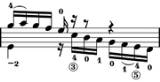
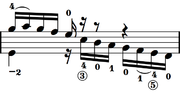 On string instruments fingers are numbered from 1 to 4, beginning with the index finger, the thumb not being counted because it does not play on a string, and 0 indicating an open string. In those cases on string instruments where the thumb is used (such as high notes on a cello, thumb position
), it is represented by a symbol the shape of a 0 with a vertical stem below (somewhat similar to Ǫ, for instance). Position
may be indicated through ordinal numbers
(e.g., 3rd). The string may be indicated through roman numerals, often I-IV. A change in positions is a shift
. Guitar music indicates position with roman numerals and string designations with circled numbers.
The classical guitar
also has a fingering notation system for the plucking hand, known as pima (or less commonly pimac), where p=pulgar (thumb), i=índice (index finger), m=medio (middle finger), a=anular (ring finger) and, very rarely, c=chico (little finger). It is usually only notated in scores where a passage is particularly difficult, or requires specific fingering for the plucking hand. Otherwise, plucking-hand fingering is generally left to the discretion of the guitarist.
of the bore is affected by the distribution and size of apertures along its length, leading to the formation of standing wave
s at the desired pitch. Several alternate fingerings may exist for any given pitch.
Simple flute
s (including recorder
s) as well as bagpipe chanter
s have open holes which are closed by the pads of the player's fingertips. Some such instruments use simple keywork to extend the player's reach for one or two notes. The keywork on instruments such as modern flutes
, clarinet
s, or oboe
s is elaborate and variable. Modern flutes typically use the Boehm system
of keywork, while clarinets typically use a similarly named system
invented by Hyacinthe Klosé
. Another system of clarinet keywork, the Öhler system, is used mostly in Germany and Austria.
introduced an innovation in fingering for the organ and the clavier
. (A similar, although according to Bach's son Carl Philipp Emanuel Bach
less radical, innovation was introduced by François Couperin
, at roughly the same time in 1716, in his book L'art de toucher le clavecin
.) Prior to Bach, playing rarely involved the thumb. Bach's new fingering retained many features of the conventional fingering up until that point, including the passing of one finger under or over another (Playing many of Bach's works requires such fingering, especially passing the third finger over the fourth or the fourth finger over the fifth.), but introduced the far greater use of the thumb. Modern fingering also uses the thumb to a similar extent, and involves the passing of the thumb under the other fingers, but does not, as Bach's did, generally involve the passing of any other fingers over or under one another.
In the 1980s Lindley
and Boxall showed that the above relies solely on C.P.E. Bach's testimony: all the extant fingerings from J.S.Bach and his circle use the ancient methods, with very limited use of the thumb. More recently it has been shown that all his harpsichord works and most of the organ works as well are playable with the old technique.
Music
Music is an art form whose medium is sound and silence. Its common elements are pitch , rhythm , dynamics, and the sonic qualities of timbre and texture...
, fingering is the choice of which finger
Finger
A finger is a limb of the human body and a type of digit, an organ of manipulation and sensation found in the hands of humans and other primates....
s and hand positions
Position (string technique)
On a string instrument, position is the relative location of the hand on the instrument's neck, indicated by ordinal numbers . Fingering, independent of position, is indicated by numbers, 1-4, and string is indicated by roman numerals, I-IV...
to use when playing certain musical instrument
Musical instrument
A musical instrument is a device created or adapted for the purpose of making musical sounds. In principle, any object that produces sound can serve as a musical instrument—it is through purpose that the object becomes a musical instrument. The history of musical instruments dates back to the...
s. Fingering typically changes throughout a piece; the challenge of choosing good fingering for a piece is to make the hand movements as comfortable as possible without changing hand position too often. A fingering can be the result of the working process of the composer
Composer
A composer is a person who creates music, either by musical notation or oral tradition, for interpretation and performance, or through direct manipulation of sonic material through electronic media...
, who puts it into the manuscript, an editor
Editor
The term editor may refer to:As a person who does editing:* Editor in chief, having final responsibility for a publication's operations and policies* Copy editing, making formatting changes and other improvements to text...
, who adds it into the printed score, or the performer, who puts his or her own fingering in the score or in performance. A substitute fingering is an alternative to the indicated fingering, not to be confused with finger substitution
Finger substitution
Finger substitution is a playing technique used on many different instruments, ranging from stringed instruments such as the violin and cello to keyboard instruments such as the piano and pipe organ. It involves replacing one finger which is depressing a string or key with another finger to...
.
Fingering also applies to other instruments, such as woodwind, brass
Brass instrument
A brass instrument is a musical instrument whose sound is produced by sympathetic vibration of air in a tubular resonator in sympathy with the vibration of the player's lips...
, and stringed instruments. Depending on the instrument, not all the fingers may be used. For example, saxophonists do not use the right thumb and string instruments (usually) only use the fingers.
Brass instruments
Fingering applies to the rotary and piston valves employed on many brass instruments.The trombone
Trombone
The trombone is a musical instrument in the brass family. Like all brass instruments, sound is produced when the player’s vibrating lips cause the air column inside the instrument to vibrate...
, a fully chromatic brass instrument without valves, employs equivalent numbered notation for slide positions rather than fingering.
Keyboard instruments
On keyboard instruments all fingers are used. So there are numbers from 1 (thumb) to five.The numbers are related to the fingers themselves, not to the hand position on the keyboard.
After Cristofori invented the pianoforte from the harpsichord
Harpsichord
A harpsichord is a musical instrument played by means of a keyboard. It produces sound by plucking a string when a key is pressed.In the narrow sense, "harpsichord" designates only the large wing-shaped instruments in which the strings are perpendicular to the keyboard...
in 1700, and after it became popular in the decades after 1740, eventually replacing the harpsichord, the piano technique developed tremendously (it was parallel with the piano builders´ progress and piano pedagogy, and as part of it piano fingering changed).
Keyboard instruments: Piano
There are only few publications about piano fingering.It is mentioned by Carl Philipp Emanuel Bach (son of Johann Sebastian Bach
Johann Sebastian Bach
Johann Sebastian Bach was a German composer, organist, harpsichordist, violist, and violinist whose sacred and secular works for choir, orchestra, and solo instruments drew together the strands of the Baroque period and brought it to its ultimate maturity...
) in his book Versuch über die wahre Art, das Clavier zu spielen (Essay on the True Art of Playing Keyboard Instruments, ISBN 0393097161.) he dedicated several paragraphs to this topic, see the German original: "Von der Fingersetzung".
The British pianist Tobias Matthay
Tobias Matthay
Tobias Augustus Matthay was an English pianist, teacher, and composer.-Biography:Matthaw as born in London in 1858 to parents who had come from northern Germany and were naturalised British subjects...
wrote a small book Principles of Fingering (ISBN 0900180420).
The German pianist Uli Molsen wrote a "Fingersatz-Kurs". The German pianist Wolfgang Ellenberger published an eBook about a systematical nomenclature of piano fingering including a "fingering edition" with different piano pieces "The Fingering System".
The basics of fingering are illustrated in pictures on the website "Piano Basics", RainbowPianoTechnique.com.
String instruments
Thumb position
In music performance and education, thumb position, not a traditional position, is a stringed instrument playing technique used to facilitate playing in the upper register of the double bass, cello, and related instruments, such as the electric upright bass...
), it is represented by a symbol the shape of a 0 with a vertical stem below (somewhat similar to Ǫ, for instance). Position
Position (string technique)
On a string instrument, position is the relative location of the hand on the instrument's neck, indicated by ordinal numbers . Fingering, independent of position, is indicated by numbers, 1-4, and string is indicated by roman numerals, I-IV...
may be indicated through ordinal numbers
Ordinal number (linguistics)
In linguistics, ordinal numbers are the words representing the rank of a number with respect to some order, in particular order or position . Its use may refer to size, importance, chronology, etc...
(e.g., 3rd). The string may be indicated through roman numerals, often I-IV. A change in positions is a shift
Shift (string technique)
On a string instrument, shifting, or a shift, is a movement of the fingers of the left hand from one position to another on the same string. Position is indicated through ordinal numbers . Strings may be indicated through roman numerals, I-IV, and fingering may be indicated through numbers, 1-4...
. Guitar music indicates position with roman numerals and string designations with circled numbers.
The classical guitar
Classical guitar
The classical guitar is a 6-stringed plucked string instrument from the family of instruments called chordophones...
also has a fingering notation system for the plucking hand, known as pima (or less commonly pimac), where p=pulgar (thumb), i=índice (index finger), m=medio (middle finger), a=anular (ring finger) and, very rarely, c=chico (little finger). It is usually only notated in scores where a passage is particularly difficult, or requires specific fingering for the plucking hand. Otherwise, plucking-hand fingering is generally left to the discretion of the guitarist.
Woodwind instruments
Fingering of woodwind instruments is not always simple or intuitive, depending on how the acoustic impedanceAcoustic impedance
The acoustic impedance at a particular frequency indicates how much sound pressure is generated by a given air vibration at that frequency. The acoustic impedance Z is frequency dependent and is very useful, for example, for describing the behaviour of musical wind instruments...
of the bore is affected by the distribution and size of apertures along its length, leading to the formation of standing wave
Standing wave
In physics, a standing wave – also known as a stationary wave – is a wave that remains in a constant position.This phenomenon can occur because the medium is moving in the opposite direction to the wave, or it can arise in a stationary medium as a result of interference between two waves traveling...
s at the desired pitch. Several alternate fingerings may exist for any given pitch.
Simple flute
Flute
The flute is a musical instrument of the woodwind family. Unlike woodwind instruments with reeds, a flute is an aerophone or reedless wind instrument that produces its sound from the flow of air across an opening...
s (including recorder
Recorder
The recorder is a woodwind musical instrument of the family known as fipple flutes or internal duct flutes—whistle-like instruments which include the tin whistle. The recorder is end-blown and the mouth of the instrument is constricted by a wooden plug, known as a block or fipple...
s) as well as bagpipe chanter
Chanter
The chanter is the part of the bagpipe upon which the player creates the melody. It consists of a number of finger-holes, and in its simpler forms looks similar to a recorder...
s have open holes which are closed by the pads of the player's fingertips. Some such instruments use simple keywork to extend the player's reach for one or two notes. The keywork on instruments such as modern flutes
Western concert flute
The Western concert flute is a transverse woodwind instrument made of metal or wood. It is the most common variant of the flute. A musician who plays the flute is called a flautist, flutist, or flute player....
, clarinet
Clarinet
The clarinet is a musical instrument of woodwind type. The name derives from adding the suffix -et to the Italian word clarino , as the first clarinets had a strident tone similar to that of a trumpet. The instrument has an approximately cylindrical bore, and uses a single reed...
s, or oboe
Oboe
The oboe is a double reed musical instrument of the woodwind family. In English, prior to 1770, the instrument was called "hautbois" , "hoboy", or "French hoboy". The spelling "oboe" was adopted into English ca...
s is elaborate and variable. Modern flutes typically use the Boehm system
Boehm System
The Boehm system is a system of keywork for the flute, created by inventor and flautist Theobald Boehm between 1831 and 1847.Prior to the development of the Boehm system, flutes were most commonly made of wood, with an inverse conical bore, eight keys, and tone holes that were small in size, and...
of keywork, while clarinets typically use a similarly named system
Boehm system (clarinet)
The Boehm system for the clarinet is a system of clarinet keywork, developed between 1839 and 1843 by Hyacinthe Klosé and Auguste Buffet jeune. The name is somewhat deceptive; the system was inspired by Theobald Boehm's system for the flute, but necessarily differs from it, since the clarinet...
invented by Hyacinthe Klosé
Hyacinthe Klosé
Hyacinthe Eléonore Klosé was a French clarinet player, professor at the Conservatoire de Paris, and composer....
. Another system of clarinet keywork, the Öhler system, is used mostly in Germany and Austria.
History
Johann Sebastian BachJohann Sebastian Bach
Johann Sebastian Bach was a German composer, organist, harpsichordist, violist, and violinist whose sacred and secular works for choir, orchestra, and solo instruments drew together the strands of the Baroque period and brought it to its ultimate maturity...
introduced an innovation in fingering for the organ and the clavier
Clavier
Clavier is a Walloon municipality located in the Belgian province of Liège. On January 1, 2006, Clavier had a total population of 4,172. The total area is 79.12 km² which gives a population density of approximately 53 inhabitants per km²....
. (A similar, although according to Bach's son Carl Philipp Emanuel Bach
Carl Philipp Emanuel Bach
right|250pxCarl Philipp Emanuel Bach was a German Classical period musician and composer, the fifth child and second son of Johann Sebastian Bach and Maria Barbara Bach...
less radical, innovation was introduced by François Couperin
François Couperin
François Couperin was a French Baroque composer, organist and harpsichordist. He was known as Couperin le Grand to distinguish him from other members of the musically talented Couperin family.-Life:Couperin was born in Paris...
, at roughly the same time in 1716, in his book L'art de toucher le clavecin
L'Art de toucher le Clavecin
L'art de toucher le clavecin is a didactic treatise by the French composer François Couperin...
.) Prior to Bach, playing rarely involved the thumb. Bach's new fingering retained many features of the conventional fingering up until that point, including the passing of one finger under or over another (Playing many of Bach's works requires such fingering, especially passing the third finger over the fourth or the fourth finger over the fifth.), but introduced the far greater use of the thumb. Modern fingering also uses the thumb to a similar extent, and involves the passing of the thumb under the other fingers, but does not, as Bach's did, generally involve the passing of any other fingers over or under one another.
In the 1980s Lindley
Mark Lindley
Mark Lindley is both a noted musicologist and, more recently, an historian of modern India. Born in Washington DC, he studied at Harvard University , Juilliard School of Music and Columbia University...
and Boxall showed that the above relies solely on C.P.E. Bach's testimony: all the extant fingerings from J.S.Bach and his circle use the ancient methods, with very limited use of the thumb. More recently it has been shown that all his harpsichord works and most of the organ works as well are playable with the old technique.