

Films considered the worst ever

Encyclopedia
The film
s listed here have achieved notably negative reception as being called the worst films ever made. The films have been cited by a combination of reputable sources as the worst movies of all time. Examples of such sources include Metacritic
, Roger Ebert
's list of most hated films, Leonard Maltin
's Movie Guide
, Rotten Tomatoes
, being featured on Mystery Science Theater 3000
, and the Golden Raspberry Award ("Razzies").
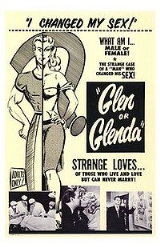
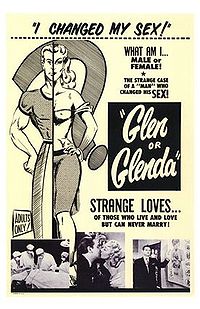 A semi-autobiographical
quasi-documentary
about transvestism
, starring and directed by Ed Wood. After a nightmarish dream sequence, Glen undergoes psychotherapy to help cure his affliction. Béla Lugosi
appears in this film, as he did in several other Wood films toward the end of his career. Many of Wood's fans and critic Leonard Maltin
insist that this was far worse than Plan 9 from Outer Space
; Maltin considers it "possibly the worst movie ever made". In his book Cult Movies 3, Danny Peary
suggests that this is actually a radical, if ineptly made film that presents a far more personal story than is contained in films by more well-respected auteur
s.
Robot Monster
A science fiction
film, originally shot and exhibited in 3D
, featuring an actor dressed in a gorilla suit and what looks almost like a diving helmet
. The film, produced and directed by Phil Tucker
, is listed in Michael Sauter's book The Worst Movies of All Time among "The Baddest of the B's." It is also featured in The Book of Lists
10 worst movie list, in The Fifty Worst Films of All Time
. The Golden Turkey Awards
confers its main character the title of "Most Ridiculous Monster in Screen History" and, listing its director Phil Tucker among the runners-up to "Worst Director of All Time" (the winner being Ed Wood), states that "What made Robot Monster ineffably worse than any other low-budget sci-fi epic was its bizarre artistic pretension". Noted film composer Elmer Bernstein
wrote the score for this film. It was featured on Mystery Science Theater 3000
, and was fondly remembered by author Stephen King
who quotes, and agrees with, a review in Castle of Frankenstein
magazine ("certainly among the finest terrible movies ever made", "one of the most laughable poverty row
quickies").
The Conqueror
A Howard Hughes
-funded box-office bomb featuring white actor John Wayne
as Mongolia
n chieftain Genghis Khan
and the redheaded Susan Hayward
as a Tartar
princess. The movie was filmed near St. George, Utah
, downwind from a nuclear testing
range in Nevada
, and is often blamed for the cancer
deaths of many of the cast and crew, including Hayward, Wayne, Agnes Moorehead
, Pedro Armendáriz
, and director Dick Powell
. The film made the 10-worst list in The Book of Lists, appears in Michael Sauter's book The Worst Movies of All Time, and was one of the films listed in Michael Medved's
book The Fifty Worst Films of All Time
. Hughes refused to distribute the film until 1974, when Paramount
reached a deal with him. This was the last film that Hughes produced.
Plan 9 from Outer Space
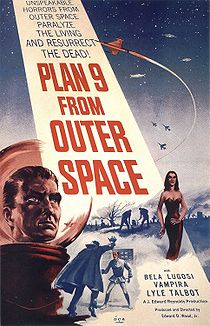 Ed Wood's Plan 9 was labeled the "Worst Film Ever" by The Golden Turkey Awards
. This movie marked the final appearance of Béla Lugosi
. Wood shot only a small amount of test footage featuring his idol Lugosi before the actor's death. This footage, repeated several times, was included in the final movie. Following Lugosi's death, the character was played by Tom Mason
, the chiropractor
of Wood's wife at the time, who played his scenes holding the character's cape in front of his face. Wood was apparently undeterred by the numerous physical differencessuch as height, build and that Mason was nearly bald while Lugosi retained a full head of hair until his deaththat distinguished Mason from Lugosi. Years later, video distributors such as Avenue One DVD began to make light of this, adding such blurbs as "Almost Starring Bela Lugosi" to the cover art. Shot in 1956, the film was not released until 1959 due to difficulty in finding a distributor. It has played at the New Orleans Worst Film Festival. In 1994, Tim Burton
directed Ed Wood
, which includes some material about the trials and tribulations of making Plan 9. On the popular film review site Rotten Tomatoes
Phil Hall calls it "Far too entertaining to be considered as the very worst film ever made". Likewise John Wirt goes as far as to call it "The ultimate cult flick", and Videohound's Complete Guide to Cult Flicks and Trash Pics states that, "In fact, the film has become so famous for its own badness that it's now beyond criticism."
The Beast of Yucca Flats
A film by Coleman Francis
shot silently with added narration. The plot concerns a scientist (played by Tor Johnson
) who is exposed to radiation from an atomic blast, which turns him into a monster. The film opens with a scene of implied necrophilia
that has nothing to do with the remainder of the movie and does not fit anywhere into the film's chronology. Leonard Maltin
's TV and Movie Guide calls it "one of the worst films ever made". Bill Warren
said "It may very well be the worst non-porno science fiction
movie ever made." It was featured on Mystery Science Theater 3000
, where members of the cast state it is by far one of the worst films they have seen up to that point.
Eegah
A low-budget shocker, featuring Richard Kiel
as a prehistoric caveman emerging in early 1960s California and finding love with another teenager. Arch Hall, Jr. performs musical numbers, with lyrics widely considered to be terrible. The film's notoriety was enhanced as a result of being featured on episodes of Canned Film Festival
and Mystery Science Theater 3000
, where the cast of the show stated in The Mystery Science Theater 3000 Amazing Colossal Episode Guide (ISBN 0-553-37783-3), that they consider the shaving scene (where Eegah lolls his tongue around and laps up shaving cream) to be one of the most disgusting things they have seen. It was also one of the films listed in Michael Medved
's book The Fifty Worst Films of All Time
.
The Creeping Terror
Directed by Arthur J. Nelson (who also stars in the film under the pseudonym Vic Savage), the film is memorable for its use of some bargain-basement effects: stock footage of a rocket launch played in reverse to depict the landing of an alien spacecraft, and the "monster" appears to be composed of a length of shag carpet draped over several actors, whose sneakers are occasionally visible. Due to having had most of its dialogue lost, the movie also employs a technique that has come to be synonymous with Z-movie horror: voiceover
narration.
Santa Claus Conquers the Martians
This holiday staple was the creation of Nicholas Webster
. When Martian
children get to see Santa Claus
only on TV, their parents decide to abduct Santa to make them happy. Like many others in this category, it has been featured in Mystery Science Theater 3000. The film is cited on a 10-worst list in The Book of Lists
, in The Fifty Worst Films of All Time
. It is also known for starring a very young Pia Zadora
. Cinematic Titanic
released a production of the movie in November 2008.
Monster A Go-Go
Monster A Go-Go began as Terror at Halfday by Bill Rebane
. The production ran out of money and the film was abandoned. Herschell Gordon Lewis
, who reportedly needed a second feature to compose a double bill, purchased and completed the film for a minimal amount of money. Several of the film's actors were unable to return, so Lewis simply replaced their parts with new characters who mysteriously appear and fill the roles of the missing characters. One of the actors Lewis managed to rehire had gained weight, gone bald, and grown a goatee, so Lewis recast him as the brother of the original character. The picture consists mostly of lengthy dialogue sequences concerning the apparent mutation of an astronaut into a monster. Much of the film's dialogue is unintelligible due to poor audio quality, and due to overexposure of the film, several characters' faces appear to be bright white, glowing circles. At one point, when a phone supposedly rings, a person can easily be heard making the noise with his mouth. During the climax of the movie, as soldiers prepare to confront the mutated astronaut, he abruptly vanishes and the narrator informs the audience that "there was no monster," and that the astronaut has, in fact, been in the Atlantic Ocean the entire time. All Movie Guide calls the film a "surreal anti-masterpiece". It was also featured on Mystery Science Theater 3000, where writer Paul Chaplin
called the dialogue "beyond recognition", and also added "I recall this episode as being the first time we decided explicitly to write sketches having nothing to do with the movie. Really, we had no choice. We ran through a long string of topics trying to find one that had something to do with the movie, but since the movie is about nothing, any topic that is about something (that is, any topic that exhibits "topicness") cannot, by definition, have anything to do with this movie. Understand? Interesting philosophical dilemma. I think we solved it nicely.", The entire cast of the show later stated it was officially the worst movie they have ever seen.
Manos: The Hands of Fate
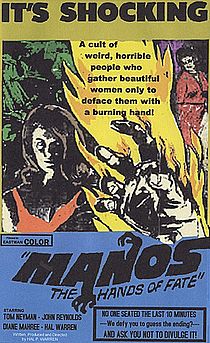 A low-budget horror film made by El Paso
insurance salesman Hal P. Warren, about a vacationing family that is kidnapped by a polygamous cult of Pagans. Among its most notorious flaws, besides poor production qualities, is the opening sequence, a several minute long series of long tracking shots of the countryside with almost no dialogue; it was intended to be the opening credits sequence, but no credits were ever developed to be superimposed over the footage. The film also dedicates significant time to a young couple who are spotted at various locations making out in their car, and who have no bearing on the plot other than to point the police in the direction of the cult compound during the film's climax. The film's main monster, Torgo (John Reynolds), was intended to be a satyr
, but this is never stated onscreen and only conveyed with the use of bizarre prosthetic devices which the actor wore backwards under his trousers, making his knees bulge and forcing him to walk awkwardly. In another infamous scene that grew out of cast and crew availability restraints which caused Warren to shoot night-for-night scenes, two police officers hear gunshots and pull up near the cult's dwelling. But owing to insufficient lighting to do a pan shot, the officers walk only a few feet from their car before appearing to "give up" their investigation. The film gained notoriety and cult popularity by being featured on Mystery Science Theater 3000. As of March 2011, it has a 0% rating at Rotten Tomatoes
, based on 11 reviews.
Myra Breckinridge
This 1970 film based on the book of the same name
by Gore Vidal
, directed by Michael Sarne and starring Raquel Welch
, Mae West
, John Huston
and Farrah Fawcett
provoked controversy due to a scene in which Welch forcibly
pegs
a bound man while clips from various classic films play onscreen. The film was initially rated X
before edits and an appeal to the MPAA brought it down to an R. The film also used the technique of inserting clips from Golden Age
movies in such a way that the dialogue took on sexual undertones. Several stars whose films were featured objected to the gimmick, and some (such as Loretta Young
) sued to remove the footage. The film was a critical failure, with Time magazine
saying "Myra Breckinridge is about as funny as a child molester." The film is also cited in the book The Fifty Worst Films of All Time
. Gore Vidal has disowned the film, calling it "an awful joke", and blamed the movie for a decade-long drought in the sale of the original book.
At Long Last Love
At Long Last Love
was renowned director Peter Bogdanovich
's musical homage to great 1930s Hollywood musicals. It features 16 songs by Cole Porter
and stars Cybill Shepherd
and Burt Reynolds
. Upon release, it received a slew of very negative reviews. Esquire
film critic John Simon
said, "it may be the worst movie musical of this--or any-- decade." The Buffalo News
film critic Jeff Simon wrote, "About 45 minutes in, it became apparent to one and all that this was one of the worst and most embarrassing major-talent turkeys of all time." It was included in the books The Fifty Worst Films of All Time
and Michael Sauter's book The Worst Films of All Time. The Encyclopedia of American Cinema for Smartphones and Mobile Devices noted it was "panned by critics as one of the worst films ever made." It is also included in The golden turkey awards:nominees and winners, the worst achievements in Hollywood history
. Film critic Jay Cocks
said it's "regarded as the great white elephant
catastrophe of its time." Bogdanovich, who was also the screenwriter, sent press releases to newspapers across the country apologizing for this film.
Heaven's Gate
This Western
epic, based on the Johnson County War
in 1890s Wyoming
, was plagued by massive cost and time overruns, largely due to director Michael Cimino
's extreme attention to detail. He demanded 50 takes of at least one scene, and refused to start shooting for another until a cloud he liked rolled across the sky. It cost over $44 million, but only brought in $3.5 million at the box office. The original version ran at nearly four hours, but was yanked from release after only one week due to scathing reviews. It later resurfaced in a 149-minute version, but by then the damage was done. Vincent Canby
famously called it "an unqualified disaster," among other things. Roger Ebert
called it "the most scandalous cinematic waste I've ever seen." Cimino won the 1980 Golden Raspberry Award for Worst Director, and the film was nominated for four more Razzies, including Worst Picture. In February 2010, the readers of Empire
voted it the 6th worst film of all time. That same year, Joe Queenan
of The Guardian
also called it the worst film ever made, saying that much of it was "beyond belief." Cimino was initially thought to be a director on the rise after directing The Deer Hunter
(which won five Oscars, including Best Picture and Best Director), but his reputation never recovered after Heaven's Gate. The film also effectively ended the existence of United Artists
, as an independent Hollywood studio; its parent firm sold the company to MGM, where it still operates.
Mommie Dearest
Mommie Dearest was based on the memoir of the same name
by Christina Crawford
about her upbringing by Joan Crawford
. It was the first film to sweep the Golden Raspberry Awards. It won five Razzies including "Worst Picture" and Worst Actress (Faye Dunaway
, shared with Bo Derek
). The same organization also named it "Worst Picture of the Decade." The film is part of the "100 most awful" in the book The Official Razzie Movie Guide: Enjoying the Best of Hollywood's Worst. Entertainment writer Michael Sauter included the film in his book The Worst Movies of All Time. The film earned, as film critic and television host Richard Crouse
put it, "some of the nastiest reviews ever." Writing for the Chicago Sun Times, film critic Roger Ebert
wrote of this film, "I can't imagine who would want to subject themselves to this movie. "Mommie Dearest" is a painful experience that drones on endlessly, as Joan Crawford
's relationship with her daughter, Christina, disintegrates from cruelty through jealousy into pathos." Of the performance of Faye Dunaway
, Variety
said "Dunaway does not chew scenery. Dunaway starts neatly at each corner of the set in every scene and swallows it whole, costars and all."
Inchon
This war movie, directed by Terence Young and starring Laurence Olivier
as General Douglas MacArthur
, was meant to be a depiction of the Battle of Inchon
during the Korean War
. Producer Mitsuharu Ishii was a senior member of the Japanese branch of the Unification Church
, whose leader, Sun Myung Moon
, claimed he had the film made to show MacArthur's spirituality and connection to God and the Japanese people. The film's eventual production cost of $46 million resulted in a $5 million box office gross, and the New York Times review written by Vincent Canby
calls the movie "the most expensive B-movie ever." Every conceivable kind of problem plagued production, including labor issues, the U.S. military withdrawing support due to the film's Unification Church connection, weather and natural disasters, customs difficulties, expensive directorial blunders, and the original director (Andrew McLaglen
) quitting before the start of production. Olivier's performance was roundly panned and he was awarded the 1982 Golden Raspberry award for Worst Actor. The film itself took the 1982 Razzies for Worst Picture and Worst Screenplay, and Young's direction earned him a tie for Worst Director of 1982. Inchon was later profiled in multiple books on worst in film, including The Hollywood Hall of Shame
by Harry and Michael Medved
, and The Worst Movies of All Time by Michael Sauter. To date, Inchon has never been released on home video in the United States.
Howard the Duck
This film is loosely based on the Marvel Comics character
, which was created by Steve Gerber
and artist Val Mayerik
, and stars Lea Thompson
, Tim Robbins
, and Jeffrey Jones
. The film retains only two central characters: the eponymous duck and Beverly Switzler, and makes no effort to have them look or behave similarly to their counterparts from the comics. In his Movie Guide, Leonard Maltin
calls the film a "hopeless mess of a movie". The film was also among Siskel and Ebert's
picks for the "Worst Films of 1986". The film was adapted by Willard Huyck
and his wife Gloria Katz
and directed by Huyck, with no input from Gerber, who "was hoping against hope that the [movie's] script and the movie itself weren't as bad as [he] thought they were or, at least, that they wouldn't be received as badly as [he] thought they would [be]," citing that many films he hated were at least successful. Huyck and Katz were once considered "luminaries". The film was considered so bad, that it was soon dubbed "Howard the Turkey. The film won four Razzies: Worst Picture, New Star, Visual Effects, and Screenplay. Over the years, however, the film has gained its own dedicated cult following. Ed Gale, who was credited as playing Howard in the duck suit, said in the DVD extras documentary Releasing the Duck that he receives more fan mail
as Howard the Duck than he does as Chucky, the main antagonist
in the commercially successful Child's Play
horror film series.
The Garbage Pail Kids Movie
The film is a live-action adaptation of the then-popular, yet controversial trading card series of the same name
, itself a gross-out parody of the Cabbage Patch Kids
dolls. The title characters are depicted by dwarf actors in low budget costumes, with poorly functioning mouths and expressionless faces. The film is often criticized for its gross-out humor, nonsensical plot, poor explanations, bad acting, and the creepy appearance of the Garbage Pail Kids. It has a 0% rating on Rotten Tomatoes
and Caryn James of the New York Times said the movie is "too repulsive for children or adults of any age" and is "enough to make you believe in strict and faraway boarding schools." Carlos Coto of the Sun-Sentinel
said that "The Garbage Pail Kids Movie is one of the worst ever made". Much of its content is said to be inappropriate for children, its intended audience. Throughout the movie, the Garbage Pail Kids steal, get in fights, bite toes off people, fart in people's faces, threaten others with switch blades, and run over cars. Some have pointed out that the movie contradicts its own message, that people should be judged by their behavior, not their appearance. In addition to scatological behavior, the movie has several scenes that feature sexual images, violence, and drinking. Offended parents launched a nation-wide protest of the movie that successfully resulted in the movie being withdrawn from circulation. The shortened release contributed to the movie's poor gross of only $1,576,615. It was nominated for three Golden Raspberry Awards at the 8th Golden Raspberry Awards: Worst Visual Effects, Worst New Star for the Garbage Pail Kids collectively, and Worst Song.
Hobgoblins
This film by Rick Sloane
, widely considered to be a blatant rip-off
capitalizing on the popularity of the 1984 film Gremlins
. MST3K writer Paul Chaplin
later commented on Hobgoblins, saying, “It shoots right to the top of the list of the worst movies we’ve ever done." Greg Muskewitz at Efilmcritic.com called it "Jim Henson
's worst nightmare." Hobgoblins is also one of the few films considered the worst of all time to have spawned a sequel—Hobgoblins 2
, made twenty years after the original.
Mac and Me
The film is about a young boy in a wheelchair who meets and befriends an alien who has crash landed on earth. The decision to make the film was based on the success of E.T. the Extra-Terrestrial
(the title itself, Mac and Me, comes from the working title for E.T.—E.T. and Me.), as well as to serve as a marketing vehicle for Coca-Cola
and McDonald's
. One scene in the film is a large, impromptu dance-off with the main character MAC the alien (dressed in a teddy bear costume), a football team, Ronald McDonald
, and various other people inside and outside of a McDonald's restaurant. The film's cast list states "and Ronald McDonald as Himself." Mac and Me has a rating of 0% on Rotten Tomatoes, and Leonard Maltin
referred to it as "more like a TV commercial than a movie". Scott Weinberg of eFilmcritic.com called it "Quite possibly one of the worst movies of the past 435 years" and Marjorie Baumgarten of the Austin Chronicle
called it a "shameless E.T. knockoff". The film was nominated for four Razzie Awards including Worst Picture and Worst Screenplay and won two trophies, Worst Director for Stewart Raffill
(tied with Blake Edwards
for Sunset
) and Worst New Star for Ronald McDonald in a small cameo.
Troll 2
Notable in part for not featuring any trolls (the antagonists are goblins from the town of Nilbog – which is goblin
spelled backwards), the film also has no relation to the original Troll, which was also critically panned. (It was released overseas as Goblins, but in the US as Troll 2 in an attempt to capitalize on Trolls "popularity".) Not only one of the "least scary horror movies ever", according to Yahoo! Movies
, but "by pretty much any measure... one of the worst films ever made". Director Claudio Fragasso
(who used the pseudonym Drake Floyd for his work on the film) has maintained for twenty years that the film is a "masterpiece." Despite the script being written in awkward language (Fragasso and his wife Rosella Drudi, native Italians, spoke virtually no English when they wrote the script), Fragasso insisted the American actors deliver the lines as written. The goblins in the movie are dwarfs
wearing burlap sacks and latex masks. Campy
acting, confusing plot twists, and unintentional homosexual innuendos have contributed to give the movie a cult status comparable to The Rocky Horror Picture Show
. Nearly twenty years after its release, the movie's child star, Michael Stephenson, made a documentary about the film titled Best Worst Movie
, released to critical success in 2009.
Highlander II: The Quickening
A sequel to the cult film Highlander
, which transitions the fantasy
franchise into science fiction
and retcons the mystical warriors of the first film into space aliens. It was met with harsh criticism by both critics and audiences. Based on 23 reviews collected by Rotten Tomatoes, the film currently holds a 0%, "Rotten" rating; all 23 reviews being negative. Common criticisms included the lack of motivation for the characters, the new and seemingly incongruent origin for the Immortals, the resurrection of Ramirez, and apparent contradictions in the film's internal logic. Roger Ebert
of the Chicago Sun-Times
gave the film a score of 0.5 star (out of four), saying: "Highlander II: The Quickening is the most hilariously incomprehensible movie I've seen in many a long day—a movie almost awesome in its badness. Wherever science fiction fans gather, in decades and generations to come, this film will be remembered in hushed tones as one of the immortal low points of the genre." He continued saying "If there is a planet somewhere whose civilization is based on the worst movies of all time, "Highlander 2: The Quickening" deserves a sacred place among their most treasured artifacts." Giving the film a score of 2 out of 10, IGN
's review of the film said: "How bad is this movie? Well, imagine if Ed Wood were alive today, and someone gave him a multi-million dollar budget. See his imagination running rampant, bringing in aliens from outer space with immensely powerful firearms, immortals who bring each other back to life by calling out their names, epic duels on flying skateboards, and a blatant disregard for anything logical or previously established—now you are starting to get closer to the vision of Highlander II. Awarding the film one star out of five, Christopher Null
of FilmCritic.com said, "Highlander has become a bit of a joke, and here's where the joke started. ... Incomprehensible doesn't even begin to explain it. This movie is the equivalent of the 'Hey, look over there!' gag. You look, and the guy you wanted to beat up has run away and hid."
In 1995, the film's director Russell Mulcahy
made a director's cut
version known as Highlander II: The Renegade Version and then later released another version simply known as Highlander II: The Special Edition for its 2004 DVD release. The film was reconstructed on both occasions largely from existing material, with certain scenes removed and others added back in, and the entire sequence of events changed.
North
This Rob Reiner
film is a film adaption of the novel North: The Tale of a 9-Year-Old Boy Who Becomes a Free Agent and Travels the World in Search of the Perfect Parents by Alan Zweibel
, who also wrote the screenplay and has a minor role in the film. North, which is also Scarlett Johansson
's debut film, was a critical and commercial failure, earning only $7,138,449 worldwide. The film was widely criticized for its plot, its all-star cast of insensitive characters, lack of humor, and portrayal of numerous ethnic stereotypes. Based on 19 reviews, the film has an 11% approval rating at Rotten Tomatoes
as of March 2011. Roger Ebert gave the film zero stars and, in his review, famously wrote "I hated this movie. Hated hated hated hated hated this movie. Hated it. Hated every simpering stupid vacant audience-insulting moment of it. Hated the sensibility that thought anyone would like it. Hated the implied insult to the audience by its belief that anyone would be entertained by it." He continued saying "North is a bad film – one of the worst movies ever made," and is also on his list of most hated films. Both Roger Ebert and Gene Siskel
named North as the worst film of 1994. Mick LaSalle of the San Francisco Chronicle said in his review that "North is director Rob Reiner's first flat-out failure, a sincerely wrought, energetically made picture that all the same crashes on takeoff. It's strange and oddly distasteful, at its best managing to be bad in some original and unexpected ways." Richard Roeper
named North as one of the 40 worst movies he has ever seen, saying that, "Of all the films on this list, North may be the most difficult to watch from start to finish." The film was nominated for the for the following awards at the 15th Golden Raspberry Awards: Worst Picture, Worst Actor (Bruce Willis
, also for Color of Night
), Worst Supporting Actress (Kathy Bates
), Worst Supporting Actor (Dan Aykroyd
, also for Exit to Eden
), Worst Director, and Worst Screenplay (Andrew Scheinman
and Alan Zweibel
).
Showgirls
A large amount of hype was put behind promoting the sex and nudity in this NC-17 film with a $45 million budget, but the final result was critically derided. Most of the hype revolved around the film's star, Elizabeth Berkley
, who only two years before had been one of the stars of the teenage sitcom
Saved by the Bell
(in which she played a young straw
feminist
). The film won seven of the thirteen Razzie Awards for which it was nominated. The film also appeared on Metacritic's list of the all-time lowest-scoring films. The film, however, has garnered a cult following over the years, as evidenced by it grossing over $100 million in the video market. The edited R-rated version, which director Paul Verhoeven developed for video outlets that wouldn't carry NC-17 films, deletes about three minutes of the more graphic sex scenes. TBS has broadcasted the film on television in its prime time schedule, but this version adds digitally animated solid black underwear to hide breasts and genitalia. This version has also been broadcast by VH1
as part of its Movies That Rock series.
An Alan Smithee Film: Burn Hollywood Burn
Sort of a self-parody, this movie portrays the making of a movie considered extremely horrendous by its director (Eric Idle
). Since his name is Alan Smithee
, taking his name off the credits is a logical impossibility, and he destroys all copies of the movie. Also starring Jackie Chan
, Oscar winner Whoopi Goldberg
, and Oscar-nominated actors Ryan O'Neal
and Sylvester Stallone
, this film was widely panned by critics upon its release. It won five Razzies, including Worst Picture. With an estimated budget of $10 million, Burn Hollywood Burn only grossed approximately $52,850, making it a tremendous box office flop. Roger Ebert
gave the film a zero out of four stars, calling it a "spectacularly bad film—incompetent, unfunny, ill-conceived, badly executed, lamely written, and acted by people who look trapped in the headlights." It is also on his "most hated" list. In the documentary Directed by Alan Smithee, director Arthur Hiller
stated he had his credit replaced with the pseudonym Alan Smithee because he was so appalled with the botched final cut by the film's producers. It was written by Joe Eszterhas
and at one point in the movie a character comments that the film-within-the-film was "worse than Showgirls
", which was also written by Eszterhas.
Battlefield Earth
Based on the first half of L. Ron Hubbard
's novel of the same name and starring John Travolta
, Forest Whitaker
, and Barry Pepper
. It was criticized for its poor script, hammy acting by Travolta, overuse of Dutch angle
s, laughable dialogue, and several plot inconsistencies. The movie's distributor, Franchise Pictures
, was later forced out of business after it emerged that it had overstated the film's budget by $31 million. The film has a 2% rating at Rotten Tomatoes, and was included in their Top 100 worst reviewed movies of the last 10 years. Roger Ebert
predicted that the film "for decades to come will be the punch line of jokes about bad movies." It is also on his "most hated" list. It won seven Golden Raspberry Awards, including Worst Picture and Worst Screen Couple (John Travolta and "anyone on the screen with him"). In 2005, an eighth Razzie (for Worst "Drama" of Our First 25 Years) was awarded to the film, and in 2010 the film won a ninth Razzie at the 30th Golden Raspberry Awards
for "Worst Picture of the Decade", the most of any film in the history of the awards. The movie appeared on Metacritic's list of the all-time lowest-scoring films, is on the MRQE's 50 Worst Movies list.
Freddy Got Fingered
A comedy film starring Tom Green
, who also wrote and directed it, featuring largely gross-out and shock humor (including multiple instances of bestiality) similar to that featured in The Tom Green Show
. In the film, Green stars as a 28-year-old slacker and cartoonist who falsely accuses his father of child molestation when he questions his son's life goals. Freddy Got Fingered received overwhelmingly negative reviews, with CNN
critic Paul Clinton declaring it "quite simply the worst movie ever released by a major studio in Hollywood history". A review in The Washington Post
said: "If ever a movie testified to the utter creative bankruptcy of the Hollywood film industry, it is the abomination known as Freddy Got Fingered." Film reviewer Roger Ebert
included the film on his "most hated" list, gave it zero out of four stars, and wrote: "This movie doesn't scrape the bottom of the barrel. This movie isn't the bottom of the barrel. ... This movie doesn't deserve to be mentioned in the same sentence with barrels." Freddy Got Fingered was nominated for eight awards at the 2001 Razzies, and won for Worst Picture, Worst Actor, Worst Director, Worst Screenplay, and Worst On-Screen Couple. Razzies founder John J. B. Wilson called the film "offensive, stupid and obnoxious" and said it had "no redeeming value". Tom Green accepted his awards in person, traveling to the ceremony in a white Cadillac
, wearing a tuxedo and rolling out his own red carpet
to the presentation. In 2010, the film was nominated at the 30th Golden Raspberry Awards
for "Worst Picture of the Decade", although it lost to Battlefield Earth. Freddy Got Fingered also appeared on Metacritic's list of the all-time lowest-scoring films.
The Room
This independently produced film about an amiable banker whose friends betray him one by one has been called "the Citizen Kane
of bad movies" by some critics. Although the film's star, writer, producer and director Tommy Wiseau
has claimed it to be a black comedy
(and that, as a result, the film's numerous flaws are intentional), other actors involved in the production have denied this, stating that Wiseau intended it to be a melodrama
tic romance. Its bizarre lines, protracted sex scenes, nonsensical exterior shots (one scene features three establishing shots during its duration), and infamous use of green-screen
for "outdoor" rooftop scenes, were considered so laughable that it has gained a cult status, and regularly sells out midnight viewings at theaters in the United States, Canada, the United Kingdom and Australia. It made its broadcast premiere as an April Fools' Day
special in 2009 on Cartoon Network
's Adult Swim
block, edited down from its original R rating to a TV-14/DSLV rating. The day after its appearance, its DVD became the top-selling independent film
on Amazon.com
. It has garnered a cult following similar to The Rocky Horror Picture Show
, and in June 2010, The Room started playing at the American Film Institute
. Mystery Science Theater 3000
alumni Michael J. Nelson
, Kevin Murphy
, and Bill Corbett
produced an audio commentary track to accompany the movie through their site RiffTrax
.com.
From Justin to Kelly
A Robert Iscove
musical starring Kelly Clarkson
and Justin Guarini
, respectively the winner and runner-up of the first season of American Idol
. Clarkson and Guarini star as a Texan waitress and a Pennsylvania college student who meet and fall in love during spring break in Miami, while their friends experience their own romantic mishaps and successes. The movie currently has an 8% rating out of 59 reviews on Rotten Tomatoes, and is considered a box-office bomb, grossing only $5 million with a budget of $12 million. The low quality of the movie's choreography prompted the creation of a Golden Raspberry "Governor's Award," though it was also nominated for seven other Razzies, including Worst Picture, Worst Actor (Guarini), Worst Actress (Clarkson) and Worst Screenplay (Kim Fuller
). Among the extremely critical comments from reviewers, Owen Gleiberman
of Entertainment Weekly
wrote, "How bad is From Justin to Kelly? Set in Miami during spring break, it's like Grease: The Next Generation acted out by the food-court staff at SeaWorld." Clarkson herself has disavowed the film, saying "Two words: Contractually obligated!" in response to questions about why she agreed to participate.
Gigli
A Martin Brest
movie featuring Jennifer Lopez
and Ben Affleck
, with appearances by Al Pacino
and Christopher Walken
. Gigli was originally a black comedy
with no romantic subplot. The producers demanded script rewrites throughout filming, hoping to cash in on the Lopez-Affleck romance that was big news in celebrity-watching publications of the time such as Us
and People
. This film cost $54 million to make but grossed only $6 million, making it one of the biggest box office bombs of all time. It was also the winner of seven Razzies (including 2005's Worst "Comedy" of Our First 25 Years), and in 2010 the film was nominated at the 30th Golden Raspberry Awards
for "Worst Picture of the Decade". The film is in Rotten Tomatoes' Top 100 worst reviewed movies of the last 10 years, where it has a 6% rating.
Catwoman
Nominally based on the DC Comics character
and starring Halle Berry
, the titular Catwoman bears little resemblance to the Batman
antagonist: The cinematic Catwoman has superpowers
, unlike in the comics, and leaps from rooftop to rooftop in stiletto heels. The character's signature lycra
catsuit
was replaced with slashed leather trousers and matching bra
, and a mask that also acts as a hat. As the movie character differs so widely from her comic book source, the character, as portrayed in this film, has been cited as "Catwoman In Name Only". The film was the result of various rewrites by a total of 28 different screenwriters, though only four were credited after arbitration with the WGA. It has a 10% rating at Rotten Tomatoes, and was declared "arguably the worst superhero film ever made" by the Orlando Sentinel
. Jean Lowerison of the San Diego Metropolitan said in her review that Catwoman "Goes on my 'worst' list for the year, and quite possibly for all time." The Village Voice
summed up reviews of the film under the title "Me-Ouch." The movie was the winner of four Razzies for Worst Picture, Worst Actress, Worst Director (Pitof
), and Worst Screenplay. Berry arrived at the ceremony to accept her Razzie in person (with her Best Actress Oscar for Monster's Ball
in hand), saying: "First of all, I want to thank Warner Brothers. Thank you for putting me in a piece of shit, god-awful movie . . . It was just what my career needed." It is on Roger Ebert's "most hated" list.
Alone in the Dark
Loosely based on a series of video games
by Infogrames
and directed by Uwe Boll
, this film was panned by critics from Entertainment Weekly
, Variety
, The Village Voice
and various Internet movie sites for a multitude of reasons, including poor script and production values, overuse of slow-motion and quick cuts to optimize the gory content, almost no connection to the game, and bad acting. One review said the movie was "so poorly built, so horribly acted and so sloppily stitched together that it's not even at the straight-to-DVD level." The movie has received a 1% rating at Rotten Tomatoes, and was included in their Top 100 worst reviewed movies of the last 10 years. Critic Rob Vaux states that this movie is so bad that "the other practitioners of cinematic drivel can rest a little easier now; they can walk in the daylight with their heads held high, a smile on their lips and a song in their hearts. It's okay, they'll tell themselves. I didn't make Alone in the Dark." Screenwriter Blair Erickson wrote about his experience dealing with Boll and his original script, which was closer to the actual game itself, and Boll's script change demands on the comedy website Something Awful
. It appeared on Metacritic's list of the all-time lowest-scoring films, and is on the MRQE's 50 Worst Movies list. It also received two 2005 Golden Raspberry Awards
nominations for Worst Director (Uwe Boll) and Worst Actress (Tara Reid
), and won three 2005 Stinkers Awards, for Worst Picture, Worst Director, and Worst Special Effects. In 2009, Peter Hartlaub, the San Francisco Chronicle
's pop culture critic, named it the worst film of the decade.
Birdemic: Shock and Terror
An independently produced film that is an apparent homage to Alfred Hitchcock
's The Birds
, Birdemic tells the story of a romance between the two leading characters, played by Alan Bagh
and Whitney Moore, as their small town is attacked by birds. Written, directed, and produced by James Nguyen, the film was intended to be a "romantic thriller" but gained a cult following due to its poor quality, with reviewers calling out its wooden acting, bad dialogue, amateurish sound and editing, nonsensical plot and, in particular, its special effects, consisting primarily of poorly rendered CGI eagles and vultures that perform physically awkward aerial maneuvers and explode upon impact with the ground. The film, which cost $10,000 to make, was called by the Huffington Post "truly, one of the worst films ever made" and by The Village Voice
as "one more in the pantheon of beloved trash-terpieces". Slate
deemed it among the worst movies ever made, while Salon referred to it as "a cult hit among bad-movie fans" and Variety
stated that the film displayed "all the revered hallmarks of hilariously bad filmmaking." Following the home media release of Birdemic, Michael J. Nelson
, Kevin Murphy
, and Bill Corbett
of Mystery Science Theater 3000
fame produced an audio commentary track to accompany the movie through Rifftrax
.
Film
A film, also called a movie or motion picture, is a series of still or moving images. It is produced by recording photographic images with cameras, or by creating images using animation techniques or visual effects...
s listed here have achieved notably negative reception as being called the worst films ever made. The films have been cited by a combination of reputable sources as the worst movies of all time. Examples of such sources include Metacritic
Metacritic
Metacritic.com is a website that collates reviews of music albums, games, movies, TV shows and DVDs. For each product, a numerical score from each review is obtained and the total is averaged. An excerpt of each review is provided along with a hyperlink to the source. Three colour codes of Green,...
, Roger Ebert
Roger Ebert
Roger Joseph Ebert is an American film critic and screenwriter. He is the first film critic to win a Pulitzer Prize for Criticism.Ebert is known for his film review column and for the television programs Sneak Previews, At the Movies with Gene Siskel and Roger Ebert, and Siskel and Ebert and The...
's list of most hated films, Leonard Maltin
Leonard Maltin
Leonard Maltin is an American film and animated film critic and historian, author of several mainstream books on cinema, focusing on nostalgic, celebratory narratives.-Personal life:...
's Movie Guide
Leonard Maltin's Movie Guide
Leonard Maltin's Movie Guide is a book-format collection of movie capsule reviews that began in 1969 and has been updated yearly since 1978. It was originally called TV Movies, which became Leonard Maltin's TV Movies and Video Guide, which then became Leonard Maltin's Movie and Video Guide...
, Rotten Tomatoes
Rotten Tomatoes
Rotten Tomatoes is a website devoted to reviews, information, and news of films—widely known as a film review aggregator. Its name derives from the cliché of audiences throwing tomatoes and other vegetables at a poor stage performance...
, being featured on Mystery Science Theater 3000
Mystery Science Theater 3000
Mystery Science Theater 3000 is an American cult television comedy series created by Joel Hodgson and produced by Best Brains, Inc., that ran from 1988 to 1999....
, and the Golden Raspberry Award ("Razzies").
Glen or Glenda (1953)
Autobiography
An autobiography is a book about the life of a person, written by that person.-Origin of the term:...
quasi-documentary
Documentary film
Documentary films constitute a broad category of nonfictional motion pictures intended to document some aspect of reality, primarily for the purposes of instruction or maintaining a historical record...
about transvestism
Transvestism
Transvestism is the practice of cross-dressing, which is wearing clothing traditionally associated with the opposite sex. Transvestite refers to a person who cross-dresses; however, the word often has additional connotations. -History:Although the word transvestism was coined as late as the 1910s,...
, starring and directed by Ed Wood. After a nightmarish dream sequence, Glen undergoes psychotherapy to help cure his affliction. Béla Lugosi
Béla Lugosi
Béla Ferenc Dezső Blaskó , commonly known as Bela Lugosi, was a Hungarian actor of stage and screen. He was best known for having played Count Dracula in the Broadway play and subsequent film version, as well as having starred in several of Ed Wood's low budget films in the last years of his...
appears in this film, as he did in several other Wood films toward the end of his career. Many of Wood's fans and critic Leonard Maltin
Leonard Maltin
Leonard Maltin is an American film and animated film critic and historian, author of several mainstream books on cinema, focusing on nostalgic, celebratory narratives.-Personal life:...
insist that this was far worse than Plan 9 from Outer Space
Plan 9 from Outer Space
Plan 9 from Outer Space is a 1959 science fiction film written and directed by Edward D. Wood, Jr. The film features Gregory Walcott, Mona McKinnon, Tor Johnson and Maila "Vampira" Nurmi...
; Maltin considers it "possibly the worst movie ever made". In his book Cult Movies 3, Danny Peary
Danny Peary
Danny Peary is an American film critic and sports writer. He has written many books on cinema and sports-related topics.-Biography:...
suggests that this is actually a radical, if ineptly made film that presents a far more personal story than is contained in films by more well-respected auteur
Auteur theory
In film criticism, auteur theory holds that a director's film reflects the director's personal creative vision, as if they were the primary "auteur"...
s.
Robot MonsterRobot MonsterRobot Monster is a 1953 American science fiction film made in 3-D by Phil Tucker. It is frequently considered one of the worst films ever made.- Plot :...
(1953)
A science fictionScience fiction
Science fiction is a genre of fiction dealing with imaginary but more or less plausible content such as future settings, futuristic science and technology, space travel, aliens, and paranormal abilities...
film, originally shot and exhibited in 3D
3-D film
A 3-D film or S3D film is a motion picture that enhances the illusion of depth perception...
, featuring an actor dressed in a gorilla suit and what looks almost like a diving helmet
Diving helmet
Diving helmets are worn mainly by professional divers engaged in surface supplied diving, though many models can be adapted for use with scuba equipment....
. The film, produced and directed by Phil Tucker
Phil Tucker
Phil Tucker was an American film director, writer, producer, and editor. While Tucker directed his first six feature films in the span of two years , he is best known for his first film, the science fiction B movie Robot Monster, often considered an example of "so bad it's good" filmmaking in the...
, is listed in Michael Sauter's book The Worst Movies of All Time among "The Baddest of the B's." It is also featured in The Book of Lists
The Book of Lists
The Book of Lists refers to any one of a series of books compiled by David Wallechinsky, his father best selling author Irving Wallace and sister Amy Wallace....
10 worst movie list, in The Fifty Worst Films of All Time
The Fifty Worst Films of All Time
The Fifty Worst Films of All Time is a 1978 book by Harry Medved, with Randy Dreyfuss and Michael Medved. This book represents choices for the 50 worst sound films ever made, in alphabetical order...
. The Golden Turkey Awards
The Golden Turkey Awards
The Golden Turkey Awards is a 1980 book by film critic Michael Medved and his brother Harry Medved.The book awards the fictional "Golden Turkey Awards" to films judged by the authors as poor in quality, and to directors and actors judged to have created a chronically inept body of work...
confers its main character the title of "Most Ridiculous Monster in Screen History" and, listing its director Phil Tucker among the runners-up to "Worst Director of All Time" (the winner being Ed Wood), states that "What made Robot Monster ineffably worse than any other low-budget sci-fi epic was its bizarre artistic pretension". Noted film composer Elmer Bernstein
Elmer Bernstein
Elmer Bernstein was an American composer and conductor best known for his many film scores. In a career which spanned fifty years, he composed music for hundreds of film and television productions...
wrote the score for this film. It was featured on Mystery Science Theater 3000
Mystery Science Theater 3000
Mystery Science Theater 3000 is an American cult television comedy series created by Joel Hodgson and produced by Best Brains, Inc., that ran from 1988 to 1999....
, and was fondly remembered by author Stephen King
Stephen King
Stephen Edwin King is an American author of contemporary horror, suspense, science fiction and fantasy fiction. His books have sold more than 350 million copies and have been adapted into a number of feature films, television movies and comic books...
who quotes, and agrees with, a review in Castle of Frankenstein
Castle of Frankenstein
Castle of Frankenstein was an American horror, science fiction and fantasy film magazine, distributed by Kable News and published in New Jersey from 1962 to 1975 by Calvin Thomas Beck's Gothic Castle Publishing Company. The first three issues were edited by Larry Ivie and Ken Beale. From 1963 and...
magazine ("certainly among the finest terrible movies ever made", "one of the most laughable poverty row
Poverty Row
Poverty Row is a slang term used in Hollywood from the late silent period through the mid-fifties to refer to a variety of small and mostly short-lived B movie studios...
quickies").
The ConquerorThe Conqueror (film)The Conqueror is a 1956 CinemaScope epic film produced by Howard Hughes and starring John Wayne as the Mongol conqueror Genghis Khan. Other performers included Susan Hayward, Agnes Moorehead, and Pedro Armendáriz. Directed by actor/director Dick Powell, the film was principally shot near St...
(1956)
A Howard HughesHoward Hughes
Howard Robard Hughes, Jr. was an American business magnate, investor, aviator, engineer, film producer, director, and philanthropist. He was one of the wealthiest people in the world...
-funded box-office bomb featuring white actor John Wayne
John Wayne
Marion Mitchell Morrison , better known by his stage name John Wayne, was an American film actor, director and producer. He epitomized rugged masculinity and became an enduring American icon. He is famous for his distinctive calm voice, walk, and height...
as Mongolia
Mongolia
Mongolia is a landlocked country in East and Central Asia. It is bordered by Russia to the north and China to the south, east and west. Although Mongolia does not share a border with Kazakhstan, its western-most point is only from Kazakhstan's eastern tip. Ulan Bator, the capital and largest...
n chieftain Genghis Khan
Genghis Khan
Genghis Khan , born Temujin and occasionally known by his temple name Taizu , was the founder and Great Khan of the Mongol Empire, which became the largest contiguous empire in history after his death....
and the redheaded Susan Hayward
Susan Hayward
Susan Hayward was an American actress.After working as a fashion model in New York, Hayward travelled to Hollywood in 1937 when open auditions were held for the leading role in Gone with the Wind . Although she was not selected, she secured a film contract, and played several small supporting...
as a Tartar
Tatars
Tatars are a Turkic speaking ethnic group , numbering roughly 7 million.The majority of Tatars live in the Russian Federation, with a population of around 5.5 million, about 2 million of which in the republic of Tatarstan.Significant minority populations are found in Uzbekistan, Kazakhstan,...
princess. The movie was filmed near St. George, Utah
St. George, Utah
St. George is a city located in the southwestern part of the U.S. state of Utah, and the county seat of Washington County, Utah. It is the principal city of and is included in the St. George, Utah, Metropolitan Statistical Area. The city is 119 miles northeast of Las Vegas, Nevada, and 303 miles ...
, downwind from a nuclear testing
Nuclear testing
Nuclear weapons tests are experiments carried out to determine the effectiveness, yield and explosive capability of nuclear weapons. Throughout the twentieth century, most nations that have developed nuclear weapons have tested them...
range in Nevada
Nevada
Nevada is a state in the western, mountain west, and southwestern regions of the United States. With an area of and a population of about 2.7 million, it is the 7th-largest and 35th-most populous state. Over two-thirds of Nevada's people live in the Las Vegas metropolitan area, which contains its...
, and is often blamed for the cancer
Cancer
Cancer , known medically as a malignant neoplasm, is a large group of different diseases, all involving unregulated cell growth. In cancer, cells divide and grow uncontrollably, forming malignant tumors, and invade nearby parts of the body. The cancer may also spread to more distant parts of the...
deaths of many of the cast and crew, including Hayward, Wayne, Agnes Moorehead
Agnes Moorehead
Agnes Robertson Moorehead was an American actress. Although she began with the Mercury Theatre, appeared in more than seventy films beginning with Citizen Kane and on dozens of television shows during a career that spanned more than thirty years, Moorehead is most widely known to modern audiences...
, Pedro Armendáriz
Pedro Armendáriz
Pedro Armendáriz was a Mexican actor of the cinema of Mexico and Hollywood.-Early life:Born Pedro Gregorio Armendáriz Hastings in Mexico City, Distrito Federal, Mexico to Pedro Armendáriz García-Conde and Adela Hastings . He was also the cousin of actress Gloria Marín...
, and director Dick Powell
Dick Powell
Richard Ewing "Dick" Powell was an American singer, actor, producer, director and studio boss.Despite the same last name he was not related to William Powell, Eleanor Powell or Jane Powell.-Biography:...
. The film made the 10-worst list in The Book of Lists, appears in Michael Sauter's book The Worst Movies of All Time, and was one of the films listed in Michael Medved's
Michael Medved
Michael Medved is an American radio host, author, political commentator and film critic. His Seattle, Washington-based nationally syndicated talk show, The Michael Medved Show, airs throughout the U.S...
book The Fifty Worst Films of All Time
The Fifty Worst Films of All Time
The Fifty Worst Films of All Time is a 1978 book by Harry Medved, with Randy Dreyfuss and Michael Medved. This book represents choices for the 50 worst sound films ever made, in alphabetical order...
. Hughes refused to distribute the film until 1974, when Paramount
Paramount Pictures
Paramount Pictures Corporation is an American film production and distribution company, located at 5555 Melrose Avenue in Hollywood. Founded in 1912 and currently owned by media conglomerate Viacom, it is America's oldest existing film studio; it is also the last major film studio still...
reached a deal with him. This was the last film that Hughes produced.
Plan 9 from Outer SpacePlan 9 from Outer SpacePlan 9 from Outer Space is a 1959 science fiction film written and directed by Edward D. Wood, Jr. The film features Gregory Walcott, Mona McKinnon, Tor Johnson and Maila "Vampira" Nurmi...
(1959)
The Golden Turkey Awards
The Golden Turkey Awards is a 1980 book by film critic Michael Medved and his brother Harry Medved.The book awards the fictional "Golden Turkey Awards" to films judged by the authors as poor in quality, and to directors and actors judged to have created a chronically inept body of work...
. This movie marked the final appearance of Béla Lugosi
Béla Lugosi
Béla Ferenc Dezső Blaskó , commonly known as Bela Lugosi, was a Hungarian actor of stage and screen. He was best known for having played Count Dracula in the Broadway play and subsequent film version, as well as having starred in several of Ed Wood's low budget films in the last years of his...
. Wood shot only a small amount of test footage featuring his idol Lugosi before the actor's death. This footage, repeated several times, was included in the final movie. Following Lugosi's death, the character was played by Tom Mason
Tom Mason
Thomas Robert "Tom" Mason was a chiropractor who lived in Los Angeles in the 1950s.-Biography:He is best known as the stand-in for the then recently deceased Bela Lugosi in Edward D. Wood, Jr.'s infamous movie Plan 9 From Outer Space. Dr. Mason Thomas Robert "Tom" Mason (April 29, 1920 –...
, the chiropractor
Chiropractic
Chiropractic is a health care profession concerned with the diagnosis, treatment and prevention of disorders of the neuromusculoskeletal system and the effects of these disorders on general health. It is generally categorized as complementary and alternative medicine...
of Wood's wife at the time, who played his scenes holding the character's cape in front of his face. Wood was apparently undeterred by the numerous physical differencessuch as height, build and that Mason was nearly bald while Lugosi retained a full head of hair until his deaththat distinguished Mason from Lugosi. Years later, video distributors such as Avenue One DVD began to make light of this, adding such blurbs as "Almost Starring Bela Lugosi" to the cover art. Shot in 1956, the film was not released until 1959 due to difficulty in finding a distributor. It has played at the New Orleans Worst Film Festival. In 1994, Tim Burton
Tim Burton
Timothy William "Tim" Burton is an American film director, film producer, writer and artist. He is famous for dark, quirky-themed movies such as Beetlejuice, Edward Scissorhands, The Nightmare Before Christmas, Ed Wood, Sleepy Hollow, Corpse Bride and Sweeney Todd: The Demon Barber of Fleet...
directed Ed Wood
Ed Wood (film)
Ed Wood is a 1994 American comedy-drama biopic directed and produced by Tim Burton, and starring Johnny Depp as cult filmmaker Edward D. Wood, Jr. The film concerns the period in Wood's life when he made his best-known films as well as his relationship with actor Bela Lugosi, played by Martin Landau...
, which includes some material about the trials and tribulations of making Plan 9. On the popular film review site Rotten Tomatoes
Rotten Tomatoes
Rotten Tomatoes is a website devoted to reviews, information, and news of films—widely known as a film review aggregator. Its name derives from the cliché of audiences throwing tomatoes and other vegetables at a poor stage performance...
Phil Hall calls it "Far too entertaining to be considered as the very worst film ever made". Likewise John Wirt goes as far as to call it "The ultimate cult flick", and Videohound's Complete Guide to Cult Flicks and Trash Pics states that, "In fact, the film has become so famous for its own badness that it's now beyond criticism."
The Beast of Yucca FlatsThe Beast of Yucca FlatsThe Beast of Yucca Flats is a B horror film released in 1961. The film stars Swedish former wrestler Tor Johnson and was both written and directed by Coleman Francis...
(1961)
A film by Coleman FrancisColeman Francis
Coleman C. Francis was an American actor, writer, producer, and director perhaps best-known for his film trilogy consisting of The Beast of Yucca Flats , The Skydivers , Red Zone Cuba , all three of which were filmed in the general Yucca Mountain, Nevada area and used preoccupation with light...
shot silently with added narration. The plot concerns a scientist (played by Tor Johnson
Tor Johnson
Tor Johansson , better known by the stage name Tor Johnson, was a Swedish professional wrestler and actor....
) who is exposed to radiation from an atomic blast, which turns him into a monster. The film opens with a scene of implied necrophilia
Necrophilia
Necrophilia, also called thanatophilia or necrolagnia, is the sexual attraction to corpses,It is classified as a paraphilia by the Diagnostic and Statistical Manual of the American Psychiatric Association. The word is artificially derived from the ancient Greek words: νεκρός and φιλία...
that has nothing to do with the remainder of the movie and does not fit anywhere into the film's chronology. Leonard Maltin
Leonard Maltin
Leonard Maltin is an American film and animated film critic and historian, author of several mainstream books on cinema, focusing on nostalgic, celebratory narratives.-Personal life:...
's TV and Movie Guide calls it "one of the worst films ever made". Bill Warren
Bill Warren
William Bond Warren , better known as Bill Warren, is an American film historian and critic generally regarded as one of the leading authorities on science fiction, horror and fantasy films....
said "It may very well be the worst non-porno science fiction
Science fiction
Science fiction is a genre of fiction dealing with imaginary but more or less plausible content such as future settings, futuristic science and technology, space travel, aliens, and paranormal abilities...
movie ever made." It was featured on Mystery Science Theater 3000
Mystery Science Theater 3000
Mystery Science Theater 3000 is an American cult television comedy series created by Joel Hodgson and produced by Best Brains, Inc., that ran from 1988 to 1999....
, where members of the cast state it is by far one of the worst films they have seen up to that point.
EegahEegahEegah! is a 1962 horror film starring Arch Hall, Jr., Arch Hall, Sr., Marilyn Manning and Richard Kiel in the titular role....
(1962)
A low-budget shocker, featuring Richard KielRichard Kiel
Richard Dawson Kiel is an American actor best known for his role as the steel-toothed Jaws in the James Bond movies The Spy Who Loved Me and Moonraker as well as the video game Everything or Nothing, and Mr. Larson in Happy Gilmore...
as a prehistoric caveman emerging in early 1960s California and finding love with another teenager. Arch Hall, Jr. performs musical numbers, with lyrics widely considered to be terrible. The film's notoriety was enhanced as a result of being featured on episodes of Canned Film Festival
Canned Film Festival
The Canned Film Festival was a nationally syndicated late night television comedy series that aired in the United States for a single season in the summer of 1986. With only a one-letter difference in the spelling, the name is an intentional play on the name for the Cannes Film Festival, the...
and Mystery Science Theater 3000
Mystery Science Theater 3000
Mystery Science Theater 3000 is an American cult television comedy series created by Joel Hodgson and produced by Best Brains, Inc., that ran from 1988 to 1999....
, where the cast of the show stated in The Mystery Science Theater 3000 Amazing Colossal Episode Guide (ISBN 0-553-37783-3), that they consider the shaving scene (where Eegah lolls his tongue around and laps up shaving cream) to be one of the most disgusting things they have seen. It was also one of the films listed in Michael Medved
Michael Medved
Michael Medved is an American radio host, author, political commentator and film critic. His Seattle, Washington-based nationally syndicated talk show, The Michael Medved Show, airs throughout the U.S...
's book The Fifty Worst Films of All Time
The Fifty Worst Films of All Time
The Fifty Worst Films of All Time is a 1978 book by Harry Medved, with Randy Dreyfuss and Michael Medved. This book represents choices for the 50 worst sound films ever made, in alphabetical order...
.
The Creeping TerrorThe Creeping TerrorThe Creeping Terror is a 1964 horror/science fiction film, in which a slug-like monster terrorizes an American town after escaping from a crashed spaceship...
(1964)
Directed by Arthur J. Nelson (who also stars in the film under the pseudonym Vic Savage), the film is memorable for its use of some bargain-basement effects: stock footage of a rocket launch played in reverse to depict the landing of an alien spacecraft, and the "monster" appears to be composed of a length of shag carpet draped over several actors, whose sneakers are occasionally visible. Due to having had most of its dialogue lost, the movie also employs a technique that has come to be synonymous with Z-movie horror: voiceoverVoiceOver
VoiceOver is a screen reader built into Apple Inc.'s Mac OS X, iOS and iPod operating systems. By using VoiceOver, the user can access their Macintosh or iOS device based on spoken descriptions and, in the case of the Mac, the keyboard. The feature is designed to increase accessibility for blind...
narration.
Santa Claus Conquers the MartiansSanta Claus Conquers the MartiansSanta Claus Conquers the Martians is a 1964 science fiction film that regularly appears on lists of the worst films ever made. It is regularly featured in the "bottom 100" list on the Internet Movie Database, and was also featured in an episode of the 1986 syndicated series, the Canned Film...
(1964)
This holiday staple was the creation of Nicholas WebsterNicholas Webster
Nicholas Webster was an American film and television director. Chiefly remembered for his CBS program The Violent World of Sam Huff ; the ABC Close Up documentary Walk in My Shoes , nominated for an Emmy as the best television program of the year , it was the first...
. When Martian
Martian
As an adjective, the term martian is used to describe anything pertaining to the planet Mars.However, a Martian is more usually a hypothetical or fictional native inhabitant of the planet Mars. Historically, life on Mars has often been hypothesized, although there is currently no solid evidence of...
children get to see Santa Claus
Santa Claus
Santa Claus is a folklore figure in various cultures who distributes gifts to children, normally on Christmas Eve. Each name is a variation of Saint Nicholas, but refers to Santa Claus...
only on TV, their parents decide to abduct Santa to make them happy. Like many others in this category, it has been featured in Mystery Science Theater 3000. The film is cited on a 10-worst list in The Book of Lists
The Book of Lists
The Book of Lists refers to any one of a series of books compiled by David Wallechinsky, his father best selling author Irving Wallace and sister Amy Wallace....
, in The Fifty Worst Films of All Time
The Fifty Worst Films of All Time
The Fifty Worst Films of All Time is a 1978 book by Harry Medved, with Randy Dreyfuss and Michael Medved. This book represents choices for the 50 worst sound films ever made, in alphabetical order...
. It is also known for starring a very young Pia Zadora
Pia Zadora
Pia Zadora is an American actress and singer. After working as a child actress on Broadway, in regional theater, and in the film Santa Claus Conquers the Martians , she came to national attention in 1981 when, following her starring role in the highly criticized Butterfly, she won a Golden Globe...
. Cinematic Titanic
Cinematic Titanic
Cinematic Titanic is a project by Mystery Science Theater 3000 creator and original host, Joel Hodgson.The project involves "riffing" B-movies, in a manner similar to that of MST3K....
released a production of the movie in November 2008.
Monster A Go-GoMonster A Go-GoMonster A Go-Go, is a 1965 science fiction horror film directed by Bill Rebane and Herschell Gordon Lewis . It's considered one of the worst films ever.- Production :The film had an unusual production history...
(1965)
Monster A Go-Go began as Terror at Halfday by Bill RebaneBill Rebane
"Ito" Rebane is an American film director, producer, screenwriter, and author. He is best known for low budget horror movies such as Twist Craze] and The Giant Spider Invasion....
. The production ran out of money and the film was abandoned. Herschell Gordon Lewis
Herschell Gordon Lewis
Herschell Gordon Lewis is an American filmmaker, best known for creating the "splatter film" subgenre of horror...
, who reportedly needed a second feature to compose a double bill, purchased and completed the film for a minimal amount of money. Several of the film's actors were unable to return, so Lewis simply replaced their parts with new characters who mysteriously appear and fill the roles of the missing characters. One of the actors Lewis managed to rehire had gained weight, gone bald, and grown a goatee, so Lewis recast him as the brother of the original character. The picture consists mostly of lengthy dialogue sequences concerning the apparent mutation of an astronaut into a monster. Much of the film's dialogue is unintelligible due to poor audio quality, and due to overexposure of the film, several characters' faces appear to be bright white, glowing circles. At one point, when a phone supposedly rings, a person can easily be heard making the noise with his mouth. During the climax of the movie, as soldiers prepare to confront the mutated astronaut, he abruptly vanishes and the narrator informs the audience that "there was no monster," and that the astronaut has, in fact, been in the Atlantic Ocean the entire time. All Movie Guide calls the film a "surreal anti-masterpiece". It was also featured on Mystery Science Theater 3000, where writer Paul Chaplin
Paul Chaplin
Paul Chaplin is a U.S. writer and comedian, best known for his work on the television series Mystery Science Theater 3000, for which he wrote and played the recurring characters of an Observer, Ned the Nanite, Pitch the Demon, and Ortega, along with several other bit roles.- Biography :After...
called the dialogue "beyond recognition", and also added "I recall this episode as being the first time we decided explicitly to write sketches having nothing to do with the movie. Really, we had no choice. We ran through a long string of topics trying to find one that had something to do with the movie, but since the movie is about nothing, any topic that is about something (that is, any topic that exhibits "topicness") cannot, by definition, have anything to do with this movie. Understand? Interesting philosophical dilemma. I think we solved it nicely.", The entire cast of the show later stated it was officially the worst movie they have ever seen.
Manos: The Hands of FateManos: The Hands of FateManos: The Hands of Fate is an American horror film written, directed, produced by, and starring Harold P. Warren. It is widely recognized to be one of the worst films ever made...
(1966)
El Paso, Texas
El Paso, is a city in and the county seat of El Paso County, Texas, United States, and lies in far West Texas. In the 2010 census, the city had a population of 649,121. It is the sixth largest city in Texas and the 19th largest city in the United States...
insurance salesman Hal P. Warren, about a vacationing family that is kidnapped by a polygamous cult of Pagans. Among its most notorious flaws, besides poor production qualities, is the opening sequence, a several minute long series of long tracking shots of the countryside with almost no dialogue; it was intended to be the opening credits sequence, but no credits were ever developed to be superimposed over the footage. The film also dedicates significant time to a young couple who are spotted at various locations making out in their car, and who have no bearing on the plot other than to point the police in the direction of the cult compound during the film's climax. The film's main monster, Torgo (John Reynolds), was intended to be a satyr
Satyr
In Greek mythology, satyrs are a troop of male companions of Pan and Dionysus — "satyresses" were a late invention of poets — that roamed the woods and mountains. In myths they are often associated with pipe-playing....
, but this is never stated onscreen and only conveyed with the use of bizarre prosthetic devices which the actor wore backwards under his trousers, making his knees bulge and forcing him to walk awkwardly. In another infamous scene that grew out of cast and crew availability restraints which caused Warren to shoot night-for-night scenes, two police officers hear gunshots and pull up near the cult's dwelling. But owing to insufficient lighting to do a pan shot, the officers walk only a few feet from their car before appearing to "give up" their investigation. The film gained notoriety and cult popularity by being featured on Mystery Science Theater 3000. As of March 2011, it has a 0% rating at Rotten Tomatoes
Rotten Tomatoes
Rotten Tomatoes is a website devoted to reviews, information, and news of films—widely known as a film review aggregator. Its name derives from the cliché of audiences throwing tomatoes and other vegetables at a poor stage performance...
, based on 11 reviews.
Myra BreckinridgeMyra Breckinridge (film)Myra Breckinridge is a 1970 American campy comedy film, based on Gore Vidal's 1968 novel of the same name, the film was directed by Michael Sarne, with Raquel Welch in the title role. It also starred John Huston as Buck Loner, Mae West as Leticia Van Allen, Farrah Fawcett, Rex Reed, Roger Herren,...
(1970)
This 1970 film based on the book of the same nameMyra Breckinridge
Myra Breckinridge is a 1968 satirical novel by Gore Vidal written in the form of a diary. It was made into a movie in 1970. Described by the critic Dennis Altman as "part of a major cultural assault on the assumed norms of gender and sexuality which swept the western world in the late 1960s and...
by Gore Vidal
Gore Vidal
Gore Vidal is an American author, playwright, essayist, screenwriter, and political activist. His third novel, The City and the Pillar , outraged mainstream critics as one of the first major American novels to feature unambiguous homosexuality...
, directed by Michael Sarne and starring Raquel Welch
Raquel Welch
Jo Raquel Tejada , better known as Raquel Welch, is an American actress, author and sex symbol. Welch came to attention as a "new-star" on the 20th Century-Fox lot in the mid-1960s. She posed iconically in a animal skin bikini for the British-release One Million Years B.C. , for which she may be...
, Mae West
Mae West
Mae West was an American actress, playwright, screenwriter and sex symbol whose entertainment career spanned seven decades....
, John Huston
John Huston
John Marcellus Huston was an American film director, screenwriter and actor. He wrote most of the 37 feature films he directed, many of which are today considered classics: The Maltese Falcon , The Treasure of the Sierra Madre , Key Largo , The Asphalt Jungle , The African Queen , Moulin Rouge...
and Farrah Fawcett
Farrah Fawcett
Farrah Fawcett was an American actress and artist. A multiple Golden Globe and Emmy Award nominee, Fawcett rose to international fame when she first appeared as private investigator Jill Munroe in the first season of the television series Charlie's Angels, in 1976...
provoked controversy due to a scene in which Welch forcibly
Rape
Rape is a type of sexual assault usually involving sexual intercourse, which is initiated by one or more persons against another person without that person's consent. The act may be carried out by physical force, coercion, abuse of authority or with a person who is incapable of valid consent. The...
pegs
Pegging (sexual practice)
Pegging is a sexual practice in which a woman penetrates a man's anus with a strap-on dildo. The neologism "pegging" was popularized when it became the winning entry in a contest in Dan Savage's Savage Love sex advice column, held after an observation was made that there was no common name for the...
a bound man while clips from various classic films play onscreen. The film was initially rated X
X-rated
In some countries, X is or has been a motion picture rating reserved for the most explicit films. Films rated X are intended only for viewing by adults, usually legally defined as people over the age of 17.-United Kingdom:...
before edits and an appeal to the MPAA brought it down to an R. The film also used the technique of inserting clips from Golden Age
Classical Hollywood cinema
Classical Hollywood cinema or the classical Hollywood narrative, are terms used in film history which designates both a visual and sound style for making motion pictures and a mode of production used in the American film industry between roughly the 1910s and the early 1960s.Classical style is...
movies in such a way that the dialogue took on sexual undertones. Several stars whose films were featured objected to the gimmick, and some (such as Loretta Young
Loretta Young
Loretta Young was an American actress. Starting as a child actress, she had a long and varied career in film from 1917 to 1953...
) sued to remove the footage. The film was a critical failure, with Time magazine
Time (magazine)
Time is an American news magazine. A European edition is published from London. Time Europe covers the Middle East, Africa and, since 2003, Latin America. An Asian edition is based in Hong Kong...
saying "Myra Breckinridge is about as funny as a child molester." The film is also cited in the book The Fifty Worst Films of All Time
The Fifty Worst Films of All Time
The Fifty Worst Films of All Time is a 1978 book by Harry Medved, with Randy Dreyfuss and Michael Medved. This book represents choices for the 50 worst sound films ever made, in alphabetical order...
. Gore Vidal has disowned the film, calling it "an awful joke", and blamed the movie for a decade-long drought in the sale of the original book.
At Long Last LoveAt Long Last LoveAt Long Last Love is an American motion picture musical that was released in 1975. It was written, produced and directed by Peter Bogdanovich and stars Burt Reynolds and Cybill Shepherd....
(1975)
At Long Last LoveAt Long Last Love
At Long Last Love is an American motion picture musical that was released in 1975. It was written, produced and directed by Peter Bogdanovich and stars Burt Reynolds and Cybill Shepherd....
was renowned director Peter Bogdanovich
Peter Bogdanovich
Peter Bogdanovich is an American film historian, director, writer, actor, producer, and critic. He was part of the wave of "New Hollywood" directors, which included William Friedkin, Brian De Palma, George Lucas, Martin Scorsese, Michael Cimino, and Francis Ford Coppola...
's musical homage to great 1930s Hollywood musicals. It features 16 songs by Cole Porter
Cole Porter
Cole Albert Porter was an American composer and songwriter. Born to a wealthy family in Indiana, he defied the wishes of his domineering grandfather and took up music as a profession. Classically trained, he was drawn towards musical theatre...
and stars Cybill Shepherd
Cybill Shepherd
Cybill Lynne Shepherd is an American actress, singer and former model. Her best known roles include starring as Jacy in The Last Picture Show, as Betsy in Taxi Driver, as Madeleine Spencer in Psych, as Maddie Hayes on Moonlighting, as Cybill Sheridan on Cybill, and as Phyllis Kroll on The L...
and Burt Reynolds
Burt Reynolds
Burton Leon "Burt" Reynolds, Jr. is an American actor. Some of his memorable roles include Bo 'Bandit' Darville in Smokey and the Bandit, Lewis Medlock in Deliverance, Bobby "Gator" McCluskey in White Lightning and sequel Gator, Paul Crewe and Coach Nate Scarborough in The Longest Yard and its...
. Upon release, it received a slew of very negative reviews. Esquire
Esquire (magazine)
Esquire is a men's magazine, published in the U.S. by the Hearst Corporation. Founded in 1932, it flourished during the Great Depression under the guidance of founder and editor Arnold Gingrich.-History:...
film critic John Simon
John Simon (critic)
John Ivan Simon is an American author and literary, theater, and film critic.-Personal life:Simon was born in Subotica, Bačka, County of Bačka, the Kingdom of Serbs, Croats, and Slovenes, later, known as Yugoslavia . He is of Hungarian descent...
said, "it may be the worst movie musical of this--or any-- decade." The Buffalo News
The Buffalo News
The Buffalo News is the primary newspaper of the Buffalo – Niagara Falls metropolitan area, and the area's only daily newspaper. It is the only newspaper owned by Berkshire Hathaway.-History:...
film critic Jeff Simon wrote, "About 45 minutes in, it became apparent to one and all that this was one of the worst and most embarrassing major-talent turkeys of all time." It was included in the books The Fifty Worst Films of All Time
The Fifty Worst Films of All Time
The Fifty Worst Films of All Time is a 1978 book by Harry Medved, with Randy Dreyfuss and Michael Medved. This book represents choices for the 50 worst sound films ever made, in alphabetical order...
and Michael Sauter's book The Worst Films of All Time. The Encyclopedia of American Cinema for Smartphones and Mobile Devices noted it was "panned by critics as one of the worst films ever made." It is also included in The golden turkey awards:nominees and winners, the worst achievements in Hollywood history
The Golden Turkey Awards
The Golden Turkey Awards is a 1980 book by film critic Michael Medved and his brother Harry Medved.The book awards the fictional "Golden Turkey Awards" to films judged by the authors as poor in quality, and to directors and actors judged to have created a chronically inept body of work...
. Film critic Jay Cocks
Jay Cocks
Jay Cocks is a film critic and motion picture screenwriter.He is a graduate of Kenyon College. He was a critic for Time, Newsweek, and Rolling Stone, among other magazines, before moving into film writing....
said it's "regarded as the great white elephant
White elephant
A white elephant is an idiom for a valuable but burdensome possession of which its owner cannot dispose and whose cost is out of proportion to its usefulness or worth...
catastrophe of its time." Bogdanovich, who was also the screenwriter, sent press releases to newspapers across the country apologizing for this film.
Heaven's GateHeaven's Gate (film)Heaven's Gate is a 1980 American epic Western film based on the Johnson County War, a dispute between land barons and European immigrants in Wyoming in the 1890s...
(1980)
This WesternWestern (genre)
The Western is a genre of various visual arts, such as film, television, radio, literature, painting and others. Westerns are devoted to telling stories set primarily in the latter half of the 19th century in the American Old West, hence the name. Some Westerns are set as early as the Battle of...
epic, based on the Johnson County War
Johnson County War
The Johnson County War, also known as the War on Powder River, was a range war which took place in April 1892 in Johnson County, Natrona County and Converse County in the U.S. state of Wyoming...
in 1890s Wyoming
Wyoming
Wyoming is a state in the mountain region of the Western United States. The western two thirds of the state is covered mostly with the mountain ranges and rangelands in the foothills of the Eastern Rocky Mountains, while the eastern third of the state is high elevation prairie known as the High...
, was plagued by massive cost and time overruns, largely due to director Michael Cimino
Michael Cimino
Michael Cimino is an American film director, screenwriter, producer and author. He is best known for writing and directing Academy Award-winning The Deer Hunter and the infamous Heaven's Gate. His films are characterized by their striking visual style and controversial subject...
's extreme attention to detail. He demanded 50 takes of at least one scene, and refused to start shooting for another until a cloud he liked rolled across the sky. It cost over $44 million, but only brought in $3.5 million at the box office. The original version ran at nearly four hours, but was yanked from release after only one week due to scathing reviews. It later resurfaced in a 149-minute version, but by then the damage was done. Vincent Canby
Vincent Canby
Vincent Canby was an American film critic who became the chief film critic for The New York Times in 1969 and reviewed more than 1000 films during his tenure there.-Life and career:...
famously called it "an unqualified disaster," among other things. Roger Ebert
Roger Ebert
Roger Joseph Ebert is an American film critic and screenwriter. He is the first film critic to win a Pulitzer Prize for Criticism.Ebert is known for his film review column and for the television programs Sneak Previews, At the Movies with Gene Siskel and Roger Ebert, and Siskel and Ebert and The...
called it "the most scandalous cinematic waste I've ever seen." Cimino won the 1980 Golden Raspberry Award for Worst Director, and the film was nominated for four more Razzies, including Worst Picture. In February 2010, the readers of Empire
Empire (magazine)
Empire is a British film magazine published monthly by Bauer Consumer Media. From the first issue in July 1989, the magazine was edited by Barry McIlheney and published by Emap. Bauer purchased Emap Consumer Media in early 2008...
voted it the 6th worst film of all time. That same year, Joe Queenan
Joe Queenan
Joe Queenan is a humorist, critic and author from Philadelphia who graduated from Saint Joseph's University. He has written for numerous publications, such as Spy Magazine, TV Guide, Movieline, The Guardian and the New York Times Book Review...
of The Guardian
The Guardian
The Guardian, formerly known as The Manchester Guardian , is a British national daily newspaper in the Berliner format...
also called it the worst film ever made, saying that much of it was "beyond belief." Cimino was initially thought to be a director on the rise after directing The Deer Hunter
The Deer Hunter
The Deer Hunter is a 1978 drama film co-written and directed by Michael Cimino about a trio of Russian American steel worker friends and their infantry service in the Vietnam War. The film stars Robert De Niro, Christopher Walken, Meryl Streep, John Savage, John Cazale, and George Dzundza...
(which won five Oscars, including Best Picture and Best Director), but his reputation never recovered after Heaven's Gate. The film also effectively ended the existence of United Artists
United Artists
United Artists Corporation is an American film studio. The original studio of that name was founded in 1919 by D. W. Griffith, Charles Chaplin, Mary Pickford and Douglas Fairbanks....
, as an independent Hollywood studio; its parent firm sold the company to MGM, where it still operates.
Mommie DearestMommie Dearest (film)Mommie Dearest is a 1981 American biographical drama film about Joan Crawford, starring Faye Dunaway. The film was directed by Frank Perry. The story was adapted for the screen by Robert Getchell, Tracy Hotchner, Frank Perry, and Frank Yablans, based on the 1978 autobiography of the same name by...
(1981)
Mommie Dearest was based on the memoir of the same nameMommie Dearest
Mommie Dearest is a memoir and exposé written by Christina Crawford, the adopted daughter of actress Joan Crawford. The book, which depicts Christina's childhood and her relationship with her mother, was published in 1978.-Christina Crawford's claims:...
by Christina Crawford
Christina Crawford
Christina Crawford is an American writer and actress, best known as the author of Mommie Dearest, an exposé of alleged child abuse by her mother, actress Joan Crawford.-Early life and education:...
about her upbringing by Joan Crawford
Joan Crawford
Joan Crawford , born Lucille Fay LeSueur, was an American actress in film, television and theatre....
. It was the first film to sweep the Golden Raspberry Awards. It won five Razzies including "Worst Picture" and Worst Actress (Faye Dunaway
Faye Dunaway
Faye Dunaway is an American actress.Dunaway won an Academy Award for Best Actress for her performance in Network after receiving previous nominations for the critically acclaimed films Bonnie and Clyde and Chinatown...
, shared with Bo Derek
Bo Derek
Mary Cathleen Collins , better known as Bo Derek, is an American film and television actress, model, and sex symbol, known for her role as Jenny Hanley in the 1979 comedy film 10. However, Derek's film career soon faltered; her later films, including, Bolero and Ghosts Can't Do It , were poorly...
). The same organization also named it "Worst Picture of the Decade." The film is part of the "100 most awful" in the book The Official Razzie Movie Guide: Enjoying the Best of Hollywood's Worst. Entertainment writer Michael Sauter included the film in his book The Worst Movies of All Time. The film earned, as film critic and television host Richard Crouse
Richard Crouse
Richard Crouse in Bridgewater, Nova Scotia, Canada) is a television personality and host on Canadian television and news. He currently hosts In Short on Bravo!, and was the host of Reel to Real, Canada's longest-running television show about movies, from 1998 to 2008 and is the regular film critic...
put it, "some of the nastiest reviews ever." Writing for the Chicago Sun Times, film critic Roger Ebert
Roger Ebert
Roger Joseph Ebert is an American film critic and screenwriter. He is the first film critic to win a Pulitzer Prize for Criticism.Ebert is known for his film review column and for the television programs Sneak Previews, At the Movies with Gene Siskel and Roger Ebert, and Siskel and Ebert and The...
wrote of this film, "I can't imagine who would want to subject themselves to this movie. "Mommie Dearest" is a painful experience that drones on endlessly, as Joan Crawford
Joan Crawford
Joan Crawford , born Lucille Fay LeSueur, was an American actress in film, television and theatre....
's relationship with her daughter, Christina, disintegrates from cruelty through jealousy into pathos." Of the performance of Faye Dunaway
Faye Dunaway
Faye Dunaway is an American actress.Dunaway won an Academy Award for Best Actress for her performance in Network after receiving previous nominations for the critically acclaimed films Bonnie and Clyde and Chinatown...
, Variety
Variety (magazine)
Variety is an American weekly entertainment-trade magazine founded in New York City, New York, in 1905 by Sime Silverman. With the rise of the importance of the motion-picture industry, Daily Variety, a daily edition based in Los Angeles, California, was founded by Silverman in 1933. In 1998, the...
said "Dunaway does not chew scenery. Dunaway starts neatly at each corner of the set in every scene and swallows it whole, costars and all."
InchonInchon (film)Inchon is a 1982 war film about the Battle of Inchon, considered to be the turning point of the Korean War. The film was directed by Terence Young and financed by Unification Church founder Sun Myung Moon. It stars Laurence Olivier as General Douglas MacArthur, who led the United States surprise...
(1982)
This war movie, directed by Terence Young and starring Laurence OlivierLaurence Olivier
Laurence Kerr Olivier, Baron Olivier, OM was an English actor, director, and producer. He was one of the most famous and revered actors of the 20th century. He married three times, to fellow actors Jill Esmond, Vivien Leigh, and Joan Plowright...
as General Douglas MacArthur
Douglas MacArthur
General of the Army Douglas MacArthur was an American general and field marshal of the Philippine Army. He was a Chief of Staff of the United States Army during the 1930s and played a prominent role in the Pacific theater during World War II. He received the Medal of Honor for his service in the...
, was meant to be a depiction of the Battle of Inchon
Battle of Inchon
The Battle of Inchon was an amphibious invasion and battle of the Korean War that resulted in a decisive victory and strategic reversal in favor of the United Nations . The operation involved some 75,000 troops and 261 naval vessels, and led to the recapture of the South Korean capital Seoul two...
during the Korean War
Korean War
The Korean War was a conventional war between South Korea, supported by the United Nations, and North Korea, supported by the People's Republic of China , with military material aid from the Soviet Union...
. Producer Mitsuharu Ishii was a senior member of the Japanese branch of the Unification Church
Unification Church
The Unification Church is a new religious movement founded by Korean religious leader Sun Myung Moon. In 1954, the Unification Church was formally and legally established in Seoul, South Korea, as The Holy Spirit Association for the Unification of World Christianity . In 1994, Moon gave the church...
, whose leader, Sun Myung Moon
Sun Myung Moon
Sun Myung Moon is the Korean founder and leader of the worldwide Unification Church. He is also the founder of many other organizations and projects...
, claimed he had the film made to show MacArthur's spirituality and connection to God and the Japanese people. The film's eventual production cost of $46 million resulted in a $5 million box office gross, and the New York Times review written by Vincent Canby
Vincent Canby
Vincent Canby was an American film critic who became the chief film critic for The New York Times in 1969 and reviewed more than 1000 films during his tenure there.-Life and career:...
calls the movie "the most expensive B-movie ever." Every conceivable kind of problem plagued production, including labor issues, the U.S. military withdrawing support due to the film's Unification Church connection, weather and natural disasters, customs difficulties, expensive directorial blunders, and the original director (Andrew McLaglen
Andrew McLaglen
Andrew Victor McLaglen is a British-American film and television director and former actor.Andrew McLaglen was born in London, the son of British actor Victor McLaglen and Enid Lamont. He was from a film family that included eight uncles and an aunt, and he grew up on movie sets with his parents...
) quitting before the start of production. Olivier's performance was roundly panned and he was awarded the 1982 Golden Raspberry award for Worst Actor. The film itself took the 1982 Razzies for Worst Picture and Worst Screenplay, and Young's direction earned him a tie for Worst Director of 1982. Inchon was later profiled in multiple books on worst in film, including The Hollywood Hall of Shame
The Hollywood Hall of Shame
The Hollywood Hall of Shame is a 1984 book by brothers Harry Medved and Michael Medved. The authors had previously written or been involved in the creation of similar books exploring "bad movies" or "cinematic mistakes": The Fifty Worst Films of All Time, and The Golden Turkey Awards.While those...
by Harry and Michael Medved
Michael Medved
Michael Medved is an American radio host, author, political commentator and film critic. His Seattle, Washington-based nationally syndicated talk show, The Michael Medved Show, airs throughout the U.S...
, and The Worst Movies of All Time by Michael Sauter. To date, Inchon has never been released on home video in the United States.
Howard the DuckHoward the Duck (film)Howard the Duck is a 1986 American science fiction comedy film directed by Willard Huyck and produced by George Lucas. It is loosely based on the Marvel comic book of the same name, created by Steve Gerber and quoting scripts by Bill Mantlo, the film focuses on Howard, an alien from a planet...
(1986)
This film is loosely based on the Marvel Comics characterHoward the Duck
Howard the Duck is a comic book character in the Marvel Comics universe created by writer Steve Gerber and artist Val Mayerik. The character first appeared in Adventure into Fear #19 and several subsequent series have chronicled the misadventures of the ill-tempered, anthropomorphic, "funny...
, which was created by Steve Gerber
Steve Gerber
Stephen Ross "Steve" Gerber was an American comic book writer best known as co-creator of the satiric Marvel Comics character Howard the Duck....
and artist Val Mayerik
Val Mayerik
Val Mayerik is an American comic-book and commercial artist, best known as co-creator of Marvel Comics' satiric character Howard the Duck.-Early life and career:...
, and stars Lea Thompson
Lea Thompson
Lea Katherine Thompson is an American actress and director. She is best known for her 1990s NBC situation comedy Caroline in the City and her portrayal of Lorraine Baines McFly, Marty McFly's mother, in the Back to the Future trilogy...
, Tim Robbins
Tim Robbins
Timothy Francis "Tim" Robbins is an American actor, screenwriter, director, producer, activist and musician. He is the former longtime partner of actress Susan Sarandon...
, and Jeffrey Jones
Jeffrey Jones
Jeffrey Duncan Jones is an American actor. He has appeared in many films and television series, but may be best known for his roles as Emperor Joseph II in Miloš Forman’s Amadeus, Charles Deetz in Beetlejuice, and Dean of Students Edward R...
. The film retains only two central characters: the eponymous duck and Beverly Switzler, and makes no effort to have them look or behave similarly to their counterparts from the comics. In his Movie Guide, Leonard Maltin
Leonard Maltin
Leonard Maltin is an American film and animated film critic and historian, author of several mainstream books on cinema, focusing on nostalgic, celebratory narratives.-Personal life:...
calls the film a "hopeless mess of a movie". The film was also among Siskel and Ebert's
At the Movies with Gene Siskel and Roger Ebert
At the Movies was a movie review television program that aired from 1982 to 1990. It was produced by Tribune Entertainment and created by Gene Siskel and Roger Ebert, who had left Sneak Previews the previous year....
picks for the "Worst Films of 1986". The film was adapted by Willard Huyck
Willard Huyck
Willard Huyck is an American screenwriter, director and producer, best known for his association with George Lucas. They met as students at the USC School of Cinematic Arts, and along with others, they became members of a renowned group of amateur filmmakers called The Dirty Dozen...
and his wife Gloria Katz
Gloria Katz
Gloria Katz is an American screenwriter and film producer, best known for her association with George Lucas. Along with her husband Willard Huyck, Katz has created the screenplays of films including American Graffiti, Indiana Jones and the Temple of Doom and the notorious Howard the Duck.-...
and directed by Huyck, with no input from Gerber, who "was hoping against hope that the [movie's] script and the movie itself weren't as bad as [he] thought they were or, at least, that they wouldn't be received as badly as [he] thought they would [be]," citing that many films he hated were at least successful. Huyck and Katz were once considered "luminaries". The film was considered so bad, that it was soon dubbed "Howard the Turkey. The film won four Razzies: Worst Picture, New Star, Visual Effects, and Screenplay. Over the years, however, the film has gained its own dedicated cult following. Ed Gale, who was credited as playing Howard in the duck suit, said in the DVD extras documentary Releasing the Duck that he receives more fan mail
Fan mail
Fan mail is mail sent to a public figure, especially a celebrity, by their admirers or "fans".In return celebrities may send a poster or picture and usually a return letter.-Overview:...
as Howard the Duck than he does as Chucky, the main antagonist
Antagonist
An antagonist is a character, group of characters, or institution, that represents the opposition against which the protagonist must contend...
in the commercially successful Child's Play
Child's Play (film series)
Child's Play is a horror film franchise created by Don Mancini, with its first installment, Child's Play, being released on November 9, 1988. The film has so far spawned four sequels and has gone into other media, such as comic books. The films all feature Chucky, a killer Good Guys doll with the...
horror film series.
The Garbage Pail Kids MovieThe Garbage Pail Kids MovieThe Garbage Pail Kids Movie is a 1987 live action musical film adaptation of the popular series of children's trading cards directed by Rod Amateau. The cards were a parody of the popular Cabbage Patch Kids dolls and each card featured a character that typically had a gross habit or abnormality...
(1987)
The film is a live-action adaptation of the then-popular, yet controversial trading card series of the same nameGarbage Pail Kids
Garbage Pail Kids , "La Pandilla Basura" or "Basuritas" in Latin America, "Gang do Lixo" in Brazil, "Sgorbions" in Italy, "Les Crados" in France and "Die total kaputten Kids" in Germany) is a series of trading cards produced by the Topps Company, originally released in 1985 and designed to parody...
, itself a gross-out parody of the Cabbage Patch Kids
Cabbage Patch Kids
Cabbage Patch Kids is a line of dolls created by American art student Xavier Roberts in 1978. It was originally called "Little People". The original dolls were all cloth and sold at local craft shows, then later at Babyland General Hospital in Cleveland, Georgia...
dolls. The title characters are depicted by dwarf actors in low budget costumes, with poorly functioning mouths and expressionless faces. The film is often criticized for its gross-out humor, nonsensical plot, poor explanations, bad acting, and the creepy appearance of the Garbage Pail Kids. It has a 0% rating on Rotten Tomatoes
Rotten Tomatoes
Rotten Tomatoes is a website devoted to reviews, information, and news of films—widely known as a film review aggregator. Its name derives from the cliché of audiences throwing tomatoes and other vegetables at a poor stage performance...
and Caryn James of the New York Times said the movie is "too repulsive for children or adults of any age" and is "enough to make you believe in strict and faraway boarding schools." Carlos Coto of the Sun-Sentinel
Sun-Sentinel
The Sun Sentinel, owned by the Tribune Company, is the main daily newspaper of Fort Lauderdale, Florida, U.S., and all of Broward County, but circulates throughout all of South Florida.-Overview:...
said that "The Garbage Pail Kids Movie is one of the worst ever made". Much of its content is said to be inappropriate for children, its intended audience. Throughout the movie, the Garbage Pail Kids steal, get in fights, bite toes off people, fart in people's faces, threaten others with switch blades, and run over cars. Some have pointed out that the movie contradicts its own message, that people should be judged by their behavior, not their appearance. In addition to scatological behavior, the movie has several scenes that feature sexual images, violence, and drinking. Offended parents launched a nation-wide protest of the movie that successfully resulted in the movie being withdrawn from circulation. The shortened release contributed to the movie's poor gross of only $1,576,615. It was nominated for three Golden Raspberry Awards at the 8th Golden Raspberry Awards: Worst Visual Effects, Worst New Star for the Garbage Pail Kids collectively, and Worst Song.
HobgoblinsHobgoblins (film)Hobgoblins is a 1988 low-budget B-movie directed by Rick Sloane, often seen as a rip-off of Gremlins. It earned infamy after it was shown on Mystery Science Theater 3000 and is often regarded as one of the worst films ever made.- Plot :...
(1988)
This film by Rick SloaneRick Sloane
Rick Sloane is an American cult film maker. He is credited as writer, director, producer , editor and cinematographer of much of his own work...
, widely considered to be a blatant rip-off
Mockbuster
A mockbuster is a film created with the apparent intention of piggy-backing on the publicity of a major film with a similar title or theme and are often made with a low budget. Often these films are created to be released direct-to-video at the same time as the mainstream film reaches theaters or...
capitalizing on the popularity of the 1984 film Gremlins
Gremlins
Gremlins is a 1984 American horror comedy film directed by Joe Dante, released by Warner Bros. The film is about a young man who receives a strange creature—called a Mogwai—as a pet, which then spawns other creatures who transform into small, destructive, evil monsters. It was followed by a sequel,...
. MST3K writer Paul Chaplin
Paul Chaplin
Paul Chaplin is a U.S. writer and comedian, best known for his work on the television series Mystery Science Theater 3000, for which he wrote and played the recurring characters of an Observer, Ned the Nanite, Pitch the Demon, and Ortega, along with several other bit roles.- Biography :After...
later commented on Hobgoblins, saying, “It shoots right to the top of the list of the worst movies we’ve ever done." Greg Muskewitz at Efilmcritic.com called it "Jim Henson
Jim Henson
James Maury "Jim" Henson was an American puppeteer best known as the creator of The Muppets. As a puppeteer, Henson performed in various television programs, such as Sesame Street and The Muppet Show, films such as The Muppet Movie and The Great Muppet Caper, and created advanced puppets for...
's worst nightmare." Hobgoblins is also one of the few films considered the worst of all time to have spawned a sequel—Hobgoblins 2
Hobgoblins 2
Hobgoblins 2 is a 2009 direct-to-DVD sequel to the 1988 science-fiction film, Hobgoblins. Written and directed by Rick Sloane, the film was released on DVD by Shout! Factory on June 23, 2009...
, made twenty years after the original.
Mac and MeMac and MeMac and Me is a 1988 sci-fi fantasy film co-written and directed by Stewart Raffill about a "Mysterious Alien Creature" escapes from nefarious NASA agents and is befriended by a young boy who uses a wheelchair. Together, they try to find MAC's family, from whom he has been separated...
(1988)
The film is about a young boy in a wheelchair who meets and befriends an alien who has crash landed on earth. The decision to make the film was based on the success of E.T. the Extra-TerrestrialE.T. the Extra-Terrestrial
E.T. the Extra-Terrestrial is a 1982 American science fiction film co-produced and directed by Steven Spielberg, written by Melissa Mathison and starring Henry Thomas, Dee Wallace, Robert MacNaughton, Drew Barrymore, and Peter Coyote...
(the title itself, Mac and Me, comes from the working title for E.T.—E.T. and Me.), as well as to serve as a marketing vehicle for Coca-Cola
Coca-Cola
Coca-Cola is a carbonated soft drink sold in stores, restaurants, and vending machines in more than 200 countries. It is produced by The Coca-Cola Company of Atlanta, Georgia, and is often referred to simply as Coke...
and McDonald's
McDonald's
McDonald's Corporation is the world's largest chain of hamburger fast food restaurants, serving around 64 million customers daily in 119 countries. Headquartered in the United States, the company began in 1940 as a barbecue restaurant operated by the eponymous Richard and Maurice McDonald; in 1948...
. One scene in the film is a large, impromptu dance-off with the main character MAC the alien (dressed in a teddy bear costume), a football team, Ronald McDonald
Ronald McDonald
Ronald McDonald is a clown character used as the primary mascot of the McDonald's fast-food restaurant chain. In television commercials, the clown inhabits a fantasy world called McDonaldland, and has adventures with his friends Mayor McCheese, the Hamburglar, Grimace, Birdie the Early Bird, and...
, and various other people inside and outside of a McDonald's restaurant. The film's cast list states "and Ronald McDonald as Himself." Mac and Me has a rating of 0% on Rotten Tomatoes, and Leonard Maltin
Leonard Maltin
Leonard Maltin is an American film and animated film critic and historian, author of several mainstream books on cinema, focusing on nostalgic, celebratory narratives.-Personal life:...
referred to it as "more like a TV commercial than a movie". Scott Weinberg of eFilmcritic.com called it "Quite possibly one of the worst movies of the past 435 years" and Marjorie Baumgarten of the Austin Chronicle
Austin Chronicle
The Austin Chronicle is an alternative weekly, tabloid-style newspaper published every Thursday in Austin, Texas, United States. The paper is distributed through free news-stands, often at local eateries or coffee houses frequented by its targeted demographic...
called it a "shameless E.T. knockoff". The film was nominated for four Razzie Awards including Worst Picture and Worst Screenplay and won two trophies, Worst Director for Stewart Raffill
Stewart Raffill
Stewart Raffill is an American director and writer of many films.Raffill's The Philadelphia Experiment, won the "Best Film" award of the 1985 Fantafestival. While You Were Waiting, won the Silver Award in the Short Dramatic category of the 2002 Atlantic City Film Festival. In 2009, he directed...
(tied with Blake Edwards
Blake Edwards
Blake Edwards was an American film director, screenwriter and producer.Edwards' career began in the 1940s as an actor, but he soon turned to writing radio scripts at Columbia Pictures...
for Sunset
Sunset (film)
Sunset is a 1988 film released by TriStar Pictures. Written and directed by Blake Edwards, the movie stars Bruce Willis as legendary western actor Tom Mix and James Garner as legendary lawman Wyatt Earp....
) and Worst New Star for Ronald McDonald in a small cameo.
Troll 2Troll 2Troll 2 is a 1990 horror film directed by Claudio Fragasso and starring Michael Stephenson, George Hardy, Margo Prey, Connie Young , Deborah Reed, and Jason Wright...
(1990)
Notable in part for not featuring any trolls (the antagonists are goblins from the town of Nilbog – which is goblinGoblin
A goblin is a legendary evil or mischievous illiterate creature, a grotesquely evil or evil-like phantom.They are attributed with various abilities, temperaments and appearances depending on the story and country of origin. In some cases, goblins have been classified as constantly annoying little...
spelled backwards), the film also has no relation to the original Troll, which was also critically panned. (It was released overseas as Goblins, but in the US as Troll 2 in an attempt to capitalize on Trolls "popularity".) Not only one of the "least scary horror movies ever", according to Yahoo! Movies
Yahoo! Movies
Yahoo! Movies , provided by the Yahoo! network, is home to a large collection of information on movies, past and new releases, trailers and clips, box office information, and showtimes and movie theater information. Yahoo! Movies also includes red carpet photos, actor galleries, and production...
, but "by pretty much any measure... one of the worst films ever made". Director Claudio Fragasso
Claudio Fragasso
Claudio Fragasso is an Italian screenwriter and film director of mostly low-budget exploitation films.- Filmmaking history :...
(who used the pseudonym Drake Floyd for his work on the film) has maintained for twenty years that the film is a "masterpiece." Despite the script being written in awkward language (Fragasso and his wife Rosella Drudi, native Italians, spoke virtually no English when they wrote the script), Fragasso insisted the American actors deliver the lines as written. The goblins in the movie are dwarfs
Dwarfism
Dwarfism is short stature resulting from a medical condition. It is sometimes defined as an adult height of less than 4 feet 10 inches , although this definition is problematic because short stature in itself is not a disorder....
wearing burlap sacks and latex masks. Campy
Camp (style)
Camp is an aesthetic sensibility that regards something as appealing because of its taste and ironic value. The concept is closely related to kitsch, and things with camp appeal may also be described as being "cheesy"...
acting, confusing plot twists, and unintentional homosexual innuendos have contributed to give the movie a cult status comparable to The Rocky Horror Picture Show
The Rocky Horror Picture Show
The Rocky Horror Picture Show is the 1975 film adaptation of the British rock musical stageplay, The Rocky Horror Show, written by Richard O'Brien. The film is a parody of B-movie, science fiction and horror films of the late 1940s through early 1970s. Director Jim Sharman collaborated on the...
. Nearly twenty years after its release, the movie's child star, Michael Stephenson, made a documentary about the film titled Best Worst Movie
Best Worst Movie
The child star of Troll 2, Michael Stephenson, directed a feature-length documentary about Troll 2 and its subsequent recent resurgence entitled Best Worst Movie. The film debuted March 14, 2009, at the South Lamar Alamo Draft House in Austin, Texas, as part of the Spotlight Features for the South...
, released to critical success in 2009.
Highlander II: The QuickeningHighlander II: The QuickeningHighlander II: The Quickening is the second installment to the Highlander film series, released on January 31, 1991.-Plot:In August 1994, news broadcasts announce that the ozone layer is fading, and will be completely gone in a matter of months. In Africa, millions have perished from the effects of...
(1991)
A sequel to the cult film HighlanderHighlander (film)
Highlander is a 1986 fantasy action film directed by Russell Mulcahy and based on a story by Gregory Widen. It stars Christopher Lambert, Sean Connery, Clancy Brown, and Roxanne Hart. The film depicts the climax of an ages-old battle between immortal warriors, depicted through interwoven past and...
, which transitions the fantasy
Fantasy
Fantasy is a genre of fiction that commonly uses magic and other supernatural phenomena as a primary element of plot, theme, or setting. Many works within the genre take place in imaginary worlds where magic is common...
franchise into science fiction
Science fiction
Science fiction is a genre of fiction dealing with imaginary but more or less plausible content such as future settings, futuristic science and technology, space travel, aliens, and paranormal abilities...
and retcons the mystical warriors of the first film into space aliens. It was met with harsh criticism by both critics and audiences. Based on 23 reviews collected by Rotten Tomatoes, the film currently holds a 0%, "Rotten" rating; all 23 reviews being negative. Common criticisms included the lack of motivation for the characters, the new and seemingly incongruent origin for the Immortals, the resurrection of Ramirez, and apparent contradictions in the film's internal logic. Roger Ebert
Roger Ebert
Roger Joseph Ebert is an American film critic and screenwriter. He is the first film critic to win a Pulitzer Prize for Criticism.Ebert is known for his film review column and for the television programs Sneak Previews, At the Movies with Gene Siskel and Roger Ebert, and Siskel and Ebert and The...
of the Chicago Sun-Times
Chicago Sun-Times
The Chicago Sun-Times is an American daily newspaper published in Chicago, Illinois. It is the flagship paper of the Sun-Times Media Group.-History:The Chicago Sun-Times is the oldest continuously published daily newspaper in the city...
gave the film a score of 0.5 star (out of four), saying: "Highlander II: The Quickening is the most hilariously incomprehensible movie I've seen in many a long day—a movie almost awesome in its badness. Wherever science fiction fans gather, in decades and generations to come, this film will be remembered in hushed tones as one of the immortal low points of the genre." He continued saying "If there is a planet somewhere whose civilization is based on the worst movies of all time, "Highlander 2: The Quickening" deserves a sacred place among their most treasured artifacts." Giving the film a score of 2 out of 10, IGN
IGN
IGN is an entertainment website that focuses on video games, films, music and other media. IGN's main website comprises several specialty sites or "channels", each occupying a subdomain and covering a specific area of entertainment...
's review of the film said: "How bad is this movie? Well, imagine if Ed Wood were alive today, and someone gave him a multi-million dollar budget. See his imagination running rampant, bringing in aliens from outer space with immensely powerful firearms, immortals who bring each other back to life by calling out their names, epic duels on flying skateboards, and a blatant disregard for anything logical or previously established—now you are starting to get closer to the vision of Highlander II. Awarding the film one star out of five, Christopher Null
Christopher Null
Christopher Null is a film critic, columnist and former blogger for Yahoo! Tech, editor of Drinkhacker.com, and is the founder and editor in chief of Filmcritic.com.-Publications:...
of FilmCritic.com said, "Highlander has become a bit of a joke, and here's where the joke started. ... Incomprehensible doesn't even begin to explain it. This movie is the equivalent of the 'Hey, look over there!' gag. You look, and the guy you wanted to beat up has run away and hid."
In 1995, the film's director Russell Mulcahy
Russell Mulcahy
Russell Mulcahy is an Australian film director. His work is easily recognized by his use of fast cuts, tracking shots and use of glowing lights.- Music videos :...
made a director's cut
Director's cut
A director's cut is a specially edited version of a film, and less often TV series, music video, commercials, comic book or video games, that is supposed to represent the director's own approved edit...
version known as Highlander II: The Renegade Version and then later released another version simply known as Highlander II: The Special Edition for its 2004 DVD release. The film was reconstructed on both occasions largely from existing material, with certain scenes removed and others added back in, and the entire sequence of events changed.
NorthNorth (film)North is an American 1994 comedy film directed by Rob Reiner, and starring Elijah Wood, Bruce Willis, Jason Alexander, Julia Louis-Dreyfus, Dan Aykroyd, Reba McEntire, and Alan Arkin...
(1994)
This Rob ReinerRob Reiner
Robert "Rob" Reiner is an American actor, director, producer, writer, and political activist.As an actor, Reiner first came to national prominence as Archie and Edith Bunker's son-in-law, Michael "Meathead" Stivic, on All in the Family. That role earned him two Emmy Awards during the 1970s...
film is a film adaption of the novel North: The Tale of a 9-Year-Old Boy Who Becomes a Free Agent and Travels the World in Search of the Perfect Parents by Alan Zweibel
Alan Zweibel
Alan Zweibel is an American producer and writer who has worked on such productions as Saturday Night Live, PBS' Great Performances, and It's Garry Shandling's Show.-Early life:...
, who also wrote the screenplay and has a minor role in the film. North, which is also Scarlett Johansson
Scarlett Johansson
Scarlett Johansson is an American actress, model and singer.Johansson made her film debut in North and was later nominated for the Independent Spirit Award for Best Female Lead for her performance in Manny & Lo . She rose to further prominence with her roles in The Horse Whisperer and Ghost World...
's debut film, was a critical and commercial failure, earning only $7,138,449 worldwide. The film was widely criticized for its plot, its all-star cast of insensitive characters, lack of humor, and portrayal of numerous ethnic stereotypes. Based on 19 reviews, the film has an 11% approval rating at Rotten Tomatoes
Rotten Tomatoes
Rotten Tomatoes is a website devoted to reviews, information, and news of films—widely known as a film review aggregator. Its name derives from the cliché of audiences throwing tomatoes and other vegetables at a poor stage performance...
as of March 2011. Roger Ebert gave the film zero stars and, in his review, famously wrote "I hated this movie. Hated hated hated hated hated this movie. Hated it. Hated every simpering stupid vacant audience-insulting moment of it. Hated the sensibility that thought anyone would like it. Hated the implied insult to the audience by its belief that anyone would be entertained by it." He continued saying "North is a bad film – one of the worst movies ever made," and is also on his list of most hated films. Both Roger Ebert and Gene Siskel
Gene Siskel
Eugene Kal "Gene" Siskel was an American film critic and journalist for the Chicago Tribune. Along with colleague Roger Ebert, he hosted the popular review show Siskel & Ebert At the Movies from 1975 until his death....
named North as the worst film of 1994. Mick LaSalle of the San Francisco Chronicle said in his review that "North is director Rob Reiner's first flat-out failure, a sincerely wrought, energetically made picture that all the same crashes on takeoff. It's strange and oddly distasteful, at its best managing to be bad in some original and unexpected ways." Richard Roeper
Richard Roeper
Richard E. Roeper is an American columnist and film critic for The Chicago Sun-Times and now a co-host on The Roe Conn Show on WLS-AM...
named North as one of the 40 worst movies he has ever seen, saying that, "Of all the films on this list, North may be the most difficult to watch from start to finish." The film was nominated for the for the following awards at the 15th Golden Raspberry Awards: Worst Picture, Worst Actor (Bruce Willis
Bruce Willis
Walter Bruce Willis , better known as Bruce Willis, is an American actor, producer, and musician. His career began in television in the 1980s and has continued both in television and film since, including comedic, dramatic, and action roles...
, also for Color of Night
Color of Night
Color of Night is a 1994 American erotic mystery thriller film produced by Cinergi Pictures and released in the United States by Hollywood Pictures. Directed by Richard Rush, the film stars Bruce Willis, Jane March, Ruben Blades, Lesley Ann Warren, and Scott Bakula...
), Worst Supporting Actress (Kathy Bates
Kathy Bates
Kathleen Doyle "Kathy" Bates is an American actress and director.After several small roles in film and television, Bates rose to prominence with her performance in Misery , for which she won both the Academy Award for Best Actress and a Golden Globe...
), Worst Supporting Actor (Dan Aykroyd
Dan Aykroyd
Daniel Edward "Dan" Aykroyd, CM is a Canadian comedian, actor, screenwriter, musician, winemaker and ufologist. He was an original cast member of Saturday Night Live, an originator of The Blues Brothers and Ghostbusters and has had a long career as a film actor and screenwriter.-Early...
, also for Exit to Eden
Exit To Eden (film)
Exit to Eden is a 1994 American comedy-thriller loosely based on the Anne Rice novel of the same name, directed by Garry Marshall and adapted to the screen by Deborah Amelon and Bob Brunner. The original music score was composed by Patrick Doyle....
), Worst Director, and Worst Screenplay (Andrew Scheinman
Andrew Scheinman
Andrew Scheinman is a film and television producer, as well as a film director and screenwriter. Before he got his start in entertainment, he worked as a tennis pro, as well as earning a JD from the University of Virginia School of Law in 1973...
and Alan Zweibel
Alan Zweibel
Alan Zweibel is an American producer and writer who has worked on such productions as Saturday Night Live, PBS' Great Performances, and It's Garry Shandling's Show.-Early life:...
).
ShowgirlsShowgirlsShowgirls is a 1995 American drama film directed by Paul Verhoeven and starring former teen actress Elizabeth Berkley, Kyle MacLachlan, and Gina Gershon...
(1995)
A large amount of hype was put behind promoting the sex and nudity in this NC-17 film with a $45 million budget, but the final result was critically derided. Most of the hype revolved around the film's star, Elizabeth BerkleyElizabeth Berkley
Elizabeth Berkley is an American television, film, and theatre actress. Berkley's most notable roles were in the television series Saved by the Bell, as brainy feminist Jessie Spano, and the 1995 Paul Verhoeven film Showgirls, as exotic dancer Nomi Malone.-Early life:Berkley was born and raised...
, who only two years before had been one of the stars of the teenage sitcom
Situation comedy
A situation comedy, often shortened to sitcom, is a genre of comedy that features characters sharing the same common environment, such as a home or workplace, accompanied with jokes as part of the dialogue...
Saved by the Bell
Saved by the Bell
Saved by the Bell is an American television sitcom that aired between 1989 and 1993. The series is a retooled version of the 1988 series Good Morning, Miss Bliss, which was itself later folded into the history of Saved by the Bell...
(in which she played a young straw
Straw man
A straw man is a component of an argument and is an informal fallacy based on misrepresentation of an opponent's position, twisting his words or by means of [false] assumptions...
feminist
Feminism
Feminism is a collection of movements aimed at defining, establishing, and defending equal political, economic, and social rights and equal opportunities for women. Its concepts overlap with those of women's rights...
). The film won seven of the thirteen Razzie Awards for which it was nominated. The film also appeared on Metacritic's list of the all-time lowest-scoring films. The film, however, has garnered a cult following over the years, as evidenced by it grossing over $100 million in the video market. The edited R-rated version, which director Paul Verhoeven developed for video outlets that wouldn't carry NC-17 films, deletes about three minutes of the more graphic sex scenes. TBS has broadcasted the film on television in its prime time schedule, but this version adds digitally animated solid black underwear to hide breasts and genitalia. This version has also been broadcast by VH1
VH1
VH1 or Vh1 is an American cable television network based in New York City. Launched on January 1, 1985 in the old space of Turner Broadcasting's short-lived Cable Music Channel, the original purpose of the channel was to build on the success of MTV by playing music videos, but targeting a slightly...
as part of its Movies That Rock series.
An Alan Smithee Film: Burn Hollywood BurnAn Alan Smithee Film: Burn Hollywood BurnAn Alan Smithee Film: Burn Hollywood Burn was made in 1997 and released in 1998. It was regarded as one of the worst films of all time, and scooped five awards at the 1998 Golden Raspberry Awards. The film had an estimated budget of $10,000,000 and grossed at least $52,850...
(1998)
Sort of a self-parody, this movie portrays the making of a movie considered extremely horrendous by its director (Eric IdleEric Idle
Eric Idle is an English comedian, actor, author, singer, writer, and comedic composer. He was as a member of the British comedy group Monty Python, a member of the The Rutles on Saturday Night Live and author of the play, Spamalot....
). Since his name is Alan Smithee
Alan Smithee
Alan Smithee was an official pseudonym used by film directors who wish to disown a project, coined in 1968. Until its use was formally discontinued in 2000, it was the sole pseudonym used by members of the Directors Guild of America when a director dissatisfied with the final product proved to...
, taking his name off the credits is a logical impossibility, and he destroys all copies of the movie. Also starring Jackie Chan
Jackie Chan
Jackie Chan, SBS, MBE is a Hong Kong actor, action choreographer, comedian, director, producer, martial artist, screenwriter, entrepreneur, singer and stunt performer. In his movies, he is known for his acrobatic fighting style, comic timing, use of improvised weapons, and innovative stunts...
, Oscar winner Whoopi Goldberg
Whoopi Goldberg
Whoopi Goldberg is an American comedian, actress, singer-songwriter, political activist, author and talk show host.Goldberg made her film debut in The Color Purple playing Celie, a mistreated black woman in the Deep South. She received a nomination for the Academy Award for Best Actress and won...
, and Oscar-nominated actors Ryan O'Neal
Ryan O'Neal
Charles Patrick Ryan O'Neal , better known as Ryan O'Neal, is an American actor best known for his appearances in the ABC nighttime soap opera Peyton Place and for his roles in such films as Paper Moon , Stanley Kubrick's Barry Lyndon , A Bridge Too Far , and Love Story , for which he received...
and Sylvester Stallone
Sylvester Stallone
Michael Sylvester Gardenzio Stallone , commonly known as Sylvester Stallone, and nicknamed Sly Stallone, is an American actor, filmmaker, screenwriter, film director and occasional painter. Stallone is known for his machismo and Hollywood action roles. Two of the notable characters he has portrayed...
, this film was widely panned by critics upon its release. It won five Razzies, including Worst Picture. With an estimated budget of $10 million, Burn Hollywood Burn only grossed approximately $52,850, making it a tremendous box office flop. Roger Ebert
Roger Ebert
Roger Joseph Ebert is an American film critic and screenwriter. He is the first film critic to win a Pulitzer Prize for Criticism.Ebert is known for his film review column and for the television programs Sneak Previews, At the Movies with Gene Siskel and Roger Ebert, and Siskel and Ebert and The...
gave the film a zero out of four stars, calling it a "spectacularly bad film—incompetent, unfunny, ill-conceived, badly executed, lamely written, and acted by people who look trapped in the headlights." It is also on his "most hated" list. In the documentary Directed by Alan Smithee, director Arthur Hiller
Arthur Hiller
Arthur Hiller, OC is a Canadian film director. His filmography includes 33 major studio releases, including the 1970 film Love Story...
stated he had his credit replaced with the pseudonym Alan Smithee because he was so appalled with the botched final cut by the film's producers. It was written by Joe Eszterhas
Joe Eszterhas
József A. "Joe" Eszterhas is a Hungarian-American writer, best known for his work on the pulp erotic films Basic Instinct and Showgirls. He has also written several non-fiction books, including an autobiography entitled Hollywood Animal.-Early life:Eszterhas was born in Csákánydoroszló, Hungary,...
and at one point in the movie a character comments that the film-within-the-film was "worse than Showgirls
Showgirls
Showgirls is a 1995 American drama film directed by Paul Verhoeven and starring former teen actress Elizabeth Berkley, Kyle MacLachlan, and Gina Gershon...
", which was also written by Eszterhas.
Battlefield EarthBattlefield Earth (film)Battlefield Earth is a 2000 American science fiction film adapted from L. Ron Hubbard's novel of the same name. It was directed by Roger Christian, and stars John Travolta, Forest Whitaker, and Barry Pepper...
(2000)
Based on the first half of L. Ron HubbardL. Ron Hubbard
Lafayette Ronald Hubbard , better known as L. Ron Hubbard , was an American pulp fiction author and religious leader who founded the Church of Scientology...
's novel of the same name and starring John Travolta
John Travolta
John Joseph Travolta is an American actor, dancer and singer. Travolta first became known in the 1970s, after appearing on the television series Welcome Back, Kotter and starring in the box office successes Saturday Night Fever and Grease...
, Forest Whitaker
Forest Whitaker
Forest Steven Whitaker is an American actor, producer, and director. He has earned a reputation for intensive character study work for films such as Bird and Ghost Dog: The Way of the Samurai, and for his recurring role as ex-LAPD Lieutenant Jon Kavanaugh on the gritty, award-winning television...
, and Barry Pepper
Barry Pepper
Barry Robert Pepper is a Canadian actor. He is best known for playing roles like Sergeant Michael Strank in the Clint Eastwood film, Flags of Our Fathers, Private Daniel Jackson in Saving Private Ryan, Roger Maris in 61*, Ned Pepper in True Grit and for his recent role as Robert F...
. It was criticized for its poor script, hammy acting by Travolta, overuse of Dutch angle
Dutch angle
Dutch tilt, Dutch angle, Dutch shot, oblique angle, German angle, canted angle, Batman angle, or jaunty angle are terms used for one of many cinematic techniques often used to portray the psychological uneasiness or tension in the subject being filmed...
s, laughable dialogue, and several plot inconsistencies. The movie's distributor, Franchise Pictures
Franchise Pictures
Franchise Pictures LLC was an independent motion picture production and distribution company founded by Elie Samaha and Andrew Stevens. They were known for their production in the action film genre...
, was later forced out of business after it emerged that it had overstated the film's budget by $31 million. The film has a 2% rating at Rotten Tomatoes, and was included in their Top 100 worst reviewed movies of the last 10 years. Roger Ebert
Roger Ebert
Roger Joseph Ebert is an American film critic and screenwriter. He is the first film critic to win a Pulitzer Prize for Criticism.Ebert is known for his film review column and for the television programs Sneak Previews, At the Movies with Gene Siskel and Roger Ebert, and Siskel and Ebert and The...
predicted that the film "for decades to come will be the punch line of jokes about bad movies." It is also on his "most hated" list. It won seven Golden Raspberry Awards, including Worst Picture and Worst Screen Couple (John Travolta and "anyone on the screen with him"). In 2005, an eighth Razzie (for Worst "Drama" of Our First 25 Years) was awarded to the film, and in 2010 the film won a ninth Razzie at the 30th Golden Raspberry Awards
30th Golden Raspberry Awards
The 30th Golden Raspberry Awards or Razzies were held on March 6, 2010 in Hollywood to honor the worst films of 2009. The nominations were announced on February 1...
for "Worst Picture of the Decade", the most of any film in the history of the awards. The movie appeared on Metacritic's list of the all-time lowest-scoring films, is on the MRQE's 50 Worst Movies list.
Freddy Got FingeredFreddy Got FingeredFreddy Got Fingered is a 2001 American comedy film directed, co-written by and starring Tom Green. Some of the scenes feature similar antics to those seen in his own The Tom Green Show and scenes in Road Trip. It is largely built around gross-out and shock humor...
(2001)
A comedy film starring Tom GreenTom Green
Michael Thomas "Tom" Green is a Canadian actor, rapper, writer, comedian, talk show host and media personality. Best known for his shock humour brand of comedy, Green found mainstream prominence via his MTV television show The Tom Green Show...
, who also wrote and directed it, featuring largely gross-out and shock humor (including multiple instances of bestiality) similar to that featured in The Tom Green Show
The Tom Green Show
The Tom Green Show is a North American television show that first aired in September 1994 on Rogers Television 22, a community channel in Ottawa, Ontario, until 1996, and was later picked up by The Comedy Network in 1997...
. In the film, Green stars as a 28-year-old slacker and cartoonist who falsely accuses his father of child molestation when he questions his son's life goals. Freddy Got Fingered received overwhelmingly negative reviews, with CNN
CNN
Cable News Network is a U.S. cable news channel founded in 1980 by Ted Turner. Upon its launch, CNN was the first channel to provide 24-hour television news coverage, and the first all-news television channel in the United States...
critic Paul Clinton declaring it "quite simply the worst movie ever released by a major studio in Hollywood history". A review in The Washington Post
The Washington Post
The Washington Post is Washington, D.C.'s largest newspaper and its oldest still-existing paper, founded in 1877. Located in the capital of the United States, The Post has a particular emphasis on national politics. D.C., Maryland, and Virginia editions are printed for daily circulation...
said: "If ever a movie testified to the utter creative bankruptcy of the Hollywood film industry, it is the abomination known as Freddy Got Fingered." Film reviewer Roger Ebert
Roger Ebert
Roger Joseph Ebert is an American film critic and screenwriter. He is the first film critic to win a Pulitzer Prize for Criticism.Ebert is known for his film review column and for the television programs Sneak Previews, At the Movies with Gene Siskel and Roger Ebert, and Siskel and Ebert and The...
included the film on his "most hated" list, gave it zero out of four stars, and wrote: "This movie doesn't scrape the bottom of the barrel. This movie isn't the bottom of the barrel. ... This movie doesn't deserve to be mentioned in the same sentence with barrels." Freddy Got Fingered was nominated for eight awards at the 2001 Razzies, and won for Worst Picture, Worst Actor, Worst Director, Worst Screenplay, and Worst On-Screen Couple. Razzies founder John J. B. Wilson called the film "offensive, stupid and obnoxious" and said it had "no redeeming value". Tom Green accepted his awards in person, traveling to the ceremony in a white Cadillac
Cadillac
Cadillac is an American luxury vehicle marque owned by General Motors . Cadillac vehicles are sold in over 50 countries and territories, but mostly in North America. Cadillac is currently the second oldest American automobile manufacturer behind fellow GM marque Buick and is among the oldest...
, wearing a tuxedo and rolling out his own red carpet
Red carpet
A red carpet is traditionally used to mark the route taken by heads of state on ceremonial and formal occasions, and has in recent decades been extended to use by VIPs and celebrities at formal events.- History :...
to the presentation. In 2010, the film was nominated at the 30th Golden Raspberry Awards
30th Golden Raspberry Awards
The 30th Golden Raspberry Awards or Razzies were held on March 6, 2010 in Hollywood to honor the worst films of 2009. The nominations were announced on February 1...
for "Worst Picture of the Decade", although it lost to Battlefield Earth. Freddy Got Fingered also appeared on Metacritic's list of the all-time lowest-scoring films.
The RoomThe Room (film)The Room is a 2003 independent drama film starring Tommy Wiseau, who also wrote, directed, and produced the feature. In addition to Wiseau, the principal cast includes Juliette Danielle, Greg Sestero, Philip Haldiman, Kyle Vogt, Carolyn Minnott, and Robyn Paris...
(2003)
This independently produced film about an amiable banker whose friends betray him one by one has been called "the Citizen KaneCitizen Kane
Citizen Kane is a 1941 American drama film, directed by and starring Orson Welles. Many critics consider it the greatest American film of all time, especially for its innovative cinematography, music and narrative structure. Citizen Kane was Welles' first feature film...
of bad movies" by some critics. Although the film's star, writer, producer and director Tommy Wiseau
Tommy Wiseau
Tommy Wiseau is a screenwriter, director, producer, executive producer, and actor. He is the founder of the film production company Wiseau Films. Wiseau is best known for his film The Room which has been described as "one of the worst movies ever made" and has gained cult film status...
has claimed it to be a black comedy
Black comedy
A black comedy, or dark comedy, is a comic work that employs black humor or gallows humor. The definition of black humor is problematic; it has been argued that it corresponds to the earlier concept of gallows humor; and that, as humor has been defined since Freud as a comedic act that anesthetizes...
(and that, as a result, the film's numerous flaws are intentional), other actors involved in the production have denied this, stating that Wiseau intended it to be a melodrama
Melodrama
The term melodrama refers to a dramatic work that exaggerates plot and characters in order to appeal to the emotions. It may also refer to the genre which includes such works, or to language, behavior, or events which resemble them...
tic romance. Its bizarre lines, protracted sex scenes, nonsensical exterior shots (one scene features three establishing shots during its duration), and infamous use of green-screen
Chroma key
Chroma key compositing is a technique for compositing two images together. A color range in the top layer is made transparent, revealing another image behind. The chroma keying technique is commonly used in video production and post-production...
for "outdoor" rooftop scenes, were considered so laughable that it has gained a cult status, and regularly sells out midnight viewings at theaters in the United States, Canada, the United Kingdom and Australia. It made its broadcast premiere as an April Fools' Day
April Fools' Day
April Fools' Day is celebrated in different countries around the world on April 1 every year. Sometimes referred to as All Fools' Day, April 1 is not a national holiday, but is widely recognized and celebrated as a day when many people play all kinds of jokes and foolishness...
special in 2009 on Cartoon Network
Cartoon Network
Cartoon Network is a name of television channels worldwide created by Turner Broadcasting which used to primarily show animated programming. The channel began broadcasting on October 1, 1992 in the United States....
's Adult Swim
Adult Swim
Adult Swim is an adult-oriented Cable network that shares channel space with Cartoon Network from 9:00 pm until 6:00 am ET/PT in the United States, and broadcasts in countries such as Australia and New Zealand...
block, edited down from its original R rating to a TV-14/DSLV rating. The day after its appearance, its DVD became the top-selling independent film
Independent film
An independent film, or indie film, is a professional film production resulting in a feature film that is produced mostly or completely outside of the major film studio system. In addition to being produced and distributed by independent entertainment companies, independent films are also produced...
on Amazon.com
Amazon.com
Amazon.com, Inc. is a multinational electronic commerce company headquartered in Seattle, Washington, United States. It is the world's largest online retailer. Amazon has separate websites for the following countries: United States, Canada, United Kingdom, Germany, France, Italy, Spain, Japan, and...
. It has garnered a cult following similar to The Rocky Horror Picture Show
The Rocky Horror Picture Show
The Rocky Horror Picture Show is the 1975 film adaptation of the British rock musical stageplay, The Rocky Horror Show, written by Richard O'Brien. The film is a parody of B-movie, science fiction and horror films of the late 1940s through early 1970s. Director Jim Sharman collaborated on the...
, and in June 2010, The Room started playing at the American Film Institute
American Film Institute
The American Film Institute is an independent non-profit organization created by the National Endowment for the Arts, which was established in 1967 when President Lyndon B. Johnson signed the National Foundation on the Arts and the Humanities Act...
. Mystery Science Theater 3000
Mystery Science Theater 3000
Mystery Science Theater 3000 is an American cult television comedy series created by Joel Hodgson and produced by Best Brains, Inc., that ran from 1988 to 1999....
alumni Michael J. Nelson
Michael J. Nelson
Michael John Nelson is a U.S. comedian and writer, most famous for his work on the cult television series Mystery Science Theater 3000 . Nelson was the head writer of the series for most of the show's 11-year run, and spent half of that time playing the on-air host, also named Mike Nelson...
, Kevin Murphy
Kevin Murphy (actor)
Kevin Wagner Murphy is an American actor and writer best known as the voice and puppeteer of Tom Servo on the Peabody Award-winning comedy series Mystery Science Theater 3000.- Early career :...
, and Bill Corbett
Bill Corbett
Bill Corbett is an American writer and performer for television, film and theatre. He was a writer and performer on the cult television show Mystery Science Theater 3000 , for which he voiced the robot Crow T. Robot during the show's later seasons on the Sci Fi Channel and played the character...
produced an audio commentary track to accompany the movie through their site RiffTrax
RiffTrax
RiffTrax are downloadable audio commentaries featuring comedians Michael J. Nelson, Kevin Murphy and Bill Corbett heckling films in the style of Mystery Science Theater 3000, a TV show in which Nelson was the head writer, and later the host. The RiffTrax are sold online and delivered by digital...
.com.
From Justin to KellyFrom Justin to KellyFrom Justin to Kelly is a 2003 American romantic comedy musical film starring Kelly Clarkson and Justin Guarini, the winner and runner-up, respectively, of the first season of American Idol...
(2003)
A Robert IscoveRobert Iscove
Robert Iscove is a Canadian film and television director, television producer and a choreographer...
musical starring Kelly Clarkson
Kelly Clarkson
Kelly Brianne Clarkson is an American pop rock singer-songwriter and actress. Clarkson came into prominence after becoming the winner of the inaugural season of the television series American Idol in 2002 and would later become the runner-up in the television special World Idol in 2003.In 2003,...
and Justin Guarini
Justin Guarini
Justin Guarini is an American singer/songwriter and actor who rose to fame in 2002 as the first runner-up on the debut season of the television show American Idol.-Background:...
, respectively the winner and runner-up of the first season of American Idol
American Idol
American Idol, titled American Idol: The Search for a Superstar for the first season, is a reality television singing competition created by Simon Fuller and produced by FremantleMedia North America and 19 Entertainment...
. Clarkson and Guarini star as a Texan waitress and a Pennsylvania college student who meet and fall in love during spring break in Miami, while their friends experience their own romantic mishaps and successes. The movie currently has an 8% rating out of 59 reviews on Rotten Tomatoes, and is considered a box-office bomb, grossing only $5 million with a budget of $12 million. The low quality of the movie's choreography prompted the creation of a Golden Raspberry "Governor's Award," though it was also nominated for seven other Razzies, including Worst Picture, Worst Actor (Guarini), Worst Actress (Clarkson) and Worst Screenplay (Kim Fuller
Kim Fuller
Kim Fuller is a British writer for film, radio and television. His brother Simon Fuller is Britain's most successful music manager as manager of Annie Lennox and The Spice Girls amongst others and creator of the Idol Series...
). Among the extremely critical comments from reviewers, Owen Gleiberman
Owen Gleiberman
Owen Gleiberman is an American film critic for Entertainment Weekly, a position he has held since the magazine's launch in 1990. From 1981–89, he worked at the Boston Phoenix....
of Entertainment Weekly
Entertainment Weekly
Entertainment Weekly is an American magazine, published by the Time division of Time Warner, that covers film, television, music, broadway theatre, books and popular culture...
wrote, "How bad is From Justin to Kelly? Set in Miami during spring break, it's like Grease: The Next Generation acted out by the food-court staff at SeaWorld." Clarkson herself has disavowed the film, saying "Two words: Contractually obligated!" in response to questions about why she agreed to participate.
GigliGigliGigli is a 2003 romantic comedy film written and directed by Martin Brest and starring Ben Affleck, Jennifer Lopez, Al Pacino, Christopher Walken, and Lainie Kazan....
(2003)
A Martin BrestMartin Brest
Martin Brest is an American film director, screenwriter, and producer.-Education:He was born in a Jewish family in the Bronx, New York....
movie featuring Jennifer Lopez
Jennifer Lopez
Jennifer Lynn Lopez is an American actress, singer, record producer, dancer, television personality, and fashion designer. Lopez began her career as a dancer on the television comedy program In Living Color. Subsequently venturing into acting, she gained recognition in the 1995 action-thriller...
and Ben Affleck
Ben Affleck
Benjamin Géza Affleck-Boldt , better known as Ben Affleck, is an American actor, film director, writer, and producer. He became known with his performances in Kevin Smith's films such as Mallrats and Chasing Amy...
, with appearances by Al Pacino
Al Pacino
Alfredo James "Al" Pacino is an American film and stage actor and director. He is famous for playing mobsters, including Michael Corleone in The Godfather trilogy, Tony Montana in Scarface, Alphonse "Big Boy" Caprice in Dick Tracy and Carlito Brigante in Carlito's Way, though he has also appeared...
and Christopher Walken
Christopher Walken
Christopher Walken is an American stage and screen actor. He has appeared in more than 100 movies and television shows, including Joe Dirt, Annie Hall, The Deer Hunter, The Prophecy trilogy, The Dogs of War, Sleepy Hollow, Brainstorm, The Dead Zone, A View to a Kill, At Close Range, King of New...
. Gigli was originally a black comedy
Black comedy
A black comedy, or dark comedy, is a comic work that employs black humor or gallows humor. The definition of black humor is problematic; it has been argued that it corresponds to the earlier concept of gallows humor; and that, as humor has been defined since Freud as a comedic act that anesthetizes...
with no romantic subplot. The producers demanded script rewrites throughout filming, hoping to cash in on the Lopez-Affleck romance that was big news in celebrity-watching publications of the time such as Us
Us Weekly
Us Weekly is a celebrity gossip magazine, founded in 1977 by The New York Times Company, who sold it in 1980. It was acquired by Wenner Media in 1986. The publication covers topics ranging from celebrity relationships to the latest trends in fashion, beauty, and entertainment...
and People
People (magazine)
In 1998, the magazine introduced a version targeted at teens called Teen People. However, on July 27, 2006, the company announced it would shut down publication of Teen People immediately. The last issue to be released was scheduled for September 2006. Subscribers to this magazine received...
. This film cost $54 million to make but grossed only $6 million, making it one of the biggest box office bombs of all time. It was also the winner of seven Razzies (including 2005's Worst "Comedy" of Our First 25 Years), and in 2010 the film was nominated at the 30th Golden Raspberry Awards
30th Golden Raspberry Awards
The 30th Golden Raspberry Awards or Razzies were held on March 6, 2010 in Hollywood to honor the worst films of 2009. The nominations were announced on February 1...
for "Worst Picture of the Decade". The film is in Rotten Tomatoes' Top 100 worst reviewed movies of the last 10 years, where it has a 6% rating.
CatwomanCatwoman (film)Catwoman is a 2004 American superhero film and quasi-spinoff of the Batman film series directed by Pitof and released by Warner Bros. and Village Roadshow Pictures on July 23, 2004....
(2004)
Nominally based on the DC Comics characterCatwoman
Catwoman is a fictional character associated with DC Comics' Batman franchise. Historically a supervillain, the character was created by Bill Finger and Bob Kane, partially inspired by Kane's cousin, Ruth Steel...
and starring Halle Berry
Halle Berry
Halle Berry is an American actress and a former fashion model. Berry received an Emmy, Golden Globe, SAG, and an NAACP Image Award for Introducing Dorothy Dandridge and won an Academy Award for Best Actress and was nominated for a BAFTA Award in 2001 for her performance in Monster's Ball, becoming...
, the titular Catwoman bears little resemblance to the Batman
Batman
Batman is a fictional character created by the artist Bob Kane and writer Bill Finger. A comic book superhero, Batman first appeared in Detective Comics #27 , and since then has appeared primarily in publications by DC Comics...
antagonist: The cinematic Catwoman has superpowers
Superpower (ability)
Superpower is a popular culture term for a fictional superhuman ability. When a character possesses multiple such abilities, the terms super powers or simply powers are used...
, unlike in the comics, and leaps from rooftop to rooftop in stiletto heels. The character's signature lycra
Spandex
Spandex or elastane is a synthetic fibre known for its exceptional elasticity. It is strong, but less durable than natural Latex, its major non-synthetic competitor. It is a polyurethane-polyurea copolymer that was co-invented in 1959 by chemists C. L. Sandquist and Joseph Shivers at DuPont's...
catsuit
Catsuit
A catsuit is a close-fitting one-piece garment that covers the torso and the legs, and frequently the arms. They are usually made from stretchable material, such as lycra, chiffon, spandex , leather, latex, PVC, or velour, and frequently close using a zipper at the front or back.Catsuits, which...
was replaced with slashed leather trousers and matching bra
Brassiere
A brassiere is an undergarment that covers, supports, and elevates the breasts. Since the late 19th century, it has replaced the corset as the most widely accepted method for supporting breasts....
, and a mask that also acts as a hat. As the movie character differs so widely from her comic book source, the character, as portrayed in this film, has been cited as "Catwoman In Name Only". The film was the result of various rewrites by a total of 28 different screenwriters, though only four were credited after arbitration with the WGA. It has a 10% rating at Rotten Tomatoes, and was declared "arguably the worst superhero film ever made" by the Orlando Sentinel
Orlando Sentinel
The Orlando Sentinel is the primary newspaper of the Orlando, Florida region. It was founded in 1876. The Sentinel is owned by Tribune Company and is overseen by the Chicago Tribune. As of 2005, the Sentinel’s president and publisher was Kathleen Waltz; she announced her resignation in February 2008...
. Jean Lowerison of the San Diego Metropolitan said in her review that Catwoman "Goes on my 'worst' list for the year, and quite possibly for all time." The Village Voice
The Village Voice
The Village Voice is a free weekly newspaper and news and features website in New York City that features investigative articles, analysis of current affairs and culture, arts and music coverage, and events listings for New York City...
summed up reviews of the film under the title "Me-Ouch." The movie was the winner of four Razzies for Worst Picture, Worst Actress, Worst Director (Pitof
Pitof
Jean-Christophe "Pitof" Comar is a French visual effects supervisor and director notable for Vidocq and Catwoman.-Career:...
), and Worst Screenplay. Berry arrived at the ceremony to accept her Razzie in person (with her Best Actress Oscar for Monster's Ball
Monster's Ball
Monster's Ball is a 2001 romantic drama film directed by Marc Forster, starring Billy Bob Thornton, Halle Berry, and Heath Ledger, and written by Milo Addica and Will Rokos. It was produced by Lionsgate and Lee Daniels Entertainment....
in hand), saying: "First of all, I want to thank Warner Brothers. Thank you for putting me in a piece of shit, god-awful movie . . . It was just what my career needed." It is on Roger Ebert's "most hated" list.
Alone in the DarkAlone in the Dark (2005 film)Alone in the Dark is a 2005 horror film, loosely based on Infogrames' popular video game series of the same name. It is directed by Uwe Boll, and stars Christian Slater as supernatural detective Edward Carnby and Tara Reid as the scientist assisting him...
(2005)
Loosely based on a series of video gamesAlone in the Dark (series)
Alone in the Dark is a series of survival horror computer games from Infogrames. In most of the series, the gamer plays as private investigator Edward Carnby, who usually goes to investigate a haunted mansion or town that is full of undead creatures. The story is based on the writings of H. P...
by Infogrames
Infogrames
Infogrames Entertainment SA was an international French holding company headquartered in Paris, France. It was the owner of Atari, Inc., headquartered in New York City, U.S. and Atari Europe. It was founded in 1983 by Bruno Bonnell and Christophe Sapet using the proceeds from an introductory...
and directed by Uwe Boll
Uwe Boll
Uwe Boll is a German director, producer and screenwriter, whose work includes several films adapted from video games. He finances his own films through his Boll KG production company. He is often cited as the worst director of all time.-Early life:...
, this film was panned by critics from Entertainment Weekly
Entertainment Weekly
Entertainment Weekly is an American magazine, published by the Time division of Time Warner, that covers film, television, music, broadway theatre, books and popular culture...
, Variety
Variety (magazine)
Variety is an American weekly entertainment-trade magazine founded in New York City, New York, in 1905 by Sime Silverman. With the rise of the importance of the motion-picture industry, Daily Variety, a daily edition based in Los Angeles, California, was founded by Silverman in 1933. In 1998, the...
, The Village Voice
The Village Voice
The Village Voice is a free weekly newspaper and news and features website in New York City that features investigative articles, analysis of current affairs and culture, arts and music coverage, and events listings for New York City...
and various Internet movie sites for a multitude of reasons, including poor script and production values, overuse of slow-motion and quick cuts to optimize the gory content, almost no connection to the game, and bad acting. One review said the movie was "so poorly built, so horribly acted and so sloppily stitched together that it's not even at the straight-to-DVD level." The movie has received a 1% rating at Rotten Tomatoes, and was included in their Top 100 worst reviewed movies of the last 10 years. Critic Rob Vaux states that this movie is so bad that "the other practitioners of cinematic drivel can rest a little easier now; they can walk in the daylight with their heads held high, a smile on their lips and a song in their hearts. It's okay, they'll tell themselves. I didn't make Alone in the Dark." Screenwriter Blair Erickson wrote about his experience dealing with Boll and his original script, which was closer to the actual game itself, and Boll's script change demands on the comedy website Something Awful
Something Awful
Something Awful, often abbreviated to SA, is a comedy website housing a variety of content, including blog entries, forums, feature articles, digitally edited pictures, and humorous media reviews. It was created by Richard "Lowtax" Kyanka in 1999 as a largely personal website, but as it grew, so...
. It appeared on Metacritic's list of the all-time lowest-scoring films, and is on the MRQE's 50 Worst Movies list. It also received two 2005 Golden Raspberry Awards
2005 Golden Raspberry Awards
The Golden Raspberry Awards are given to the worst movies of the year. The nominations for the 26th annual Golden Raspberry Awards were announced on January 30, 2006...
nominations for Worst Director (Uwe Boll) and Worst Actress (Tara Reid
Tara Reid
Tara Donna Reid is an American actress. Reid has acted on television shows such as Saved By The Bell: The New Class, Days of our Lives, California Dreams, and Scrubs....
), and won three 2005 Stinkers Awards, for Worst Picture, Worst Director, and Worst Special Effects. In 2009, Peter Hartlaub, the San Francisco Chronicle
San Francisco Chronicle
thumb|right|upright|The Chronicle Building following the [[1906 San Francisco earthquake|1906 earthquake]] and fireThe San Francisco Chronicle is a newspaper serving primarily the San Francisco Bay Area of the U.S. state of California, but distributed throughout Northern and Central California,...
's pop culture critic, named it the worst film of the decade.
Birdemic: Shock and TerrorBirdemic: Shock and TerrorBirdemic: Shock and Terror is a 2008 independent horror film written, directed, and produced by James Nguyen. The leading cast is made up of Alan Bagh and Whitney Moore...
(2008)
An independently produced film that is an apparent homage to Alfred HitchcockAlfred Hitchcock
Sir Alfred Joseph Hitchcock, KBE was a British film director and producer. He pioneered many techniques in the suspense and psychological thriller genres. After a successful career in British cinema in both silent films and early talkies, Hitchcock moved to Hollywood...
's The Birds
The Birds (film)
The Birds is a 1963 horror film directed by Alfred Hitchcock based on the 1952 short story "The Birds" by Daphne du Maurier. It depicts Bodega Bay, California which is, suddenly and for unexplained reasons, the subject of a series of widespread and violent bird attacks over the course of a few...
, Birdemic tells the story of a romance between the two leading characters, played by Alan Bagh
Alan Bagh
Alan Bagh is an American actor and model. He is best known for playing "Rod" in the horror film Birdemic.-Career:Alan has performed in theater, film, television, commercial, internet, and industrial productions, in subcategories such as seals, acting, casting, props, hair and make-up,...
and Whitney Moore, as their small town is attacked by birds. Written, directed, and produced by James Nguyen, the film was intended to be a "romantic thriller" but gained a cult following due to its poor quality, with reviewers calling out its wooden acting, bad dialogue, amateurish sound and editing, nonsensical plot and, in particular, its special effects, consisting primarily of poorly rendered CGI eagles and vultures that perform physically awkward aerial maneuvers and explode upon impact with the ground. The film, which cost $10,000 to make, was called by the Huffington Post "truly, one of the worst films ever made" and by The Village Voice
The Village Voice
The Village Voice is a free weekly newspaper and news and features website in New York City that features investigative articles, analysis of current affairs and culture, arts and music coverage, and events listings for New York City...
as "one more in the pantheon of beloved trash-terpieces". Slate
Slate (magazine)
Slate is a US-based English language online current affairs and culture magazine created in 1996 by former New Republic editor Michael Kinsley, initially under the ownership of Microsoft as part of MSN. On 21 December 2004 it was purchased by the Washington Post Company...
deemed it among the worst movies ever made, while Salon referred to it as "a cult hit among bad-movie fans" and Variety
Variety (magazine)
Variety is an American weekly entertainment-trade magazine founded in New York City, New York, in 1905 by Sime Silverman. With the rise of the importance of the motion-picture industry, Daily Variety, a daily edition based in Los Angeles, California, was founded by Silverman in 1933. In 1998, the...
stated that the film displayed "all the revered hallmarks of hilariously bad filmmaking." Following the home media release of Birdemic, Michael J. Nelson
Michael J. Nelson
Michael John Nelson is a U.S. comedian and writer, most famous for his work on the cult television series Mystery Science Theater 3000 . Nelson was the head writer of the series for most of the show's 11-year run, and spent half of that time playing the on-air host, also named Mike Nelson...
, Kevin Murphy
Kevin Murphy (actor)
Kevin Wagner Murphy is an American actor and writer best known as the voice and puppeteer of Tom Servo on the Peabody Award-winning comedy series Mystery Science Theater 3000.- Early career :...
, and Bill Corbett
Bill Corbett
Bill Corbett is an American writer and performer for television, film and theatre. He was a writer and performer on the cult television show Mystery Science Theater 3000 , for which he voiced the robot Crow T. Robot during the show's later seasons on the Sci Fi Channel and played the character...
of Mystery Science Theater 3000
Mystery Science Theater 3000
Mystery Science Theater 3000 is an American cult television comedy series created by Joel Hodgson and produced by Best Brains, Inc., that ran from 1988 to 1999....
fame produced an audio commentary track to accompany the movie through Rifftrax
RiffTrax
RiffTrax are downloadable audio commentaries featuring comedians Michael J. Nelson, Kevin Murphy and Bill Corbett heckling films in the style of Mystery Science Theater 3000, a TV show in which Nelson was the head writer, and later the host. The RiffTrax are sold online and delivered by digital...
.
See also
- List of songs deemed the worst
- List of television series notable for negative reception
- List of video games notable for negative reception
- Z movieZ movieThe term Z movie arose in the mid-1960s as an informal description of certain unequivocally non-A films. It was soon adopted to characterize low-budget pictures with quality standards well below those of most B movies and even so-called C movies...