


Film chain

Encyclopedia
Television
Television is a telecommunication medium for transmitting and receiving moving images that can be monochrome or colored, with accompanying sound...
- Professional video camera
Professional video camera
A professional video camera is a high-end device for creating electronic moving images...
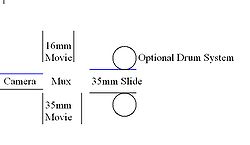
with one or more projectors aligned into the photographic lens
Photographic lens
A camera lens is an optical lens or assembly of lenses used in conjunction with a camera body and mechanism to make images of objects either on photographic film or on other media capable of storing an image chemically or electronically.While in principle a simple convex lens will suffice, in...
of the camera. With two or more projectors a system of front-surface mirrors that can pop-up are used in a multiplexer. These mirrors switch different projectors into the camera lens. The camera could be fed live to air for broadcasting
Broadcasting
Broadcasting is the distribution of audio and video content to a dispersed audience via any audio visual medium. Receiving parties may include the general public or a relatively large subset of thereof...
through a vision mixer
Vision mixer
A vision mixer is a device used to select between several different video sources and in some cases Compositing video sources together to create special effects...
or recorded to a VTR for post-production
Post-production
Post-production is part of filmmaking and the video production process. It occurs in the making of motion pictures, television programs, radio programs, advertising, audio recordings, photography, and digital art...
or later broadcast. In most TV use this has been replaced by a telecine
Telecine
Telecine is transferring motion picture film into video and is performed in a color suite. The term is also used to refer to the equipment used in the post-production process....
Projectors
The projectors often are: 16 mm film movie projectorMovie projector
A movie projector is an opto-mechanical device for displaying moving pictures by projecting them on a projection screen. Most of the optical and mechanical elements, except for the illumination and sound devices, are present in movie cameras.-Physiology:...
, a 35 mm slide projector
Slide projector
A slide projector is an opto-mechanical device to view photographic slides. Slide projectors were common in the 1950s to the 1970s as a form of entertainment; family members and friends would gather to view slide shows...
and a 35 mm film
35 mm film
35 mm film is the film gauge most commonly used for chemical still photography and motion pictures. The name of the gauge refers to the width of the photographic film, which consists of strips 35 millimeters in width...
movie projector. In low-end use the motion picture
Film
A film, also called a movie or motion picture, is a series of still or moving images. It is produced by recording photographic images with cameras, or by creating images using animation techniques or visual effects...
35 mm projector would be replaced by a second 16 mm projector or 8 mm film
8 mm film
8 mm film is a motion picture film format in which the filmstrip is eight millimeters wide. It exists in two main versions: the original standard 8mm film, also known as regular 8 mm or Double 8 mm, and Super 8...
, or Super 8 mm film
Super 8 mm film
Super 8 mm film is a motion picture film format released in 1965 by Eastman Kodak as an improvement of the older "Double" or "Regular" 8 mm home movie format....
or Single-8
Single-8
Single-8 is a motion picture film format introduced by Fujifilm of Japan in 1965 as an alternative to the Kodak Super 8 format. The company Konan claims in its to have developed the Single-8 system in 1959....
projector. The multiplexer with the camera and projectors surrounding it would often be called a film island.
The optical or mag or magnetic strip
Magnetic tape
Magnetic tape is a medium for magnetic recording, made of a thin magnetizable coating on a long, narrow strip of plastic. It was developed in Germany, based on magnetic wire recording. Devices that record and play back audio and video using magnetic tape are tape recorders and video tape recorders...
sound track on the motion picture would be picked up by the projector and would be fed to an audio
Sound recording and reproduction
Sound recording and reproduction is an electrical or mechanical inscription and re-creation of sound waves, such as spoken voice, singing, instrumental music, or sound effects. The two main classes of sound recording technology are analog recording and digital recording...
sound
Sound
Sound is a mechanical wave that is an oscillation of pressure transmitted through a solid, liquid, or gas, composed of frequencies within the range of hearing and of a level sufficiently strong to be heard, or the sensation stimulated in organs of hearing by such vibrations.-Propagation of...
mixing console
Mixing console
In professional audio, a mixing console, or audio mixer, also called a sound board, mixing desk, or mixer is an electronic device for combining , routing, and changing the level, timbre and/or dynamics of audio signals. A mixer can mix analog or digital signals, depending on the type of mixer...
or to the VTR. See: Sound-on-film
Sound-on-film
Sound-on-film refers to a class of sound film processes where the sound accompanying picture is physically recorded onto photographic film, usually, but not always, the same strip of film carrying the picture. Sound-on-film processes can either record an analog sound track or digital sound track,...
, Film Sound and 35 mm Sound.
The slide projector at a TV station would be used for the TV station’s logo, the famous “Please Stand By” slide and some test patterns. Some used a dual-rotating drum slide projector that would have its own mirrors to switch between the drums.
The film projectors used in a film chain are not standard. A special five-blade shutter is used to convert the film’s 24 frames per second into NTSC
NTSC
NTSC, named for the National Television System Committee, is the analog television system that is used in most of North America, most of South America , Burma, South Korea, Taiwan, Japan, the Philippines, and some Pacific island nations and territories .Most countries using the NTSC standard, as...
’s 30 frame per second video. If this was not used, the video would have major flicker problems. This process is called a "3:2" pull down. Modern telecines use the same process, but it is done electronically, not with a five-blade shutter. "3:2" pull down means that a film frame is shown for three TV fields. The next film frame is shown for 2 TV fields. The add field in the “3” is used to convert the 24 frames per second to 30 frames per second. A normal projector has a 2 bladed shutter that shows the same frame twice. Before modern continuous motion telecines, film chains were sometime referred to as telecines.
All film projectors use sprocket
Intermittent mechanism
The intermittent mechanism or intermittent movement is the device by which film is regularly advanced and then held in place for a brief duration of time in a movie camera or movie projector. This is in contrast to a continuous mechanism, whereby the film is constantly in motion and the image is...
rollers to move the film and a pull-down claws to move and stop the film in the gate. The film is moved in the gate while the shutter blocks the light.
In PAL
PAL
PAL, short for Phase Alternating Line, is an analogue television colour encoding system used in broadcast television systems in many countries. Other common analogue television systems are NTSC and SECAM. This page primarily discusses the PAL colour encoding system...
, SECAM
SECAM
SECAM, also written SÉCAM , is an analog color television system first used in France....
and other 25 frames per second systems, the film projector speed is increased one frame per second to 25 frame/s. This gives a one-to-one film to video frame transfer ratio. Thus a standard 2 bladed shutter can be used.
See frame rate differences for more information.
The Camera
A film chain usually used a video camera tubeVideo camera tube
In older video cameras, before the mid to late 1980s, a video camera tube or pickup tube was used instead of a charge-coupled device for converting an optical image into an electrical signal. Several types were in use from the 1930s to the 1980s...
as this reduced flicker. Vidicon image pick up tube were the preferred pick up for film chains as these gave the least amount of flicker. When CCD-charge-coupled device
Charge-coupled device
A charge-coupled device is a device for the movement of electrical charge, usually from within the device to an area where the charge can be manipulated, for example conversion into a digital value. This is achieved by "shifting" the signals between stages within the device one at a time...
cameras were introduced these were also used in a film chain. CCD cameras often gave a sharper picture, but with more flicker.
Early film chains had black and white (B&W) cameras and many were later replaced with color.
The camera could be a standard professional video camera
Professional video camera
A professional video camera is a high-end device for creating electronic moving images...
, but most often was a camera designed for the purpose of film transfer.
Originally only print positive film was used. Later cameras that could invert and color correct color negative film were used.
Professional video camera
Professional video camera
A professional video camera is a high-end device for creating electronic moving images...
s made for film chains were used for broadcast use.
A scene-by-scene color correction option was later added to film chains. This was first done by notching the edge of the film where a color change was wanted. Later, machines that counted the sprocket holes were used. At the mark (the notch or the electronic sprocket-count number) the next stored color correction would occur. See color grading
Color grading
Color grading or colour painting, is the process of altering and enhancing the color of a motion picture, video image, or still image either electronically, photo-chemically or digitally. The photo-chemical process is also referred to as color timing and is typically performed at a photographic...
for more information.
Products
- RCARCARCA Corporation, founded as the Radio Corporation of America, was an American electronics company in existence from 1919 to 1986. The RCA trademark is currently owned by the French conglomerate Technicolor SA through RCA Trademark Management S.A., a company owned by Technicolor...
was by far the largest maker of film chains for broadcast with the color TK-26, TK-27, TK-28 and TK-29 film pickup cameras.
Its broadcast division also designed and built 16mm projectors for television use, including the TP-6, that was often used with a TP-15 Multiplexer.
A different RCA division developed 35mm projectors for television use, culminating in the 35mm FR-35 and a not so well regarded 16mm FR-16 projectors.
RCA's TP-66 debuted in the early 1960s was widely used in stations and networks for 16mm silent, optical and magnetic sound film playback, both live on air and to videotape for editing or delayed broadcast. It is still used by a number of home movie transfer outfits due to its generally low cost of acquisition, and that it was designed to run 24/7 playing back without problems the film content that made up much television programming in television's first 30 years.
RCA's final film pickup camera, the TK-29, came in three models, A, B and C. The "A" was a basic model, "B" added more control and options.
The TK-29C was RCA's "teleproduction" version, and could be equipped with "ChromaComp," an early form of color correction hardware.
For transfer of high-end television commercials to videotape, TK-29C's were equipped by some post-production houses with various forms of triggering the color correction settings in sync with film movement. Punched paper tape was one of the methods used to record the settings, much like film color timing systems of that era.
As television program suppliers moved to videotape and then satellite distribution, prints of theatrical films and programs were transferred to videotape, often from separate 35mm picture and sound elements. Sacramento independent television station KRBK (31) kept its film islands and 1" recorders busy transferring Hollywood-created material for syndication. One of the two islands that had a TK-29C, FR-35, and an electronic pitch shifter to restore the natural pitch of the sound when films and shows were speeded up to gain more commercial time. Episodes of "Little House on the Prairie" were transferred at KRBK, and are still being fed to stations for airing.
- General ElectricGeneral ElectricGeneral Electric Company , or GE, is an American multinational conglomerate corporation incorporated in Schenectady, New York and headquartered in Fairfield, Connecticut, United States...
also made film chains, both in B&W and color; among its color film cameras were the PE-24 and PE-240, both of which used four vidiconVideo camera tubeIn older video cameras, before the mid to late 1980s, a video camera tube or pickup tube was used instead of a charge-coupled device for converting an optical image into an electrical signal. Several types were in use from the 1930s to the 1980s...
tubes (designated as "4-V"). GE film chains were also prevalent in many television stations; one of its largest clients was ABCAmerican Broadcasting CompanyThe American Broadcasting Company is an American commercial broadcasting television network. Created in 1943 from the former NBC Blue radio network, ABC is owned by The Walt Disney Company and is part of Disney-ABC Television Group. Its first broadcast on television was in 1948...
. CBS also used GE film pickup cameras.
- Eastman Kodak made several well regarded 16mm projectors for television use.
- TeleMation Inc. made B&W and color film chains like the TMM-203 Multiplexer and TMU-100 Uniplexers. TeleMation cameras and later film chain camera rack were used for the pick up. These often used Bell & Howell projectors, like the B&H 379. Bell & Howell later purchased Telemation. FotomatFotomatFotomat was a once-widespread retail chain of photo development drive-thru kiosks located in shopping center parking lots. Fotomat Corporation was founded by Preston Fleet in San Diego, California, in the 1960s, , and became a public company in 1971 and listed on the New York Stock Exchange in 1977...
used a fleet of TeleMation units for 16mm, 8mm and S8mm transfers to VHSVHSThe Video Home System is a consumer-level analog recording videocassette standard developed by Victor Company of Japan ....
.
- A number of manufacturers made small home film transfer system.
The introduction of the Rank Cintel
Cintel
Cintel International Ltd is a British company, based in Ware, Hertfordshire,SG12 0AE, which specialises in the design and manufacture of professional post-production equipment, for transcribing film into video or data formats...
Mark III flying spot scanner and Bosch
Robert Bosch GmbH
Robert Bosch GmbH is a multinational engineering and electronics company headquartered in Gerlingen, near Stuttgart, Germany. It is the world's largest supplier of automotive components...
Fernseh
Fernseh
The Fernseh AG television company was registered in Berlin on July 3, 1929 by John Logie Baird, Robert Bosch and other partners with an initial capital of 100,000 Reichsmark....
FDL60, called a telecines, paved the way to shift from projector based transfer to a more gentle system, continuous transport motion, that allowed the easy transfer of negative film and print film and decline of film chains.
Ext. Links and Ref.
- Film island Page and photo
- TeleMation Inc. B&W New Hampshire Video
- RCA TK26 Tech-notes TV History
- TMM-203 Patent Patent Storm
- WATV history RCA Film Chain view of slide wheel
- philotfarnsworth.com Early chain
- Armed Forces Radio and TV, AFRN - AFRTS, KODK - WVCX/WVCQ Film Chain
- University of CambridgeSmall lowQ table top model
- FEN Okinawa Equipment Broadcast Chain
- Early Television Museum Hilliard, OH, Early RCA TK-20 Iconoscope Film Chain Camera
- WTVT RCA TK-26 color film chain
- WFLA RCA TK-26 with side open
- 1962 KSTP-TV, Minneapolis-St. Paul, Film Chain
- TV Broadcasting, by Harold E. Ennes, 1971, Chapter 5, Page 224 to 259

