
All Topics  
Filbert

 
Filbert

   Email Print
   Bookmark   Link


Filbert


The Filbert (Corylus maxima) is a species of hazel
Hazel

The hazels are a genus of deciduous trees and large shrubs native to the temperate northern hemisphere. The genus is usually placed in the birch family Betulaceae, though some botanists split the hazels into a separate family Corylaceae.Hazel plants prefer a nice warm, mild,moist climate nothing more nothing less....
 native to southeastern Europe
Europe

Europe is, conventionally, one of the world's seven continents. Comprising the westernmost peninsula of Eurasia, Europe is generally divided from Asia to its east by the water divide of the Ural Mountains, the Ural , the Caspian Sea, and by the Caucasus Mountains to the southeast....
 and southwestern Asia
Asia

Asia is the world's largest and most populous continent. It covers 8.6% of the Earth's total surface area and, with over 4 billion people, it contains more than 60% of the world's current human population....
, from the Balkans
Balkans

The Balkans is the historical name of a geographic subregion of southeastern Europe. The region takes its name from the Balkan Mountains, which run through the centre of Bulgaria into eastern Serbia....
 to Ordu
Ordu

Ordu is a port on the Black Sea coast of Turkey and the capital city of Ordu Province....
 in Turkey
Turkey

Turkey , known officially as the Republic of Turkey , is a Eurasian country that stretches across the Anatolian peninsula in southwest Asia and Thrace in the Balkans region of Southern Europe....
.

It is a deciduous
Deciduous

Deciduous means falling off at maturity or tending to fall off and is typically used in reference to trees or shrubs that lose their leaves seasonally and to the shedding of other plant structures such as petals after flowering or fruit when ripe....
 shrub
Shrub

A shrub or bush is a horticulture rather than strictly Botany category of woody plant, distinguished from a tree by its multiple stems and lower height, usually less than 5-6 m tall....
 6–10 m tall, with stems
Plant stem

A stem is one of two main structural axes of a vascular plant. The stem is normally divided into nodes and internodes, the nodes hold buds which grow into one or more leaf, inflorescence , conifer cones or other stems etc....
 up to 20 cm thick. The leaves
Leaf

In botany, a leaf is an above-ground plant Organ specialized for photosynthesis. For this purpose, a leaf is typically flat and thin, to expose the cells containing chloroplast to light over a broad area, and to allow light to penetrate fully into the tissues....
 are rounded, 5–12 cm long by 4–10 cm broad, with a coarsely double-serrated margin. The flower
Flower

A flower, sometimes known as a bloom or blossom, is the reproduction structure found in flowering plants . The biological function of a flower is to mediate the union of male sperm with female ovum in order to produce seeds....
s are wind-pollinated
Anemophily

Anemophily or wind pollination is a form of pollination whereby pollen is distributed by wind. Anemophilous plants may be either gymnosperms or angiosperms ....
 catkin
Catkin

A catkin or ament is a slim, cylindrical flower cluster, with inconspicuous or no petals, usually wind-pollination but sometimes insect pollinated ....
s produced in late winter; the male
Malé

Mal? , population 104,403 , is the Capital , the largest city in terms of population, and the name of an island in the Maldives. It is located at the southern edge of North Male' Atoll Kaafu Atoll....
 (pollen
Pollen

Pollen is a fine to coarse powder consisting of Gametophyte , which produce the male gametes of spermatophyta. A hard coat covering the pollen grain protects the sperm cells during the process of their movement between the stamens of the flower to the pistil of the next flower....
) catkins are pale yellow, 5–10 cm long, while the female
Female

Female is the sex of an organism, or a part of an organism, which produces mobile ovum . The ova are defined as the larger gametes in a heterogamous reproduction system, while the smaller, usually motile gamete, the spermatozoon, is produced by the male....
 catkins are bright red and only 1–3 mm long.


Nutrition Facts


Discussion
Ask a question about 'Filbert'
Start a new discussion about 'Filbert'
Answer questions from other users
Full Discussion Forum


Encyclopedia


The Filbert (Corylus maxima) is a species of hazel
Hazel

The hazels are a genus of deciduous trees and large shrubs native to the temperate northern hemisphere. The genus is usually placed in the birch family Betulaceae, though some botanists split the hazels into a separate family Corylaceae.Hazel plants prefer a nice warm, mild,moist climate nothing more nothing less....
 native to southeastern Europe
Europe

Europe is, conventionally, one of the world's seven continents. Comprising the westernmost peninsula of Eurasia, Europe is generally divided from Asia to its east by the water divide of the Ural Mountains, the Ural , the Caspian Sea, and by the Caucasus Mountains to the southeast....
 and southwestern Asia
Asia

Asia is the world's largest and most populous continent. It covers 8.6% of the Earth's total surface area and, with over 4 billion people, it contains more than 60% of the world's current human population....
, from the Balkans
Balkans

The Balkans is the historical name of a geographic subregion of southeastern Europe. The region takes its name from the Balkan Mountains, which run through the centre of Bulgaria into eastern Serbia....
 to Ordu
Ordu

Ordu is a port on the Black Sea coast of Turkey and the capital city of Ordu Province....
 in Turkey
Turkey

Turkey , known officially as the Republic of Turkey , is a Eurasian country that stretches across the Anatolian peninsula in southwest Asia and Thrace in the Balkans region of Southern Europe....
.

It is a deciduous
Deciduous

Deciduous means falling off at maturity or tending to fall off and is typically used in reference to trees or shrubs that lose their leaves seasonally and to the shedding of other plant structures such as petals after flowering or fruit when ripe....
 shrub
Shrub

A shrub or bush is a horticulture rather than strictly Botany category of woody plant, distinguished from a tree by its multiple stems and lower height, usually less than 5-6 m tall....
 6–10 m tall, with stems
Plant stem

A stem is one of two main structural axes of a vascular plant. The stem is normally divided into nodes and internodes, the nodes hold buds which grow into one or more leaf, inflorescence , conifer cones or other stems etc....
 up to 20 cm thick. The leaves
Leaf

In botany, a leaf is an above-ground plant Organ specialized for photosynthesis. For this purpose, a leaf is typically flat and thin, to expose the cells containing chloroplast to light over a broad area, and to allow light to penetrate fully into the tissues....
 are rounded, 5–12 cm long by 4–10 cm broad, with a coarsely double-serrated margin. The flower
Flower

A flower, sometimes known as a bloom or blossom, is the reproduction structure found in flowering plants . The biological function of a flower is to mediate the union of male sperm with female ovum in order to produce seeds....
s are wind-pollinated
Anemophily

Anemophily or wind pollination is a form of pollination whereby pollen is distributed by wind. Anemophilous plants may be either gymnosperms or angiosperms ....
 catkin
Catkin

A catkin or ament is a slim, cylindrical flower cluster, with inconspicuous or no petals, usually wind-pollination but sometimes insect pollinated ....
s produced in late winter; the male
Malé

Mal? , population 104,403 , is the Capital , the largest city in terms of population, and the name of an island in the Maldives. It is located at the southern edge of North Male' Atoll Kaafu Atoll....
 (pollen
Pollen

Pollen is a fine to coarse powder consisting of Gametophyte , which produce the male gametes of spermatophyta. A hard coat covering the pollen grain protects the sperm cells during the process of their movement between the stamens of the flower to the pistil of the next flower....
) catkins are pale yellow, 5–10 cm long, while the female
Female

Female is the sex of an organism, or a part of an organism, which produces mobile ovum . The ova are defined as the larger gametes in a heterogamous reproduction system, while the smaller, usually motile gamete, the spermatozoon, is produced by the male....
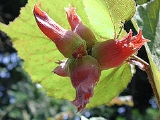
 catkins are bright red and only 1–3 mm long. The fruit
Fruit

The term fruit has different meanings dependent on context, and the term is not synonymous in food preparation and biology. In botany, which is the scientific study of plants, fruits are the ripened Ovary of flowering plants....
 is a nut
Nut (fruit)

Nut is a general term for the large, dry, oily seed or fruit of some plant. While a wide variety of dried seeds and fruits are called nuts, only a certain number of them are considered by biologists to be true nuts....
 produced in clusters of 1–5 together; each nut is 1.5–2.5 cm long, fully enclosed in a 3–5 cm long, tubular involucre (husk
Husk

Husk in botany is the outer shell or coating of a seed....
).

The Filbert is similar to the related Common Hazel
Common Hazel

The Common Hazel is a species of hazel native to Europe and western Asia, from the British Isles south to Iberian Peninsula, Greece, Turkey and Cyprus, north to central Scandinavia, and east to the central Ural Mountains, the Caucasus, and northwestern Iran....
 (C. avellana), differing in having the nut more fully enclosed by the tubular involucre. This feature is shared by the Beaked Hazel
Beaked Hazel

Corylus cornuta is a deciduous shrubby hazel found in most of North America, from southern Canada south to Georgia and California. It grows in dry woodlands and forest edges and can reach 4 - 8 m tall with stems 10 - 25 cm thick with smooth gray bark....
 (C. cornuta) of North America
North America

North America is the northern continent of the Americas, situated in the Earth's northern hemisphere and almost totally in the western hemisphere....
, and the Asian Beaked Hazel (C. sieboldiana) of eastern Asia
Asia

Asia is the world's largest and most populous continent. It covers 8.6% of the Earth's total surface area and, with over 4 billion people, it contains more than 60% of the world's current human population....
.

Uses

The Filbert nut is edible, and is very similar to the Common Hazel nut. Its main use is as large filler (along with peanuts as small filler) in most containers of mixed nuts. Filberts are sometimes grown in orchard
Orchard

An orchard is an intentional planting of trees or shrubs maintained for food agriculture. Orchards comprise fruit tree or nut -producing trees grown for commercial production....
s for the nuts, but much less often than the Common Hazel.

The purple-leaved cultivar
Cultivar

A cultivar is a cultivated plant that has been selected and given a unique name because of its decorative or useful characteristics; it is usually distinct from similar plants and when Plant propagation it retains those characteristics....
 Corylus maxima 'Purpurea' is a popular ornamental shrub
Ornamental plant

Ornamental plants are typically grown in the flower garden or as house plants. Most commonly they are grown for the display of their flowers. Other common ornamental features include leaves, scent, fruit, Plant stem and bark....
 in garden
Garden

A garden is a planned space, usually outdoors, set aside for the display, cultivation, and enjoyment of plants and other forms of nature. The garden can incorporate both natural and man-made materials....
s.

Language

In Oregon
Oregon

Oregon is a U.S. state in the Pacific Northwest region of the United States. The area was inhabited by many indigenous tribes before the arrival of traders, explorers and settlers....
, "filbert" is used for commercial hazelnuts in general. Use in this manner has faded partly due to the efforts of Oregon's hazelnut growers to brand their product to better appeal to global markets and avoid confusion.

The etymology for 'filbert' is Norman French, probably named after Saint Philibert
Philibert of Jumièges

Saint Philibert of Jumi?ges was an abbot and Monastery founder, particularly associated with Jumi?ges Abbey.He was born in Gascony as the only son of a Vic or Vic-Jour based courtier of Dagobert I and was educated by Saint Ouen....
, whose feast day (20 August; old style) came when the nuts were mature.