

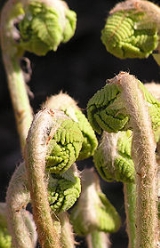
Fiddlehead

Encyclopedia
Fiddleheads or Fiddlehead greens are the furled fronds of a young fern
, harvested for use as a vegetable
. Left on the plant, each fiddlehead would unroll into a new frond
(circinate vernation
). As fiddleheads are harvested early in the black season before the frond has opened and reached its full height, they are cut fairly close to the ground.
Fiddleheads have antioxidant activity, are a source of Omega 3 and Omega 6, and are high in iron and fibre.
The fiddlehead resembles the curled ornamentation (called a scroll) on the end of a stringed instrument, such as a violin
. It is also called a crozier, after the curved staff used by bishop
s, which has its origins in the shepherd's crook.
.
The most popular of these are:
Fiddleheads' ornamental value makes them very expensive in the temperate regions where they are not abundant.
of any non-farmed food species.
as well as among Native Americans
for centuries.
, galangal
, lemongrass, turmeric
leaves and other spices. This dish is called gulai pakis or gulai paku, and originated from the Minangkabau ethnic group of Indonesia
.
In East Asia, fiddleheads of bracken (Pteridium aquilinum
) are eaten as a vegetable, called warabi (蕨) in Japan, gosari (고사리) in Korea, and juécài (蕨菜) in China and Taiwan. In Korea, a typical banchan
(small side dish) is gosari-namul (고사리나물) that consists of prepared fernbrake fiddleheads that have been sauteed. It is a component of the popular dish bibimbap
. In Japan
, bracken fiddleheads are a prized dish, and roasting the fiddleheads is reputed to neutralize any toxins in the vegetable.
In Japan, fiddleheads of flowering fern (Osmunda japonica), known as zenmai (薇) in Japanese, as well as those of the ostrich fern (Matteuccia struthiopteris), known as kogomi (コゴミ), are commonly eaten in springtime. Fiddleheads in Japan are considered sansai
, or wild vegetables.
In the Indian subcontinent
, it is found in the Himalayan North Eastern states of India. In the Kullu
valley in Himachal Pradesh
, it is known locally as "lingri" and is famously used to make a pickle "lingri ka achaar". In the Kangra Valley
of Himachal it is called 'Lungdu' in the local Kangri Pahari language. In Darjeeling and Sikkim
regions, it is called ningro and is well loved as a vegetable side dish, often mixed with local cheese. It is also pickled. In Assam
, it is known as 'dhekia xaak'; there it is a popular side dish.
(especially Maine
) in the United States
, and of Quebec
and the Maritimes
in Canada
. The Canadian village of Tide Head, New Brunswick
, bills itself as the "Fiddlehead Capital of the World." Fiddleheads are also exported fresh or frozen. They are typically steamed or boiled before being eaten hot, with hollandaise sauce
or butter and lemon, or chilled, in salad or with mayonnaise
.
For the Maliseet, a native tribe or the area where the ostrich fern grows, fiddleheads were considered to be medicinal as well as a foodstuff and were gathered in quantity during the relatively brief season before they unfurl.
To cook fiddleheads, it is advised to remove the yellow/brown skin, then boil the sprouts twice with a change of water between boilings. Removing the water reduces the bitterness and the content of tannins and toxins. The Centers for Disease Control associated a number of food-borne illness cases with fiddleheads in the early nineties. Although they did not identify a toxin in the fiddleheads, the findings of that case suggest fiddleheads should be cooked thoroughly before eating. The cooking time recommended by health authorities is 15 minutes if boiled and 10 to 12 minutes if steamed. The cooking method recommended by gourmets is to spread a thin layer in a steam basket and steam lightly, just until tender crisp.
Fiddleheads are available in the market for only a few weeks in springtime, and are fairly expensive. Pickled and frozen fiddleheads, however, can be found in some shops year-round.
s and minerals, as well as omega-3
and omega-6
fatty acids. They are a source of antioxidants and dietary fibre. They are low in sodium, but rich in potassium, which may make them suitable for people who need a low-sodium diet.
Fiddleheads may harbour microbes, and should be washed and cooked before eating.
Many ferns also contain the enzyme
thiaminase
, which breaks down thiamine
. This can lead to beriberi
and other vitamin B complex deficiencies if consumed to excess or if one's diet is lacking in these vitamin
s.
Further, there is some evidence that certain varieties of fiddleheads, e.g. bracken (Pteridium genus), are carcinogenic. Ostrich fern (Matteuccia struthiopteris) is not thought to cause cancer, although there is evidence it contains an as yet unidentified toxin.
Fern
A fern is any one of a group of about 12,000 species of plants belonging to the botanical group known as Pteridophyta. Unlike mosses, they have xylem and phloem . They have stems, leaves, and roots like other vascular plants...
, harvested for use as a vegetable
Vegetable
The noun vegetable usually means an edible plant or part of a plant other than a sweet fruit or seed. This typically means the leaf, stem, or root of a plant....
. Left on the plant, each fiddlehead would unroll into a new frond
Frond
The term frond refers to a large, divided leaf. In both common usage and botanical nomenclature, the leaves of ferns are referred to as fronds and some botanists restrict the term to this group...
(circinate vernation
Vernation
Vernation is the formation of new leaves or fronds. In plant anatomy, it is the arrangement of leaves in a bud....
). As fiddleheads are harvested early in the black season before the frond has opened and reached its full height, they are cut fairly close to the ground.
Fiddleheads have antioxidant activity, are a source of Omega 3 and Omega 6, and are high in iron and fibre.
The fiddlehead resembles the curled ornamentation (called a scroll) on the end of a stringed instrument, such as a violin
Violin
The violin is a string instrument, usually with four strings tuned in perfect fifths. It is the smallest, highest-pitched member of the violin family of string instruments, which includes the viola and cello....
. It is also called a crozier, after the curved staff used by bishop
Bishop
A bishop is an ordained or consecrated member of the Christian clergy who is generally entrusted with a position of authority and oversight. Within the Catholic Church, Eastern Orthodox, Oriental Orthodox Churches, in the Assyrian Church of the East, in the Independent Catholic Churches, and in the...
s, which has its origins in the shepherd's crook.
Varieties
The fiddleheads of certain ferns are eaten as a cooked leaf vegetableLeaf vegetable
Leaf vegetables, also called potherbs, green vegetables, greens, leafy greens or salad greens, are plant leaves eaten as a vegetable, sometimes accompanied by tender petioles and shoots...
.
The most popular of these are:
- BrackenBrackenBracken are several species of large, coarse ferns of the genus Pteridium. Ferns are vascular plants that have alternating generations, large plants that produce spores and small plants that produce sex cells . Brackens are in the family Dennstaedtiaceae, which are noted for their large, highly...
, Pteridium aquilinum, found worldwide - Ostrich fernOstrich fernThe ostrich fern or shuttlecock fern is a crown-forming, colony-forming fern, occurring in temperate regions of the Northern Hemisphere in eastern and northern Europe, northern Asia and northern North America....
, Matteuccia struthiopteris, found in northern regions worldwide, and the central/eastern part of North AmericaNorth AmericaNorth America is a continent wholly within the Northern Hemisphere and almost wholly within the Western Hemisphere. It is also considered a northern subcontinent of the Americas... - Cinnamon fernCinnamon fernOsmundastrum cinnamomeum, the Cinnamon Fern, is a species of eusporangiate fern in the family Osmundaceae. It is native to the Americas and eastern Asia, growing in swamps, bogs and moist woodlands....
or buckhorn fern, Osmunda cinnamomea, found in the Eastern parts of North America - Royal fernRoyal fernOsmunda regalis, the Old World Royal fern, is a species of Osmunda, native to Europe, Africa, and Asia, growing in woodland bogs. The species is sometimes known as flowering fern due to the appearance of its fertile fronds.-Description:...
, Osmunda regalis, found worldwide - Zenmai or flowering fern, Osmunda japonica, found in East AsiaEast AsiaEast Asia or Eastern Asia is a subregion of Asia that can be defined in either geographical or cultural terms...
- Vegetable fernVegetable fernVegetable fern is an edible fern found throughout Asia and Oceania. It is probably the most commonly consumed fern . The young fronds are stir-fried as a "vegetable" or used in salads....
, Athyrium esculentum, found throughout Asia and OceaniaOceaniaOceania is a region centered on the islands of the tropical Pacific Ocean. Conceptions of what constitutes Oceania range from the coral atolls and volcanic islands of the South Pacific to the entire insular region between Asia and the Americas, including Australasia and the Malay Archipelago...
Fiddleheads' ornamental value makes them very expensive in the temperate regions where they are not abundant.
Sources and harvesting
Though available regionally in some supermarkets and restaurants, fiddleheads are not cultivated and are available only seasonally. In rural areas, fiddleheads are harvested by individuals in early spring. When picking fiddleheads, three tops per plant is the recommended harvest. Each plant produces seven tops that turn into fronds; over-picking will kill the plant. Maintaining sustainable harvesting methods is important in the propagationPlant propagation
Plant propagation is the process of creating new plants from a variety of sources: seeds, cuttings, bulbs and other plant parts. Plant propagation can also refer to the artificial or natural dispersal of plants.-Sexual propagation :...
of any non-farmed food species.
Culinary uses
Fiddleheads have been part of traditional diets in much of Northern France since the beginning of the Middle Ages, AsiaAsia
Asia is the world's largest and most populous continent, located primarily in the eastern and northern hemispheres. It covers 8.7% of the Earth's total surface area and with approximately 3.879 billion people, it hosts 60% of the world's current human population...
as well as among Native Americans
Indigenous peoples of the Americas
The indigenous peoples of the Americas are the pre-Columbian inhabitants of North and South America, their descendants and other ethnic groups who are identified with those peoples. Indigenous peoples are known in Canada as Aboriginal peoples, and in the United States as Native Americans...
for centuries.
Asian cuisine
In Indonesia, young fiddlehead ferns are cooked in a rich coconut sauce spiced with chili pepperChili pepper
Chili pepper is the fruit of plants from the genus Capsicum, members of the nightshade family, Solanaceae. The term in British English and in Australia, New Zealand, India, Malaysia and other Asian countries is just chilli without pepper.Chili peppers originated in the Americas...
, galangal
Galangal
Galangal is a rhizome of plants of the genus Alpinia or Kaempferia in the ginger family Zingiberaceae, with culinary and medicinal uses originated from Indonesia...
, lemongrass, turmeric
Turmeric
Turmeric is a rhizomatous herbaceous perennial plant of the ginger family, Zingiberaceae. It is native to tropical South Asia and needs temperatures between 20 °C and 30 °C and a considerable amount of annual rainfall to thrive...
leaves and other spices. This dish is called gulai pakis or gulai paku, and originated from the Minangkabau ethnic group of Indonesia
Indonesia
Indonesia , officially the Republic of Indonesia , is a country in Southeast Asia and Oceania. Indonesia is an archipelago comprising approximately 13,000 islands. It has 33 provinces with over 238 million people, and is the world's fourth most populous country. Indonesia is a republic, with an...
.
In East Asia, fiddleheads of bracken (Pteridium aquilinum
Pteridium aquilinum
Pteridium aquilinum is a species of fern occurring in temperate and subtropical regions throughout much of the northern hemisphere....
) are eaten as a vegetable, called warabi (蕨) in Japan, gosari (고사리) in Korea, and juécài (蕨菜) in China and Taiwan. In Korea, a typical banchan
Banchan
Banchan refers to small dishes of food served along with cooked rice in Korean cuisine. This word is used both in the singular and plural....
(small side dish) is gosari-namul (고사리나물) that consists of prepared fernbrake fiddleheads that have been sauteed. It is a component of the popular dish bibimbap
Bibimbap
Bibimbap is a signature Korean dish. The word literally means "mixed meal." Bibimbap is served as a bowl of warm white rice topped with namul and gochujang . A raw or fried egg and sliced meat are common additions. The ingredients are stirred together thoroughly just before eating...
. In Japan
Japan
Japan is an island nation in East Asia. Located in the Pacific Ocean, it lies to the east of the Sea of Japan, China, North Korea, South Korea and Russia, stretching from the Sea of Okhotsk in the north to the East China Sea and Taiwan in the south...
, bracken fiddleheads are a prized dish, and roasting the fiddleheads is reputed to neutralize any toxins in the vegetable.
In Japan, fiddleheads of flowering fern (Osmunda japonica), known as zenmai (薇) in Japanese, as well as those of the ostrich fern (Matteuccia struthiopteris), known as kogomi (コゴミ), are commonly eaten in springtime. Fiddleheads in Japan are considered sansai
Sansai
is a Japanese word literally meaning "mountain vegetables", originally referring to vegetables that grew naturally in the wild and were not cultivated. However in modern times, the distinction is somewhat blurred, as some sansai such as warabi have been successfully cultivated...
, or wild vegetables.
In the Indian subcontinent
Indian subcontinent
The Indian subcontinent, also Indian Subcontinent, Indo-Pak Subcontinent or South Asian Subcontinent is a region of the Asian continent on the Indian tectonic plate from the Hindu Kush or Hindu Koh, Himalayas and including the Kuen Lun and Karakoram ranges, forming a land mass which extends...
, it is found in the Himalayan North Eastern states of India. In the Kullu
Kullu
Kullu, once known as Kul-anti-peetha - "the end of the habitable world", is the capital town of the Kullu District, in the state of Himachal Pradesh, India. It is located on the banks of the Beas River in the Kullu Valley about ten kilometres north of the airport at Bhuntar.Kullu is a broad open...
valley in Himachal Pradesh
Himachal Pradesh
Himachal Pradesh is a state in Northern India. It is spread over , and is bordered by the Indian states of Jammu and Kashmir on the north, Punjab on the west and south-west, Haryana and Uttar Pradesh on the south, Uttarakhand on the south-east and by the Tibet Autonomous Region on the east...
, it is known locally as "lingri" and is famously used to make a pickle "lingri ka achaar". In the Kangra Valley
Kangra Valley
Kangra Valley is situated in Himachal Pradesh, India. It is a popular tourist destination, with the peak season around March and April.Dharamsala, the headquarters of Kangra district, lies on the southern spur of Dhauladhar in the valley .-Geography:...
of Himachal it is called 'Lungdu' in the local Kangri Pahari language. In Darjeeling and Sikkim
Sikkim
Sikkim is a landlocked Indian state nestled in the Himalayan mountains...
regions, it is called ningro and is well loved as a vegetable side dish, often mixed with local cheese. It is also pickled. In Assam
Assam
Assam , also, rarely, Assam Valley and formerly the Assam Province , is a northeastern state of India and is one of the most culturally and geographically distinct regions of the country...
, it is known as 'dhekia xaak'; there it is a popular side dish.
North American cooking
Ostrich ferns, known locally as fiddlehead ferns, grow wild in wet areas of North-East North America in spring. Fiddleheads are a traditional dish of northern New EnglandNew England
New England is a region in the northeastern corner of the United States consisting of the six states of Maine, New Hampshire, Vermont, Massachusetts, Rhode Island, and Connecticut...
(especially Maine
Maine
Maine is a state in the New England region of the northeastern United States, bordered by the Atlantic Ocean to the east and south, New Hampshire to the west, and the Canadian provinces of Quebec to the northwest and New Brunswick to the northeast. Maine is both the northernmost and easternmost...
) in the United States
United States
The United States of America is a federal constitutional republic comprising fifty states and a federal district...
, and of Quebec
Quebec
Quebec or is a province in east-central Canada. It is the only Canadian province with a predominantly French-speaking population and the only one whose sole official language is French at the provincial level....
and the Maritimes
Maritimes
The Maritime provinces, also called the Maritimes or the Canadian Maritimes, is a region of Eastern Canada consisting of three provinces, New Brunswick, Nova Scotia, and Prince Edward Island. On the Atlantic coast, the Maritimes are a subregion of Atlantic Canada, which also includes the...
in Canada
Canada
Canada is a North American country consisting of ten provinces and three territories. Located in the northern part of the continent, it extends from the Atlantic Ocean in the east to the Pacific Ocean in the west, and northward into the Arctic Ocean...
. The Canadian village of Tide Head, New Brunswick
Tide Head, New Brunswick
Tide Head is a Canadian village in Restigouche County, New Brunswick.-Geography:Located on the south bank of the Restigouche River 10 km west of Campbellton, the village is situated where the tides on the Restigouche River cease to become visible, the reason for its name.-History:The first...
, bills itself as the "Fiddlehead Capital of the World." Fiddleheads are also exported fresh or frozen. They are typically steamed or boiled before being eaten hot, with hollandaise sauce
Hollandaise sauce
Hollandaise sauce is an emulsion of egg yolk and butter, usually seasoned with lemon juice. In appearance it is light yellow and opaque, smooth and creamy. The flavor is rich and buttery, with a mild tang added by the lemon juice, yet not so strong as to overpower mildly-flavored foods.Hollandaise...
or butter and lemon, or chilled, in salad or with mayonnaise
Mayonnaise
Mayonnaise, , often abbreviated as mayo, is a sauce. It is a stable emulsion of oil, egg yolk and either vinegar or lemon juice, with many options for embellishment with other herbs and spices. Lecithin in the egg yolk is the emulsifier. Mayonnaise varies in color but is often white, cream, or pale...
.
For the Maliseet, a native tribe or the area where the ostrich fern grows, fiddleheads were considered to be medicinal as well as a foodstuff and were gathered in quantity during the relatively brief season before they unfurl.
To cook fiddleheads, it is advised to remove the yellow/brown skin, then boil the sprouts twice with a change of water between boilings. Removing the water reduces the bitterness and the content of tannins and toxins. The Centers for Disease Control associated a number of food-borne illness cases with fiddleheads in the early nineties. Although they did not identify a toxin in the fiddleheads, the findings of that case suggest fiddleheads should be cooked thoroughly before eating. The cooking time recommended by health authorities is 15 minutes if boiled and 10 to 12 minutes if steamed. The cooking method recommended by gourmets is to spread a thin layer in a steam basket and steam lightly, just until tender crisp.
Fiddleheads are available in the market for only a few weeks in springtime, and are fairly expensive. Pickled and frozen fiddleheads, however, can be found in some shops year-round.
Health effects
Fiddleheads contain various vitaminVitamin
A vitamin is an organic compound required as a nutrient in tiny amounts by an organism. In other words, an organic chemical compound is called a vitamin when it cannot be synthesized in sufficient quantities by an organism, and must be obtained from the diet. Thus, the term is conditional both on...
s and minerals, as well as omega-3
Omega-3 fatty acid
N−3 fatty acids are essential unsaturated fatty acids with a double bond starting after the third carbon atom from the end of the carbon chain....
and omega-6
Omega-6 fatty acid
n−6 fatty acids are a family of unsaturated fatty acids that have in common a final carbon–carbon double bond in the n−6 position, that is, the sixth bond, counting from the methyl end.The biological effects of the n−6 fatty acids are largely mediated by their conversion to n-6 eicosanoids...
fatty acids. They are a source of antioxidants and dietary fibre. They are low in sodium, but rich in potassium, which may make them suitable for people who need a low-sodium diet.
Fiddleheads may harbour microbes, and should be washed and cooked before eating.
Many ferns also contain the enzyme
Enzyme
Enzymes are proteins that catalyze chemical reactions. In enzymatic reactions, the molecules at the beginning of the process, called substrates, are converted into different molecules, called products. Almost all chemical reactions in a biological cell need enzymes in order to occur at rates...
thiaminase
Thiaminase
Thiaminase is an enzyme that metabolizes or breaks down thiamine into two molecular parts.The old name was "Aneurinase".There are two types: -Sources:Source include:* Bracken , Nardoo and other plants.* Some fish including carp and goldfish....
, which breaks down thiamine
Thiamine
Thiamine or thiamin or vitamin B1 , named as the "thio-vitamine" is a water-soluble vitamin of the B complex. First named aneurin for the detrimental neurological effects if not present in the diet, it was eventually assigned the generic descriptor name vitamin B1. Its phosphate derivatives are...
. This can lead to beriberi
Beriberi
Beriberi is a nervous system ailment caused by a thiamine deficiency in the diet. Thiamine is involved in the breakdown of energy molecules such as glucose and is also found on the membranes of neurons...
and other vitamin B complex deficiencies if consumed to excess or if one's diet is lacking in these vitamin
Vitamin
A vitamin is an organic compound required as a nutrient in tiny amounts by an organism. In other words, an organic chemical compound is called a vitamin when it cannot be synthesized in sufficient quantities by an organism, and must be obtained from the diet. Thus, the term is conditional both on...
s.
Further, there is some evidence that certain varieties of fiddleheads, e.g. bracken (Pteridium genus), are carcinogenic. Ostrich fern (Matteuccia struthiopteris) is not thought to cause cancer, although there is evidence it contains an as yet unidentified toxin.