
|
|
|
|
Ferritin
|
| |
|
| |
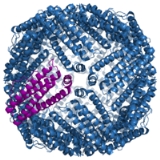
Ferritin is a globular protein complex consisting of 24 protein subunits and is the main intracellular iron storage protein in both prokaryotes and eukaryotes, keeping it in a soluble and non-toxic form. Ferritin which is not combined with iron is called apoferritin.
Description Ferritin, a 450 kDa protein consisting of 24 subunits is present in every cell type. In vertebrates, these subunits are both the light (L) and the heavy (H) type with an apparent molecular weight of 19 kDA or 21 kDA respectively.

Discussion
Ask a question about 'Ferritin'
Start a new discussion about 'Ferritin'
Answer questions from other users
|
Encyclopedia
Ferritin is a globular protein complex consisting of 24 protein subunits and is the main intracellular iron storage protein in both prokaryotes and eukaryotes, keeping it in a soluble and non-toxic form. Ferritin which is not combined with iron is called apoferritin.
Description Ferritin, a 450 kDa protein consisting of 24 subunits is present in every cell type. In vertebrates, these subunits are both the light (L) and the heavy (H) type with an apparent molecular weight of 19 kDA or 21 kDA respectively. In plants and bacteria the complex only consists of the H-chain type. Inside the ferritin shell, iron ions form crystallites together with phosphate and hydroxide ions. The resulting particle is similar to the mineral ferrihydrite. Each ferritin complex can store about 4500 iron (Fe3+) ions.
Some ferritin complexes in vertebrates are hetero-oligomers of two highly-related gene products with slightly different physiological properties. The ratio of the two homologous proteins in the complex depends on the relative expression levels of the two genes.
Mitochondrial ferritin was recently identified as a protein precursor. It is classified as a metal-binding protein which is located within the mitochondria. After the protein is taken up by the mitochondria it can be processed into a mature protein and assemble functional ferritin shells. It's structure was determined at 1.70 angstroms through the use of X-ray diffraction and contains 182 residues. It is 67% helical. The Ramachandran plot shows that the structure of mitochondrial ferritin is mainly alpha helical with a low prevalence of beta sheets.
Function
Free iron is toxic to cells as it acts as a catalyst in the formation of free radicals from reactive oxygen species via the Fenton Reaction. Hence organisms have evolved an elaborate set of protective mechanisms to bind iron in various tissue compartments. Within cells, iron is stored complexed to protein as ferritin or hemosiderin. Apoferritin binds to free ferrous iron and stores it in the ferric state. As ferritin accumulates within cells of the reticuloendothelial system, protein aggregates are formed as hemosiderin. Iron in ferritin or hemosiderin can be extracted for release by the RE cells although hemosiderin is less readily available. Under steady state conditions, the serum ferritin level correlates with total body iron stores; thus, the serum ferritin FR5Rl is the most convenient laboratory test to estimate iron stores.
Ferritin is also used in materials science as a precursor in making iron nanoparticles for carbon nanotube growth by chemical vapor deposition.
Mitochondrial ferritin has many roles pertaining to molecular function. It participates in ferroxidase activity, binding, iron ion binding, oxidoreductase activity, ferric iron binding, metal ion binding as well as transition metal binding. Within the realm of biological proceses it participates in oxidation-reduction, iron ion transport across membranes and cellular iron ion homeostasis.
Diagnostic uses
Serum ferritin levels are measured in patients as part of the iron studies workup for anemia and for restless legs syndrome. The ferritin levels measured have a direct correlation with the total amount of iron stored in the body (except in certain circumstances, such as anemia of chronic disease).
Normal blood levels are 30-300 ng/mL for males and 15-200 ng/mL for females. ((according to clinical medicine by Kumar & Clark page 428)).
Lowered
If ferritin is low there is a risk for lack in iron which could lead to anemia. Low ferritin levels (<50 ng/mL) have been associated with symptoms of restless legs syndrome even in the absence of anemia.
In the setting of anemia, serum ferritin is the most sensitive lab test for iron deficiency anemia.
In a certain study in Paris, France, the level of iron in the blood (measured by ordering a ferritin serum test) has been connected to ADHD in children. Specifically, the lower the iron level, the more severe the ADHD symptoms.
Elevated
If ferritin is high there is iron in excess, which would be excreted in the stool.
Ferritin is also used as a marker for iron overload disorders, such as hemochromatosis and porphyria in which the ferritin level may be abnormally raised.
As ferritin is also an acute-phase reactant, it is often elevated in the course of disease. A normal C-reactive protein can be used to exclude elevated ferritin caused by acute phase reactions.
Ferritin can be elevated during periods of acute malnourishment.
See also
External links
|
| |
|
|