


Fenrisulfr

Encyclopedia

Norse mythology
Norse mythology, a subset of Germanic mythology, is the overall term for the myths, legends and beliefs about supernatural beings of Norse pagans. It flourished prior to the Christianization of Scandinavia, during the Early Middle Ages, and passed into Nordic folklore, with some aspects surviving...
, Fenrir (Old Norse
Old Norse
Old Norse is a North Germanic language that was spoken by inhabitants of Scandinavia and inhabitants of their overseas settlements during the Viking Age, until about 1300....
: "fen
Fen
A fen is a type of wetland fed by mineral-rich surface water or groundwater. Fens are characterised by their water chemistry, which is neutral or alkaline, with relatively high dissolved mineral levels but few other plant nutrients...
-dweller"), Fenrisúlfr (Old Norse: "Fenris wolf
Gray Wolf
The gray wolf , also known as the wolf, is the largest extant wild member of the Canidae family...
"), Hróðvitnir (Old Norse: "fame-wolf"), or Vánagandr (Old Norse: "the monster of the river Ván") is a monstrous wolf. Fenrir is attested in the Poetic Edda
Poetic Edda
The Poetic Edda is a collection of Old Norse poems primarily preserved in the Icelandic mediaeval manuscript Codex Regius. Along with Snorri Sturluson's Prose Edda, the Poetic Edda is the most important extant source on Norse mythology and Germanic heroic legends, and from the early 19th century...
, compiled in the 13th century from earlier traditional sources, and the Prose Edda
Prose Edda
The Prose Edda, also known as the Younger Edda, Snorri's Edda or simply Edda, is an Icelandic collection of four sections interspersed with excerpts from earlier skaldic and Eddic poetry containing tales from Nordic mythology...
and Heimskringla
Heimskringla
Heimskringla is the best known of the Old Norse kings' sagas. It was written in Old Norse in Iceland by the poet and historian Snorri Sturluson ca. 1230...
, written in the 13th century by Snorri Sturluson
Snorri Sturluson
Snorri Sturluson was an Icelandic historian, poet, and politician. He was twice elected lawspeaker at the Icelandic parliament, the Althing...
. In both the Poetic Edda and Prose Edda, Fenrir is the father of the wolves Sköll
Skoll
In Norse mythology, Sköll is a wolf that chases the horses Árvakr and Alsviðr, that drag the chariot which contains the sun through the sky every day, trying to eat her. Sköll has a brother, Hati, who chases Máni, the moon...
and Hati Hróðvitnisson, is a son of Loki
Loki
In Norse mythology, Loki or Loke is a god or jötunn . Loki is the son of Fárbauti and Laufey, and the brother of Helblindi and Býleistr. By the jötunn Angrboða, Loki is the father of Hel, the wolf Fenrir, and the world serpent Jörmungandr. By his wife Sigyn, Loki is the father of Nari or Narfi...
, and is foretold to kill the god Odin
Odin
Odin is a major god in Norse mythology and the ruler of Asgard. Homologous with the Anglo-Saxon "Wōden" and the Old High German "Wotan", the name is descended from Proto-Germanic "*Wodanaz" or "*Wōđanaz"....
during the events of Ragnarök
Ragnarök
In Norse mythology, Ragnarök is a series of future events, including a great battle foretold to ultimately result in the death of a number of major figures , the occurrence of various natural disasters, and the subsequent submersion of the world in water...
, but will in turn be killed by Odin's son Víðarr.
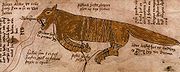
In the Prose Edda, additional information is given about Fenrir, including that, due to the gods' knowledge of prophecies foretelling great trouble from Fenrir and his rapid growth, the gods bound him, and as a result Fenrir bit off the right hand of the god Týr. Depictions of Fenrir have been identified on various objects, and scholarly theories have been proposed regarding Fenrir's relation to other canine beings in Norse mythology. Fenrir has been the subject of artistic depictions, and he appears in literature.
Poetic Edda
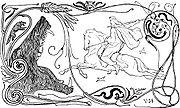

Völuspá
Völuspá is the first and best known poem of the Poetic Edda. It tells the story of the creation of the world and its coming end related by a völva addressing Odin...
, and in two stanzas of the poem Vafþrúðnismál
Vafþrúðnismál
In Norse mythology, Vafþrúðnismál is the third poem in the Poetic Edda. It is a conversation in verse form conducted initially between the Æsir Odin and Frigg, and subsequently between Odin and the giant Vafþrúðnir...
. In stanza 40 of the poem Völuspá, a völva
Völva
A vǫlva or völva is a shamanic seeress in Norse paganism, and a recurring motif in Norse mythology....
divulges to Odin
Odin
Odin is a major god in Norse mythology and the ruler of Asgard. Homologous with the Anglo-Saxon "Wōden" and the Old High German "Wotan", the name is descended from Proto-Germanic "*Wodanaz" or "*Wōđanaz"....
that, in the east, an old woman sat in the forest Járnviðr
Járnviðr
In Norse mythology, Járnviðr is a forest inhabited by troll women who bore giantesses and giant wolves. Járnviðr is attested in the Poetic Edda, compiled in the 13th century from earlier traditional sources, and the Prose Edda, written in the 13th century by Snorri Sturluson.-Poetic Edda:Járnvid...
, "and bred there the broods of Fenrir. There will come from them all one of that number to be a moon-snatcher in troll
Troll
A troll is a supernatural being in Norse mythology and Scandinavian folklore. In origin, the term troll was a generally negative synonym for a jötunn , a being in Norse mythology...
's skin." Further into the poem, the völva foretells that Odin will be consumed by Fenrir at Ragnarök:
- Then is fulfilled Hlín
HlínIn Norse mythology, Hlín is a goddess associated with the goddess Frigg. Hlín appears in a poem in the Poetic Edda, compiled in the 13th century from earlier traditional sources, the Prose Edda, written in the 13th century by Snorri Sturluson, and in kennings found in skaldic poetry...
's- second sorrow,
- when Óðinn goes
- to fight with the wolf,
- and Beli's slayer
FreyrFreyr is one of the most important gods of Norse paganism. Freyr was highly associated with farming, weather and, as a phallic fertility god, Freyr "bestows peace and pleasure on mortals"...
,- bright, against Surtr
SurtrIn Norse mythology, Surtr or Surt is an eldjötunn. Surtr is attested in the Poetic Edda, compiled in the 13th century from earlier traditional sources, and the Prose Edda, written in the 13th century by Snorri Sturluson...
.- Then shall Frigg
FriggFrigg is a major goddess in Norse paganism, a subset of Germanic paganism. She is said to be the wife of Odin, and is the "foremost among the goddesses" and the queen of Asgard. Frigg appears primarily in Norse mythological stories as a wife and a mother. She is also described as having the power...
's- sweet friend fall.
In the stanza that follows, the völva describes that Odin's "tall child of Triumph's Sire" (Odin's son Víðarr) will then come to "strike at the beast of slaughter," and with his hands, he will drive a sword onto the heart of "Hveðrungr
Loki
In Norse mythology, Loki or Loke is a god or jötunn . Loki is the son of Fárbauti and Laufey, and the brother of Helblindi and Býleistr. By the jötunn Angrboða, Loki is the father of Hel, the wolf Fenrir, and the world serpent Jörmungandr. By his wife Sigyn, Loki is the father of Nari or Narfi...
's son," avenging the death of his father.
In the first of two stanzas mentioning Fenrir in Vafþrúðnismál, Odin poses a question to the wise jötunn Vafþrúðnir
Vafþrúðnir
Vafþrúðnir is a wise jötunn in Norse mythology. In the Poetic Edda poem Vafþrúðnismál, Vafþrúðnir acts as both Odin's host and opponent in a deadly battle of wits, resulting in Vafþrúðnir's defeat....
:
- "Much I have travelled, much have I tried out,
- much have I tested the Powers;
- from where will a sun come into the smooth heaven
- when Fenrir has assailed this one?"
In the stanza that follows, Vafþrúðnir responds that Sól (here referred to as Álfröðull), will bear a daughter before Fenrir attacks her, and that this daughter shall continue the paths of her deceased mother through the heavens.
Prose Edda
Prose Edda
The Prose Edda, also known as the Younger Edda, Snorri's Edda or simply Edda, is an Icelandic collection of four sections interspersed with excerpts from earlier skaldic and Eddic poetry containing tales from Nordic mythology...
, Fenrir is mentioned in three books: Gylfaginning
Gylfaginning
Gylfaginning, or the Tricking of Gylfi , is the first part of Snorri Sturluson's Prose Edda after Prologue. The Gylfaginning deals with the creation and destruction of the world of the Norse gods, and many other aspects of Norse mythology...
, Skáldskaparmál
Skáldskaparmál
The second part of Snorri Sturluson's Prose Edda the Skáldskaparmál or "language of poetry" is effectively a dialogue between the Norse god of the sea, Ægir and Bragi, the god of poetry, in which both Norse mythology and discourse on the nature of poetry are intertwined...
and Háttatal
Háttatal
The Háttatal is the last section of the Prose Edda composed by the Icelandic poet, politician, and historian Snorri Sturluson. Using, for the most part, his own compositions, it exemplifies the types of verse forms used in Old Norse poetry...
.
Gylfaginning chapters 13 and 25
In chapter 13 of the Prose Edda book Gylfaginning, Fenrir is first mentioned in a stanza quoted from Völuspá. Fenrir is first mentioned in prose in chapter 25, where the enthroned figure of HighHigh, Just-As-High, and Third
High, Just-As-High, and Third are three men that respond to questions posed by Gangleri in the Prose Edda book Gylfaginning...
tells Gangleri
Gylfi
In Norse mythology, Gylfi, Gylfe, Gylvi, or Gylve was the earliest king in Scandinavia recorded. The traditions on Gylfi deal with how he was tricked by the gods and his relations with the goddess Gefjon.-The creation of Zealand:...
(described as King Gylfi
Gylfi
In Norse mythology, Gylfi, Gylfe, Gylvi, or Gylve was the earliest king in Scandinavia recorded. The traditions on Gylfi deal with how he was tricked by the gods and his relations with the goddess Gefjon.-The creation of Zealand:...
in disguise) about the god Týr. High says that one example of Týr's bravery is that when the Æsir
Æsir
In Old Norse, áss is the term denoting a member of the principal pantheon in Norse paganism. This pantheon includes Odin, Frigg, Thor, Baldr and Tyr. The second pantheon comprises the Vanir...
were luring Fenrir (referred to here as Fenrisúlfr) to place the fetter Gleipnir
Gleipnir
In Norse mythology, Gleipnir is the binding that holds the mighty wolf Fenrisulfr . The Gods had attempted to bind Fenrir twice before with huge chains of metal, but Fenrir was able to break free both times. Therefore, they commissioned the dwarves to forge a chain that was impossible to break...
on the wolf, Týr placed his hand within the wolf's mouth as a pledge. This was done at Fenrir's own request because he did not trust that the Æsir would let him go. As a result, when the Æsir refused to release him, he bit off Týr's hand at a location "now called the wolf-joint" (the wrist
Wrist
In human anatomy, the wrist is variously defined as 1) the carpus or carpal bones, the complex of eight bones forming the proximal skeletal segment of the hand;...
), causing Týr to be one-handed and "not considered to be a promoter of settlements between people."
Gylfaginning chapter 34
In chapter 34, High describes Loki, and says that Loki had three children with a female jötunn named Angrboða located in the land of JötunheimrJötunheimr
Jötunheimr is one of the Nine Worlds and the homeland of the Giants of Norse Mythology — Rock Giants and Frost Giants.-Legend:...
; Fenrisúlfr, the serpent Jörmungandr
Jörmungandr
In Norse mythology, Jörmungandr , mostly known as Jormungand, orJörmungand , or Midgard Serpent , or World Serpent, is a sea serpent, and the middle child of the giantess Angrboða and the god Loki...
, and the female being Hel
Hel (being)
In Norse mythology, Hel is a being who presides over a realm of the same name, where she receives a portion of the dead. Hel is attested in the Poetic Edda, compiled in the 13th century from earlier traditional sources, and the Prose Edda, written in the 13th century by Snorri Sturluson...
. High continues that, once the gods found that these three children were being brought up in the land of Jötunheimr
Jötunheimr
Jötunheimr is one of the Nine Worlds and the homeland of the Giants of Norse Mythology — Rock Giants and Frost Giants.-Legend:...
, and when the gods "traced prophecies that from these siblings great mischief and disaster would arise for them" the gods expected a lot of trouble from the three children, partially due to the nature of the mother of the children, yet worse so due to the nature of their father.
High says that Odin sent the gods to gather the children and bring them to him. Upon their arrival, Odin threw Jörmungandr into "that deep sea that lies round all lands", and then threw Hel into Niflheim
Niflheim
Niflheim is one of the Nine Worlds and is a location in Norse mythology which overlaps with the notions of Niflhel and Hel...
, and bestowed upon her authority over nine worlds
Norse cosmology
The cosmology of Norse mythology has 'nine homeworlds', unified by the world tree Yggdrasill. Mapping the nine worlds escapes precision because the Poetic Edda often alludes vaguely, and the Prose Edda may be influenced by medieval Christian cosmology...
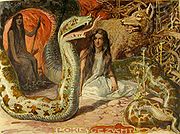
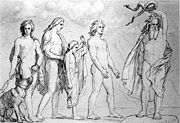
. However, the Æsir brought up the wolf "at home", and only Týr had the courage to approach Fenrir, and give Fenrir food. The gods noticed that Fenrir was growing rapidly every day, and since all prophecies foretold that Fenrir was destined to cause them harm, the gods formed a plan. The gods prepared three fetters: The first, greatly strong, was called Leyding. They brought Leyding to Fenrir and suggested that the wolf try his strength with it. Fenrir judged that it was not beyond his strength, and so let the gods do what they wanted with it. At Fenrir's first kick the bind snapped, and Fenrir loosened himself from Leyding. The gods made a second fetter, twice as strong, and named it Dromi. The gods asked Fenrir to try the new fetter, and that should he break this feat of engineering, Fenrir would achieve great fame for his strength. Fenrir considered that the fetter was very strong, yet also that his strength had grown since he broke Leyding, yet that he would have to take some risks if he were to become famous. Fenrir allowed them to place the fetter.
When the Æsir exclaimed that they were ready, Fenrir shook himself, knocked the fetter to ground, strained hard, and kicking with his feet, snapped the fetter – breaking it into pieces that flew far into the distance. High says that, as a result, to "loose from Leyding" or to "strike out of Dromi" have become sayings for when something is achieved with great effort. The Æsir started to fear that they would not be able to bind Fenrir, and so Odin sent Freyr
Freyr
Freyr is one of the most important gods of Norse paganism. Freyr was highly associated with farming, weather and, as a phallic fertility god, Freyr "bestows peace and pleasure on mortals"...
's messenger Skírnir
Skirnir
In Norse mythology, Skírnir is the god Freyr's messenger and vassal. In the Poetic Edda poem Skírnismál, Skírnir is sent as a messenger to Jötunheimr to conduct Freyr's wooing of the fair Gerðr on condition of being given Freyr's sword as a reward. Skírnir also threatens Gerðr with his gambantein,...
down into the land of Svartálfaheimr to "some dwarfs
Dwarf (Germanic mythology)
In Germanic mythology, a dwarf is a being that dwells in mountains and in the earth, and is associated with wisdom, smithing, mining, and crafting...
" and had them make a fetter called Gleipnir
Gleipnir
In Norse mythology, Gleipnir is the binding that holds the mighty wolf Fenrisulfr . The Gods had attempted to bind Fenrir twice before with huge chains of metal, but Fenrir was able to break free both times. Therefore, they commissioned the dwarves to forge a chain that was impossible to break...
. The dwarves constructed Gleipnir from six mythical ingredients. After an exchange between Gangleri and High, High continues that the fetter was smooth and soft as a silken ribbon, yet strong and firm. The messenger brought the ribbon to the Æsir, and they thanked him heartily for completing the task.
The Æsir went out on to the lake Amsvartnir
Amsvartnir
In Norse mythology, Amsvartnir is a lake. Amsvartnir contains the island Lyngvi, where the gods bound the wolf Fenrir. The lake is solely attested in the Prose Edda book Gylfaginning, written in the 13th century by Snorri Sturluson...
sent for Fenrir to accompany them, and continued to the island Lyngvi (Old Norse "a place overgrown with heather
Calluna
Calluna vulgaris is the sole species in the genus Calluna in the family Ericaceae. It is a low-growing perennial shrub growing to tall, or rarely to and taller, and is found widely in Europe and Asia Minor on acidic soils in open sunny situations and in moderate shade...
"). The gods showed Fenrir the silken fetter Gleipnir, told him to tear it, stated that it was much stronger than it appeared, passed it among themselves, used their hands to pull it, and yet it did not tear. However, they said that Fenrir would be able to tear it, to which Fenrir replied:
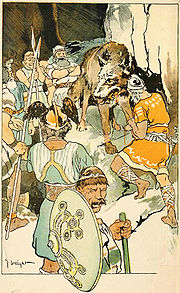
"It looks to me that with this ribbon as though I will gain no fame from it if I do tear apart such a slender band, but if it is made with art and trickery, then even if it does look thin, this band is not going on my legs."
The Æsir said Fenrir would quickly tear apart a thin silken strip, noting that Fenrir earlier broke great iron binds, and added that if Fenrir wasn't able to break slender Gleipnir then Fenrir is nothing for the gods to fear, and as a result would be freed. Fenrir responded:
"If you bind me so that I am unable to release myself, then you will be standing by in such a way that I should have to wait a long time before I got any help from you. I am reluctant to have this band put on me. But rather than that you question my courage, let someone put his hand in my mouth as a pledge that this is done in good faith."
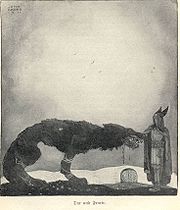
With this statement, all of the Æsir look to one another, finding themselves in a dilemma. Everyone refused to place their hand in Fenrir's mouth until Týr put out his right hand and placed it into the wolf's jaws. When Fenrir kicked, Gleipnir caught tightly, and the more Fenrir struggled, the stronger the band grew. At this, everyone laughed, except Týr, who there lost his right hand. When the gods knew that Fenrir was fully bound, they took a cord called Gelgja (Old Norse "fetter") hanging from Gleipnir, inserted the cord through a large stone slab called Gjöll
Gjöll
In Norse mythology, Gjöll is one of the eleven rivers traditionally associated with the Élivágar, according to Gylfaginning, originating from the wellspring Hvergelmir in Niflheim, flowing through Ginnungagap, and thence into the worlds of existence...
(Old Norse "scream"), and the gods fastened the stone slab deep into the ground. After, the gods took a great rock called Thviti (Old Norse "hitter, batterer"), and thrust it even further into the ground as an anchoring peg. Fenrir reacted violently; he opened his jaws very widely, and tried to bite the gods. The gods thrust "a certain sword" into Fenrir's mouth, the hilt of the sword on Fenrir's lower gums and the point his upper gums. Fenrir "howled horribly," saliva ran from his mouth, and this saliva formed the river Ván (Old Norse "hope"). There Fenrir will lie until Ragnarök. Gangleri comments that Loki created a "pretty terrible family" though important, and asks why the Æsir did not just kill Fenrir there since they expected great malice from him. High replies that "so greatly did the gods respect their holy places
Vé (shrine)
In Germanic paganism, a vé or wēoh is a type of shrine or sacred enclosure. The term appears in skaldic poetry and in place names in Scandinavia , often in connection with a Norse deity or a geographic feature. The name of the Norse god Vé, refers to the practice...
and places of sanctuary that they did not want to defile them with the wolf's blood even though the prophecies say that he will be the death of Odin."
Gylfaginning chapters 38 and 51
In chapter 38, High says that there are many menEinherjar
In Norse mythology, the einherjar are those that have died in battle and are brought to Valhalla by valkyries. In Valhalla, the einherjar eat their fill of the nightly-resurrecting beast Sæhrímnir, and are brought their fill of mead by valkyries...
in Valhalla
Valhalla
In Norse mythology, Valhalla is a majestic, enormous hall located in Asgard, ruled over by the god Odin. Chosen by Odin, half of those that die in combat travel to Valhalla upon death, led by valkyries, while the other half go to the goddess Freyja's field Fólkvangr...
, and many more who will arrive, yet they will "seem too few when the wolf comes." In chapter 51, High foretells that as part of the events of Ragnarök, after Fenrir's son Sköll
Skoll
In Norse mythology, Sköll is a wolf that chases the horses Árvakr and Alsviðr, that drag the chariot which contains the sun through the sky every day, trying to eat her. Sköll has a brother, Hati, who chases Máni, the moon...
has swallowed the sun and his other son Hati Hróðvitnisson has swallowed the moon
Mani
Mani is a name or word occurring in several etymologically unrelated languages and cultures, including:* Maní - a legend of the indigenous tribe Tupi in Brazil.* Mani , the founder of Manichaeism....
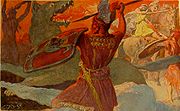
, the stars will disappear from the sky. The earth will shake violently, trees will be uprooted, mountains will fall, and all binds will snap – Fenrisúlfr will be free. Fenrisúlfr will go forth with his mouth opened wide, his upper jaw touching the sky and his lower jaw the earth, and flames will burn from his eyes and nostrils. Later, Fenrisúlfr will arrive at the field Vígríðr
Vígríðr
In Norse mythology, Vígríðr or Óskópnir, is a large field foretold to host a battle between the forces of the gods and the forces of Surtr as part of the events of Ragnarök. The field is attested in the Poetic Edda, compiled in the 13th century from earlier traditional material, and in the Prose...
with his brother Jörmungandr. With the forces assembled there, an immense battle will take place. During this, Odin will ride to fight Fenrisúlfr. During the battle, Fenrisúlfr will eventually swallow Odin, killing him, and Odin's son Víðarr will move forward and kick one foot into the lower jaw of the wolf. This foot will bear a legendary shoe "for which the material has been collected throughout all time." With one hand, Víðarr will take hold of the wolf's upper jaw and tear apart his mouth, killing Fenrisúlfr. High follows this prose description by citing various quotes from Völuspá in support, some of which mention Fenrir.
.jpg)
Skáldskaparmál and Háttatal
In the Epilogue section of the Prose Edda book SkáldskaparmálSkáldskaparmál
The second part of Snorri Sturluson's Prose Edda the Skáldskaparmál or "language of poetry" is effectively a dialogue between the Norse god of the sea, Ægir and Bragi, the god of poetry, in which both Norse mythology and discourse on the nature of poetry are intertwined...
, a euhemerized
Euhemerus
Euhemerus was a Greek mythographer at the court of Cassander, the king of Macedon. Euhemerus' birthplace is disputed, with Messina in Sicily as the most probable location, while others champion Chios, or Tegea.-Life:...
monologue equates Fenrisúlfr to Pyrrhus
Pyrrhus
Pyrrhus or Pyrrhos or Pyrros may refer to the following figures from Greek history and mythology:* Pyrrhus or Neoptolemus, son of Achilles* Pyrrhus of Epirus , famous king, to whom the term Pyrrhic victory alludes...
, attempting to rationalize that "it killed Odin, and Pyrrhus could be said to be a wolf according to their religion, for he paid no respect to places of sanctuary when he killed the king in the temple in front of Thor's altar." In chapter 2, "wolf's enemy" is cited as a kenning
Kenning
A kenning is a type of literary trope, specifically circumlocution, in the form of a compound that employs figurative language in place of a more concrete single-word noun. Kennings are strongly associated with Old Norse and later Icelandic and Anglo-Saxon poetry...
for Odin as used by the 10th century skald
Skald
The skald was a member of a group of poets, whose courtly poetry is associated with the courts of Scandinavian and Icelandic leaders during the Viking Age, who composed and performed renditions of aspects of what we now characterise as Old Norse poetry .The most prevalent metre of skaldic poetry is...
Egill Skallagrímsson
Egill Skallagrímsson
Egill Skallagrímsson was a Viking Age warrior and skald. Egill is one of the great anti-heroes of the Icelandic sagas.-Life:...
. In chapter 9, "feeder of the wolf" is given as a kenning for Týr and, in chapter 11, "slayer of Fenrisúlfr" is presented as a kenning for Víðarr. In chapter 50, a section of Ragnarsdrápa
Ragnarsdrápa
Ragnarsdrápa is a skaldic poem composed in honour of the Scandinavian hero Ragnar Lodbrok. It is attributed to the oldest known skald Bragi Boddason who lived in the 9th century, and composed for the Swedish king Björn at Haugi. Bragi describes the images on a decorated shield which Ragnar had...
by the 9th century skald Bragi Boddason
Bragi Boddason
In his Edda Snorri Sturluson quotes many stanzas attributed to Bragi Boddason the old , a court poet who served several Swedish kings, Ragnar Lodbrok, Östen Beli and Björn at Hauge who reigned in the first half of the ninth century...
is quoted that refers to Hel
Hel (being)
In Norse mythology, Hel is a being who presides over a realm of the same name, where she receives a portion of the dead. Hel is attested in the Poetic Edda, compiled in the 13th century from earlier traditional sources, and the Prose Edda, written in the 13th century by Snorri Sturluson...
, the being, as "the monstrous wolf's sister." In chapter 75, names for warg
Warg
In Norse mythology, a vargr is a wolf and in particular refers to the wolf Fenrir and his sons Sköll and Hati. Based on this, J. R. R. Tolkien in his fiction used the Old English form warg In Norse mythology, a vargr (often anglicised as warg or varg) is a wolf and in particular refers to the...
s and wolves are list, including both "Hróðvitnir" and "Fenrir."
"Fenrir" appears twice in verse as a common noun for a "wolf" or "warg" in chapter 58 of Skáldskaparmál, and in chapter 56 of the book Háttatal
Háttatal
The Háttatal is the last section of the Prose Edda composed by the Icelandic poet, politician, and historian Snorri Sturluson. Using, for the most part, his own compositions, it exemplifies the types of verse forms used in Old Norse poetry...
. Additionally, the name "Fenrir" can be found among a list of jötnar in chapter 75 of Skáldskaparmál.
Heimskringla
Heimskringla
Heimskringla is the best known of the Old Norse kings' sagas. It was written in Old Norse in Iceland by the poet and historian Snorri Sturluson ca. 1230...
saga Hákonar saga góða, the poem Hákonarmál
Hákonarmál
Hákonarmál is a skaldic poem which the skald Eyvindr skáldaspillir composed about the fall of the Norwegian king Hákon the Good at the battle of Fitjar and his reception in Valhalla. This poem emulates Eiríksmál and is intended to depict the Christian Hákon as a friend to the pagan gods...
by the 10th century skald
Skald
The skald was a member of a group of poets, whose courtly poetry is associated with the courts of Scandinavian and Icelandic leaders during the Viking Age, who composed and performed renditions of aspects of what we now characterise as Old Norse poetry .The most prevalent metre of skaldic poetry is...
Eyvindr skáldaspillir
Eyvindr Skáldaspillir
Eyvindr Finnsson skáldaspillir was a 10th century Norwegian skald. He was the court poet of king Hákon the Good and earl Hákon of Hlaðir. His son Hárekr later became a prominent chieftain in Norway.His preserved works are:...
is presented. The poem is about the fall of King Haakon I of Norway
Haakon I of Norway
Haakon I , , given the byname the Good, was the third king of Norway and the youngest son of Harald Fairhair and Thora Mosterstang.-Early life:...
; although he is Christian, he is taken by two valkyrie
Valkyrie
In Norse mythology, a valkyrie is one of a host of female figures who decides who dies in battle. Selecting among half of those who die in battle , the valkyries bring their chosen to the afterlife hall of the slain, Valhalla, ruled over by the god Odin...
s to Valhalla
Valhalla
In Norse mythology, Valhalla is a majestic, enormous hall located in Asgard, ruled over by the god Odin. Chosen by Odin, half of those that die in combat travel to Valhalla upon death, led by valkyries, while the other half go to the goddess Freyja's field Fólkvangr...
, and is there received as one of the Einherjar. Towards the end of the poem, a stanza relates sooner will the bonds of Fenrir snap than as good a king as Haakon shall stand in his place:
- Unfettered will fare the Fenris Wolf
- and ravaged the realm of men,
- ere that cometh a kingly prince
- as good, to stand in his stead.
Archaeological record
