
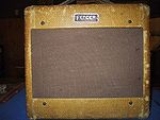
Fender Amplifiers have a long history.
Leo FenderClarence Leonidas "Leo" Fender was an American inventor who founded Fender Electric Instrument Manufacturing Company, or "Fender" for short...
began building guitar amps before he started manufacturing guitars. The first of these amps were the
K&FK&F Manufacturing Corporation was a company started by Clayton Orr Kauffman and Leo Fender in 1945. K&F manufactured amplifiers and electric lap steel guitars. Very few of the K&F instruments have survived. The amps featured an 8" speaker with one input with a volume control or a 10" speaker with...
models, which were produced between 1945 and 1946. The original Fender amps were tube-powered and the company also started producing solid-state models in the late 1960s.
K&F
The
K&F amplifiers were the first "Fender" amps made. They were made by the
K&F Manufacturing CorporationK&F Manufacturing Corporation was a company started by Clayton Orr Kauffman and Leo Fender in 1945. K&F manufactured amplifiers and electric lap steel guitars. Very few of the K&F instruments have survived. The amps featured an 8" speaker with one input with a volume control or a 10" speaker with...
, which was run by
Leo FenderClarence Leonidas "Leo" Fender was an American inventor who founded Fender Electric Instrument Manufacturing Company, or "Fender" for short...
and
Doc KauffmanDoc Kauffman was Leo Fender's business partner in the K&F company, which they started in 1945. After Kauffman left, K&F became Fender. In the 1930's he was a chief designer of electric guitars for Rickenbacker.-References:...
. Most of the amps were finished in a "gray crinkle" finish. The finishes were baked in the Kauffman family oven. They were made in three different sizes, 1x8" (one 8" speaker), 1x10", and 1x15". They are all very rare today and few have survived.
Woodie
The
Woodie amplifiers were made between 1946 and 1947. They were the first Fender amplifiers made.
Tweed
The
Tweed Fender amplifiers were instrument amplifiers made in
tweedTweed is a rough, unfinished woolen fabric, of a soft, open, flexible texture, resembling cheviot or homespun, but more closely woven. It is made in either plain or twill weave and may have a check or herringbone pattern...
covering. The tweed was first used on Fender amps in 1948 on the Champion 800 or "
green tweed" model. The Fender company stopped using the tweed covering on all amplifiers, except the
ChampThe Fender Champ was a guitar amplifier made by Fender. It was introduced in 1948 and discontinued in 1982. An updated version was introduced in 2006 as part of the "Vintage Modified" line....
, in 1960. Fender last used the tweed on the Champ in 1964. The tweed covering was also used on Fender's guitar cases in the 1950s. The tweed cloth started out as a single color off white fabric, moved to a horizontal stripe two-tone pattern and finally a
diagonal two-tone tweed.
This era is distinct not just for the covering, but also the construction of the amplifiers: the chassis are mounted to the back with the tubes pointed down, as opposed to having the chassis mounted on the top of the cabinet. This has the benefit of providing ease of access to the inside while providing a strong top.
At the beginning of the tweed era, Fender constructed its cabinets in "wide panel", where the top and bottom panel is wider than the side. Fender later on constructed them with "narrow panel", in which all the panels have more or less the same width. Toward the end, despite keeping such construction, Fender utilized
tolexTolex is the trade name of a flexible vinyl material used to cover Fender amplifiers, Coffin Case guitar cases and guitar cases from the 1960s onwards....
to cover its amps.
Aside from reissues and Customs series, Fender's Hot Rod series is the only modern line that uses such construction.
Blonde
The
Blonde Fender amplifiers were produced between 1960 and 1964. The blonde amps included all of the piggyback Fender amps (the
TremoluxThe Fender Tremolux was a guitar amplifier made by Fender. It was introduced in the summer of 1955 with a rated power output of 15 watts, cathode bias, two 6V6 output tubes, and a 5V4 tube rectifier...
,
BassmanThe Fender Bassman was a bass amplifier introduced by Fender in 1952. Although it was originally designed for bass guitars, it was frequently used for normal electric guitar in rock and roll, blues, and country bands.-History:...
,
ShowmanThe Fender Showman was a guitar amplifier produced by the Fender company. It was introduced in 1960 and was discontinued in 1993. Blackface and Silverface models such as the Showman and Showman Reverb employed the same "piggyback head" design as the Bandmaster and the Bassman...
, and
BandmasterThe Fender Bandmaster was a musical instrument amplifier made by Fender. It was introduced in 1953 and discontinued in 1974. This page focuses solely on the Bandmaster...
) and a few of the combo amps, including the
TwinThe Fender Twin is a guitar amplifier made by Fender. It was introduced in 1952, two years before Fender began selling Stratocaster electric guitars. The amps are known for their characteristically clean tone....
amp. Two different colors of grillcloths were featured on the blondes, oxblood and wheat. There are several experimental Fender Tweed amps in blonde.
The first time the blonde tolex was used on a production amp was on the Showman. The following quote is featured in "The Soul Of Tone" by Tom Wheeler.
"We didn't really have a wrapping for the amplifier head, but I needed to use it that night and the only thing he (Leo FenderClarence Leonidas "Leo" Fender was an American inventor who founded Fender Electric Instrument Manufacturing Company, or "Fender" for short...
) had was that cream [tolex], and Leo says, "Oh my God, don't let anybody see it because they are going to want it 'cause you're playing on it, but it's gonna stain with coffee and cigarette butts."
-Dick DaleDick Dale is an American surf rock guitarist, known as The King of the Surf Guitar. He experimented with reverberation and made use of custom made Fender amplifiers, including the first-ever 100-watt guitar amplifier.-Early life:Dale was born in South Boston, Massachusetts and lived in nearby...
While the majority of the piggybacks were produced in blonde tolex, there are a few examples of the brown tolex Bassman amplifiers.
Brownface
The
Brownface Fender
amplifiersFender Amplifiers have a long history. Leo Fender began building guitar amps before he started manufacturing guitars. The first of these amps were the K&F models, which were produced between 1945 and 1946...
were introduced in 1959 and discontinued in 1963. This period marked the beginning of Fender's use of
TolexTolex is the trade name of a flexible vinyl material used to cover Fender amplifiers, Coffin Case guitar cases and guitar cases from the 1960s onwards....
to cover amp cabinets. Most of the brownface amps featured a "wheat" grille cloth. Some of them also came with a dark maroon or "oxblood" grill cloth.
There were many notable accomplishments for the company's amplifier division during these years. Namely, the introduction of the stand-alone spring reverb unit in 1961, followed by the subsequent incorporation of the reverb circuit within a combo-amp design with the 1963
VibroverbThe Fender Vibroverb was a 40-watt combo guitar amplifier originally manufactured in 1963 and 1964. It was the first Fender amplifier to incorporate on-board reverb and vibrato effects, both of which became standard features on many high-end Fender tube amps during the 1960s and 1970s.- Brownface,...
. Other notable accomplishments of this period include the shift of the top-of-the-line model from the traditional
Twin-AmpThe Fender Twin is a guitar amplifier made by Fender. It was introduced in 1952, two years before Fender began selling Stratocaster electric guitars. The amps are known for their characteristically clean tone....
to include other models, like the
Vibrasonic AmpThe Fender Vibrasonic was an amplifier made by Fender. It was introduced in 1959 and was discontinued in 1964. At the time of its introduction, the Vibrasonic-Amp was the first amplifier design to displace the Fender Twin as the company's new top of the line or "flagship" model...
in early 1960, as well as the blonde
Showman AmpThe Fender Showman was a guitar amplifier produced by the Fender company. It was introduced in 1960 and was discontinued in 1993. Blackface and Silverface models such as the Showman and Showman Reverb employed the same "piggyback head" design as the Bandmaster and the Bassman...
in 1961. Also worthy of note are Fender's employment of the silicon rectifier to reduce heat caused by tube recitifiers, as well as the advancement of the vibrato circuit which many feel to be at its best during these years. For all of these innovations however, these years are most recognized for the various color combinations the amplifiers wore--brown tolex with yellow or "wheat" grille cloth being the most common.
The shift from the tweed design to tolex occurred in limited production in 1960. The tolex on the earliest versions in this era was pinkish brown and rough textured. There were only six amplifiers covered in tolex originally, and they were called the Professional Series:
Bandmaster-AmpThe Fender Bandmaster was a musical instrument amplifier made by Fender. It was introduced in 1953 and discontinued in 1974. This page focuses solely on the Bandmaster...
,
Concert-AmpThe Fender Concert was an guitar amplifier made by Fender. It was introduced in 1960 and it was discontinued in 1967, at which time a typical Fender Concert was priced at $315, about as much as a Martin D-28 at the time...
, Pro-Amp,
Super-AmpThe Fender Super was a guitar amplifier made by Fender. It was originally called the Dual Professional and was introduced in 1947. The Dual Professional included two 10" Jensen speakers. It was renamed the Super in fall of 1947.-See also:*Fender Super Reverb...
, the Twin-Amp (production halted Feb-May 1960, resumed as the blonde Twin) and the Vibrasonic-Amp. These were considered a step above the student models (
ChampThe Fender Champ was a guitar amplifier made by Fender. It was introduced in 1948 and discontinued in 1982. An updated version was introduced in 2006 as part of the "Vintage Modified" line....
,
HarvardThe Fender Harvard was a guitar amplifier made by Fender from 1955 to 1961. The Harvard appeared only in a tweed covered 'narrow-panel' cabinet, but in two different circuit designs - 5F10 and 6G10....
,
DeluxeThe Fender Deluxe Reverb is a guitar amplifier made originally by Fender Musical Instruments, and now by Fender. The Deluxe Reverb is a 22-watt tube amplifier , powered by a pair of 7408/6V6GT power tubes, one GZ34/5AR4 rectifier tube, four 7025/12AX7 preamp tubes, and two 6201/12AT7 tubes driving...
,
PrincetonThe Fender Princeton was a guitar amplifier made by Fender. It was introduced in 1947 and discontinued in 1979. After Fender introduced the Champ Amp in 1948, the Princeton occupied the next to the bottom spot in the Fender line...
, Vibrolux) which remained tweed-covered in 1960. Grille cloths were initially the same as those used in the previous tweed era (i.e.: maroon with gold stripe). Beginning in mid to late 1961, Fender introduced another color combination: a smoother but still light brown tolex with a dark maroon or "oxblood" grill cloth. By mid 1961, after this short-lived look, Fender is using the darker brown tolex which was a mainstay for many of the mid 1961 to 1963 amps. Between 1961 and 1963, there were three different grille cloth colors: wheat, brown, and maroon and many tolex-grille color combinations are found suggesting that
Leo FenderClarence Leonidas "Leo" Fender was an American inventor who founded Fender Electric Instrument Manufacturing Company, or "Fender" for short...
and Co. was not hesitant to use up whatever stocks of materials were on hand. This mode of operation would seem to extend to the electrical components as well given that it is not uncommon to find actual production amps that vary from the published schematics.
Variations of Fender's circuit design appear to have spiked in the tweed-to-tolex transition from 1959 to 1960. Many of the earliest brown amps from this period have a combination of features uncommon for production amps. To start with, the sharp cut of the upper-front edge of the cabinet is a feature that distinguishes most of the 1960 brown Fenders. This was caused by not using a router bit along this edge during the finishing stages of the cabinetry. A router was later employed giving the tolex amps from approximately 1961 onward a more common rounded upper edge. Another interesting feature of these early brown amps is the unusual "center-volume" array of control nobs—reading "BASS-TREBLE-VOLUME" from left to right—which appears to have been a feature of the six Professional Series of amps between approximately January and May 1960. Afterwards, this was changed to the order we still find today (VOLUME-TREBLE-BASS). A feature that coincides with these "center volume" Fenders is the plugged "pulse adj." would-be jack or control feature on the back panel. Suggestions as to what this control may have been were published in
Vintage Guitar MagazineVintage Guitar is a guitar magazine, published monthly since 1986. Writers for the magazine include Seymour W. Duncan, George Gruhn, and Wolf Marshall...
in the late 1990s.
As the brown-era wore on, the plight of the smaller, student model amps was varied. They all remained in name at least except for the 1x10" Harvard which was not continued through 1961. The 1x8" Champ-Amp remained a tweed-covered through 1963 and into 64 when it made the change to black tolex. The 1x10" Vibrolux amp remained a tweed amp until it was upgraded in 1961 to a single 12" speaker powered by a duet of 6L6 power tubes and a larger output transformer. Also upgraded from tweed was the Princeton-Amp which acquired its brown tolex in 1962 along with a larger speaker array: 1x10". The Deluxe-Amp remained as well, however its upgrade was largely aesthetic as it remained a 2-6V6 powered single 12" speaker voiced amplifier.
Another aspect of this period of Fender Amplifiers can be found in the new amplifiers which made their debuts at this time. The Concert-Amp came to fill the demand for a tolex 4x10" design so ably filled by its predecessor the Bassman. The Showman Amp was designed with
Dick DaleDick Dale is an American surf rock guitarist, known as The King of the Surf Guitar. He experimented with reverberation and made use of custom made Fender amplifiers, including the first-ever 100-watt guitar amplifier.-Early life:Dale was born in South Boston, Massachusetts and lived in nearby...
in mind. Its interleaved output transformer and top of the line JBL speaker(s) made it a formidable presence at the time. Its blonde tolex and head and cabinet design made it a harbinger of changes on the horizon for Fender Amps. Following its lead, the Bassman-Amp as well as the Bandmaster-Amp were covered in blonde and changed from combo amps (all in one) to the new head-and-cabinet design. The year 1960 saw the end of the 3x10" combo with the short-lived, center-volume Bandmaster. The JBL speaker upgrade points to concerns that had been mounting at Fender since the debut of the hi-powered 80 watt Twin Amp in 1958. Speakers of the era were unable to keep pace. Another new design, the 1x15" Vibrasonic-Amp featured a Lansing speaker and was temporarily touted as the flagship of Fender Amps in early 1960. This leads us to perhaps an interesting moment of brown-era Fender Amp history: the mystery of the brown Twin-Amp.
Blackface
The
Blackface Fender
amplifiersFender Amplifiers have a long history. Leo Fender began building guitar amps before he started manufacturing guitars. The first of these amps were the K&F models, which were produced between 1945 and 1946...
were produced between 1964 and 1967. The first piggyback blackface amps (as well as the Princeton) had white knobs. After 1964 the amps had skirted black knobs. The blackface cosmetics were discontinued in late 1967; they returned for a brief period in 1981 before their discontinuation the following year.
Blackfaced cosmetics do not necessarily mean "pre-CBS" since the CBS company takeover took place in 1965 and amps with blackfaced cosmetics were produced up to 1967. After the buyout the front panels were changed from "Fender Electric Instrument Co." to "Fender Musical Instruments". No real changes were made to the amps until the silverfaced amps of 1968 where certain circuit changes made them less desirable than the blackfaced amps. This affected some models more than others. For example, the Twin Reverb and
Super ReverbThe Fender Super Reverb was a guitar amplifier made by Fender. It was introduced in 1963 and was discontinued in 1982. This was essentially a Fender Super amplifier with built-in reverb and vibrato. The original Super Reverb amplifiers were all tube design and featured spring reverb. There were...
combos, along with the
Dual Showman ReverbThe Fender Showman was a guitar amplifier produced by the Fender company. It was introduced in 1960 and was discontinued in 1993. Blackface and Silverface models such as the Showman and Showman Reverb employed the same "piggyback head" design as the Bandmaster and the Bassman...
and
Bandmaster ReverbThe Fender Bandmaster Reverb was an amplifier made by Fender, essentially a Silverface Bandmaster piggyback head with built-in reverb and vibrato. It was introduced in 1968 and was discontinued in 1980. Master volume models with "pull boost" tone circuit and a Mid control knob for the Normal...
"piggyback" heads were equipped with a master volume control while other models such as the
Deluxe ReverbThe Fender Deluxe Reverb is a guitar amplifier made originally by Fender Musical Instruments, and now by Fender. The Deluxe Reverb is a 22-watt tube amplifier , powered by a pair of 7408/6V6GT power tubes, one GZ34/5AR4 rectifier tube, four 7025/12AX7 preamp tubes, and two 6201/12AT7 tubes driving...
were not altered in any way except for the change in cosmetics.
Silverface cosmetics do not necessarily denote silverface circuitry, however.
Leo FenderClarence Leonidas "Leo" Fender was an American inventor who founded Fender Electric Instrument Manufacturing Company, or "Fender" for short...
was notorious for tweaking his designs. During the transitional period from late 1967 to mid 1968, the circuit designs of the Twin Reverb and
Super ReverbThe Fender Super Reverb was a guitar amplifier made by Fender. It was introduced in 1963 and was discontinued in 1982. This was essentially a Fender Super amplifier with built-in reverb and vibrato. The original Super Reverb amplifiers were all tube design and featured spring reverb. There were...
were altered to eliminate an uncommon but serious oscillation in the signal chain. These changes took some months to finalize, as Leo worked through some designs, and happened after the cosmetic changes. Furthermore, the schematic and tube charts that shipped with these models did not always reflect the actual circuitry. Fender had many leftover AB763 (blackface) tube charts left over well into 1969 and shipped these charts with silverface models.
Save for a few series (such as HotRod series), a majority of modern Fender amplifiers sports blackface cosmetics.
Silverface
Fender
Silverface amplifiersFender Amplifiers have a long history. Leo Fender began building guitar amps before he started manufacturing guitars. The first of these amps were the K&F models, which were produced between 1945 and 1946...
were built between 1967 and 1981. They are often referred to as Silverface (or Chromeface) because of their brushed aluminum face plate.
The first Silverface amps, manufactured between 1967 and 1969, had an aluminum frame (trim) around the grillcloth, mid-1960s "tailed" amp logo and the AB763 blackface circuit. An even rarer feature were the vertical, narrow black lines, which separated knob groups in the control panel. This cosmetic detail (later referred to as "blackline") was abandoned pretty quickly, though. All of the Silverface amps generally had blue labels on the face plate, but in some rare exceptions (such as the
BroncoFor the guitar see, Fender BroncoThe Fender Bronco was a guitar amplifier made by Fender. It was the first silverfaced amplifier introduced in 1967 to sport the modern-looking "tailless" Fender amp decal, which became a standard feature on other Fender amplifiers in the early 1970s. The Bronco was...
) the colour was red instead. Some transitional models produced before the "tailless" period in 1973 featured the AC568 circuit, still retaining the tailed Fender amp decal introduced in 1964.
In 1973
CBSCBS Broadcasting Inc. is a major US commercial broadcasting television network, which started as a radio network. The name is derived from the initials of the network's former name, Columbia Broadcasting System. The network is sometimes referred to as the "Eye Network" in reference to the shape of...
changed the "tailed" Fender amp logo to the modern-looking "tailless" style (which was first introduced in 1967 on the student
Bronco ampFor the guitar see, Fender BroncoThe Fender Bronco was a guitar amplifier made by Fender. It was the first silverfaced amplifier introduced in 1967 to sport the modern-looking "tailless" Fender amp decal, which became a standard feature on other Fender amplifiers in the early 1970s. The Bronco was...
) and added a "Made in the USA" script on the bottom side three years later.
All Silverface models usually came with a sparkling silver/blue grillcloth (some later models had a non-standard sparkling silver/orange grillcloth, and a black grille cloth was even fitted to some production runs). The Silverface control face plate was discontinued in 1981 and the second series of the blackface amps designed by Paul Rivera were produced. Paul Rivera went on to found
Rivera AmplifiersRivera was founded by Paul Rivera as a R+D firm in August 1976 in Southern California. Rivera manufacture a range of tube/valve-powered guitar amplifiers...
.
Fender made a limited-edition Mini-Twin practice amplifier modeled after the mid-70s Twin Reverb models in 1996. The Silverface Edition MT-10 had the authentic look right down to the grill cloth. This 1-watt Twin featured 3 in. speakers, "skirted" style Fender knobs for Gain, Volume, Tone and Power and included a tilt-back stand.
Early solid-state models
First transistorized Fender amplifiers were introduced in 1966. At the time they were the company's "flagship" range and aimed to obsolete the tube-based designs. The amplifiers were naturally given traditional Fender model names, earliest including 'Dual Showman', 'Twin Reverb', and 'Bassman'. Other products in the line were the 'Solid-State Reverb Unit' and the 'Solid-State Public-Address System'. 'Super Reverb', 'Pro Reverb', 'Vibrolux Reverb' and 'Deluxe Reverb' amplifiers followed in 1967.
The amplifiers were mainly designed by Robert "Bob" Rissi, Sawa Jacobson and Paul Spranger, who came up with the novel idea of making a heatsink to operate like a chimney to achieve increased and non-restricted airflow. Paul also designed the distinctive angled chassis and overall cosmetic styling. He was granted patents for both accounts.
In 1969 more transistor amplifiers were introduced, including the 'Zodiac' series and the behemoth 'Super Showman System'. Seth Lover, the legendary designer of the Gibson "P.A.F." pickup, and another former Gibson employee, Richard Chauncey Evans, were hired to help in designing the latter series, which consisted of a 'SS-1000' preamplifier head and 'XFL-1000' and 'XFL-2000' self-powered speaker cabinets. The head featured three cascadeable channels, a "Dimension V" oil can delay effect, reverb, vibrato, and a fuzz. The powered cabinets could switch between normal and "tube-emulated" operation. There really was nothing quite like it on the market.
Zodiac-series amplifiers consisted of 'Capricorn', 'Scorpio', 'Taurus' and 'Libra' models. Aside from being covered with fake alligator skin, they were cosmetically very similar to Super Showman. However, these were smaller combo amplifiers with fewer features and unshamedly aimed for the market segment that looked for more inxepensive products.
The documentation relating to these amplifiers has so far remained quite scarce due to general lack of interest in the subject.
Fender's early transistor amplifiers had an extensive marketing campaign but in the end they proved to be a major disaster. Many key executives of Fender had resigned after the CBS purchase and quality control of the PCB-constructed amps was rather sloppy during the times. Reputedly many of the early solid-state amplifiers failed simply because employees didn't bother to clean up the soldering machines or attach the semiconductors properly to their heat sinks. The infancy of semiconductor technology also meant that many designs failed due to thermal runaway caused by insufficient cooling or lack of knowledge concerning "safe" power ratings of transistors. The cascaded effects from all this created a very poor reputation for the transistor products and the entire solid-state line was discontinued already in 1971. Additionally the experience also scared Fender away from solid-state amplifier technology for the next ten years.
Second series blackface
The silverface amplifiers were succeeded by a new breed of Fender designs. At this point Fender's executives had noticed that they were competing on a market at which old fashioned features such as "tremolo" were played out and many guitarists were no longer looking for a "cleanish" country amp but were after for more versatile tone controls and, perhaps more importantly, greater amount of distortion. Fender was now basically competing with the likes of Mesa/Boogie or Marshall and losing the game.
The Blackface cosmetics were (sort of) reintroduced in the mid 1970's in a series of amplifiers designed by Ed Jahns. The first amplifiers in this new line included the infamous 185W 'Super Twin' and 'Super Twin Reverb' amplifiers which featured active tone controls and a built-in distortion circuit that blended between clean and distorted sounds (a circuit that later gained a reputation as one of the most hideous features ever fitted to a Fender amplifier). Some bass amplifiers with greatly similar architecture were also released, namely the 'Studio Bass' and 'PS300'.
These amplifiers didn't yet obsolete the Silverface series and manufacturing of both co-existed for years. In fact, many silverface designs were revised to the ultra-linear architecture to step up their output power from 100 watts to 135 watts.
The new "blackfaces" actually came in varying cosmetic styles. All of them naturally had a black control panel and traditional knobs, but they no longer featured the blackface-style lettering to depict the model name and the traditional control panel layout was partially redesigned. Some of these amplifiers had a silver grille cloth, typical to previous BF and SF series amps, but more often the amplifiers sported a black grille cloth. Some amplifiers also had an aluminum trimming running around the grille. The styling didn't become consistent before the early 1980's, at which point all these designs were already discontinued to make way for the very similar looking "II Series".
In the late 1970's and very early 1980's the "Supers" were followed by the tube-based '30', '75 (Lead)', and '140' tube amps (with reverb and overdrive features) and two solid-state 'Harvard' amps (one with reverb), which were 15W practice amplifiers. Design-wise the tube amplifiers were quite different from their predecessors, as the active tone controls and blending distortion circuit had been removed and the latter feature replaced by a crude version of the channel switching concept. A new feature addition was a crude insert-style effects loop.
II Series
The
II Series (two series) Fender amplifiers were produced from 1982 until 1986, being the last Fender amps to be made at Fullerton. The specifications for these amplifiers, and leadership of the design team, came from Paul Rivera (then marketing director) and are known as Fender
Rivera era amplifiers. Some amplifiers in the series used the
II moniker such as the Deluxe Reverb II and Twin Reverb II, while others such as the Concert and Super Champ did not. Many of these amps had the normal Fender clean sound and in addition a switchable mid voiced gain channel, designed to compete with the
Mesa BoogieMesa/Boogie is a company in Petaluma, California that makes amplifiers for guitars and basses. It has been in operation since 1969....
Mark series amps that had gained popularity at the time. See the Ampwares Fender Amp Guide at http://www.ampwares.com/fender.asp or the II Series schematic page at http://www.stratopastor.org.uk/strato/amps/twoseriesfenders/twoseriesfenders.html . The tube amps in the series feature hand-wired eyelet board construction and are also becoming sought-after collectors items, due to the design and build quality. There were also some
solid-stateSolid-state electronics are those circuits or devices built entirely from solid materials and in which the electrons, or other charge carriers, are confined entirely within the solid material...
amplifiers using the
II moniker also but without the same tonal qualities or collectability.
Red Knob
The
Red Knob Fender amplifiers were produced from 1987 until 1993. These were some of the first models produced by the newly formed Fender Musical Instrument Corporation. These amplifiers, named for their bright red control knobs have a slightly similar appearance to the older Blackface cosmetics, having black control panels with white lettering and the late 1970s "scripted tailless" Fender logo. Many of these models were simply refitted with black knobs and early 1970s "unscripted tailless" Fender logos in 1996 when most Fender amplifier manufacturing moved to the
EnsenadaEnsenada is a coastal city in Mexico and the third-largest city in Baja California. It is located south of San Diego on the Baja California Peninsula. The city is locally referred to as La Cenicienta del Pacífico, or, The Cinderella of the Pacific...
factory in
MexicoThe United Mexican States , commonly known as Mexico , is a federal constitutional republic in North America. It is bordered on the north by the United States; on the south and west by the Pacific Ocean; on the southeast by Guatemala, Belize, and the Caribbean Sea; and on the east by the Gulf of...
. This series of amplifiers all used printed circuit board construction and the tube amps are notoriously difficult to service. The Red Knob amps, with their high-gain channels, had their own sound, not much like the older classic Black and Silver Face designs.
Popular Fender amps
- Bassman
The Fender Bassman was a bass amplifier introduced by Fender in 1952. Although it was originally designed for bass guitars, it was frequently used for normal electric guitar in rock and roll, blues, and country bands.-History:...
- Blues Junior
The Blues Junior is a professional tube guitar amplifier introduced in 1995 by the Fender company. It is aimed at achieving the warm, tube-driven tone common in many styles of American blues and blues rock dating back to the 1950s, while remaining both portable and affordable. Fender frequently...
- Champ
The Fender Champ was a guitar amplifier made by Fender. It was introduced in 1948 and discontinued in 1982. An updated version was introduced in 2006 as part of the "Vintage Modified" line....
- Bandmaster
The Fender Bandmaster was a musical instrument amplifier made by Fender. It was introduced in 1953 and discontinued in 1974. This page focuses solely on the Bandmaster...
- Deluxe Reverb
The Fender Deluxe Reverb is a guitar amplifier made originally by Fender Musical Instruments, and now by Fender. The Deluxe Reverb is a 22-watt tube amplifier , powered by a pair of 7408/6V6GT power tubes, one GZ34/5AR4 rectifier tube, four 7025/12AX7 preamp tubes, and two 6201/12AT7 tubes driving...
- Harvard
The Fender Harvard was a guitar amplifier made by Fender from 1955 to 1961. The Harvard appeared only in a tweed covered 'narrow-panel' cabinet, but in two different circuit designs - 5F10 and 6G10....
- Hot Rod Deluxe
The Fender Hot Rod Deluxe is a guitar amplifier manufactured and sold by the Fender Musical Instruments Corporation. It was introduced in 1995 as part of the "Hot Rod" line of guitar amplifiers and has been in continuous production since. This model, along with the Hot Rod Deville, were originally...
- Hot Rod DeVille
The Fender Hot Rod DeVille is a combo tube guitar amplifier manufactured and sold by Fender. It was introduced in 1996 as part of Fender's Hot Rod line of amplifiers, and since then has been in continuous production...
- Princeton
The Fender Princeton was a guitar amplifier made by Fender. It was introduced in 1947 and discontinued in 1979. After Fender introduced the Champ Amp in 1948, the Princeton occupied the next to the bottom spot in the Fender line...
- Pro Junior
The Fender Pro Junior is a guitar amp manufactured by Fender Musical Instruments Co. It is the lowest-priced model of the Hot Rod series and has a 10" Eminence Speaker...
- Pro Reverb
The Fender Pro Reverb is a high-end guitar amplifier made by Fender. It was in production from 1965 and was discontinued in 1982. The Pro Reverb is a 40-watt tube amplifier and has a pair 12" speakers; however, models later than 1976 were increased to 70 watts.The Pro Reverb is most often used by...
- Showman
The Fender Showman was a guitar amplifier produced by the Fender company. It was introduced in 1960 and was discontinued in 1993. Blackface and Silverface models such as the Showman and Showman Reverb employed the same "piggyback head" design as the Bandmaster and the Bassman...
- Super Reverb
The Fender Super Reverb was a guitar amplifier made by Fender. It was introduced in 1963 and was discontinued in 1982. This was essentially a Fender Super amplifier with built-in reverb and vibrato. The original Super Reverb amplifiers were all tube design and featured spring reverb. There were...
- Tremolux
The Fender Tremolux was a guitar amplifier made by Fender. It was introduced in the summer of 1955 with a rated power output of 15 watts, cathode bias, two 6V6 output tubes, and a 5V4 tube rectifier...
- Twin Reverb
- Vibrosonic
- Vibroverb
The Fender Vibroverb was a 40-watt combo guitar amplifier originally manufactured in 1963 and 1964. It was the first Fender amplifier to incorporate on-board reverb and vibrato effects, both of which became standard features on many high-end Fender tube amps during the 1960s and 1970s.- Brownface,...