
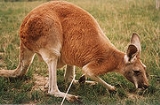
The
fauna of Australia consists of a huge variety of animals; some 83% of mammals, 89% of reptiles, 90% of fish and insects and 93% of
amphibianAmphibians , are a class of vertebrate animals including animals such as toads, frogs, caecilians, and salamanders. They are characterized as non-amniote ectothermic tetrapods...
s that inhabit the continent are endemic to Australia. This high level of endemism can be attributed to the continent's long geographic isolation,
tectonicPlate tectonics is a scientific theory that describes the large scale motions of Earth's lithosphere...
stability, and the effects of an unusual pattern of climate change on the soil and
floraThe flora of Australia comprises a vast assemblage of plant species estimated to over 20,000 vascular and 14,000 non-vascular plants, 250,000 species of fungi and over 3,000 lichens...
over geological time. A unique feature of Australia's fauna is the relative scarcity of native placental mammals. Consequently the
marsupialMarsupials are an infraclass of mammals, characterized by giving birth to relatively undeveloped young. Close to 70% of the 334 extant species occur in Australia, New Guinea, and nearby islands, with the remaining 100 found in the Americas, primarily in South America, but with thirteen in Central...
s—a group of mammals that raise their young in a
pouchThe pouch is a distinguishing feature of female marsupials ; the name marsupial is derived from the Latin marsupium, meaning "pouch". Marsupials give birth to a live but relatively undeveloped fetus called a joey. When the joey is born it crawls from inside the mother to the pouch...
, including the macropods,
possumA possum is any of about 70 small to medium-sized arboreal marsupial species native to Australia, New Guinea, and Sulawesi .Possums are quadrupedal diprotodont marsupials with long tails...
s and
dasyuromorphsThe order Dasyuromorphia comprises most of the Australian carnivorous marsupials, including quolls, dunnarts, the numbat, the Tasmanian devil, and the recently extinct thylacine...
—occupy many of the
ecological nicheIn ecology, a niche is a term describing the relational position of a species or population in its ecosystem to each other; e.g. a dolphin could potentially be in another ecological niche from one that travels in a different pod if the members of these pods utilize significantly different food...
s placental animals occupy elsewhere in the world. Australia is home to two of the 5 known extant species of
monotremeMonotremes are mammals that lay eggs instead of giving birth to live young like marsupials and placental mammals...
s and has numerous venomous species, which include the
PlatypusThe platypus is a semi-aquatic mammal endemic to eastern Australia, including Tasmania. Together with the four species of echidna, it is one of the five extant species of monotremes, the only mammals that lay eggs instead of giving birth to live young...
,
spiderSpiders are air-breathing arthropods that have eight legs, and chelicerae with fangs that inject venom. They are the largest order of arachnids and rank seventh in total species diversity among all other groups of organisms...
s,
scorpionScorpions are predatory arthropod animals of the order Scorpiones within the class Arachnida. They have eight legs and are easily recognized by the pair of grasping claws and the narrow, segmented tail, often carried in a characteristic forward curve over the back, ending with a venomous stinger...
s,
octopusThe octopus is a cephalopod mollusc of the order Octopoda. Octopuses have two eyes and four pairs of arms, and like other cephalopods they are bilaterally symmetric. An octopus has a hard beak, with its mouth at the center point of the arms...
,
jellyfishJellyfish are free-swimming members of the phylum Cnidaria. Medusa is another word for jellyfish, and refers to any free-swimming jellyfish stages in the phylum Cnidaria...
, molluscs,
stonefishSynanceia verrucosa is a fish species, sometimes lethal to humans, which is known as the reef stonefish or simply stonefish. They are carnivorous ray-finned fish with venomous spines that lives on reef bottoms, camouflaged as a rock...
, and
stingrayThe stingrays are a group of rays, which are cartilaginous fishes related to sharks. They are classified in the suborder Myliobatoidei of the order Myliobatiformes, and consist of eight families: Hexatrygonidae , Plesiobatidae , Urolophidae , Urotrygonidae , Dasyatidae , Potamotrygonidae The...
s. Uniquely, Australia has more venomous than non-venomous species of
snakeSnakes are elongate, legless, carnivorous reptiles of the suborder Serpentes that can be distinguished from legless lizards by their lack of eyelids and external ears. Like all squamates, snakes are ectothermic, amniote vertebrates covered in overlapping scales...
s.
The settlement of Australia by
Indigenous AustraliansIndigenous Australians are the original inhabitants of the Australian continent and nearby islands. The Aboriginal Indigenous Australians migrated from the Indian continent around 75,000 to 100,000 years ago....
between 48,000 and 70,000 years ago, and by Europeans from 1788, has significantly affected the fauna. Hunting, the introduction of non-native species, and land-management practices involving the modification or destruction of habitats have led to numerous
extinctionIn biology and ecology, extinction is the end of an organism or of a group of organisms , normally a species. The moment of extinction is generally considered to be the death of the last individual of the species, although the capacity to breed and recover may have been lost before this point...
s. Some examples include the
Paradise ParrotThe Paradise Parrot was a colourful medium-sized parrot native to the grassy woodlands of the Queensland - New South Wales border area of northeastern Australia. Once moderately common within its fairly restricted range, the last live bird was seen in 1927...
,
Pig-footed BandicootThe Pig-footed Bandicoot, Chaeropus ecaudatus, was a small marsupial of the arid and semi-arid plains of Australia. The distribution range of the species was later reduced to an inland desert region, where it was last recorded in the 1950s, and is now presumed to be extinct.-Classification:This...
and the
Broad-faced PotorooThe Broad-faced Potoroo is an extinct species of marsupial that once lived in Australia. The first specimen was collected in 1839 and described by John Gould in 1844, but even then it was rare and only a handful of specimens were ever collected, the last in 1875...
. Unsustainable land use still threatens the survival of many species. To target threats to the survival of its fauna, Australia has passed wide-ranging federal and state legislation and established numerous
protected areasProtected areas of Australia include Commonwealth and off-shore protected areas managed by the Australian government, as well as protected areas within each of the six states of Australia and two self-governing territories , which are managed by the eight state and territory...
.
Origins
Both
geologicAustralia is a continent situated on the Indo-Australian Plate.The geology of Australia includes virtually all known rock types and from all geological time periods spanning over 3.8 billion years of the Earth's history.-Components:...
and climatic events helped to make Australia's fauna unique. Australia was once part of the southern supercontinent
GondwanaIn paleogeography, Gondwana , originally Gondwanaland, was the southernmost of two supercontinents that later became parts of the Pangaea supercontinent. It existed from approximately 510 to 180 million years ago . Gondwana is believed to have sutured between ca. 570 and 510 Mya,...
, which also included South America, Africa, India and Antarctica. Gondwana began to break up 140 million years ago (MYA); 50 MYA Australia separated from Antarctica and was relatively isolated until the collision of the
Indo-Australian PlateThe Indo-Australian Plate is a major tectonic plate that includes the continent of Australia and surrounding ocean, and extends northwest to include the Indian subcontinent and adjacent waters...
with Asia in the
MioceneThe Miocene is a geological epoch of the Neogene Period and extends from about . The Miocene was named by Sir Charles Lyell. Its name comes from the Greek words and and means "less recent" because it has 18% fewer modern sea invertebrates than the Pliocene. The Miocene follows the Oligocene...
era 5.3 MYA. The establishment and
evolutionEvolution is any change across successive generations in the heritable characteristics of biological populations. Evolutionary processes give rise to diversity at every level of biological organisation, including species, individual organisms and molecules such as DNA and proteins.Life on Earth...
of the present-day fauna was apparently shaped by the unique climate and the geology of the continent. As Australia
driftedContinental drift is the movement of the Earth's continents relative to each other. The hypothesis that continents 'drift' was first put forward by Abraham Ortelius in 1596 and was fully developed by Alfred Wegener in 1912...
, it was, to some extent, isolated from the effects of global climate change. The unique fauna that originated in Gondwana, such as the marsupials, survived and
adaptedIn evolutionary biology, adaptive radiation is the evolution of ecological and phenotypic diversity within a rapidly multiplying lineage. Starting with a recent single ancestor, this process results in the speciation and phenotypic adaptation of an array of species exhibiting different...
in Australia.
After the
MioceneThe Miocene is a geological epoch of the Neogene Period and extends from about . The Miocene was named by Sir Charles Lyell. Its name comes from the Greek words and and means "less recent" because it has 18% fewer modern sea invertebrates than the Pliocene. The Miocene follows the Oligocene...
, fauna of Asian origin were able to establish themselves in Australia. The
Wallace LineThe Wallace Line separates the ecozones of Asia and Wallacea, a transitional zone between Asia and Australia. West of the line are found organisms related to Asiatic species; to the east, a mixture of species of Asian and Australian origin is present...
—the hypothetical line separating the
zoogeographicalZoogeography is the branch of the science of biogeography that is concerned with the geographic distribution of animal species.-External links:*: A course outline and collection of Web resources by Dr. Taylor, UBC...
regions of Asia and Australasia—marks the tectonic boundary between the
EurasianThe Eurasian Plate is a tectonic plate which includes most of the continent of Eurasia , with the notable exceptions of the Indian subcontinent, the Arabian subcontinent, and the area east of the Chersky Range in East Siberia...
and Indo-Australian plates. This continental boundary prevented the formation of land bridges and resulted in a distinct zoological distribution, with limited overlap, of most Asian and Australian fauna, with the exception of birds. Following the emergence of the circumpolar current in the mid-
OligoceneThe Oligocene is a geologic epoch of the Paleogene Period and extends from about 34 million to 23 million years before the present . As with other older geologic periods, the rock beds that define the period are well identified but the exact dates of the start and end of the period are slightly...
era (some 15 MYA), the Australian climate became increasingly arid, giving rise to a diverse group of arid-specialised organisms, just as the wet tropical and seasonally wet areas gave rise to their own uniquely adapted species.
Mammals
Australia has a rich mammalian fossil history, as well as a variety of extant mammalian species, dominated by the marsupials. The fossil record shows that monotremes have been present in Australia since the
Early CretaceousThe Early Cretaceous or the Lower Cretaceous , is the earlier or lower of the two major divisions of the Cretaceous...
145–99 MYA, and that
marsupialMarsupials are an infraclass of mammals, characterized by giving birth to relatively undeveloped young. Close to 70% of the 334 extant species occur in Australia, New Guinea, and nearby islands, with the remaining 100 found in the Americas, primarily in South America, but with thirteen in Central...
s and placental mammals date from the
EoceneThe Eocene Epoch, lasting from about 56 to 34 million years ago , is a major division of the geologic timescale and the second epoch of the Paleogene Period in the Cenozoic Era. The Eocene spans the time from the end of the Palaeocene Epoch to the beginning of the Oligocene Epoch. The start of the...
56–34 MYA, when modern mammals first appeared in the fossil record. Although marsupials and placental mammals did coexist in Australia in the Eocene, only marsupials have survived to the present. The placental mammals made their reappearance in Australia in the Miocene, when Australia moved closer to
IndonesiaIndonesia , officially the Republic of Indonesia , is a country in Southeast Asia and Oceania. Indonesia is an archipelago comprising approximately 13,000 islands. It has 33 provinces with over 238 million people, and is the world's fourth most populous country. Indonesia is a republic, with an...
, and bats and
rodentRodentia is an order of mammals also known as rodents, characterised by two continuously growing incisors in the upper and lower jaws which must be kept short by gnawing....
s started to appear reliably in the fossil record. The marsupials evolved to fill specific ecological niches, and in many cases they are physically similar to the placental mammals in
EurasiaEurasia is a continent or supercontinent comprising the traditional continents of Europe and Asia ; covering about 52,990,000 km2 or about 10.6% of the Earth's surface located primarily in the eastern and northern hemispheres...
and North America that occupy similar niches, a phenomenon known as
convergent evolutionConvergent evolution describes the acquisition of the same biological trait in unrelated lineages.The wing is a classic example of convergent evolution in action. Although their last common ancestor did not have wings, both birds and bats do, and are capable of powered flight. The wings are...
. For example, the top predator in Australia, the
Tasmanian TigerThe thylacine or ,also ;binomial name: Thylacinus cynocephalus, Greek for "dog-headed pouched one") was the largest known carnivorous marsupial of modern times. It is commonly known as the Tasmanian tiger or the Tasmanian wolf...
, bore a striking resemblance to
canidCanidae is the biological family of carnivorous and omnivorous mammals that includes wolves, foxes, jackals, coyotes, and domestic dogs. A member of this family is called a canid . The Canidae family is divided into two tribes: Canini and Vulpini...
s such as the
Gray WolfThe gray wolf , also known as the wolf, is the largest extant wild member of the Canidae family...
;
gliding possumsThe family Petauridae includes 11 medium-sized possum species: four striped possums, the six species wrist-winged gliders in genus Petaurus, and Leadbeater's Possum which has only vestigal gliding membranes...
and
flying squirrelFlying squirrels, scientifically known as Pteromyini or Petauristini, are a tribe of 44 species of squirrels .- Description :...
s have similar adaptations enabling their arboreal lifestyle; and the
NumbatThe numbat , also known as the banded anteater, or walpurti, is a marsupial found in Western Australia. Its diet consists almost exclusively of termites. Once widespread across southern Australia, the range is now restricted to several small colonies and it is listed as an endangered species...
and anteaters are both digging insectivores. For the most part, mammals are not a highly visible part of the faunal landscape, as most species are nocturnal and many arboreal. Furthermore, there are few extant large ground-dwelling species.
Monotremes and marsupials
Two of the five living species of
monotremeMonotremes are mammals that lay eggs instead of giving birth to live young like marsupials and placental mammals...
occur in Australia: the
PlatypusThe platypus is a semi-aquatic mammal endemic to eastern Australia, including Tasmania. Together with the four species of echidna, it is one of the five extant species of monotremes, the only mammals that lay eggs instead of giving birth to live young...
and the
Short-beaked EchidnaThe short-beaked echidna , also known as the spiny anteater because of its diet of ants and termites, is one of four living species of echidna and the only member of the genus Tachyglossus...
. The monotremes differ from other mammals in their methods of reproduction; in particular, they lay eggs instead of giving birth to live young. The Platypus—a
venomVenom is the general term referring to any variety of toxins used by certain types of animals that inject it into their victims by the means of a bite or a sting...
ous, egg-laying, duck-billed amphibious mammal—is considered to be one of the strangest creatures in the animal kingdom. When it was first presented by
Joseph BanksSir Joseph Banks, 1st Baronet, GCB, PRS was an English naturalist, botanist and patron of the natural sciences. He took part in Captain James Cook's first great voyage . Banks is credited with the introduction to the Western world of eucalyptus, acacia, mimosa and the genus named after him,...
to English naturalists it was thought to be so strange that it was a cleverly created hoax. The Short-beaked Echidna is similarly strange, covered in hairy spikes with a tubular snout in the place of a mouth, and a tongue that can move in and out of the snout about 100 times a minute to capture
termiteTermites are a group of eusocial insects that, until recently, were classified at the taxonomic rank of order Isoptera , but are now accepted as the epifamily Termitoidae, of the cockroach order Blattodea...
s.
Australia has the world's largest and most diverse range of
marsupialMarsupials are an infraclass of mammals, characterized by giving birth to relatively undeveloped young. Close to 70% of the 334 extant species occur in Australia, New Guinea, and nearby islands, with the remaining 100 found in the Americas, primarily in South America, but with thirteen in Central...
s. Marsupials are characterised by the presence of a pouch in which they rear their young. The carnivorous marsupials—order
DasyuromorphiaThe order Dasyuromorphia comprises most of the Australian carnivorous marsupials, including quolls, dunnarts, the numbat, the Tasmanian devil, and the recently extinct thylacine...
—are represented by two surviving families: the
DasyuridaeDasyuridae is a family of marsupials native to Australia and New Guinea, including 61 species divided into 15 genera. Many are small and mouse-like, giving them the misnomer marsupial mice, but the group also includes the cat-sized quolls, as well as the Tasmanian Devil...
with 51 members, and the Myrmecobiidae with the numbat as its sole surviving member. The Tasmanian Tiger was the largest Dasyuromorphia and the last living specimen of the family Thylacinidae; however, what appears to have been the last known specimen died in captivity in 1936. The world's largest surviving carnivorous marsupial is the
Tasmanian DevilThe Tasmanian devil is a carnivorous marsupial of the family Dasyuridae, now found in the wild only on the Australian island state of Tasmania. The size of a small dog, it became the largest carnivorous marsupial in the world following the extinction of the thylacine in 1936...
; it is the size of a small dog and can hunt, although it is mainly a scavenger. It became extinct on the mainland some 600 years ago, and is now found only in
TasmaniaTasmania is an Australian island and state. It is south of the continent, separated by Bass Strait. The state includes the island of Tasmania—the 26th largest island in the world—and the surrounding islands. The state has a population of 507,626 , of whom almost half reside in the greater Hobart...
. There are four species of
quollThe quoll, or native cat, is a carnivorous marsupial native to mainland Australia, New Guinea and Tasmania. It is primarily nocturnal and spends most of the day in its den. There are six species of quoll; four are found in Australia and two in New Guinea...
, or native cat, all of which are threatened species. The remainder of the Dasyuridae are referred to as 'marsupial mice'; most weigh less than 100 g. There are two species of
Marsupial MoleMarsupial moles is a family of marsupials of the order Notoryctemorphia, consisting of only two extant species:* Notoryctes typhlops * Notoryctes caurinus ...
—order Notoryctemorphia—that inhabit the deserts of Western Australia. These rare, blind and earless carnivorous creatures spend most of their time underground; little is known about them.
The
bandicootBandicoots are a group of about 20 species of small to medium-sized, terrestrial marsupial omnivores in the order Peramelemorphia.- Etymology :...
s and
bilbiesBilbies are desert-dwelling marsupial omnivores; they are members of the order Peramelemorphia. Before European colonisation of Australia, there were two species. One became extinct in the 1950s; the other survives but remains endangered....
—order
PeramelemorphiaThe order Peramelemorphia includes the bandicoots and bilbies: it equates approximately to the mainstream of marsupial omnivores...
—are marsupial
omnivoreOmnivores are species that eat both plants and animals as their primary food source...
s. There are seven species in Australia, most of which are endangered. These small creatures share several characteristic physical features: a plump, arch-backed body with a long, delicately tapering snout, large upright ears, long, thin legs, and a thin tail. The evolutionary origin of this group is unclear, because they share characteristics from both carnivorous and herbivorous marsupials.
HerbivorousHerbivores are organisms that are anatomically and physiologically adapted to eat plant-based foods. Herbivory is a form of consumption in which an organism principally eats autotrophs such as plants, algae and photosynthesizing bacteria. More generally, organisms that feed on autotrophs in...
marsupials are classified in the order
DiprotodontiaDiprotodontia is a large order of about 120 marsupial mammals including the kangaroos, wallabies, possums, koala, wombats, and many others. Extinct diprotodonts include the rhinoceros-sized Diprotodon, and Thylacoleo, the so-called "marsupial lion"....
, and further into the suborders
VombatiformesVombatiformes is one of the three suborders of the large marsupial order Diprotodontia. Five of the seven known families within this suborder are extinct; only the families Phascolarctidae, with the Koala, and Vombatidae, with three extant species of wombat, survive.Among the extinct families are...
and
PhalangeridaPhalangerida is one of the two former suborders of the large marsupial order Diprotodontia. This large and diverse suborder included kangaroos, wallabies, quokkas, possums, gliding possum-like marsupials and others. The much smaller suborder Vombatiformes encompasses only the koalas and wombats...
. The Vombatiformes include the Koala and the three species of
wombatWombats are Australian marsupials; they are short-legged, muscular quadrupeds, approximately in length with a short, stubby tail. They are adaptable in their habitat tolerances, and are found in forested, mountainous, and heathland areas of south-eastern Australia, including Tasmania, as well as...
. One of Australia's best-known marsupials, the Koala is an arboreal species that feeds on the leaves of various species of
eucalyptusEucalyptus is a diverse genus of flowering trees in the myrtle family, Myrtaceae. Members of the genus dominate the tree flora of Australia...
. Wombats, on the other hand, live on the ground and feed on
grassesThe Poaceae is a large and nearly ubiquitous family of flowering plants. Members of this family are commonly called grasses, although the term "grass" is also applied to plants that are not in the Poaceae lineage, including the rushes and sedges...
,
sedgesCyperaceae are a family of monocotyledonous graminoid flowering plants known as sedges, which superficially resemble grasses or rushes. The family is large, with some 5,500 species described in about 109 genera. These species are widely distributed, with the centers of diversity for the group...
and
rootIn vascular plants, the root is the organ of a plant that typically lies below the surface of the soil. This is not always the case, however, since a root can also be aerial or aerating . Furthermore, a stem normally occurring below ground is not exceptional either...
s. Wombats use their rodent-like front teeth and powerful claws to dig extensive burrow systems; they are mainly
crepuscularCrepuscular animals are those that are active primarily during twilight, that is during dawn and dusk. The word is derived from the Latin word crepusculum, meaning "twilight." Crepuscular is, thus, in contrast with diurnal and nocturnal behavior. Crepuscular animals may also be active on a bright...
and
nocturnalNocturnality is an animal behavior characterized by activity during the night and sleeping during the day. The common adjective is "nocturnal"....
.
The
PhalangeridaPhalangerida is one of the two former suborders of the large marsupial order Diprotodontia. This large and diverse suborder included kangaroos, wallabies, quokkas, possums, gliding possum-like marsupials and others. The much smaller suborder Vombatiformes encompasses only the koalas and wombats...
includes six families and 26 species of
possumA possum is any of about 70 small to medium-sized arboreal marsupial species native to Australia, New Guinea, and Sulawesi .Possums are quadrupedal diprotodont marsupials with long tails...
and three families with 51 species of macropod. The possums are a diverse group of arboreal marsupials and vary in size from the Little Pygmy Possum, weighing just 7 g, to the cat-sized
Common RingtailThe common ringtail possum is an Australian marsupial. It lives in a variety of habitats and eats a variety of leaves of both native and introduced plants, as well as flowers and fruits. These dietary factors have, over time, aided burgeoning introduced populations in New Zealand...
and
BrushtailThe Common Brushtail Possum is a nocturnal, semi-arboreal marsupial of the family Phalangeridae, it is native to Australia, and the largest of the possums.Like most possums, the Common Brushtail is nocturnal...
possums. The
SugarThe sugar glider is a small gliding possum originating from the marsupial family.The sugar glider is native to eastern and northern mainland Australia and is also native to New Guinea and the Bismarck Archipelago.- Habitat :Sugar gliders can be found all throughout the northern and eastern parts of...
and
Squirrel GliderThe Squirrel Glider is a nocturnal gliding possum, one of the wrist-winged gliders of the genus Petaurus.-Habitat:...
s are common species of gliding possum, found in the eucalypt forests of eastern Australia, while the
Feathertail GliderThe Feathertail Glider , also known as the Pygmy Gliding Possum, Pygmy Glider, Pygmy Phalanger, Flying Phalanger and Flying Mouse, is the world's smallest gliding possum and is named for its long feather-shaped tail. Although only the size of a very small mouse , it can leap and glide up to 25 metres...
is the smallest glider species. The gliding possums have membranes called 'patagiums' that extend from the fifth finger of their forelimb back to the first toe of their hind foot. These membranes, when outstretched, allow them to glide between trees.
The macropods are divided into three families: the
HypsiprymnodontidaeThe Musky Rat-kangaroo is a marsupial species found in the rainforests of northeast Australia. Although some scientists place this species as a subfamily of the family Potoroidae, the most recent classification places it in the family Hypsiprymnodontidae with prehistoric rat-kangaroos.It is the...
, with the Musky Rat-kangaroo as its only member; the
PotoroidaeThe marsupial family Potoroidae includes the bettongs, potoroos, and two of the rat-kangaroos. All are rabbit-sized, brown, jumping marsupials and resemble a large rodent or a very small wallaby.- Characteristics :...
, with 11 species; and the Macropodidae, with 45 species. Macropods are found in all Australian environments except alpine areas. The Potoroidae include the bettongs, potaroos and rat-kangaroos, small species that make nests and carry plant material with their tails. The Macropodiae include
kangarooA kangaroo is a marsupial from the family Macropodidae . In common use the term is used to describe the largest species from this family, especially those of the genus Macropus, Red Kangaroo, Antilopine Kangaroo, Eastern Grey Kangaroo and Western Grey Kangaroo. Kangaroos are endemic to the country...
s,
wallabiesA wallaby is any of about thirty species of macropod . It is an informal designation generally used for any macropod that is smaller than a kangaroo or wallaroo that has not been given some other name.-Overview:...
and associated species; size varies widely within this family. Most macropods have large hind legs and long, narrow hind feet, with a distinctive arrangement of four toes, and powerfully muscled tails, which they use to hop around. The Musky Rat-kangaroo is the smallest macropod and the only species that is quadrupedal not bipedal, while the male
Red KangarooThe Red Kangaroo is the largest of all kangaroos, the largest mammal native to Australia, and the largest surviving marsupial. It is found across mainland Australia, avoiding only the more fertile areas in the south, the east coast, and the northern rainforests.-Description:This species is a very...
is the largest, reaching a height of about 2 m and weighing up to 85 kg.
Placental mammals
Australia has indigenous placental mammals from two orders: the bats—order Chiroptera—represented by six families; and the mice and rats—order
RodentRodentia is an order of mammals also known as rodents, characterised by two continuously growing incisors in the upper and lower jaws which must be kept short by gnawing....
ia, family
MuridaeMuridae is the largest family of mammals. It contains over 600 species found naturally throughout Eurasia, Africa, and Australia. They have been introduced worldwide. The group includes true mice and rats, gerbils, and relatives....
. Bats and rodents are relatively recent arrivals to Australia; bats are present in the fossil record only from as recently as 15 MYA, and probably arrived from Asia. There are only two endemic
generaIn biology, a genus is a low-level taxonomic rank used in the biological classification of living and fossil organisms, which is an example of definition by genus and differentia...
of bats, although 7% of the world's bats species live in Australia. Rodents first arrived in Australia 5–10 MYA, undergoing a wide radiation to produce the species collectively known as the 'old endemic' rodents. The old endemics are represented by 14 extant genera. A million years ago, the
ratRats are various medium-sized, long-tailed rodents of the superfamily Muroidea. "True rats" are members of the genus Rattus, the most important of which to humans are the black rat, Rattus rattus, and the brown rat, Rattus norvegicus...
entered Australia from
New GuineaNew Guinea is the world's second largest island, after Greenland, covering a land area of 786,000 km2. Located in the southwest Pacific Ocean, it lies geographically to the east of the Malay Archipelago, with which it is sometimes included as part of a greater Indo-Australian Archipelago...
and evolved into seven species of
Rattus, collectively called the 'new endemics'.
Since human settlement many placental mammals have been introduced to Australia and are now
feralA feral organism is one that has changed from being domesticated to being wild or untamed. In the case of plants it is a movement from cultivated to uncultivated or controlled to volunteer. The introduction of feral animals or plants to their non-native regions, like any introduced species, may...
. The first animal introduced to Australia was the
DingoThe Australian Dingo or Warrigal is a free-roaming wild dog unique to the continent of Australia, mainly found in the outback. Its original ancestors are thought to have arrived with humans from southeast Asia thousands of years ago, when dogs were still relatively undomesticated and closer to...
. Fossil evidence suggests that people from the north brought the Dingo to Australia about 5000 years ago. When Europeans settled Australia they intentionally released many species into the wild including the
Red FoxThe red fox is the largest of the true foxes, as well as being the most geographically spread member of the Carnivora, being distributed across the entire northern hemisphere from the Arctic Circle to North Africa, Central America, and the steppes of Asia...
,
Brown HareThe Cape, Common or Brown Hare is a hare natively found throughout Africa, and has spread to many parts of the Europe, Middle East and Asia. The Cape Hare is a nocturnal herbivore.They are fast...
, and the
European RabbitThe European Rabbit or Common Rabbit is a species of rabbit native to south west Europe and north west Africa . It has been widely introduced elsewhere often with devastating effects on local biodiversity...
. Other domestic species have escaped and over time have produced wild populations including the
catThe cat , also known as the domestic cat or housecat to distinguish it from other felids and felines, is a small, usually furry, domesticated, carnivorous mammal that is valued by humans for its companionship and for its ability to hunt vermin and household pests...
,
Fallow DeerThe Fallow Deer is a ruminant mammal belonging to the family Cervidae. This common species is native to western Eurasia, but has been introduced widely elsewhere. It often includes the rarer Persian Fallow Deer as a subspecies , while others treat it as an entirely different species The Fallow...
,
Red DeerThe red deer is one of the largest deer species. Depending on taxonomy, the red deer inhabits most of Europe, the Caucasus Mountains region, Asia Minor, parts of western Asia, and central Asia. It also inhabits the Atlas Mountains region between Morocco and Tunisia in northwestern Africa, being...
,
Sambar DeerThe Sambar ' is a large deer native to southern and southeast Asia. Although it primarily refers to R. unicolor, the name "Sambar" is also sometimes used to refer to the Philippine Deer and the Rusa Deer...
,
Rusa DeerThe Javan Rusa or Sunda Sambar is a deer native to the islands of Java, Bali and Timor in Indonesia...
,
ChitalThe chital or cheetal , also known as chital deer, spotted deer or axis deer is a deer which commonly inhabits wooded regions of Sri Lanka, Nepal, Bangladesh, Bhutan, India, and in small numbers in Pakistan...
,
Hog DeerThe Hog Deer is a small deer whose habitat ranges from Pakistan, through northern India, to mainland southeast Asia...
, Domestic Horse,
DonkeyThe donkey or ass, Equus africanus asinus, is a domesticated member of the Equidae or horse family. The wild ancestor of the donkey is the African Wild Ass, E...
,
PigThe domestic pig is a domesticated animal that traces its ancestry to the wild boar, and is considered a subspecies of the wild boar or a distinct species in its own right. It is likely the wild boar was domesticated as early as 13,000 BC in the Tigris River basin...
, Domestic Goat,
Water BuffaloThe water buffalo or domestic Asian water buffalo is a large bovine animal, frequently used as livestock in southern Asia, and also widely in South America, southern Europe, northern Africa, and elsewhere....
,
BlackbuckBlackbuck is a species of antelope native to the Indian subcontinent. Their range decreased sharply during the 20th century. Since 2003, the IUCN lists the species as near threatened....
and the
DromedaryThe dromedary or Arabian camel is a large, even-toed ungulate with one hump on its back. Its native range is unclear, but it was probably the Arabian Peninsula. The domesticated form occurs widely in North Africa and the Middle East...
. Only three species of placental mammal were not deliberately introduced to Australia, the
House MouseThe house mouse is a small rodent, a mouse, one of the most numerous species of the genus Mus.As a wild animal the house mouse mainly lives associated with humans, causing damage to crops and stored food....
,
Black RatThe black rat is a common long-tailed rodent of the genus Rattus in the subfamily Murinae . The species originated in tropical Asia and spread through the Near East in Roman times before reaching Europe by the 1st century and spreading with Europeans across the world.-Taxonomy:The black rat was...
and the
Brown RatThe brown rat, common rat, sewer rat, Hanover rat, Norway rat, Brown Norway rat, Norwegian rat, or wharf rat is one of the best known and most common rats....
.
Forty-six marine mammals from the order
CetaceaThe order Cetacea includes the marine mammals commonly known as whales, dolphins, and porpoises. Cetus is Latin and is used in biological names to mean "whale"; its original meaning, "large sea animal", was more general. It comes from Ancient Greek , meaning "whale" or "any huge fish or sea...
are found in Australian coastal waters. Since the majority of these species have global distribution, some authors do not consider them to be Australian species. There are nine species of
baleen whaleThe Baleen whales, also called whalebone whales or great whales, form the Mysticeti, one of two suborders of the Cetacea . Baleen whales are characterized by having baleen plates for filtering food from water, rather than having teeth. This distinguishes them from the other suborder of cetaceans,...
present, including the enormous
Humpback WhaleThe humpback whale is a species of baleen whale. One of the larger rorqual species, adults range in length from and weigh approximately . The humpback has a distinctive body shape, with unusually long pectoral fins and a knobbly head. It is an acrobatic animal, often breaching and slapping the...
. There are 37 species of toothed whale, which include all six genera of the family
ZiphiidaeBeaked whales are 21 species of toothed whales, members of the family Ziphiidae, are notable for their elongated beaks. Beaked whales are one of the world's most extreme divers. They can dive for long periods—20 to 30 minutes is common, and 85 minute dives have been recorded—and to...
, and 21 species of
oceanic dolphinOceanic dolphins are the members of the Delphinidae family of cetaceans. These marine mammals are related to whales and porpoises. They are found worldwide, mostly in the shallower seas of the continental shelves...
, including the
Australian Snubfin DolphinThe Australian snubfin dolphin is a dolphin found off the northern coasts of Australia. It closely resembles the Irrawaddy dolphin and was not described as a separate species until 2005. The Australian snubfin is tri-coloured, while the Irrawaddy dolphin only has two colours on its skin...
, a species first described in 2005. Some oceanic dolphins, such as the
OrcaThe killer whale , commonly referred to as the orca, and less commonly as the blackfish, is a toothed whale belonging to the oceanic dolphin family. Killer whales are found in all oceans, from the frigid Arctic and Antarctic regions to tropical seas...
, can be found in all waters around the continent; others, such as the
Irrawaddy DolphinThe Irrawaddy dolphin is a euryhaline species of oceanic dolphin found in discontinuous subpopulations near sea coasts and in estuaries and rivers in parts of the Bay of Bengal and Southeast Asia.-Etymology and taxonomic history:...
, are confined to the warm northern waters. The
DugongThe dugong is a large marine mammal which, together with the manatees, is one of four living species of the order Sirenia. It is the only living representative of the once-diverse family Dugongidae; its closest modern relative, Steller's sea cow , was hunted to extinction in the 18th century...
is an endangered marine species that inhabits the waters of north-eastern and north-western Australia, particularly the
Torres StraitThe Torres Strait is a body of water which lies between Australia and the Melanesian island of New Guinea. It is approximately wide at its narrowest extent. To the south is Cape York Peninsula, the northernmost continental extremity of the Australian state of Queensland...
. It can grow up to 3 m long and weigh as much as 400 kg. The dugong is the only herbivorous marine mammal in Australia, feeding on sea grass in coastal areas. The destruction of sea grass beds is a threat to the survival of this species. Eleven species of seal—family
PinnipedPinnipeds or fin-footed mammals are a widely distributed and diverse group of semiaquatic marine mammals comprising the families Odobenidae , Otariidae , and Phocidae .-Overview: Pinnipeds are typically sleek-bodied and barrel-shaped...
ia—live off the southern coast.
Birds
Australia and its territories are home to around 800 species of bird; about 350 of these are endemic to the zoogeographic region that covers Australia, New Guinea and New Zealand. The fossil record of birds in Australia is patchy; however, there are records of the ancestors of contemporary species as early as the
Late OligoceneThe Oligocene is a geologic epoch of the Paleogene Period and extends from about 34 million to 23 million years before the present . As with other older geologic periods, the rock beds that define the period are well identified but the exact dates of the start and end of the period are slightly...
. Birds with a Gondwanan history include the flightless
ratiteA ratite is any of a diverse group of large, flightless birds of Gondwanan origin, most of them now extinct. Unlike other flightless birds, the ratites have no keel on their sternum—hence the name from the Latin ratis...
s (the
EmuThe Emu Dromaius novaehollandiae) is the largest bird native to Australia and the only extant member of the genus Dromaius. It is the second-largest extant bird in the world by height, after its ratite relative, the ostrich. There are three subspecies of Emus in Australia...
and
Southern CassowaryThe Southern Cassowary, Casuarius casuarius, also known as Double-wattled Cassowary, Australian Cassowary or Two-wattled Cassowary, is a large flightless black bird...
),
megapodesThe megapodes, also known as incubator birds or mound-builders, are stocky, medium-large chicken-like birds with small heads and large feet in the family Megapodiidae. Their name literally means large foot , and is a reference to the heavy legs and feet typical of these terrestrial birds...
(the
MalleefowlThe Malleefowl is a stocky ground-dwelling Australian bird about the size of a domestic chicken...
and
Australian Brush-turkeyThe Australian Brushturkey or Australian Brush-turkey, , also frequently called the Scrub Turkey or Bush Turkey, is a common, widespread species of mound-building bird from the family Megapodiidae found in eastern Australia from Far North Queensland to Illawarra in New South Wales...
), and a huge group of endemic parrots, order Psittaciformes. Australian parrots comprise a sixth of the world's parrots, including many
cockatooA cockatoo is any of the 21 species belonging to the bird family Cacatuidae. Along with the Psittacidae and the Strigopidae , they make up the parrot order Psittaciformes . Placement of the cockatoos as a separate family is fairly undisputed, although many aspects of the other living lineages of...
s and
galahThe Galah , Eolophus roseicapilla, also known as the Rose-breasted Cockatoo, Galah Cockatoo, Roseate Cockatoo or Pink and Grey, is one of the most common and widespread cockatoos, and it can be found in open country in almost all parts of mainland Australia.It is endemic on the mainland and was...
s. The
KookaburraKookaburras are terrestrial kingfishers native to Australia and New Guinea. They are large to very large, with a total length of . The name is a loanword from Wiradjuri guuguubarra, and is onomatopoeic of its call...
is the largest species of the
kingfisherKingfishers are a group of small to medium sized brightly coloured birds in the order Coraciiformes. They have a cosmopolitan distribution, with most species being found in the Old World and Australia...
family, known for its call, which sounds uncannily like loud, echoing human laughter.
The
passerineA passerine is a bird of the order Passeriformes, which includes more than half of all bird species. Sometimes known as perching birds or, less accurately, as songbirds, the passerines form one of the most diverse terrestrial vertebrate orders: with over 5,000 identified species, it has roughly...
s of Australia, also known as songbirds or perching birds, include
wrenThe wrens are passerine birds in the mainly New World family Troglodytidae. There are approximately 80 species of true wrens in approximately 20 genera....
s,
robinThe bird family Petroicidae includes roughly 45 species in about 15 genera. All are endemic to Australasia: New Guinea, Australia, New Zealand and numerous Pacific Islands as far east as Samoa. For want of an accurate common name, the family is often called the Australasian robins. Within the...
s, the
magpie groupThe family Artamidae gathers together 20 species of mostly crow-like birds native to Australasia and nearby areas.There are two subfamilies: Artaminae, the woodswallows, are sombre-coloured, soft-plumaged birds that have a brush-tipped tongue but seldom use it for gathering nectar. Instead, they...
,
thornbillAcanthiza is a genus of passeriform birds, mostly found in Australia but with one species restricted to New Guinea. These birds are commonly known as thornbills. They are not closely related to species in the hummingbird genus Chalcostigma which are also called thornbills.They are found...
s,
pardalotePardalotes or peep-wrens are a family, Pardalotidae, of very small, brightly coloured birds native to Australia, with short tails, strong legs, and stubby blunt beaks. This family is composed of four species in one genus, Pardalotus, and several subspecies. The name derives from a Greek word...
s, the huge
honeyeaterThe honeyeaters are a large and diverse family of small to medium sized birds most common in Australia and New Guinea, but also found in New Zealand, the Pacific islands as far east as Samoa and Tonga, and the islands to the north and west of New Guinea known as Wallacea...
family, treecreepers,
lyrebirdA Lyrebird is either of two species of ground-dwelling Australian birds, that form the genus, Menura, and the family Menuridae. They are most notable for their superb ability to mimic natural and artificial sounds from their environment. Lyrebirds have unique plumes of neutral coloured...
s, Birds of Paradise and
bowerbirdBowerbirds make up the bird family Ptilonorhynchidae. The family has 20 species in eight genera. These are medium-sized passerines, ranging from the Golden Bowerbird to the Great Bowerbird...
s. The
Satin BowerbirdThe Satin Bowerbird, Ptilonorhynchus violaceus is a bowerbird endemic to eastern Australia.A rare natural intergeneric hybrid between the Satin Bowerbird and the Regent Bowerbird is known as Rawnsley's Bowerbird.-Distribution:...
has attracted the interest of evolutionary psychologists; it has a complex courtship ritual in which the male creates a bower filled with blue, shiny items to woo mates.
Relatively recent colonists from
EurasiaEurasia is a continent or supercontinent comprising the traditional continents of Europe and Asia ; covering about 52,990,000 km2 or about 10.6% of the Earth's surface located primarily in the eastern and northern hemispheres...
are swallows,
larkLarks are passerine birds of the family Alaudidae. All species occur in the Old World, and in northern and eastern Australia; only one, the Shore Lark, has spread to North America, where it is called the Horned Lark...
s,
thrushThe thrushes, family Turdidae, are a group of passerine birds that occur worldwide.-Characteristics:Thrushes are plump, soft-plumaged, small to medium-sized birds, inhabiting wooded areas, and often feed on the ground or eat small fruit. The smallest thrush may be the Forest Rock-thrush, at and...
es,
cisticolaCisticolas are a genus of very small insectivorous birds formerly classified in the Old World warbler family Sylviidae, but now usually considered to be in the separate family Cisticolidae, along with other southern warbler genera. They are believed to be quite closely related to the swallows and...
s,
sunbirdThe sunbirds and spiderhunters are a family, Nectariniidae, of very small passerine birds. There are 132 species in 15 genera. The family is distributed throughout Africa, southern Asia and just reaches northern Australia. Most sunbirds feed largely on nectar, but also take insects and spiders,...
s, and some
raptorsBirds of prey are birds that hunt for food primarily on the wing, using their keen senses, especially vision. They are defined as birds that primarily hunt vertebrates, including other birds. Their talons and beaks tend to be relatively large, powerful and adapted for tearing and/or piercing flesh....
, including the large
Wedge-tailed EagleThe Wedge-tailed Eagle , sometimes known as the Eaglehawk in its native range, is the largest bird of prey in Australia, but it is also found in southern New Guinea. It has long, fairly broad wings, fully feathered legs, and an unmistakable wedge-shaped tail...
. A number of bird species have been introduced by humans; some, like the
European GoldfinchThe European Goldfinch or Goldfinch is a small passerine bird in the finch family.-Habitat and range:The goldfinch breeds across Europe, North Africa, and western and central Asia, in open, partially wooded lowlands. It is resident in the milder west of its range, but migrates from colder regions...
and
GreenfinchThe European Greenfinch, or just Greenfinch, Carduelis chloris, is a small passerine bird in the finch family Fringillidae. The genus Carduelis might be split up and in this case, the greenfinches would be separated in their old genus Chloris again.This bird is widespread throughout Europe, north...
, coexist happily with Australian species, while others, such as the Common Starling, Common Blackbird,
House SparrowThe House Sparrow is a bird of the sparrow family Passeridae, found in most parts of the world. One of about 25 species in the genus Passer, the House Sparrow occurs naturally in most of Europe, the Mediterranean region, and much of Asia...
and Indian Mynah, are destructive of some native bird species and thus destabilise the native ecosystem.
About 200 species of
seabirdSeabirds are birds that have adapted to life within the marine environment. While seabirds vary greatly in lifestyle, behaviour and physiology, they often exhibit striking convergent evolution, as the same environmental problems and feeding niches have resulted in similar adaptations...
live on the Australian coast, including many species of migratory seabird. Australia is at the southern end of the East Asian-Australasian flyway for migratory water birds, which extends from
Far-East RussiaRussian Far East is a term that refers to the Russian part of the Far East, i.e., extreme east parts of Russia, between Lake Baikal in Eastern Siberia and the Pacific Ocean...
and Alaska through
Southeast AsiaSoutheast Asia, South-East Asia, South East Asia or Southeastern Asia is a subregion of Asia, consisting of the countries that are geographically south of China, east of India, west of New Guinea and north of Australia. The region lies on the intersection of geological plates, with heavy seismic...
to Australia and New Zealand. About two million birds travel this route to and from Australia each year. One very common large seabird is the
Australian PelicanThe Australian Pelican is a large water bird, widespread on the inland and coastal waters of Australia and New Guinea, also in Fiji, parts of Indonesia and as a vagrant to New Zealand.-Taxonomy:...
, which can be found in most waterways in Australia. The
Little PenguinThe Little Penguin is the smallest species of penguin. The penguin, which usually grows to an average of in height and in length , is found on the coastlines of southern Australia and New Zealand, with possible records from Chile.Apart from Little Penguins, they have several common names...
is the only species of
penguinPenguins are a group of aquatic, flightless birds living almost exclusively in the southern hemisphere, especially in Antarctica. Highly adapted for life in the water, penguins have countershaded dark and white plumage, and their wings have become flippers...
that breeds on mainland Australia.
Amphibians and reptiles
Australia has four families of native frogs and one introduced
toadA toad is any of a number of species of amphibians in the order Anura characterized by dry, leathery skin , short legs, and snoat-like parotoid glands...
, the Cane Toad. In 1935 the Cane Toad was introduced to Australia in a failed attempt to control pests in
sugarcaneSugarcane refers to any of six to 37 species of tall perennial grasses of the genus Saccharum . Native to the warm temperate to tropical regions of South Asia, they have stout, jointed, fibrous stalks that are rich in sugar, and measure two to six metres tall...
crops. It has since become a devastating pest, spreading across northern Australia. As well as competing with native insectivores for food, the Cane Toad produces a venom that is toxic to native fauna, as well as to humans. The
MyobatrachidaeMyobatrachidae is a family of frogs found in Australia and New Guinea. Members of this family vary greatly in size, from species less than long, to the second largest frog in Australia, the Giant Barred Frog , at in length...
, or southern frogs, are Australia's largest group of frogs, with 112 species classified into anywhere from 17 to 22 genera. A notable member of this group is the colourful and endangered
Corroboree FrogThe Corroboree frogs are two species of small, ground dwelling frogs, native to Southern Tablelands of Australia. The two species are the Southern Corroboree Frog and the Northern Corroboree Frog .-Taxonomy:'Corroboree' is an Indigenous Australian word for a gathering or meeting where...
. The
tree frogHylidae is a wide-ranging family of frogs commonly referred to as "tree frogs and their allies". However, the hylids include a diversity of frog species, many of which do not live in trees, but are terrestrial or semi-aquatic.-Characteristics:...
s, from family Hylidae, are common in high rainfall areas on the north and east coasts; there are 77 Australian species from three genera. The 18 species from two genera of the
MicrohylidaeMicrohylidae is a geographically widespread family of frogs. There are 413 species in 69 genera and nine subfamilies, which is the largest number of genera of any frog family.-Description:...
frogs are restricted to the rainforests of northern Australia and nearby habitats; the smallest species, the
Scanty FrogThe Scanty Frog or the Dainty Nursery Frog is a Microhylid frog found in a restircted area of rainforest in north-east Queensland. It is the smallest frog species in Australia.-Physical description:...
, is from this family. There is a single species from the world's dominant frog group, family Ranidae — the
Australian Wood FrogThe Australian wood frog , locally simply known as "the" wood frog, is the only species from the family Ranidae that occurs in Australia. The species is restricted to the rainforest of northern Queensland, the eastern border of Arnhem Land, in the Northern Territory and much of New Guinea...
— which only occurs in the Queensland rainforests. As elsewhere, there has been a precipitous decline in Australia's frog populations in recent years. Although the full reasons for the decline are uncertain, it can be at least partly attributed to the fatal amphibian fungal disease
chytridiomycosisChytridiomycosis is an infectious disease of amphibians, caused by the chytrid Batrachochytrium dendrobatidis, a non-hyphal zoosporic fungus. Chytridiomycosis has been linked to dramatic population declines or even extinctions of amphibian species in western North America, Central America, South...
. Another theory for the decline might be, as research shows, that species from the Southern Hemisphere are on average 4.6 million years old, compared to an average 2.9 million years old for the Northern Hemisphere: Researchers believe this age difference is because of the history of severe Ice Ages in the Northern Hemisphere, which may drive older species to extinction.
Australia has two species of
crocodileA crocodile is any species belonging to the family Crocodylidae . The term can also be used more loosely to include all extant members of the order Crocodilia: i.e...
. The
Saltwater CrocodileThe saltwater crocodile, also known as estuarine or Indo-Pacific crocodile, is the largest of all living reptiles...
, known colloquially as the "salty," is the largest living crocodile species; reaching over 7 m, and weighing over 1,000 kg, they can and do kill people. They live on the coast and in the freshwater rivers and wetlands of northern Australia, and they are farmed for their meat and leather.
Freshwater CrocodileThe freshwater crocodile , also known as the Australian freshwater crocodile, Johnston's crocodile or colloquially as freshie, is a species of reptile endemic to the northern regions of Australia...
s, found only in northern Australia, are not considered dangerous to humans.
The Australian coast is visited by six species of
sea turtleCheloniidae is a family of turtles belonging to the sea turtle superfamily Chelonioidea.-Extant genera:*Genus Caretta**Loggerhead sea turtle *Genus Chelonia**Green sea turtle *Genus Eretmochelys...
: the
FlatbackThe flatback sea turtle is a sea turtle that is endemic to the continental shelf of Australia. Flatback turtles belong to the Cheloniidae, or sea turtle, superfamily and are the only species found in the genus Natator....
,
Green SeaThe Green sea turtle or green turtle is a large sea turtle of the family Cheloniidae. It is the only species in the genus Chelonia. Its range extends throughout tropical and subtropical seas around the world, with two distinct populations in the Atlantic and Pacific Oceans...
,
HawksbillThe hawksbill sea turtle is a critically endangered sea turtle belonging to the family Cheloniidae. It is the only extant species in its genus. The species has a worldwide distribution, with Atlantic and Pacific subspecies. E. imbricata imbricata is the Atlantic subspecies, while E...
,
Olive RidleyThe olive ridley sea turtle , also known as the Pacific ridley, is a species of sea turtle.- Description :The olive ridley is a small extant sea turtle, with an adult carapace length averaging 60 to 70 cm 1...
,
LoggerheadThe loggerhead sea turtle , or loggerhead, is an oceanic turtle distributed throughout the world. It is a marine reptile, belonging to the family Cheloniidae. The average loggerhead measures around long when fully grown, although larger specimens of up to have been discovered...
and the
Leatherback Sea TurtleThe leatherback sea turtle is the largest of all living sea turtles and the fourth largest modern reptile behind three crocodilians. It is the only living species in the genus Dermochelys. It can easily be differentiated from other modern sea turtles by its lack of a bony shell. Instead, its...
s; all are protected in Australian waters. There are 29 species of Australian freshwater
turtleTurtles are reptiles of the order Testudines , characterised by a special bony or cartilaginous shell developed from their ribs that acts as a shield...
s from eight genera of family
ChelidaeThe Chelidae are one of the three living families of the turtle suborder Pleurodira and are commonly called the Austro-South American Side Neck turtles. The Family is distributed in Australia, New Guinea, parts of Indonesia and throughout most of South America. It is a large family of turtles with...
. The Pig-nosed Turtle is the only Australian turtle not of that family. Australia is the only continent without any living species of land
tortoiseTortoises are a family of land-dwelling reptiles of the order of turtles . Like their marine cousins, the sea turtles, tortoises are shielded from predators by a shell. The top part of the shell is the carapace, the underside is the plastron, and the two are connected by the bridge. The tortoise...
.
Australia is the only continent where venomous snakes outnumber their non-venomous cousins. Australian snakes belong to seven families. Of these, the most venomous species, including the
Fierce SnakeThe Inland Taipan , also known as the Small Scaled Snake and Fierce Snake, is native to Australia and is regarded as the most venomous land snake in the world based on LD50 values in mice. It is a species of taipan belonging to the Elapidae family...
,
Eastern Brown SnakeThe eastern brown snake , often referred to as the common brown snake, is a species of genus Pseudonaja. This snake is considered the second most venomous land snake based on its value in mice. It is native to Australia, New Guinea and Indonesia.-Description:Adult eastern brown snakes are highly...
,
TaipanThe taipans are a genus of large, fast, highly venomous Australasian snakes of the elapid family.-Overview:The taipan was named by Donald Thomson after the word used by the Wik-Mungkan Aboriginal people of central Cape York Peninsula, Queensland, Australia.There are three known species: the coastal...
and Eastern Tiger Snake are from the family
ElapidaeElapidae is a family of venomous snakes found in tropical and subtropical regions around the world, terrestrially in Asia, Australia, Africa, North America and South America and aquatically in the Pacific and Indian Oceans...
. Of the 200 species of elapid, 86 are found only in Australia. Thirty-three sea snakes from family Hydrophiidae inhabit Australia's northern waters; many are extremely venomous. Two species of sea snake from the
AcrochordidaeThe Acrochordidae are a monotypic family created for the genus Acrochordus. This is a group of primitive aquatic snakes found in Australia and Indonesia. Currently, 3 species are recognized.-Description:...
also occur in Australian waters. Australia has only 11 species from the world's most significant snake family Colubridae; none are endemic, and they are considered to be relatively recent arrivals from Asia. There are 15 python species and 31 species of insectivorous
blind snakeThe Typhlopidae are a family of blind snakes. They are found mostly in the tropical regions of Africa, Asia, the Americas, and all mainland Australia and various islands. The rostral scale overhangs the mouth to form a shovel like burrowing structure. They live underground in burrows, and since...
.
There are more than 700 species of lizards in Australia with representatives of five families. There are >130 species in 20 genera of
geckoGeckos are lizards belonging to the infraorder Gekkota, found in warm climates throughout the world. They range from 1.6 cm to 60 cm....
found throughout the Australian continent. The
PygopodidaePygopodidae is a family of squamates that have reduced or absent limbs and are related to the geckos. There are at least 35 species in two subfamilies and eight genera. They have unusually long, slender, bodies, giving them a strong resemblance to snakes...
is a family of limbless lizards endemic to the Australian region; all 39 species from seven genera occur in Australia. The
AgamidaeAgamids, lizards of the family Agamidae, include more than 300 species in Africa, Asia, Australia, and a few in Southern Europe. Many species are commonly called dragons or dragon lizards. Phylogenetically they may be sister to the Iguanidae, and have a similar appearance. Agamids usually have...
or Dragon lizards are represented by 70 species in 14 genera, including the
Thorny DevilThorny Devil is an Australian lizard. It is also known as the Thorny Dragon, Mountain Devil, Thorny Lizard, or the Moloch and is the sole species of genus Moloch....
, Bearded Dragon and
Frill-necked LizardThe frill-necked lizard , also known as the frilled lizard or frilled dragon, is found mainly in northern Australia and southern New Guinea. Its name comes from the large frill around its neck, which usually stays folded against the lizard's body. It is largely arboreal, spending the majority of...
. There are 30 species of
monitor lizardMonitor lizards are usually large reptiles, although some can be as small as in length. They have long necks, powerful tails and claws, and well-developed limbs. Most species are terrestrial, but arboreal and semiaquatic monitors are also known...
, family Varanidae, in Australia, where they are commonly known as
goannaGoanna is the name used to refer to any number of Australian monitor lizards of the genus Varanus, as well as to certain species from Southeast Asia.There are around 30 species of goanna, 25 of which are found in Australia...
s. The largest Australian monitor is the
PerentieThe Perentie is the largest monitor lizard or goanna native to Australia, and fourth largest lizard on earth, after the Komodo Dragon, crocodile monitor and the water monitor...
, which can reach up to 2 m in length. There are 389 species of
skinkSkinks are lizards belonging to the family Scincidae. Together with several other lizard families, including Lacertidae , they comprise the superfamily or infraorder Scincomorpha...
from 38 genera, comprising about 50% of the total Australian lizard fauna; this group includes the
blue-tongued lizardBlue tongue lizard redirects here. For the aboriginal Australian myth, see Bluetongue Lizard .Blue-tongued skinks comprise the Australasian genus, Tiliqua, which contains some of the largest members of the skink family . They are commonly called blue-tongued lizards or simply blue-tongues in...
s.
Fish
More than 4,400 species of fish inhabit Australia's waterways; of these, 90% are endemic. However, because of the relative scarcity of freshwater waterways, Australia has only about 300 species of freshwater fish. Two families of freshwater fish have ancient origins: the
arowanaArowanas are freshwater bony fish of the family Osteoglossidae, also known as bonytongues. In this family of fishes, the head is bony and the elongate body is covered by large, heavy scales, with a mosaic pattern of canals. The dorsal and the anal fins have soft rays and are long based, while the...
or bonytongues, and the
Queensland LungfishThe Queensland lungfish, Neoceratodus forsteri is the sole surviving member of the family Ceratodontidae and order Ceratodontiformes. It is one of only six extant lungfish species in the world...
. The Queensland Lungfish is the most primitive of the
lungfishLungfish are freshwater fish belonging to the Subclass Dipnoi. Lungfish are best known for retaining characteristics primitive within the Osteichthyes, including the ability to breathe air, and structures primitive within Sarcopterygii, including the presence of lobed fins with a well-developed...
, having evolved before Australia separated from Gondwana. One of the smallest freshwater fish, peculiar to the southwest of Western Australia, is the Salamanderfish, which can survive desiccation in the dry season by burrowing into mud. Other families with a potentially Gondwanan origin include the
RetropinnidaeRetropinnidae is a family of bony fish that contains the southern hemisphere smelts and graylings. They are quite closely related to the northern smelts , which they greatly resemble, but not to the northern graylings . Species from this family are only found in southeastern Australia and New Zealand...
, Galaxiidae,
AplochitonidaeThe Aplochitonidae are a family of ray-finned fish that are found in the western Pacific and Indian Ocean, mostly in the Indonesian and Australian regions. They are also commonly known as the velvetfishes....
and
PercichthyidaeThe members of Percichthyidae family are known as the temperate perches. They belong to the Order Perciformes or perch-like fishes.The name Percichthyidae derives from the Ancient Greek words Perca for 'perch' and ichthyos for 'fish' and translated basically means perch-like...
. Apart from the ancient freshwater species, 70% of Australia's freshwater fish have affinities with tropical Indo-Pacific marine species that have adapted to freshwater. These species include freshwater
lampreyLampreys are a family of jawless fish, whose adults are characterized by a toothed, funnel-like sucking mouth. Translated from an admixture of Latin and Greek, lamprey means stone lickers...
s,
herringsClupeidae is the family of the herrings, shads, sardines, hilsa and menhadens. It includes many of the most important food fishes in the world.-Description and biology:...
,
catfishThe eeltail catfish are a family of catfish whose tails are elongated in an eel-like fashion. These catfishes are native to the Indian Ocean and western Pacific from Japan to Australia and Fiji. The family includes about 35 species in 10 genera. About half of the species are freshwater, occurring...
, rainbowfish, and some 50 species of
gudgeonSleeper gobies are members of the Eleotridae fish family, found predominantly in the tropical Indo-Pacific. There are approximately 35 genera and 150 species. While many eleotrids pass through a planktonic stage in the sea and some spend their entire lives in the sea, as adults the majority live in...
, including the
Sleepy CodThe sleepy cod, Oxyeleotris lineolatus, is a medium-sized freshwater fish, native to tropical regions of northern Australia.Sleepy cod generally weigh up to 3 kg. They are very common in waterways across northern Australia. They are plain brown coloured fishes. They are sedentary in nature...
. Native freshwater game fish include the
BarramundiThe Barramundi , also known as Asian Seabass, is a species of catadromous fish in family Latidae of order Perciformes. The native species is widely distributed in the Indo-West Pacific region from the Persian Gulf, through Southeast Asia to Papua New Guinea and Northern Australia. Known in Thai...
,
Murray CodThe Murray cod is a large Australian predatory freshwater fish of the Maccullochella genus and the Percichthyidae family. Although the species is a called cod in the vernacular, it is not related to the northern hemisphere marine cod species...
, and
Golden PerchThe golden perch, Macquaria ambigua, is an Australian native freshwater fish, primarily of the Murray-Darling river system. It is not a true perch of the genus Perca....
. Two species of endangered
freshwater sharkThe river sharks are five rare species of shark in the genus Glyphis, although, due to their secretive habits, other species could easily remain undiscovered. Their precise geographic range is uncertain, but the known species are documented in parts of South and Southeast Asia and Australia...
are found in the
Northern TerritoryThe Northern Territory is a federal territory of Australia, occupying much of the centre of the mainland continent, as well as the central northern regions...
.
Several exotic freshwater fish species, including
BrownThe brown trout and the sea trout are fish of the same species....
,
BrookThe brook trout, Salvelinus fontinalis, is a species of fish in the salmon family of order Salmoniformes. In many parts of its range, it is known as the speckled trout or squaretail. A potamodromous population in Lake Superior are known as coaster trout or, simply, as coasters...
and
Rainbow TroutThe rainbow trout is a species of salmonid native to tributaries of the Pacific Ocean in Asia and North America. The steelhead is a sea run rainbow trout usually returning to freshwater to spawn after 2 to 3 years at sea. In other words, rainbow trout and steelhead trout are the same species....
,
AtlanticThe Atlantic salmon is a species of fish in the family Salmonidae, which is found in the northern Atlantic Ocean and in rivers that flow into the north Atlantic and the north Pacific....
and
Chinook SalmonThe Chinook salmon, Oncorhynchus tshawytscha, is the largest species in the pacific salmon family. Other commonly used names for the species include King salmon, Quinnat salmon, Spring salmon and Tyee salmon...
, Redfin Perch,
Common CarpThe Common carp is a widespread freshwater fish of eutrophic waters in lakes and large rivers in Europe and Asia. The wild populations are considered vulnerable to extinction, but the species has also been domesticated and introduced into environments worldwide, and is often considered an invasive...
, and
MosquitofishMosquitofish were introduced to Australia in 1925, spreading from the northeast coasts south to New South Wales, Southern Australia, and parts of Western Australia by 1934...
, have been introduced to Australian waterways. The Mosquitofish is a particularly aggressive species known for harassing and nipping the fins of other fish. It has been linked to declines and localised extirpations of several small native fish species. The introduced trout species have had serious negative impacts on a number of
uplandIn studies of the ecology of freshwater rivers, habitats are classified as upland and lowland.-Definitions:Upland habitats are cold, clear, rocky, fast flowing rivers in mountainous areas; lowland habitats are warm, slow flowing rivers found in relatively flat lowland areas, with water that is...
native fish species including
Trout CodThe trout cod or bluenose cod, Maccullochella macquariensis, is a large predatory freshwater fish of the Maccullochella genus and the Percichthyidae family which was originally found in the south-east corner of the Murray-Darling river system in Australia...
,
Macquarie PerchThe Macquarie perch is an Australian native freshwater fish of the Murray-Darling river system. It is a member of the Percichthyidae family and is closely related to the golden perch ....
and
mountain galaxiasThe mountain galaxias species complex is a group of freshwater Galaxiid fish found all over southeast Australia. They form a cryptic species complex.-Classification:These fish were originally designated as a single species, Galaxias olidus, despite:...
species as well as other upland fauna such as the Spotted Tree Frog. The Common Carp is strongly implicated in the dramatic loss in waterweed, decline of small native fish species and permanently elevated levels of turbidity in the
Murray-Darling BasinThe Murray-Darling basin is a large geographical area in the interior of southeastern Australia, whose name is derived from its two major rivers, the Murray River and the Darling River. It drains one-seventh of the Australian land mass, and is currently by far the most significant agricultural...
of southwest Australia.
Most of Australia's fish species are marine. Groups of interest include the
moray eelMoray eels are cosmopolitan eels of the family Muraenidae. The approximately 200 species in 15 genera are almost exclusively marine, but several species are regularly seen in brackish water and a few, for example the freshwater moray can sometimes be found in freshwater...
s and
squirrelfishThe Holocentridae is a family of ray-finned fish, belonging to the order Beryciformes with the members of the subfamily Holocentrinae typically known as squirrelfish, while the members of Myripristinae typically are known as soldierfish...
, as well as the
pipefishPipefishes or pipe-fishes are a subfamily of small fishes, which, together with the seahorses, form the family Syngnathidae.-Anatomy:...
and seahorses, whose males incubate their partner's eggs in a specialised pouch. There are 80 species of
grouperGroupers are fish of any of a number of genera in the subfamily Epinephelinae of the family Serranidae, in the order Perciformes.Not all serranids are called groupers; the family also includes the sea basses. The common name grouper is usually given to fish in one of two large genera: Epinephelus...
in Australian waters, including one of the world's biggest
bony fishOsteichthyes , also called bony fish, are a taxonomic group of fish that have bony, as opposed to cartilaginous, skeletons. The vast majority of fish are osteichthyes, which is an extremely diverse and abundant group consisting of over 29,000 species...
, the
Giant GrouperThe giant grouper , also known as the brindle bass, brown spotted cod, or bumblebee grouper and as the Queensland groper in Australia, is the largest bony fish found in coral reefs, and the aquatic emblem of Queensland, Australia. It is found throughout the Indo-Pacific region, with the exception...
, which can grow as large as 2.7 m and weigh up to 400 kg. The
trevallyCarangidae is a family of fish which includes the jacks, pompanos, jack mackerels, and scads.They are marine fish found in the Atlantic, Indian and Pacific Oceans...
, a group of 50 species of silver schooling fish, and the
snapperThe Australasian snapper or Pagrus auratus is a species of porgie found in coastal waters of New Zealand and Australia. Although it is almost universally known in these countries as snapper it does not belong to the Lutjanidae family...
s are popular species for commercial fishing. The
Great Barrier ReefThe Great Barrier Reef is the world'slargest reef system composed of over 2,900 individual reefs and 900 islands stretching for over 2,600 kilometres over an area of approximately...
supports a huge variety of small- and medium-sized reef fish, including the
damselfishDamselfish comprise the family Pomacentridae except those of the genera Amphiprion and Premnas. They can grow up to long. While most are marine, a few species inhabit the lower stretches of rivers in freshwater. Damselfish usually have bright colors. in tropical coral reefs, and many of those are...
,
butterflyfishThe butterflyfish are a group of conspicuous tropical marine fish of the family Chaetodontidae; the bannerfish and coralfish are also included in this group. Found mostly on the reefs of the Atlantic, Indian and Pacific Oceans, there are approximately 120 species in 10 genera...
,
angelfishMarine angelfish are perciform fish of the family Pomacanthidae. They are found on shallow reefs in the tropical Atlantic, Indian, and mostly western Pacific oceans. The family contains seven genera and approximately 86 species...
,
gobiesThe gobies form the family Gobiidae, which is one of the largest families of fish, with more than 2,000 species in more than 200 genera. Most are relatively small, typically less than 10 cm in length...
,
cardinalfishCardinalfishes are a family, Apogonidae, of ray-finned fishes. They are found in the Atlantic, Indian, and Pacific oceans, they are chiefly marine, but some species are found in brackish water...
,
wrasseThe wrasses are a family, Labridae, of marine fish, many of which are brightly colored. The family is large and diverse, with over 600 species in 82 genera, which are divided into nine subgroups or tribes....
es,
triggerfishTriggerfishes are about 40 species of often brightly colored fishes of the family Balistidae. Often marked by lines and spots, they inhabit tropical and subtropical oceans throughout the world, with the greatest species richness in the Indo-Pacific...
and
surgeonfishAcanthuridae is the family of surgeonfishes, tangs, and unicornfishes. The family includes about 80 species in six genera, all of which are marine fish living in tropical seas, usually around coral reefs...
. There are several venomous fish, among them several species of
stonefishSynanceia verrucosa is a fish species, sometimes lethal to humans, which is known as the reef stonefish or simply stonefish. They are carnivorous ray-finned fish with venomous spines that lives on reef bottoms, camouflaged as a rock...
and
pufferfishTetraodontidae is a family of primarily marine and estuarine fish of the Tetraodontiformes order. The family includes many familiar species which are variously called pufferfish, balloonfish, blowfish, bubblefish, globefish, swellfish, toadfish, toadies, honey toads, sugar toads, and sea squab...
and the
red lionfishThe red lionfish is a venomous coral reef fish in the family Scorpaenidae, order Scorpaeniformes. P. volitans is natively found in the Indo-Pacific region, but has become a huge invasive problem in the Caribbean Sea and along the East coast of the United States along with a similar species,...
, all of which have toxins that can kill humans. There are 11 venomous species of
stingrayThe stingrays are a group of rays, which are cartilaginous fishes related to sharks. They are classified in the suborder Myliobatoidei of the order Myliobatiformes, and consist of eight families: Hexatrygonidae , Plesiobatidae , Urolophidae , Urotrygonidae , Dasyatidae , Potamotrygonidae The...
, the largest of which is the smooth stingray. The
barracudaThe barracuda is a ray-finned fish known for its large size and fearsome appearance. Its body is long, fairly compressed, and covered with small, smooth scales. Some species could reach up to 1.8m in length and 30 cm in width...
s are one of the reef's largest species. However, large reef fish should not be eaten for fear of
ciguateraCiguatera is a foodborne illness caused by eating certain reef fishes whose flesh is contaminated with toxins originally produced by dinoflagellates such as Gambierdiscus toxicus which lives in tropical and subtropical waters. These dinoflagellates adhere to coral, algae and seaweed, where they are...
poisoning.
SharkSharks are a type of fish with a full cartilaginous skeleton and a highly streamlined body. The earliest known sharks date from more than 420 million years ago....
s inhabit all the coastal waters and estuarine habitats of Australia's coast. There are 166 species, including 30 species of
requiem sharkRequiem sharks are a family, Carcharhinidae, of sharks in the order Carcharhiniformes, containing migratory, live-bearing sharks of warm seas such as the tiger shark, the blue shark, the bull shark, and the milk shark.The name may be related to the French word for shark, "requin", itself of...
, 32 of
catsharkCatsharks are ground sharks of the family Scyliorhinidae, with over 150 known species. While they are generally known as catsharks, many species are commonly called dogfish....
, six of
wobbegong sharkWobbegong is the common name given to the 12 species of carpet sharks in the family Orectolobidae. They are found in shallow temperate and tropical waters of the western Pacific Ocean and eastern Indian Ocean, chiefly around Australia and Indonesia, although one species occurs as far north as Japan...
, and 40 of
dogfish sharkSqualidae is the family of dogfish sharks. They are found in the Atlantic, Pacific, and Indian oceans, from tropical equatorial climates to the Arctic and Antarctic....
. There are three species from the family
HeterodontidaeThe bullhead sharks are a small order of basal modern sharks . There are nine living species in a single genus, Heterodontus, in the family Heterodontidae. All are relatively small, with the largest species being just in adult length...
: the
Port Jackson sharkThe Port Jackson shark, Heterodontus portusjacksoni, is a nocturnal, oviparous type of bullhead shark of the family Heterodontidae, found in the coastal region of southern Australia, including the waters off Port Jackson. It has a large head with prominent forehead ridges and dark brown...
, the
zebra bullhead sharkThe Zebra Bullhead Shark is a bullhead shark of the family Heterodontidae, found in the subtropical western Pacific Ocean between latitudes 40° N to 20° S, at depths of between 50 and 200 m. Its length is up to 1.25 m. Reproduction is oviparous....
and the
crested bullhead sharkThe crested bullhead shark is an uncommon species of bullhead shark, family Heterodontidae, occurring off eastern Australia from the coast to a depth of . This shark can be distinguished from other members of its family by the large size of the ridges above its eyes and by its color pattern of...
. In 2004, there were 12 unprovoked shark attacks in Australia, of which two were fatal. Only 3 species of shark pose a significant threat to humans: the
bull sharkThe bull shark, Carcharhinus leucas, also known as Zambezi shark or unofficially known as Zambi in Africa and Nicaragua shark in Nicaragua, is a shark common worldwide in warm, shallow waters along coasts and in rivers...
, the
tiger sharkThe tiger sharks, Galeocerdo cuvier, is a species of requiem shark and the only member of the genus Galeocerdo. Commonly known as sea tigers, tiger sharks are relatively large macropredators, capable of attaining a length of over . It is found in many tropical and temperate waters, and is...
and the
great white sharkThe great white shark, scientific name Carcharodon carcharias, also known as the great white, white pointer, white shark, or white death, is a large lamniform shark found in coastal surface waters in all major oceans. It is known for its size, with the largest individuals known to have approached...
. Some popular beaches in Queensland and
New South WalesNew South Wales is a state of :Australia, located in the east of the country. It is bordered by Queensland, Victoria and South Australia to the north, south and west respectively. To the east, the state is bordered by the Tasman Sea, which forms part of the Pacific Ocean. New South Wales...
are protected by
shark netA shark net is a submerged net placed around beaches to reduce shark attacks on swimmers.Shark nets do not offer complete protection but work on the principle of "fewer sharks, fewer attacks". They reduce occurrence via shark mortality. Reducing the local shark populations is believed to reduce the...
ting, a method that has reduced the population of both dangerous and harmless shark species through accidental entanglement. The overfishing of sharks has also significantly reduced shark numbers in Australian waters, and several species are now endangered. A
megamouth sharkThe megamouth shark, Megachasma pelagios, is an extremely rare species of deepwater shark. Since its discovery in 1976, only a few megamouth sharks have been seen, with 53 specimens known to have been caught or sighted as of 2011, including three recordings on film...
was found on a
PerthPerth is the capital and largest city of the Australian state of Western Australia and the fourth most populous city in Australia. The Perth metropolitan area has an estimated population of almost 1,700,000....
beach in 1988; very little is known about this species, but this discovery may indicate the presence of the species in Australian coastal waters.
Invertebrates
| Taxonomic group |
Estimated number of species described |
Estimated total number of species in Australia |
| Porifera |
1,416 |
~3,500- |
CnidariaCnidaria is a phylum containing over 9,000 species of animals found exclusively in aquatic and mostly marine environments. Their distinguishing feature is cnidocytes, specialized cells that they use mainly for capturing prey. Their bodies consist of mesoglea, a non-living jelly-like substance,...
|
1,270 |
~1,760 |
| Platyhelminthes |
1,506 |
~10,800 |
AcanthocephalaAcanthocephala is a phylum of parasitic worms known as acanthocephales, thorny-headed worms, or spiny-headed worms, characterized by the presence of an evertable proboscis, armed with spines, which it uses to pierce and hold the gut wall of its host...
|
57 |
~160 |
| Nematoda |
2,060 |
30,000 |
| Mollusca |
9,336 |
~12,250 |
AnnelidThe annelids , formally called Annelida , are a large phylum of segmented worms, with over 17,000 modern species including ragworms, earthworms and leeches... a |
2,125 |
~4,230 |
OnychophoraThe velvet worms are a minor ecdysozoan phylum. These obscurely segmented organisms have tiny eyes, antennae, multiple pairs of legs and slime glands. They have variously been compared to worms with legs, caterpillars and slugs...
|
56 |
~56 |
CrustaceaCrustaceans form a very large group of arthropods, usually treated as a subphylum, which includes such familiar animals as crabs, lobsters, crayfish, shrimp, krill and barnacles. The 50,000 described species range in size from Stygotantulus stocki at , to the Japanese spider crab with a leg span...
|
6,426 |
~9,500 |
| Arachnida |
5,666 |
~27,960 |
InsectInsects are a class of living creatures within the arthropods that have a chitinous exoskeleton, a three-part body , three pairs of jointed legs, compound eyes, and two antennae... a |
58,532 |
~83,860 |
EchinodermEchinoderms are a phylum of marine animals. Echinoderms are found at every ocean depth, from the intertidal zone to the abyssal zone.... ata |
1,206 |
~1,400 |
| Other invertebrates |
2,929 |
~7,230 |
| Modified from: Williams et al. 2001. |
Of the estimated 200,000 animal species in Australia, about 96% are invertebrates. While the full extent of invertebrate diversity is uncertain, 90% of
insectInsects are a class of living creatures within the arthropods that have a chitinous exoskeleton, a three-part body , three pairs of jointed legs, compound eyes, and two antennae...
s and molluscs are considered endemic. Invertebrates occupy many ecological niches and are important in all ecosystems as decomposers, pollinators, and food sources. The largest group of invertebrates is the insects, comprising 75% of Australia's known species of animals. The most diverse insect orders are the
ColeopteraColeoptera is an order of insects commonly called beetles. The word "coleoptera" is from the Greek , koleos, "sheath"; and , pteron, "wing", thus "sheathed wing". Coleoptera contains more species than any other order, constituting almost 25% of all known life-forms...
, with 28,200 species of
beetleColeoptera is an order of insects commonly called beetles. The word "coleoptera" is from the Greek , koleos, "sheath"; and , pteron, "wing", thus "sheathed wing". Coleoptera contains more species than any other order, constituting almost 25% of all known life-forms...
s and
weevilA weevil is any beetle from the Curculionoidea superfamily. They are usually small, less than , and herbivorous. There are over 60,000 species in several families, mostly in the family Curculionidae...
s, the
LepidopteraLepidoptera is a large order of insects that includes moths and butterflies . It is one of the most widespread and widely recognizable insect orders in the world, encompassing moths and the three superfamilies of butterflies, skipper butterflies, and moth-butterflies...
with 20,816 species including
butterfliesA butterfly is a mainly day-flying insect of the order Lepidoptera, which includes the butterflies and moths. Like other holometabolous insects, the butterfly's life cycle consists of four parts: egg, larva, pupa and adult. Most species are diurnal. Butterflies have large, often brightly coloured...
and
mothA moth is an insect closely related to the butterfly, both being of the order Lepidoptera. Moths form the majority of this order; there are thought to be 150,000 to 250,000 different species of moth , with thousands of species yet to be described...
s, and 12,781 species of
Hymenoptera Hymenoptera is one of the largest orders of insects, comprising the sawflies, wasps, bees and ants. There are over 130,000 recognized species, with many more remaining to be described. The name refers to the heavy wings of the insects, and is derived from the Ancient Greek ὑμήν : membrane and...
, including the
antAnts are social insects of the family Formicidae and, along with the related wasps and bees, belong to the order Hymenoptera. Ants evolved from wasp-like ancestors in the mid-Cretaceous period between 110 and 130 million years ago and diversified after the rise of flowering plants. More than...
s,
beeBees are flying insects closely related to wasps and ants, and are known for their role in pollination and for producing honey and beeswax. Bees are a monophyletic lineage within the superfamily Apoidea, presently classified by the unranked taxon name Anthophila...
s and
waspThe term wasp is typically defined as any insect of the order Hymenoptera and suborder Apocrita that is neither a bee nor an ant. Almost every pest insect species has at least one wasp species that preys upon it or parasitizes it, making wasps critically important in natural control of their...
s. Order
DipteraDiptera , or true flies, is the order of insects possessing only a single pair of wings on the mesothorax; the metathorax bears a pair of drumstick like structures called the halteres, the remnants of the hind wings. It is a large order, containing an estimated 240,000 species, although under half...
, which includes the
fliesTrue flies are insects of the order Diptera . They possess a pair of wings on the mesothorax and a pair of halteres, derived from the hind wings, on the metathorax...
and
mosquitoMosquitoes are members of a family of nematocerid flies: the Culicidae . The word Mosquito is from the Spanish and Portuguese for little fly...
es, comprises 7,786 species, Order
HemipteraHemiptera is an order of insects most often known as the true bugs , comprising around 50,000–80,000 species of cicadas, aphids, planthoppers, leafhoppers, shield bugs, and others...
, including bugs, aphids and hoppers, comprises 5,650 species; and there are 2,827 species of order
OrthopteraOrthoptera is an order of insects with paurometabolous or incomplete metamorphosis, including the grasshoppers, crickets and locusts.Many insects in this order produce sound by rubbing their wings against each other or their legs, the wings or legs containing rows of corrugated bumps...
, including
grasshopperThe grasshopper is an insect of the suborder Caelifera in the order Orthoptera. To distinguish it from bush crickets or katydids, it is sometimes referred to as the short-horned grasshopper...
s,
cricketCrickets, family Gryllidae , are insects somewhat related to grasshoppers, and more closely related to katydids or bush crickets . They have somewhat flattened bodies and long antennae. There are about 900 species of crickets...
s and katydids. Introduced species that pose a significant threat to native species include the
European waspThe German wasp, or European wasp, Vespula germanica, is a wasp found in much of the Northern Hemisphere, native to Europe, northern Africa, and temperate Asia. It has been introduced and is well-established in many other places, including North America, South America , Australia and New Zealand...
, the
red fire antSee main article Fire ant.The red imported fire ant , or simply RIFA, is one of over 280 species in the widespread genus Solenopsis...
, the
yellow crazy antThe yellow crazy ant is a species of ant, introduced accidentally to northern Australia and Christmas Island in the Indian Ocean, that has wreaked ecological damage in both locations....
and feral honeybees which compete with native bees.
Australia has a wide variety of arachnids, including 135 species of
spiderSpiders are air-breathing arthropods that have eight legs, and chelicerae with fangs that inject venom. They are the largest order of arachnids and rank seventh in total species diversity among all other groups of organisms...
that are familiar enough to have common names. There are numerous highly venomous species, including the notorious
Sydney funnel-webThe Sydney funnel-web spider, Atrax robustus, is an Australian funnel-web spider usually found within a radius of Sydney, New South Wales, Australia.-Description:...
and redback spiders, whose bites can be deadly. There are thousands of species of mites and ticks from the subclass Acari. Australia also has eight species of
pseudoscorpionA pseudoscorpion, , is an arachnid belonging to the order Pseudoscorpionida, also known as Pseudoscorpiones or Chelonethida....
and nine
scorpionScorpions are predatory arthropod animals of the order Scorpiones within the class Arachnida. They have eight legs and are easily recognized by the pair of grasping claws and the narrow, segmented tail, often carried in a characteristic forward curve over the back, ending with a venomous stinger...
species.
In the Annelida (sub)class
OligochaetaOligochaeta is a subclass of animals in the biological phylum Annelida, which is made up of many types of aquatic and terrestrial worms, and this includes all of the various earthworms...
there are many families of aquatic worms, and for native terrestrial
wormThe term worm refers to an obsolete taxon used by Carolus Linnaeus and Jean-Baptiste Lamarck for all non-arthropod invertebrate animals, and stems from the Old English word wyrm. Currently it is used to describe many different distantly-related animals that typically have a long cylindrical...
s: the
EnchytraeidaeThe Enchytraeidae are a microdrile oligochaete family. They resemble small earthworms and include both terrestrial species known as potworms that live in highly organic terrestrial environments, as well as some that are marine...
(pot worms) and the "true" earthworms in families
AcanthodrilidaeAcanthodrilidae is an ancient and widely distributed family of earthworms which has native representatives in Australia, New Zealand, South Africa, South America and North America. Interestingly, no native species are known from India nor Asia...
, Octochaetidae and
MegascolecidaeMegascolecidae is a large family of earthworms which has native representatives in Australia, New Zealand, Southeast and East Asia, and North America. The most ancient lineages of the family show a Gondwanan distribution and have been used as evidence of continental drift. Members of the Pheretima...
. The latter includes the world's largest earthworm, the
giant Gippsland earthwormThe giant Gippsland earthworm, Megascolides australis, is one of Australia's 1,000 native earthworm species. These Giant earthworms average 1 meter long and 2 cm in diameter and can reach 3 m in length...
, found only in
GippslandGippsland is a large rural region in Victoria, Australia. It begins immediately east of the suburbs of Melbourne and stretches to the New South Wales border, lying between the Great Dividing Range to the north and Bass Strait to the south...
,
VictoriaVictoria is the second most populous state in Australia. Geographically the smallest mainland state, Victoria is bordered by New South Wales, South Australia, and Tasmania on Boundary Islet to the north, west and south respectively....
. On average they reach 80 cm in length, but specimens up to 3.7 m in length have been found.
The large family
ParastacidaeParastacidae is the family of freshwater crayfish found in the southern hemisphere. The family is a classic Gondwana-distributed taxon, with extant members in South America, Madagascar, Australia, New Zealand and New Guinea, and extinct taxa also in Antarctica.Three genera are to be found in Chile,...
includes 124 species of Australian freshwater crayfish. These include the world's smallest crayfish, the swamp crayfish, which does not exceed 30 mm in length, and the world's largest crayfish, the
Tasmanian giant freshwater crayfishThe Tasmanian giant freshwater crayfish is the largest freshwater invertebrate in the world. The species is only found in Tasmania , and is listed as a vulnerable species due to habitat loss and over fishing. It is also severely threatened by siltation and de-snagging of streams as decaying wood...
, measuring up to 76 cm long and weighing 4.5 kg. The crayfish genus
CheraxCherax is the largest and most widespread genus of fully and partially aquatic crayfish in the Southern Hemisphere. Its members may be found in lakes, rivers and streams across most of Australia and New Guinea. In Australia the many species of Cherax are commonly known as yabbies...
includes the
common yabbyThe common yabby, Cherax destructor, is an Australian freshwater crustacean in the Parastacidae family. It is listed as a vulnerable species of crayfish by the World Conservation Union , though the validity of this listing is questionable; wild yabby populations remain strong, and have expanded...
, in addition to the farmed species
marronMarron is a name given to two closely related species of crayfish in Western Australia. Formerly considered a single species, it is now thought to comprise two species, the critically endangered Cherax tenuimanus, and the species which is outcompeting it, Cherax cainii.Marron make excellent eating,...
and
Queensland red clawCherax quadricarinatus is an Australian freshwater crayfish.-Distribution and ecology:C...
. Species from the genus
EngaeusEngaeus is a genus of freshwater crayfish found in Australia. Fifteen of the 35 species in the genus occur in Tasmania, where they are known as the Tasmanian land crayfish...
, commonly known as the land crayfish, are also found in Australia.
Engaeus species are not entirely aquatic, because they spend most of their lives living in burrows. Australia has seven species of freshwater crab from the genus
AustrothelphusaAustrothelphusa is a genus of freshwater crab endemic to Australia, comprising the following species:*Austrothelphusa agassizi *Austrothelphusa angustifrons Austrothelphusa is a genus of freshwater crab endemic to Australia, comprising the following species:*Austrothelphusa agassizi (Rathbun,...
. These crabs live burrowed into the banks of waterways and can plug their burrows, surviving through several years of drought. The extremely primitive freshwater
mountain shrimpAnaspididae is a family of freshwater crustacean that is endemic to Tasmania, Australia. The family contains 3 genera and 5 species. This group of crustaceans are considered living fossils. They are commonly and collectively known as the Tasmanian anaspid crustaceans. Anaspidids have stalked eyes,...
, found only in Tasmania, are a unique group, resembling species found in the fossil record from 200 MYA.
A huge variety of marine invertebrates are found in Australian waters, with the
Great Barrier ReefThe Great Barrier Reef is the world'slargest reef system composed of over 2,900 individual reefs and 900 islands stretching for over 2,600 kilometres over an area of approximately...
an important source of this diversity. Families include the Porifera or sea sponges, the
CnidariaCnidaria is a phylum containing over 9,000 species of animals found exclusively in aquatic and mostly marine environments. Their distinguishing feature is cnidocytes, specialized cells that they use mainly for capturing prey. Their bodies consist of mesoglea, a non-living jelly-like substance,...
(includes the
jellyfishJellyfish are free-swimming members of the phylum Cnidaria. Medusa is another word for jellyfish, and refers to any free-swimming jellyfish stages in the phylum Cnidaria...
,
coralCorals are marine animals in class Anthozoa of phylum Cnidaria typically living in compact colonies of many identical individual "polyps". The group includes the important reef builders that inhabit tropical oceans and secrete calcium carbonate to form a hard skeleton.A coral "head" is a colony of...
s and
sea anemoneSea anemones are a group of water-dwelling, predatory animals of the order Actiniaria; they are named after the anemone, a terrestrial flower. Sea anemones are classified in the phylum Cnidaria, class Anthozoa, subclass Zoantharia. Anthozoa often have large polyps that allow for digestion of larger...
s,
comb jelliesThe Ctenophora are a phylum of animals that live in marine waters worldwide. Their most distinctive feature is the "combs", groups of cilia that they use for swimming, and they are the largest animals that swim by means of cilia – adults of various species range from a few millimeters to in size...
), the
EchinodermEchinoderms are a phylum of marine animals. Echinoderms are found at every ocean depth, from the intertidal zone to the abyssal zone....
ata (includes the
sea urchinSea urchins or urchins are small, spiny, globular animals which, with their close kin, such as sand dollars, constitute the class Echinoidea of the echinoderm phylum. They inhabit all oceans. Their shell, or "test", is round and spiny, typically from across. Common colors include black and dull...
s,
sea starStarfish or sea stars are echinoderms belonging to the class Asteroidea. The names "starfish" and "sea star" essentially refer to members of the class Asteroidea...
s,
brittle starBrittle stars or ophiuroids are echinoderms in the class Ophiuroidea closely related to starfish. They crawl across the seafloor using their flexible arms for locomotion. The ophiuroids generally have five long slender, whip-like arms which may reach up to in length on the largest specimens...
s, sea cucumbers, the
lamp shellBrachiopods are a phylum of marine animals that have hard "valves" on the upper and lower surfaces, unlike the left and right arrangement in bivalve molluscs. Brachiopod valves are hinged at the rear end, while the front can be opened for feeding or closed for protection...
s) and the Mollusca (includes
snailSnail is a common name applied to most of the members of the molluscan class Gastropoda that have coiled shells in the adult stage. When the word is used in its most general sense, it includes sea snails, land snails and freshwater snails. The word snail without any qualifier is however more often...
s,
slugSlug is a common name that is normally applied to any gastropod mollusc that lacks a shell, has a very reduced shell, or has a small internal shell...
s,
limpetLimpet is a common name for a number of different kinds of saltwater and freshwater snails ; it is applied to those snails that have a simple shell which is more or less conical in shape, and either is not spirally coiled, or appears not to be coiled in the adult snails.The name limpet is most...
s,
squidSquid are cephalopods of the order Teuthida, which comprises around 300 species. Like all other cephalopods, squid have a distinct head, bilateral symmetry, a mantle, and arms. Squid, like cuttlefish, have eight arms arranged in pairs and two, usually longer, tentacles...
,
octopusThe octopus is a cephalopod mollusc of the order Octopoda. Octopuses have two eyes and four pairs of arms, and like other cephalopods they are bilaterally symmetric. An octopus has a hard beak, with its mouth at the center point of the arms...
,
cockleCockle is the common name for a group of small, edible, saltwater clams, marine bivalve molluscs in the family Cardiidae.Various species of cockles live in sandy sheltered beaches throughout the world....
s,
oysterThe word oyster is used as a common name for a number of distinct groups of bivalve molluscs which live in marine or brackish habitats. The valves are highly calcified....
s,
clamThe word "clam" can be applied to freshwater mussels, and other freshwater bivalves, as well as marine bivalves.In the United States, "clam" can be used in several different ways: one, as a general term covering all bivalve molluscs...
s, and
chitonChitons are small to large, primitive marine molluscs in the class Polyplacophora.There are 900 to 1,000 extant species of chitons in the class, which was formerly known as Amphineura....
s). Venomous invertebrates include the
box jellyfishChironex fleckeri, commonly known as sea wasp, is a species of Box jellyfish found in coastal waters from northern Australia and New Guinea north to the Philippines and Vietnam. It has been described as "the most lethal jellyfish in the world", with at least 63 known deaths from 1884 to...
, the
blue-ringed octopusThe blue-ringed octopuses are three octopus species that live in tide pools in the Pacific Ocean, from Japan to Australia . They are currently recognized as one of the world's most venomous marine animals...
, and ten species of
cone snailConidae is a taxonomic family of minute to quite large sea snails, marine gastropod molluscs in the superfamily Conoidea.The snails within this family are sophisticated predatory animals...
, which can cause respiratory failure and death in humans. The
crown-of-thorns starfishThe crown-of-thorns starfish is a large nocturnal sea star that preys upon coral polyps. The crown-of-thorns receives its name from venomous thorn-like spines that cover its body. It is endemic to tropical coral reefs in the Red Sea, the Indian Ocean, and the Pacific Ocean...
usually inhabits the Reef at low densities. However, under conditions that are not yet well understood, they can reproduce to reach an unsustainable population density when coral is devoured at a rate faster than it can regenerate. This presents a serious reef management issue. Other problematic marine invertebrates include the native species purple sea urchin and the white urchin, which have been able to take over marine habitats and form urchin barrens due to the over harvesting of their natural predators which include
abaloneAbalone , from aulón, are small to very large-sized edible sea snails, marine gastropod molluscs in the family Haliotidae and the genus Haliotis...
and rock lobster. Introduced invertebrate pests include the
Asian musselThe Asian mussel, Musculista senhousia, is a small saltwater mussel, a marine bivalve mollusk species in the family Mytilidae. Its common names include: the Asian date mussel, the Japanese mussel, Senhouse's mussel, the green mussel and the green bagmussel...
,
New Zealand green-lipped musselThe New Zealand green-lipped mussel, is a bivalve mollusc in the family Mytilidae. P. canaliculus has great importance as a cultivated species for New Zealand.-Distribution:Perna canaliculus has a wide distribution which covers all of New Zealand's mainland. P...
,
black-striped musselThe black-striped mussel, scientific name Mytilopsis sallei, is a small marine bivalve mollusc in the family Dreissenidae, the false mussels.It is closely related and ecologically similar to the zebra mussel, Dreissena polymorpha.-Distribution:...
and the
Northern Pacific seastarAsterias amurensis, commonly called the northern Pacific starfish, is an invasive species in Australia, and native to the coasts of northern China, North Korea, South Korea, Russia and Japan. Distribution of this species into other countries has increased...
, all of which displace native shellfish.
There are many unique marine crustaceans in Australian waters. The best-known class, to which all the edible species of crustacean belong, is
MalacostracaMalacostraca is the largest of the six classes of crustaceans, containing over 25,000 extant species, divided among 16 orders. Its members display a greater diversity of body forms than any other class of animals, and include crabs, lobsters, shrimp, krill, woodlice, scuds , mantis shrimp and many...
. The warm waters of northern Australia are home to many species of
decapodThe decapods or Decapoda are an order of crustaceans within the class Malacostraca, including many familiar groups, such as crayfish, crabs, lobsters, prawns and shrimp. Most decapods are scavengers. It is estimated that the order contains nearly 15,000 species in around 2,700 genera, with...
crustaceans, including
crabTrue crabs are decapod crustaceans of the infraorder Brachyura, which typically have a very short projecting "tail" , or where the reduced abdomen is entirely hidden under the thorax...
s,
false crabsAnomura is a group of decapod crustaceans, including hermit crabs and others. Although the names of many anomurans includes the word crab, all true crabs are in the sister group to the Anomura, the Brachyura .-Description:The name Anomala reflects the unusual variety of forms in this group;...
,
hermit crabHermit crabs are decapod crustaceans of the superfamily Paguroidea. Most of the 1100 species possess an asymmetrical abdomen which is concealed in an empty gastropod shell that is carried around by the hermit crab.-Description:...
s,
lobstersSpiny lobsters, also known as langouste or rock lobsters, are a family of about 45 species of achelate crustaceans, in the Decapoda Reptantia...
,
shrimpsThalassinidea is an infraorder of decapod crustaceans that live in burrows in muddy bottoms of the world's oceans. In Australian English, the littoral thalassinidean Trypaea australiensis is referred to as the yabby , frequently used as bait for estuarine fishing; elsewhere, however, they are...
, and
prawnPrawns are decapod crustaceans of the sub-order Dendrobranchiata. There are 540 extant species, in seven families, and a fossil record extending back to the Devonian...
s. The
peracaridsThe superorder Peracarida is a large group of malacostracan crustaceans, having members in marine, freshwater, and terrestrial habitats. They are chiefly defined by the presence of a brood pouch, or marsupium, formed from thin flattened plates borne on the basalmost segments of the legs Other...
, including the
amphipodsAmphipoda is an order of malacostracan crustaceans with no carapace and generally with laterally compressed bodies. The name amphipoda means "different-footed", and refers to the different forms of appendages, unlike isopods, where all the legs are alike. Of the 7,000 species, 5,500 are classified...
and
isopodsIsopods are an order of peracarid crustaceans, including familiar animals such as woodlice and pill bugs. The name Isopoda derives from the Greek roots and...
, are more diverse in the colder waters of southern Australia. Less-well-known marine groups include the classes
RemipediaRemipedia is a class of blind crustaceans found in coastal aquifers which contain saline groundwater, with populations identified in almost every ocean basin so far explored, including in Australia, the Caribbean Sea, the Atlantic Ocean...
,
CephalocaridaCephalocarida is a class inside the subphylum Crustacea that comprises only twelve shrimp-like benthic species. They were discovered in 1955 by Howard L. Sanders, and are commonly referred to as horseshoe shrimps. They have been grouped together with the Remipedia in the Xenocarida...
,
BranchiopodaBranchiopoda is a class of crustaceans. It is the sister group to the remaining crustaceans, and comprises fairy shrimp, clam shrimp, Cladocera, Notostraca and the Devonian Lepidocaris...
,
MaxillopodaMaxillopoda is a diverse class of crustaceans including barnacles, copepods and a number of related animals. It does not appear to be a monophyletic group, and no single character unites all the members.-Description:...
(which includes the
barnacleA barnacle is a type of arthropod belonging to infraclass Cirripedia in the subphylum Crustacea, and is hence related to crabs and lobsters. Barnacles are exclusively marine, and tend to live in shallow and tidal waters, typically in erosive settings. They are sessile suspension feeders, and have...
s,
copepodCopepods are a group of small crustaceans found in the sea and nearly every freshwater habitat. Some species are planktonic , some are benthic , and some continental species may live in limno-terrestrial habitats and other wet terrestrial places, such as swamps, under leaf fall in wet forests,...
s and fish lice), and the
OstracodOstracoda is a class of the Crustacea, sometimes known as the seed shrimp because of their appearance. Some 65,000 species have been identified, grouped into several orders....
a. Notable species include the
Tasmanian giant crabThe Tasmanian giant crab, Pseudocarcinus gigas is a species of crab that resides in the southern waters of Australia on the edge of the continental shelf mostly at depths of .-Description:The Tasmanian giant crab is one of the largest crabs in the world, reaching a mass of and a...
, the second largest crab species in the world, found in deep water, and weighing up to 13 kg, and the Australian
spiny lobsterSpiny lobsters, also known as langouste or rock lobsters, are a family of about 45 species of achelate crustaceans, in the Decapoda Reptantia...
s, such as the
Western rock lobsterPanulirus cygnus is a species of spiny lobster , found off the west coast of Australia. Panulirus cygnus is the basis of Australia's most valuable fishery, making up 20% of value of Australia's total fishing industry, and is identified as the western rock lobster.-Description:The species has five...
, which are distinct from other
lobsterClawed lobsters comprise a family of large marine crustaceans. Highly prized as seafood, lobsters are economically important, and are often one of the most profitable commodities in coastal areas they populate.Though several groups of crustaceans are known as lobsters, the clawed lobsters are most...
species as they do not have claws.
Invasive species
Introduction of exotic fauna in Australia by design, accident and natural processes has led to a considerable number of
invasive"Invasive species", or invasive exotics, is a nomenclature term and categorization phrase used for flora and fauna, and for specific restoration-preservation processes in native habitats, with several definitions....
,
feralA feral organism is one that has changed from being domesticated to being wild or untamed. In the case of plants it is a movement from cultivated to uncultivated or controlled to volunteer. The introduction of feral animals or plants to their non-native regions, like any introduced species, may...
and pest species which have flourished and now impact the environment adversely. Introduced organisms affect the environment in a number of ways.
RabbitRabbits are small mammals in the family Leporidae of the order Lagomorpha, found in several parts of the world...
s render land economically useless by eating everything.
Red FoxThe red fox is the largest of the true foxes, as well as being the most geographically spread member of the Carnivora, being distributed across the entire northern hemisphere from the Arctic Circle to North Africa, Central America, and the steppes of Asia...
es affect local endemic fauna by
predationIn ecology, predation describes a biological interaction where a predator feeds on its prey . Predators may or may not kill their prey prior to feeding on them, but the act of predation always results in the death of its prey and the eventual absorption of the prey's tissue through consumption...
while the
cane toadThe Cane Toad , also known as the Giant Neotropical Toad or Marine Toad, is a large, terrestrial true toad which is native to Central and South America, but has been introduced to various islands throughout Oceania and the Caribbean...
poisons the predators by being eaten. The invasive species include birds (Indian Mynah) and fish (
common carpThe Common carp is a widespread freshwater fish of eutrophic waters in lakes and large rivers in Europe and Asia. The wild populations are considered vulnerable to extinction, but the species has also been domesticated and introduced into environments worldwide, and is often considered an invasive...
), insects (
red imported fire antSee main article Fire ant.The red imported fire ant , or simply RIFA, is one of over 280 species in the widespread genus Solenopsis...
) and molluscs (
Asian musselThe Asian mussel, Musculista senhousia, is a small saltwater mussel, a marine bivalve mollusk species in the family Mytilidae. Its common names include: the Asian date mussel, the Japanese mussel, Senhouse's mussel, the green mussel and the green bagmussel...
). The problem is compounded by invasive exotic
floraFlora is the plant life occurring in a particular region or time, generally the naturally occurring or indigenous—native plant life. The corresponding term for animals is fauna.-Etymology:...
as well as introduced diseases, fungi and parasites.
Costly, laborious and time-consuming efforts at control of these species has met with little success and this continues to be a major problem area in the conservation of Australia's biodiversity.
Human impact and conservation
For at least 40,000 years, Australia's fauna played an integral role in the traditional lifestyles of
Indigenous AustraliansIndigenous Australians are the original inhabitants of the Australian continent and nearby islands. The Aboriginal Indigenous Australians migrated from the Indian continent around 75,000 to 100,000 years ago....
, who exploited many species as a source of food and skins. Vertebrates commonly harvested included macropods, opossums, seals, fish and the
Short-tailed ShearwaterThe Short-tailed Shearwater or Slender-billed Shearwater , also called Yolla or Moonbird, and commonly known as the muttonbird in Australia, is the most abundant seabird species in Australian waters, and is one of the few Australian native birds in which the chicks are commercially harvested...
, most commonly known as the Muttonbird. Invertebrates used as food included insects such as the
Bogong mothThe Bogong moth is a temperate species of night-flying moth notable for appearing in large numbers around major public buildings in Canberra, the capital city of Australia, during spring as it migrates to the High Plains. The moth's name 'Bogong' is the same as the mountain ranges on the High...
and larvae collectively called
witchetty grubThe witchetty grub is a term used in Australia for the large, white, wood-eating larvae of several moths...
s and molluscs. The use of
fire-stick farmingFire-stick farming is a term coined by Australian archaeologist Rhys Jones in 1969 to describe the practice of Indigenous Australians where fire was used regularly to burn vegetation to facilitate hunting and to change the composition of plant and animal species in an area.Fire-stick farming had...
, in which large swathes of bushland were burnt to facilitate hunting, modified both flora and fauna — and are thought to have contributed to the extinction of large herbivores with a specialised diet, such as the flightless birds from the genus
GenyornisGenyornis was a monotypic genus of large, flightless bird that lived in Australia until 50±5 thousand years ago. Many species became extinct in Australia around that time, coinciding with the arrival of humans....
. The role of hunting and landscape modification by aboriginal people in the extinction of the
Australian megafaunaAustralian megafauna are a number of large animal species in Australia, often defined as species with body mass estimates of greater than 30 kilograms, or equal to or greater than 30% greater body mass than their closest living relatives...
is debated.
The impact of Aborigines on native species populations is widely considered to be less significant than that of the European settlers, whose impact on the landscape has been on a relatively large scale. Since European settlement, direct exploitation of native fauna, habitat destruction and the introduction of exotic predators and competitive herbivores has led to the extinction of some 27 mammal, 23 bird and 4 frog species. Much of Australia's fauna is protected by legislation; a notable exception is kangaroos, which are prolific and are regularly culled. The federal
Environment Protection and Biodiversity Conservation Act 1999The Environment Protection and Biodiversity Conservation Act 1999 is an Act of the Parliament of Australia that provides a framework for protection of the Australian environment, including its biodiversity and its natural and culturally significant places...
was created to meet Australia's obligations as a signatory to the 1992
Convention on Biological DiversityThe Convention on Biological Diversity , known informally as the Biodiversity Convention, is an international legally binding treaty...
. This act protects all native fauna and provides for the identification and protection of
threatened speciesThreatened species are any speciesg animals, plants, fungi, etc.) which are vulnerable to endangerment in the near future.The World Conservation Union is the foremost authority on threatened species, and treats threatened species not as a single category, but as a group of three categories,...
. In each state and territory, there is statutory listing of threatened species. At present, 380 animal species are classified as either endangered or threatened under the EPBC Act, and other species are protected under state and territory legislation. More broadly, a complete cataloguing of all the species within Australia has been undertaken, a key step in the conservation of Australian fauna and biodiversity. In 1973, the federal government established the
Australian Biological Resources StudyAustralian Biological Resources Study is a project undertaken by Parks Australia Division of Australia's Department of the Environment, Water, Heritage and the Arts ....
(ABRS), which coordinates research in the taxonomy, identification, classification and distribution of flora and fauna. The ABRS maintains free online databases cataloguing much of the described Australian flora and fauna. Impacts such as the illegal setting of traps in rivers affect animals such as the Australian platypus, along with lack of awareness each year an average of 2–5 Australians lose their lives to what is presumed a safe creature. The key is understanding of Australia's diverse wildlife and fauna; what seems safe is often deadly.
Australia is a member of the
International Whaling CommissionThe International Whaling Commission is an international body set up by the terms of the International Convention for the Regulation of Whaling , which was signed in Washington, D.C...
and is strongly opposed to commercial whaling—all Cetacean species are protected in Australian waters. Australia is also a signatory to the
CITESCITES is a multilateral treaty, drafted as a result of a resolution adopted in 1963 at a meeting of members of the International Union for Conservation of Nature...
agreement and prohibits the export of endangered species.
Protected areasProtected areas of Australia include Commonwealth and off-shore protected areas managed by the Australian government, as well as protected areas within each of the six states of Australia and two self-governing territories , which are managed by the eight state and territory...
have been created in every state and territory to protect and preserve the country's unique ecosystems. These protected areas include national parks and other reserves, as well as 64 wetlands registered under the
Ramsar ConventionThe Ramsar Convention is an international treaty for the conservation and sustainable utilization of wetlands, i.e., to stem the progressive encroachment on and loss of wetlands now and in the future, recognizing the fundamental ecological functions of wetlands and their economic, cultural,...
and 16
World Heritage SiteA UNESCO World Heritage Site is a place that is listed by the UNESCO as of special cultural or physical significance...
s. As of 2002, 10.8% (774,619.51 km²) of the total land area of Australia is within protected areas. Protected marine zones have been created in many areas to preserve marine biodiversity; as of 2002, these areas cover about 7% (646,000 km²) of Australia's marine jurisdiction. The
Great Barrier ReefThe Great Barrier Reef is the world'slargest reef system composed of over 2,900 individual reefs and 900 islands stretching for over 2,600 kilometres over an area of approximately...
is managed by the Great Barrier Reef Marine Park Authority under specific federal and state legislation. Some of Australia's fisheries are already overexploited, and quotas have been set for the sustainable harvest of many marine species.
The
State of the Environment Report, 2001, prepared by independent researchers for the federal government, concluded that the condition of the environment and environmental management in Australia had worsened since the previous report in 1996. Of particular relevance to wildlife conservation, the report indicated that many processes—such as
salinitySoil salinity and dryland salinity are two problems degrading the environment of Australia. Salinity is a concern in most states, but especially in the south-west of Western Australia....
, changing hydrological conditions, land clearing, fragmentation of ecosystems, poor management of the coastal environment, and
invasive speciesInvasive species are a serious threat to the native biodiversity of Australia and are an ongoing cost to Australian agriculture.Management and the prevention of the introduction of new invasive species are key environmental and agricultural policy issues for the Australian federal and state...
—pose major problems for protecting Australia's biodiversity.
See also
External links