


Fatal hilarity

Encyclopedia
Ancient Greece
Ancient Greece is a civilization belonging to a period of Greek history that lasted from the Archaic period of the 8th to 6th centuries BC to the end of antiquity. Immediately following this period was the beginning of the Early Middle Ages and the Byzantine era. Included in Ancient Greece is the...
.
Pathophysiology
Death may result from several pathologies that deviate from benignBenignity
Benignity [from Latin benignus , from bonus + genus ] is a medical term used to describe a condition that is harmless...
laughter
Laughter
Laughing is a reaction to certain stimuli, fundamentally stress, which serves as an emotional balancing mechanism. Traditionally, it is considered a visual expression of happiness, or an inward feeling of joy. It may ensue from hearing a joke, being tickled, or other stimuli...
. Infarction
Infarction
In medicine, infarction refers to tissue death that is caused by a local lack of oxygen due to obstruction of the tissue's blood supply. The resulting lesion is referred to as an infarct.-Causes:...
of the pons
Pons
The pons is a structure located on the brain stem, named after the Latin word for "bridge" or the 16th-century Italian anatomist and surgeon Costanzo Varolio . It is superior to the medulla oblongata, inferior to the midbrain, and ventral to the cerebellum. In humans and other bipeds this means it...
and medulla oblongata
Medulla oblongata
The medulla oblongata is the lower half of the brainstem. In discussions of neurology and similar contexts where no ambiguity will result, it is often referred to as simply the medulla...
in the brain may cause pathological laughter.
Laughter can cause atonia and collapse
Collapse (medical)
Collapse is a sudden and often unannounced loss of postural tone , often but not necessarily accompanied by loss of consciousness.If the episode was accompanied by a loss of consciousness, the term syncope is used. The main causes are cardiac , seizures or a psychological cause...
("gelastic syncope
Syncope (medicine)
Syncope , the medical term for fainting, is precisely defined as a transient loss of consciousness and postural tone characterized by rapid onset, short duration, and spontaneous recovery due to global cerebral hypoperfusion that most often results from hypotension.Many forms of syncope are...
"), which in turn can cause trauma. See also laughter-induced syncope
Laughter-induced syncope
Laughter-induced syncope is an unusual but recognized form of situational syncope likely to have a similar pathophysiological origin to tussive syncope. One case report occurred while watching the television show Seinfeld, and was given the name Seinfeld syncope.There are few case reports of this...
, cataplexy
Cataplexy
Cataplexy is a sudden and transient episode of loss of muscle tone, often triggered by emotions. It is a rare disease , but affects roughly 70% of people who have narcolepsy...
, and Bezold-Jarisch reflex
Bezold-Jarisch reflex
The Bezold–Jarisch reflex involves a variety of cardiovascular and neurological processes which cause hypopnea and bradycardia .-Physiology:...
. Gelastic seizure
Gelastic seizure
A gelastic seizure, also known as "gelastic epilepsy" is a rare type of seizure that involves a sudden burst of energy, usually in the form of laughing or crying. This syndrome usually occurs for no obvious reason and is uncontrollable. It is slightly more common in males than females. The term...
s can be due to focal lesions to the hypothalamus
Hypothalamus
The Hypothalamus is a portion of the brain that contains a number of small nuclei with a variety of functions...
. Depending upon the size of the lesion, the emotional lability
Lability
Lability refers to something that is constantly undergoing change or something that is likely to undergo change.-Chemistry:The term is used to describe a relatively unstable and transient chemical species...
may be a sign of an acute condition, and not itself the cause of the fatality. Gelastic syncope has also been associated with the cerebellum
Cerebellum
The cerebellum is a region of the brain that plays an important role in motor control. It may also be involved in some cognitive functions such as attention and language, and in regulating fear and pleasure responses, but its movement-related functions are the most solidly established...
.
Historical deaths attributed to laughter
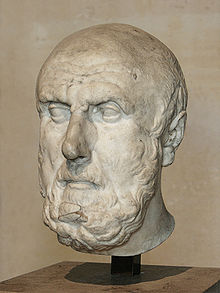
- In the third century B.C., ChrysippusChrysippusChrysippus of Soli was a Greek Stoic philosopher. He was a native of Soli, Cilicia, but moved to Athens as a young man, where he became a pupil of Cleanthes in the Stoic school. When Cleanthes died, around 230 BC, Chrysippus became the third head of the school...
, the GreekAncient GreeceAncient Greece is a civilization belonging to a period of Greek history that lasted from the Archaic period of the 8th to 6th centuries BC to the end of antiquity. Immediately following this period was the beginning of the Early Middle Ages and the Byzantine era. Included in Ancient Greece is the...
stoicStoicismStoicism is a school of Hellenistic philosophy founded in Athens by Zeno of Citium in the early . The Stoics taught that destructive emotions resulted from errors in judgment, and that a sage, or person of "moral and intellectual perfection," would not suffer such emotions.Stoics were concerned...
philosopher, died of laughter after giving his donkeyDonkeyThe donkey or ass, Equus africanus asinus, is a domesticated member of the Equidae or horse family. The wild ancestor of the donkey is the African Wild Ass, E...
wine, then seeing it attempt to feed on figsCommon figThe Common fig is a deciduous tree growing to heights of up to 6 m in the genus Ficus from the family Moraceae known as Common fig tree. It is a temperate species native to the Middle East.-Description:...
. - In 1410, King Martin of Aragon died from a combination of indigestion and uncontrollable laughter.
- In 1556, Pietro AretinoPietro AretinoPietro Aretino was an Italian author, playwright, poet and satirist who wielded immense influence on contemporary art and politics and invented modern literate pornography.- Life :...
"is said to have died of suffocation from laughing too much." - In 1660, Thomas UrquhartThomas UrquhartSir Thomas Urquhart of Cromarty was a Scottish writer and translator, most famous for his translation of Rabelais.-Life:...
, the ScottishScottish peopleThe Scottish people , or Scots, are a nation and ethnic group native to Scotland. Historically they emerged from an amalgamation of the Picts and Gaels, incorporating neighbouring Britons to the south as well as invading Germanic peoples such as the Anglo-Saxons and the Norse.In modern use,...
aristocrat, polymathPolymathA polymath is a person whose expertise spans a significant number of different subject areas. In less formal terms, a polymath may simply be someone who is very knowledgeable...
and first translator of RabelaisFrançois RabelaisFrançois Rabelais was a major French Renaissance writer, doctor, Renaissance humanist, monk and Greek scholar. He has historically been regarded as a writer of fantasy, satire, the grotesque, bawdy jokes and songs...
into English, is said to have died laughing upon hearing that Charles IICharles II of EnglandCharles II was monarch of the three kingdoms of England, Scotland, and Ireland.Charles II's father, King Charles I, was executed at Whitehall on 30 January 1649, at the climax of the English Civil War...
had taken the throne.
Modern deaths attributed to laughter
- On 24 March 1975, Alex Mitchell, a 50-year-old bricklayer from King's LynnKing's LynnKing's Lynn is a sea port and market town in the ceremonial county of Norfolk in the East of England. It is situated north of London and west of Norwich. The population of the town is 42,800....
, EnglandEnglandEngland is a country that is part of the United Kingdom. It shares land borders with Scotland to the north and Wales to the west; the Irish Sea is to the north west, the Celtic Sea to the south west, with the North Sea to the east and the English Channel to the south separating it from continental...
, died laughing while watching the "Kung Fu KapersKung Fu KapersKung Fu Kapers is an episode of the British comedy television series The Goodies — a BAFTA-nominated series for Best Light Entertainment Programme.This episode is also known as "Ecky-Thump"....
" episode of The GoodiesThe Goodies (TV series)The Goodies is a British television comedy series of the 1970s and early 1980s. The series, which combines surreal sketches and situation comedy, was broadcast by BBC 2 from 1970 until 1980 — and was then broadcast by the ITV company LWT for a year, between 1981 to 1982.The show was...
, featuring a kiltKiltThe kilt is a knee-length garment with pleats at the rear, originating in the traditional dress of men and boys in the Scottish Highlands of the 16th century. Since the 19th century it has become associated with the wider culture of Scotland in general, or with Celtic heritage even more broadly...
-clad ScotsmanScotsmanScotsman may mean:* a man from Scotland, in common parlance - see also Scottish people.* No true Scotsman, a common logical fallacy.*The Scotsman, a national newspaper based in Edinburgh, Scotland....
with his bagpipesBagpipesBagpipes are a class of musical instrument, aerophones, using enclosed reeds fed from a constant reservoir of air in the form of a bag. Though the Scottish Great Highland Bagpipe and Irish uilleann pipes have the greatest international visibility, bagpipes of many different types come from...
battling a master of LancastrianLancastrianLancastrian is an adjective describing:* A native or inhabitant of Lancashire* A partisan on the side of the House of Lancaster in the Wars of the Roses.* A person associated with Lancaster University....
martial art "Ecky Thump", who was armed with a black pudding . After twenty-five minutes of continuous laughter, Mitchell finally slumped on the sofa and died from heart failure. His widow later sent The Goodies a letter thanking them for making Mitchell's final moments of life so pleasant. - In 1989, Ole Bentzen, a Danish audiologist, died laughing while watching A Fish Called WandaA Fish Called WandaA Fish Called Wanda is a 1988 crime-comedy film written by John Cleese and Charles Crichton. It was directed by Crichton and an uncredited Cleese, and stars Cleese, Jamie Lee Curtis, Kevin Kline and Michael Palin. The film is about a jewel heist and its aftermath...
. His heart was estimated to have beaten at between 250 and 500 beats per minute, before he succumbed to cardiac arrestCardiac arrestCardiac arrest, is the cessation of normal circulation of the blood due to failure of the heart to contract effectively...
. - In 2003, Damnoen Saen-um, a Thai ice cream salesman, is reported to have died while laughing in his sleep at the age of 52. His wife was unable to wake him, and he stopped breathing after two minutes of continuous laughter. He is believed to have died of either heart failure or asphyxiaAsphyxiaAsphyxia or asphyxiation is a condition of severely deficient supply of oxygen to the body that arises from being unable to breathe normally. An example of asphyxia is choking. Asphyxia causes generalized hypoxia, which primarily affects the tissues and organs...
tion.
Fictional deaths attributed to laughter
- Old Mr Dawes or Mr Dawes Senior, in Mary PoppinsMary Poppins (film)Mary Poppins is a 1964 musical film starring Julie Andrews and Dick Van Dyke, produced by Walt Disney, and based on the Mary Poppins books series by P. L. Travers with illustrations by Mary Shepard. The film was directed by Robert Stevenson and written by Bill Walsh and Don DaGradi, with songs by...
- The "Killer Joke"The Funniest Joke in the World"The Funniest Joke in the World" is the title most frequently used for written references to a Monty Python's Flying Circus comedy sketch, which is also known by two other phrases that appear within it, "Joke Warfare" and "Killer Joke", the latter being the most commonly spoken title used to refer...
sketch by Monty PythonMonty PythonMonty Python was a British surreal comedy group who created their influential Monty Python's Flying Circus, a British television comedy sketch show that first aired on the BBC on 5 October 1969. Forty-five episodes were made over four series... - The Toon Patrol in Who Framed Roger RabbitWho Framed Roger RabbitWho Framed Roger Rabbit is a 1988 American fantasy-comedy-noir film directed by Robert Zemeckis and released by Touchstone Pictures. The film combines live action and animation, and is based on Gary K. Wolf's novel Who Censored Roger Rabbit?, which depicts a world in which cartoon characters...
- In the Give Yourself Goosebumps books by RL Stein, it is possibly to get an ending where chimpanzees tickle your feet until you die of laughter.
See also
- Kuru (disease)Kuru (disease)Kuru is an incurable degenerative neurological disorder that is a type of transmissible spongiform encephalopathy, caused by a prion found in humans...
, also known as "laughing sickness" - Laughing gasLaughing gasLaughing gas is a common name of Nitrous oxide, particularly when used as an anestheticLaughing gas may also refer to:* Laughing Gas , a 1936 comic novel by P. G...
- Paradoxical laughterParadoxical laughterParadoxical laughter is an exaggerated expression of humour which is unwarranted by external events. It may be uncontrollable laughter which may be recognised as inappropriate by the person involved...
- Tickle tortureTickle tortureTickle torture is the use of tickling to abuse, dominate, humiliate or even "prank" someone. The victim laughs even if he or she finds the experience unpleasant because the laughter is an innate reflex rather than social conditioning...