
Home      Discussion      Topics      Dictionary      Almanac
Signup       Login
Fanconi anemia

Fanconi anemia

Overview
Fanconi anemia is a genetic disease
Genetic disorder
A genetic disorder is an illness caused by abnormalities in genes or chromosomes, especially a condition that is present from before birth. Most genetic disorders are quite rare and affect one person in every several thousands or millions....

 with an incidence of 1 per 350,000 births, with a higher frequency in Ashkenazi Jews
Ashkenazi Jews
Ashkenazi Jews, also known as Ashkenazic Jews or Ashkenazim , are the Jews descended from the medieval Jewish communities along the Rhine in Germany from Alsace in the south to the Rhineland in the north. Ashkenaz is the medieval Hebrew name for this region and thus for Germany...

 and Afrikaners in South Africa.
Discussion
Ask a question about 'Fanconi anemia'
Start a new discussion about 'Fanconi anemia'
Answer questions from other users
Full Discussion Forum
 
Unanswered Questions
Encyclopedia
Fanconi anemia is a genetic disease
Genetic disorder
A genetic disorder is an illness caused by abnormalities in genes or chromosomes, especially a condition that is present from before birth. Most genetic disorders are quite rare and affect one person in every several thousands or millions....

 with an incidence of 1 per 350,000 births, with a higher frequency in Ashkenazi Jews
Ashkenazi Jews
Ashkenazi Jews, also known as Ashkenazic Jews or Ashkenazim , are the Jews descended from the medieval Jewish communities along the Rhine in Germany from Alsace in the south to the Rhineland in the north. Ashkenaz is the medieval Hebrew name for this region and thus for Germany...

 and Afrikaners in South Africa.

FA is the result of a genetic defect in a cluster of proteins responsible for DNA repair. As a result, the majority of FA patients develop cancer, most often acute myelogenous leukemia, and 90% develop bone marrow failure
Aplastic anemia
Aplastic anemia is a condition where bone marrow does not produce sufficient new cells to replenish blood cells. The condition, per its name, involves both aplasia and anemia...

 (the inability to produce blood cells) by age 40. About 60-75% of FA patients have congenital defects, commonly short stature, abnormalities of the skin, arms, head, eyes, kidneys, and ears, and developmental disabilities. Around 75% of FA patients have some form of endocrine problem, with varying degrees of severity. Median age of death was 30 years in 2000.

Treatment with androgens and hematopoietic (blood cell) growth factors can help bone marrow failure temporarily, but the long-term treatment is bone marrow transplant if a donor is available.

Because of the genetic defect in DNA repair, cells from people with FA are sensitive to drugs that treat cancer by DNA cross-linking, such as mitomycin C
Mitomycin
The mitomycins are a family of aziridine-containing natural products isolated from Streptomyces caespitosus or Streptomyces lavendulae. One of these compounds, mitomycin C, finds use as a chemotherapeutic agent by virtue of its antitumour antibiotic activity. It is given intravenously to treat...

.

The disease is named after the Swiss pediatrician who originally described this disorder, Guido Fanconi
Guido Fanconi
Guido Fanconi was a Swiss pediatrician. He was born in Poschiavo, Canton Grisons in the Italian-speaking region of Switzerland. Fanconi is regarded as one of the founders of modern pediatrics....

. It should not be confused with Fanconi syndrome
Fanconi syndrome
Falconi syndrome is a disease of the proximal renal tubules of the kidney in which glucose, amino acids, uric acid, phosphate and bicarbonate are passed into the urine, instead of being reabsorbed. Fanconi syndrome affects the proximal tubule, which is the first part of the tubule to process fluid...

, a kidney disorder also named after Fanconi.

Genetic prevalence


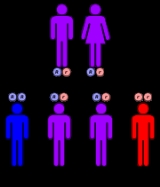
FA is primarily an autosomal recessive genetic disorder. This means that two mutated alleles (one from each parent) are required to cause the disease. There is a 25% risk that each subsequent child will have FA. About 2% of FA cases are X-linked recessive, which means that if the mother has a Fanconi anemia gene there is a 50% chance that male offspring will present with Fanconi anemia.

Scientists have identified 15 FA or FA-like genes: FANCA
FANCA
Fanconi anemia, complementation group A, also known as FANCA, is a protein which in humans is encoded by the FANCA gene.- Function :...

, FANCB
FANCB
Fanconi anemia group B protein is a protein that in humans is encoded by the FANCB gene.-Further reading:...

, FANCC, FANCD1 (BRCA2), FANCD2
FANCD2
Fanconi anemia group D2 protein is a protein that in humans is encoded by the FANCD2 gene. The Fanconi anemia complementation group currently includes FANCA, FANCB, FANCC, FANCD1 , FANCD2 , FANCE, FANCF, FANCG, and FANCL.- Function :Fanconi anemia is a genetically heterogeneous recessive disorder...

, FANCE
FANCE
Fanconi anemia group E protein is a protein that in humans is encoded by the FANCE gene.-Interactions:FANCE has been shown to interact with Fanconi anemia, complementation group C, FANCG, FANCD2, FANCF and FANCA.-Further reading:...

, FANCF
FANCF
Fanconi anemia group F protein is a protein that in humans is encoded by the FANCF gene.-Interactions:FANCF has been shown to interact with Fanconi anemia, complementation group C, FANCG, FANCA and FANCE.-Further reading:...

, FANCG
FANCG
Fanconi anemia group G protein is a protein that in humans is encoded by the FANCG gene.-Interactions:FANCG has been shown to interact with FANCF, FANCA, FANCE and BRCA2.-Further reading:...

, FANCI
FANCI
Fanconi anemia, complementation group I also known as KIAA1794, is a protein which in humans is encoded by the FANCI gene...

, FANCJ, FANCL
FANCL
E3 ubiquitin-protein ligase FANCL is an enzyme that in humans is encoded by the FANCL gene.-Further reading:...

, FANCM
FANCM
Fanconi anemia, complementation group M, also known asFANCM is a human gene.-Function:The protein encoded by this gene, FANCM displays ATPase activity and promotes dissociation of DNA triplexes. It is believed that FANCM in conjunction with other Fanconi anemia-associated proteins repair DNA at...

, FANCN, FANCP and RAD51C
RAD51C
RAD51 homolog C , also known as RAD51C, is a protein which in humans is encoded by the RAD51C gene.-Function:This gene is a member of the RAD51 family of related genes, which encode strand-transfer proteins thought to be involved in recombinational repair of damaged DNA and in meiotic recombination...

. FANCB is the one exception to FA being autosomal recessive, as this gene is on the X chromosome
X chromosome
The X chromosome is one of the two sex-determining chromosomes in many animal species, including mammals and is common in both males and females. It is a part of the XY sex-determination system and X0 sex-determination system...

.

Approximately 1,000 persons worldwide currently suffer from the disease. The carrier frequency
Frequency
Frequency is the number of occurrences of a repeating event per unit time. It is also referred to as temporal frequency.The period is the duration of one cycle in a repeating event, so the period is the reciprocal of the frequency...

 in the Ashkenazi Jewish population is about 1/90. Genetic counseling
Genetic counseling
Genetic counseling or traveling is the process by which patients or relatives, at risk of an inherited disorder, are advised of the consequences and nature of the disorder, the probability of developing or transmitting it, and the options open to them in management and family planning...

 and genetic testing
Genetic testing
Genetic testing is among the newest and most sophisticated of techniques used to test for genetic disorders which involves direct examination of the DNA molecule itself. Other genetic tests include biochemical tests for such gene products as enzymes and other proteins and for microscopic...

 is recommended for families that may be carriers of Fanconi anemia.

Because of the failure of hematologic components to develop – leukocytes, red blood cell
Red blood cell
Red blood cells are the most common type of blood cell and the vertebrate organism's principal means of delivering oxygen to the body tissues via the blood flow through the circulatory system...

s and platelets - the body's capabilities to fight infection, deliver oxygen, and form clots are all diminished.

Treatment


The first line of therapy is androgens and hematopoietic growth factor
Hematopoietic growth factor
Hematopoietic growth factor is a group of proteins that causes blood cells to grow and mature.- External links :* entry in the public domain NCI Dictionary of Cancer Terms...

s, but only 50-75% of patients respond. A more permanent cure is hematopoietic stem cell transplantation. If no potential donors exist, a savior sibling
Savior sibling
A savior sibling is a child who is born to provide an organ or cell transplant to a sibling that is affected with a fatal disease, such as cancer or Fanconi anemia, that can best be treated by hematopoietic stem cell transplantation....

 can be conceived by preimplantation genetic diagnosis
Preimplantation genetic diagnosis
In medicine and genetics pre-implantation genetic diagnosis refers to procedures that are performed on embryos prior to implantation, sometimes even on oocytes prior to fertilization. PGD is considered another way to prenatal diagnosis...

 (PGD) to match the recipient's HLA type.

Prognosis


Many patients eventually develop acute myelogenous leukemia (AML). Older patients are extremely likely to develop head and neck, esophageal, gastrointestinal, vulvar and anal cancers. Patients who have had a successful bone marrow transplant and, thus, are cured of the blood problem associated with FA still must have regular examinations to watch for signs of cancer. Many patients do not reach adulthood.

The overarching medical challenge that Fanconi patients face is a failure of their bone marrow to produce blood cells. In addition, Fanconi patients normally are born with a variety of birth defects. For instance, 90% of the Ashkenazi children born with Fanconi's have no thumbs. A good number of Fanconi patients have kidney problems, trouble with their eyes, developmental retardation and other serious defects, such as microcephaly (small head).

Hematological abnormalities


Clinically, hematological abnormalities are the most serious symptoms in FA. By the age of 40, 98% of FA patients will have developed some type of hematological abnormality. It is interesting to note, however, the few cases in which older patients have died without ever developing them.
Symptoms appear progressively, and often lead to complete bone marrow
Bone marrow
Bone marrow is the flexible tissue found in the interior of bones. In humans, bone marrow in large bones produces new blood cells. On average, bone marrow constitutes 4% of the total body mass of humans; in adults weighing 65 kg , bone marrow accounts for approximately 2.6 kg...

 failure. While at birth, blood count is usually normal, macrocytosis
Macrocytosis
Macrocytosis is the enlargement of red blood cells with near-constant hemoglobin concentration, and is defined by a mean corpuscular volume of greater than 100 femtolitres .- Causes :...

/megaloblastic anemia
Megaloblastic anemia
Megaloblastic anemia is an anemia that results from inhibition of DNA synthesis in red blood cell production. When DNA synthesis is impaired, the cell cycle cannot progress from the G2 growth stage to the mitosis stage...

, defined as unusually large red blood cells, is the first detected abnormality, often within the first decade of life (median age of onset is 7 years). Within the next 10 years, over 50% of patients presenting haematological abnormalities will have developed pancytopenia
Pancytopenia
Pancytopenia is a medical condition in which there is a reduction in the number of red and white blood cells, as well as platelets.If only two parameters from the full blood count are low, the term bicytopenia can be used...

, defined as abnormalities in two or more blood cell lineages. Most commonly, a low platelet count (thrombocytopenia
Thrombocytopenia
Thrombocytopenia is a relative decrease of platelets in blood.A normal human platelet count ranges from 150,000 to 450,000 platelets per microliter of blood. These limits are determined by the 2.5th lower and upper percentile, so values outside this range do not necessarily indicate disease...

) precedes a low neutrophil count (neutropenia
Neutropenia
Neutropenia, from Latin prefix neutro- and Greek suffix -πενία , is a granulocyte disorder characterized by an abnormally low number of neutrophils, the most important type of white blood cell...

), with both appearing with relative equal frequencies. The deficiencies cause increased risk of hemorrhage and recurrent infections, respectively.

As FA is now known to affect the DNA
DNA
Deoxyribonucleic acid is a nucleic acid that contains the genetic instructions used in the development and functioning of all known living organisms . The DNA segments that carry this genetic information are called genes, but other DNA sequences have structural purposes, or are involved in...

 repair, and given the current knowledge about dynamic cell division in the bone marrow, it is not surprising to find patients are more likely to develop bone marrow failure, myelodysplastic syndromes (MDS) and acute myeloid leukemia
Acute myeloid leukemia
Acute myeloid leukemia , also known as acute myelogenous leukemia, is a cancer of the myeloid line of blood cells, characterized by the rapid growth of abnormal white blood cells that accumulate in the bone marrow and interfere with the production of normal blood cells. AML is the most common acute...

 (AML). The next sections will detail those pathologies.

Myelodysplastic syndromes


MDS, formerly known as preleukemia, are a group of bone marrow neoplastic diseases that share many of the morphologic features of AML, with some important differences. First, the percentage of undifferentiated progenitor cells, blasts cells, is always less than 20%, and there is considerably more dysplasia, defined as cytoplasmic and nuclear morphologic changes in erythroid, granulocytic and megakaryocytic precursors, than what is usually seen in cases of AML. These changes reflect delayed apoptosis or a failure of programmed cell death
Programmed cell death
Programmed cell-death is death of a cell in any form, mediated by an intracellular program. PCD is carried out in a regulated process which generally confers advantage during an organism's life-cycle...

. When left untreated, MDS can lead to AML in about 30% of cases. Due the nature of the FA pathology, MDS diagnosis cannot be made solely through cytogenetic analysis of the marrow. Indeed, it is only when morphologic analysis of marrow cells is performed, that a diagnosis of MDS can be ascertained. Upon examination, MDS-afflicted FA patients will show many clonal variations, appearing either prior or subsequent to the MDS. Furthermore, cells will show chromosomal aberrations, the most frequent being monosomy 7 and partial trisomies of chromosome 3q 15. Observation of monosomy 7 within the marrow is well correlated with an increased risk of developing AML and with a very poor prognosis, death generally ensuing within 2 years.

Acute myeloid leukemia


FA patients are at elevated risk for the development of acute myeloid leukemia
Acute myeloid leukemia
Acute myeloid leukemia , also known as acute myelogenous leukemia, is a cancer of the myeloid line of blood cells, characterized by the rapid growth of abnormal white blood cells that accumulate in the bone marrow and interfere with the production of normal blood cells. AML is the most common acute...

 (AML), defined as presence of 20% or more of myeloid blasts in the marrow or 5 to 20% myeloid blasts in the blood. All of the subtypes of AML can occur in FA with the exception of promyelocytic. However, myelomonocytic and acute monocytic are the most common subtypes observed. It is also interesting to note that many MDS patients will evolve into AML given they survive long enough. Furthermore, the risk of developing AML increases with the onset of bone marrow failure.

Although risk of developing either MDS or AML before the age of 20 is only 27%, this risk increases to 43% by the age of 30 and 52% by the age of 40. Even with a marrow transplant, about 1/4 of FA patients diagnosed with MDS/ALS will die from MDS/ALS-related causes within 2 years. (Butturini, A et al 1994. Blood. 84:1650-4)

Bone marrow failure


The last major haematological complication associated with FA is bone marrow failure, defined as inadequate blood cell production. Several types of failure are observed in FA patients, and generally precede MDS and AML. Detection of decreasing blood count is generally the first sign used to assess necessity of treatment and possible transplant. While most FA patients are initially responsive to androgen therapy and haemopoietic growth factor
Growth factor
A growth factor is a naturally occurring substance capable of stimulating cellular growth, proliferation and cellular differentiation. Usually it is a protein or a steroid hormone. Growth factors are important for regulating a variety of cellular processes....

s, these have been shown to promote leukemia, especially in patients with clonal cytogenetic abnormalities, and have severe side effects, including hepatic adenomas and adenocarcinomas. The only treatment left would be bone marrow transplant; however, such an operation has a relatively low success rate in FA patients when the donor is unrelated (30% 5-year survival). It is therefore imperative to transplant from an HLA-identical sibling. Furthermore, due to the increased susceptibility of FA patients to chromosomal damage, pretransplant conditioning cannot include high doses of radiations or immunosuppressants, and thus increase chances of patients developing graft-versus-host disease
Graft-versus-host disease
Graft-versus-host disease is a common complication after a stem cell transplant or bone marrow transplant from another person . Immune cells in the donated marrow or stem cells recognize the recipient as "foreign". The transplanted immune cells then attack the host's body cells...

. If all precautions are taken, and the marrow transplant is performed within the first decade of life, 2-year probability of survival can be as high as 89%. However, if the transplant is performed at ages older than 10, 2-year survival rates drop to 54%.

A recent report by Zhang et al. investigates the mechanism of bone marrow failure in FANCC-/- cells. They hypothesize and successfully demonstrate that continuous cycles of hypoxia-reoxygenation, such as those seen by haemopoietic and progenitor cells as they migrate between hyperoxic blood and hypoxic marrow tissues, leads to premature cellular senescence and therefore inhibition of haemopoietic function. Senescence, together with apoptosis, may constitute a major mechanism of haemopoietic cell depletion occurred in bone marrow failure.

Molecular basis of FA


There are 15 genes responsible for FA, one of them being the breast-cancer susceptibility gene BRCA2
BRCA2
BRCA2 is a protein that in humans is encoded by the BRCA2 gene.BRCA2 orthologs have been identified in most mammals for which complete genome data are available....

. They are involved in the recognition and repair of damaged DNA; genetic defects leave them unable to repair DNA. The FA core complex of 8 proteins is normally activated when DNA stops replicating because of damage.The core complex adds ubiquitin
Ubiquitin
Ubiquitin is a small regulatory protein that has been found in almost all tissues of eukaryotic organisms. Among other functions, it directs protein recycling.Ubiquitin can be attached to proteins and label them for destruction...

, a small protein that combines with BRCA2
BRCA2
BRCA2 is a protein that in humans is encoded by the BRCA2 gene.BRCA2 orthologs have been identified in most mammals for which complete genome data are available....

 in another cluster to repair DNA. At the end of the process, ubiquitin is removed.

Recent studies have shown that eight of these proteins, FANCA, -B, -C, -E, -F, -G, -L and –M assemble to form a core protein complex in the nucleus. According to current models, the complex moves from the cytoplasm into the nucleus following nuclear localization signals on FANCA and FANCE. Assembly is activated by replicative stress, particularly DNA damage
DNA repair
DNA repair refers to a collection of processes by which a cell identifies and corrects damage to the DNA molecules that encode its genome. In human cells, both normal metabolic activities and environmental factors such as UV light and radiation can cause DNA damage, resulting in as many as 1...

 caused by cross-link
Cross-link
Cross-links are bonds that link one polymer chain to another. They can be covalent bonds or ionic bonds. "Polymer chains" can refer to synthetic polymers or natural polymers . When the term "cross-linking" is used in the synthetic polymer science field, it usually refers to the use of...

ing agents(mitomycin C or cisplatin) or reactive oxygen species
Reactive oxygen species
Reactive oxygen species are chemically reactive molecules containing oxygen. Examples include oxygen ions and peroxides. Reactive oxygen species are highly reactive due to the presence of unpaired valence shell electrons....

 (ROS). Indeed, FANCA and FANCG have been observed to multimerize when a cell is faced with oxidative stress-induced damage.

Following assembly, the protein core complex activates FANCL protein which acts as an E3 ubiquitin-ligase and monoubiquitinates FANCD2.

Monoubiquitinated FANCD2, also known as FANCD2-L, then goes on to interact with a BRCA1/BRCA2 complex. Details are not known, but similar complexes are involved in genome surveillance and associated with a variety of proteins implicated in DNA repair and chromosomal stability. With a crippling mutation in any FA protein in the complex, DNA repair is much less effective, as shown by its response to damage caused by cross-linking agents such as cisplatin, diepoxybutane and Mitomycin C. Bone marrow is particularly sensitive to this defect.

In another pathway responding to ionizing radiation
Ionizing radiation
Ionizing radiation is radiation composed of particles that individually have sufficient energy to remove an electron from an atom or molecule. This ionization produces free radicals, which are atoms or molecules containing unpaired electrons...

, FANCD2 is thought to be phosphorylated by protein complex ATM/ATR activated by double-strand DNA breaks, and takes part in S-phase checkpoint control. This pathway was proven by the presence of radioresistant DNA synthesis
DNA replication
DNA replication is a biological process that occurs in all living organisms and copies their DNA; it is the basis for biological inheritance. The process starts with one double-stranded DNA molecule and produces two identical copies of the molecule...

, the hallmark of a defect in the S phase
S phase
S-phase is the part of the cell cycle in which DNA is replicated, occurring between G1 phase and G2 phase. Precise and accurate DNA replication is necessary to prevent genetic abnormalities which often lead to cell death or disease. Due to the importance, the regulatory pathways that govern this...

 checkpoint, in patients with FA-D1 or FA-D2. Such a defect readily leads to uncontrollable replication of cells and might also explain the increase frequency of AML in these patients.

Other FA protein interactions


Although the above described pathway seems to be the most integral part of the DNA damage response in cells and explains the pathology of FA, novel approaches have determined that most FA proteins have an alternate role. Indeed, recent investigations on FANCC, one of the intensively studied proteins, have shown that it plays an important role in cellular responses to oxidative stress
Oxidative stress
Oxidative stress represents an imbalance between the production and manifestation of reactive oxygen species and a biological system's ability to readily detoxify the reactive intermediates or to repair the resulting damage...

. For example, it has been found to interact with NADPH
Nicotinamide adenine dinucleotide
Nicotinamide adenine dinucleotide, abbreviated NAD, is a coenzyme found in all living cells. The compound is a dinucleotide, since it consists of two nucleotides joined through their phosphate groups. One nucleotide contains an adenine base and the other nicotinamide.In metabolism, NAD is involved...

 cytochrome P450 reductase, associated with increased production of ROS, and glutathione S-transferase
Glutathione S-transferase
Enzymes of the glutathione S-transferase family are composed of many cytosolic, mitochondrial, and microsomal proteins. GSTs are present in eukaryotes and in prokaryotes, where they catalyze a variety of reactions and accept endogenous and xenobiotic substrates.GSTs can constitute up to 10% of...

, responsible for production of the anti-oxidant
Antioxidant
An antioxidant is a molecule capable of inhibiting the oxidation of other molecules. Oxidation is a chemical reaction that transfers electrons or hydrogen from a substance to an oxidizing agent. Oxidation reactions can produce free radicals. In turn, these radicals can start chain reactions. When...

 glutathione. These two enzymes are both involved in either triggering or detoxifying ROS. Not surprisingly, mice with Cu/Zn superoxide dismutase and FANCC mutations demonstrate defective haemopoiesis. FANCC was also shown to bind STAT1 and help receptor docking and phosphorylation of STAT135, which helps in tumor suppression. This leads to the conclusion that FANCC participates in cell growth arrest and cell cycle progression, inhibiting apoptosis, a possible cause of bone marrow failure due to depletion of haemopoietic progenitors. Another FA protein linked to protection against oxidative damage is FANCG. Indeed, this protein interacts with cytochrome P450 2E1 suggesting a possible role in detoxifying cytochrome ROS, produced readily by the members of this superfamily36. Furthermore, FANCG is identical to post-replication repair protein XRCC9, hinting at the possibility that FANCG also interacts directly with DNA by means of its internal leucine zipper
Leucine zipper
A leucine zipper, aka leucine scissors, is a common three-dimensional structural motif in proteins. These motifs are usually found as part of a DNA-binding domain in various transcription factors, and are therefore involved in regulating gene expression...

. Thus it is readily seen that FA proteins also act outside of the Fanconi pathway, either by helping neutralize ROS or by taking part in DNA repair. Such mechanisms help understand the causes behind bone marrow failure, where reoxygenation-induced oxidative stress is very common. Furthermore, it is known that cross-linking agents produce ROS and it is possible that FA cell hypersensitivity to cross-linkers is not due directly to them, but rather to the cell’s impaired ability to cope with increased ROS production.

External Links