
All Topics  
Faisal of Saudi Arabia

 
Faisal of Saudi Arabia

   Email Print
   Bookmark   Link


Faisal of Saudi Arabia


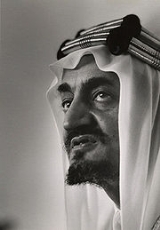
Faisal ibn Abdul Aziz Al Saud, King of Saudi Arabia (1903 or 1906—March 25, 1975) was the King
List of kings of Saudi Arabia

The King of Saudi Arabia is Saudi Arabia's head of state and absolute monarch. He serves as the head of the Saudi Monarchy and House of Saud.Within Saudi Arabia the king is known by the title of The Custodian of the Two Holy Mosques , which refers to Saudi Arabia's jurisdiction over the mosques of Masjid al Haram in Mecca and Masjid a...
 of Saudi Arabia
Saudi Arabia

The Kingdom of Saudi Arabia, KSA , is an Arab country and the largest country of the Arabian Peninsula. It is bordered by Jordan on the northwest, Iraq on the north and northeast, Kuwait, Qatar, Bahrain, and the United Arab Emirates on the east, Oman on the southeast, and Yemen on the south....
 from 1964 to 1975. As king he is credited with rescuing the country's finances and implementing a policy of modernization and reform, while his main foreign policy themes were pan-Islamic(pro Muslim world), anti-Communism
Anti-communism

Anti-communism is opposition to communism. Historically, the word communism has been used to refer to several types of communal social organization and their supporters, but, since the mid-19th century, the dominant school of communism in the world has been Marxism....
, and anti-Zionism
Anti-Zionism

Anti-Zionism is opposition to Zionism, the international Jewish political movement that established a homeland for the Jewish People in Palestine , and continues to support the state of Israel....
.

al was born in Riyadh
Riyadh

Riyadh is the Capital of Saudi Arabia and its largest city. It is also the capital of Riyadh Province, and belongs to the historical regions of Nejd and Al-Yamama....
, the third son of Saudi Arabia's founder, Ibn Saud
Ibn Saud of Saudi Arabia

*Saud of Saudi Arabia*Faisal of Saudi Arabia*Muhammad bin Abdul Aziz Al Saud*Khalid of Saudi Arabia*Nasr*Saad*Fahd of Saudi Arabia*Mansur*Abdullah of Saudi Arabia...
.


Discussion
Ask a question about 'Faisal of Saudi Arabia'
Start a new discussion about 'Faisal of Saudi Arabia'
Answer questions from other users
Full Discussion Forum


Encyclopedia


  • Abdullah
  • Muhammad
  • Sara
  • Luluwa
  • Khalid
  • Saud
    Saud bin Faisal bin Abdul Aziz

    Saud bin Faisal bin Abdul Aziz Al Saud, more commonly referred to as Saud al-Faisal, is the Foreign Minister of Saudi Arabia. He was appointed to that position in 1975 by Khalid of Saudi Arabia,and He speaks 7 languages....
  • Sa'd
  • Abd al-Rahman
  • Bandar
  • Latifa
  • Munira
  • al-Jauhara
  • al-Anud
  • Misha'il
  • Fahda
  • Nura
  • Turki
  • Haifa
    Haifa bint Faisal

    Princess Haifa bint Faisal is the wife of Prince Bandar bin Sultan, the former Saudi ambassador to United States, daughter of the late Faisal of Saudi Arabia and sister to foreign minister, Saud Al-Faisal....


Faisal ibn Abdul Aziz Al Saud, King of Saudi Arabia (1903 or 1906—March 25, 1975) was the King
List of kings of Saudi Arabia

The King of Saudi Arabia is Saudi Arabia's head of state and absolute monarch. He serves as the head of the Saudi Monarchy and House of Saud.Within Saudi Arabia the king is known by the title of The Custodian of the Two Holy Mosques , which refers to Saudi Arabia's jurisdiction over the mosques of Masjid al Haram in Mecca and Masjid a...
 of Saudi Arabia
Saudi Arabia

The Kingdom of Saudi Arabia, KSA , is an Arab country and the largest country of the Arabian Peninsula. It is bordered by Jordan on the northwest, Iraq on the north and northeast, Kuwait, Qatar, Bahrain, and the United Arab Emirates on the east, Oman on the southeast, and Yemen on the south....
 from 1964 to 1975. As king he is credited with rescuing the country's finances and implementing a policy of modernization and reform, while his main foreign policy themes were pan-Islamic(pro Muslim world), anti-Communism
Anti-communism

Anti-communism is opposition to communism. Historically, the word communism has been used to refer to several types of communal social organization and their supporters, but, since the mid-19th century, the dominant school of communism in the world has been Marxism....
, and anti-Zionism
Anti-Zionism

Anti-Zionism is opposition to Zionism, the international Jewish political movement that established a homeland for the Jewish People in Palestine , and continues to support the state of Israel....
.

Biography

Faisal was born in Riyadh
Riyadh

Riyadh is the Capital of Saudi Arabia and its largest city. It is also the capital of Riyadh Province, and belongs to the historical regions of Nejd and Al-Yamama....
, the third son of Saudi Arabia's founder, Ibn Saud
Ibn Saud of Saudi Arabia

*Saud of Saudi Arabia*Faisal of Saudi Arabia*Muhammad bin Abdul Aziz Al Saud*Khalid of Saudi Arabia*Nasr*Saad*Fahd of Saudi Arabia*Mansur*Abdullah of Saudi Arabia...
. Faisal's mother was Tarfa bint Abdullah ibn Abd al-Latif Aal ash-Shaykh, whom Ibn Saud had married in 1902 after capturing Riyadh. She was a descendent of Muhammad ibn Abd Al-Wahhab, and her father was one of Ibn Saud's principal religious teachers and advisers.

Being one of Ibn Saud's eldest sons, Faisal was delegated numerous responsibilities during Ibn Saud's quest to consolidate control over Arabia. In 1925, Faisal, in command of an army of Saudi loyalists, won a decisive victory in the Hijaz. In return, he was made the governor of Hijaz the following year. After the new Saudi kingdom was formalized in 1932 Faisal received the post of Minister of Foreign Affairs, a position which he continued to hold until his death, even during his reign as king. Faisal also commanded a section of the Saudi forces that took part in the brief Saudi-Yemeni War
Saudi-Yemeni War

The Saudi-Yemeni War was a war between Saudi Arabia and Yemen fought in 1934, in which Saudi Arabia won control of the provinces of Asir and Najran Province....
 of 1934, successfully fighting off Yemeni
Yemeni

Yemeni may refer to:* Something of, from, or related to Yemen, an Arab country located on the Arabian Peninsula in Southwest Asia.* A person from Yemen, or of Yemeni descent....
 claims over Saudi Arabia's southern provinces.

Crown Prince and Prime Minister

Upon the ascension of Faisal's elder brother, Saud, to the throne in 1953, Faisal was appointed Crown Prince
Crown Prince

A Crown Prince or Crown Princess is the heir apparent to the throne in a royal or imperial monarchy. The wife of a crown prince is also titled crown princess....
. Saud, however, embarked on a lavish and ill-considered spending program that included the construction of a massive royal residence on the outskirts of the capital, Riyadh. He also faced pressure from neighboring Egypt
Egypt

Egypt is a country mainly in North Africa, with the Sinai Peninsula forming a land bridge in Western Asia. Covering an area of about , Egypt borders the Mediterranean Sea to the north, the Gaza Strip and Israel to the northeast, the Red Sea to the east, Sudan to the south and Libya to the west....
, where Gamal Abdel Nasser
Gamal Abdel Nasser

Gamal Abdel Nasser was the second President of Egypt from 1956 until his death in 1970. Along with Muhammad Naguib, he led the Egyptian Revolution of 1952, which removed Farouk of Egypt and heralded a new period of industrialization in Egypt, together with a profound advancement of Arab nationalism, including a short-lived United Arab Republ...
 had overthrown the monarchy in 1952. Nasser was able to cultivate a group of dissident princes led by Talal ibn Abdul Aziz who defected to Egypt (see Free Princes
Free Princes

Free Princes was a Saudi liberal political movement founded in 1958 by Prince Talal bin Abdul Aziz al-Saud due to the tensions between King Faisal and King Saud....
). Fearing that Saud's financial policies were bringing the state to the brink of collapse, and that his handling of foreign affairs was inept, senior members of the royal family and the religious leadership (the "ulema
Ulema

Ulema refers to the educated class of Muslim legal scholars engaged in the several fields of Islamic studies. They are best known as the arbiters of Sharia law....
") pressured Saud into appointing Faisal to the position of prime minister in 1958, giving Faisal wide executive powers. In this new position, Faisal set about cutting spending dramatically in an effort to rescue the state treasury from bankruptcy. This policy of financial prudence was to become a hallmark of his era and earned him a reputation for thriftiness among the populace.

A power struggle ensued thereafter between Saud and Faisal, and on 18 December, 1960, Faisal resigned as prime minister in protest, arguing that Saud was frustrating his financial reforms. Saud took back his executive powers and, having induced Talal to return from Egypt, appointed Talal as minister of finance. In 1962, however, Faisal rallied enough support within the royal family to install himself as prime minister for a second time.

It was during this period as head of the Saudi government, that Faisal, though still not king, established his reputation as a reforming and modernizing figure. He introduced education for women and girls despite the consternation of many conservatives in the religious establishment. To appease the objectors, however, he allowed the female educational curriculum to be written and overseen by members of the religious leadership, a policy which lasted long after Faisal's death. It was also during this time that Faisal formally abolished slavery.

In 1963, Faisal established the country's first television station, though actual broadcasts would not begin for another two years. As with many of his other policies, the move aroused strong objections from the religious and conservative sections of the country. Faisal assured them, however, that Islamic principles of modesty would be strictly observed, and made sure that the broadcasts contained a large amount of religious programming.

Struggle with Saud

The struggle with Saud, the king, continued in the background during this time. Taking advantage of the king's absence from the country for medical reasons in early 1963, Faisal began amassing more power for himself. He removed many of Saud's loyalists from their posts and appointed like-minded princes in key military and security positions, such as his brother Abdullah
Abdullah of Saudi Arabia

* Khaled bin Abdullah* Mutaib bin Abdullah* Abdul Aziz bin Abdullah* Faisal bin Abdullah* Sultan bin Abdullah* Turki bin Abdullah bin Abdul Aziz...
, to whom he gave command of the National Guard in 1962. Upon Saud's return, Faisal demanded that he be made regent and that Saud be reduced to a purely ceremonial role. In this, he had the crucial backing of the ulema, including an edict (or fatwa) issued by the grand mufti
Mufti

A mufti is an Islamic scholar who is an interpreter or expounder of Islamic law . A muftiat or diyanet is a council of muftis....
 of Saudi Arabia, a relative of Faisal's on his mother's side, calling on Saud to accede to his brother's demands. Saud refused, however, and made a last-ditch attempt to retake executive powers, leading Faisal to order the National Guard to surround Saud's palace. His loyalists outnumbered and outgunned, Saud relented, and on March 4, 1964, Faisal was appointed regent. A meeting of the elders of the royal family and the ulema was convened later that year, and a second fatwa was decreed by the grand mufti calling on Saud to abdicate the throne in favor of his brother. The royal family supported the fatwa and immediately informed Saud of their decision. Saud, by now shorn of all his powers, agreed, and Faisal was proclaimed king on November 2, 1964. Shortly thereafter, Saud left into exile in Greece
Greece

Greece , officially the Hellenic Republic , is a country in southeastern Europe, situated on the southern end of the Balkans. It has borders with Albania, Bulgaria and the former Yugoslav Republic of Macedonia to the north, and Turkey to the east....
.

King of Saudi Arabia

Upon his ascension, Faisal still viewed the restoration of the country's finances to be his main priority. He continued to pursue his conservative financial policies during the first few years of his reign, and his aims of balancing the country's budget eventually succeeded, helped by an increase in oil production.

Faisal embarked on a modernization project that encompassed vast parts of the kingdom and involved various public sector institutions. The pinacle of his achievements in modernizing the Kingdom was the establishment of a judicial system, a project lead and executed by International Lawyer and Judge, the former Syrian Minister of Justice, Zafer Moussly.

The improved financial situation allowed Faisal to pursue various reforms and modernization projects. Several universities were established or expanded during his rule, and he continued to send a great number of students to foreign universities, especially in the United States
United States

The United States of America is a Federal government constitutional republic comprising U.S. state and a federal district. The country is situated mostly in central North America, where its Contiguous United States and Washington, D.C., the Capital districts and territories, lie between the Pacific Ocean and Atlantic Oceans, Borders of the U...
. These students would later form the core of the Saudi civil service.

Many of the country's ministries, government agencies, and welfare programs were begun during Faisal's reign, and he invested heavily in infrastructure. He also introduced policies such as agricultural and industrial subsidies that were later to reach their height under his successors, Khalid and Fahd. Faisal also introduced the country's current system of administrative regions, and laid the foundations for a modern welfare system. In 1970, he established the Ministry of Justice and inaugurated the country's first "five-year plan" for economic development.

Television broadcasts officially began in 1965. In 1966, an especially zealous nephew of Faisal attacked the newly-established headquarters of Saudi television but was killed by security personnel. The attacker was the brother of Faisal's future assassin, and the incident is the most widely-accepted motive for the murder. Despite the opposition from conservative Saudis to his reforms, however, Faisal continued to pursue modernization while always making sure to couch his policies in Islamic terms.

The 1950's and 1960's saw numerous coup d'etats in the region. Muammar al-Gaddafi
Muammar al-Gaddafi

Muammar Abu Minyar al-Gaddafi#Name also known as Colonel Gaddafi has been the de facto leader of Libya since a 1969 coup....
's coup that overthrew the monarchy in oil-rich Libya
Libya

Libya , officially the Great Socialist People's Libyan Arab Jamahiriya , is a country located in North Africa. Bordering the Mediterranean Sea to the north, Libya lies between Egypt to the east, Sudan to the southeast, Chad and Niger to the south, and Algeria and Tunisia to the west....
 in 1969 was especially ominous for Saudi Arabia due the similarity between the two sparsely-populated desert countries. As a result, Faisal undertook to build a sophisticated security apparatus and cracked down firmly on dissent. As in all affairs, Faisal justified these policies in Islamic terms. Early in his reign, when faced by demands for a written constitution for the country, Faisal responded that "our constitution is the Quran." In 1969, Faisal ordered the arrest of hundreds of military officers, including some generals, alleging that a military coup was being planned. The arrests were possibly based on a tip from American intelligence, but it is unclear how serious the threat actually was.

Faisal also put down protests by Saudi workers employed by the international oil company, Aramco, in the Eastern Province, and banned the formation of labor unions in 1965. In compensation for these actions, however, Faisal introduced a far-reaching labor law with the aim of providing maximum job security for the Saudi workforce. He also introduced pension and social insurance programs for workers despite objections from some of the ulema.

Foreign relations

As king, Faisal continued the close alliance with the United States
United States

The United States of America is a Federal government constitutional republic comprising U.S. state and a federal district. The country is situated mostly in central North America, where its Contiguous United States and Washington, D.C., the Capital districts and territories, lie between the Pacific Ocean and Atlantic Oceans, Borders of the U...
 begun by his father, and relied on the U.S. heavily for arming and training his armed forces. Faisal was also anti-Communist. He refused any political ties with the Soviet Union and other Communist bloc countries, professing to see a complete incompatibility between Communism and Islam, and associating Communism
Communism

Communism is a socioeconomic structure and political ideology that promotes the establishment of an egalitarianism, classlessness, stateless society based on common ownership and control of the means of production and property in general....
 with Zionism
Zionism

Zionism is the international Jewish political movement that originally supported the reestablishment of a homeland for the Jewish People in Palestine....
, which he also criticized sharply.

Faisal also supported monarchist and conservative movements in the Arab world, and sought to counter the influences of socialism
Socialism

Socialism refers to a broad set of economic theories of social organization advocating public or state ownership and administration of the means of production and distribution of goods, and a society characterized by equality for all individuals, with a fair or Egalitarianism method of compensation....
 and Arab Nationalism
Arab nationalism

Arab nationalism is a nationalist ideology which rose to prominence amongst Arabs from the early 20th century onwards. Its central premise is that the peoples and countries of the Arab World, from the Atlantic Ocean to the Arabian Sea, constitute one nation and are bound together by their common linguistic, cultural, and historical heritage....
 in the region by promoting pan-Islamism
Pan-Islamism

Pan-Islamism is a political movement advocating the unity of Muslims under one Islamic state often a Caliphate. While Pan-Arabism, a ideology often in competition with Pan-Islamism, advocates the unity and independence of Arabs regardless of religion, pan-Islamism advocates the unity and independence of Muslims regardless of ethnicity....
 as an alternative. To that end, he called for the establishment of the Muslim World League, visiting several Muslim countries to advocate the idea. He also engaged in a propaganda and media war with Egypt
Egypt

Egypt is a country mainly in North Africa, with the Sinai Peninsula forming a land bridge in Western Asia. Covering an area of about , Egypt borders the Mediterranean Sea to the north, the Gaza Strip and Israel to the northeast, the Red Sea to the east, Sudan to the south and Libya to the west....
's pan-Arabist president, Gamal Abdel Nasser
Gamal Abdel Nasser

Gamal Abdel Nasser was the second President of Egypt from 1956 until his death in 1970. Along with Muhammad Naguib, he led the Egyptian Revolution of 1952, which removed Farouk of Egypt and heralded a new period of industrialization in Egypt, together with a profound advancement of Arab nationalism, including a short-lived United Arab Republ...
, and engaged in a proxy war with Egypt in Yemen
Yemen

Yemen , officially the Republic of Yemen is an Arab country located on the Arabian Peninsula in Southwest Asia. Yemen has an estimated population of more than 23 million people and is bordered by Saudi Arabia to the North, the Red Sea to the West, the Arabian Sea and Gulf of Aden to the South, and Oman to the east....
 that lasted until 1967 (see Yemeni Civil War). Faisal never explicitly repudiated pan-Arabism, however, and continued to call for inter-Arab solidarity in broad terms.

Following the death of Nasser
Gamal Abdel Nasser

Gamal Abdel Nasser was the second President of Egypt from 1956 until his death in 1970. Along with Muhammad Naguib, he led the Egyptian Revolution of 1952, which removed Farouk of Egypt and heralded a new period of industrialization in Egypt, together with a profound advancement of Arab nationalism, including a short-lived United Arab Republ...
 in 1970, Faisal drew closer to Egypt
Egypt

Egypt is a country mainly in North Africa, with the Sinai Peninsula forming a land bridge in Western Asia. Covering an area of about , Egypt borders the Mediterranean Sea to the north, the Gaza Strip and Israel to the northeast, the Red Sea to the east, Sudan to the south and Libya to the west....
's new president, Anwar Sadat
Anwar Sadat

Muhammad Anwar Al Sadat, or Anwar El Sadat , was the third President of Egypt, serving from 15 October 1970 until his assassination on 6 October 1981....
, who himself was planning a break with the Soviet Union
Soviet Union

The Union of Soviet Socialist Republics was a Constitution of the Soviet Union socialist state that existed in Eurasia from 1922 to 1991.The name is a translation of the , romanization of Russian Soyuz Sovetskikh Sotsialisticheskikh Respublik, abbreviated ????, SSSR....
 and a move towards the pro-American camp. During the 1973 Arab-Israeli War, launched by Sadat, Faisal withdrew Saudi oil from world markets, in protest over Western
Western world

The term Western world, the West or the Occident can have multiple meanings dependent on its context . Accordingly, the basic definition of what constitutes "the West" varies, expanding and contracting over time, in relation to various historical circumstances....
 support for Israel
Israel

Israel officially the State of Israel , is a country in the Middle East located on the eastern shore of the Mediterranean Sea. It borders Lebanon in the north, Syria in the northeast, Jordan in the east, and Egypt on the southwest, and contains geographically diverse features within its relatively small area....
 during the conflict. This action quadrupled the price of oil and was the primary force behind the 1973 energy crisis. It was to be the defining act of Faisal's career, and gained him lasting prestige among many Arabs and Muslims world-wide. In 1974 he was named Time magazine's Man of the Year
Person of the Year

Person of the Year is an annual issue of the United States newsmagazine Time that features and profiles a man, woman, couple, group, idea, place, or machine that "for better or for worse, ...has done the most to influence the events of the year."...
, and the financial windfall generated by the crisis fueled the economic boom that occurred in Saudi Arabia after his death. The new oil revenue also allowed Faisal to greatly increase aid and subsidies to Egypt, Syria
Syria

Syria , officially the Syrian Arab Republic , is an Arab-majority country in Southwest Asia, bordering Lebanon and the Mediterranean Sea to the west, Israel to the southwest, Jordan to the south, Iraq to the east, and Turkey to the north....
, and the Palestine Liberation Organization
Palestine Liberation Organization

The Palestine Liberation Organization is a political and paramilitary organization regarded by the Arab League since October 1974 as the "sole legitimate representative of the Palestinian people."...
, which had begun following the 1967 Arab-Israeli War. It is a commonly-held, but so far unsubstantiated popular belief in Saudi Arabia and the Arab World
Arab world

The Arab World refers to Arabic-speaking countries stretching from the Atlantic Ocean in the west to the Arabian Sea in the east, and from the Mediterranean Sea in the north to the Horn of Africa and the Indian Ocean in the southeast....
 that Faisal's oil boycott was the real cause of his assassination, via a Western
Western world

The term Western world, the West or the Occident can have multiple meanings dependent on its context . Accordingly, the basic definition of what constitutes "the West" varies, expanding and contracting over time, in relation to various historical circumstances....
 conspiracy.

Faisal also forged a close alliance with Pakistan
Pakistan

Pakistan , officially the Islamic Republic of Pakistan, is a country located in South Asia and borders Central Asia and the Middle East. It has a 1,046 kilometre coastline along the Arabian Sea and Gulf of Oman in the south, and is bordered by Afghanistan and Iran in the west, India in the east and People's Republic of China in th...
, where his foreign policies remain popular, and where he is still praised in history textbooks. Lyallpur, which was then the third largest city and currently is the fifth largest, was renamed Faisalabad
Faisalabad

is a city located in the Subdivisions of Pakistan of Punjab , Pakistan. It was Geographical renaming Lyallpur. Faisalabad is the List of most populated metropolitan areas in Pakistan city in Pakistan with an estimated 2006 population of 2.6 million ....
 (lit. "City of Faisal") in 1979 in his honor. The Faisal Mosque
Faisal Mosque

The Shah Faisal Masjid in Islamabad, Pakistan, is among one of the largest mosques in the world. It is a state National Mosque. It is a popular masjid in the Islamic world, and is renowned for both its size and its architecture covering an area of 5,000 square meters with a capacity of 300,000 worshippers....
 in Islamabad
Islamabad

Islamabad is the Capital of Pakistan, and is the tenth largest city in Pakistan. The Rawalpindi/Islamabad List of most populous metropolitan areas in Pakistan is the third largest in Pakistan with a population of over 4.5 million inhabitants, 1.5 million in Islamabad and three million in Rawalpindi....
 is named after him as well. The main highway in Karachi
Karachi

is the largest city, seaport and the International financial centre of Pakistan. It is List of metropolitan areas by population in terms of metropolitan population, and is Pakistan's premier centre of banking, industry, and trade....
 was renamed Shahrah-e-Faisal
Shahrah-e-Faisal

Shara-e-Faisal is one of the major boulevard in Karachi, Sindh, Pakistan. It is named after Faisal of Saudi Arabia of Saudi Arabia. Shah Faisal Colony a suburb close to Jinnah International Airport was also named after Shah Faisal....
 and a suburb close to Karachi Airport
Jinnah International Airport

Jinnah International Airport previously Quaid-e-Azam International Airport is Pakistan's largest International airport and Domestic airport airport....
 was also renamed Shah Faisal Colony
Shah Faisal Colony

Shah Faisal Colony is a residential area in Karachi, Sindh, Pakistan. Its initial name was "Drigh Colony" named after a high official during the British rule, but like so many other cities later getting new names, its name was changed to "Shah Faisal Colony" after....
.

Assassination

On March 25, 1975, Faisal was shot point blank and killed by his half-brother's son, Faisal bin Musa'id, who had just come back from the United States. The murder occurred at a majlis, (Arabic for "a place for sitting") an event where the king or leader opens up his residence to the citizens to enter and petition the king. The stated reason was revenge for Faisal bin Musa'id's brother Khaled, who had been killed by Saudi Defense Force members while taking part in a demonstration in 1965.

Prince Faisal Bin Musa'id was captured directly after the attack and declared officially insane. He was later found guilty of regicide
Regicide

The broad definition of regicide is the deliberate killing of a monarch, or the person responsible for the killing of a monarch. In a narrower sense, in the United Kingdom tradition, it refers to the judicial execution of a king after alleged due process of law....
 and in June 1975 he was beheaded
Decapitation

Decapitation , or beheading, is the cutting off of the head of a person or animal. Beheading typically refers to the act of intentional decapitation, e.g., as a means of murder or capital punishment; it may be accomplished, for example, with an axe, sword, knife, wire, or by means of a guillotine....
 in the public square in Riyadh
Riyadh

Riyadh is the Capital of Saudi Arabia and its largest city. It is also the capital of Riyadh Province, and belongs to the historical regions of Nejd and Al-Yamama....
.

Faisal was buried in Riyadh, and was succeeded by his half-brother, Khalid
Khalid of Saudi Arabia

*Bandar bin Khalid*Abdallah al-Khalid*al-Jauhara bint Khalid*Nuf bint Khalid*Mudhi bint Khalid*Fahd bin Khalid*Saud bin Khalid*Hussa bint Khalid...
.

Family

Faisal married several times, but his most prominent wife was Iffat Al-Thuniyyan, raised in Turkey
Turkey

Turkey , known officially as the Republic of Turkey , is a Eurasian country that stretches across the Anatolian peninsula in southwest Asia and Thrace in the Balkans region of Southern Europe....
, though a descendant of the members of the Al Saud clan who were taken to Istanbul
Istanbul

Istanbul is the largest city in Turkey, List of metropolitan areas in Europe by population, and List of cities proper by population in the world with a population of 12.6 million....
 or Cairo
Cairo

Cairo , which means "the triumphant", is the Cairo and largest city of Egypt.It is the most populous metropolitan area in Egypt and is also one of the most populous in the world....
 by Egyptian
Egyptian

Egyptian may refer to:* Of or pertaining to Egypt, a country in northeastern Africa** A citizen of Egypt. See Demographics of Egypt.** Egyptians, an ethnic group in North Africa...
 forces in 1818 (see First Saudi State
First Saudi State

The First Saudi State was established in the year 1744 when Sheikh Muhammad ibn Abd al Wahhab settled in Diriyah and Prince Muhammad ibn Saud agreed to support and espouse Wahhab's cause, with a view of cleansing the Islamic faith from what they considered to be distortions of Islamic practice ....
). Iffat is credited with being the influence behind many of her late husband's reforms, particularly with regards to women.

The late King's sons have held and continue to hold important positions within the Saudi government. Khalid was the governor of Asir Province in southwestern Saudi Arabia for more than three decades before becoming governor of Makkah Province in 2007, while another son, Saud Al-Faisal, has been the Saudi foreign minister since 1975. A third son, Turki bin Faisal Al Saud served as head of Saudi intelligence, ambassador to the United Kingdom
United Kingdom

The United Kingdom of Great Britain and Northern Ireland, commonly known as the United Kingdom , the UK or Britain,is a sovereign state located off the northwestern coast of continental Europe....
, and later ambassador to the United States, a post he held from July 2005 until December 2006.

His sons received exceptional education compared to other princes born to Saudi monarchs. Turki received formal education at prestigious schools in New Jersey
New Jersey

New Jersey is a state in the Mid-Atlantic States and Northeastern United States regions of the United States. It is bordered on the north by New York, on the east by the Hudson River and the Atlantic Ocean, on the southwest by Delaware, and on the west by Pennsylvania....
, and later attended Georgetown University
Georgetown University

Georgetown University is a Society of Jesus private university located in Georgetown, Washington, D.C. Father John Carroll founded the school in 1789, though its roots extend back to 1634....
, while Saud is an alumnus
Alumnus

An alumnus according to the American Heritage Dictionary is "a male graduate or former student of a school, college, or university." In addition, an alumna is "a female graduate or former student of a school, college, or university." If a group includes more than one gender, even if there is only one male, the plural form alumni i...
 of Princeton
Princeton University

Princeton University is a private university university located in Princeton, New Jersey, New Jersey, United States. The school is one of the eight universities of the Ivy League and has the largest per-student Financial endowment in the world....
.

Faisal's daughter, Haifa
Haifa bint Faisal

Princess Haifa bint Faisal is the wife of Prince Bandar bin Sultan, the former Saudi ambassador to United States, daughter of the late Faisal of Saudi Arabia and sister to foreign minister, Saud Al-Faisal....
, is married to his nephew Bandar ibn Sultan, the former long-serving Saudi ambassador to the United States and current Saudi national security advisor. Bandar, the son of an African concubine, had been all but disowned by his father Sultan at the time, due to his perceived inferior lineage. Faisal, however, forced Sultan to recognize Bandar as a legitimate prince by giving Bandar his own daughter's hand in marriage, thus breaking a major taboo in Saudi society at the time.

After his death, Faisal's family established the King Faisal Foundation
King Faisal Foundation

The King Faisal Foundation was established in 1976 by the sons of King Faisal of Saudi Arabia. The Director-General is HRH Prince Khalid Al-Faisal....
.

See also

  • House of Saud
    House of Saud

    House of Saud is the royal family of the Saudi Arabia. The modern nation of Saudi Arabia was established in 1932, though the roots and influence for the House of Saud had been planted in the Arabian Peninsula several centuries earlier....
  • King Faisal Foundation
    King Faisal Foundation

    The King Faisal Foundation was established in 1976 by the sons of King Faisal of Saudi Arabia. The Director-General is HRH Prince Khalid Al-Faisal....